
 The film opens with a dead end drifter being ushered off a bus in the little every town of Walton, wedged somewhere between LA and SF. Although in actuality it was shot partially on location in Orange, California, serving up a perfect representation of quaint Middle America. You can almost hear Paul Simon singing from the future (Got off a greyhound to look for America) as Dana Andrews gets off the bus. Except he winds up at Pop’s instead. There he sizes up the town and gets his first eyeful of the alluring waitress Stella (Linda Darnell).
He’s dead broke but he also has a brain on his shoulders and that gets him far with a pair of traveling fortune tellers who he is able to promote throughout town, despite the wariness of the townsfolk. This moral crusade is led by Clara Mills (Anne Revere) who is suspicious of such goings-on. It’s her sister, the righteous Ms. June Mills (Alice Faye) who ascertains, “Are we to judge?” She obviously is acquainted with the Beatitudes. And what she says is true but this whole issue made out of a couple of no-name mystics seems like a strange place to try and develop a film-noir.
It’s a curious portrait. Here we have small town America, a wily drifter, two women, and a fortune teller putting on a Seance. But this is only a pretense to get to the dark heart of this film. Eric Stanton is bent on marrying Stella and he tells her as much. They’ve got something (When they lock eyes the cash register clangs). But the underlying problem is that he has no dough, no money to make anything of a marriage. Stella’s not a dumb girl. She’s just opportunistic and she wants some assurance at the end of a proposal.
As Darnell’s character notes several times, she likes the way Andrews talks and he is a real talker, he’d probably make a grand used car salesman. As the story progresses it’s easier to get a line on his train of thought and the way he thinks is insidious indeed.
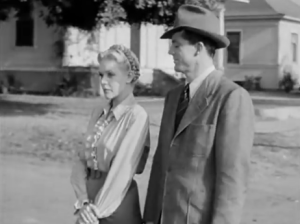 Being blessed with a certain amount of charm, Stanton strikes up a relationship with the untouchable gal, the churchgoer, the book reader, the generally good human being, June. He knows how to pull her out of her shell. Catering to her necessity to get out and live life (All the things you look down on are the things that make up life. Little things, like a game of bowling..or a swim at night, or a dance, a kiss, stuff that bubbles). It works and she begins to be swayed. Conveniently she also has a great deal of money. The outcome seems obvious and yet the story twists in unexpected ways.
Linda Darnell certainly steals the beginning of the story as the beautiful brunette that every man in town is batty over. The list of interested suitors is quite long but it doesn’t matter much. The latter half of the film is Alice Faye’s and as she was supposed to be the star of this picture it’s only fair that she should get her due.
Except, understandably, she felt slighted by Daryl Zanuck who lobbied for his sweetheart Darnell and as a result, a great deal of Faye’s dramatic performance was left on the cutting room floor. What’s left as a testament of her performance, might pale in comparison to her counterparts Andrews and Darnell but it’s often true that it takes that virtuous character to juxtapose with the seedier qualities of those around them.
 Fallen Angel undoubtedly gets a bad rap because it does not reach the rapturous, beguiling heights of Laura (1944) from the year prior, but it deserves to be seen in its own light. It’s true that both films are murder mysteries but while Fallen Angel isn’t all that interesting in that regard it has a surprisingly sharp script in other ways. Preminger works through his story with a certain dynamic assurance and like its predecessor, it’s the characters that are by far the most fascinating. Laura was a superior mystery, character study, etc., but Fallen Angel gleams brightly thanks in part to its classical chiaroscuro cinematography and an engaging menagerie of locals including Charles Bickford, Percy Kilbride, Bruce Cabot, and John Carradine.
Dana Andrews thrives in his element as the laconic drifter who nevertheless knows how to play people. Every time I caught a glimpse of Darnell’s hair decorated with a flower all I could hear were the refrains of Scott Mckenzie’s “San Francisco” ringing in my ears. And although Faye would not make another film until 1962, hers was not a bad performance. Above all, Otto Preminger deserves a break because Fallen Angel is still a minor noir classic.
3.5/5 Stars
 If you know what you want in life be sure of it and you can’t miss. I found that out early. ~ Lawrence Tierney as Sam Wilde
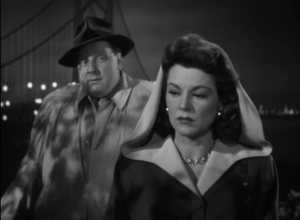 However, evil always looks to catch up with the guilty party and a private investigator is poking around in all the places he can to find the culprit behind an egregious crime. Walter Slezak’s Albert Arnett is a witty sleazeball with the lowest scruples imaginable when money is concerned. But he also happens to be decent at his occupation bringing him to San Francisco in pursuit of answers.
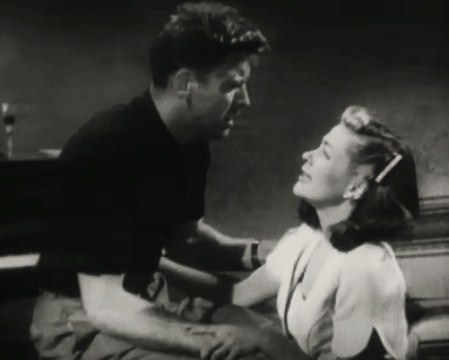 Aesthetically, Robert Siodmak’s roots in German Expressionism are crucial to the formation of the film-noir world as we know it today and Criss Cross has to be one of the most diverting additions to his repertoire. Once more he’s paired with his star from The Killers (1946) Burt Lancaster with another raging score from Miklos Rozsa and yet again there is a heist involved.
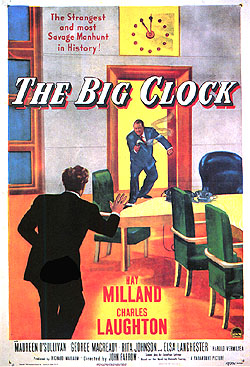 With its rather dreary title aside, The Big Clock is actually an enjoyable thriller that works like well-oiled clockwork. It’s true that oftentimes the most relatable noir heroes are not the hardboiled detectives, although they might be tougher and grittier, it’s the hapless everymen who we can more easily empathize with. Bogart, Powell, and Mitchum are great but sometimes it’s equally enjoyable to have someone who doesn’t quite fit the elusive parameters that we unwittingly draw up for film-noir. Ray Milland is a handsome actor and he was at home in both screwball comedies (Easy Living) and biting drama (The Lost Weekend). He’s not quite what you would describe as a prototypical noir hero.
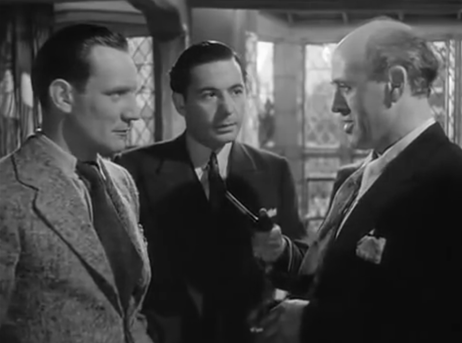 Green for Danger gives murder mysteries a good name because it is drawn up excellently but also with a degree of charm and that should not be taken too lightly or maybe it should. But either way, there’s no doubt that director Sidney Gilliat’s tale based off of a novel by Christianna Brand is quality entertainment.
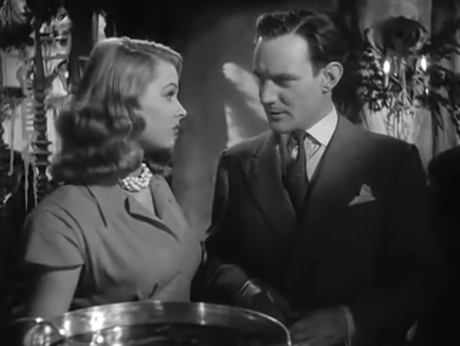 He comes in and steals the film but he does have some enjoyable castmates to work off of. Dr. Barnes (Trevor Howard) the anesthesiologist and the suave surgeon Mr. Eden (Leo Genn) are both in love with the same girl and understandably so. The attractive Nurse Freddi (Sally Gray) is a real prize but only one among a taut nursing staff including the fragile Nurse Sanson and the always lively Nurse Woods (Megs Jenkins). Before the Inspector arrives on the scene they are the true backbone of the storyline and it’s confirmed early on that the murderer comes from within their ranks. The age-old puzzle is left, to decipher who the culprit is and for what nefarious purpose.
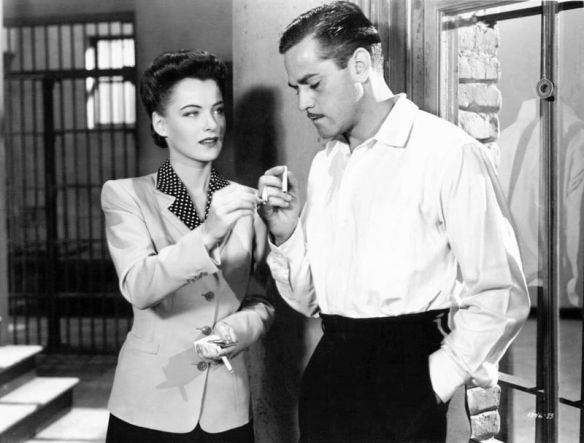 Robert Siodmak might not be the foremost of lauded directors, but it’s indisputable that film noir as a genre, a movement, a style, whatever you want to call it, would be a lot less interesting without him.
 The strands of our lives are woven together and neither time nor the world can break them.
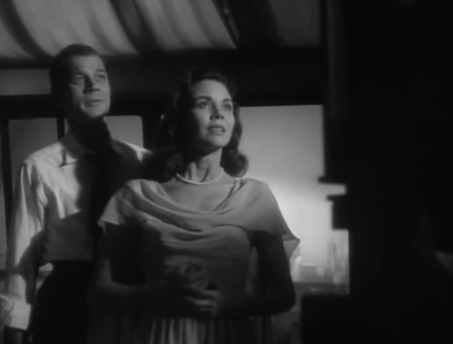 But it’s a chance encounter with a young girl named Jennie (Jennifer Jones) that gives Eben the type of inspiration that every artist dreams of because it’s precisely this spontaneous spark of joyous energy he needs to add something vibrant to his own life. In her constantly evolving role, Jennifer Jones exudes an effervescence, a certain radiance in body and spirit that lights up the screen in embodying this apparition of a girl.
 I find that despite his pedigree Joseph Cotten still comes off as an underrated actor and with each film I see him, I enjoy him immensely. Maybe for those very qualities. He’s not altogether handsome but he has a pleasant face. His voice isn’t the most formidable or debonair but it does have character. The supporting players lend some Irish flair to the cast and it’s striking that everyone from Ethel Barrymore to Lilian Gish glows with a certain hope. There is no obvious antagonistic force in this film. Eben Adams found his inspiration — the muse of a lifetime — and that passion is enough to lay the foundations of a film.
 Soldiers returning home from war is a recurring theme in films such as The Best Years of Our Lives and Act of Violence and given the circumstances it makes sense. This was the reality. Men returning home from war as heroes. But even heroes have to re-acclimate to the world they left behind.
 With Dashiell Hammett’s The Maltese Falcon making a splash just the year before and giving a big leg up to its star Humphrey Bogart as well as its director John Huston, it’s no surprise that another such film would be in the works to capitalize on the success. This time it was based on Hammett’s novel The Glass Key and it would actually be a remake of a previous film from the 30s starring George Raft.
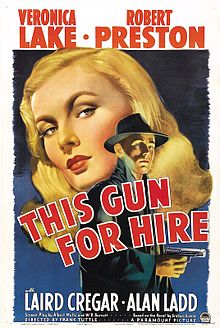 Alan Ladd and Veronica Lake found themselves partnered together on numerous occasions partially out of convenience (at 5’6 and 4’11 they were a perfect height match) but also there’s a genuine chemistry between them. And it all came into being with This Gun for Hire an economical film-noir where Ladd wasn’t even one of the top-billed stars.
 4 Star Films