Review: The Killers (1946)

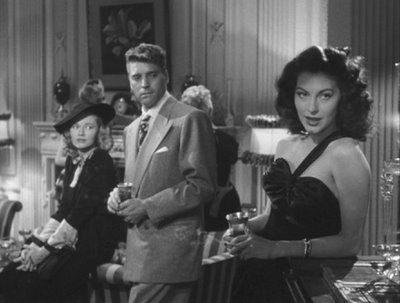
Thekillers2It’s been said that Robert Siodmak’s The Killers was Ernest Hemingway’s favorite adaptation of one of his works which was, in this case, a short story. As a film-noir, it works on numerous levels from the cinematography, to the score, to the young stars, to the ingenious narrative. Some credit, of course, can go to Hemingway for the concept, but a lot of the creative success must be given to the likes of Siodmak, John Huston and a host of others.

The film opens in an instant with two lurking gunmen entering a diner in a small New Jersey town called Brentwood. Their target is a washed up boxer called “The Swede” and we do not know why, but after terrorizing a few locals, they riddle him with bullet holes and that’s the end of it. It’s an intense sequence because the thugs (William Conrad and Charles McGraw)  are antagonistic and Miklos Rozsa’s score is nearly relentlessness.

The story could have ended there if it wasn’t for an insurance investigator named Reardon (Edmond O’Brien), who takes an interest in the dead man so he can find his beneficiary. In the present, he begins to piece together little fragments of the boxer’s past slowly but surely.

It starts out with Nick Adams who witnessed the thugs and worked with The Swede when a mysterious man came by the filing station. Soon after Ole Andreson stopped coming in to work and a while later he was dead. That’s all Nick knows, and it does not give Reardon much to go on.

Next, he tracks down The Swede’s beneficiary who turns out to be a kindly hotel maid. The connection seems slim, but it turns out that she kept him from committing suicide after a tough evening where he tore his flat apart. It’s still not much to go on, but Reardon thanks her and moves on with his investigation, still intrigued.

Then he goes to Philadelphia and gets his biggest puzzle piece from a policeman named Lubinsky, who used to run with the Swede as kids and probably knew him the best of anyone. He and his wife explain to Reardon how Pete Llund, as he was known, lost his final bout and was forced to move on with his life. About that time he met Kitty Collins for the first time and was infatuated for good.

Charleston is next the old stooge who spent a good many years locked up in a cell with the Swede. Reardon comes upon him at the funeral and from the old convict, he learns about a bank job that the washed up boxer got involved in. The other partners were Blinky, Dum Dum, and Big Jim. They are Reardon’s next points of interest.

Blinky is near death and recounts the robbery. Dum Dum crosses path with Reardon and shares about the aftermath of the job which went sour. Next, comes Big Jim whose tight-lipped about the past. Last but not least is Kitty, who is fearful that Reardon knows something and can actually blackmail her. That’s when everything begins to line up and heat up. After being absent for so long, the Killers are back in the picture and Rozsa’s score picks up again threatening the status quo of the film. They put us on edge again and for good reason. But the real focal point of the ending is Kitty.

Obviously, Citizen Kane has so many layers of interest, but it shares a similar narrative arc to The Killers where the main character is killed and his story gets pieced together thanks to flashbacks that are furnished from the present. Except, in many ways, the story of The Swede intrigues me more as a character. Charles Foster Kane is a magnate with an impressive if not tragic life.

Swede’s life is probably just as tragic except it was more humble and chock full of more crime. He was small time and he even failed in love when his friend Lubinsky got the girl of his dreams. It’s an interesting life too that ended unnaturally with gunshots rather than Kane who died as an old man. The Swede was cut short in a tragic sort of way and I think that’s part of what intrigues Reardon. It’s more than a job, but a mysterious story of a man’s life that the audience also gets taken along for. As far as storytelling goes, it’s great and it really works to flesh out these characters.

Ultimately, Reardon feels like the main character of sorts, but such an aura is built around The Swede and Kitty that it is understandable that this film made stars out of Lancaster and Gardner. They are certainly memorable partially because we hardly ever seen them in the present (except for Kitty at the end). Their whole persona is built off of what others say and there’s something interesting about that. There’s the fatalistic and sullen Swede which turned out be a perfect debut for Burt Lancaster. Ava Gardner has the soft seductive whisper of lethal poison all wrapped up in a beautiful body and it leaves a major impression.

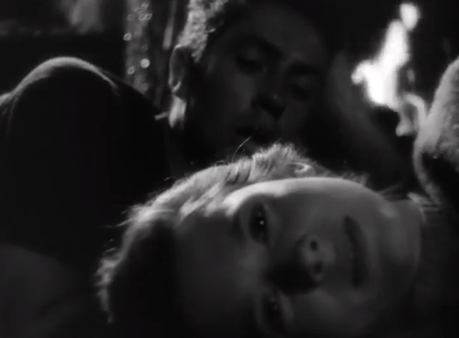
Above all else, The Killers is a prime example of film noir blending German Expressionism from Siodmak’s native Germany with more documentary style sequences that take inspiration from post-war neo-realism. The opening sequence especially drips with noir sensibilities that, at its most dramatic, looms with shadows from the exterior of the diner to the low-key lighting of the Swede’s bedroom. For a while, it’s even difficult to know that’s Burt Lancaster reclined on the bed because his whole body is fully encased as he speaks. It’s only when he gets up into the light that we finally are introduced before he gets gunned down a few minutes later. It’s great staging and the atmosphere remains for a great deal of the film from the prison cell to Big Jim’s mansion. Each place is contrasted with the present or other locales like Reardon’s office which are more natural in lighting. It doesn’t get much better than that.

4.5/5 Stars

Brute Force (1947)

BruteForceImage873Potentially one of the weaker Jules Dassin films noir, Brute Force is still a worthwhile film exploring the dynamics of a prison during the 1940s. The inspiration comes from the rebellion at Alcatraz in 1946 and this film was shocking at the time for the amount of violence it portrayed. It stars Burt Lancaster as the glowering leader of a group of prisoners in block K17. His main antagonist and the villain of the entire yard is the authoritarian Captain Munsey (Hume Cronyn in an especially icy role).

The story follows the inmates as they make due with prison life and bide their time waiting for parole. However, Joe Collins, who is fresh off a spell of solitary confinement, seems bent on escape. The prison warden is an older fellow struggling to keep tempers from boiling over. The likable but often inebriated doctor (Art Smith) can see the writing on the wall. Things are reaching the end of the line if Munsey continues to hike up his tactics that are making the men resent him more and more every day. It’s positively a powder keg and it’s not going to be a pretty sight if the pressures get to be too much.

The entirety of the film takes place within the confines of the prison except for a couple flashbacks as four men recall the women they left outside in the real world. They are played by Anita Colby, Ella Raines, Yvonne De Carlo and Ann Blyth respectively, reflecting the hope, memories, and loved ones who are pulling at these men and ultimately led them to get into trouble. Perhaps it’s a stretch, but you might even be able to call them the femme fatales in an otherwise very male-centric film.

One man hangs himself afterward from Munsey and another gets it for causing problems for Joe. Neither of these men is looking to stand down anytime soon as Joe cautiously begins enacting plans of escape with another prisoner named Gallagher (Charles Bickford). Munsey continues to hound prisoners for information while halting all privileges.

Ultimately, the finale turns into the most electrifying moment of the film, while simultaneously Munsey is made the new warden and Collins puts his plan in action. Guards are waiting for him and his crew, but Gallagher has plans of his own in the compound. It leads to a handful of explosions, endless mayhem, and more than a few deaths. This is what happens when you use brute force.

4/5 Stars

Review: The Big Sleep (1946)

b4c25-bigsleep1

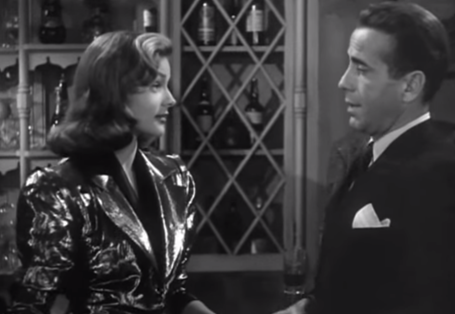
Philip Marlowe is undoubtedly Raymond Chandler’s character, but Howard Hawks and Humphrey Bogart brought him right out of a pulp novel and stuck him on the silver screen to ever be solidified in our minds. Needless to say, this is a quintessential film-noir coming right at the tail end of WWII, known as much for its incomprehensible plot line as it is the romantic pairing of Bogey and Bacall.The title credits role and the contours of our two leads can be seen in the background, cigarette in toe with Max Steiner’s furious score pulsing in rhythm. We find ourselves on the doorstep of a man named Sternwood. A hand is ringing the doorbell and a servant answers. The hand, of course, belongs to Humphrey Bogart or closer yet Philip Marlowe. Right off the bat, he gets the come on from the flirtatious younger daughter of Sternwood and he takes it in stride.

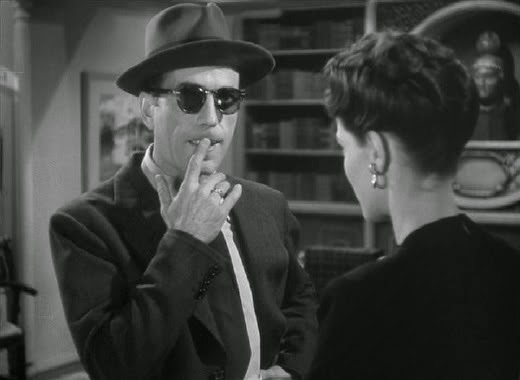
When he meets the sickly man of the house, he’s stricken to a wheelchair parked inside a greenhouse. He and Marlowe get chummy, and he calls upon the P.I. to find a man named Geiger, while bemoaning the trouble his daughters get into. For good measure, Marlowe also gets his first taste of Sternwood’s older daughter Vivian Rutledge who is more mature, but suspicious all the same. From then on the case is a series of storefronts, L.A. street corners, and car interiors. It’s hard to believe, but it also seems so dark and dreary with buckets of rain to boot. It must be L.A. in winter (or in an alternative universe). Bogey has a little fun masquerading as an antique book aficionado and every lady he interacts with feels like another Carmen Sternwood. Always ready to flirt and he usually gives them the time of day.
He stakes out a home and he investigates a piercing scream only to find a disoriented Carmen in a big mess. Next, a dead man is pulled out of a Packard near Lido Pier. The names keep piling up too. There’s A. G. Geiger, Sean Regan, Owen Taylor, Joe Brody, Eddie Mars, Harry Jones (Elisha Cook Jr.), and a number of others. Most are seen at one time or another but a few are not.
08bfb-bigsleepBy this point, The Big Sleep is less about all the facts and more about how we get there in the end. Obviously, the source material is from Raymond Chandler, but the witty script full of great patter is courtesy of William Faulkner and Leigh Brackett of all people. Bogey and Bacall have some fun on the telephone (You like to play games don’t you) which coincidentally has no bearing on the plot. Later on, they have some more spirited back and forth about horse racing. It’s at these times that you cannot help but chuckle at the rapier wit of the script. Philip Marlowe is a great character with a lot of great things to say indeed.
Soon we suspect there is something romantic going on between Eddie Mars and Rutledge. A few more stooges get it and Marlowe gets himself beat up in a dark back alley (Of course). Next thing we know is our new favorite gumshoe is tied up in a house with two ladies. Rutledge is there and the wife of Eddie Mars. What? He gets out of harm’s way thanks to Vivian, and the showdown that we have been waiting for comes to pass. Marlowe outsmarts everyone and puts the damper on the case. Everything seemingly comes to a smooth resolution, the audience just has little idea how we got there. But that’s not the greatest of concerns.
It would be great enough to watch The Big Sleep for the sass and repartee which it is positively dripping with. Thanks to the reworking of the film in 1946, the Bogey and Bacall dynamic became more prominent and fun. Although it is slightly disappointing that a lot of Martha Vickers’s performance ended up on the cutting floor, it is made slightly better by a memorable appearance by a young Dorothy Malone. All in all, there is very little to complain about if you just sit back and enjoy this very engaging film-noir for what it is. Howard Hawks brought us yet another unassuming post-war classic that is unequivocally American.

4.5/5 Stars

Caught (1949)

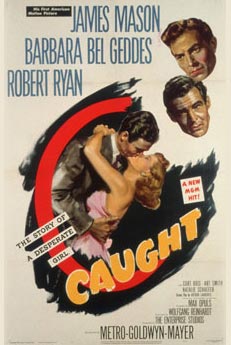
Caught_(1949_film)Max Ophul’s Caught is an interesting mix of soap opera drama and dark, brooding noir. It follows aspiring model Leonora Eames (Barbara Bel Geddes), who is obsessed with improving herself through charm school, landing a modeling job, and finding a rich husband. She’s not the only one in a world of young pretty girls who thinks money makes the world go round.

She’s a little bit different than the others, but they have slowly made her buy into the whole system. Then, one night she gets what all these gold digging girls could only dream of, she meets the filthy rich and oddly-named Smith Ohlrig (Robert Ryan), and it’s all quite by accident.

Soon more to prove a point than for love, Smith marries Leonora, and she tries her best to love him like a good wife. But he’s too busy and too difficult to get close to. She spends all her days stuck at home and unhappy with Smith’s hired aide Franzi Kartos (Curt Bois). Leonora realizes she needs something else and heads out to get a job away from Smith and his money.

The first opportunity she gets is as a receptionist for the doctor’s office of a kindly young pediatrician and his older colleague across the hall (Frank Ferguson). He pegs her as an odd applicant from the beginning but allows her to come on and work. Once she commits, Leonora proves to be a hard worker and she and Dr. Quinada (James Mason) hit it off, though he still finds her peculiar.

caught2

Once more, Leonora tries to patch things up with Ohlrig who begs her to come back home, which she does. Because she wants their marriage to still work out. However, Leonora also gets some big news from a doctor that complicates the situation. She truly is caught. She cannot leave Smith due to their marriage and other difficulties while her affections truly lie with kindly Dr. Quinada who feels the same.

Ultimately, there has to be a showdown and so there is. Leonora has to make her decision. Then Smith has one of his angina attacks and she doesn’t want to help him. It causes her increased guilt and ensuing complications. But Ohlrig doesn’t die and Leonora finally has the future she wants with Quinada.caught3Max Ophul’s was always a master with these types of melodramas and his trademark dolly shots are as prevalent as ever, developing some of the scenes wonderfully. It becomes more than a plot but a visual presentation too, and the shots often are augmented by how he moves in and about a room.  Robert Ryan steps into the villainous role easily and James Mason is a surprisingly amiable good guy. Also, though his role is small, Frank Ferguson is nonetheless pivotal and thoroughly enjoyable as a fatherly figure. Of course, Barbara Bel Geddes is a worthy protagonist, because she is ultimately the one trapped between her two male counterparts and she is the one who goes through the most mental torment with Ohlrig potentially being close behind.

Above all, Caught is a timeless indictment not simply of corrupt capitalism but a generally misguided philosophy that money is everything. Quinada has the best approach, realizing that money is necessary, but it can never buy you happiness or remedy your relationships. Smith never figures that out and it is difficult for Leonora to leave that worldview completely behind — as it is for many of us.

4/5 Stars

They Live by Night (1948)

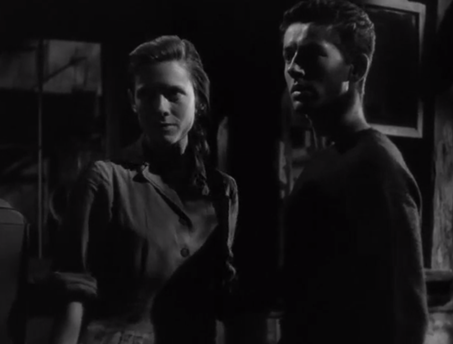
theyliveby4Regrettably, I have seen very little of Nicholas Ray, however from his debut in They Live by Night, I saw the same care spent on his youthful characters, which is also noticeable in Rebel Without a Cause. He does not treat “Keechie” and “Bowie” as cardboard cutouts or kids who are dumb and in love. They have value and feelings that are worth examining more closely.

The film opens with three thugs breaking out of the local prison. Two of the men Chicamaw (Howard Da Silva) and T-Dub (Jay C. Flippen) are weathered criminals. The third, Bowie is a baby-faced kid looking hardly a day over 20, but he went into the clink for a reason.

They find shelter at a nearby filling station where Chicamaw’s mangy older brother (Wil Wright) makes a living with his timid, no-nonsense daughter Katherine. They get a car and have enough money to get their feet off the ground before a big bank job in Kelton.

theyliveby2It goes off without a major hitch, but soon after Bowie gets in a car accident and Chicamaw takes him back to his brother’s to be cared for. Katharine is there and the two of them find companionship in each other because neither one has anyone else to turn to. They are young, naive, and in love. They’ve never had these types of feelings before.

Since Bowie needs to lay low, he takes “Keechie” with him and they make an adventure out of it. Ultimately, it results in a cheap $20 marriage and a lot of nice intimate nights spent together driving and cuddling. They’re living the lives of carefree newlyweds who need no one but each other. They find a simple cottage out in the backcountry owned by a homely proprietor (Byron Foulger), and it acts as a new home. A perfect oasis from the newspapers, the cops, and Bowie’s accomplices.

However, they do catch up with him eventually, and he and Katherine split fast after a tiff. They want a normal life, but Chicamaw and T-Dub won’t allow it because they need more money from another bank job. He won’t and in the subsequent attempt, his former partners eat it. The lookout is still hot for the boy as well.

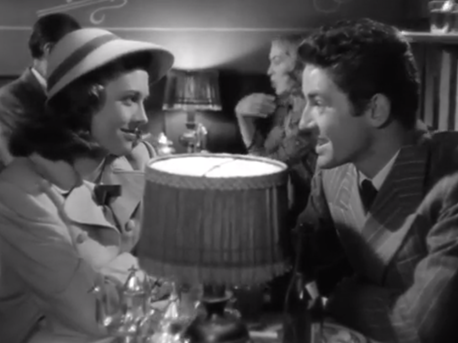
theyliveby1He seems so undeserving of hard justice, but it is bound to come after him anyways. For such relative newcomers, Farley Granger and Cathy O’Donnell (The Best Years of Our Lives) have such genuine chemistry opposite each other. Granger is more often than not gentle and kind. O’Donnell is pretty in a simple, unadorned type of way. They elicit so much more sympathy than Bonnie and Clyde or even the fugitives in Gun Crazy. Perhaps because they aren’t even outlaws, only young kids who are victims of their circumstances.

4/5 Stars

Force of Evil (1948)

Forceofevil

This is Wall Street… and today was important because tomorrow – July Fourth – I intended to make my first million dollars. An exciting day in any man’s life. Temporarily, the enterprise was slightly illegal. You see I was the lawyer for the numbers racket”  ~ Joe Morse

Not in recent memory has a film left such a different taste in my mouth. Force of Evil has all the trappings of a thoroughly engrossing noir crime film. There’s the crooked lawyer Joe Morse (John Garfield), looking to get ahead by helping a top level gangster named Tucker take over the numbers racket in New York. There’s his estranged older brother Leo (Thomas Gomez) wanting nothing to do with his brother’s dirty money. It’s a classic Cain and Able type conflict. Add realistic location shooting inter-cut with voice-over, and a David Raksin score to make a real winner.

Yet Force of Evil is a dangerous film to take at face value because on that level alone it is highly entertaining. However, director and screenwriter Abraham Polonsky created something special here at only 78 minutes in length. His film has a certain rhythm that is hard to pinpoint. John Garfield especially delivers his lines impeccably, drifting in and out of common everyday jargon and moral convictions. It’s a slightly higher level of dialogue that deserves more digestion and thought. He even gives a taxi cab soliloquy that gives On the Waterfront a run for its money.

As a big picture, the plot makes sense for the most part. Joe is on the verge of making millions on the Fourth of July, and he wants to cut his brother in on it. But his brother works one of the smaller rackets which is bound to be pushed out. He has his own sense of morality, where he can bear what he does but not what Joe will hand him.

Leo reluctantly agrees to join the big operation out of necessity until things get way too involved, and this time Joe is in a place where he has to get out himself, with no way of protecting his brother. His resolve to watch over his brother is to no avail when the Ficco Gang tries to push their way into the racket. Meanwhile, Joe still finds time to flirt with the innocent and proper Doris Lowry (Beatrice Pearson), the former secretary of Leo, who is in complete juxtaposition with Mrs. Tucker (Marie Windsor), who Morse keeps company with initially.

However, this whole mess is constantly being complicated. There is “Freddie” Bauer (Howland Chamberlain), the nervous fellow who used to work with Leo and now, with the big takeover, is looking to blow the whistle on whoever he can to stay out of the fray. There’s the police who seem intent on getting their hands on everybody they can and not showing favoritism towards anyone. There’s Leo who is righteously indignant while also taking his brother’s offer of a better position begrudgingly. There’s Doris who is in all ways sensible and yet still falls for Joe, not in your typical passionate way, but it still happens nonetheless. There’s the line between legitimate business and criminal activity that is constantly be zig-zagged.

Finally, there is Joe who deserves the greatest amount of scrutiny. John Garfield apparently could not pinpoint his character’s deal initially either, but he must have figured it out because he nailed it. It’s probably his greatest performance. He’s the kind of guy who blows the whistle on his own brother in order to help him in his own way. It doesn’t quite make sense, and he seems so often blinded, but he keeps pushing forward in a vain attempt towards success. All the caustic words and aggressive come-ons don’t work. Ultimately, he has to come to reality. When Joe does, that’s when he realizes what he has started and what he has done to Leo. By that point, it’s nearly too late for him, and it’s most definitely too late for Leo.

4/5 Stars

Review: Mildred Pierce (1945)

mildredpierce1Mildred Pierce is a hybrid between two genres in a way. It most certainly could be categorized as a weepie 1940s melodrama, a so-called “woman’s picture,” and yet it has the undeniable framing devices of a typical film-noir. It’s unique in other ways as well. It features a strong, independent woman as the lead, the eponymous Mildred Pierce and her aspirations and the struggles in her life become the focal point of this story.

Before any gun was fired or a dead body was found at a beach house or any of that happened, Mildred was a stay at home housewife with two daughters and a husband. It becomes all too clear that all is not right in the Pierce household as Bert becomes annoyed with Mildred, who spends so much time doting over eldest daughter Veda (Ann Blyth). It’s as if she needs to earn Veda’s love and Bert realizes the issue early on. They separate and soon after they watch their youngest daughter die of pneumonia suddenly.

What happens next is Mildred’s big break. She starts out all alone and discouraged before finding a job as a waitress, and ultimately, starting up her own restaurant with the help of the hapless Wally Fay (Jack Carson). She finds a loyal friend and employee in Ida (Eve Arden) and a rejuvenated love life thanks to the socialite Monte Beragon (Zachary Scott).

Veda on her part is ecstatic to finally have a life of nice things with the stream of income coming in from her mother, however, she still does not approve of her mother working in the restaurant business. Mother is so Philistine after all.

Thus, despite all the work and effort, she has put into holding onto her one remaining daughter, Veda begins to drift farther and farther away from Mildred until a fight causes Veda to leave home. Most people would say good riddance, but Mildred Pierce is not like that. She has an unhealthy, almost obsessive need for her daughter’s affection. She will do anything to get her back and most of it has to do with giving Veda stuff.

She is far from happy but finally marries Beragon, because she thinks it might bring Veda back to her home. It works but what she doesn’t know is that she is getting forced out of her own company by Bergaon. That evening she found her gun and then Beragon got murdered on the premises of his beach house.

Back in the station, the shadowy noir sensibilities are still present and Mildred abruptly finishes up her tale. Except for the police investigator and the audience know better. That was not the end of the story. There’s one last cruel twist.

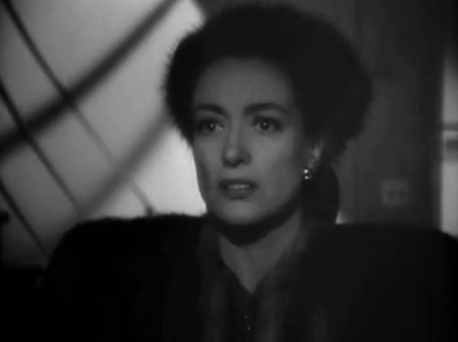
In my mind, Joan Crawford is rivaled only by Bette Davis in giving me the shivers, except in this film her eyes are so expressive, giving off emotion without her even saying anything. Within this film, I find the character dynamics and gender conflict to be quite interesting and there are really 6 main characters we can look at:

Mildred: A strong woman who gains her independence the hard way by putting in work to earn her honest wage. She is not a bad person per se, but her weakness is an unhealthy love for her daughter, or rather, a need to have the affection of a girl who never can be satisfied. It leads to divorce, a loveless marriage and a lot of heartaches.

Veda is a little spoiled brat and most of the pain and problems in the film stem from her. She constantly plays on her mother’s emotions heartlessly and even goes so far as to steal her man. That is perhaps the ultimate slap in the face after all she has already done.

Ida: Along with Wally Fay, Ida is perhaps one of the more likable characters in the film, because she is a strong woman who also holds a lot of wit thanks to the performance of Eve Arden. She also utters the famous line that shines some light on the Veda situation (Alligators have the right idea. They eat their young).

Bert: Although he takes part in an affair and is not the perfect husband, I think Mildred and the audience realize how right he was. He saw all the drama with Veda coming, and he remained civil with Mildred through it all, continuing to look out for her.

Monte: He may not be a “villain,” but Beragon is ultimately another corrupt character who is driven by money and his social status. However, it is interesting to ponder whether it was his own avarice and playboy instincts that led him to do what he did, or was he wholly influenced by Veda?

Wally: Finally, we have Wally Fay played the always enjoyable Jack Carson. He too has his eye on Mildred, but although he can be forward and a little annoying, he ultimately looks out for her much like Bert. And yet to call him an angel would be an overstatement because he still has his own interests in mind.

That’s what makes these characters so fascinating since there are some obvious antagonists, but each character, at their core,  has faults. Thus, it makes sense that this film has melodrama brought on by familiar conflict and the like, only to descend down into the noirish world brought on by vice and greed. Whatever you label this film as, the fact of the matter is, it was a major hallmark for the fading Joan Crawford as well as the ever versatile director Michael Curtiz.

4.5/5 Stars

Review: The Postman Always Rings Twice (1946)

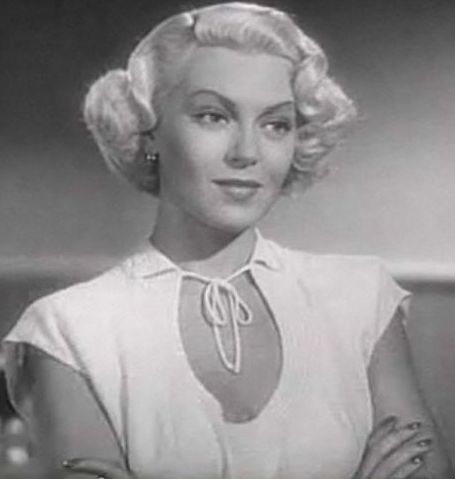
Lana_Turner_in_The_Postman_Always_Rings_TwiceThe first time I saw this gripping noir, my least favorite part of the film probably was the title, and it still is. That’s saying a lot, and the film is adapted from the James M. Cain crime novel anyways, with the title included free of charge. Otherwise, Postman is a wonderful example of the film noir canon, and yet it lacks the elements of your more typical private eye mystery.

It trades dark streets of crime for a small roadside burger joint owned by a shrewd man and his noticeably younger wife. Bring a drifter searching for a quick buck and you have everything set for the deadliest of love triangles. At the tips are John Garfield as the rambling man Frank who initially couldn’t care less for his boss’s pretty wife. Then there’s Cora, the alluring girl who seems out of place in her life. Then you have the money-grubbing Nick (Cecil Kellaway) who seems naively oblivious to the whole situation.

At first, nothing seems to be afoot, and Cora is adamant about not getting involved with the new hand. However, ultimately things evolve. That’s not necessarily the exciting part. We expect the rapid and lurid love affair that soon besets Frank and Cora.  We expect, more likely than not, that Nick will either catch them or they will knock him off first. They choose the latter and its far from preferable. Soon the district attorney is down their throats with his own suspicions about the forbidden couple. He’s pretty smart too.

Sackett plays Frank and Cora off of each other. They’re both scared. Neither one wants jail or worst the gas chamber. Nora ends up being the only one prosecuted, but her sly lawyer (Hume Cronyn) is able to call his opponents bluff and get Cora off with hardly a hitch. The only problem is that Frank and Cora hate each other guts now. They are positively poisoned to each other.

The story could end there and it would be ironic enough, but it doesn’t. It has yet another act where Frank and Cora make up following the illness of her mother, the flourishing of her establishment after the trial, and a bout with blackmail. All seems to be better than it ever was, but fate can have a cruel sense of humor.

On one out of the ordinary car ride, Frank crashes and in the aftermath, Cora is left dead with Frank on the fast track to the gas chamber. And that’s where the title comes in. The Postman Always Rings Twice. In other words, if you don’t pay for your crimes the first time around, you always end paying up one way or another. Cora was killed and Frank faced execution. Neither one got off in the end.

Putting aside the Hay’s Codes need for justice to be dealt, this is a wonderfully sardonic tale and ultimately sensual noir for the 1940s. Lana Turner was never better dancing with relative ease between amorous sweetness and acidic intentions. And the moment she first shows up on the screen is one of the most eye-catching entrances by a femme fatale period. Although not the greatest of leading men, John Garfield is surprisingly credible opposite, Turner. He plays the hard-working everyman incredibly well. Hume Cronyn, for his part, plays his wily prosecutor wonderfully with a sly smile all the while. I cannot quite put a finger on it, but I like him.

4.5/5 Stars

Act of Violence (1948)

ActofViolenceAct of Violence is an interesting post-war moral tale from director Fred Zinnemann. Frank (Van Heflin) returned home from war a hero. He now has a small child with his pretty young wife Edith (Janet Leigh) in the vibrant California town of Santa Lisa.

Little is known about his P.O.W. past and all his comrades were killed. Except one. His friend Joe (Robert Ryan) is still alive but he is plagued by a crippled leg now. He finds out about Frank’s whereabouts and it become his personal vendetta to straighten him out. The innocent Edith is in the dark about the whole ordeal and with the shadow of Joe constantly haunting him, Frank must family face the specter of his past.

He goes off on a business trip to escape and there out of desperation he winds up hiring a hit man to get Joe off his back. The two former buddies set up a meeting (which is really a trap), But as would be expected it does not work out as planned. Justice is dealt but there is still a strange sense of moral ambiguity. This is  certainly not Zinnemann’s best work, but it brings up some interesting questions about moral scruples and personal conflict.

3.5/5 Stars

Phantom Lady (1944)

PhantomladyThe film uses the motif of a mysterious lady who cannot be found as the jumping off point for this Film-Noir. It is this so called phantom lady who Scott Henderson (Alan Curtis) meets at a bar after having a spat with his wife. They lift each others spirits and part ways. Returning home, he is met by the police inspector (Thomas Gomez), who found that Henderson’s wife was strangled to death. Scott is the prime suspect and now he needs his alibi which seemed so airtight before.

She truly has vanished and no one remembers her so Henderson is on the verge of the death penalty. It is his smitten secretary Carol (Ella Raines) who takes up his cause. She retraces his steps interrogating a bartender and wheedling information out of a puny drummer (Elisha Cook Jr.). Soon an old friend (Franchot Tone) of Scott’s returns from South America and everything gets a little more interesting.

Phantom Lady stars a cast of only a couple recognizable names, however Robert Siodmak does a decent job at making this noir interesting and it is certainly worth a watch.

3.5/5 Stars