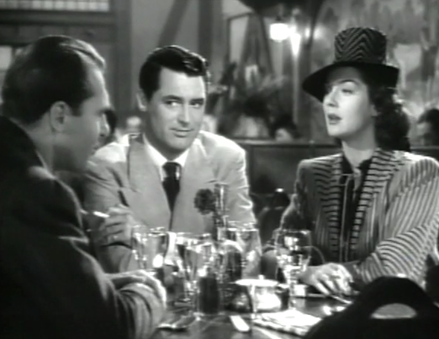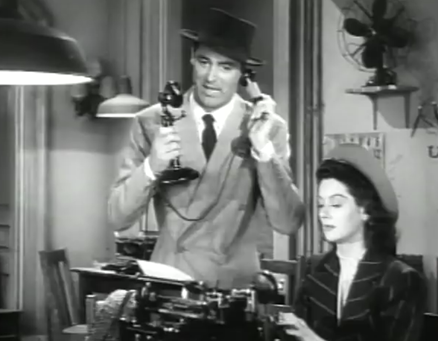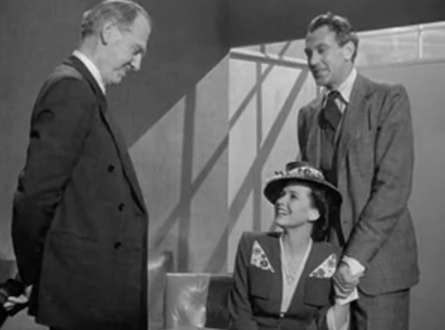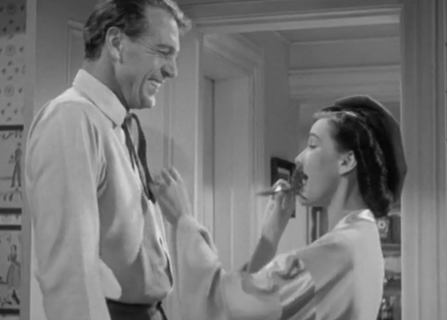
Christmas in Connecticut (1945)

416cc-christmasinconnecticutElizabeth Lane  is the perfect cook, hostess, wife and mother who is the talk of the town thanks to her daily column in a reputable publication. Anecdotes from her quaint lifestyle out on a Connecticut farm have everyone from war vets (Dennis Morgan) and publishing magnates (Sydney Greenstreet) fawning over her cooking. She’s a chef extraordinaire. Except she doesn’t actually exist, or rather not in that incarnation. Instead the persona is the creation of New York columnist Elizabeth Lane who lives in an apartment with very little culinary ability of her own. That’s why things get complicated when a young sailor followed by the old publisher want to meet her and share Christmas on her farm. She knows Mr. Alexander Yardley is a stickler for the truth and so she rushes to pull off a masquerade to keep her job. It’s a harebrained scenario involving the farm of a beau and her kindly chef pal Felix (S.Z. Sakall) who covers for her lack of cooking ability. For a while it works and romance is in the air, but as you would expect things get a little complicated. Everything ends up hunky dunky in the end. If you’re feeling a Christmas comedy with screwball elements, you’ve come to the right place. Stanwyck is always great and Sakall invariably steals the show at times.

3.5/5 Stars


T-Men (1947)

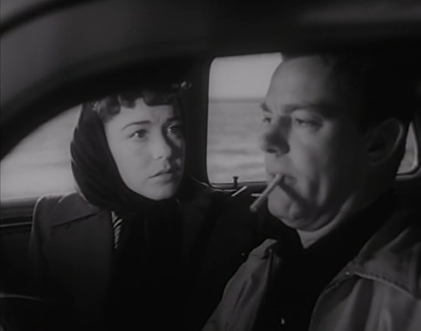
fb214-tmen3T-Men looks like it could be a dated 1940s procedural right out of a stuffy newsreel. It’s complete with an omniscient narrator overlaying everything. He gives us all the juicy bits without relaying all the superfluous details because, after all, this is a composite case. Also, a lot of effort is made to bring up similarities with the Al Capone case.  So, in other words, it does feel like a heavy-handed newsreel at times.

However, thanks to director Anthony Mann and the pure cinematography of John Alton, T-Men sheds its shallow top layer and gets interesting.

We are given a bit of dry exposition to kick things off. We are following a couple T-Men named Dennis O’Brien (Dennis O’Keefe) and Tony Genaro (Alfred Ryder), complete with full personal bios, who are called on to infiltrate a counterfeiting ring. They get in with the Vantucci mob and make their way from Detroit to L.A. O’Brien aka Vannie Harrigan goes to all the steam baths across town and finally comes across a man named the Schemer. After putting his phony dough in circulation the plan is set in motion as he gets in with the thugs of L.A. too.

And that’s what the rest of the film entails, with O’Brien keeping his cover, while also staying in contact with his superiors and being joined by Tony, aka Tony Galvani from Detroit. It would be run-of-the-mill if not for a few scenes and Alton’s images as previously mentioned.

One day Toni runs into his wife in the most awkward and potentially deadly of circumstances. A well-meaning friend nearly blows his cover in front of a thug and Mary Genaro (June Lockhart) bravely protects her husband. It’s a painful moment.

All too soon Toni’s in trouble and O’Brien soon after, but he’s almost gotten to the top. The digging and prodding have nearly reached their apex. A bit of luck and some timely police support get to O’Brien soon enough so he survives. It’s a show of heroics and gutsy police work like we have undoubtedly seen many times before.

T-Men is kind of like The Departed without all the thrills and plot twists, and cursing if you want to see it that way. But the images are so moody and beautiful that it’s hard not to at least tip your hat if you had one. Do yourself a favor and see Raw Deal, a film with many of the same components and probably a slightly better payoff.

3.5/5 Stars

Review: Murder, My Sweet (1944)

e30de-murdermysweet1Ann Grayle: You know, I think you’re nuts. You go barging around without a very clear idea of what you’re doing. Everybody bats you down, smacks you over the head, fills you full of stuff…and you keep right on hitting between tackle and end. I don’t think you even know which side you’re on.

Phillip Marlowe: I don’t know which side anybody’s on. I don’t even know who’s playing today.

Now after seeing the original Dick Powell as a crooner in light song and dance flicks, his re-imagined image as Chandler’s Phillip Marlowe is that much more surprising. This film quickly dropped being the potential musical Farewell my Lovely and ultimately became a hard-boiled Noir called Murder, My Sweet. To Powell’s credit, his new alter ego works and he brings his own spin to the role. Perhaps he has a little more humor than Bogart but there is still enough of the tough guy in his role to make it work. He’s also deliciously cheeky which is perfectly illustrated by a scene where he lights his match on the butt of a statue. It’s great.

Edward Dmytryk gave us a film that has often been credited with helping to define the film-noir style of the 1940s. It makes perfect sense since his film brims with many of the major hallmarks of the genre. The powder-burned Marlowe’s initial narration carried through a flashback lends a wry and cynical commentary to the entire story. The screen itself is cloaked in shadows, filled with billows of cigarette smoke, and is often superimposed with disorienting images.

Early on one man named Marriot is dead, Marlowe gets clocked over the head, roughed up several times, not to mention drugged up. He gets hired, used, thrown off, and seduced more than once. All because of an expensive jade necklace. As Anne (Anne Shirley) notes, Marlowe goes charging into his case not quite knowing what is going on or who he is dealing with. That ambiguity is one of the strengths of this film because we are never allowed the comfort of knowing who to side with.

By default, we begin the film from the point of view of Marlowe, and so he is our anti-hero who we track with the entire film. He gets the giant thug Moose (Mike Mazurki) tossed his way first. Marlowe meets the pretty Anne who hides her true intentions, introducing him to her wealthy father (Miles Mander) and seductive stepmother (Claire Trevor). Next up is quack doctor Jules Amthor (Otto Kruger) who appears to be our most clear cut villain and yet nothing is for sure.

It takes a late night confrontation at a beach house for things to straighten themselves out. Yet even up until that point, we do not know Marlowe’s true intentions, and he does not find out the resolution of the case until well after, thanks to the powder burns to the face.

Aside from Dick Powell’s anchoring performance, Claire Trevor is a tantalizing femme fatale, while Anne Shirley plays the guardian angel rather well. The juxtaposition of a morally questionable woman and an innocent girl develops the tension, not to mention that they are step-daughter and step-mother. When it’s all said and done, Marlowe got a sweet deal. He didn’t even need the jade necklace.

4/5 Stars

Raw Deal (1948)

5453f-rawdeal2Anthony Mann may be most widely known for his westerns often headlined by Jimmy Stewart, but he most definitely honed his craft earlier on. Raw Deal is everything you want and expect from film-noir. Our protagonist is a man who breaks out of the State Penitentiary, you have your potential femme fatale, the moral ambiguity, and most of the other necessary hallmarks.

As a lover of black and white cinematography, Raw Deal is highly appealing with its chiaroscuro, silhouettes, and framing of characters. But after all, that’s often part of the allure of noir.

Claire Trevor’s matter of fact voice-over backed by the theremin is highly effective in dictating the disconcerting mood for the entirety of the film. All our previous predispositions tell us the stage is set for a chilling ending but we can hardly imagine what it is at this point.

After Joe (Dennis O’Keefe) busts out of prison, we get much of what you would expect. A tense manhunt involving a dragnet crossing multiple state lines and a fugitive at large with accomplices. There is violence and melodrama galore as Joe dodges the police while also trying to reconnect with a crooked mob boss named Rick (Raymond Burr), who leveraged an escape attempt so Joe would get knocked off.

With the circumstances as they are, he’s not too keen on giving Joe the 50Gs that he is owed and so Rick wants the fugitive knocked off if the cops don’t get to him first. Put in this light, the film feels analogous to many other noir staples like White Heat, Out of the Past, Gun Crazy or The Big Heat to name a few. However, it has its own wrinkle that makes it interesting.

Joe has his femme fatale to be sure, but the kicker is that there are two dames pulling at his heart strings. Pat (Claire Trevor) is more the dame since she was born in a bad area and has been waiting around for Joe a long time. She’s faithful even to the point of helping him escape, but she’s not the most endearing of characters. Ann (Marsha Hunt) on the other hand is the tender social worker who has been trying to help Joe the legal way. When he breaks out she is taken as a sort of hostage and has difficulties reconciling her feelings for him with what she sees in front of her.

However, he’s certainly not all hardened criminal and so that is part of what makes the rest of the film so interesting. Each character walks the thin line of morality and each one crosses over to the other side even if its only for an instant.

For, Pat the clock continues to tick and her conscience ultimately catches up with her. As the drama reaches its near apex we see Joe’s true feelings, and in a sense, who he has become compared to who he was earlier. However, we cannot help feeling a tinge of remorse in the end. So you see, the film succeeded in doing the near impossible, making me sympathize for Claire Trevor’s character. She seemingly often plays undesirables, but they are never cookie cutter and the same can be said for Raw Deal.

4/5 Stars

“You’re something from under a rock” ~ Ann Martin

Le Silence de la mer (1949)

f9677-lesilence1Out of the many titans of French film, I found a personal favorite in Jean-Pierre Melville. Aside from changing his name in honor of the American author who wrote about the great white whale, Melville was also a member of the French Resistance during WWII. Thus, he seems to be the perfect man to helm a film based on a novel that was secretly published during the Nazi occupation. You would think that it would be brimming with political agenda and underhanded controversy.

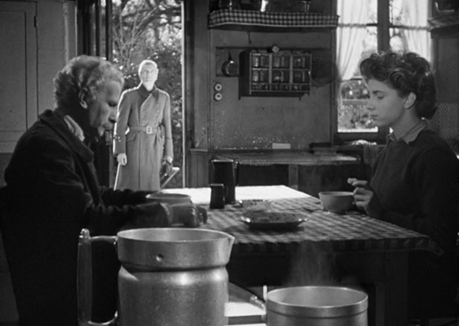
Instead, Melville gifts us a nuanced and sympathetic film about a German Lieutenant who is quartered in the home of a French gentleman and his young niece. In many ways, much of the story plays out as an extended monologue rattled off by Werner von Ebrennac, and it becomes the perfect narrative device for an intimate character study. He is met by silence and passive aggression from his hosts, who hate his guts and the situation they have been placed in. He represents everything they despise, and his mere presence also reminds them of the shameful fact that France has fallen.

And yet he is far from the stereotype, and Melville never allows this German Lieutenant to succumb to our preconceptions. This has to be one of the most sympathetic depictions of a German soldier ever seen captured on film. It turns out that Ebrennac is a perfect gentleman, cultured in literature (Moliere, Rascine, Cervantes, Dante, Shakespeare, and Goethe), and a seasoned musician. His head is full of romantic ideals about the reviving of France as it is taken under the wing of its new conqueror.

His words are always met with a quiet contempt as uncle and niece continually sit reading and knitting. It never seems to change or stop. There is never a change in temperate or a word spoken. Just the words of Ebrennac every evening after he gets back and the voice-over of the older gentlemen constantly illuminates us about the unspoken workings of his mind.

Soon, however, the Lieutenant learns the reality of the war from Treblinka to the Nazi ideology pervading the psyche of all the German military. Friends have been brainwashed, and his view of the German war is completely dashed. There is nothing left to do but apply for a transfer and resign himself to the hell that has been created. Uncle and niece reluctantly bid farewell to a man who was the exception.

This was Jean-Pierre Melville’s first feature, but I really enjoyed it as simple as it is. He seems to understand the ambiguities of war. It often is difficult to decipher who is in the right or the wrong. Germany was the odious villain and France the obvious victim. However, in this domestic drama the tables are seemingly switched in stark contrast.

4/5 Stars

Gaslight (1944)

eb609-gaslight-1944Directed by George Cukor and starring Ingrid Bergman, Charles Boyer, and Josesph Cotten, with Angela Lansbury, this film begins rather abruptly with a young girl in England who witnessed the aftermath of her aunt’s murder. Then in a whirl wind she has become married to a nice young pianist and they move back to her old home in England to settle down to together. From that point on everything begins to change gradually. Gregory has a violent outburst over a letter, Paula loses her brooch mysteriously, a picture is misplaced, there are seemingly footsteps from above, and the gaslights change for no apparent reason. Gregory continues to manipulate and isolate his wife telling her it is for her own girl. A traumatic night at the opera and the new maid only worsen Paula’s mental state. She soon believes she is sinking deeper and deeper into hysteria thanks to Gregory. However, a former admirer of her aunt becomes curious of Paula and tries in earnest to meet her as he reopens her aunt’s case. Finally, they meet and together they piece together what is really going on. In the final climatic moments the inspector comes to Paula’s aid and she turns the tables on her husband. All the main players do a wonderful job, especially Bergman, and this film was built up nicely. My only qualms would have to be Joseph Cotten playing an Englishman and I found it hard to follow in the very beginning.

4.5/5 Stars

A Letter from an Unknown Woman (1948)

8cc43-letter_from_an_unknown_woman_posterThe place is Austria. The time around 1900. This tearful romance is framed by a lovely plot device in the form of a circular narrative. As the title suggests a woman writes a letter to the man who she has always loved. As she relates their story, he slowly pieces it all together.
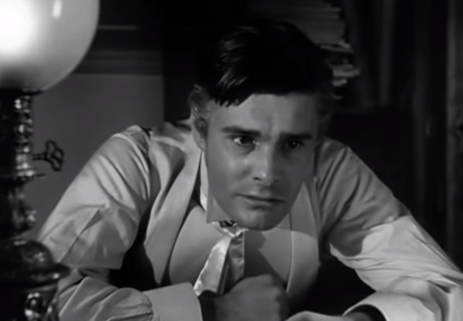
Lisa was a shy and timid girl. She becomes acquainted with dashing piano prodigy Stefan Brand (Louis Jourdan) from afar as he has moved in next door to her mother’s home. She is a quiet observer of all he does, sharing in each one of his musical triumphs and seeing his friends (mostly women). Lisa even goes so far as to attend dancing school, so that she might learn good manners to impress him someday. Most of all his playing enchants her each and every evening as she silently listens to his gifted hands.
Thursdays were rug beating day and on one such day, she got her chance. She met Stefan’s kindly mute servant and secretly enters the shrine of her love for one blissful moment. However, things quickly change as Lisa’s widowed mother has a beau who wants them to come and live in Linz. So they move away from the oblivious Brand, but the wistful Lisa takes one last visit to her old home.
Soon she is introduced to the stately Liet. Leopold and as time passes he graciously asks for her hand. Taken aback, Lisa balks and mentions another in Vienna who her parents do not know of (and who does not know her). No one understands the reason why, only she does, and she is not one to tell. Lisa, however, moves forward and begins to model dresses for rich clientele. Finally, as a grown woman she has her first true face-to-face encounter with the man whom she worships.

Thus, begins their enchanted time together. He does not quite understand the gravity of the situation, but she is content in just being with him. That is enough. No explanations need to be made. Their evenings are spent eating lobster, walking through the streets, taking a train ride all over the world, and munching on caramel apples. Top it off with a passionate embrace followed by a kiss and the fairy tale ending seems to be imminent. But as we already suspected, it is not that easy, and a train rapidly takes him out of her life.

As time passes, she has a son who is Stefan’s boy, but she resolves not to tell him and raise him by herself. For a while, it is a struggle, but she gets remarried and she seems happy enough with a comfortable lifestyle, a gentlemanly husband, and a cute son. Stefan Brand is now a washed up has-been who used to have a wealth of talent 10 years ago. At the opera, he happens to cross paths with Lisa, a strangely familiar figure, and she realizes that she must go to him. She is absolutely ecstatic to be reunited with her first love, but all too soon it becomes evident he cannot remember her. He is fascinated by her the same way he was 10 years ago, but he has forgotten. Unrequited love hurts too much and a broken marriage is already upon her. As her son before her, Lisa’s life is taken by Typhus and all that is left of her is this letter for Stefan.
 
All that’s left for him to do is hit his head in despair. He let her slip through his fingers, if only he had known. If only his servant had not been mute, because he knew who the girl was. Brand has new resolve, however, and instead of running away he faces an unpleasant fate with honor. 
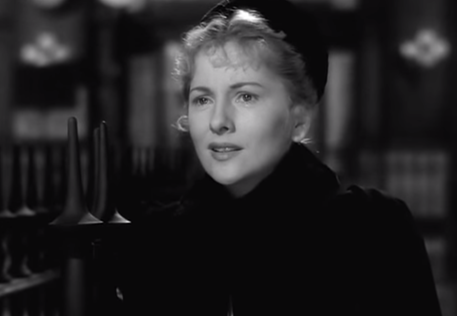
Joan Fontaine is as sweetly demure as ever, and she fits this role so beautifully with her narration being a wonderful guiding hand to the film’s story. Her character slowly grows and matures in front of us, and yet one thing remains unchanged, her love of Stefan Brand. In some ways, the label of a “woman’s picture” has a negative connotation, but really all it refers to is a film that takes the point of view of a woman, or it focuses specifically on women. These stories crafted by men during the 40s and 50s were meant to be weepy tales for women audiences. Looking back now, however, they can resonant with all audiences and in this case some of that is due to the direction of Max Ophuls. 
Ophuls camera is hardly ever stagnant, following Joan Fontaine as she moves, with gracefully smooth sweeps and tracking shots. Give him a staircase and it becomes almost a playground for him to move about as he sees fit. What we are left with is an elegant look, because the movement does not take away from the elegance but actually accentuates it. No one could accuse the camera of being hurky-jerky, and it makes the impact of the stationary camera that more potent.
At an approximately 86 minute running time, A Letter from an Unknown Woman is a marvel because it is laced with character development, romance, and drama that builds steadily and reaches a teary crescendo.
 
4.5/5 Stars

Review: His Girl Friday (1940)

25148-hisgirl1It all happened in the “Dark Ages” of the newspaper game — When to a reporter “Getting that story” justified anything short of murder. Incidentally you will see in this picture no resemblance to the men and women of the press of today.”

Hildy Johnson (aka His Girl Friday) is making her return to the Morning Post but not to get her old job back. She came to pay a visit to her former husband (and paper editor) who she divorced because she is newly engaged and wants to break everything off for good. It means she can go off into the sunset with her new beau, but it also means no more paper. She drops the news and it turns out the wedding is set for the next day so Walter has very little time to go to work. He soon begins a sly barrage of subtle and not so subtle jabs, ridicules, and put downs aimed at the easy target Bruce Baldwin (Ralph Bellamy). Walter cuts him off, plays dumb, and is in general condescending and conniving. Hildy sees it all unfolding and half watches with bemusement, while also trying to stop Walter from causing any major trouble.

You see he’s a wonderful fellow in a loathsome sort of way, but you cannot help but like him. Because as Hildy notes he comes by charm naturally since “his grandfather was a snake.” These are the kinds of barbs and witty put downs we deal with the entire film. Besides being good fun, it also is quite extraordinary, since they never stop coming. It’s also fascinating to simply watch the many expressions of Cary Grant, whether it is a smirk or straight face, it always has a tinge of mischief which suits his character just fine. He seems more like a little boy at times, trying to win back his girl, and in many ways, that’s what he’s trying to do. But back to the action.

Hildy unwittingly falls into Walter’s trap, and from that point on there’s no stopping her, or Walter’s scheme for that matter. When the wheels of journalism start turning there’s no stopping someone like Hildy with newsprint in her blood. Walter lets her catch wind of a man who pleads innocence though he is to be hung for shooting a black policeman. Hildy puts up a fight, but she doesn’t last very long.

Soon she’s gotten into talk to the nervous prisoner Earl and gets his point of view on the whole messy ordeal. The other newsboys are callous to the world, and as the gallows goes up outside their window, all they can do is play cards and think about the best scoop. Hildy is a little different but she’s still leaving…or is she?

Next, Williams escapes and the mad search for the fugitive is on as the newsroom goes into an uproar. The mayor and sheriff are in a tizzy and then a reprieve for Williams comes, but they ignore it because they need this hanging in order to get re-elected. By a stroke of luck, Hildy finds Williams and stashes him away in a desk. Now she is hooked, and when Walter hears about her stroke of luck, everything begins again like old times. Bruce and his mother are soon disregarded as Hildy types feverishly, and Walter wheels and deals on the telephone. Then, the sheriff and mayor burst in with the rest of the boys. Williams’ hiding place is uncovered and the two reconciled lovebirds look like they might wind up with a jail sentence. But the honorable air-head Mr. Pettibone saves the day. All that’s left to do is depart on a two-week honeymoon to Niagara Falls or maybe a workers riot in Albany. All is right with the world again. Walter’s got His Girl Friday, and she’s got her lovable wiseguy husband back.

I’m not quite sure why I am so often drawn to this movie because it is more than it being readily available in the public domain. The dynamic of Grant and Russell is certainly superb. Walter can be an absolute cad, but Grant’s charm makes him bearable to the end. Russell is the true star of this film and she deals the punches with the rest of the boys. It really is the perfect role for her. The film is blessed with the great supporting cast including Porter Hall, Roscoe Karns, Gene Lockhart, Billy Gilbert and a host of others who populate the film with colorful faces and voices.

After seeing Nothing Sacred (1937) it was also interesting to see another script from Ben Hecht about journalism. Again, it might be a screwball comedy but there are also political undertones. Most blatantly about journalism itself, but also about corrupt leaders (like the mayor and sheriff), the Red Scare, gender roles, capital punishment, and even WWII.

Of course, it must also be noted that this is a film directed by the great Howard Hawks. I have always had difficulty pinpointing his trademarks, because the reality is, he was so versatile, trying his hand at so many different genres. All I know is that I more often than not enjoy his work behind the camera because it is seamless and it feels quintessentially American. His Girl Friday is no different. Although, this one is just a tad faster than most. It’s sure to raise your blood pressure so be warned.

5/5 Stars


Review: The Pride of the Yankees (1942)

b9d42-prideofthe3Before superheroes headlined any Marvel or DC blockbuster, it was real life heroes that audiences wanted to see. No pastime was quite as popular as baseball and in that era Lou Gehrig was one of the titans along with Babe Ruth and the rest of the Yankees. You see this film is less of a biography (It certainly is not completely accurate), and more of a visual eulogy to a contemporary hero. The prologue explains as much:

“This is the story of a hero of the peaceful paths of everyday life. It is the story of a gentle young man who, in the full flower of his great fame, was a lesson in simplicity and modesty to the youth of America. He faced death with that same valor and fortitude that has been displayed by thousands of young Americans on the far-flung fields of battle. He left behind him a memory of courage and devotion that will ever be an inspiration to all men. This is the story of Lou Gehrig” ~ Damon Runyon

As a modern viewer, I am just happy I can recognize baseball names like Miller Huggins, Joe McCarthy, Bill Dickey, Tony Lazzeri, and of course, Babe Ruth. When audiences went out to see this film starring Gary Cooper and Teresa Wright back in the day, they were practically living it. World War II had already heated up and one of the great American heroes had died the previous year. Lou Gehrig was all those things in the prologue and more making it hard to get it all into a film.
Like any other superhero, he has an origin story beginning with his childhood in Manhattan, living with his poor German immigrant parents. His domineering mother convinces him to go to Columbia for engineering, but he soon ends up in the big leagues because of his tremendous skill with a bat. He is often a shy and even awkward young man, but he loves his parents and he can sure play ball. It’s that last point that gains him a lot of respect after a less than graceful start as “Tanglefoot.”
He soon becomes a lethal one-two punch with Babe Ruth, after initially being dismissed as the rookie and a boob. Journalist Sam Blake (Walter Brennan) has a major influence in Gehrig’s life and never loses faith in the young man’s abilities. He also does Lou a favor by introducing him to an attractive young Chicago socialite named Eleanor Twitchell (Teresa Wright), who finds Gehrig quite ridiculous at first. Soon, however, a budding romance begins with the often reserved Gehrig falling for the vibrant and vivacious young Eleanor. He gets engaged, married, hits two home runs for a little boy, and wins a world series. A lot of his other exploits are laid out for us too and the trophies and accolades start stacking up. All of this happens during the happy times when Gehrig is on top of the world, first with Murder Row and then The Bronx Bombers.
But all fairy tales must come to an end, and Lou Gehrig’s is especially tragic. He plays an, at that time, unheard of 2,000 consecutive games, but he also falls into a rapid decline. Eleanor looks on helplessly as her husband begins to deteriorate in front of her eyes, and the fans know something is not right. Gehrig gets examined and learns he has ALS, but very little is known about it. Much less can be done to treat it.
His final appearance at Yankee Stadium came on Lou Gehrig Day in 1939. That day he gave his “Luckiest Man Speech,” and he walked off the field for good. Gary Cooper delivers the partially revised dialogue with a calm and clear delivery that seems to truly epitomize Gehrig. Although he is playing the man, it is almost as if he is giving a eulogy.
That’s a fitting ending because we do not need to see the suffering or the death. What we remember is the wonderfully full life he led. Perhaps this film had more cultural relevance back in 1942, but I would argue that it is still a stirring, heart-wrenching film. You have a small heart if you cannot find a place in it for this one.
Although he was not too good at baseball, in the other sequences Cooper seems like the perfect man to embody Gehrig. He is distinctly American, strong, quiet and he also has a pleasant charm with a comical streak in him. The look on his face when he realizes his weakness tears the heart. Teresa Wright had many fine performances early on in her career, but I will step out on a limb and say that this is probably the best one. She has so much spirit and at the same time, she is funny with a noticeable tenderness. She is the perfect wife and a wonderful actress to embody Eleanor Gehrig.
In a society that places so much interest in make-believe superheroes, I don’t mind taking some time to acknowledge a real one. We were the lucky ones Lou, thanks. Let anyone and everyone who does the Ice Bucket Challenge know who you are. You deserve to be remembered. Always.
4.5/5 Stars

The Stranger (1946)

f6c39-the_stranger_filmIn a whirlwind, the film goes from a moody foreign locale to a quaint American town called Harper, but it never ceases to be a gripping film noir. Considered Orson Welles‘ weakest project thus far, The Stranger is still thoroughly enjoyable thanks to the performances of Edward G. Robinson, Loretta Young and Welles himself. Much like Shadow of a Doubt, this film shows that noir thrillers can still take place in middle America, and they can be pulse-pounders all the same. Also, an evil man can easily exist in a mundane environment and still be evil.

The reason we end up in Harper of all towns has to do with an “escaped” Nazi war criminal. He was allowed to escape and investigator Mr. Wilson (Robinson) follows him. It’s an idyllic little town and one of its most respected members is professor Charles Rankin (Welles), who is soon to be wed to pretty Mary Longstreet (Young). Little does she know that he is former Nazi war criminal Franz Kindler, and he is the man the escaped Konrad Meinike is looking for. Mr. Wilson is very interested in his whereabouts too.

Meinike soon disappears but not before deterring Wilson. However, not one to shy away from his duty, Wilson soon ingratiates himself with the local people, especially the newly married Mary and her kindly family. He is eager to learn more about the professor and at first, the gentleman seems above reproach, but something lurks underneath his calm exterior. Soon the beloved family dog Red is killed, an increasingly manic Rankin confesses his predicament to his wife and conveniently leaves out a few facts. Now constantly paranoid, Mary’s life is in far more peril than she realizes, and Wilson takes all the precautions he can. The clanging of the newly refurbished clock becomes a point of major contention, and it also serves as the perfect locale for a final climatic showdown (Put aside the absurdity and just watch it).

The whole town turns out for the show and finally after getting conked on the head and nearly killed during the case, Mr. Wilson finally has time to relax. Welles is not quite as memorable as Harry Lime here but still a sophisticated villain of sorts.  Likewise, Barton Keyes is a bit more memorable but Edward G. Robinson still brings his personality, iconic voice, and memorable mug to the table. Loretta Young has a radiant face and eyes like always. In other words, they do what they do. It works in making The Stranger a worthwhile thriller with the expected melodramatic music and shadowy facades of a film-noir. This is undoubtedly an oversimplification, but  then again, Orson Welles needs no introduction, and he certainly does not need me to vouch for creative genius.

4/5 Stars