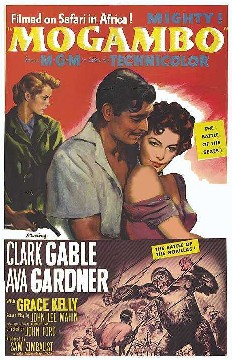
Mogambo (1953): John Ford Updates Red Dust

Mogambo

Whether it’s apocryphal or not the term “Mogambo” is purported to be the Swahili word for “passion,” although it’s difficult to know if this was only hearsay propagated by westerners (now including myself).

Regardless, it boasts an intriguing if altogether curious assemblage of talent. One would be remiss not to acknowledge John Ford as the story looks ripe for his kind of gripping panoramas. What’s lovely about the exterior shots is how it feels like a new prairie — a new landscape for Ford to photograph and bring his exemplary eye for portraiture and compositional space to.

Against this backdrop you have both people and animals living in this symbiotic give and take of aggression and nurturing — in some ways hearkening back to the primordial roots of Adam and Eve taking care of creatures in the Garden. Is it a stretch to wax lyrical in such a way? For another director, it’s quite possible, but because Ford was always the propagator of myth and parables it seems only fitting to use this language to describe the picture.

On a more pragmatic note, Mogambo is Red Dust transplanted to the African plains and maintaining the heavy influences of Western Imperialism. Though there is one fine concession, a “score” made up entirely of Congolese tribal music providing what feels like an authentic backbeat and rhythm to the movie. Otherwise, it’s a Hollywood Technicolor extravaganza in toto, albeit one delivered courtesy of Pappy Ford.

The plot isn’t of exceptional interest given the fact it already has antecedents in other movies, and it feels especially antiquated now. However, it’s also a double-edged sword as they don’t make any movies quite like this anymore, and so there’s a certain amount of novelty in the established panoply.

Vic Marsell (Clark Gable) is a big game hunter for pay in the modern world. Eloise “Honey Bear” Kelly — a real firecracker of a woman (Ava Gardner) — winds up at their secluded outpost on the invitation of a maharajah. The main problem is the man picked up and left without bothering to tell her. She’s good and stranded.

Her attempts to make her way back to civilization don’t work so well, and their outpost becomes quite the mating ground with the arrival of a callow man of learning (Donald Sinden) and his wife (Grace Kelly). You need not be a soothsayer to wager a guess what might happen in this sweltering country.

Ava Garner’s no Harlow gold, and she doesn’t have to be. If it’s not plainly obvious, she’s Ava Garder, a cloying, sassy icon in her own right more than capable of finding her place among the animals and everyone else on the African Safari.

She’s a barrel of laughs to have around, and she has a quip for every occasion be it Secretary birds or (Bobby) Thompson’s Gazelles. Consequently, she also proves herself to be an incorrigible pot-stirrer and, thus, the film’s most enchanting asset.

While Gable still feels adequate doing the rounds as his prototypical gruff hero (over 20 years after his initial success), Gardner gives off this sensual aura of sport and irreverence. Grace Kelly has the naive sheen of a prim and proper anthropologist’s wife out for an adventure, which of course, she is.

Given our players and Ford’s manning of the romantic drama, it’s the broader themes paired with the laid-back sense of fun — reminiscent of a Howard Hawk’s picture — that become the most agreeable moments.  This is before it burns with the imminent flames of passion.

Every detail and accent of the environment seem to reinforce the romantic tensions creating these parallels between mating rituals out in the wild and their human equivalents. It’s an open-air Noah’s ark. Every creature is looking for its respective mate.

Ava Gardner pacing with her parasol joined by the Leopard pacing in its cage. A lion in the bush growling for a lioness. Hippos fighting in the local riverbed no doubt over a female companion. There are even polygamous males in the local communities with tribal premarital rituals to guarantee fidelity.

In lieu of a flood, Mogambo swipes the famous storm scene from Red Dust, but it’s punctuated by a singular moment of its own. It’s the first sign of electricity. Gable yanks off Grace Kelly’s headscarf and brings it about her neck with a forceful tug. Nothing else happens, but the animalistic fury and the passion is obvious, matching both the animals and the weather right outside the window.

There is another element we could consider and as I don’t like to spend too much time on these things, I only mention it in light of the film. Garble and Kelly famously had a romantic fling on set. Far from being a real-life love triangle — Gardner was still married to a devoted Frank Sinatra at the time — the younger starlet went to her elder for worldly counsel. And she provided it. If intuition proves correct, Gable wasn’t a far cry from the man he portrayed in this film, at least when women were concerned.

The final act takes them out into the jungle in pursuit of gorillas, “the truest link between man and his primordial derivation,” although a local father might have a word or two to say on the origin of species — Man in particular. Soon thereafter, relationships get more complicated and they begin to splinter under pressure as per the expected conventions.

If I can make a summation, you come to Mogambo for how the milieu informs the romance and not the other way around. Length catches up with it in the end as the steaminess slowly burns off. What we are left with are the palette and the performances. It’s well nigh enough to make this movie spectacular entertainment. Fans of either Ford, Gable, Gardner or Princess Grace should at least prick up their ears. Although, in the end, Ava steals the show.

3.5/5 Stars

Ikiru (1952): Loving and Living

ikiru takashi shimura

“This man bears a cross called cancer. He’s Christ.”

Ikiru is instantly a tale of dramatic irony as we see x-ray footage and an omniscient narrator tells us matter-of-factly the signs of cancer are already obvious. Our protagonist’s work life hits hard as he’s a public affairs section chief — dangerously close to my own title — thoroughly buried in the bureaucracy of Japan.

The great tragedy is how he’s never actually lived. He’s killing time, stamping documents with his inkan (official seal). I know it well because I sat at a desk in Japan watching others doing much the same. There were fewer teetering paper mountaintops around me, but the sentiment holds true. All his will and passion evaporated over the past 20 years. How this happened is made quite clear. We are once again privy to the dizzying circular bureaucracy that I’ve been subjected to in my own lifetime, from college campuses and also living abroad in Japan.

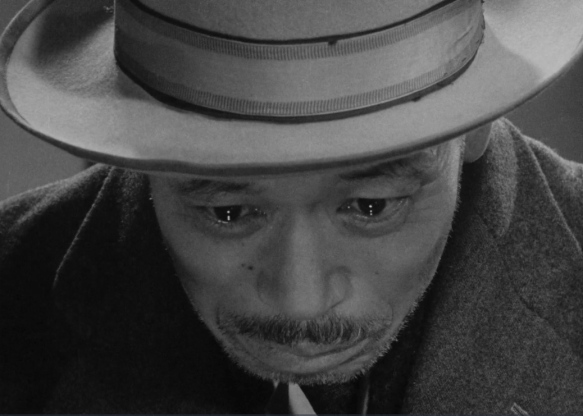
Even as he portrays a man of such a sorry constitution, there’s something instantly endearing about Takashi Shimura. In fact, he has been a friend of mine for quite some time. Aside from Toshiro Mifune and Setsuko Hara, he might be one of Japanese cinema’s most instantly recognizable icons. There’s a glint in his eyes of warmth that so quickly can turn to melancholy. It serves him well in Ikiru as do his distinguished features and graying hair. The dejectedness up his posture, the glumness in his being, verges on camp but it never loses its purpose.

The greatest revelation is the composition of the film itself in the hands of Akira Kurosawa and his editor Koichi Iwashita. I never recalled the editing of the picture, cutting and shifting between time periods. The delight in his son Mitsuo’s athletic prowess only for it to be crushed seconds later on the basepaths. Then, there was the boy’s appendix operation, an event he was not able to stay around for. It paints the relationship with his son, drifting through time, as the world spins around him, and Kurosawa follows the motion to find the heart of his picture.

As Watanabe sinks lower, taking an unprecedented leave from work, leaving all the underlings to surmise the reason, he meets a lowly fiction writer in a bar. The man’s occupation gives him a bit of license to wax philosophical, and he’s more forthcoming, more whimsical than we’re accustomed to coming across, especially in Japanese culture. He tries to empower the dying man to live it up.

After all,  greed is a virtue, especially greed in enjoying life, and so they take to the night scene with reckless abandon blowing Watanabe’s savings in the process. For a night he tries on the life of a profligate and a drunkard with middling results. There are light-up pinball machines, rowdy smoke-filled beer halls, and lively streets overrun by women of the night. They proceed to make their way to every conceivable bar imaginable. As the montage and music roll on and on, I couldn’t help but recall The Best Years of our Lives.

It was a celebration under very different circumstances. A soldier comes back from V-J Day ready to live it up. But much like Watanabe-san, Al (Fredric March) is looking to put off the inevitable for a bit longer. It’s a lot easier to face this heightened reality than the morning after. It’s a diversion tactic.

In one space the two merrymakers totter up the stairs as couples dance cheek to cheek. Their destination seems to be the lively piano bar jumping with tons of western-infused honky-tonk rhythm and blues. But Watanabe-san subsequently brings the mood to a standstill as the house stops to watch him sing a melody born out of the melancholy of the past — reminding us life is brief.

To this point, he feels pitiful almost laughable, laid prostrate by his very drunkenness, and gallivanting around the streets to the sidewalk symphony of honking taxi cabs and the distinct notes of “Bibbity Bobbity Boo.”

The morning after is what we expect. Not only a hangover but real-life sets in and the baggage that comes with it. He realizes his son and daughter-in-law are completely absent. Not only absent; they are indignant about his behavior. Because of course, they don’t understand. He hasn’t told them anything.

Screenshot 2020-04-03 at 65225 PM

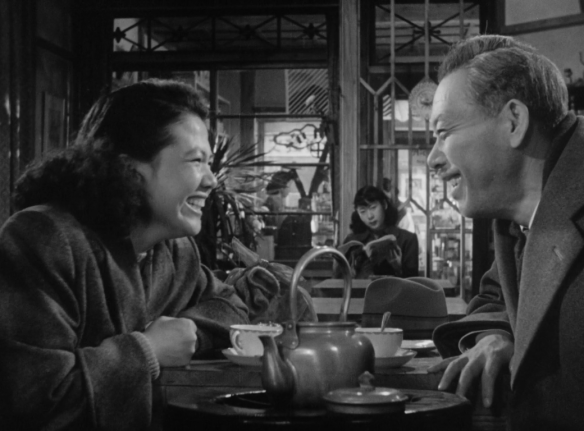
Instead, he gravitates toward the youth of his garrulous young colleague (Miki Odagiri) bursting with untapped spunkiness. The key is how she makes up for his lack of both humor and energy. She somehow uplifts him with her very spirit — teaches him what it means to really live — what it is to have giggle fits. From the outside looking in, without his context, it looks like a sordid romance or some odd preoccupation. It’s more innocent than that.

He recounts how when he was a little kid, he was drowning in a pond; everything was going black as he writhed and thrashed around in the deep void around him. He felt the very same sensation when he found out about his illness — all alone in the world — his son as distant as his mother and father were when he was in the water. Full stop.

Ikiru and the act of living life are split into two distinct segments. Much of it is expounded upon after the inevitable happens and Watanabe-san has passed away. It’s one of the most abrupt deaths in film history. But that was never the point. Death was inevitable. What mattered is how he used the time before. How he lived it out. This tangles with the existential questions of life itself with all its subjectivities.

It sounds callous to say Kurosawa uses the motif, but what unfolds, in narrative terms, is like Rashomon meeting an abridged Citizen Kane. It’s artful and extraordinary taking the recollections of all the observers in his life to try and make sense of this man’s final hours.

The extended scene that follows almost plays out like a parable for me; it makes the dichotomy so apparent even as it expresses so much about these human beings. His fellow bureaucrats shed no tears at his wake. They have no gifts or kind words for him. And yet a host of working-class women, women who only knew him for a very few hours, anoint his burial with tears and burn incense for him.

The rich and well-to-do have no humility, no need, no appreciation because they’ve allowed themselves to be insulated — they believe they’ve brought every good thing on themselves. Revelation falls to those who are less fortunate, who have spent their whole lives impoverished and low. They can appreciate how a simple action by a simple man can be ripe with the kind of profound meaning these men sitting around idly by will never comprehend (much less believe).

It’s admittedly out of left field, but one of the songs I was taken with last year was COIN’s infectious pop record “Cemetery.” Its most gutting line goes, ” Never made time for the family but he is the richest man in the cemetery.” The words terrify me to death, and they inform how I think about Ikiru — its purpose — the meaning of Mr. Watanabe-san’s final act of unswerving resolve.

It’s a warning and a cry, a pronunciation and a prayer for all those who are willing to pay it heed. What is life but to be lived out? There are only a finite amount of hours and days between “In the beginning” and “The end.” There’s no hitch on a hearse. All we can take away from this life is that which is given away. Ikiru must only be understood out of this profound paradox.

Because these men — these acquaintances sit on their duffs partaking of his family’s hospitality — trying as they might, to make sense of the mystery of his transformation. How could this be? What would cause a man to be so radically different even cavalier with both his time and his resources? They quibble about it incessantly as Watanabe-san’s actions make fools of the wise.

It’s really very simple. He says it himself even as he’s half doubled-over with pain, his voice on its last rasping legs, constantly being humiliated. “I can’t afford to hate people. I haven’t got that kind of time.” What if that was our mentality? When I look around me, who is my neighbor? It is anyone and everyone. Not just my friends but the ones who ridicule me — the ones who are hard to live with. What if spent less of my time criticizing and hating and more time loving and living. After all, aren’t they one and the same?

5/5 Stars

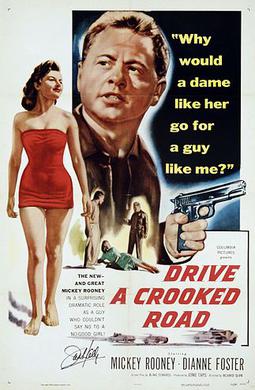
Drive a Crooked Road (1954): A Malibu Sunshine Noir

Drive_a_crooked_road

“On a clear day, you can see Catalina.”

Drive a Crooked Road might best be labeled as a So-Cal sunshine noir, and it easily has a place at the counter next to Shack Out on 101 and equally grubby fare.

Because under the right circumstances, it’s easy to see how Mickey Rooney could make a darn good noir protagonist. Like one of the genre stalwarts — Elisha Cook Jr. — he’s small in stature. Visually, he’s a bit of a pipsqueak and if you strip away his typical magnetism, the confidence, and charisma of a lifelong entertainer, there’s something quite fragile and forlorn there.

Rooney, for all his successes and the serpentine nature of his career, does himself credit here, reinventing his image once more. Eddie Shannon is the kind of guy who gets stepped on his entire life and takes it. He’s a lowly mechanic with far-off dreams of racing a European job at Le Mans. His other prominent feature is the scar on his forehead as if to mark him as a kind of social outcast.

Admittedly, his life is nothing more than fixing cars by day and going back home at night to a mantle lined with childhood trophies. It’s as if they’re compensation, a way of telling himself he is a big deal after all as he kicks back on his bed.

I won’t make any claims that the actor-turned-director Richard Quine is a virtuoso hand, but I do enjoy a handful of his films with varying themes. What draws together some of the better ones are his collaborators. Kim Novak made a startling debut in another sordid noir of the same year Pushover. Then, he had a good many collaborations with both Bill Holden and Jack Lemmon, just to name a few.

What Drive The Crooked Road shows off is his substantial collaborations with future mainstream directing giant Blake Edwards. Rooney, a fellow youth actor, was a holdover from their days together working on the screen as some of the industry’s promising talent. The greatest joy is how it shuns the prevailing song-and-dance, happy-go-lucky entertainment they normally stuck their name to and gladly takes a divergent path.

As good a place as any to start is with a femme fatale (Dianne Foster). She comes by the repair shop one day to get her car fixed up. That could be the end of it, but she has other plans. So Eddie pays the good-looking dame Matthews a house call.

It’s immediately apparent she’s shamelessly flaunting herself. First, on the lawn then, hanging over the side of her convertible, and finally, right next to him as he digs under the hood. Barbara makes her presence known, as it were, and she has total command of the scene.

This perceptible dynamic is so crucial as is Rooney’s diffident performance if the story’s to come off. How visibly uncomfortable he feels being around her — making eye contact with her flirtations — as she chats him up on the way to sunbathing above Malibu. It implicitly coaxes him out to the water’s edge.

Because even as his whole existence is uncomfortable in her very presence, he desperately wants someone as beautiful as her to give him the time of day. The fact she actually paid him notice gives him hope.

If it’s not obvious already, this bit of come-hither interplay devolves into a not so unfamiliar ploy used most definitively in Scarlet Street. Edward G. Robinson’s Christopher Cross was a suffocating nobody as well with nothing but his art. Kitty (Joan Bennet) exploits him for all he’s worth on the behest of her boyfriend (Dan Duryea).

In Barbara Matthews’s case, she’s operating on behalf of her major love interest, the dashing and charismatic, if generally despicable cad, Steve Norris (Kevin McCarthy). He and his smart-aleck buddy (Jack Kelly), don’t immediately strike one as a criminal types. And yet their high-living, bon vivant ways, and impatience with the normal tenets of capitalism cause them to buck the system.

They’re looking to rob a bank, a handy joint they scoped out while spending their summer vacation in Palm Springs. You could say the crime fits the criminals. The only problem is a driver. They need someone to navigate the windy backroads from Palm Springs to San Diego. Someone with handles who can help them make a quick getaway since time is of the essence. That’s why they called on Barbara to reel Eddie in.

However, she’s the only one to realize what is really happening. They label him like all the rest as an ugly little guy, a lonesome little animal; and it’s true by the world’s prognostications. But Matthews sees more being around him. There’s an earnestness, a candor in how he interacts with her.

She calls it devotion, a terrible kind of worship because he’s fallen for her irrevocably hook, line, and sinker. It’s pretty much instantaneous since the first moment she ever gave him the time of day. He’s not a normal mark; he’s completely given himself over to him, totally vulnerable. One can only imagine what he might do if he finds out he’s just a sucker.

Of course, her conspirators fail to heed her warnings. After all, what could a born loser do to them? So Eddie comes aboard, brought into their confidence, initially hesitant until Barbara leverages everything so he thinks he’s doing this for her. 15,000 smackers could do a lot for them. He studies their home movies religiously in an effort to gain a lay of the land in preparation for game day. Once more, he’s devoted because he thinks she wants this. It’s not for himself but to earn her affections.

Again, Barbara is overcome by misgivings about the entire operation. In her own way, she tries to give him a way out — knowing where they are headed listening to Eddie’s big talk about driving better than he ever has, doing the job so he can get the money she wants. He couldn’t see he’s being played unless he was hit in the head with it. That’s what it takes.

One of the greatest investments of the film really comes with Foster’s performance. Because at first, she feels like a prototypical noir vamp, merciless in how she uses her feminine wiles, and yet, if we can coin the phrase, she is a tender femme fatale.

Take, for instance, one scene where Eddie makes an impromptu house call to see her. They’re supposed to stay apart for the good of the mission and still, he cannot bear to be away from her. She comes out into the living room, closing the bedroom door to meet him.

At first, I thought she closed her door behind her to cover up something — maybe a male visitor lurking behind. But it’s simpler than that, even more innocent. Finally, Eddie leaves and she goes into her bedroom and cries. Whereas Kitty’s laughter was mistaken for tears in Scarlet Street, here the tears are real, there’s this conflicted tenderness present.

But of course, all this must be put on hold as the day of the bank robbery arrives. They make their best-laid plans, intercepting the route of the usual bank employee. In another quality creative decision a la Gun Crazy, we are forced to wait out the job from the getaway car with Eddie and Steve. It comes off without a hitch because it’s not primarily a heist film at all.

If that were the case, everything would need to go awry at this point. The question remains, Why do we hold off? Because the true pearl in the oyster is how the story is not solely about the tension of the bank robbery and whether they will succeed, though that becomes of great interest. Encompassing all of these genre elements is really the underlying character piece.

What will Eddie do? What will happen to him at the end of said crooked road when reality sets in and he finds out he’s been used. Because it’s not a question of if but when it will happen; eventually it does.

There’s the confrontation, the reveal, the turn of events. You’ll have to witness them for yourself. The images resonate most deeply with me. A car overturned on the beach, the tide lapping up against the shore in the background. There’s not a more fitting summation of the film’s juxtaposition of elements — that is sun-soaked, Malibu beachfront noir.

The final interludes bring to mind another paranoia piece of the atomic age, Kiss Me Deadly, and far from jumping off the deep end, Quine’s picture has its own misanthropic edge. Where the beach, shrouded in shadows, provides the perfect landscape for a devastating capitulation. It’s a testament to his core players, Rooney and Foster in particular. I’ll never look at Mickey Rooney the same way again.

3.5/5 Stars

Middle of the Night (1959): Chayefsky Does May-December Romance

Screenshot 2020-02-14 at 7.56.31 PM

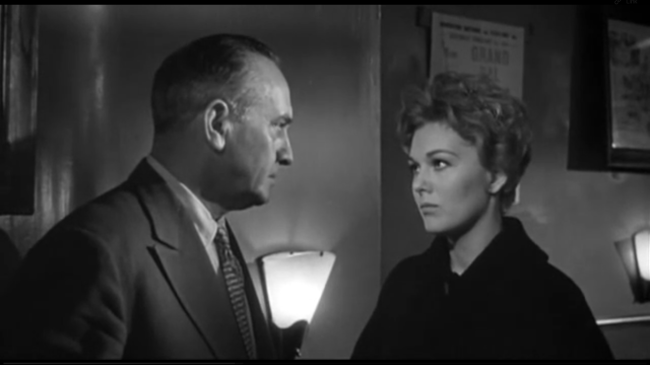
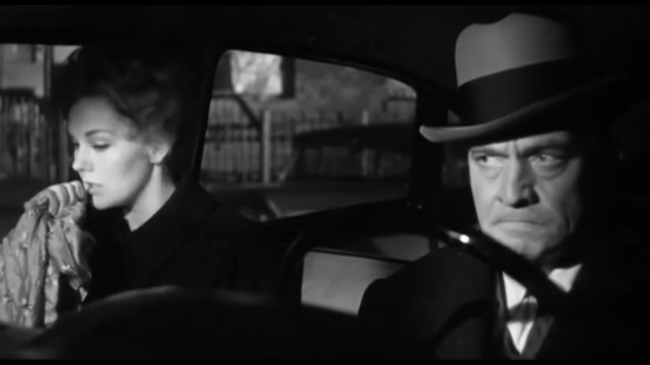
Middle of The Night proves instantly placeable thanks to its black-and-white, New York streets aesthetic. Although the name Paddy Chayefsky, emblazoned over the credits, gives us as much of an inclination of the story we are about to experience.

Because to this day, his name carries with it a hallowed note of reverence and a few distinctives. Not only did he garner the unprecedented acclaim of The Academy, his films were also always centered on characters in their individual spaces and mundane lives. His prose propelled the script into a place of primacy and his words were a form of gospel to center the story around.

While he did time in the nascent days of television where the lines between stage, screen, and theater were relatively thin, he ultimately propelled himself into the movies by maintaining his personal ethos and letting his words speak for themselves.

You might term them kitchen sink dramas, but whatever the phrase, they tackle issues of life as they happen in unfiltered ways. Analogous examples might be Marty, A Catered Affair, even a non-Chayesfy piece like Love With The Proper Stranger.

These roles were delivered on the stage by stalwarts E.G. Marshall and Eva Marie Saint, then another illustrious pair: Edward G. Robinson and Gena Rowlands. In the film, they fall to Frederic March and Kim Novak. Who you like most might fall to personal preference.

Far from having ice in her veins, Novak is nervous and skittish in all circumstances. It almost takes some getting used to and yet when you do, she feels more relatable than any other point in her career. Because she’s given up her self-assured cool and husky tones for a voice of a far more timorous nature.

March is always a splendid performer — he has a likability and an innate honesty to his characterizations. In principle, the same can be said of his overall performance here, but the element getting in the way at times is his lapses into an ethnic patois. Authentic backstory or not, it doesn’t quite suit him nor does he need it. But then my feelings started to evolve.

Because I became aware he seems to change how he speaks depending on who he’s talking to. After all, it’s not too farfetched as I have friends who lapse back into shorthand and slang to accommodate certain friends or family from a certain cultural subset. Whether or not this holds true in Middle of The Night, it hints at the complicated patchwork of interpersonal relationships human beings are constantly grappling with.

Recently I watched another Kim Novak romance, Strangers When We Meet, and its strengths fall to its extravagant Technicolor and a certain Hollywood opulence augmenting the middle-class romantic drama burning between Novak and Kirk Douglas. It is a West Coast counterpart to Middle of The Night because they are poles apart, both thematically and in the environments they take time depicting.

Here our main tension builds out of a May-December romance between an aging widower (March) and his beautiful young secretary (Novak). But while it gives the pretense of a superficial affair on the page, the brilliance of Chayefsky’s script is how he’s able to tease out the warm and tentative love budding between two people.

Lee Grant and Martin Balsam’s screen time might only accumulate to a few scenes each. However, even on the outskirts of the drama like they are, they still manage to leave a lasting impact on the story. It’s a testament to the scripting and the veteran caliber of the performers.

One scene, in particular, feels like a masterclass in stringing conversations together through overlapping ideas, cut-off sentences, and the types of asides that dot real-life conversation. Jack (Balsam) is talking about getting a sitter so they can take a vacation before tax season hits him. His wife Marilyn (Grant) — Jerry’s daughter — is preoccupied with her father’s romances. They are mismatched and going off on their own separate tangents.

Jerry doesn’t want to end up like his contemporary, the ostentatious shell-of a man (Albert Dekker), who talks a big talk about his romantic exploits while feeling generally regretful of the life he’s led. Jerry’s far from envious, especially as his live-in sister constantly tries to subtly influence his love life in unwanted ways.

Despite their mutual affinity, the disparate couple has their share of reservations. Because for the here and now, they are happy; they need each other and they love each other. But they can’t help but consider the obvious barriers around them.

If I’m remembering the underlying themes of Marty, the same elements hold true here too: the imprint of family and related peer pressure shape our decisions and ultimately our happiness. Since the days of Romeo & Juliet oftentimes family influence only serves to make matters all the more confusing. If romance happened in a vacuum, it might be a lot more manageable.

Because Betty and Jerry get away together and have a grand ol’ time at a rambunctious New Year’s party where everyone and their wife seems to be their new best friend. The age gap feels inconsequential when you’re full up on bubbly and at the top of the world.

Screenshot 2020-02-14 at 8.51.02 PM

Still, they must return home to reality and with their mutual feelings not quite sorted out. They tell themselves the only thing that matters is them, and yet that’s a fallacy because there are so many strings attached. It’s a reminder of how serious relationships make those involved come to terms with everything. Because every person brings with them a plethora of familial relationships they must navigate.

Mother raises hell yelling down the stairwell at her daughter’s suitor with all her nosy neighbors crammed in the hallway to get a good look at Betty’s Spencer Tracy. And that’s not the end of it. Everyone else is agitated and high-strung, compounded by their own problems, and it’s these prolonged scenes providing a platform for the talents of Grant and Balsam.

My heart really breaks for Novak when her scuzzy ex-husband stops by from the Vegas circuit to try and win her back along with the “half hours” she used to give him. But she’s tired of it. Tired of being desired or more exactly objectified in this manner. She deserves better.

With Jerry momentarily out of the picture, it gives us the time and space to realize the gravity of her individual predicament and the struggles of her own life. She desperately needs Jerry. Constantly clinging to him, wringing her hands, biting her thumb as signs of her constant uncertainty and distress. Because there has never been any type of stability in her life.

Meanwhile, he’s continually obsessed with her but also about how others perceive her — jealous of any younger man who might have eyes for her. His fits of temper become exacerbated over time as he’s overcome by chippiness on the turn of a dime. It’s inconsequential until it totally blinds him, almost crippling their relationship. You could call these neuroses or you could simply acknowledge them as traits of two frightened little people.

Later, they share a fateful exchange in the snow. It looks like what they have has finally imploded. Can it be salvaged? We can’t be sure. He says, “It’s a lousy kind of love.” She replies tearfully, “It’s the only kind I know.” It’s pitiful and real and honest. Sometimes I feel like Chayefsky is on a soapbox — in a movie like The Americanization of Emily — here he just seems human.

This sums it up, doesn’t it? None of us are perfect at love. We have our own hangups, issues, and idiosyncrasies getting in the way of loving our spouses and the significant people in our lives well. Whatever the outcome of The Middle of The Night, surely we can agree it intersects with all of us on some primeval level. This is the brilliance of Chayesky at his best. Because the humble origins allow him to shine through.

3.5.5 Stars

Les Cousins (1959): Chabrol Takes on Paris

Screenshot 2019-12-16 at 90447 PM.png

“A girl and an exam aren’t the end of the world.”

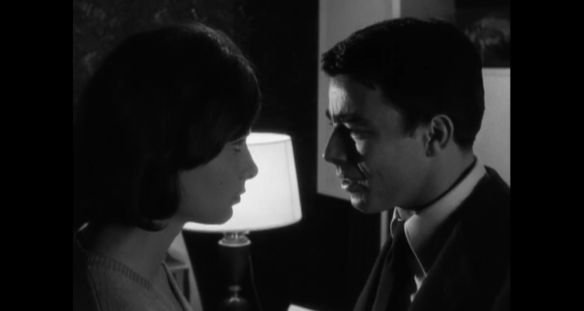
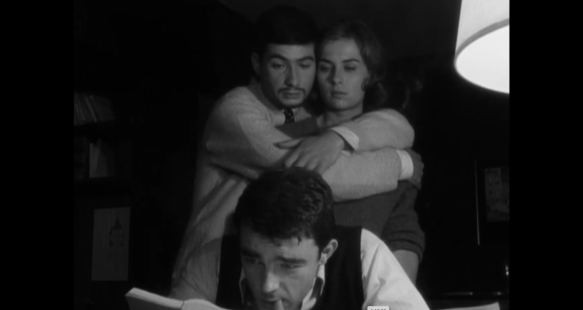
Most anyone can probably tell you Les Cousins is a fine companion piece to follow-up Le Beau Serge, and it’s true. It features much the same cast — specifically Jean-Claude Brialy and Gerard Blane, in a kind of role reversal. However, instead of pervasive talk about Brialy’s health, this picture is occupied with their familial connection. Otherwise, the action has been transported from the rural to the jazzy street corners of Paris.

Regardless, it doesn’t play like your typical or atypical Nouvelle Vague film, but that’s not to say it’s conventional. Instead, there’s a crispness to it and a composure to the filmmaking.  Truffaut arguably didn’t get there until The Soft Skin, and I don’t know if Godard ever aspired to that. What connects them truly is Cahiers du Cinema and the shared affinity for a new form to upend the preferred traditions of their contemporary French cinema.

Paul is a flamboyant prodigal who, with his goatee, might have been a beatnik if France was lucky to have the craze. They certainly have soiree and cafe culture, and he might as be their elder statesman because he’s not one to fritter his time away on anything so insignificant as studying.

The other primary player, Charles, is a square milquetoast with commendable tact, both proper and reticent, eyes often flooded with shy embarrassment. Whereas Brialy gets to fill up every scene and fly all over the place with hyperbole and a clever line to enter and exit every conversation he throws himself into, Blain easily acquiesces to the story. Somehow the dynamic seems to favor Le Beau Serge and yet there is some mode of fascination to see the roles reversed in a new environment.

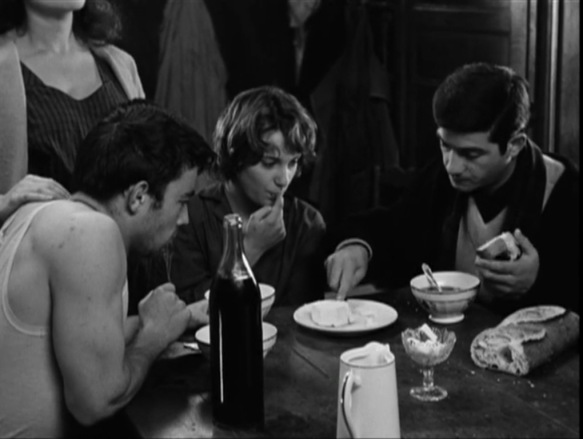
Because it’s true Paul’s flat is quite the bachelor pad, laden with a cluttering of artwork and frequented by the gregarious creep Clovis, a sly reprobate who likes a good party, a pretty face, and stirring up trouble. We get a mild suggestion of what might be afoot when a girl from last winter is mentioned to be on the way up. It’s very serious — very cryptic — but when Paul slips her the wad of money, and she slips out again rarely to be seen, it says more than enough.

But it’s quickly lost among the new stimuli and if we are to share the place of Charles, naivete clouds his perceptions. Taking to the streets in the real world as it were, Les Cousins momentarily taps into the New Wave’s invigorating on-location energy. Certainly, the jump cuts of Breathless happened on the streets of Paris, and here we have two fellows taking to the streets and sightseeing with a flurry of abandon.

Next on the agenda, Paul takes his cousin to the local hangout, what is jokingly referred to as “the bowels of hell.” Whatever it is, the tavern is a lively place frequented by people who all seem to know Paul on a friendly basis. The one who sticks out to Charles is Florence; he grows impetuous, immediately taken with the girl.

Between classes, he wanders into a bookstore where the proprietor bemoans the modern generation’s reading habits. They’ve given up Balzac and Dostoevsky for detective fiction and racier fare. Reading is relaxation and nothing more. He effectively acts as a barometer for Paul and his ilk.

That same evening, they hold quite the gathering effectively, playing as the complete antithesis to the humble dance thrown together in Le Beau Serge. This is livelier, full of bubbles, and glamour. Eventually, it devolves into a raucous affair driven by alcohol and the frisky amorousness in the air — a superficial portrait of the debauchery of the idle bourgeoisie. Fellini’s La Dolce Vita is not too far off albeit with an influx of Parisian youthfulness.

The scenes of two lovers on the street are a gorgeous fixture within the picture, looking sleek and stylish in the patchwork of shadows and moonbeams. Again, it’s an obvious compliment, although it seems to set it apart from some of its Nouvelle Vague brethren.

Screenshot 2019-12-16 at 84938 PM

It’s the beginning of something we can’t quite judge right off. She’s somehow taken with the idea of trying to love him; this at least is genuine enough. Whether it’s his utter devotion — the lovestruck sincerity of his words — or some idealized vision of her own mind, we can’t be sure.

Her friends think it’s a lark and a laugh attempting to serve her with their idea of a reality check. After all, she’s a girl who’s slept around. Why try and play at something inauthentic to who she already is? She and Charles are not from the same walk of life nor the same standards — moral or otherwise. It’s the same old story and as an impressionable girl of 20, she seems to believe them easily enough.

Soon the two young men are warring for the affections of the same girl. Their arrangement is verging on a menage a trois, though they remain admittedly good-natured on the surface. One suspects heartbreak lies dormant. In the follow-up gathering, there’s something more tenuous in the air as Wagner’s “Valkyrie” begins to pick up.

Paul sombers up in a curious change in mood as the movie somehow switches gears. Even as the merriment commences outside, Charles castigates Florence for getting in the way of his studies. He spends the entire evening in the adjoining room feverishly attempting to work in preparation for his impending exam.  Based on my own proclivities, it’s easy to empathize with him and in this roundabout way, it has a pulse on much of the college experience.

However, the most curious of the melodramatic crescendos ramps up out of nothing. This darkly cynical undercurrent begins to exert itself rather insidiously, but it enters in too late to really gel with everything Chabrol has crafted thus far. It feels like an incongruity in its final act — the progression is illogical and at the same time too cleanly resolved. Florence all but dissolves from the story like a phantom as Paul listens to the empty chambers of his gun click, utterly dumbfounded. I’ve let something slip here, but I will leave you to consider the results.

Les Cousins plays as a weaker, less whizz-bang rendition of Jules et Jim, nor can it quite justify its ending. But at this earlier juncture, it feels as if Chabrol already has a better grasp of traditional filmmaking compared to his compatriots, while injecting the picture with mood and artistic flourishes that feel far from conventional. He’s tapping into some still-to-be-exploited reservoirs and even if it doesn’t quite land the finish, Les Cousins offers up something with prolonged interludes of intrigue. This would be a springboard for a prolific career ahead.

4/5 Stars

Le Beau Serge (1959): The New Wave Goes Provincial

Screenshot 2019-12-12 at 81146 PM.png

Claude Chabrol was looking to shoot his first film in Paris but for budgetary reasons, he decided to set his first picture in the village of Sardent where his mother grew up. Le Beau Serge could not occur in any other place.

True, the opening shots are universal. Francois (Jean-Claude Brialy) riding the bus into town, there to be met by his relations, or actually someone who turns out to be a childhood friend, the amicable baker Michel (Michel Creuze). He’s seems made for a sleepy, humble town such as this — content with the life he has around him.

That this might be the beginning of the New Wave in the rural countryside is a curious conclusion. Because it’s true Chabrol was one of the boys at Cahiers du Cinema, soon followed up the more well-remembered works of Truffaut and Godard.

However, it’s also a timeless tale you might see out of any year if you were to pick it out of a hat. Because coming from a small town or returning to a place you haven’t seen in some time are touchstones many of us resonate with. I’ve never dug very much into Claude Chabrol’s filmography aside from a couple stray diversions like Les Biches, but it’s some comfort starting at the beginning.

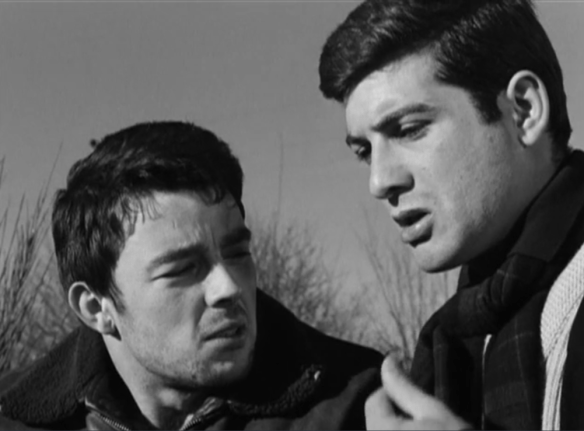
The title gives us some minor inclination. Even as Francois and then Michel are introduced initially, we know Serge (Gerard Blain) is a person of great interest, and it’s true he represents something elemental to the story. He is plagued by demons Michel will never know. When we first get a glimpse of him, he’s quite royally soused, and it catches Francois off guard. He knows him from a different time and is worried about his boyhood chum.

What becomes evident are the themes of duality due to the character foils Chabrol posits. The one point of criticism is how the picture gets carried away with the mood music as if in his youth the director’s not brave enough to be still; he still needs some pulse going through the story. Although perhaps we must temper this because although cinematically you can witness some of the same verve of Truffaut — the type of energy that would come to define the Nouvelle Vague — this movie is generally quite reserved.

Still, it does have these latent vigours of youth on its side ready to be tapped into. There are brief moments where Blain gives off the angst and bellicose of James Dean even as Brialy plays his prim and proper counterpart, Francois, who has returned to his childhood town to reclaim his health. He’s sickly and the country air is meant to do him good. In fact, it seems like every 10 or 20 minutes someone is inquiring yet again about his well-being.

But he’s also the last person Serge wants to see in his ignominy. He’s married out of guilt, a drunk, and an utter nobody. Instead of Jim Stark’s desks, he takes a slug at granite walls, driven by this same reckless, at times feeble, animal magnetism.

Screenshot 2019-12-14 at 93527 PM

It’s curious to note Chabrol takes on religion more in the bent of Eric Rohmer even as Francois makes a visitation of the local priest (Claude Cerval) and begins an ongoing dialogue on the state of the local community.

They are themes replayed in the likes of Winter Light and Calvary where the man of the cloth bemoans the fact the adolescent generation, who are still around, no longer believe in anything — even themselves, as Francois interjects. It’s yet another lens to put on not only Serge but possibly Francois and then Marie (Bernadette Lafont).

She’s the town’s harlot, slinking around with a new boyfriend on any given Sunday and reconnecting with Francois on his return. But she too is humanized by the peripheral presence of her alcoholic old man Gomaoud.

Meanwhile, Serge totters through the cemetery spouting off garbled exposition except, this isn’t what immediately stands out; there’s something engaging about the whole scenario. Chabrol does well throughout the entire film to utilize the real, honest contours of the entire town in a seamless manner, and it’s in a moment like this where it really comes to bear. The same cemetery plays into a confrontation between Francois and Glomoud when he accosts the old man for his behavior.

The personal comes to a head at the local dance hall — the most humble of spaces plucked out of a simpler age. Francois and Serge end up fighting over a girl at a party with Serge expressing the violence we always knew him capable of. It almost feels like he has left his friend for dead, whether or not that’s entirely the case.

This might have been the end, with Francois leaving on the same bus dejected, going back to the city, never to see his pal again. Yet he refuses to leave for some inexplicable reason. Soon their world is ensconced in a layer of snow, making for a gorgeous final act. It’s nature’s way of suggesting — and Chabrol’s too — maybe our sins can be wiped away or at the very least forgotten.

Francois is paid a visit by the local priest entreating him to leave for the sake of his health. But he’s resolved to stay — to be an example — and hopefully help his old friend find his way somehow. It’s the idealism shining through again, believing he can help, that he can be an answer and a savior in some sense.

Once more we must attribute these feelings to the bull-headedness and the pride of youth. It can be both a blessing and a curse. It’s what makes Serge resent his friend, and it’s why his friend thinks Serge still needs him. His act of charitability involves extending a hand of support to Serge’s stoic and increasingly pregnant wife Yvonne (Michele Mertiz). Francois can’t be Serge’s ultimate savior and maybe a newborn child cannot right his life, but in a human sense, it’s still a sign of hope just like new-fallen snow.

By the time Le Beau Serge is over, it’s elementary enough to realize why it’s been overshadowed by the freneticism of Breathless or even the exuberance of 400 Blows and Jules et Jim. In its own way, it’s a fine entry onto the cinematic stage for Chabrol. While it offers youth, it also supplies a deep, even surprising, thoughtfulness.

4/5 Stars

Winchester 73 (1950): James Stewart The Western Antihero

Winchester_73.png

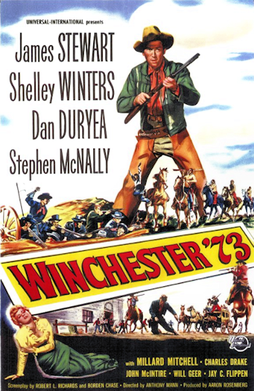
Winchester 73 has the initially dubious reputation of being a portmanteau western. Whether or not this is a one-of-a-kind distinction, any number of popular culture vehicles have employed the device in often gimmicky fashion. It makes for a La Ronde-esque sitcom episode in a pinch.

However, this James Stewart-Anthony Mann collaboration succumbs to no such fate. It’s positively stuffed with quality talent and vignettes woven quite closely together. There is a compounding weight to them even as characters both minor and substantial all but stand on their own two feet.

Equally compelling is Anthony Mann’s usual dynamism — continued from his film noir days — and also the very specific mise-en-scene he develops. The opening shot behind the credit is an exquisite first impression with a pair of silhouettes trodding along the ridge in a perfect arc off into the distance. It’s a type of instant exposition in the most primal sense: two men riding toward their unseen destination.

The two strangers sidle into town, the hard-bitten gentleman Linn McAdams (Stewart) and his trusty sidekick (Millard Mitchell), who takes a calculated stance on just about everything. We know they’ve seen a lot of the world together and all sorts of people…

One of them just happens to be Dutch Henry Brown (Stephan McNally, who they happen on in the local watering hole. In another western, guns at the ready, they would have obliterated each other on the spot. However, in this picture, where a fairly obstinate rein of law and order rules, they are forced to bide their time outside the watchful eye of the city limits.

Will Geer does surprisingly well as a wry and affable Wyatt Earp. His characterization is just personal enough to take some of the mystique out of the legend and make him into a real human being we can appreciate in relatable terms.

But these scenes are a mere setup for a whole slew of encounters. It’s as if we lose our characters for a time as McAdams and High-Spade ride along the trail. However, Mann has a lot of fertile material to work with.

It transcends the simple conceit and builds into a genuine story rife with conflict, both personal and circumstantial. The story obliges by rolling over on itself as it continues to introduce new players at its own leisure.

In one roadside establishment, an insouciant horse trader (John McIntire) sits at the table playing solitaire. He sits by ready to play middle man to the Indians emboldened by Crazy Horse’s victory at the Little Bighorn, while gladly supplying Dutch Henry and his cronies desperately-needed weapons of their own.

It just so happens a Winchester becomes a fine bargaining piece. And yet even a secondary character like him is provided subtext. A man like him — a purported half breed — is deemed as an outsider by two nations.

Certainly, the Indians always carry the subjugated and degraded station in the western. Winchester 73 has its own issues assuredly, starting with Rock Hudson playing a Native American. However, the one equalizer is the universal avarice for the Winchester Rifle. Everyone wants it; some even to the point of death.

Other involved parties are a couple fleeing for their lives — a forthright woman with a gleam in her eye (Shelley Winters) and her craven man (Charles Drake). Alongside our heroes, they find some shelter in the company of a cavalry unit pinned down by the same Indians (a youthful Tony Curtis among them). Their leader, a crusty old vet (Jay C. Flippen), is astute enough to take advice from the men around him, and they make a valiant defense of their position to live another day.

It’s about this point in time where a viewer might realize we still have yet to see that perennial sleazy scene-stealer Dan Duryea and he makes his auspicious entrance as his usually snide gunman, the left-handed Waco Johnnie Dean pinned down in a farmhouse with his gang. There’s more hell to pay.

The glorious fact is how the film peaks at so many points. We have the battle over the rifle’s rightful owner in town, first, through competition then treachery. What follows is a Custer-like resistance with far better results, a homestead hostage standoff against authorities, the makings of a bank robbery, and, of course, the ultimate showdown on a craggy rock face.

These moments are easy to acknowledge because they are so prolific but what makes these exclamation points are the very fact the script knocked out by Borden Chase and Robert L. Richards and as executed by the actors and its director, finds the time for conversation, lulls, and lit cigarettes.

By no means does it search out the utterly stylized extremes of Sergio Leone, but it understands the same dramatic gradient. Action means so much more if we have time and space to truly appreciate its impact.

What also matters are the stakes at play. Thankfully, Winchester ’73 makes itself about more than just a gun. A gun is a stand-in and indication of any number of grievances and human vices. It brings out all the issues already in play.

James Stewart was still fairly fresh off WWII. He was a different man from the gee-shucks everyman — more complicated and torn than he had ever been before. The films he made upon his return had yet to truly catch fire until Winchester ’73. It was a portent and signaled a true resurgence for the actor. Joining with the likes of Mann and Hitchcock, he very effectively redefined his image in a fundamentally intriguing way.

He became a man of vengeance with goodness soured by hate and desires tainted by darkness. When you look into his eyes in any of the number of pictures he made with Mann and Hitch, you begin to recognize something else. It’s not unadulterated innocence or even indignance. His eyes now burn with fury and genuine malice. His hands are calloused, comfortable cramming bullets into the stock of his gun. Because he’s not afraid of using it.

Reconsidering the mise-en-scene, it’s a joy to watch how Mann handles shots in such a blistering manner. But there is also a closeness and with it a violent intimacy to his direction. One scene might have a sleepy-eyed cowboy all but stretched out in the foreground as the camera peers over him into a cabin as two men converse.

Then, we have a bar room mauling in the most claustrophobic manner. Foreheads sweating, bodies writhing in palpable pain, and blood-vessels bulging with rage. It’s astounding how the man’s films almost inevitably feature such images and yet, despite their prevalence, I never grow tired of them.

They put many more technical or cashed-out sequences to shame because what is not scrimped on is the very transparent humanity in its most righteous and ugly iterations. Mann understands that there is not only primacy in the images of the West — we often think rolling plains and panoramas — but the western would mean nothing without morality. Hard unyielding codes, or a lack thereof, warring against each other. Where do these originate from if not the hearts and souls of men?

What Winchester ’73 hints at is how even a man like James Stewart can be consumed by demons. Over the course of a film, a story of a mere rifle, repeatedly develops character until it settles on something splitting right to his core identity. The beauty is in how swatches of dialogue, interweaving character arcs, and splashes of light and dark help in illustrating his singular journey.

This was the first in a thoroughly distinguished partnership between the western’s newfound antihero, Stewart, and one of the genres unsung mavericks in Mann. It just might be the best of the batch, which is saying something.

4.5/5 Stars

The Gazebo (1959): The Other Hitchcock Movie Hitchcock Didn’t Make

If there’s any revelation from The Gazebo, it has to be the comic talents of Glenn Ford. Between his constant hypertension and exacerbated nerves, there’s a high-strung comic eccentricity present all but flying in the face of the persona Ford built his career on. The mind will quickly flash to a plethora of embittered noir and hardened westerns. Here he’s the epitome of a spineless worry-wort. He’s Average Joe incarnated, and it’s incessantly funny.

But to show how subjective performance (and comedy) is to this day, let me go ahead and cite the NY Times’ eminent Bosley Crowther who said of Ford, “Perhaps if Mr. Ford were a better or, at least, less wooden comedian than he is, some of this blundering and blathering would seem a little brighter than it does.” Do with it what you will.

Although she isn’t allotted too much to do, Debbie Reynolds scintilates in all her absolutely plucky, lovely delightfulness, with a devotion for her high-strung husband that remains irrepressible. It plays as a bit of a sad irony as she had recently been left by her husband Eddie Fisher for Liz Taylor. Ford had also divorced his longtime wife Eleanor Powell. The relational context cannot be totally lost on the audience.

The story itself throws us right into the action, stealing a trick from syndicated television with an opening murder! In fact, it is a television episode because our protagonist, Elliot Nash, is an overworked writer-director who’s at his wits end nearly every night as he tries to steady the ship behind the monitor. It seems like a curious occupation — a terribly high anxiety job — for someone of his temperament. From a narrative perspective, it all fits together impeccably.

Because he gets himself involved in murder; he even commits murder. But that’s a long story. In order for any of that to take, there must be the comic flourishes to disrupt the normal beats. One starting place is their home life. Elliot wants mightily to leave the home behind, going so far as to renovate his house to make it less appealing to his wife. It provides this Mr. Blandings Builds His Dream House or Green Acres kind of sensibility that’s just innately silly.

We must also mention Elliot’s pet pigeon, Herman, highlighting even more of his master’s kooky eccentricities. The other asset in the picture is the supporting cast including the wisecracking best friend Harlow (Carl Reiner), who always seems to find himself over after another day at the law firm so he can try and steal a kiss from Nell. He also proves useful as Elliot tries to formulate how one exactly goes about getting away with murder. It’s important to have a talking partner to bounce ideas off of.

Their housekeeper Matilda (Doro Merande) holds up her part of the bargain by yelling every line of dialogue with the sensitivity of a foghorn, partially because she takes care of her deaf mother by night. Then, there’s the always stately, if slightly oddball, John McGiver, who has the most delightful diction. How he says “Gaze-bo” just kills me. More on that subject momentarily.

Many folks consider Charade the greatest Hitchock picture that Hitchock didn’t make and rightfully so. You have the supernal acting talents and the main conceit about innocents on the run. There’s a suave comic elegance to go with genuine spy thrills. This plot is one side of the Hitchcockian coin if you will.

The other side is obsessed with the perfect murder and how to go about it. You need look no further than Rope or Strangers on a Train or even the more comic proclivities of The Trouble with Harry to see these prevailing themes at work.  Another element he becomes increasingly obsessed with is murder in the home. The famed director once quipped that this was its rightful place (Hence the success of his TV program). To this lineage, we might easily include Shadow of a Doubt or Dial M for Murder.

Here is where The Gazebo actually does do quite well to highlight an aspect of the genre that infatuated the director though we could probably stop short of calling this picture Hitchcockian in wit. It is anything but, and there is individual charm in that. It never quite sheds its out-and-out goofiness.

At this time, it seems important to note the film was based on a play. Apart from using this as an excuse to dismiss some of the more stagy moments, which feel relatively few, the play was actually written by Alec Coppel. He, coincidentally, penned a little doozy called Vertigo. You probably have heard about it. And subsequently, his hero winds up getting on the phone with Hitch on more than one occasion. Here is the hint of the autobiographical.

Otherwise, the movie leaves all of the Master’s sensibilities behind, and while I would never quite compare Ford to Cary Grant, he gives that kind of virtuoso performance, which feels simultaneously all over the place and perfectly suited for what the movie requires. Everything falls back on Ford’s continuously scattered protagonist as he flounders around every which way. It’s a black comedy but not in the usual way.

It works because of its hero’s complete bumbling collapse. He’s the perfect magic bullet for the film because in a send-up of a genre that requires premeditation, cunning, and nerves of steel, he lacks all of these things. He’s a generally sympathetic guy. But working in television, he obviously has an active imagination and he gets ideas.

Also, he’s being heftily blackmailed. Not from any dark secret from his past. On the contrary, his wife, an up-and-coming broadway talent, once modeled nude and now the cheesecake shots have gotten into some opportunistic hands. Martin Landau makes a late cameo as a heavy who looks to kidnap Mrs. Nash for leverage. No, he’s not the blackmailer, but he’s tied in with a different man, a man Elliot may have accidentally killed…

Soon the police are involved, a missing bullet, Herman the pigeon, and of course, the Gazebo. Particulars like these mean everything and at the same time nothing at all as we sit back and enjoy the ride. If the movie loses a bit of steam leading up to its pat ending, then it’s more than forgiven.

Otherwise, it’s thoroughly delightful — crazy and cockeyed in the most agreeable of ways. Nothing more, nothing less. Contrary to Mr. Crowther, Glenn Ford does the audience a service by lightening up. One wonders how Hitchcock might have used him.

3.5/5 Stars

The Lemon Drop Kid (1951): Bob Hope and Silver Bells

the lemon drop kid.png

“Don’t look like you’re handling hot reindeer” – Bob Hope as The Lemon Drop Kid

There blows the infamous Lemon Drop Kid a racetrack scrounger feeding the populous phony tips. In another context, he’d be one slimy stooge a la Richard Widmark, but played by Bob Hope, he’s nothing but a lovable dope. As with any Hope vehicle, it does seem as if the part was tailor-made for him with the gags to boot, and he has his usual repertoire ready.

It all slides along with the usual endearing hiccups until it hits a brick wall. The Kid inauspiciously steps into a booby trap of a southern gal whose actually with feared mobster Moose Moran (Fred Clark) of all people. He pays off his friends handsomely and his enemies not so much…

Because The Kid made him lose out on a sure thing — $10,000 in cold hard cash — he’s put out an ultimatum. Either The Kid gets him the dough by Christmas Eve or else he’ll find his head in his stocking on Christmas morning. It makes the craven grifter shiver just thinking about it.

He’s got to get a move on with his days running down. The main problem — or else there would be no movie — is the fact he has little capital to work with. He’s broke and everyone he knows is either in the pokey, homeless, or not too keen to dish out their hard-earned cash. It’s these odds and Bob Hope’s own persona that allow us to root for such an incorrigible loser.

He pays a house call on his best girl Brainy Baxter (Marilyn Maxwell) who fits into the latter category. She’s not about giving out handouts, and she has good reason. However, after a few minutes of schmoozing about a marriage license, The Kid has run off with more of her money.

Local New York boss Oxford Charlie (Lloyd Nolan) is the next stop and not being too fond of the Kid himself. Given their history and his own financial straights, he’s not about to oblige. The Kid does reconnect with an old chum Nellie Thursday (Jane Darwell), but she is the worst off of all of them with her husband about to be paroled from the clink and the two of them having barely enough money to get by on.

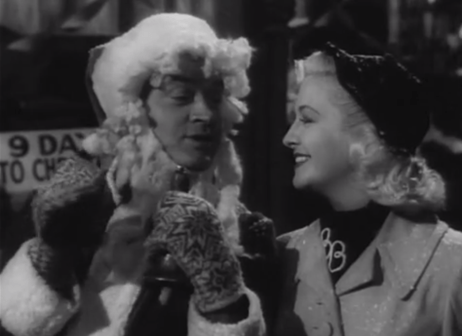
To swipe a phrase from Dr. Seuss, a street-corner Santa gives The Kid an awful idea –The Kid has a wonderful, awful idea. Although knowing Hope, he bungles it. The first time he dons his bearded costume and gets out his bell and tin can, it lands him in the clink for panhandling. The host of elves jailed with him let him have it. But he gets smarter once bail is posted.

Soon he’s wrangled together all the lovable scum of the earth to help him salvage Christmas — and his life — from being completely abysmal. These are the most gratifying scenes for bringing in such grouchy talents as William Frawley, Sid Melton, and Jay C. Flippen. They pull off the parts well providing the manpower for The Kid’s regiment of Santas.

Soon with Nellie as their real-life poster doll, they turn a casino into an old folks’ home completely on the level. The Kid is the only one in it for himself. Everyone else thinks they’re genuinely in it for the ladies, and it pays heavy dividends in a matter of days. People appreciate the extra goodwill during the holidays.

In fact, the platoon of reformed Santa Clauses do fine work. Brainy is happy, we have the birth of “Silver Bells;” it even looks like The Kid might live to see New Year’s. Oxford Charlie is also visually impressed. So impressed he decides to elbow his way into the racket taking the old dolls as hostages to live in his own home, leaving The Kid high and dry.

In his typical self-aware fashion, Hope mentions Milton Berle in passing, so what better gag than to take a cue from Mr. Television himself? He infiltrates Charlie’s base. However, the only problems left to be solved are how to deal with Oxford Charlie and then Moose Moran.

Thankfully, the movie ends with the right ribbon on top with the good guys beating the bad, the guy getting the girl, and one final jab at Bing Crosby as the curtains go down. The Kid has finally learned about selflessness even if Hope still plays up his usual vanity. He wouldn’t be Bob Hope without that, now would he?

It won’t win major accolades, but if you’re a fan of our star or crave alternative Yuletide entertainment to fill out your holiday festivities, The Lemon Drop Kid has something to offer. It’s corny and full of the kind of good-natured cheer that just about everyone could use more of during Christmastime. If you don’t, you know who you are.

3/5 Stars

Operation Petticoat (1959): Blake Edward’s Cheeky Service Sit-Com

operation petticoat 1.png

“On a sub you have to operate in close quarters.”

Operation Petticoat positions itself as an easy film to enjoy and a difficult one to love. It’s true Blake Edwards was capable of stirring up breezy even wacky entertainment, from Breakfast at Tiffany’s to The Pink Panther to The Great Race. Even this is only acknowledging a very small subset of his filmography without consideration of the several exemplary dramas he directed.

He was usually aided by fine casts, who could carry the material smartly, and it’s little different here. Cary Grant was hardly ever ruffled nor stretched in his later career, and Operation Petticoat could hardly be considered more than a lark for him. He plays his quietly bemused self — this time a submarine Lt. Commander, who must make the most of a wonky situation following the attack on Pearl Harbor. 

For his part, Tony Curtis is all but at ease as the wheeler-dealer with a touch of sleazy class. Let’s just say he’s got an affinity for the finer things in life and the ladies who can give it to him. It’s generally a delight to see Cary Grant return to a sub after Destination Tokyo, this time joined by Curtis, who looks to be relishing going toe-to-toe and rustling the feathers of his boyhood idol.

Forgiving the shameless pun, without its two stars, the movie would be sunk by mediocrity. If we want to give a slightly backhanded compliment, Operation Petticoat is a fitting precursor to some of the popular sitcoms of the ’60s.

Helping the argument are the presence of Gavin MacLeod, Marian Ross, and Dick Sargent representing, of all things, McHale’s Navy, Happy Days, and Bewitched. And of course, although it transposed the action of a submarine crew to a rural locale, one cannot forget Petticoat Junction.

Like McHale’s Navy, it would be all but impossible to pull off the wartime comedy set in the aftermath of Pearl Harbor if we hadn’t at least won the war. This gives freedom for some creative license and a bit of zaniness sprinkled in with the typical military fare. One must only remember one gag recycled in the TV show, namely, sinking a truck with a torpedo.

Before they can even get afloat, they have to put their belching sub back into working order. The man up for the task is their latest addition Lt. Holden. Though the commander doesn’t relish the idea, he turns the other way and lets his junkman get to work pilfering everything he can get his grubby hands on. He’s able to do what no one else could, securing all the parts (by dubious means) to get them back in commission.

If we want to point out the film’s flaws, it takes about an hour to really churn up some steam by entering the waters of a 50s era rom-com afloat in awkward waters. Because once they get past the fear that the Sea Tiger will fall apart around them, they find their newest conundrum. They are being tasked with accommodating a batch of stranded nurses. It just isn’t done. It isn’t decent. And yet somehow in this film it happens and, subsequently, becomes the source for most of the comedy.

Quite mysteriously, all the shipmen aboard fall ill and need medical attention from the nursing staff. Their commanding officer all but scares them back to perfect health. Holden is all but smitten by bodacious blonde, Dina Merrill, who has the ill-fortune for always falling in love with Mr. Wrong. He’s not exactly the prototypical image of the upstanding, clean-cut boy next door.

Major Heywood (Virginia Gregg) strikes up a boiler room romance with the local fix-it man (Arthur O’Connell) because she proves just as resourceful as he is. He’s forced to mince every small-minded word he ever said about women and washing in his workspace. Commander Sherman is hardly on the lookout for such flings, simply trying to navigate their highly irregular and awkward situation and the perpetual clumsiness of Nurse Crandall (Joan O’Brien).

Between designated shower times for the ladies, the sharing of pajamas between co-eds, and allowing for Lt. Crandall’s curvaceous figure in the tight quarters of the submarine, he gets more than he bargained for, all played for wry comic effect, of course. It’s these later interludes milking the sheer awkwardness that exhibit touches of redolence on par with Pillow Talk or any such brethren. It’s a reason to miss the films of old. Cheeky and more brazen than expected, but mostly good-natured, especially compared to the hypersexualized culture we now live in.

operation petticoat 2.pngVarious scenarios spring to mind of farcical hijinks worthy of McHale’s band of Eight Balls. Prime examples are Holden setting up a supply depot casino to wrangle parts and even resorting to pig-napping to augment their New Year’s festivities. Seaman Hornsby causes quite the stir and in order to hold onto the plump porker, Commander Sherman generously opens up his subordinate’s quarters so a disgruntled native can raid them in recompense. He comes away with a golf bag, tennis rackets, and all the doodads you can imagine.

In another stroke of brilliance, some Einstein has the foresight to mix white paint with the red so they have enough for a new coat. For any of those who passed preschool, that makes — not gray — but pink. When they’re not picking up more passengers and wayward goats, babies are being born in the makeshift ward.

 The most cringe-worthy moment comes when they get caught in the crosshairs of a friendly battleship looking to sink the unidentified, highly irregular submarine. As one last resort, they signal their allies with a trail of women’s undergarments. Surely the Japanese would not resort to the same tactics. 

The resolution to the story is fit for the crowd-pleasing, sunshiny rom-com we’ve been offered. Cary and Tony say a cheering goodbye to their old friend The Sea Tiger, and we get some novel if unsurprising exposition about their love lives. In case you didn’t guess as much, a movie about a pink co-ed submarine is not going to push your brain or the envelope. For the generous viewer, it’s intermittently mirthful and relatively harmless amusement not to be taken too seriously.

3/5 Stars