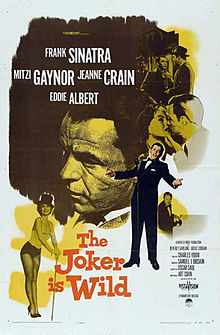
The Joker is Wild (1957)

Jokerwild.jpgIt required quite the journey to make it to this film, starting out with a different joker entirely. My introduction to comedian Joe E. Lewis happened because of the late, great Jerry Lewis. Revisiting his life and work I made the discovery that the comedian changed his name to avoid confusion with two men. First, Joe Louis the stellar boxer of the 1930s and then Joe E. Lewis the comedian.

I had never heard of the latter and if you’re in the same boat, here is a biopic that gives a little more definition to his life and times. It seems desirable to actually turn back the clock and see footage of the man himself but if anyone has to play him why not have Frank Sinatra and he does a fine job with a performance that finds time to crack the jokes, throw back a few tunes, while still revealing the inner demons that befall even a funny man. Yet again Ol’ Blue Eyes proves he’s an acting talent to be taken seriously.

Lewis’s beginnings were nearly tragic as he found himself under attack by one of Al Capone’s enforcers who slit his vocal chords and left him for dead after he walked out of his current contract to sing at another club. Except he fought back and even with a shaky voice he found his way to burlesque shows and then stand-up comedy followed.

All the while he was supported by his piano accompanist and best friend (Eddie Albert) and even finds time for love or rather it comes to find him in the form of Jeanne Crain. However, with obligations in serving the troops and his own insistence that a marriage would never work, he balks at popping the question only to regret it for years to come.

Soon his alcohol problem is even more of an issue — even affecting his work — and the marriage he got into with one of his precocious chorus girls (Mitzi Gaynor) was doomed to fail from the beginning.  The self-destructive tendencies seem present in this life as they often are for those in entertainment. And far from rewriting the ending to his story, we leave Brown in a very real state. He’s no longer married and he’s still trying to break his habit for the sauce. It’s a very honest place to be and that’s to the film’s credit.

I will forever be a pushover for Jeanne Crain who always plays the most charming romantic roles and here it is little different. Though she’s older, her beauty is still as striking as ever. Furthermore, Mitzi Gaynor slightly subverts her reputation here delivering in a couple of scenes that aren’t simply song and dance showcases.

Meanwhile, Eddie Albert just might be the greatest second banana known to man because he instantly makes his star all the more lovable acting as their faithful foil in all circumstances. He was just so phenomenal in those types of roles building something out of almost nothing.

There’s little left to do but let the lyrics of All the Way carry us away into to the evening with a bit of melancholy:

When somebody needs you
It’s no good unless he needs you all the way
Through the good or lean years
And for all the in-between years come what may

Who knows where the road will lead us
Only a fool would say
But if you’ll let me love you
It’s for sure I’m gonna love you all the way all the way 

3.5/5 Stars
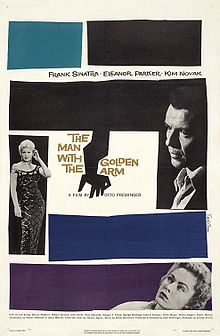
The Man with The Golden Arm (1955)

220px-The_Man_with_the_Golden_Arm_poster

Everybody’s habitual something ~ Kim Novak as Molly

Otto Preminger was the creator of a number of important “issue pictures” because he dared deal with themes that others had shied away from, mostly in part because of the production codes that ruled Hollywood well into the 1960s. Thus, any type of drug addiction was seemingly out of the question.

Such an issue might seem almost unthinkable in this day and age but that very fact is one of the reasons that The Man with the Golden Arm still maintains some resonance. Perhaps it has aged some and looks tame by today’s standards, a film that hardly dares to mention the drug in question, and yet there is much to be enjoyed all the same.

Saul Bass’s opening titles for one made the credit sequences of a film into an important attraction and he did much the same for Alfred Hitchcock and other Preminger films as well. The film is also laced with what might be best termed as sleazy jazz music to underscore the world that Frankie Machine (Frank Sinatra) returns to.

Before a word of dialogue is even spoken in the local dive we already have a pulse on what kind of place this is. It’s the type of world that sucks the life out of you. People lead you astray and if you’re not able to make something of yourself you’re bound to sink into the pits.

He is just off a stint in the State Penitentiary but unlike many, his story has a touch of hope. He’s gotten the monkey off his back as they say. He’s no longer addicted thanks to the help of a doctor who also tried to line up a job for him as a drummer. It looks like he has some talent that can take him places. He’s got a lifeline out of town.

His return is a heralded one. Everyone’s intent on welcoming him back including first-rate scrounger Sparrow (Arnold Stang) as well as the pudgy local card shark Schwiefka and the “dealer” Nifty Louie. He’s very much the devil on Frankie’s shoulder coaxing him to give him a call if he ever needs a fix of candy because he used to be a great customer.

Meanwhile, Charlie’s wheelchair-bound wife Zosh (Eleanor Parker) is constantly paranoid about his purported unfaithfulness and simultaneously quells any of his aspirations to make anything more of his life. She’s just a scared little person and her fear stifles Machine even as he tries to make her understand that things are different now.

The one person who does seem to understand him is his old flame Molly (Kim Novak) who is currently a hostess at the local club. He remains faithful to Zosh and yet it is the friendship with another woman that gives him the encouragement to pursue this new path.

Yet the film soon delves into the depths of addiction. As often rings true, after you think you’ve got addiction beat (any kind), it comes back with raging abandon and it goes for the choke hold. A bad break and the plethora of undesirable influences are leading Machine down the well-trod paths of old. He initially gives in and yet still battles and fights and shakes his way back to sobriety. But it’s not easy. The only place he has to turn is Molly and she gladly gives him her support.

All in all, this is a fairly unflinching portrait for the time and this picture points to the fact that Frank Sinatra was a serious actor, not simply a singer, a personality, or a star. Here he offers up an honest to goodness performance though his career was ripe with many others. Still, this one encapsulates the tortured cycles of those trapped in the throes of addiction.

Meanwhile, Kim Novak’s performance flows with a sincerity — a woman who is willing to do what is good and right even when it is difficult and seemingly offers very little recompense. It’s a stirring turn indeed.

The histrionics of Eleanor Parker are maybe a bit much and yet in this performance, you begin to see why she is hardly remembered along with other classical beauties. It’s because she actually wanted to be an actress first and a star second and thus, instead of projecting a certain image in all her pictures, it does seem like she’s constantly changing and stretching our expectations of her. Today her choices look quite audacious and yet it no doubt left her contemporary audiences a little befuddled. That in no way detracts from her efforts here if only to magnify our appreciation for Sinatra and Novak’s characters.

Rather than simply seeing this as an antiquated issue picture, a film made for a different era and for a different person than me, I would like to say that there is something of note in The Man with the Golden Arm. As Molly so lucidly acknowledges, many of us go through some type of cycle or we succumb to some habitual pattern whether it be an addiction or something less extreme. Still, either way, these very things can detract from our lives and trap us in rhythms of life that hinder our relationships and all that is truly paramount. That’s just a small caveat to take heed of.

3.5/5 Stars

Caged (1950)

caged 1.png

Caged proves to be a stark, even uncompromising picture for the 1950s. Director John Cromwell had a long career in Hollywood, helmed some quality film noir, and became a subsequent casualty of the Blacklist, but this just might be his finest effort.

Furthermore, despite being an actress of some acclaim, I must admit that even I forget about Eleanor Parker aside from her well-remembered appearance in The Sound of Music (1965). But if Caged is any indication, she is most certainly worthy of more credit. She freely channels a bit of the flustered timidity of Joan Fontaine early on only to transform into a completely different person entirely.

It’s a film that dances on the complete opposite spectrum of George Cukor’s The Women (1939) another film that is dominated by the lives of female characters. In that case, the narrative is preoccupied with the intricacies of their frivolous catty ways and malicious gossip. Caged has not even a pretense for laughter.

Likewise, the scenes of incarceration bring to mind images of  The Snake Pit (1946) and Shock Corridor (1964) but even those films were about mental illness and the lack of quality care, not so much the abominable corruption that begins to coalesce within prison walls.

Marie Allen (Eleanor Parker) is one of the first-time offenders who comes in with the new batch of prisoners. At only 19 years of age, she seems like no more than a girl and yet she’s already been married, had her husband fatally killed during a bank robbery, is pregnant with a child, and has an accessory rap pinned on her. That’s how Marie got where she is even if she doesn’t seem meant for such a hardened life.

Agnes Moorehead delivers one of her most sympathetic performances as a champion of rehabilitation who unfortunately is fighting a losing battle against the system as we soon see.

Some might remember the imposing Hope Emerson from Cry of the City (1947) but she leaves an even more indelible mark on this picture as the ever-necessary sadistic prison guard — an individual who sees little worth in her inmates — believing them to be animals to be treated as such. She is indicative of the institution as the cog that lays down the law and narrowly believes that there is no worth left in these women. They’re trash.

When everyone thinks that it becomes a bit of a self-fulfilling prophecy. And in time as she comes up for parole and then has it spit back in her face, the changes begin to show in Marie’s face. It’s hardened. Her voice is tougher. She’s more defiant.

Andy Dufresne in Shawshank Redemption (1994) was another character with unfortunate circumstances but he maintained his humanity in a dank place. You either get busy living or get busy dying. Yet being an impressionable girl Marie takes to heart the words of her veteran prison mates, “You get tough or you get killed.”

Maybe Caged outcome is easy to read and it ultimately succumbs to melodrama but there’s still something unnerving about the film on the whole with its overarching unsentimentality.

When I saw the name of famed composer Max Steiner as part of the production that was a tip-off but Caged rather audaciously functions in many sequences without any scoring and that lends to the overall sense of realism that pulses through this prison noir.

The utter irony is that the notes of “Rock of Ages” can be heard wafting through the corridors as Marie prepares for her final parole hearing and she makes it this time. But by now there seems little chance for redemption. She is intent on calling her own shots and not about to rely on anyone else. She’s gone beyond clinging and seeking shelter from the world around her. She doesn’t seem to need anyone. She’s become part of that world. The before and after are startling. They make for a harsh indictment of a flawed prison system.

4/5 Stars


Review: A Place in the Sun (1951)

a place in the sun 1.png

George Stevens is only one among a plethora of filmmakers who came back from WWII changed. He had seen a great deal of the world’s ugliness — Dachau Concentration Camp for instance — and as a result, the films he made thereafter were more mature ruminations on humanity at-large. Adapted from Theodore Dreiser’s An American Tragedy and a subsequent play, A Place in the Sun is one of those pictures crafted in the wake of such historical change.

There’s no doubt that this is Hollywood melodrama backed by a raging score from Franz Waxman but this is no less, high powered high-class stuff. It’s augmented by gorgeous black and white imagery that reaches pitch-black tones and still manages to make Lake Tahoe into a scintillating getaway. Meanwhile, the camera captures the action with elegant movements, sashaying through space, at times nearly imperceptible to the eye. Though admittedly the film’s stature as a social commentary is less interesting now than it probably would have been in its day. Still, we can’t have everything now, can we?

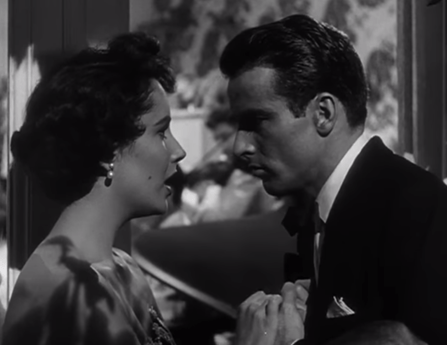
Montgomery Clift is often forgotten in the fray of powerhouse actors but the line can easily be traced from his intense performances to the work of Brando and Dean which would also sprout up in the 50s. Though that same intensity is there, it never feels like he’s trying to sell us a gimmick or a method. He’s simply trying to provide a lens to see a bit more clearly the intricacies of an individual, in this case, one George Eastman. It manages to be a profound and at times an agonizing performance.

Of course, Elizabeth Taylor is exquisite in every frame as always but her bright-eyed sincerity is equally arresting. She feels perfectly made for the role of Angela Vickers and seamlessly transitions into more adult fare with A Place in the Sun, standing tall alongside Clift, destined to make them one of the great romantic pairings of the 1950s. She supposedly said that she finally felt less like a puppet and more like an actress after this film. It shows.

Still, though given a thankless role at times, Shelley Winters is equally important because, in her simpler, humbler way, she reflects how quickly a man can change. She’s not a bad person at all, just a frail, even helpless one who feels like she has very few people in the world to hold onto. George proves to be a comparable companion until he unwittingly finds himself running in different circles and that’s where the tension begins.

I look at George Eastman and see the same drive for recognition, power, and wealth in many of us, those desires that oftentimes can be our undoing because they turn out to be meaningless. The irony is that his intentions never seem malicious but he is undermined by something. He quickly sinks into this double life. At first, he was simply happy to have a job and some companionship. His desires were simple. But slowly, as he found himself rising in the ranks of the Eastman company and getting more recognition, he couldn’t help but want more. Are these impulses bad? Not in the least, but they led him to some pretty rocky soil.

The scene that stands out in my mind could seem fairly mundane. But Stevens maintains a fairly long shot that’s peering through Eastman’s living room and we can see into the next room over as he is on the phone. It feels like minutes go by and Stevens fearlessly never cuts the sequence. The first call is from Alice which he takes.

But the second comes from Angela and at that point, we know that things have changed. It’s set up the dilemma. He genuinely loves Angela and wishes to be with her and to be a part of her life. Yet for that to come to fruition he must do something about the other girl. Alice won’t disappear. It’s funny how someone who you used to appreciate so dearly now feels like a burden. To her credit, we feel sorry for  Winters’ character without question.

In fact, the film succeeds along those lines. We pity her for the sorrowful position she is placed in — essentially abandoned by George. And even in her frivolity and opulence, there’s a candidness to Angela that makes us want to root for her and that allows us to simultaneously pity her because she has no idea of George’s other life. If there is anyone to lash out against it is George Eastman himself and still even in that regard, Montgomery Clift reveals the full gamut of this tortured man so even if we are hesitant to feel sorry for him, he does open us up even with a tinge of compassion.

But the muddled morality is complicated by the fact that Clift’s character has a sense of remorse. Surely he cannot be all bad based on what Vickers saw in him? His capacity to love and be tender is evident. Still, that is not enough to keep him from going on trial and the film’s final third takes place, for the majority, in a courtroom. The district attorney is played by Raymond Burr, who might well be in a dry run for Perry Mason and he comes at Eastman with all the fervor he can muster to convict him in his lies. Even in these moments, we must fall back on George’s inner conflict, his capability to love others, and his intentions for love.

If A Place in the Sun gets too preachy or succumbs too much to Hollywood’s stirringly romantic tendencies, it still might be one of the finest examples of such a film. Front and center are two phenomenal stars and Stevens films their euphoric romance with a meticulous eye, catching them in particular moments, with close-ups, and such angles that we are constantly aware of their intimacy.

As much as Eastman is looking for his place in the sun, and he could spend hours just sitting with Angela soaking in the sun’s rays (not many would blame him), it’s just as true that there is nothing new under the sun. That’s what we’re left with. Mankind is still distracted by many things. Oftentimes they are good things, but we make them ultimate things, and they wreak havoc on our lives. Meaningless, meaningless, everything is meaningless under the sun. But that doesn’t keep us from wanting to bathe in its tantalizing warmth any less. That’s part of the American Tragedy.

4.5/5 Stars

Review: Hiroshima Mon Amour (1959)

hiroshima mon amour 1

Like you I know what it is to forget and yet still be endowed with memory. These are only a couple fragments from this film stitched together but in many ways, they encapsulate the essence of its core themes.

I suppose such words ring true for all of us and Alain Resnais’ film is composed of a plethora of equally perplexing paradoxes that though never quite coming into full clarity nevertheless prove Hiroshima Mon Amour to be one of the most bewitching cinematic expressions born out of the French cinema. Without question, it is an undisputed touchstone of the forthcoming Nouvelle Vague that blew up the conventions of the 1960s.

The first time I ever saw Resnais’ romantic meditation there was something so arresting about it such that I will never forget the likes of Nevers and Hiroshima — the two entities that make up this film as not simply places of past tragedy but crucial to the very identities of the characters who come within the frame.

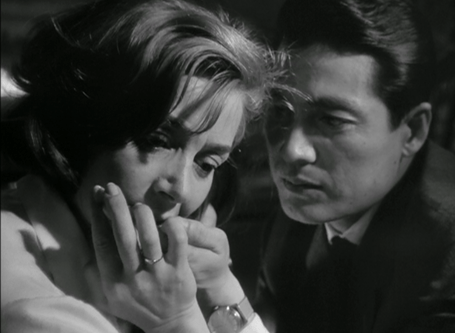
We never need to know the true names of this French actress (Emanuelle Riva in a riveting performance of immense grace) and the equally candid Japanese architect (Eiji Okada) who fall into the throes of a passionate affair together. They are represented well enough by these monikers — symbolic torchbearers of these names — emblematic of the age they ascribed to.

Like L’Eclisse (1961) or Dr. Strangelove (1964), this film too is in the wake of the atomic bomb and any subsequent discussion thereof cinematically speaking must at least acknowledge such films. Part of the necessity in this specific case is how the film takes a particular event and then extends it and intertwines it with so much more in such a way that it not only a monument to Hiroshima but a testament to human history.

We are people so quick to forget. We lose sight of the past. We bury our hurts deep inside. We are doomed to repeat many of our past mistakes. But still, more so we are capable of passions, emotions, and love that carry us through times of tribulation, pain, and suffering. It’s something to be immensely thankful for.

Resnais film is one of the great visual marvels of the 20th century with its graceful fade-outs and flashbacks — delicate camera zooms connecting memories and realities. Stylistically there’s a continuous poetic cadence of image and dialogue, repetitions with recollections. A solemnity exists in its very purposeful pacing that ties everything together with the utmost elegance which, far from being a muddled hodgepodge, forms a perplexing experience never to be fully elucidated.

It has very few equals and remains so as an achievement that can hardly be defined as a typical love story or any such blase categorization. It’s what we might conceive when we think of Film as art worthy of any sphere of discussion.

There’s hardly a meter to begin measuring how it makes us feel or the emotions it elicits.  Somehow connected to fate — two lovers crossing paths — these two individuals seemingly meant to be together and tied together not only by their romantic passion but their own histories. The striking flashback structure subsequently creates tiny microcosms of emotional resonance that flood with abandon.

Recollections of past scars unearthed over the course of the love affair. Both historical and personal. We have the depiction of the devastation in the aftermath of the bomb with images that are all but scorched into our mind’s eye with an unfettered pointedness. We are meant to see these images and take into account how they came into being.

But there’s also the personal trauma brought to the fore and exhumed with a kind of transfixing equanimity that’s hard to fully comprehend but nevertheless leaves us with something to ruminate over. Equally telling is the passage of time as memories begin to fade and minds begin to slowly forget. Again, that is the curse of our beings that we must fight to remember what has come before.

It’s no small coincidence that the cafe that our two lovers rendezvous at is none other than the Casablanca. The yearning and the melancholy are right there in the lyric of “As Time Goes By.” If you’ve never consciously thought about their meaning before then Resnais film might make you hear them anew and be moved.  Love, memory, and heartbreak are often so closely tied together. This is a film that dwells on each and finds some amount of catharsis.

The diversity of the crew is another glimmering bright spot of this joint partnership between nations with an abundance of involvement from both French and Japanese staff taking the shoot on-location to both countries. It’s a lovely marriage and a bond is formed by the picture just as the romance signals a tight-knit cross-cultural relationship on screen.

For some, individuals somewhat attuned to diverse backgrounds, Hiroshima Mon Amour is utterly groundbreaking in this realm. Though its cast is small, it’s a mighty statement having a French woman playing opposite a Japanese man. 50 years on it remains as an image that we do not see all that often, despite the changing of the tides.

Their closeness is palpable. Hands clasping tenderly. Eyes gazing with the deepest longing. The intimacy that they share speaks volumes. Even as it’s undercut by the morose strains of infidelity and wistfulness; this is a love story like few others.

4.5/5 Stars


Ohayo (1959)

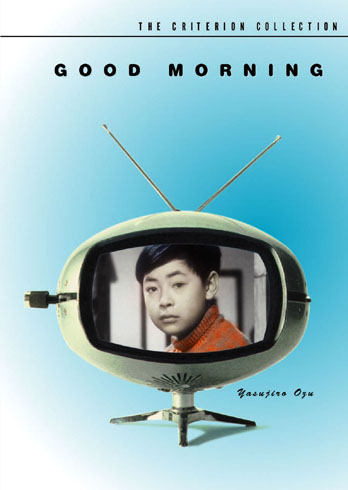
Good_morning_dvdIf Yasujiro Ozu can be considered foremost among Japan’s preeminent directors then there’s no doubt that Ohayo (Good Morning in English) is one of his most delightfully silly films. But that’s only on the surface level.
Young boys are unified in their affection for watching sumo on television and passing gas as a great gag to pull on their friends. Nosy housewives gossip incessantly whether it be the next door neighbor’s new washing machine or the mysterious disappearance of dues for the local women’s association. Meanwhile, most of the men go to work and spend their evenings knocking a few back at the bar noting how much the world is changing around them. Then they go home oftentimes a little drunk.

Ohayo is actually a reimagining of one of Ozu’s most remembered early pictures during his silent days I Was Born But… (1932) and yet he skillfully reworks the storyline into an everyday comedy of family and neighborhood drama that’s full of humor and his brand of quietly observant social commentary.

Ozu always took great care in analyzing family units and matrimonial bonds that affected relationships. Although we have a bit of a fleeting young romance in the works, this film’s greatest concern are two young boys from the Hayashi family who are giving their parents the silent treatment until they are allowed to have a television. Their parents are holding out and it begins a rather humorous ordeal as the brothers Minoru and the ridiculously comical Isamu (constantly exclaiming “I Love You”) try to make it through dinner, school, and so many other daily activities without a word.

As he would dissect many times over, Ozu focuses on the generational divide that was emerging and becoming increasingly prevalent in the post-war years as reflected by technological advancements like television and other such devices slowly turning present Japan into a land of a million idiots. At least that’s what the older generations feel.

Still, it’s just as equally occupied with the moral customs that have long ruled the nation where wives can speak so kindly to their neighbors up front only to slander them behind their backs a moment later. Saving face and personal honor is often cared about far more deeply than anything else — even in some circumstances when it happens to be at the expense of another family member.

Perhaps the most troubling thing is the very Japanese predilection to talk about nothing in particular, filling conversations with salutations, pleasantries, and comments on the current weather patterns. It hardly ever gets to anything of substance and that comes in numerous forms. Sometimes it means a young man never gets around to sharing his feelings with a girl or adults never being particularly candid with neighbors or spouses. There’s very little of that kind of transparency to be had. Few of the words passed along between people in conversation mean all that much.

The irony of the whole situation is that, in one such instance, it’s a young son who calls them out on it and he proceeds to get a heavy scolding from his father (Chishu Ryu) who bluntly tells him that he talks too much. Meanwhile, although Izamu can be constantly chiming “I Love You” in English, there’s an uneasy sense that his parents and most certainly his father, might have never said the words to him.

In these very simple ways Ozu rather delicately and still humorously tackles many of the issues that have long plagued an honor-based culture such as Japan’s but he does it with an adroitness that uses touches of humor and his own understanding of human nature to craft yet another universal tale that’s ultimately sympathetic in its portrayals.

It unsurprisingly feels like it could be a Japanese episode of Leave it to Beaver except for the father never has much of a talking to with his sons and the mother may be as put together as June Cleaver but hardly feels ever as affectionately maternal.

Equally spectacular is Ozu’s mise-en-scene which as per usual is meticulously staged and gorgeous in scene after scene. He offers up each individual image in a flat two-dimensional way that can best be described as taking cues from not only the theater but Japanese woodblock paintings with wonderful symmetry and compositions boosted by color.

He uses the clique of adjoining homes as the perfect set to send his characters in and out of with the hint of comedic forethought. While watching characters walking by on the hillside up above the homes — their figures slowly moving in and out of the frame past the houses — this provides some of Ohayo’s most visually stimulating images pleasing the eye incessantly.

There’s always a visual fearlessness that you see in very few others because he not only has color at his disposal but the staging is on point as is his disregard of the 180-degree rule of perspective. It just works. What is more, he also continues to use what could best be called establishing shots by western audiences. Except they hardly ever need to establish anything. It’s as if he simply put them there because they are vivid depictions of the reality he is painting — adding yet another distinct contour to the world he is working with — going beyond the figures that he places within the frame.

There’s no doubt that this is Ozu but not all that surprisingly this might be my personal favorite in his oeuvre for the aforementioned reasons. It feels like Ozu operating at his most playful while nevertheless maintaining his peak form as a filmmaker.

4.5/5 Stars


Johnny Guitar (1954)

johnny guitar 1.png

“I’m a stranger here myself.” ~ Sterling Hayden as Johnny Guitar

In watching even only a handful of Nicholas Ray films, it’s possible to discern fairly quickly that his films are often about the marginalized outsiders. Rebel Without a Cause (1955) is the most iconic example but this theme goes a lot further than that single movies. He even plays with the same ideas in Johnny Guitar his extraordinarily distinctive western from 1954.

There are other westerns that open like this. A stranger (Sterling Hayden) riding through the mountains and making his way to the nearest town. He overlooks a stagecoach robbery going down and miners blasting away at a mountain with dynamite. There must be a purpose to it all but the significance fails to resonate quite yet.

He goes to the local watering hole: Vienna’s. Except there’s no one there. It’s a ghost town. There are only a few solitary figures working the roulette wheels and the bar. No one else. But still, the stranger walks in as if he’s meant to be there. We don’t know why yet.

By all accounts, Sterling Hayden wasn’t much a cowboy but he had the presence of one. In the movies sometimes that’s enough. Here’s the eponymous Johnny Guitar, the man with his instrument strapped to his shoulder with little stake in the local goings-on.

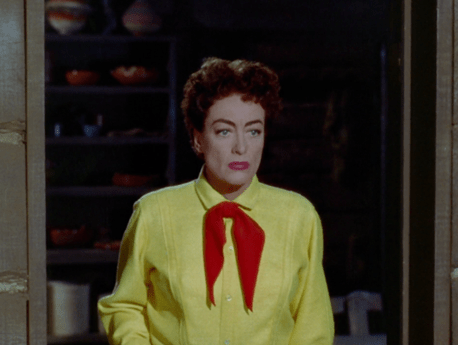
Namely, the grudge match brewing between the hotel’s fierce proprietress Vienna (the always cutthroat Joan Crawford) and fiery western lass Emma Small (Mercedes McCambridge) who packs a whole posse of cattlemen including ornery John McIvers (the venerable Ward Bond). It doesn’t help matters that Vienna opens her doors to the despised Dancin’ Kid (Scott Brady) and his cronies.

We, like Johnny, have no particular stake in their quarrel though there is a sense of some past grievances. In fact, everyone seems to have a history but we are hardly ever given a nibble, never through flashback and rarely in exposition.

Nicholas Ray creates a gorgeous world in color that showcases some of the most attractive imagery of the West in Classic Hollywood on par with The Searchers (1956) and Rio Bravo (1959). And it boasts an equally colorful array of characters including quality supporting cast members like Bond, Ben Cooper, Ernest Borgnine, Royal Dano, John Carradine, Frank Ferguson, and Paul Fix.

But the subversion of all norms begins with Joan Crawford, the woman who loves the sound of the roulette wheels spinning, ever severe, packing a six-shooter in her blue jeans. While the TruColor does much to enhance not only the scenery but her performance as her piercing eyes burn through everyone she stares down. Johhny Guitar might be in our title but Vienna is our undisputed star.

The relish of the film is perfectly rendered by the complete lack of clarity initially. It’s trying to get a line on everyone in an attempt to understand what’s going on as their allegiances are made fairly evident. It’s a matter of picking a side. But the sides are incredibly difficult to decipher. In fact, even in her moments of complete innocence, it helps her character that Crawford very rarely comes off as a sympathetic person — in reality or on the screen. So if she’s our protagonist then we’re in for a tough outing.

Of course, the feud that’s central to the tale was also twofold unraveling on both sides of the camera. Mercedes McCambridge and Joan Crawford loathed each other to put it lightly. They probably wanted to tear each other’s hair out and while not the most benevolent of relationships, it undoubtedly stoked the fires of the film’s drama. In fact, it seems like there weren’t many people who did like working with Crawford. Hayden never wanted to be in another picture with her again either. Still, once more, it all functions in front of the camera exquisitely.

There’s certainly some truth in drawing up parallels with George Stevens’ Shane (1953) but the moral lines are a lot more jumbled and the intentions of the plot far less direct. Shane is a success because it’s a fine piece of classical storytelling still underlined with an imminent threat. Johnny Guitar is beguiling because it breaks with all the conventions of the West while still carrying its own amount of subtext that’s hard to figure.

Should we even care that the posse gets these men? But you see, that’s nearly beside the point. It’s not about right or wrong but this muddled center controlled by Joan Crawford and Sterling Hayden. The man and the woman with a bit of a past but not enough that they will fall into each other’s arms and live a faithful life at one another’s side. That’s just not in their nature. Still, riding the fence proves to be a taxing ordeal.

We witness the most peculiar bank robbery as far back as I can remember committed by the local outlaws who until they ran off with the loot hadn’t exactly done anything wrong, in spite of being despised by a whole town. In other words, they played the roles expected of them. Then, a pair of hangings takes place but instead of your typical unrepentant criminals being strung up, you have a kid and a woman both ending up with a rope around their necks. The enforcers’ stomachs begin to churn uneasily. This isn’t how mob justice is supposed to work.

Subsequently, the battle to subdue the frontier is brought home with the most unconventional showdown in the western canon that’s fundamentally also one of the most stunning. It blows up in your face and then leaves you questioning this entire ordeal.

Peggy Lee’s title track is used to sing them out as one final note in this dazzling western courtesy of Nicholas Ray; dazzling for the very reason that it does everything contrary to what we have learned. It continually makes a conscious choice to upend the accepted script attached to the mythology of the West, rewriting its own narrative full of vivid imagery and equally blistering outcomes.

4.5/5 Stars

Side Street (1950)


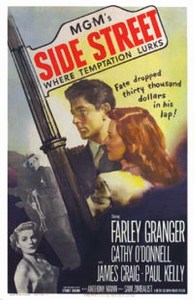
SideStreetposterThough director Anthony Mann later made a name for himself with a string of Westerns pairing him with James Stewart, it’s just as easy to enjoy him for some of the diverting crime pictures he helped craft. Everything from Raw Deal (1948) to T-Men (1947), He Walked by Night (1948), and of course this little number.
Another simple pleasure gleaned from Side Street is the second teaming of the two young starlets Farley Granger and Cathy O’Donnell who made such an impression together in Nicholas Ray’s sensitive drama They Drive By Night (1948)

We begin this particular picture with a flyover of New York City and the “Voice of God” narration comes off as another installment of The Naked City (1947) because it too takes to the streets, shot on location in the city of a thousand stories with thousands more waiting to happen.

There’s something engrossing in this style of storytelling which takes interest in several seemingly unextraordinary, unconnected individuals and then over the course of less than an hour and a half slowly ties together all the threads of their lives into one cohesive narrative.

There are some calling cards of crime pictures including sleazy extortion, a body fished out of the East River, and the police who are working the beats of the case and trying to keep the frenzy of journalists at bay. Paul Kelly and Charles McGraw head up the police procedural angle.

But the man we come to know the best is unassuming postman Joe Norson (Granger), who becomes extra jumpy after unwittingly stealing thousands of dollars when he thought he only swiped a few bucks to buy his wife a mink coat. He’s just a poor, small, unimportant little man in the scheme of things. An “Average Joe” if you pardon the expression. He’s not supposed to be embroiled in such a story. It’s a bigger can of worms than he could ever imagine and there are consequences.

Other people of interest are wealthy businessmen, crooked lawyers, cabbies, bar owners, bank tellers,  journalists, cops on the verge of retirement, nightclub singers, and at least a few ex-cons, all the usual standard bearers.

Joe’s wife is in the latest stages of her pregnancy and shortly her baby is on the way but her husband has made up a fanciful story about a new out-of-town job that’s loaded him with cash. Of course, she has no idea what’s going on and nor does he. He asks a near stranger, the man who runs the local bar to hold the cash for him. He says it’s a nightgown for his wife.

But Joe’s not a criminal. His guilty conscience is too much for him so he goes back to the office to plead with them to let him return the money. Of course, they have as much right to it as he does. What follows is a cat and mouse chase across the city. First, some thugs tail Joe looking for the $30,000. Then, Joe and ex-convict George Garsell look for the bar owner who has all but disappeared and conveniently the money’s gone too.

As the police are also involved, they want both men, believing they are complicit in different murders that have been committed. Joe has just enough time with his wife to explain his predicament. Still, he got himself into this mess and he holds the belief that he is the only one who can make it right.

What follows is a culmination of all the events thus far as all the character arcs begin to bump up against each other. Namely, Joe, a local nightclub singer (Jean Hagen), and the last man that Joe wanted to see, Garsell himself.

Side Street closes out with a lively car chase near The Third Avenue El that predates many of the revered classics from Bullitt (1968) to The French Connection (1971) years later. The full weight of the title’s meaning, subsequently makes itself increasingly clear as squads of police cars look to close in on the criminal’s getaway taxi. Of course, what makes it compelling is the fact that Joe is right in the thick of it all to the very last avenue…with a loaded gun pointed at his head. Thankfully there are no speed bumps in this one.

3.5/5 Stars


Review: To Catch a Thief (1955)

to catch a thief 10.png

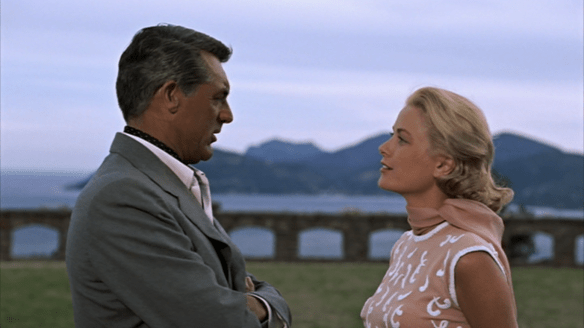
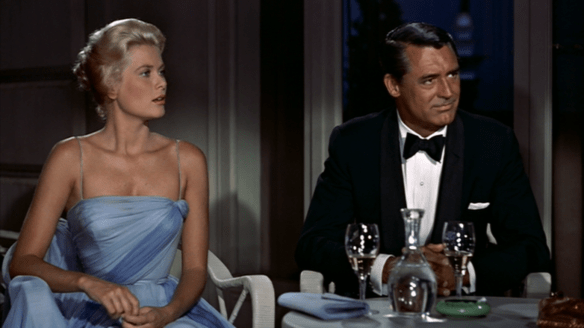
There’s little doubt that To Catch a Thief is Hitchcock at his breeziest and with the once-in-a-lifetime pairing of Cary Grant and Grace Kelly the picture could coast on looks and charm alone. Not simply based on the attributes of its stars either but the extensive on location shooting boasting Cannes shorelines colored in VistaVision and sumptuous flyovers of the winding Riviera, villas and all. It’s a scintillating getaway and a fine departure following the nerve-wracking confinement of pictures like Dial M for Murder (1954) and Rear Window (1954).

Thankfully while it is supremely light entertainment there’s something else to it as well. A rash of copycat crimes has taken place all across the Riviera leading the local police commissioner to suspect reformed cat burglar and French Resistance hero John Robie (Grant). Though the slinking and perfectly executed jewel heists bear the mark of “The Cat,” he’s the best one to acknowledge his own innocence.

Still, that doesn’t stop the police from questioning him nor his old war comrades working at a French cafe to begrudge him for what they deem as an affront to them. They want nothing to do with him. And so with things as they are, Robie must try to exonerate himself by verifying his innocence. John Williams proves the perfect accomplice as a generally agreeable chap from Lloyd’s of London who has vested interest of his own in catching the real culprit in order to recover his client’s assets.

Their introduction could not be more memorable culminating in a tussle in the flower market in Nice with bouquets flying every which way, the local authorities in hot pursuit. From there Robie floats away from the police soaking in some sunbeams as he devises his plan of action. But already we see the dangers as he must essentially play the thief, casing the joint, getting close to the jewels and their owners but all in the name of personal vindication.

What follows is a fortuitous meeting around that whirling pickpocket — the roulette wheel — where Robie makes a dashing entrance. Actually, make that a purposefully inept showing dropping a chip down a lady’s front. What follows is a fairly haphazard routine as Oregon lumber magnate Conrad Burns trading pleasantries with his newfound acquaintances.

to catch a thief 1.png

Jesse Royce Landis knocks her scenes out of the park allowing Grant and the others to laugh along amusedly due to her affinity for bourbon and straightforward speech.  Her daughter Francie (Kelly) tries to maintain her own dignity as an aloof beauty bred on finishing school.

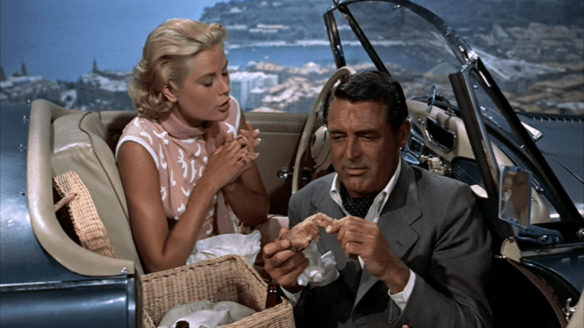
However, she’s more forward than she lets on leading with a wordless smooch in the doorway on her way to bed that begins the chase. What becomes rapidly apparent is the fact that she knows what she wants and doesn’t waste any time pursuing it. First, there’s a jaunt on the beach, then a picnic, and numerous other little romantic getaways perfectly constructed for romancing.

By now the double entendre of the title comes into full relief. On one level Robie is trying to catch someone and Francie is trying to catch him. Charade (1963) would provide a similar dynamic with the woman becoming the huntress out for love. But it’s true that the ravishing gal has a jackpot of admirable qualities which Robie nevertheless tries his best to avoid. Just as he tries relatively unsuccessfully to dodge her flurry of probing questions before finally resigning himself to beer and fried chicken.

to catch a thief 6.png

I’m the first to admit I’m the least fashion-conscious person around but there’s little denying the iconic nature of Kelly’s coral top during the picnic scenes with Grant. Again, the outfit realized by renowned costumier Edith Head is only rivaled in my admittedly meager estimation by Audrey Hepburn’s Little Black Dress (conceived by Hubert de Givenchy) in Breakfast Tiffany’s (1961) during her early morning window shopping.

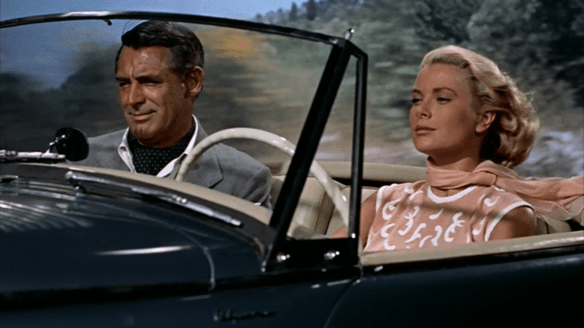
The country road car sequence is a fine summation of the film’s general balancing act of John Michael Haye’s scripting with Hitchcock eye for the visual. It’s broken up by the glib interplay between our stars and yet proves silently comedic with knowing gazes and the dodging of pedestrians and roosters as the police tail close behind Francie’s sporty Sunbeam Alpine.

Though the same scene is underlined with a bit of morbidity as Princess Grace would die in a car crash years later as Princess of Monaco brought on by a sudden stroke which occurred not far from where the film was shot. It’s a tragic moment that left a dark blot the world over.

to catch a thief 7

But for now, the picture is effervescent only bounded by fireworks with the impetuous blonde intrigued by this man who she easily pinned as “The Cat” despite his constant rebuttals. She wants to be a part of his game too, all the while entrapping him with her divine loveliness.

Now’s as good a time as any to marvel at the character of John Robie who must have been made for Cary Grant precisely. At first, it’s easy to surmise that he’s supposed to be a Frenchman who can barely speak any of his native language. However, that would disregard the randomly assorted tidbits scattered throughout the film. For one, he’s said to be an American on multiple occasions. Except as Francie notes, “you’re like an American character in an English movie.” Robie even notes he once toured Europe with a troupe of acrobats, not unlike a young Archibald Leach.

The picture is also littered with what can only be termed touches of Hitchcock whether tops of umbrellas, policemen playing hacky sack on the job, or cigarettes stubbed out in eggs instead of ashtrays.

But back to the action. The final game of cat and mouse is proposed to trap the clandestine specter who has been absconding with all the jewels. It comes down to a decadent Louis 15th extravaganza frequented by the social elite and costumed policemen milling about amid the guests. Robie is waiting to pounce and takes to the rooftops to have it out once and for all!

We think we’re in for one last perfunctory car chase instead Grant and Kelly receive their final rendezvous at a villa which proves far more thrilling. The plot generally took a backseat to the stars anyways even for a Hitchcock movie. We leave them as they embrace with Francie exclaiming, “Mother will love it here!” and Grant’s quizzical look barely visible past his costar’s shoulder. That’s priceless. How could we have more fun than this?

4/5 Stars

Picnic (1955)

Original_movie_poster_for_the_film_PicnicIt’s easy to assume that Picnic is a film that time had not been very kind to. If you do a cursory glance at contemporary reviews, the majority appear far from glowing and my own reason for returning to this romance was based on a mild interest in a cultural artifact rather than an actual investment in the film itself.

As such it’s also easy to label Picnic as a contrived melodrama ripe with implausibilities and theatrical notes. One of those hot and sweaty numbers out the Tenessee Williams school of drama. This couldn’t possibly be real life. Even the romance feels a bit thin as if falling in love with someone through a simple dance could actually happen over the course of a single day. Yes, William Holden plays the energizer bunny inside the body of a has-been jock impressively but he’s a bit old for the part. Yes, Kim Novak is an aloof beauty extraordinaire but she still somehow feels out of place as a Kansas beauty queen. Rosalind Russell is and always will be a dynamo.

It’s Labor Day weekend in rural Kansas when drifter Hal Carter (Holden) stumbles off a train to call upon an old college chum named Alan Benson (Cliff Robertson) for a job. Upon his arrival, he offers to get rid of a lady’s trash in exchange for a meal.

Due to the summer heat, it seems reasonable enough that the kindly old woman (Verna Felton) tells him to strip down to the waist but a shirtless William Holden makes a stir in town from the very first ogle. Of course, it works both ways. Madge (Novak) is the local beauty and her endlessly concerned mother wants her eldest daughter to use her looks to get a nice young man like Alan.

That’s one of the prevailing notions of the times. Women must get married. They must find a nice man with means and do it while they’re young and time is still in their favor. Better yet if they’re desirable.

The alternative is winding up like Millie (Susan Strasberg), Madge’s younger sister, who keeps her nose in books, having already landed a scholarship to college while disdaining boys and avoiding them like the plague. Further still, there’s the fate of winding up like the local school teacher, the histrionic Rosemarie (Russell) who boards with the Owens and yearns for a dream man to replace the scruffy but nevertheless good-natured Howard Bevans (Arthur O’Connell), who frequently calls on her. Consequently,  Ms. Potts is one of the most agreeable characters and seems the most fulfilled (even without a husband).

However, the arrival of Hal draws out such a visible reaction from all the other women he meets and it feels severe but more than anything you can see it as wholly representative of the sexual repression of the age. It’s so jarring since in some respects the magnetism of Carter feels relatively tame and the outcry against him uncalled for but that comes out of our own sex-saturated culture.

Upon ruminating on the movie a bit longer I began to consider what it truly means when we label a film to be “dated.” We look at scenes in Picnic and are quick to write them off as an indication of the time. Maybe it’s a bit of the historian coming out in me but isn’t that part of the magic of a film like this? It can act as a time capsule. It can come to us from the era it was made in. What’s wrong with that?

As usual James Wong Howe’s color photography does an impeccable job of giving us a sense of what that life was like as does the direction of Joshua Logan since the stage version of Picnic had been his baby. They interpret the quality times that communities have together with bands, songs, games, and the best kind of food made by the most loving hands.

People called on one another, courted, were generally courteous, and there was a sense of integrity. Yes, people were often frustrated and uncomfortable but we could say the same about today too, except now the same feelings come for different reasons. Neither a culture of asceticism nor utter hedonism will find us completely content.

In the end, I stole a page out of the Astaire & Rogers musicals to try and comprehend Picnic. Unquestionably the “Moonglow” sequence is beloved and I think we can look at it utilizing a certain lens. In an age that was supposedly “repressed” a dance was a highly evocative way to express the passion of two people and like many of the most guttural cinematic sequences, this one is visually impactful with nary a line of dialogue allowing us to be captured fully in the moment.

Howe’s final stroke of ingenuity is to show our two lovers simultaneously riding off by train and bus to their life together, within the same frame. Whether they can make it work and be happy is still in question. But part of the beauty of this existence is that we each have to make our own path in the pursuit of love and everything else that’s worth living for. To use an unforgivable metaphor, life isn’t always a picnic but the dance of life will continue regardless.

3.5/5 Stars

MY ENTRY IN THE 3RD GOLDEN BOY BLOGATHON!