The Virgin Spring (1960)

19cfc-jungfrukc3a4llanDirected by Ingmar Bergman and adapted from a Swedish ballad, this film revolves around a Christian Medieval family. Their only child is a beautiful, care free girl who they cherish. They sned her off to church with a maid servant. Along the way the two of them must pass through the forest. The girl leaves her servant behind to rest and then she goes on, meeting some herdsman on her way. She shows them hospitality by sharing her food, but the two men brutally rape and kill her. Ironically, that night they seek shelter with the girl’s family unknowingly. By accident the parents discover what became of their daughter and they must then decide what action to take. Bergman’s films certainly bring up questions about morals, religious faith, and evil. None of the characters were perfect but instead human, because they all make mistakes and must ask for God’s forgiveness

4/5 Stars

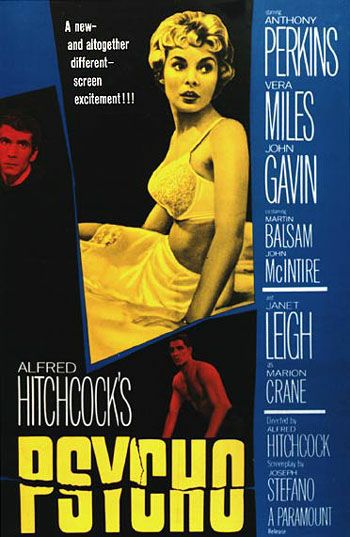
Psycho (1960) – Alfred Hitchcock

Alfred Hitchcock is much appreciated now but this film especially stands out in American culture because it was a first rate horror film when that was an anomaly. It has a chilling score, a notorious villain, and a sequence that is one of the most famous in film history.

*May Contain Spoilers

Directed by Hitchcock and starring Janet Leigh, Anthony Perkins, and Vera Miles, this film is intense from the opening sequence. Marion Crane seems to be your average love-struck woman stuck in her job. However everything quickly changes for her after she runs off with $40,000 that had been entrusted to her. Before she can get it to her boyfriend she must stop for the night at the Bates Motel. She rents a room and meets the timid, unassuming proprietor Norman. Soon it becomes obvious that he likes her but his domineering mother does not approve. Then later when Marion is taking a shower she is brutally murdered. Soon the situation becomes even more confused when a private investigator winds up missing. Marion’s sister and boyfriend resolve to go to the motel themselves. Little do they know the shocking events that await them. Undoubtedly Hitchcock’s most famous film, Psycho shakes the nerves and excites. Furthermore, it solidified Norman Bates as one of the most notorious villains of all time .

5/5 Stars

The Producers (1968)

425cf-the_producers_1968Directed and written by Mel Brooks and starring Zero Mostel and Gene Wilder, this satirical comedy revolves around a producer and a lowly accountant who scheme to produce a flop so they can run off with the production money. The plan quickly develops thanks to the enthusiasm of Max Bialystock because he is fed up with romancing elderly women for money. They wade through numerous scripts finally settling on one titled “Springtime for Hitler.” They get the rights from the deranged writer, find their equally odd director, and a groovy hippie is cast as Hitler. Everything seems set for failure on opening night when the audience appears aghast. However, when the two producers go to celebrate the reaction changes and the crowd misinterprets LSD’s portrayal of Hitler as satire. The show is a success so in one last ditch effort they destroy the theater. Bialystock and Bloom finds themselves injured, arrested, and finally tried in court for being incredibly guilty. Despite an impassioned entreaty by Bloom the two men find themselves in jail but it isn’t so bad because they go back into the production business and they are up to the same old tricks again. This film was important as Mel Brooks’ first great triumph. True it is vulgar, irreverent, and in bad taste but I think that is exactly what Brooks was going for to get a laugh. And I have to say “Springtime for Hitler” has to be one of the most annoying songs I have ever heard. Aside from that I suppose this movie does have some funny parts.
 
4/5 Stars

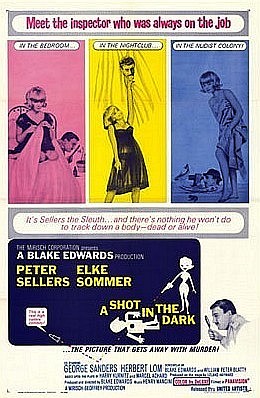
A Shot in the Dark (1964)

4a292-shot_in_the_dark

Starring a cast including Peter Sellers, Elke Sommers, Herbert Lom, and George Sanders, this comedy-mystery opens with several bustling individuals in a mansion, followed by a gunshot. A pretty maid who was found with the gun is assumed to be guilty, but the bumbling Inspector Clouseau thinks otherwise. He has run ins with his crazy boss, his man servant Kato, and the police, while he clumsily tires to solve the case. Everything seems to point to Maria after more murders. However, Clouseau spends time with her and it becomes evident to us that a black-gloved man is after him. In the melodramatic, chaotic final scene, Clouseau attempts to name the murderer, and the case is solved, no thanks to him. This second installment of the Pink Panther had some funny moments and the slapstick was very good.

4/5 Stars

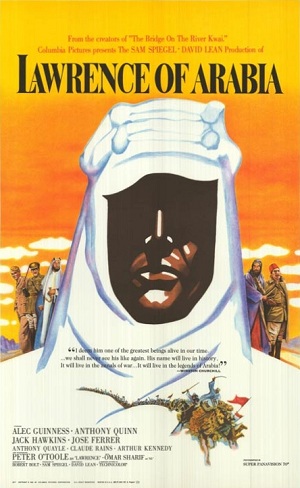
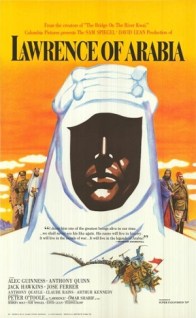
Lawrence of Arabia (1962)


A film of truly epic proportions, in length, scenery, and brilliance, Lawrence of Arabia is essential cinema. Peter O’Toole delivers a stellar performance as T.E. Lawrence, a British soldier during World War I. The movie begins with his death from a motorcycle crash, which gives an early glimpse of the character.

Then, a flashback goes to his time in Arabia where his task was to unite the Arab tribes, and lead them in rebellion against the enemy so the British might win. Against the better judgment of his commanding officer, a Mr. Dryden of the Arab Bureau suggests Lawrence be sent to assess the possibility of an Arab revolt against the Turks. Lawrence heads with his guide to pay a visit to Prince Faisal. However, his guide is shot by another man and Lawrence resolves to make the journey alone. Their paths cross again in the camp of Faisal. There Lawrence interests the Prince because his ideas are far different from his commanding officer.

Showcasing his audaciousness Lawrence suggests a bold attack on Acaba which would allow the British to bring in supplies. He leads a group of men across the brutal desert knowing that this will be less expected. Sheriff Ali (Omar Sharif) doubts it will work and disapproves that Lawrence takes two young outcasts as his servants. It is later during the journey that Lawrence truly wins over the other men, including Ali, because he is relentless, even going back for a lost straggler. With some luck, Lawrence is able to gain the help of Auda Abu Tayi, but it is not without tension. Ultimately, his forces are able to take out the Turks, and Lawrence heads back to Cairo to relay his progress. However, on the way back he must struggle with the loss of a servant and the guilt of executing a man.

Lawrence is sent back to Arabia and there he leads his forces in guerrilla operations against the Turkish railroads. His exploits are documented by an American newsman, and by this point, he has become a mythical hero among his followers. However, after going to scout a town the seemingly invincible Lawrence is ultimately flogged and tortured, leaving him a broken shell of a man. He insists on leaving Arabia but his new commander, General Allenby orders him back for one final push towards Damascus.

This final mission sees a change in Lawrence, who has hired killers and missionaries to help him in his siege. Against the better judgment of Sherif Ali, Lawrence leads a massacre of Turks as they move onward. He takes Damascus, but his fragmented counsel of Arabs are unable to unite, and the city is given back to the English. Major Lawrence is promoted once more to Colonel, and then gets shipped home because his services are no longer necessary.

This is one of those films you want to see on the big screen because the scenery and cinematography is just that impressive by itself. David Lean had a skill at making epics, and this is perhaps his masterpiece. The desert is often stark and desolate, and yet striking in the same instance. The expanse of space that is viewed in a single shot is often mind-blowing. A human being on the horizon is hardly a speck, and the ever-present camels are hardly any more substantial. To complement these grand images is an equally magnificent score by Maurice Jarre, complete with overture and all. The cast must be mentioned too with such supporting stars as Omar Sharif, Anthony Quinn, Alec Guinness, Claude Rains, Jack Hawkins, and Anthony Quayle.

Then, of course, there is the man who played Lawrence. As portrayed so wonderfully by Peter O’Toole, Lawrence is an intelligent and, at times, arrogant man, who can be odd, distant, audacious, and also unscrupulous. That being said, he was an extraordinary man who was a mover and a leader of men. A very unique, at times controversial, and long unheralded man, who contributed to the war effort in a far different way.  In many ways, he was an adopted brother to the Arabs, and their country was also his. He was “Lawrence of Arabia.”

5/5 Stars

Playtime (1967)

67d66-playtimeoriginalposterStarring and directed by Jacques Tati, this film is his most ambitious work yet. The film opens in a Parisian airport with droves of tourists. Then the audience ends up looking into an office high rise full of glass, cubicles, elevators, and escalators. All throughout we observe many characters including Mr. Hulot who seems strangely out of place in this modern, suburban city. He ends up at an international expo, visits a friend’s home in the evening, and then ends up taking part in the disastrous opening of a night club. Hulot becomes acquainted with an American tourist before she returns home from her Parisian adventure. At times this film is almost like a giant ballet, with often subtle humor, and a stream of events only connected by the characters they involve. The architecture picks up where Mon Oncle left off, the sets are on a grand scale, and even the clothing of  most of the people seem to fade into this world. This film is also international as well as universal because it is more about the image and sound than dialogue. After it all I was left with a satisfied smile. It may not be for everyone but for me personally it was a joy to watch.

5/5 Stars

Take the Money and Run (1969)

Woody Allen made this mockumentary about an inept bank robber before it was cool or at least before everyone else was doing it. Whether he is trying to escape San Quentin using a bar of soap, playing the cello, having trouble explaining his hold up in a bank, or escaping with members of a chain gang, this film has genuinely funny moments. The narration is an important touch, there are pretend interviews, and of course Woody Allen playing the inept Virgil as he seemingly plays all his roles. Janet Margolin is funny opposite Allen simply for the fact that she is so beautiful, and he is, well, Virgil Starkwell, the world’s most inept, conniving, lying, yet lovable criminal. This is certainly is not Allen’s best film and the editing probably could have been better, but he was just getting started after all. It seemed like this film had some similarities (although more comedic) to Bonnie and Clyde and Cool Hand Luke.
 
                                                                             3.5/5 Stars

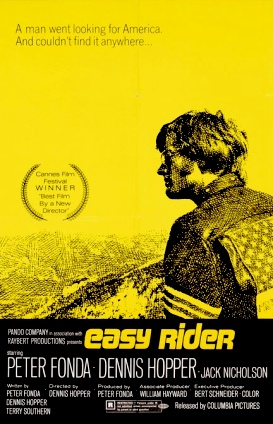
Easy Rider (1969)

d395a-easyriderStarring Peter Fonda and Dennis Hopper, this road film follows the two young men traveling across country from L.A. after a drug deal. Along the way they meet a Hippie colony, experimenting with drugs, and simply live life as they please. Much of the movie comprises of the many pit stops they take as they make their way to Mardi Gras. Some people welcome them, and still others are hostile, especially in the South. This film does a wonderful job of portraying the counter culture generation and the experiences they had. In some ways it seems that Dennis Hopper and Peter Fonda are not really acting, but partially embodying the existence that they are already used to. One of the highlights in the film would be Jack Nicholson’s odd ball, hick lawyer who crosses paths with the two hippie bikers in a Southern jail. A stellar soundtrack including such 1960s groups like the Byrds and the Band take potentially boring biking sequences and make them some of the best moments of the film. They also often express the mindset of the generation including anthems such as “Born to Be Wild” and “I Wasn’t Born to Follow.” Although it is not the greatest movie, it holds historical importance in order to help us remember this past generation.

4/5 Stars

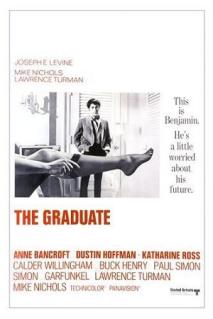
The Graduate (1967)

Some may see this film as a comedy drama that is not in the category of great movies. However I feel if nothing else, The Graduate is culturally significant because it ushered in an age in the late 1960s where films focused on trying to attract younger audiences. Along with its good writing this film was one of the forerunners in using popular music in its soundtrack.

*May Contain Spoilers

Starring Dustin Hoffman, Anne Bancroft, and Katherine Ross with direction by Mike Nichols, the film opens with Benjamin Braddock returning home from college. He has excelled in many ways and yet he feels bored and alienated from his parents. However the naive Benjamin soon finds himself in an affair with an older woman. This further confuses him as he figures out what to do with his life. His unknowing parents want him to date a girl attending Berkeley. Things become complicated since it turns out to be Mrs. Robinson’s daughter. Not wanting anything to happen between Benjamin and Elaine, Mrs. Robinson sabotages the relationship and tries to marry her daughter off while her own marriage goes down the tube. Benjamin who is ultimately in love with Elaine crashes the wedding and takes her away to face an unknown life ahead. With the help of a memorable Simon and Garfunkel soundtrack, this film ushered in a new age geared toward the younger generations.

4.5/5 Stars


2001: A Space Odyssey (1968)

I have to admit that this sci-fi film directed by Stanley Kubrick left me feeling let down. The movie itself is split up into four parts, the first beginning in the prehistoric era with a group of apes. Over time a mysterious structure appears and the apes learn how to make tools. From there it cuts to the exploration of space where man goes to Jupiter and beyond with the help of HAL 9000, a skilled but dangerous computer. The classical score is quite good working with the visual but sometimes it seems the movie is lacking in other areas. There is minimal dialogue, it seems that there could be better editing aside from the famous jump cut near the beginning, and the plot jumps all over the place. What I take away from it is the progression of man over time. The fact that there is really no memorable character except the non-human computer is also interesting. Finally, this film was made before the moon landing so in a way it was ahead of its time. That being said it still was not my favorite film.

4/5 Stars