
 As the film opens we watch a foot slowly wiggling its toes. It’s nothing extraordinary because we’ve undoubtedly seen this millions of times. If not on film then at least in our own lives. But it’s what the foot does that piques our interest. Quite dexterously but still straining, it manages to pull a record out of its sheath, set it down on the player, and lay down the needle before music finally emanates out. This simple act gives us some profound insight into the story that we are about to invest ourselves in.
My Left Foot, directed by Jim Sheridan and carried with an early tour de force performance by Daniel Day-Lewis, is an excruciatingly tortuous movie to watch at times. It follows the real-life narrative of Christy Brown, the future painter, poet, and writer who grew up in Ireland only capable of moving his left foot.
Neighbors in the community look at Christy as the bane of his family. He is his kindly mother’s unfortunate cross to bear. And true, his childhood existence is a humble one and his parents don’t quite understand how to empower him, but they still are devoted to him. His mother is the nurturing one and his father sees him as a cripple, but he loves him in spite of it.
As Christy is growing up there’s time for playing football, spin the bottle, and trying his hand (or rather foot) at watercolor. Because the truth is, Christy is a highly intelligent, creative mind only looking to express himself. And his mother continues to build him up with encouragement. In fact, Brenda Fricker’s performance brings to mind all the strong, grounded mothers in the vein of Jane Darwell’s Ma Joad. You can even find a little How Green Was My Valley or The Quiet Man in the family life.
However, it is speech therapy which becomes the next step in Christy’s development and his therapist does so much to open up his world. It’s hard for him not to feel attached and feelings of affection towards her. But as we find out over time, he’s as much a volatile creative force as he was an emblem of perseverance. Because he did not simply sit back, and when he learned to verbalize his thoughts there was a torrent of passion and perhaps even harbored anger that was finally released.
In no scene is this more evident than the one in the restaurant where his longtime therapist Eileen says she is going to marry another man, and aside from his pernicious words and his not ceasing to drink, Christy brings the conversation in the entire establishment to a standstill. In his defiance and anger, he breaks glasses, pulls off the tablecloth, and even threatens bodily harm.
But even when his pride is injured, Christy still remains faithful to his mother and father. His family life prospers even after the untimely death of his and pretty soon his career as an author flourishes after the publishing of his autobiography.
It’s up in question whether or not Christy Brownreal-lifeife received such a happy ending as this cinematic adaptation, but there is no doubt that the film gives the audience a jolt namely thanks to Day-Lewis’ complete dedication to his part. This film much like the likes of The Diving Bell and the Butterfly or even the Theory of Everything allows for great performances, but it also relies on these same actors to use constraints to their advantage. Watching Lewis is a masterclass education in what it means to truly don a role. In this case, My Left Foot truly benefits from it.
4/5 Stars
 If you’ve read any of my reviews on the original trilogy, you undoubtedly know that Star Wars had a tremendous impact on my childhood. That’s true for many young boys. It was the film franchise of choice, and it wasn’t just a series of movies. The beauty of Star Wars is that it encompasses an entire galaxy of dreams beyond our own. It’s a world that reflects ours in many ways — the difference is that they have lightsabers. But not just lightsabers. Aliens. Spaceships. Planets. The Force. Characters who for all intent and purposes live like us. Good, that is in constant conflict with the evil in the world. It’s a struggle that is constantly evolving.






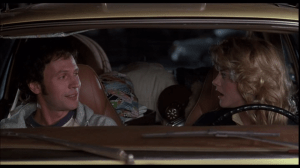 “Men and women can never really be friends”
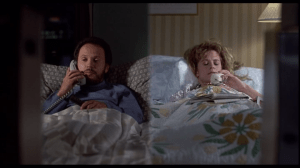 Now they have late night chats as they lie in bed listlessly or they grab a bite to eat at the local deli. In that perceived transitional period of loneliness, they find comfort and companionship. They discover what a platonic relationship can be without sex. Except much of their time is still spent talking about love and sex. Harry and Sally are so preoccupied with such topics they probably don’t even see what’s happening to them.
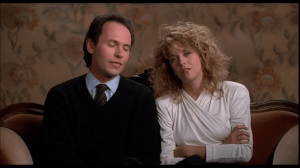 Bob Reiner’s When Harry Met Sally… works unequivocably because, in many ways, it helped define many of the unspoken rules of the rom-com following the mold of Woody Allen’s Annie Hall. Overall, the addition of Harry Connick Jr.’s music gives the film a jazzy feel rather reminiscent of Allen’s work. In fact, it does feel like Reiner emulates Allen and in this case, mimicry is the highest form of flattery. Meanwhile, Nora Ephron’s script is often inventive, creating future cliches rather than falling into old ones. To his credit, Billy Crystal is able to play his role with sincerity and sarcasm when necessary, while Meg Ryan is full of a feisty vim and vigor in her own right.
 4 Star Films