The Hurt Locker (2008)

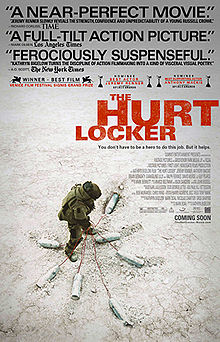
220px-HLposterUSA2Being ignorant of the term “Hurt Locker,” I did a reasonable thing and looked it up. According to IMDb:

To put someone in a “hurt locker” is to physically mess someone up, badly. It is roughly synonymous with causing someone “a world of pain.” According to the movie’s official website, “In Iraq it is soldier vernacular to speak of explosions, as sending you to the hurt locker.”

Well, that about sums it up, and it does so, beautifully by getting to the core energy that pulses through this film. It gets dicey and intense when these highly trained individuals are put into the most volatile of situations. It doesn’t get more volatile than bomb detail, and how they maintain composure in such circumstances is a miracle, a testament to grit and willpower. That’s not to say they don’t go through their own moments of turmoil. How could you not, at least at some juncture?

It struck me that this film does not feel like a political statement, even less so than Bigelow’s other war epic Zero Dark Thirty. In a sense, that would be a major disservice to the men who fight, by taking all the attention off of them and instead placing it on agendas and politics. However, all of that is left to the politicians, and we simply are given a very small taste of what those fighting the War on Terror experience. Can we fully comprehend it? No, but at least now we have a better idea of how post-traumatic stress disorder can develop. The constant strain that these people are going through takes its toll physically and emotionally. Yet they still push through their tours in order to do the job that has been handed to them. They brave a world of suicide bombers and ambiguity that could quickly send you into the hurt locker. In that way, it reminds me of a modern take on Battle of Algiers, because not everything is as clear-cut as we would like it to be.

The Hurt Locker follows Bravo Company during the tour of duty. Their first disposal expert (Guy Pearce) meets with tragedy and his buddies are forced to welcome a new member to their team, Sergeant William James (Jeremy Renner). He hasn’t disarmed 873 bombs for nothing, but he maintains such a streak by being very cavalier in his conduct. He’s a maverick, a man who will unflinchingly ditch all communication in order to focus on the task at hand. He’s a bit of a loose cannon and that’s not always the best type of personality for such a tightly knit group. They have to be if they want to survive since such behavior can be the difference between life and death. There’s a camaraderie and a rapport that builds over time, but before that he causes his compatriots to squirm more than once, and when they squirm we’re positively crawling out of our skin.

Shot in Jordan, quite close to the real-life locales, there is a gritty and raw quality to how Kathryn Bigelow frames the world with the help of cinematographer Barry Ackroyd. It manages to be personal and unsettling all at once. In comparison, it’s invariably striking how stagnant American life is when James returns home.That’s potentially a good thing, but does it mean that we’re taking life for granted, or living eternally thankful for each day that we still have breath in our lungs? That’s what The Hurt Locker does. It gives us a deeper respect for these men and a deeper appreciation for life.

4.5/5 Stars
After The Wedding (2006)

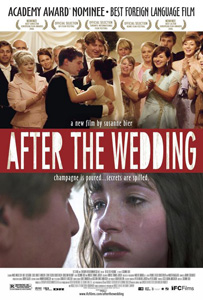
After_the_WeddingThere is a scene in After the Wedding where the new bride Anna gets up and announces that it’s not usually customary for a bride to give a toast, but something is bound to go wrong at some point, so she might as well get it over with. It’s like she’s unknowingly cushioning the blow. She does not know, and the audience certainly doesn’t know, the gravity of what she says next. There are two people in the room who do. Anna voices how much she loves her parents even though she realizes Jorgen is not her real father, she cherishes him all the same.

I try and not use the label “tearjerker” lightly, but with this Danish film from director Susanne Bier, I mean it wholeheartedly. It cuts so deeply because there’s a bitter-sweetness to it that lingers, and that only occurs when you’re actually invested in characters. We meet Jacob first (Mads Mikkelsen), a middle-aged man, who seems to have built a rewarding life teaching in India. But on a trip back to his homeland, to hopefully acquire some funding, he comes across a familial secret that impacts him greatly. It all happens because the friendly businessman Jorgen invites his new acquaintance to his daughter’s wedding the following night. We get the film’s main jolt during the wedding and the whole story is never the same afterward because it flips everyone’s life upside down.

The next big revelation comes out when loving wife Helene presses Jorgen about his heath. Anna has her own problems when she walks in on her new husband with another woman. These up the drama, but it’s important to make it clear that this story doesn’t rely on soppy drama to maintain the stakes. The peaks are powerful, but even in the valleys, it keeps our interest. Certainly the melodrama is deeply jarring, however, it only delivers such an impact, because the people involved are far from one-dimensional cardboard cutouts. This could have easily becomes some Danish attempt at a telenovela and yet it does not. Far from it, Jacob, Jorgen, Helene, and their daughter Anna are figures, who we can almost feel the contours of. They bring to mind glimpses of friends or family perhaps. Generally good folks, who have made mistakes along the road.

In his past, Jacob acknowledges a drinking problem and sleeping with other women. Now he runs an orphanage in India and he’s matured greatly. Helene admits to not knowing all the answers for the decisions she made as a young woman. She probably should have done things differently, but the bottom line is that she loves her daughter deeply and is completely devoted to her husband. Jorgen might be a mogul and a powerful man, but he also has a deep devotion to his family. Seeing him with his kids you know he is a good father because he loves and provides for them in all possible ways. He actually makes time for them and it shows.

Hellene voices the audiences concern that all this drama is too great of a coincidence, but overshadowing that detail is something very heartfelt that Jorgen says. When he knows he probably doesn’t have too much more life ahead of him, he voices the sentiment that time is so utterly important. Furthermore, every relationship, every acquaintance we make, is important to life. Without those, life is meaningless. That’s the core of this film. It’s people parsing through the mess and finding what’s important. That’s what keeps Jorgen and Hellene together. That’s what makes Anne cherish her parents so deeply. That’s what makes it so difficult for Jacob as he weighs whether to stay in Denmark or go back to India.

4/5 Stars

Finding Nemo (2003)

Finding_NemoI don’t usually do this because it dates me, but I still remember buying Finding Nemo on DVD, because it was one of the first films I ever bought. It was one of the first films I ever felt was worthy enough to spend my hard-earned birthday money on or whatever the case was.
Certainly, I jest, but I also say this to note just how impactful Nemo was for kids of my generation. Pixar, in general, has left an indelible mark on many folks, but Finding Nemo had it all, garnering inspiration from the vast underwater worlds of the great ocean blue. And as they always do Pixar is able to wholly animate, literally bring to life and attribute human characteristics to non-human subjects, whether they be toys, fish, monsters, cars and so on. But Nemo was near the top of the creative spectrum, and a lot of that sits squarely on the shoulders of its characters. It was the brainchild of Andrew Stanton and with the subject matter of a young clownfish and his overprotective father he found true narrative gold.

However, it was really the supporting characters that color all portions of the frame. First and foremost in\s Dory (Ellen Degeneres), the insanely positively and joyously scatterbrained blue tang who joins Marlin (Albert Brooks) in his quest to find his son. She is the perfect foil to bounce off his dour sensibilities. In time connecting him to a band of recovering sharks with a heavy fish addiction, a band of ultra chill sea turtles, and a silently charitable Blue Whale who propels our two heroes toward their final destination: P Sherman 42 Wallaby Way.

But of course, there are always two sides to every story and Finding Nemo does well to work from both angles. There’s the father who goes on this epic hero’s journey and the lore of the mighty clownfish searching for his lost son begins to take the ocean depths by storm. Meanwhile, Nemo has been placed in captivity against his will in the fish tank of an idiotic orthodontist but spurred on by news of his father, he gains a new resilience. He resolves to make his way back to his dad because he realizes just how much his father cares. It’s a galvanizing experience and he proves just how much he is capable of. Because he disregards any hint of inferiority and realizes his potential–the kind of potential that is not reserved for certain types of individuals, but really anyone who is willing to step out in courage. And that’s how Nemo concludes, by suggesting the importance of family and really pushing ever onward. Just keep swimming. Just keep persevering.

As we wait in exuberant expectation for Finding Dory, it’s nice to reevaluate this modern classic and be rewarded by the pleasant surprise that it truly does hold up even after all these years. The animation is still wonderfully immersive, the characters compelling and the script boasts not only master storytelling from Andrew Stanton but a remarkable melding of both humor and heart. In the modern generations, that’s an extraordinary precious combination and not something that we see all that often. That’s what makes Finding Nemo enduring, and it endures not only for children, but any demographic or audience really. Because Pixar never talks down to their audience or marginalizes certain groups with their humor or a very particular brand of storytelling. In fact, their storytelling is almost classical like the films of old, which were meant for the masses no matter age, beliefs or inclinations. It’s for everyone and it’s a wonderful gift in a century that so often is restrictive and exclusive, even despite its best efforts.

5/5 Stars

In Bruges (2007)

In_Bruges_PosterNear the end of the film, one of our main characters questions whether or not being stuck in Bruges is the equivalent to being in Hell. However, far from badmouthing the Flemish city, director Martin McDonagh actually makes it a fascinating backdrop for a film. It’s a city full of history, romanticism, mystery, and even peril. It just depends on how you look at it, with eyes of reverence or general disdain.

In Bruges, the film, only happens because two men have to make a quick getaway after knocking off a target in London. That is the life of a hit man. Quick work and then long periods of waiting. That is the majority of what we witness, following the existences of Ray (Colin Farrell) and Ken (Brendan Gleeson). Ray is a bit of a jerk sometimes and to him, Bruges is a living nightmare. Completely and utterly dull. But then he happens upon a fantastical film set starring a dwarf. There a beautiful woman Chloe (Clemence Poesy) catches his eye and then Bruges doesn’t seem so bad after all. At least for now.

Then there’s Ken. He’s not looking for casual companionship or booze. He has respect for the arts, the places of worship and the culture around him. Both men share foul Irish mouths and a general jadedness about their profession. After all, being a hitman is a living, but as Ray finds out it’s not without its stress. Shooting a little boy on accident takes its toll, and Ray must contemplate the entire framework of his morality. Meanwhile, Ken sticks by the phone and gets a call from their fiery boss Harry (Ralph Fiennes). He gets an order, and it catches him off guard. He already has his next assignment, but now he must attempt to reconcile orders with personal conviction. These are hitmen with a conscience.

Scum of the earth, yes, rough around the edges, maybe, yet somehow they still reveal their humanity. The miracle is that through the violence, we still find common ground to relate with them. We become thoroughly involved in this tale that, while darkly funny, is most certainly moving. When all the shots are fired, what we’re left with feels like a Shakespearian tragedy sprinkled with the absurdity of Bosch. Place all of this in front of the quaint Flemish setting and you have a rewarding adventure. I also recently saw Hot Fuzz and it seems that these films could almost be watched in tandem. Aside from both being British productions, they both have action, violence, and dark humor, but perhaps, more importantly, they exhibit genuine heart. That’s something not to be taken too lightly these days.

3.5/5 Stars

Hot Fuzz (2007)

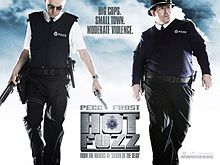
220px-HotFuzzUKposterWhen we go to see the latest action movie are we consciously thinking about what we are ingesting, what the motives of the characters are, or even the film’s title? More often than not the answer is no, because we want to be entertained, like Romans attending gladiator battles. We want thrills above content, without considering what we are being fed. In the line of these types of films are Lethal Weapon, Point Break, and now Britain’s addition Hot Fuzz.

It’s the story of probably, the most industrious, skilled, highly-trained policeman you could imagine. His name is Nick Angel (Simon Pegg) and he’s a butt-kicking, paperwork-completing sergeant, who is making the rest of the force look bad. He has the potential to be a great action hero. Enter in Martin Freeman, Steve Coogan, and Bill Nighy, and they agree to reassign him to the sleepy of village of Sanford, and all his dreams are kaput. Ambition will lead him nowhere in such a town, and it feels more like Mayberry than the locale for a great action flick.

But being as diligent as he is, Angel makes strides even before he starts his first day. Among one of his arrests at the local pub is fellow police officer Danny Butterman (Nick Frost), who also happens to be the son of the police inspector. It’s rather a strange introduction, but of course, the two of them are partners. Nick simply tries to tolerate all those around him, but it proves difficult, and he’s a little taken aback by the geniality of the locals. They all seem to know his name.

However, when a string of grisly murders takes place successively around town, Angel has what he wants, something to investigate. Again, everyone around him says it’s all been a line of unpleasant accidents. They aren’t willing to face the reality that their sleepy little town might have a murderer on the loose.

As you might expect Angel and Buttermann actually begin to build some rapport despite how different they are. However, Hot Fuzz also has a major twist that frames this entire story in a different light. And although the film does exhibit its share of violence, it also has a wickedly funny streak running through it. At times that means laugh-out-loud antics, courtesy of Nick Frost, or maybe uneasy giggles when someone bites the dust in an outrageous manner.

Edgar Wright’s film is also noticeable for its rapid editing, involving quick cuts, flying transitions, and slicing and dicing. It keeps the story at breakneck speed and yet there is a great pathos built around its characters. We actually begin to care for Nick and Danny, which is often not the case in superficial action flicks. But that’s just it. Hot Fuzz is a satirical homage to all the cop/buddy movies out there and it has its share of action, and yet there’s more to it. In other words, action films are not just skin deep. Hot Fuzz proves that resoundingly. It’s a throwaway title maybe, but not a throwaway film.

4/5 Stars

Shaun of the Dead (2004)

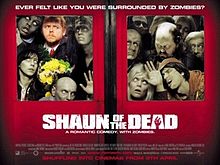
220px-Shaun-of-the-deadImagine that, it took me until after I finished the film to realize that its title was an obvious homage to Dawn of the Dead. And why not, because this comedy-zombie film celebrates the genre and George Romero’s lineage, while also carving out its own little niche. Really, this first installment from Simon Pegg and director Edgar Wright is brilliantly clever in its own right.

What I’ve come to recognize from their partnership is that they are all for the gags, the gore, and excitement, but they also have a handle on emotional impact. The worlds they build through script and character are certainly fun and engaging. I’m not even a big fan of zombie films, but this is probably one of my favorites and that’s because it’s more than just a superficial apocalyptic romp. Heaven forbid I actually care for these characters, but I do. Even Nick Frost, who is oftentimes a real idiot, but even he still finds ways to endear himself.

Simon Pegg goes through your typical hero’s journey, it’s just that it involves a lot of zombies. He begins as a washed-up assistant manager in a dead end job, with a romantic relationship that he’s really messing up. His girlfriend isn’t too happy with him as of late, and after 17 years he’s still at odds with his step-father (Bill Nighy). Meanwhile, his best friend Ed (Nick Frost) is making a nuisance of himself, playing video games and doing little else. It’s a real humdrum life that Shaun’s partaking of. You can see it in his demeanor, even his posture. If you didn’t know any better you’d think he’s a zombie or something. It’s true that Pegg and Wright have fun with a few gags like this, and even when the zombies take over the streets, Shaun hardly seems to notice. He’s so far gone in his own personal funk.

But in his case, a zombie apocalypse is just what he needs to kick-start his life again. He gains new meaning, asserts himself, and acknowledges how much he cares about those around him. He also gets to bash rows of zombies with a cricket bat and blow them up with a Winchester rifle for good measure, while saving his girlfriend Liz (Kate Ashfield), so that’s a major bonus.

Edgar Wright’s style is very dynamic and in your face, but within all the hubbub there are real moments of sincerity that elevate Shaun of the Dead not just above a lot of other zombie movies, but a lot of movies in general. Forget simply a zombie flick. This is a romance, a buddy film, and a redemption story all wrapped up into one. Simon Pegg proves himself as a leading man, who we would willingly follow during an apocalypse, especially given the other choices at hand.

4/5 Stars

Punch-Drunk Love (2002)

punchdrunk1When Paul Thomas Anderson said he was making a comedy with Adam Sandler, people undoubtedly scoffed at him. I know I would have if I had known about this film back then. However, he proved that you should never question him as a director. Much like a Kubrick or a few other auteurs, I’m not necessarily the biggest fan of Anderson, but you have to admit his films are interesting and very much their own entity.

Punch-Drunk Love is a comedy certainly, but not in your typical sense. It’s a romance, but it’s not quite like any romance I’ve ever seen. Thanks to the bolstering performance of Adam Sandler, it’s whimsical and odd. He plays Barry, a rather passive and antisocial type, who seems constantly quelled by the dominating personalities of his many sisters.

He’s obsessed with buying up pudding for a chance at frequent flyer miles, he picks up a harmonium tossed on the road-side, and most of all he’s lonely, but he’s not comfortable going on dates. His sister tries to set him up with a nice friend of hers who happens to be British (Emily Watson). Barry rejects an offer to go out to breakfast with them and out of loneliness calls a phone sex line. Out of stupidity, he hands over his credit card info, and the rest becomes a big scam that he can’t escape.

Thus, his work phone at the office is ringing off the hook from a girl trying to steal his money. His sister is continually trying to set him up, and Barry seems to live in his own little weird world at times, overflowing with his own personal odd ticks and quirks. He also has an anger problem, meaning he’s bad news if you give him a hammer.

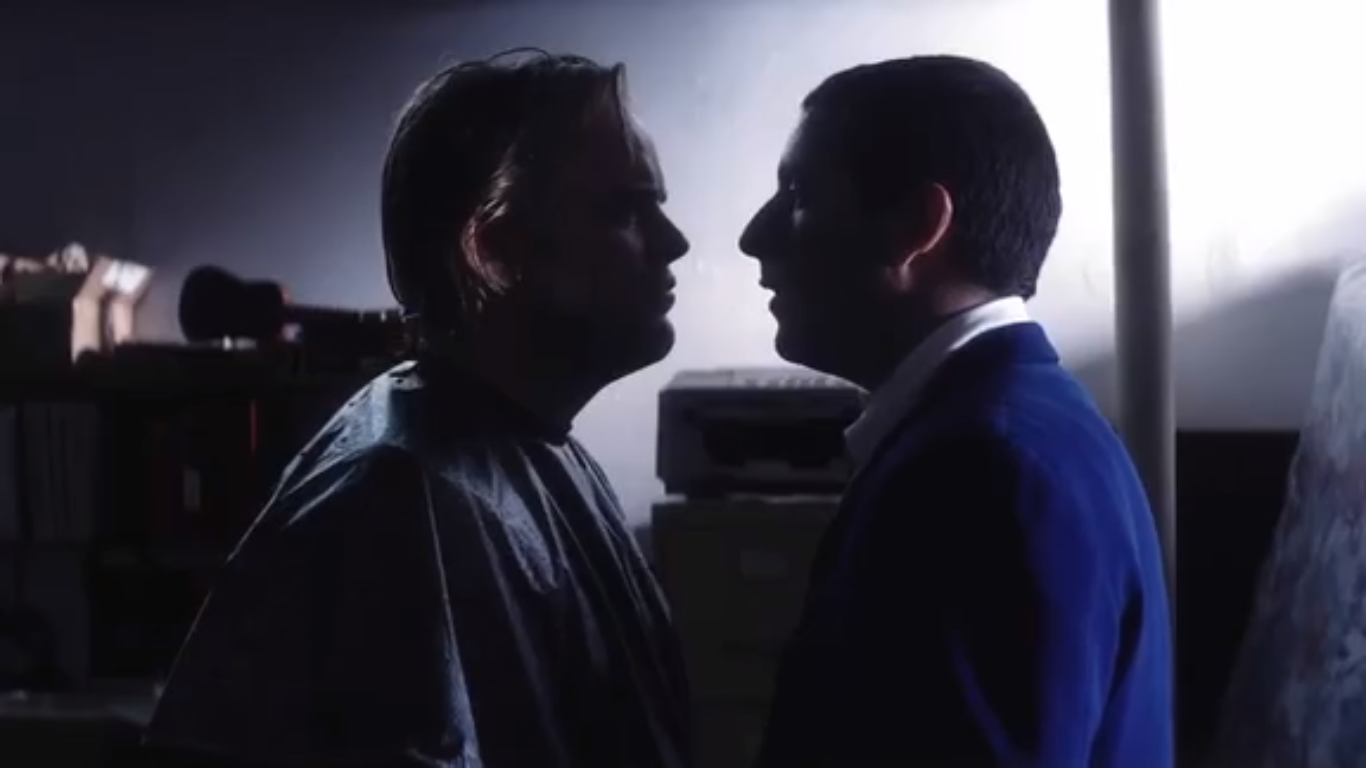
punchdrunk2At times the film is thoroughly unsettling and nervously, uncomfortably funny, thanks in part to Sandler, but also the pervasively weird sound design that utilizes the harmonium. At his core, Barry is a lonely and confused man, aren’t we all, and it reveals a depth to Sandler that many probably have not seen before. It helps that the sweet Emma Watson makes us believe he is likable and in truth, he is somewhat endearing in how he can get lost in an apartment building or always wears the same blue suit. He even follows her to Hawaii for the sake of love. But don’t get any wrong ideas. This is nowhere near the realm of 50 First Dates.

3.5/5 Stars

Atonement (2007)

atone2Without any prior knowledge and given what we know to begin with, it looks like Atonement will be a love story revolving around the characters of Keira Knightley and James McAvoy. They are, after all, the big stars in this WWII era romance based on the Ian McEwan novel. We expect to become enraptured in their passionate love affair that is to be indubitably broken up by war. However, it becomes evident very quickly that this is really a tale about a young girl  and budding author, played through the years in succession by  Saoirse Ronan, Romola Garai, and Vanessa Redgrave. It is her point of view and her part in this narrative that becomes most important, although we do not have any indication as to why to begin with.

So in front of the peering eyes of Briony Tallis, her older sister Cecilia (Knightley) and the son of the family housekeeper Robbie Turner (McAvoy) start something which Briony cannot fully comprehend and understand. What is it that is really going on around her? An intricate manipulation of time and place begins, relating the story from a number of perspectives, but always returning to Briony. How does Cecilia really feel towards Robbie, who is in a sense below her, but still proud? Briony knows she has feelings for the housekeeper’s son, but how is she to react when she finds her sister and Robbie crammed up against the bookcases together. Then, when a pair of pesky twins goes missing a search party begins. Again Briony sees something that she cannot fully understand, and yet she makes a judgment that will unwittingly tear apart two lives. There is constantly an inquisitiveness, a confusion in her expressions that is absolutely spot on.  And in these moments the score is suffocating with its pounding, clanging, and banging.

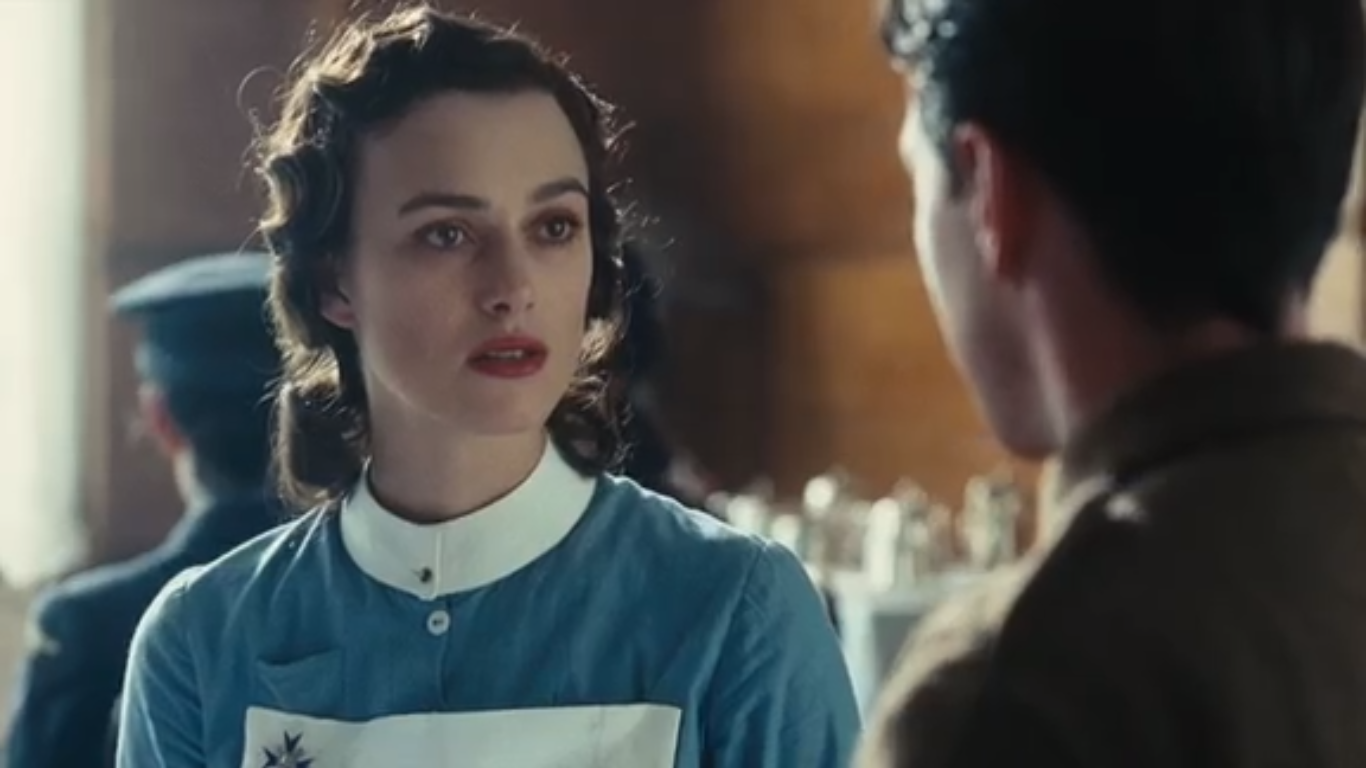
atone3Robbie gets sent away, torn from his love Cecilia, and Britain is on the brink of war. When the two lovers finally get a chance to see each other, he has joined the army in order to be released from prison, and she is working as a nurse.  But it’s a heartbreaking separation because although the passage of time is condensed for us, we can easily see the reserved, hesitant quality in both of them. How are they supposed to react? It’s difficult to hold onto the same feelings, maintain the same type of passion when you’re separated by the years. Cee reaches out to touch his hand, and he avoids her slightly. You cannot exactly blame him, but there is a tinge of sympathy for her.

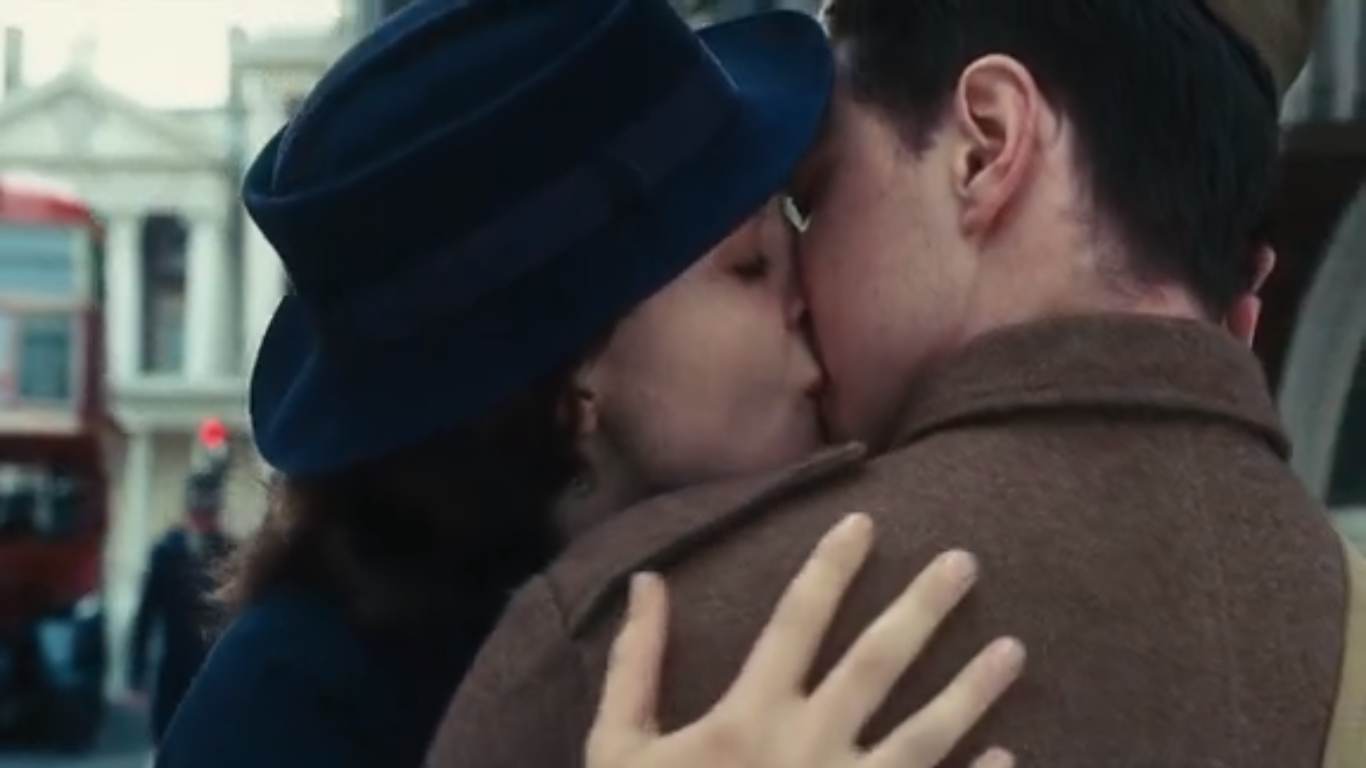
But their romance is quickly renewed and heightened once more in a matter of days, only to have the war this time pull them apart. And it’s something that’s very hard to rebound from. Robbie ends up in the middle of France and when he finally discovers the coast with a couple of comrades they come across all the forces at Dunkirk getting ready to retreat. For those engaged with WWII history, Dunkirk was in one sense a wounding blow to the English ego, but also a testament to their resilience. The men are beaten and battered, but escape the Nazi onslaught to fight another day. And yet we don’t see the fighting. With a wonderfully dynamic tracking shot director Joe Wright gives us an eye into the tired and wounded masses. And it’s somber, chilling, melancholy, and still strikingly beautiful in the same instance.

atone5Back home, Briony is now working in a hospital almost as penitence for wrongs and soon the hospital is inundated with wounded from the retreat. She is quickly thrown into action comforting a dying French soldier with a penchant for the soft refrains of Debussy. Then, comes the pivotal confrontation where Briony, now older, faces her sister who has refused to talk with her. And Robbie is there too. Together they painfully and angrily point out what the young girl had done to both of them. It’s heart-wrenching to the nth degree and yet the final revelation makes it all the more painful.

Now many years down the line, Briony, who is now much older (Redgrave) and an author of 21 books, is interviewed about her final novel Atonement. It lays out the events of the whole film, and she explains her reason for writing such a story. She wrote it to be read by the public certainly, but most importantly she wrote it for Robbie and Cee. To give them closure and the dignity that they deserved.

So you see, it’s the book within the book really or more correctly Ian McEwan writing a novel called Atonement featuring a fictitious version of the same work. In a sense, I do feel manipulated by this film, but do I mind? Not really. I don’t hold it against the film because it tells its story with so much beauty and grace.

4/5 Stars

Once (2007)

once1Only sometime after the film ended did I come to the realization that we never learn the names of our two protagonists. And yet we build such a connection with them through music, through their bits of humanity, and from being a part of their lives for a short time. Because Once really does feel like a documentary. It feels like we’re meeting these people and peering into their lives for an hour an a half of sheer delight.

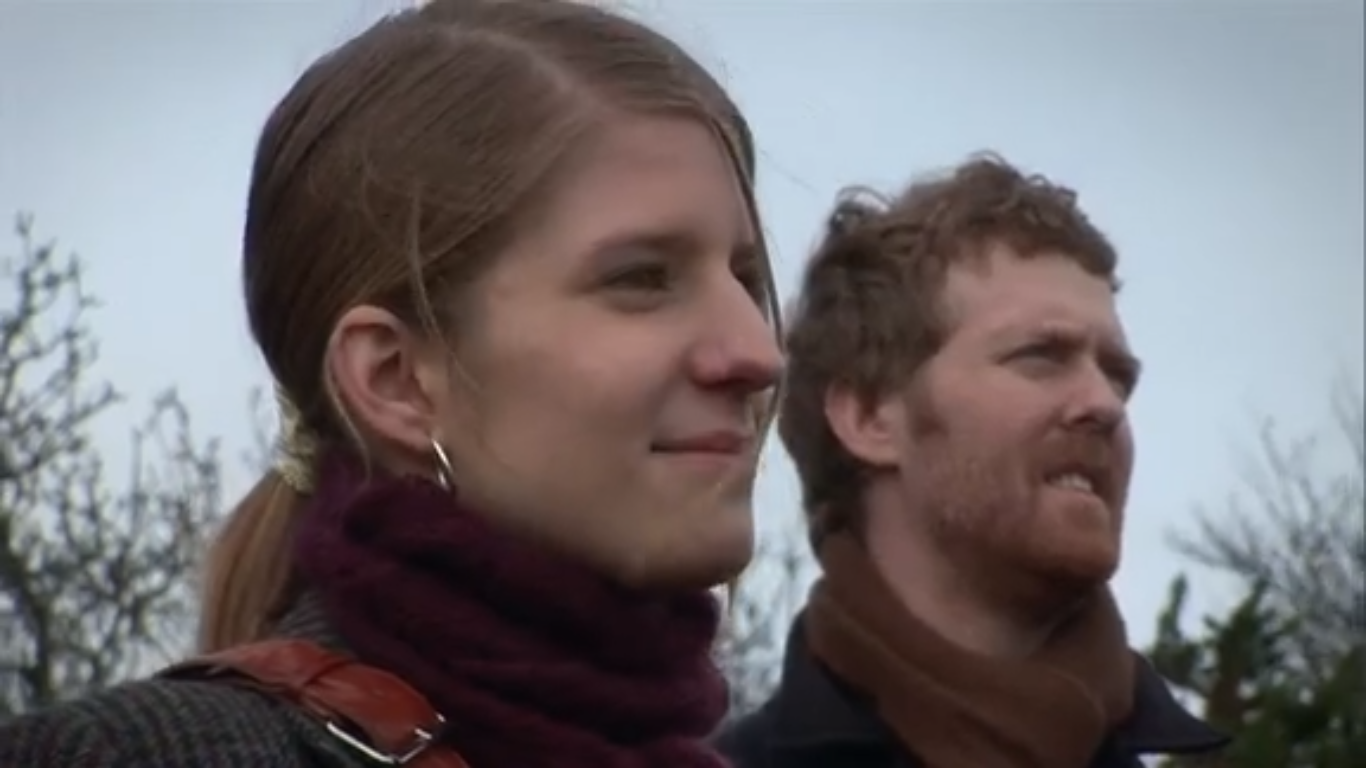
The guy (Glen Hansard) is an Irish street performer who can be found on the street corners, guitar case open, strumming away, hoping to get a buck or two. He’s good but nobody much seems to notice him. It’s as if people see you doing such a gig and think you must not be very important. I must admit I’m guilty of such a fallacy myself many a time.

But there is one person who does come up to him. It’s a girl (Marketa Irglova), very straightforward and direct, and we learn she is Czech. What could two such people have in common? Music. Of course. The universal language even more so than English. Because she obviously has an accent and he does too, to my American ears, but their music transcends cultures.

It’s easy to forget Once technically functions as a modern-day musical because more often than not the genre seems like a dying breed. The songs in this film are beautifully melodic, with wonderfully earnest lyrics, and equally well-wrought instrumentation. But it fits into the narrative and nothing feels like a forced plug to get our respect.

They’re laying it out there. Letting us into their homes and keeping all their feelings out in the open. Really they both have a humble existence, and each has had their own romantic pasts. He has memories of a love who now lives in London and despite her young age, the girl has a husband she left behind in her home country. It’s a surprise to him and the audience both.

once2Their ride on a motorcycle, for a brief instant, brought to mind the Vespa ride in Roman Holiday, although their excursion is a little less chaotic. There’s still an innate playfulness of people with wonderful chemistry and whether they are acting or not is anyone’s guess.

Everything goes back to the music though since that acts as the heart and soul of this story. When the pair of them are able to get a recording studio it looks like he might get his big chance. He invites her to sing because he really wants her to be a part of it. He rounds up a few more street musicians and they’re set. When they get to the recording studio and the tape starts rolling what follows is a performance bursting with passion and energy. You can feel the electricity.

It feels as if we’re on the ground floor of something special, unwinding right before our eyes and yet we don’t know exactly what is going to happen. He’s about to head off to London to show off his sample and perhaps catch up with an old flame. She is preparing to make amends with her husband. But before leaving the guy drops a very big present on her doorstep to thank her for all she’s done for him.

Their tune “Falling Slowly” plays in refrain summing up this music-infused love story. The question is, is this an actual love story? I would answer in the affirmative. There is no sex in the contemporary sense, but this film does most certainly have love, whether or not it becomes physical. And it acknowledges the clear distinction between sex and love. These are two people who deeply care about each other and share a connection more intimate than most people can manage.

4/5 Stars


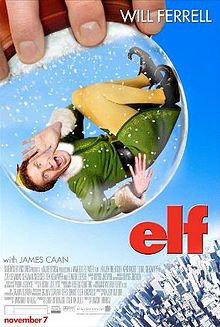
Elf (2003)

220px-Elf_movie“The best way to spread Christmas Cheer is singing loud for all to hear.”

Elf is truly a Christmas miracle. It’s a relatively modern Christmas classic (a bit over 12 years old) that holds its own in a season usually dominated by old perennial favorites. Yet, again and again, it constantly excites, mesmerizes, and bedazzles in more ways than one.

Will Ferrell is the major treasure of Elf because, without his child-like wonderment and sincerity, this film could go downhill all too quickly. Buddy walks into female locker rooms, walks around New York in an Elf suit eating discarded gum, and calls his grown-up father “daddy” in a musical serenade, after all. But to his credit, Ferrell goes for it wholeheartedly completely engulfing himself in a magical realm that bewitches every other character who decides to join him. Everyone else walks in abject reality, but Buddy like Elwood P. Dowd (Harvey) or Dudley the angel (The Bishop’s Wife) exist outside of that and when they rub up against everyone else, they leave everyone, including the audience, changed.

From the outset, Elf comes right out of a storybook as Papa Elf (the venerable Bob Newhart) recounts how a human and his adopted son saved Christmas. Of course, it starts out as a sorry tale, because truth be told Buddy cannot figure out what his purpose in life is. What is he good at? What are his talents? For all the other elves it’s obvious: they make toys.

But when Buddy finally learns of his secret past he leaves his papa behind in a tearful goodbye, gains some sage advice from Santa (the equally venerable Ed Asner), and heads off on an iceberg to find his real father in the Big Apple.

There must be a catch, and there is a small one, Buddy’s father Walter Hobbes (James Caan) is on the naughty list. In fact, he’s a real Scrooge working slavishly day after day as a children’s book publisher. But you see Buddy doesn’t see people for their faults and that’s the secret of Ferrell’s success because his innocence and irrepressible will towards his fellow man is contagious. New York might be a culture shock and Hobbes as well as his young boy Michael are not too thrilled with Buddy’s arrival, but that’s because he’s so foreign – so nice. Ultimately, he becomes the best thing to happen in their life.

In truth, Buddy goes transforming New York systematically whether it’s the Hobbes’ home, Gimbel’s Department Store, or wherever his feet take him. And of course he finds love in his world-wearied coworker Jovie (Zooey Deschanel) and saves Christmas, but that’s nothing unexpected. It’s not the results, but how we get there that counts – all those quotable moments in between.

Too often I feel bludgeoned to death by all the new takes on the Christmas season annually jostling for my affection. But the beauty of Elf is that it pays its respects to the past, thereby solidifying its own timelessness in the present. It doesn’t have to be the next big thing, but it is something that I would gladly sit down and watch annually, because of its spirit and seasonal charm. We get nods to A Christmas Story and Ralphie, an homage to George Bailey on the Bedford Fall bridge, and even Miracle on 34th Street (Buddy working at the rival Gimbels).

The music never steals the show but it does accent some sequences nicely including the voices of Louis Prima, Stevie Wonder, Ella Fitzgerald, Frank Sinatra, and so on. Each character fits well in director Jon Favreau’s narrative. The manager (Faizon Love) is a crack-up. The hired Santa (Artie Lange) is a thug. Peter Dinklage is an angry elf. James Caan is grumpy and cynical. Zooey Deschanel is pretty and cynical. Ed Asner is an endearing grouch. Bob Newhart has his usual stuttering charm. And Ferrell wraps it all up nicely with a pretty bow. Although it does completely sidestep the origins of the Christmas holiday, Elf does what it set out to do very well. It exudes Christmas spirit unabashedly.

“Christmas spirit is about believing, not seeing.” – Ed Asner as Santa

4/5 Stars