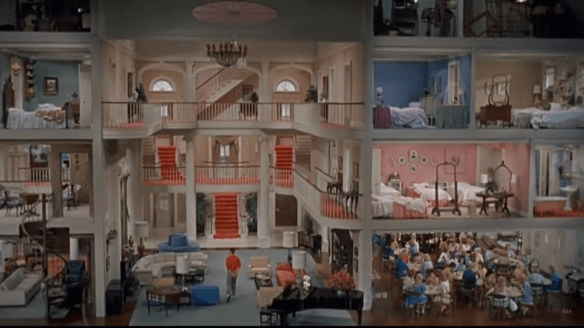
Kiss Me Kate (1953): A Musical and Meta Entertainment

kiss me kate 1.png

The film version of Kiss Me Kate, helmed by MGM’s perennial musical director George Sidney, is a translation of Cole Porter’s rousing Broadway success. We must play a game of two degrees of separation because the stage smash was itself a comical backstage adaptation of Shakespeare’s Taming of The Shrew. I cannot necessarily attest to where one begins and the other ends, between stage, film, and original play, since my own knowledge is shoddy at best. So I will contain my thoughts to the story at hand.

At its core are the strained relations of a formerly married couple composed of two prima donna stage performers: the devilishly handsome, barrel-chested baritone Fred Graham (Howard Keel) and his equally strong-willed, alluring, and talented ex Lilli Vanessi (Kathryn Grayson). In all regards, a match made it heaven. They undoubtedly deserve each other.

The undisputed peppiness of Ann Miller, as she bursts in on them and Cole Porter (Ron Randell), is an immediate jovial assault on their relationship as she flaunts her attributes in “Too Darn Hot” and gets a little lovey-dovey with the self-absorbed leading man. I’m not sure if any audience member is shocked when she’s seen playfully prancing about with her other boyfriend (the always impressive Tommy Rall) in  “Why Can’t You Behave?”

To needlessly mix metaphors, the production is nearly sunk before it gets off the ground. And yet a mixture of persuasion, jealousy, and the quality of the material coaxes Grayson’s character into the fragile reunion. Wunderbar!

Lilli’s rendition of “I Hate Men” proves a blatantly pointed number where on stage sentiments are mirrored in her life; she doesn’t mince words raging through the set, flinging props to her obvious satisfaction.

In fact, she’s far more suited for the flaming red wig she wears on stage than her actual modest cut. The 3-D qualities come to bear thanks to the tossing of beer steins and flower bouquets. It’s one of visual cues to suggest this very purposeful sense of the off-stage and on-stage lives merging and colliding with one another.

kiss me kate 2.png

We have the backroom interludes and then the continuous sequences of the performance photographed straight on until little discrepancies come into play to make everything run afoul.

Breaks in characters. Personal vendettas playing out on stage with each minor slap and smack in the stage directions supplied with ample fury from years of pent-up rage. Deviations in the actual production also come to pass. Namely, a cringe-worthy spanking as the midway curtain drops.

It’s in the intermittent period where Kate utters that immortal Shakespearian retort, “Thou Jerk.” In fact, there’s great fun to be had with this conscious collision of Old English prose and the contemporary vernacular. The number “Brush Up On Your Shakespeare” suggests as much.

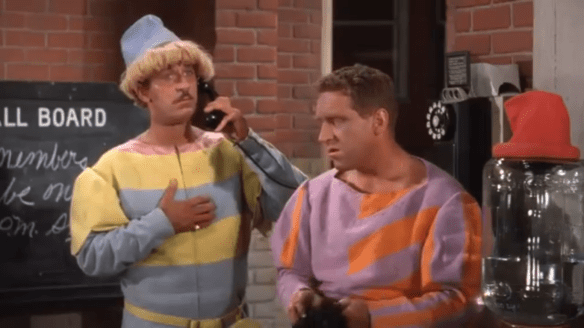
Keenan Wynn and James Whitemore are brought on to thoroughly liven up the second act as a pair of neighborly enforcers sent to visit Fred in his dressing room. They go so far as becoming a part of the production as it continues to go off script and off-the-rails. Because Kate is intent on running off with her rich boyfriend Tex (a Ralph Bellamy-type), and Graham connives to keep her around, pulling the heavies into his plan.

It feels strikingly like a His Girl Friday (1940) deal as we see our leads gravitating toward others while never finding it within themselves to completely forsake their former spouses, in spite of the mutual distaste. It’s indisputable, but it also suggest the fire still kindling between them.

Hermes Pan adds to his illustrious body of work while Bob Fosse’s choreography is almost a blip on the radar. Even then,  it’s strangely singular and expressive, charting his course toward The Pajama Game and many, many more projects to come.

Meanwhile, Ann Miller’s dancing reminds us that she’s the purest performer on taps within this picture and when given free-range, she follows up her first routine with continued verve. She does feel all over the place, but that can mostly be attributed to her character. In fact, one could affirm that she rightfully earns some of the most memorable screen time based on the uninhibited vivacity she showcases.

In its waning moments, it looks like the fictional production has finally met its inevitable end: a crash-and-burn finale, as the understudy has to rush on to take the place of the departing Catherine. In an off-the-cuff moment, playing opposite his future father-in-law’s question of where his daughter might possibly be,  Fred mutters, “Right now she should be flying over Newark.”

kiss me kate 3.png

Thus, Kiss Me Kate, at its most inventive, is hyper-aware of its meta qualities; this story-within-a-story tracing the line between the artificial and the reality projected up on the screen that is itself a fabrication of light and images. It reaches out further than most films of this type because its original release in 3-D, while admittedly a gimmick to snag the TV generation, also accentuates this razor-thin dividing line between the cinematic space and the space that the viewer occupies.

However, ultimately the production though laced with humor and vengeful lovers, quality choreography, and flamboyant set design and costuming, comes off strangely hollow in its landing. Because the ending feels false and inherently wrong.

Here is a man who is conceited and has no sense of self-sacrifice or concern for others, as farcical as he might be. Again, we could argue that Kiss Me Kate is solely entertainment, only occupying cinematic space. And yet we brushed up against everything thus far. How are we to make distinctions? In the real world, even in the 1950s and especially now, there is no excuse for Graham.

Surely, like any person, he deserves a second chance and the grace that comes from a person willing to forgive. However, one might question the way in which Lilli flies back to him. There seems to be no regard for his past indiscretions just as there’s no conversation to be had about the flings they’ve both been having on the sides. Because Kate is herself a bit of an entitled snob. And there you have this falseness most fully realized.

Life is a lot more complicated than film reality. Kiss Me Kate cannot quite pull it off because it inserts the uncluttered, picture-perfect Hollywood framing on the storyline.

Ironically, it’s actually the performance that gets continually disrupted while so-called real-life falls into place nearly seamlessly. So in the end, it matters whether you care about making a distinction between the stage and what happens backstage in the purported reality.

Because at least we can all agree that none of it is actually before us in the flesh where real lives are at stake. We can keep it at an arm’s length and laugh along with it without allowing it to influence our perceptions of this world.

Taken as such, Kiss Me Kate is a coruscating delight bursting forth, rather agreeably, with comedy and song. It can be absorbed merely as diverting Technicolor entertainment for sure. However, when we allow it to reach out and influence our worldview in other ways that’s where we might falter.

3.5/5 Stars

The Love Parade (1929): Ernst Lubitsch’s First Talkie

the love parade 1.png

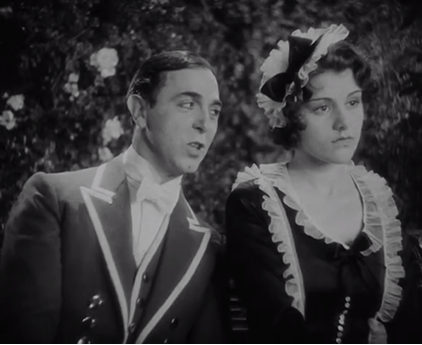
Looking over it now, The Love Parade just might be one of the finest pre-1930s musicals, capitalizing on the rising trend thanks to the success of The Jazz Singer and Broadway Melody. Whereas many of its contemporaries are mainly interesting as historical relics, this Lubitsch comedy still has some inspiration to offer, riding on its own merits alone.

The acclaimed German director’s first sound project shows no signs of a needed learning curve all but translating his command of the medium into the sound era with ease. Yes, the set-ups appear choppy due to the editing of sequences.  True, the action is often static because the camera was yet to be truly mobile. But this is also part of Lubitsch’s deceptive skill in incisively drawing our eye to whatever will give us the clearest visual cue to the jokes that he’s staging.

It’s rarely a cluttered experience though Chevalier adds to it by breaking the fourth wall, even intermittently speaking in French and English. In fact, a separate cut of the picture was made in the French-language. Also, much of the sound design was synced afterward. Both are realities of the changing times and what talkies meant for the evolution of a global industry.

But what is most striking of all is, again, Lubitsch’s impeccable handle of the visually comic because that’s something that translates from the silent days exquisitely and far from using dialogue as a mere crutch or idle chatter, in its very best applications, it’s used to punctuate the scenes with a gag.

The same goes for noises and sounds. Far from oversaturating our ears, Lubitsch almost uses them strategically giving each more import whether a whistle, a song, or erupting cannon fire. There’s a cadence in the use of noise to underscore scenes, and it feels succinct and genuinely artful.

It’s true that it’s difficult to go backward, but sometimes you wonder if filmmakers should.  Allow me to explain. The likes of Lubitsch and Hitchcock had substantial success in the modern era of filmmaking and yet they never lost their early sensibilities. It goes allow with this innate principle suggesting moviemaking was a visual medium above all else. Of course, for Hitch that meant he was the master of staging thrillers. Lubitsch will always be remembered as the king of sophisticated comedies of manners. The Love Parade is little different.

Sylvania is a country with marriage on the mind. It seems like everyone from subjects to royal courtesans are constantly obsessing over who is to be married and when. Most important of all is their Queen Louise (Jeanette MacDonald) who has yet to tie the knot. It’s very much an unfortunate circumstance for the honor of the kingdom.

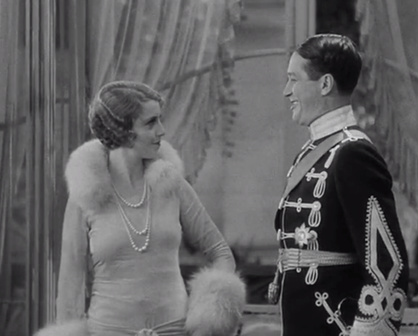
However, their savior just might come in the form of Count Alfred Renard who resides as the military attache in the Sylvanian embassy in France. But he also happens to be quite the lady’s man. It is true that the somehow deeply-rooted stereotype of Frenchmen as witty, suave romantics must at least, cinematically, start with Maurice Chevalier, before making its way through Charles Boyer and later generations.

He and the Queen gladly trade repartee in the winking song “Anything to Please the Queen” and the comic conundrum proceeds from there. He is sent before her to be reprimanded for his indiscretions, and she finds she rather likes him.

Their first dinner together carries the rapt attention of many invested onlookers from all walks of life and any number of perches, from ladies in waiting to cabinet members, and then lowly servants played uproariously by Lupino Lane and the ill-fated Lillian Roth.

the love parade 2.png

However, an onslaught of bad luck comes in full force on the wedding day including whistling, mirrors, and the piece de resistance: a cross-eyed man. Chevalier shudders at the thought until his worst nightmares come true in the form of a palace guard (Ben Turpin). The vows are spoken with a twist as the minister confirms, “I pronounce you wife and man.”

It’s summed up succinctly by one of the portly advisers (Eugene Pallette) as such, “Man is man and woman is woman. No man can be a wife.”

Perhaps it seems a silly bit of conflict and yet even now, it feels cutting-edge for the day because men still feel emasculated for such a thing. We are still so used to being the breadwinners and in positions of power almost a century later. Yes, it’s played for a certain comic effect, but the fact is MacDonald has the position of true influence as ruler of the kingdom, while Chevalier is brought up to her station in life by the title bestowed upon him when he becomes her husband.

Jacques and Lulu revel in the fact that they can get married without the complications of class in “Let’s Be Common,” backed by some stellar physical acrobatics verging on vaudeville-style slapstick. And still, marital discord exerts itself behind the palace doors. Renard is unhappy with his pointless life. Meanwhile, downstairs the male and female servants quarrel over whether or not “The Queen is Always Right.”

Is it a spoiler to admit that some concession is arrived at in the end, for the sake of love? I don’t think so, and Chevalier and MacDonald shine in the first of several pairings together. What we are left with is that unprecedented blending of sauciness and sophistication afforded to Lubitsch, particularly at this time in history, without the harsh enforcement of production codes for a few more years. What is more, the films arguably only became richer over time from The Smiling Lieutenant (1931) to Rouben Marmoulian’s Love Me Tonight (1932) and finally The Merry Widow (1934).

3.5/5 Stars

The Gay Divorcee (1934): The Astaire & Rogers Foolproof Formula

the gay divorcee.png

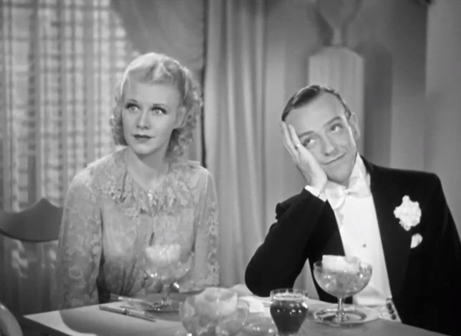
The plots to the Astaire and Rogers musicals are usually deceptively simple. Thus, thanks be to their dancing transcending it all. The affair opens in some posh corner of Europe where the always dithering Edward Everett Horton is sitting with Fred Astaire who has to prove his identity to get out of paying a check. They’ve both conveniently misplaced their wallets. After a routine complete with pretty girls and dancing fingers, he gives an impromptu performance of his own bringing down the house and proving he really is world-renowned performer Guy Holden.

Later on, at the docks, a fellow American, arriving in England (Ginger Rogers), is meeting her lovably fatuous aunt (Alice Brady) only to have her dress accidentally caught in a travel trunk. The man who comes to her aid and subsequently rips her garment is, of course, Astaire. Being a gentleman and genuinely taken with her, he gives her his coat to cover up, but the damage has already been done. She finds him a bit bothersome. You can tell it instantly by every look of disdain she throws him. Meanwhile, he eats up any pretense to talk with her, though she dismisses his advances. It’s how the story always goes.

He turns his resolve to find the girl, matched with the everyday occurrence of getting dressed to go out on the town, into the number “Needle in a Haystack,” which has Astaire exuding his typical elan on taps. Of the millions of women around, he’s looking for one very particular needle, and he’s not above canvassing the streets, even if it’s an insurmountable task, made increasingly apparent through montage. It goes to all this trouble only to very coincidentally rear-end her as he’s rubbernecking (adding yet another reason for her not to like him much).

Meanwhile, Egbert (Horton) is looking to make his father proud of him in the family law firm, though he’s never seemed to have much gumption or stomach for the trade. His worst nightmare, Hortense (the same Alice Brady) comes back into his life also bringing with her the proposition of a case that just might be his opportunity to assert himself. Mimi, the same woman constantly harried by Holden, is looking to get out of a loveless marriage and so the inept lawyer suggests setting up a rendezvous with a professional gigolo to end the union for good.

He invites Guy along for the ride knowing the sunshine, gaiety, and girls might do him good as a distraction for his lovesickness. He needs to forget this girl he’s so taken with. However, they’ve failed to compare notes. It doesn’t take extra-sensory perception to read where the picture will go from here, in fact, there’s hardly a need to continue. The human mind might do a finer job in its vivid imagination to derive what complications will arise from such a premise.

It’s a pleasant surprise to see Edward Horton doing a little saucy jig, “K-nock K-nees,” which also proves an early showcase for 40s wartime superstar Betty Grable if you’re able to recognize her. Likewise, in the subsequent scenes, Eric Blore is delightful as ever, this time as a waiter with his typical crisp & snooty delivery, ably sparring with the comic foibles of Horton.

Fortuitously, he turns up in several more instances to serve up the tea things along with idle chatter to anyone who will lend an ear. Astaire and Rogers’s first number together is the Cole Porter standard “Night and Day,” only to birth further misunderstands thanks to one ironic code phrase, “Chance is the fool’s name for fate.” Don’t ask for an explanation.

“The Continental” is an impressively glossy number that until Gene Kelly conjured up his American in Paris (1951) dream sequence, clocked in as the industry’s longest continuous dance number. Some of it involves our leads, but not the whole thing. It feels much more like a Busby Berkeley extravaganza.

And yet right there you understand the exquisite nature of Astaire and Rogers because they made dancing into something intimate and personal. It was between two people as much as it was a lavish production number, and that’s what resonates with us even after the curtain falls and we’ve been wowed by the expansive nature of the staging.

Yes, the geologist husband finally makes his token appearance as expected and the hired romancer Tonetti (Erik Rhodes) continues to bumble along in an effort to play his raffish role. Of course, Astaire proves far more convincing in the part of the lover finally getting the girl as expected.

Does any of this matter? Hardly. But it’s one final opportunity to get Astaire, Rogers, Blore, Horton, and everyone else in a room together. That’s surely enough to recommend this frolicking trifle of gaiety starring everyone’s favorite couple on taps. There’s nothing better to lift your spirits than Astaire and Rogers.

4/5 Stars

Amarcord (1973): Life is a Carnival

Amarcord.jpg

The most magical moments of Federico Fellini’s Amarcord occur at the very beginning and near the end. First, when the puffballs flutter through the air as a sign of spring and then, later, when a soft layer of powder signifies the advent of winter.

It’s a reminder of nature, of seasons, of how life is made up of rhythms, from beginning to end. If you live in California you miss out on that kind of tangible expression of life. You cannot capture the lyrical quality as the Italian maestro captures them over his vignette-driven spectacle with the aid of editor Ruggero Mastroianni.

Part of the reason I loved living abroad — in Japan specifically — there was some sense of the seasons, the utter sereneness of new-fallen snow, and a word to describe the wistfulness that often goes along with nostalgia and the lasting impression of memories (“Natsukashii”).

Fittingly, “Amarcord” is a provincial Italian expression for “I remember,” and this film is full up on quaffs of nostalgia and playful observation from the always lively creative reservoirs of Fellini. You cannot acknowledge the satire of his film without appreciating the affection embedded within it. They are closely related. Because even as you see all the faults and foibles, you cannot help but cast a sympathetic eye on these imbeciles — at least the lovable ones.

If someone else did it, you would get the sense of something mean-spirited, but when it’s your own people and your own way of life, somehow it comes off as not only humorous and perceptive but surprisingly warm.

The pacing is free; the scenes as loose as can be. Our only real markers of change are the aforementioned seasons. Around them, we get to know people. Spring means puffballs but also the local burning of an effigy on a giant bonfire to bring in the new season, complete with firecrackers and festivities.

School life is a lark full of windbags and crotchety oddballs who obliviously try to impart knowledge to their pupils on the highest arts. Their study regimen includes Greek, mathematics, the frescoes of Giotto, ancient history, the relation between church and state in Mussolini’s society, and so on. Each is a lost cause.

Around the dinner table, Mama and Papa Biondi have raging fits in what we might deem typical Italian fashion. They’re constantly bickering and scolding the bambinos for every infraction. In some upside-down manner, it’s a sign of their love and concern.

It’s true the town’s adolescent population, including their son Titta, get up to all sorts of dirty tricks, languishing in their fantasies, and going to confession only out of duty to their parents. There’s nothing contrite about it. Perhaps they don’t know any better.

You can make this argument judging from more general observation. Through Fellini’s lens, a fascist nation under Mussolini is often ridiculous. Flirtatious “Bellas” like the town hairdresser Gradisca (Magli Noel) swoon with nationalistic fervor at rallies, races, Grand Hotels, and the triumphant passage of the SS Rex — a vessel of national pride. That is until it capsizes all the beaming onlookers in their dingies.

One is reminded life is simpler and full of everyday peculiarities. Take Uncle Teo who gets a day on the town, outside of the mental institution, only to spend most of it barricaded up a tree, proclaiming how he wants a woman. One can only imagine it must be a lonely, dreary place on the inside. Then, there are snowball fights in the streets with the paths carved out of the snowpack and Gradisca a perfect target for all the gamely youth.

Nino Rota’s score accentuates so much mood, so much atmosphere, adding to the visual carnival, like a jaunty march and it is, taking us through time and sending us to places all over the little town.

On this grand scale, I’m inclined to like the idea of Fellini’s carousel of images, at least more than the particulars. This whirling, lively, rendition of life in its march of time speaks to so much about existence itself. The themes of looking back at the old ways — with nostalgia — but then also picking apart where we’ve come from to see the flaws and the idiosyncrasies. Some worthwhile, others worth stripping away and dismissing.

One of the most alarming takeaways is just how bawdy Italian culture is. Now it’s nothing new, but we are reminded of uncomfortable truths. Like the fact, Gradica is the ravishing eye-candy for every leering male in town, young and old. It speaks to so much about the male heart and mind, obsessed as it seems to be with women as commodities.

Eventually, Gradisca finds a man, her “Gary Cooper,” and we don’t have much inclination if he’s worthy of her or not. Still, it signals a change. Her wedding is a joyous Italian affair, but it also signs the beginning of the end. It’s as if, when she goes, along with her goes all the trimmings of their youth.

I am reminded of one moment when Grandpa is wandering around aimlessly in the fog. He’s not exactly a saint either. Regardless, he loses his way and laments the fact there are no trees, no people, no birds, no wine. If this is death, he’s not one for it. The situation solves itself easily enough when a carriage rattles by, and he’s found to be right outside his house.

Could this be Fellini’s way to comment on the situation and then temper it so quickly? Because a lot of the characters in Amarcord seem to be caught in this oblivious sort of fog. The greatest tools at Fellini’s disposal are merriment, humor, and even vulgarity to try and defuse situations, whether about love, death, politics, religion, whatever it is. And it’s a relatively effective form of satire a lot of the time.

However, every once in a while you remember it can only get us so far. The “eat, drink, and be merry for tomorrow we die” mentality, doesn’t quite fill one up with assurance. At least it’s not lasting. Because whether we like it or not, time is always high-stepping onward regardless of whether we’ve made peace with it or not. The turning of the seasons signify life and also death. No one feels that more than Titta. That’s what he’ll remember. Only time will tell if it gets any easier.

3.5/5 Stars

The Sting (1973): Newman and Redford Reunited

the sting 3

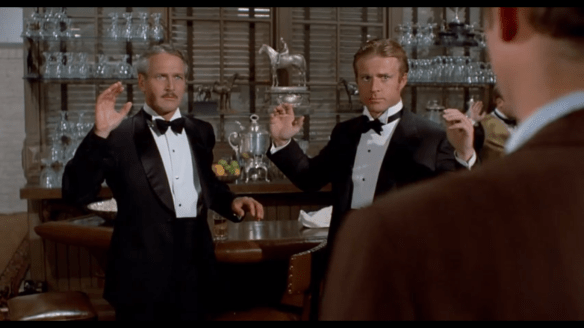
To my mind, there’s never been a dream team quite like Paul Newman and Robert Redford — a perfect one-two punch of camaraderie and cool — it comes so easy. All the ladies wanted to swoon over them, and all the men wanted to be like them. Because what they have together is something envied by us all.

Butch Cassidy was, of course, the breakout success helping to redefine the western in 1969 while also cementing the burgeoning buddy genre. It’s amazing we only ever got one other picture in the storied partnership. Thankfully it was The Sting.

Let me be candid. It’s not as great as its predecessor. I never had the same fondness for its narrative diversions and yet even on subsequent viewings, it assuredly plays to its strengths.

The period crime film captures a strain of nostalgia that feels even more euphoric seen through a second lens. This is Scott Joplin, ragtime, old-time title cards, wipe transitions galore, fine threads, better hats, and an ode to the past — twofold. This is prohibition reintroduced by way of the 1970s.

The world of Chicago gambling rackets fits somewhere in between a James Cagney & Edward G. Robinson’s Warner Bros. gangster flicks and John Garfield’s roles over a decade later (ie. Force of Evil). However, while the world is similar, director George Roy Hill has blessed The Sting with a playfulness. It lacks a cynical even brooding edge which would have been so easy to ascribe to. This is the 1970s after all. It would have been in vogue.

But in dealing with the depression years and corruption with a jocular edge, Hill has won himself an audience. He’s made it a game rather than a drama and as such it’s a welcome vessel of entertainment. This is no Godfather or Chinatown, French Connection or Dirty Harry. The Sting gives itself license to lighten up a bit. The delightful opening gambit is a taster for coming attractions introducing grifter extraordinaire: Hooker (Robert Redford), and the old vet who’s taught him everything he knows.

Luther spins tales of “The Big Con” which in their line of business is the big leagues for every man who has ever swindled someone. He urges Hooker to shake off the dust of their crummy town and make something of his unique talents. If the young drifter got his way, he would have stayed put. Still, he has crossed someone very powerful in local racketeer Doyle Lonnegan (Robert Shaw). There’s no recourse but to shove off and begin the next stage of his training.

He must meet the man Luther spoke highly of The Great Henry Gondorf (Paul Newman). In their first encounter, he’s completely swacked only to utter his first words under a showerhead raining water down on his hungover noggin. When Newman’s grouchy voice finally rings out it’s another form of wish fulfillment we’ve been waiting for. He even soaks his head a la Harper (1966). The anticipation is beginning to set in.

The Hollywood landscape has changed in 4 years. Now Redford is the worldwide megastar. Newman is still a big draw and as good as ever. Regardless, it’s a real hoot to have veteran pros like Harold Gould and Ray Walston. Somehow they feel like television actors to me and that’s by no means a dismissal. In fact, it’s actually a seal of approval; they make The Sting more colloquial even familiar.

Things pick up aboard a train as Gondorf sinks the hook into their pray so they can begin the task of reeling him in for the catch. It’s about keeping the mark off-balance, never letting them know they’re not in control, and making a whole lot of fun for the audience because we’re in on the whole shebang.

He makes a late entrance to a gentlemanly poker game by apologizing, “Sorry I’m late guys. I was taking a crap.” It’s a portent for the entire showdown. Newman hamming it up as the steely-eyed Robert Shaw looks on as if he takes every iota of the other man’s being as a personal affront. It’s a very calculated charade getting under his skin quite effectively. The brilliance of Newman is not taking himself too seriously. He has a good time with every beat and the movie benefits.

It’s a pleasure to watch him walk all over Shaw because Newman might be smug, but we’re in his corner and that comes from his long, hard-fought badge of loyalty. He’s one of those actors we relish playing the scoundrel. Harrison Ford might be the other.

As they look to hook Lonnegan by first getting his ire up and then conveniently setting him up with an ambitious inside man (Redford), we have a game on our hands. Meanwhile, the other boys assemble the crew with a makeshift gambling joint being renovated as they speak.

Hearing Ray Walston’s voice over the action, calling the races, is somehow comforting a bit like having My Favorite Martian reruns on in the background. The film is weak in the female character department but fortuitously Eileen Brennan is able to bring something hardy to the world with her mere presence.

And yet it wouldn’t be a story without a few wrinkles would it? Shaw throwing his weight around in order to play by his rules. They must acquiesce to his demands in order to make him feel secure. Then there’s a nagging cop after Hooker for some prior infraction. Soon even the Feds (led by Dana Elcar) get involved as the whole charade continues to crumble precariously.

the sting 2.png

Through it all Redford keeps his cool and looks equally fine streaking around town in his suit — usually to keep from getting the book thrown at him. He might as well be channeling the free-and-easy charisma of Steve McQueen from The Cincinnati Kid. Fittingly, The Sting is an apt descendent of not only that film but Newman’s own stellar vehicle: The Hustler.

Aside from just creating a world of smoky nostalgia, Hill is brave enough to have wordless interludes. The music is robust enough, not to mention his stars and his setting, allowing us to appreciate everything. Sometimes more is said in these moments than in any bit of filler dialogue. We get the privilege of picking up the pieces for ourselves and sitting back to bask in the thrills. The last few minutes are the grand payoff, and it’s lightning-quick but never better.

The Sting is short of a monumental artistic achievement, but it is an experience as only movies provide. It gives laughs, payoffs, and twists in a manner that is wholly satiating. To be a part of a communal event like this is something familiar and warm.

The ultimate joy of The Sting is its ability to play the audience as much as the mark and yet still giving us the relish of feeling like we’re in on the joke. It’s a movie that willingly provides the best of both worlds. And of course, we have Newman and Redford. I’ll stand by it. There was never a better pair.

4.5/5 Stars

M*A*S*H (1970): Altman Not Alda

MASH

“Suicide Is Painless” remains one of the most misanthropic themes on record and that’s without the completely nonsensical lyrics. With lyrics, it’s even more disillusioning.

Still, this stays very much in line with Robert Altman’s conception of the world. Nothing is ever straight and true. Convention must be eschewed with subverted expectations and darkly comic underpinnings. MASH is one of the finest vehicles he ever had for his methodology of the world.

In full disclosure, someone like me, raised on the sitcoms of old and classic television must admit the inherent difficulties in considering Robert Altman’s MASH, based loosely off Richard’s Hooker’s novel of the same name.

If you are unfamiliar with the historical background, it’s important to know MASH stands for Mobile Army Surgical Hospital, and they were posted on the front lines during the military police action that was the Korean War (1950-53).

For everyone else, MASH was a prominent black comedy and an arguably even more beloved television show. Its finale, of course, was the most-watched moment in TV history for many, many years.

All this is to say, to go back and retroactively analyze the original film, it’s all but impossible to totally untangle its reality from my deep affections for Alan Alda and the rest.

Because one point must be made early on. Though appearances might be initially deceiving, they could not be more disparate. My choice is to begin to focus on what Altman’s film does well.

One has to admit he brings his loose and sprawling sensibilities to war pictures with seamless ease. The frames are full of near-constant bouts of improv and an ensemble cast that’s loaded with tons of non-actors and fresh faces. The distinction to make is Altman gives them time in the spotlight, with Donald Sutherland, Tom Skerritt, and Elliot Gould pretty much becoming the head honchos in a comedy overflowing with nobodies.

Hawkeye (Donald Sutherland) is a free-and-easy surgeon with a case of “whistling dixie” and a taste for pretty nurses and awful gin. Duke is an equally game southern boy who falls into cahoots easily enough. They’ve got their eyes on the top prize christened “Lt. Dish” and the vexing but no less attractive head nurse “Hot Lips” Houlihan (Sally Kellerman).

The new chest cutter that Pierce pines for, Trapper John McIntire, is cut out of the same cloth. No wonder they all get along. Their main hobbies are sticking it to authority and they get away with every ounce of arrogance because they can back it up in the operating room. The taste that remains is all abrasive — Gould in particular — with he and Sutherland sticking it to just about everyone in their line of sight.

But that’s what this film feels like, purely anti-establishment; it’s never allowed the opportunity to be a true indictment of the utter lunacy of war. Likewise, for a film with purportedly progressive themes for the times, their treatment of the Asian characters, specifically while in Japan, is nothing short of troubling.

When they’re flown out to Japan on a special assignment, they walk all over everyone as the best surgeons around in a world would surrounded by a sea of shmucks. They gas a colonel and blackmail him handily while having no sense of sympathy for other fellow human beings. You begin to wonder about the patients they serve every day. What about them?

We have Gary Burghoff, the only holdover for the TV show. Otherwise, Henry Blake is a bland and vacuous commanding officer, hardly the lovable buffoon he would become as played by McClean Stevenson. The rest of the cast is a decent assemblage of 1970s movie talent, mostly on the road to bigger and better things.

Frank Burns (as played by Robert Duvall) is a hard-edged hypocrite far from the whiny, ferret-faced Larry Linville. The latter is far more enduring. Father Mulcahy is much the same. Unfortunately, the priest in this go-through feels like an easy runt of the jokes. His faith is something to thumb your nose at — little else.

There is not the same warmth nor the moral backbone that William Christopher would bring, only nervous timidity. Again, it’s so easy to enter this dangerous zone of comparison. Taking a page out of Luis Bunuel’s playbook, Altman is having a grand old time toying with the icons of religiosity in his film. Irreverence is his wellspring for comedy.

Because, up against the typical fare of a generation, MASH feels like a freestyle, scattered affair. Whereas the TV show was blessed by the calculated wit of its scripts balanced with pathos, this project thrives on its laxity and general indifference.

There’s a hodgepodge of overlapping dialogue simulating the cadence of real conversation with its constant asides and disruptions. It’s content to be all over the place, not conforming to any Hollywood standard of any kind.

Again, this becomes its life-force. Making a mockery of tradition in a way that no doubt does honor to the Marx Brother’s chaos and might have still been to their chagrin.

But again, MASH, for all who know anything about it, can hardly be considered an out and out war movie. And it’s not just a comedy either. Altman takes those expectations — all those things we assume this picture to be — and tosses them out.

Because MASH is full of darkness and absurdity that goes beyond war. It is an anti-war picture in general terms and yet how can we not at least laugh at the scenarios, the characters, and the insanity of it all?

Because this is a film and not the marginally sanitized airwaves of syndication television, there is the space to be raunchier, the O.R. is grislier, scenes are more sensual, but with it, all the playfulness of the later material is flushed away. It’s verging on the bitter, even vindictive.

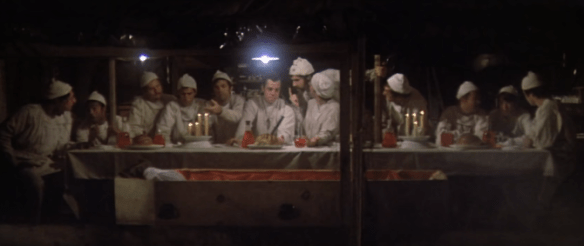
Fortunately, there is space for a few shenanigans. The in-camp dentist, known as the “Don Juan of Detroit” back home, is having serious doubts about his virility. He thinks he’s losing his prowess and so he’s made the decision to end it for good. He’s gonna commit suicide. In solidarity, all his buddies get together to put one slam-bang finish to the end of his life. A winking “last supper” of sorts that everyone’s in on.

Catching “Hot Lips” in the shower is all in a day’s work to confirm a bet of whether or not she’s a natural blonde. She spends the majority of the film anal and little better than a blithering idiot. In fact, her commanding officer calls her one (granted in the context of a football game). But she is another character who feels like a constant punchline. Altman could care less.

Speaking of the football game, it’s no doubt the piece de resistance in this monolith of absurdity. The boys rally the troops to take on a smug General’s hulking football team.

The only countermove is to call in a ringer, the one, and only, Spearchucker Jones, to help neutralize their opponent’s stacked lineup. By this point, the movie all but jumps off the deep-end leaving reality behind for the sake of comedy.

There is very little war left and nothing to think about except the Marx Brother-like mayhem on the field (although it’s not quite to the caliber of Horse Feathers). Altman directs it like a circus act.  Yelling, screaming, whistles blowing, pom-poms bouncing, from the sidelines. Players falling all over the place from injury and fatigue. It’s utter chaos. And that’s the end of it.

The final poetic justice is a payoff on the film’s first joke. Hawkeye and Duke ride out of camp in the same stolen jeep they came in. As I watched them go, I couldn’t help thinking it was a far cry from a “Goodbye” message telegraphed for a lifelong friend departing by helicopter.

Despite all my sincere attempts, I will remain horribly subjective to the end. I know it already. I’m hopeless. How can I not choose preferences with such singular interpretations of the same material? In fact, it seems like a fine problem to have. It makes it marginally easier to appreciate each on their own merits.

4/5 Stars


Smile (1975): The Miss America Satire Lost Some of Its Sheen

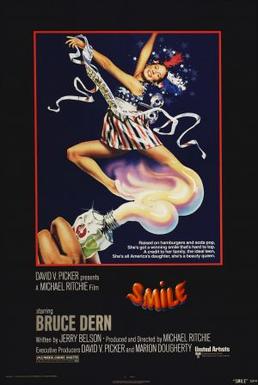
Smile_(1975_film).jpg“Smile” is a timeless hit among a plethora of classic Nat King Cole tracks. The innate warmth and the soothing nature of his vocals shine through every note. It took me many years to realize the tune was actually a Charlie Chaplin composition from City Lights later reworked with lyrics.

However, this is not a review of The King or The Tramp. It is about a movie, but to consider it, one must acknowledge the song is so very sincere, it can be used in highly ironic ways.

Case in point is Smile the movie, which was obviously fashioned as a genteel satire of Miss America culture.

It is a depiction of a different America that we can never go back to. Sometimes those words might sound wistful though, in the case of Smile, it’s more of an assertion. Because this lightly-handled prodding of societal mores, full of its share of cutesy and sickening moments, is really a commentary on a very suspect culture.

Still, one must ask the question: how much does the industry get inadvertently glorified by such a comedic extravaganza throwing all these young girls, harried folks, and inquisitive onlookers into an environment complete with plenty of pizzazz and a full-fledged happy ending?

There’s a moderate danger of missing the point — even if it is twofold. We can laugh or “smile” but we must also consider how ludicrous this all is. Thankfully the movie is aided by some of its wonkier inventions in case we’re tempted to take it at face value.

Smile is, of course, easily overshadowed by Nashville (1975) with its more discernible social significance, a grander ensemble, and a lot more going for it on all fronts. That’s not to say Smile is a bad movie. In fact, it is probably an underrated one, generally forgotten with the myriad of other 70s entertainment options moviegoers will normally flock to.

The story itself has the ring of something terribly agreeable. It’s a lightweight day-to-day observation of the annual Young American Miss Pageant in beautiful Santa Rosa, California. All the would-be “Misses” are bussed in to take part in the competition and all the laurels that come with such a crown.

Their hearts are a tizzy with excitement. Former champion Brenda DiCarlo (Barbara Feldon) knows just the feeling. Her advice is, as always, to “smile” as she helps to prepare the girls for their exhibition (which is not a competition). Although everyone knows otherwise.

Meanwhile, a Hollywood choreographer (the esteemable Michael Kidd) is brought in to work on the routines, the janitor worries about the undue stress that will be put on the pipes, and local used car salesman Big Bob Freeloader (Bruce Dern) gets ready for his civic responsibility to judge the contest.

He’s the epitome of a square, wheeler-dealer, car salesman who in his own way sees himself as a pillar of society, even if he helps to propagate the dubious cultural practices of the times.

His son, “Little Bob,” looks to snag a polaroid camera with his friends so they might capture the recently arrived pageant hopefuls in various states of undress. Though played for comedic effect, it really is a jarring, uncomfortable digression.

Because already implicit in the content are the strains of mid-century misogyny, essentially built into the fabric of society. It begins with the grown-ups as good, healthy All-American fun, until it easily seeps down to their children, teaching boys how they are to perceive girls.

Simultaneously, the local male fraternity initiation feels dangerously close to a white supremacist meeting, albeit with strange rituals (ie. kissing a dead chicken). On the ethnic front, the one non-Caucasian character, a Mexican-American, is looked on with immense derision by all the others and with the depiction, I wouldn’t blame them.

Her starry-eyed ambitions to be American are seen in a handful of characters, though she’s the only one hampered by a pointed accent. Again, it’s these obvious red lights that are being poked fun at. There’s little question about it, but if these are the issues we are dealing with, there are still other de facto problems that probably slip through the cracks.

It has not aged well even as we still have rampant issues of sexual objectification and any number of prurient problems. It could be very well that I am not in touch with the current cultural moment. If so, I stand corrected. But the odd mixture of nostalgia with light satire does come off as a weird, messily concocted cauldron of tones.

The free-flowing contact with the wide range of characters also means we never ably connect with anyone in a resonant manner. Likewise, director Michael Ritchie’s story, like The Candidate before it, is taking aim at society but in this instance, it feels like there are too many marks. It cannot cover all the ground and, therefore, feels a bit scattered.

Unfortunately, it’s lost some of its comic zing with the passage of time. Still, one of the finest bits of humor comes in an outrageous sequence when a man looks to end his life with a pistol.

His wife the former American Miss tells him he should deal with his problems instead of taking the coward’s way out. He proceeds to point the gun at her and let it go. He winds up in jail and she’s only scratched, agreeing not to press charges, much to his chagrin.

In fact, Andy DiCarlo might be the most genuinely enjoyable character for the very reason he sees the utter insanity of this world, even if everyone else brushes him off as being a little strange.

They think he needs to loosen up some like all his peers, kissing the butts of dead chickens and cheering for girls paraded up on a stage like glorified cattle. Now that’s entertainment! In this light, Smile does sound somewhat hilarious. Chalk it up to a misanthropic mood if you want. However, I’ll maintain people weren’t made to always be smiling. Sometimes a smile just won’t cut it.

3/5 Stars

NOTE: As a childhood Get Smart fan, I tried not to hold it against Smile for casting Barbara Feldon in her part. I tried my best to be objective, but, for me, she will always be 99.

The Heartbreak Kid (1972): Elaine May’s Graduate

the heartbreak kid 1.png

I was aware that this was an Elaine May film and for a brief moment I saw Jeannie Berlin and mistakenly believed our director was making an appearance. Berlin is, of course, May’s daughter, and she’s the spitting image of her mother. The same look. The same lilt in her voice. The same comic timing.

In a sense, we have this weird frame of reference now. I’m not saying Lila (Jeannie Berlin) is a stand-in for her mother per se, but we nevertheless have a curious dynamic to cull through. If we didn’t know any better, we would say this is a typical Hollywood film told from the male perspective.

Charles Grodin is an attractive young man and a newlywed who has just married a nice Jewish girl. They’re headed out on their honeymoon in Virginia Beach. What happens next is not the honeymoon phase at all. It’s the sinking feeling he’s made a mistake. Can he really spend the next 40 or 50 years of his life with this woman?

At first, they’re having a grand ol’ time singing “Close to You” on the freeway, and I couldn’t help but thinking of the inro to The Mary Tyler Moore Show or closer yet The Crocker Bank commercial that spawned another Carpenters’ hit. Here we are headed for new beginnings — a life together — and we’ve only just begun.

However, normal rhythms must be interrupted. It starts when Lila starts getting too lovey-dovey in the car. Then, she’s eating Milky Ways after they sleep together or she’s taking eons getting ready to go down to the pool deck. You get the sense her husband is just getting to know her for the first time. It’s really disconcerting if the moments weren’t equally hilarious

He’s already hustled and harried. For the most part, Grodin must push through the picture in deadpan because the film is much more a tempered affair (with a few piercing outbursts).  He responds to his romantic counterparts impeccably, first the unacknowledged goofiness of Lila and the cool flirtation of blonde, collegiate siren, Kelly (Cybil Shepherd). There’s both a rhythm to his diction and a gigglyness that overcomes him — like a little schoolboy — completely selling his double life and the comedic situation.

It’s partially the fact the scenario gets so outrageous. Because from her first toying with him on the beach, Kelly won’t stop ribbing him to death. First, it’s her “spot” on the beach then it’s her “seat” at the bar, and she’s got him playing along. He doesn’t mind getting trifled with. In fact, he instantly goes fawning over her, despite being very truly married.

Of course, that sets up the blackness of this comedy given the situation. There’s not any kind of spouse murdering or anything grotesque, just infidelity… And I say this facetiously because obviously a situation like The Heartbreak Kid played real and straight would be devastating. In real life, such scenarios don’t come with laughs.

However, Elaine May observes it beautifully and while Neil Simon’s script is mostly spot-on, it feels not so much uncharacteristic of his work as it does a creative departure. The collaboration is as much May’s as it is his, and she puts her unmistakable imprint on the material.

Soon Lenny is already planning his second life and, he hasn’t even gotten finished with his first, married to his current wife a whopping 5 days. His arguments and excuses in keeping Lila bedridden and out of the know are so fluid and self-assured it’s astounding. It’s easy enough to do with Lila.

Still, Kelly’s father (a supremely obstinate Eddie Albert) is another matter, a domineering paternal figure who’s made his position on Lenny’s pursuit of his daughter quite clear. He vehemently opposes any such actions with every fiber of his being. Over his dead body as it were.

Lenny, however, is all in. He makes the trek out to Minnesota, of all places, where the Corcoran’s reside and where Kelly currently attends university. When they get a moment alone together, he pleads with her, “Don’t play games with my life.” It’s pitiful really. A comedy such as this must continually tread the lines of tragedy as much as humor. He’s certainly a real shmuck.

They each treat their romantic partners horribly and yet by the end, it’s easy to find the story weirdly sincere. Amid all the zaniness, Lenny somehow manages to get what he was searching after — the dream girl — to right the supposed mistakes of his life.

In one sense, I cannot help but use the same lens as The Graduate. The scenarios are in some ways strikingly analogous. However, The Heartbreak Kid also owes a greater debt to the remarriage comedies of old, albeit without the imposition of the production code.

The Graduate dynamic might be partially coincidental and yet we have directors in Mike Nichols and Elaine May who famously came into the public eye as a comedic duo.  The creative realizations of the two films make sense because their type of specific, deeply insightful humor can rarely help but enter satirical territory. It comes with the intelligence and perceptiveness they bring to everything whether stand-up, directing, what have you.

The Graduate, of course, has this chaotic crescendo where Benjamin storms the church and runs off with the girl. The Heartbreak Kid is arguably even more devastating and yet it manages it through subtlety. In the lingering moments, Lenny is sitting on a couch in his second wedding reception. He’s gotten his prize — the girl he gave up everything for — but it’s strangely unsatisfying or at least when we look at him and the expression on his face, he seems unfulfilled.

Why is that? Maybe it’s some unnameable force, but I saw it to a greater extent at the end of The Graduate as well. Benjamin Braddock went through hell and back again to get a girl. Lenny’s journey was bumpy, but it also felt lighter, even low-key. Still, it goes out with a pop song too; again, more subdued and still, there’s a concerted effort to lead us obliquely into the unknown future.

The Graduate rode the pensive waves of Simon & Garfunkel while The Heartbreak Kid is provided a through-line by a cover version of The Carpenters’ “Close to You.” Although there is no comparison, we have a similar connection to a cultural touchstone. May’s film couldn’t find a more straight-laced song to keep on calling on only succeeding in further contributing to the unsettling dissonance.

I’m no authority to cover this topic in-depth, but I recall reading something to the effect that Nichols was very cognizant in casting someone very un-WASP-like in Dustin Hoffman. We could say the same of Lenny and all the locales he finds himself in, especially Minnesota. Whether merely implied or not, he is the outsider, both physically and culturally, in a similar manner.

May does well to take the dippy setup that feels very Neil Simon and push it deeper still. How a film about such a topic can be genuinely funny and somehow still manages slivers of warmth is beyond me. It’s a screwy feat of acuity, a true testament to the minds behind its creation.

4/5 Stars

Parasite (2019): Bong Joon-ho’s Household Thriller

Parasite_(2019_film)

I heard in an interview director Bong Joon-ho had the idea for Parasite percolating in his mind for a long time, and it was born out of the most curious forms of inspiration. In college, he used to tutor English for the child of a rich family. From that point of disembarkation, he started asking “what if…” and all of a sudden his latest thriller was born.

Whether this story is completely true or not, it gets at what I relish about screenwriting and the inception of ideas in any form. Oftentimes they come straight out of real-life experiences only to be morphed and molded, burnished and extrapolated upon until they take on an existence entirely their own.

In some ways, Parasite feels very much related to the previous year’s Cannes darling Shoplifters, directed by Hirokazu Koreeda. In both cases, a story about an impoverished family becomes a handy jumping-off point for social commentary. But that’s just it. The premise provides a jumping-off point and there’s little else we can compare because the stories take drastically different turns simply adjudging from their creators.

Because the Kim family live crowded in a shoddy basement-dwelling leeching off the wi-fi of those who live around them, somewhat contented or at least resigned to their vagrant lifestyle. However, one day their teenage son, Ki-woo is enlisted by a friend to fill his position tutoring the daughter of a rich family.

His family helps him with the con using their skills of photoshop, composition, and dramaturgy to pull off the masquerade and ingratiate themselves. It helps that their mark is a simple-minded, trusting, and generally kind matriarch. There’s a touch of Luis Bunuel in the depiction of this rather naive and vacuous bourgeoisie family getting overrun by the lower classes.

And yet a distinction must be made here too because Bong does not altogether mock them. There is the inkling of affection for all his ensemble even as he teases them. This is one of the keys to the movie’s success. The message is not hammered home at the expense of the characters. 

One thing leads to another and the household vacancies begin filling up. First, an English tutor, then an art therapy instructor, next a new chauffeur, and finally a housekeeper. If the early dynamic is a tad like Shoplifters, as Parasite gears up, I couldn’t help but feel this same pervading unease experienced throughout Jordan Peele’s Get Out. While it might seem like a curious touchstone, what both films fashion are compelling thrillers carved out of the home.

The domicile and symbol of social capital, stability, even the family unit, is turned into this perturbing space that can be easily sabotaged and infested. It doesn’t matter if the main thematic element is race or class. They can both function in an insidious manner as a source of tension throughout the picture, seeping in through the cracks. Where you can live life from the heights of privilege or sunken in the subterranean void below. 

While the cat’s away the mice will play, and it’s at this point we ponder where we could possibly be headed. The Kims succeed in totally taking over the house and lounging in all its decadent luxuries. This could be the end of the story. Thankfully, we are in the hands of someone who knows full-well what they are looking to accomplish. 

Part of the ingenuity of the film comes in how form follows function in this very tangible way. Because the visual and environmental disparity trickles down through the story until it emphatically erupts. The metaphor takes on a very real and concrete form throughout the picture. But for the time being, it’s all about building the mounting suspense to a crescendo.

Bong is a disciple of Hitchcock, and thus he’s taken to heart the pervasive power of dramatic irony. He can both manipulate the audience while implicating us and making us totally invested in the charade at hand.

Though Parasite does have twists — one particularly harrowing in nature — it is built out of this maintained sense of dread and tension. It only works because the director has taken us into his confidence and we know something other characters do not.

The film is also built and developed out of not only its architecture but the sound design helping to create a distinct space and also a rhythm conducive to the action. A chaotic scramble to neutralize, not a gun, but a phone with social media capabilities is the centerpiece of one memorable scene full of struggling bodies, flailing arms, and the like, choreographed to perfection.

There are certain scenes like this one where they cease to be bits of exposition and dialogue, and they feel more and more like they’re verging on visual symphony as we watch images and actions flash by with a very particular cadence. They have the force to carry us away in the moment — cutting to the music — like many of the greats have done, from Hitchcock to Scorsese. 

When the Kim family is finally at their lowest point, sleeping on a gymnasium floor, their patriarch utters the film’s one line which feels like some kind of worldview tucked into a movie that otherwise functions only as a satire, if not an out-and-out black comedy. He says the best plan is no plan because nothing works out the way you mean for it to anyway. It doesn’t matter if you kill someone or commit treason. Nothing matters. Nihilism is alive and well.

Still, the beauty of this is even while Mr. Kim says these things, there is a director behind him — an artistic creator — who has more than a vision for where he will end up. There is a purpose to everything that is happening to him. 

If the majority of the movie is an exhibition in Hithcockian manipulation, then the ending is suitably macabre for someone totally versed in the Master of Suspense. Bong somehow manages to be playful, shocking, thrilling, and a tad somber all in the course of the final hour. The film is lengthy; we don’t always know where it will wind up, and yet it ends up in places that continually lead to further questions.  You cannot unsee it or quite forget about what we have witnessed. 

Parasite has an undisputed climax and still the story continues allowing itself to sink back into a newfound despondency and the original status quo. I still cannot decide if this suits everything we have been subjected too thus far.

Although another joy of screenwriting is narrative symmetry when we can take a movie back to where it began. Because so much has happened. We have weathered so much as an audience, watching and in some perverse way, rooting for this family, only for it to end up back the way it was, under very different circumstances.

All I know is that this is one of the most wickedly sharp and ingeniously pulse-pounding movies I’ve seen in quite some time. It irks me and yet in the same instance, I cannot quite turn away.

If there is any more fruit, broader still, it will come from the phenomenal press the film has received, and in an age where acclaim still guides public opinion, like Bong said himself, maybe this can be the film to help the general public conquer their fear of subtitles. Because if Parasite‘s any indication, it wields the power to open people up to expansive avenues of cinema. This is only the tip of the iceberg.

The joy of making the leap is the realization that you are not being pulled further away from what you know. More often than not, you’re getting closer — closer to the things that feel universal — the human predilections connecting us on an intimate scale. Both the parasitic and the hospitable, the good and the evil. 

Although they couldn’t be a more diverse company, you see it in Hitchcock (a Brit), Koreeda (a Japanese), Bunuel (a Spaniard), Bong (a South Korean), and many others. Go watch them if you have the chance. My hope is you will be glad you did. 

4.5/5 Stars

Zelig (1983) and Gordon Willis’s Mimicry of Classical Hollywood

Zeligposter.jpgI never thought I’d be saying this about a Woody Allen film, but it feels more like a technical marvel than purely a testament to story or dialogue. Although The Purple Rose of Cairo did something similarly compelling, Zelig is literally a film relying on a look that is authentic to a time period. Allen even goes so far as using old-fashioned cameras, lenses, and techniques to try and get them as close to classic filmmaking as possible.

Preceding the cutting-edge footage in Forrest Gump, we have Woody Allen as his alter ego, Leonard Zelig, being inserted in all sorts of images. It’s spliced together in such a seamless way we wonder if some scenes were simply chosen because they featured a lookalike of Allen to fit with the rest of the film.

Shot as an obvious mockumentary, which could be likened to Citizen Kane‘s News Marches On segment, one might concede Zelig is humorous in a similar vein. It’s not like Take The Money and Run (1969), Sleeper (1973), or even Annie Hall (1977), each offering genuinely zany and laugh-out-loud gags.

By playing something so ludicrously out of left field, completely straight, Allen has his comedy. He goes to the furthest extreme to make this feel like a real Ken Burns-esque documentary complete with talking heads giving their dry, poorly lit commentary from the present. They lend this credence, this seemingly real-world ethos, to something so utterly ridiculous. This juxtaposition gets at the humor precisely.

The story itself isn’t much of anything at all, loosely tied together over the course of an hour. Zelig (Woody Allen) is a generally non-descript Jewish man (Allen’s usual archetype) with a curious tendency brought on by an undying need for approval.

Dr. Eudora Fletcher (Mia Farrow) is intent on helping him and confirming her findings that he is indeed suffering from a chameleon-like disorder, causing him to transform his appearance to assimilate with whoever he’s with. It could be politically, socially occupationally, even racially, as he is found speaking Chinese and frequenting an African-American jazz club in two separate instances.

In the good doctor’s presence, he conveniently thinks he’s also a psychologist trying to do therapy with her, even having a fine approximation of the vocational jargon. But this is just a cursory sign to a much deeper-seated issue.

It turns out he’s unwittingly duped tons of people with wives married, babies delivered, and all sorts of other feats and accomplishments undertaken in different lives. He’s the most interesting man in the world who consequently has no idea about any of his accomplishments.

The laundry list of real-life icons is too delightful to pass over from F. Scott Fitzgerald, Charles Lindbergh, Al Capone, Babe Ruth, Lou Gehrig, Bobby Jones, and the list keeps on going and going. William Randolph Hearts himself (a Kane archetype) and his mistress Marion Davies show up along with Charlie Chaplin, Clara Bow, Carole Lombard, Marie Dressler and a host of others I failed to mention. You get the idea. It’s among the ranks of all these folks, Zelig was able to take on his chameleon-like personality and win their friendship.

It also occurred to me that Allen always makes his admiration for Ingmar Bergman fairly obvious. Like the other director’s films, which are always inhabited by interesting female characters, Allen settled on his own muses in Dianne Keaton and Mia Farrow. Farrow in this picture, captured completely in black and white, even gives a striking visual approximation of Liv Ullmann in Persona. I’m not sure, but it seems too close not to be an obvious nod, albeit with a typical Allen twist. The added punchline is that Farrow’s character ultimately falls for her highly neurotic patient. It’s of little surprise.

Like many of the New York-based auteur’s work, Zelig doesn’t leave me with any nuggets I want to hold onto. Conceptually, it’s somewhat arresting and the execution is phenomenal. I can understand with all the credits to his name why Gordon Willis might have considered this to be one of the most difficult he ever undertook.

If I were the director of photography, I would want to pull my hair out too. But his work and attention to authenticity is probably the greatest takeaway from Zelig. Modern films pale in comparison when it comes to mimicking the past. There’s little to no contest. If nothing else, Zelig stands as the crown jewel of Classical Hollywood mimesis.

3.5/5 Stars

Note from September 2018: I did not address the allegations to Allen in this review, but I must acknowledge they now linger over any film of his we watch, especially those seen in retrospect. It’s a topic I do not know enough about, and I do not feel privy to the conversation, so I will leave it to others at the moment.