The Naked Gun: From the Files of Police Squad! (1988)

7e021-the_naked_gun_posterWhen you hear the names Zucker, Abrahams and Zucker (Airplane!, Top Secret) you automatically know there are boatloads of zany sight gags, puns and parodies to be had. Although weaker than the previous films, thanks to another bang up job by Leslie Nielsen, this police drama parody is still a lot of fun.

After single handedly beating up on the United States biggest enemies, Lieutenant Frank Drebin (Nielsen) returns to the L.A. precinct to investigate the case of a heroin ring and the brutal injury of his colleague Nordberg (O.J. Simpson). Drebin gets the obligatory briefing from his superior (George Kennedy) and the necessary gadgets for the mission. The case brings our hero in contact with the villainous Vincent Ludwig (Richardo Montalban) as well as his alluring assistant (Priscilla Presley). Drebin and Ms. Spencer’s relationship soon becomes sappily romantic (cue I’m Into Something Good) with hot dogs, movies and jaunts on the beach.

The rest of the case involves car chases, fires, incriminating documents, the arrival of the Queen and of course California Angels Baseball. That’s right. The Queen is to be assassinated and what better location than a baseball game? It is Drebin’s responsibility to stop the attempt at all costs and he makes quite a mess of the game (like he did with everything else), but he does get the job done. His methods are far from orthodox to be sure but he gets the girl and the bad guy pays for his misdeeds. Nordberg certainly is lucky to have such a loyal partner, maybe.

This comic trio pushes the wackiness as far as it can possibly go, oftentimes with mock seriousness and overdone tropes that get made fun of. For instance Drebin gives us voice-over narration, Spencer is very much a femme fatale at first and the story is your not so typical procedural format. Unexpected cameos by Weird Al, Jay Johnstone, Reggie Jackson and a whole host of professional announcers are certainly memorable. Furthermore the uproarious baseball sequences with “I Love L.A.” playing were certainly a hit.  This is a comedy classic from the files of the police squad and I cannot help but enjoy it.

3.5/5 Stars

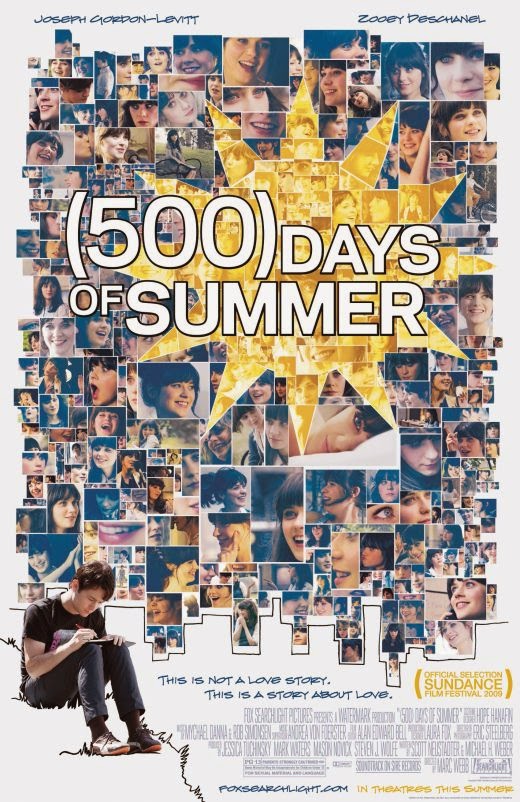
(500) Days of Summer (2009)

16ddc-five_hundred_days_of_summer“This is a story of boy meets girl, but you should know upfront, this is not a love story.”

This one line is uttered by the very thematic narrator of (500) Days of Summer and it describes an aspiring architect-greeting card salesman named Tom Hanson who meets Summer Finn at the office.

This often inventive and imaginative romantic comedy highlights the highs and woes that come with a relationship. You see Tom and Summer are seemingly two conflicting forces of nature from the beginning. He is a hopeless romantic believing in fate and love at first sight. She does not quite buy into that stuff, and she is only looking for “a friend,” nothing too serious. The so-called Summer Effect is what draws Tom to her. She is seemingly a normal everyday girl, but there is something extra special about her. But you will see for yourself.

The film’s scriptwriters do an excellent job at highlighting the minutiae that go along with any relationship. The Smiths are a point of agreement. Ikea is a place to fantasize about the American Dream, the copy room can be a place of romance, and Ringo Starr’s “Octopus’ Garden” will always be a point of contention. Mind you, all of this is out of sequence because that’s the way the memories come flooding back.

There are days when the whole world seems to be smiling with you. The birds are singing, you’re Han Solo, and it just makes you want to dance. There are days when you have bed head and your dreams are broken. There is no longer faith in romance. One day it seems like the walls are coming down and you are truly getting to know this significant other on an intimate level. Another day a small squabble over a punch and soon enough you hate everything about her. Her smile, her knees, her hair, they’re all awful.

All these things happen to Tom because Summer is not looking for anything more substantial, but he feels he is getting mixed signals. They are finally reunited and he thinks this might be his second chance. However, expectations seemingly never mirror reality. He is disillusioned realizing movies, pop songs, and even greeting cards are responsible for the lies society feeds us about love.

Now Summer has moved on in a big way, the wounds still hurt Tom, but they meet at that same bench overlooking Los Angeles for a final time. So you see this was not a love story after all. However, remember the date May 23rd, a Wednesday. We do not know the outcome but if nothing else it was the day that Tom reaffirms his belief in love.

(500) Days of Summer was different enough to be an enjoyable film which was instigated by a nonlinear storyline that pulled us along through a relationship ( day 1-500). Joseph Gordon-Levitt and Zooey Deschanel were both enjoyable and Tom’s friends and sister had enough personality to add something to the film. The music is often fitting (“Sweet Disposition” by Temper Trap helps the indie vibe), and both leads got an excuse to work out their vocal cords.  By the nature of the narrative, the story jumps around a lot, seemingly leaving loose ends. Perhaps that is just my own hangup. Because, like any love story, this film may have its imperfections, but that is not to say it is not worthwhile.

4/5 Stars


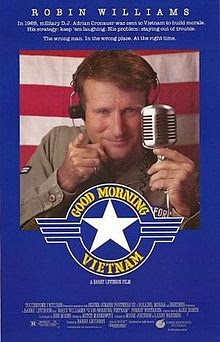
Good Morning Vietnam (1987)

4eba0-good_morning2c_vietnamGoooooooood Mooooooorning Viiieeetnammm! I’m a little late to the party I know, but I wanted to take a look at a film that in many ways personifies Robin Williams. In the last months, I have gotten to read a lot on William’s as a comic and as an actor. When I watch this film which showcases his many skills, I am especially drawn to what I call his bipolar comedy. Let me explain. On the surface, he seems like a pleasant-faced average Joe with a little twinkle in his eye. Maybe there are even moments of emotion or sadness that make their way out. Then, bing pow! The lights go on, the sirens sound, and all chaos breaks loose.

Adrian Cronauer is the perfect embodiment of William’s quick wit and off the wall antics. He has a constant supply of new voices and old reliable ones, not to mention cultural and political jokes. It all gets thrown in so fast you hardly get to bat an eye, and he does it all with that rye smile and one defiant attitude.

This is yet another nostalgic 1980s classic directed by Barry Levinson. The story begins in 1965 with the jockey getting shipped in from Crete, and soon he is the hero of all the underlings especially his young compatriot Private Garlick (Forrest Whitaker). Immediately the power dynamic is rather odd. The General overseeing everything loves his zany, sometimes crass, take on comedy. His two immediate superiors are less than pleased with his early showings of insubordination. If the General is any indication, Cronauer’s mix of humor, (censored) news updates and groovy rock n’ roll prove insanely popular.

In his spare time, Cronauer pursues a young Vietnamese girl while teaching an English class to locals. They soon enjoy his more slang-based approach to English, and he befriends a boy named Tuan. He also has some time to start a brawl at a local hangout and eventually see it blown to smithereens. It’s after this one occasion where he gets fed up with the censors controlling what he says because it doesn’t seem right. It seems too regular army, and he is certainly not that. Cronauer is suspended but during his hiatus, he gains a new found zeal performing for the boys in the field.

Due to popular demand, he gets reinstate,d but his superior, who has always had it in for him, connects him with a wanted South Vietnamese terrorist, and Cronauer soon gets the boot with an honorable discharge. The former disc jockey realizes Tuan lied to him all along, but after confronting the boy he fulfills one last commitment with his English class. Cronauer flies off into the wild blue yonder, but not without leaving a gift with Garlick for all the boys. Gooooodbyeeee Vietnaaaam!

This was a grade A performance by Robin Williams and the soundtrack was absolutely superb, full of big and small hits alike. Louis Armstrong’s “What a Wonderful World” was especially impactful due to the images that were juxtaposed with it. Furthermore, just as much of what Cronauer was lost to his students, I feel like many of his cultural quips might get lost to newer generations. I sincerely hope they do not and his political commentary will always swirl around like any of the controversy surrounding Vietnam. The magic of the character is his ability to make men laugh despite their circumstances. The magic of Robin Williams is that he was a man who made us laugh in all circumstances.

4/5 Stars

Review: Forrest Gump (1994)

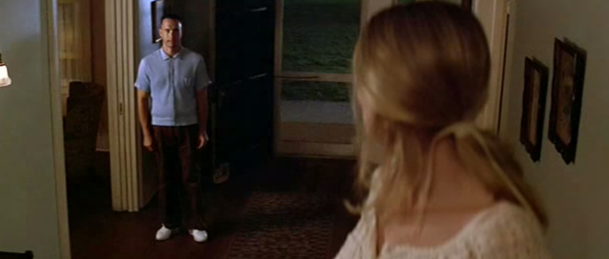
950b6-forrestgump1If you want to start out on the broadest level possible, the film is a lesson in 20th century American History. It charts the turbulent course of mankind including assassinations, counter-culture, Vietnam, Anti-War Rallies, The Cold War, Watergate and much much more. The substantial soundtrack dials back the clock to fully immerse the audience in that time and place.

It is the dream movie for pop culture fanatics and history aficionados. That’s why I enjoy it. However, much like the feather that flutters in the breeze drifting this way and that, Forrest Gump is a character who floats through history as it is made. It begins with his leg braces which give inspiration to the Elvis phenomenon. Ultimately, he plays football for Alabama, sees the school desegregated, and becomes an All-American who meets JFK.

Soon it’s off to Vietnam, followed by a Medal of Honor, and a trip back home thanks to a million dollar wound. Forrest gets a taste of the nation’s capital and soon becomes an accomplished ping pong player, makes it big in the shrimping business, and heads home back to Alabama once more after buying Apple stock. All these moments are absorbing to be sure, but that alone would make the film just okay as a historical drama.

Tom Hanks‘ Forrest Gump is the important piece in the entire equation because of the people that gravitate towards him. Forrest himself only has an IQ of 75, but he is so unlike many of the characters we are used to. Not because he is “simple” so to speak, because he is far from it. Perhaps it’s the fact that he is wholly genuine, loyal, and innocent. That’s almost unheard of these days. He seems to stand at complete odds with the history that is happening all around. Sometimes it looks very different from his eyes or he is completely oblivious to what is happening.

However, in some ways, he seems to have things figured out better than most. He loves those close to him, does what he loves, and never loses his positive spirit. His observations on life might be plain, but they are nonetheless powerful to those around him. To Hank’s credit, he infuses the character with a slow-witted charm and gives him a deep southern drawl. He’s Forrest, Forrest Gump. That’s all he needs to be.

Sally Field has a relatively short screen appearance, which is still extremely important because Forrest’s mother is the one who helps guide his whole outlook on life. She encourages him to make the best of what God has given him and to realize he is no different than other “normal” people. Her love, cultivation, and homespun knowledge is what seemingly allows Forrest to lead a full life, though pithy sayings only go so far, at some point you just have to live.

Jenny (Robin Wright) is another character who is perhaps a greater drifter than Forrest himself. She is constantly trying to find her way through the turbulent times while Forrest’s feet always seem firmly planted on the ground (Rather ironic since he is always running). She is a prodigal and always prone to return to Forrest who always welcomes her back with open arms no matter the circumstances. It might be a stint in a nightclub, living the hippie life, joining the Black Panther Party, or being with other men. Forrest is forever loyal and protective of her. She cannot always handle having him in her life, and she wishes to find her own way. He is always there for her, though, even up to the point of taking care of a son.

Bubba and Lieutenant Dan are Forrest’s best good friends and both men are greatly impacted by Vietnam. Bubba dies and Lt. Dan loses his legs (not to mention his self-respect). Forrest is fiercely loyal to both comrades, starting up Bubba Gumps Shrimping in honor of his late friend and giving work to Lt. Dan when he needs it most. He is a friend for the ages and he takes the title seriously.

Calling Forrest Gump just a historical drama or even sentimental tripe might be partially accurate and yet it cohesively adds up to more than its parts. 20 years have gone by, true, and some of the luster may have gone away, but certainly not all of it.  Though it might be far from perfect, it is a story that is worth any shortcomings, because it has heart and a fantastical telling of American history that is still worth watching.

4.5/5 Stars


Review: His Girl Friday (1940)

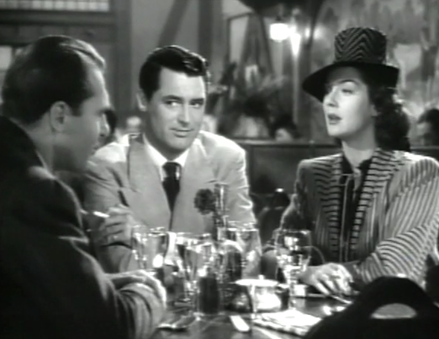
25148-hisgirl1It all happened in the “Dark Ages” of the newspaper game — When to a reporter “Getting that story” justified anything short of murder. Incidentally you will see in this picture no resemblance to the men and women of the press of today.”

Hildy Johnson (aka His Girl Friday) is making her return to the Morning Post but not to get her old job back. She came to pay a visit to her former husband (and paper editor) who she divorced because she is newly engaged and wants to break everything off for good. It means she can go off into the sunset with her new beau, but it also means no more paper. She drops the news and it turns out the wedding is set for the next day so Walter has very little time to go to work. He soon begins a sly barrage of subtle and not so subtle jabs, ridicules, and put downs aimed at the easy target Bruce Baldwin (Ralph Bellamy). Walter cuts him off, plays dumb, and is in general condescending and conniving. Hildy sees it all unfolding and half watches with bemusement, while also trying to stop Walter from causing any major trouble.

You see he’s a wonderful fellow in a loathsome sort of way, but you cannot help but like him. Because as Hildy notes he comes by charm naturally since “his grandfather was a snake.” These are the kinds of barbs and witty put downs we deal with the entire film. Besides being good fun, it also is quite extraordinary, since they never stop coming. It’s also fascinating to simply watch the many expressions of Cary Grant, whether it is a smirk or straight face, it always has a tinge of mischief which suits his character just fine. He seems more like a little boy at times, trying to win back his girl, and in many ways, that’s what he’s trying to do. But back to the action.

Hildy unwittingly falls into Walter’s trap, and from that point on there’s no stopping her, or Walter’s scheme for that matter. When the wheels of journalism start turning there’s no stopping someone like Hildy with newsprint in her blood. Walter lets her catch wind of a man who pleads innocence though he is to be hung for shooting a black policeman. Hildy puts up a fight, but she doesn’t last very long.

Soon she’s gotten into talk to the nervous prisoner Earl and gets his point of view on the whole messy ordeal. The other newsboys are callous to the world, and as the gallows goes up outside their window, all they can do is play cards and think about the best scoop. Hildy is a little different but she’s still leaving…or is she?

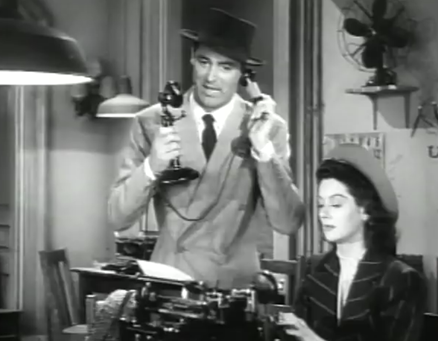
Next, Williams escapes and the mad search for the fugitive is on as the newsroom goes into an uproar. The mayor and sheriff are in a tizzy and then a reprieve for Williams comes, but they ignore it because they need this hanging in order to get re-elected. By a stroke of luck, Hildy finds Williams and stashes him away in a desk. Now she is hooked, and when Walter hears about her stroke of luck, everything begins again like old times. Bruce and his mother are soon disregarded as Hildy types feverishly, and Walter wheels and deals on the telephone. Then, the sheriff and mayor burst in with the rest of the boys. Williams’ hiding place is uncovered and the two reconciled lovebirds look like they might wind up with a jail sentence. But the honorable air-head Mr. Pettibone saves the day. All that’s left to do is depart on a two-week honeymoon to Niagara Falls or maybe a workers riot in Albany. All is right with the world again. Walter’s got His Girl Friday, and she’s got her lovable wiseguy husband back.

I’m not quite sure why I am so often drawn to this movie because it is more than it being readily available in the public domain. The dynamic of Grant and Russell is certainly superb. Walter can be an absolute cad, but Grant’s charm makes him bearable to the end. Russell is the true star of this film and she deals the punches with the rest of the boys. It really is the perfect role for her. The film is blessed with the great supporting cast including Porter Hall, Roscoe Karns, Gene Lockhart, Billy Gilbert and a host of others who populate the film with colorful faces and voices.

After seeing Nothing Sacred (1937) it was also interesting to see another script from Ben Hecht about journalism. Again, it might be a screwball comedy but there are also political undertones. Most blatantly about journalism itself, but also about corrupt leaders (like the mayor and sheriff), the Red Scare, gender roles, capital punishment, and even WWII.

Of course, it must also be noted that this is a film directed by the great Howard Hawks. I have always had difficulty pinpointing his trademarks, because the reality is, he was so versatile, trying his hand at so many different genres. All I know is that I more often than not enjoy his work behind the camera because it is seamless and it feels quintessentially American. His Girl Friday is no different. Although, this one is just a tad faster than most. It’s sure to raise your blood pressure so be warned.

5/5 Stars


Nothing Sacred (1937)

 13094-nothingsacred2Before His Girl Friday (1940) came, there was another screwball comedy about journalism, the perfect scoop, and deception. After getting on the bad side of his boss, newsman Wally Cook (Frederic March) is demoted from the living and forced to write obituaries. It’s quite the awful setup and Cook desperately looks for another story to get him in the good graces of the Morning Star’s editor.

The perfect news flash has just come up in the form of a woman who is soon going to die of radium poisoning, and so Wally Cook goes to meet her. Heading up from New York, he ends in the one horse town in Vermont. He meets a lot of unobliging people whose vocabulary is limited to “Yup” and “Nope.” He finally comes across the crying girl who has just left an appointment with a doctor. He comforts the girl cheering her up by promising a trip to the big city where she will be treated like royalty (And he’ll get his story). So Hazel Flagg soon becomes the sweetheart of New York with public appearances at Madison Square Garden, parades, poems, articles and special honors. It’s all going according to Cook’s plan, the only thing is that Hazel is not actually ill.

That’s a wrench in the plan and soon it becomes evident that Cook will look like a cad. To make matters worse, he’s falling for her and his editor Oliver Stone is all over him. Now he must take part in Hazel’s charade, despite his annoyance. She too is annoyed and ends the game so the two lovebirds can elope. Still, the story of Hazel is given a romanticized ending that the public deserves.

Frederic March is decent as the desperate and long-suffering journalist. Carole Lombard is her typical light-headed, whimsy, high-strung, scatterbrained, sniveling self. It proves to be a volatile combination partnered with Ben Hecht’s script. The news industry loses a lot of its self-respect for the sake of laughs because nothing’s sacred. Some might be interested to know that it was shot in glorious technicolor and it was the only time Lombard would appear in a technicolor film. She would, of course, die in a tragic plane crash in 1942.

This film was quite short so the story moved quickly and there were definitely some screwy moments. I am however partial to His Girl Friday and some of the other more well-known screwballs.

3.5/5 Stars

Annie Hall (1977)

annie hall 4 alvy“I would never want to belong to any club that would have someone like me for a member. That’s the key joke of my adult life, in terms of my relationships with women.”

So begins Annie Hall a film that Woody Allen, also known as Alvy Singer, begins with an opening monologue borrowing a quip from Groucho Marx. It acts as a lead into his life story, romantic and otherwise.

He had a childhood characterized as being morose, depressed, and so on, because as he noted early on “the universe is expanding.” He grew up living under a roller coaster and having fun with the local bumper cars. He grew up to be a comic with the same despondent outlook on life. In one memorable long shot of a sidewalk, we listen to Alvy talking to his friend about people making jokes about him being a Jew and his assertions seem uncalled for.

Alvy Singer and Marshall McLuhan

When Alvy was dating Annie, they went to Ingmar Bergman films and The Sorrow and the Pity was a personal favorite of Alvy. A favorite film with a perfect title and subject for the pessimistic fellow. However, what really vexes him are puffed up know-it-alls who pontificate on and on like they are God’s gift to the universe. It seems necessary at this point to break the fourth wall.

As Alvy recalls his early childhood and first relationship which began at an Adlai Stevenson rally, it is rather funny that he remains unchanged the whole time. Physically Woody Allen is playing Alvy as a young man and an old man without any change.

Then there is the fiasco with the lobsters and the memories of his first meeting with Annie over tennis. That was when he met the girl who came out of the Norman Rockwell painting. Seemingly the antithesis of Alvy himself.

Their relationship is examined with all its quirks from a trivial conversation about art, with underlying subtitles that reflect their real thoughts, to Annie’s stint as a nightclub singer. They have a comical time people watching, and Alvy recalls his second wife and the one who was a Rolling Stone reporter. His relationship with Annie also has its share of arguments, over spiders at 3 in the morning and adult education. Through it all Alvy still views Annie as a cartoon version of the Wicked Queen from “Snow White,” who he secretly loves.
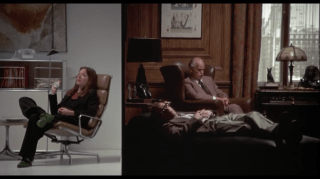
It is during a famous split screen sequence (actually a split room) where the stark differences, not only between the pair, but the genders are pointed out. Things are changing. They take a trip out to sunny California and Alvy cannot help but hate it compared to pleasantly gray New York. They have laugh tracks, wheat germ killers, and trash which is subsequently made into T.V. shows. Annie loves it all.

The inevitable comes and Annie breaks up only to have Alvy soon revisit California to propose marriage. Needless to say, it does not happen. He returns to New York and makes his first play about their last conversation verbatim, with one small revision. Alvy sees Annie one last time when she returns to New York, and they share some laughs while highlights role across the screen.

Allen’s stand-in Alvy sums it all up with one final joke about a guy who has a brother who thinks he a chicken, but he fails to do anything about it because he needs the eggs. That’s how he feels about relationships. “They’re totally irrational, and crazy, and absurd,” but you keep on because you need the eggs. Another philosophical gem from Alvy Singer.

The irony of Annie Hall is that many a person has gone on to pontificate on and on about it, but if we actually pulled an Alvy Singer and dragged Woody Allen from out behind a movie poster, I’m sure he could set us straight. Annie Hall is chock full of humor, a far from typical type of romance, and people trying to find their way in life. Take away discussion about psychoanalysis, modernism, antisemitism, and what you are left with are people just talking. Some of what they say is about such philosophical topics, but sometimes it’s not. It’s about memories, simple observations of life, and the little things that happen along the way.

There are clashing worldviews that come up against each other like New York and California (brought to us by the cinematography of Gordon Willis). There are different sorts of people like Alvy Singer and Annie Hall. Yet we still go through relationships “because we need the eggs” so to speak. We are searching for that type of intimacy and closeness, and very often we keep looking and looking. It is painful, seemingly necessary, and all the same, it can feel pointless. It’s part of being human I suppose.

Annie Hall works for me because of the quirks that give a fresh face to the typical romantic comedy and it will be the measuring stick for other such films that are being released for years to come. I am not usually a major fan of Woody Allen films, but this one is his undisputed masterpiece. It exemplifies his general philosophy and approach to comedy. Not to mention his typical players in Diane Keaton and Tony Roberts.

4.5/5 Stars

Guardians of the Galaxy (2014)

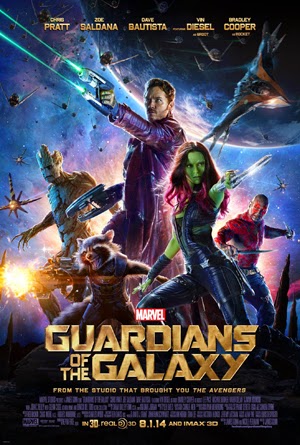
84784-gotg-posterMy first thought about this film without any prior knowledge was, “How can they have a superhero movie with a talking raccoon and a walking tree? That’s so stupid!” Well, they proved me wrong or maybe they proved me right in a sense.

Guardians of the Galaxy is stupid in numerous ways, yes, but it’s the kind of dopiness that is fun, endearing, and often hilarious. It succumbs to some of the normal superhero/blockbuster cliches, but it also finds time to make fun of itself, and it benefits from that. It does not take itself too seriously and it begins with Chris Pratt aka Peter Quill aka Star Lord (not Andy Dwyer for all those Parks and Rec fans). He is an unlikely superhero, even the actor himself, and so it makes his character work all the better for this film.
After a childhood, tragedy Peter is abducted by a group of Ravagers, and thus begins his life in the far reaches of the galaxy retrieving artifacts for his employers by any means possible. He comes across a highly sought after orb, and he himself has a price on his head. That’s how he crosses paths with deadly female assassin Gamora (Zoe Saldana), and bounty hunting partners Rocket (Bradley Cooper) and Groot (Vin Diesel). Gamora was sent by a power hungry villain bent on revenge. Rocket is a highly intelligent raccoon with an attitude, and Groot is a walking tree of few words who teams with him. They all end up in prison, and it is there where they finally begin to gel as unlikely as it sounds.
The crew is joined  by fellow inmate Drax, and they head out to deliver the mysterious orb to their contact. However, it falls into the hands of the enemy, and the gang must now protect Xandar from destruction. We have seen it all before, an epic space battle with ships zooming by, pyrotechnics everywhere and unexpected twists and turns. It is moments like these where it seems Guardians falls into the usual mold of explosions, image overload, and corny drama.
Quickly it finds itself again with Peter being goofy (ie. a dance off) or Rocket giving us one of his many wry comments in an extra epic moment (Well now I’m standing. Happy? We’re all standing now). It is these sorts of moments that make this film. Groot only knows three words, “I am Groot,” and yet Rocket has spent so much time with him that he understands every iteration. That’s how a summer blockbuster about a talking raccoon and a walking tree ends up working. It sidesteps some of the usual tropes, and when it does fall into one it willfully makes light of itself. We can forgive and forget because these “lovable misfits” are a barrel of laughs and they have a heart. It does not hurt that this film has an Awesome Mix for a soundtrack. At times I was not sure if I was watching a space opera or a rock opera — the music was so often the highlight. Then, when “Ain’t No Mountain High Enough” started playing I was sold.
3.5/5 Stars

Review: Ferris Bueller’s Day Off (1986)

de119-ferris1What’s the dream of every high school student? A school day on the town with their friends of course. In other words, the fantasy is Ferris Bueller’s Day Off. It’s utterly ludicrous but that’s part of the charm because it is such a fun romp that we forgive it for any flaws it may have.

Ferris (Matthew Broderick) is a charismatic and clever slacker who constantly breaks the fourth wall while hatching elaborate plots to get out of school and pull one over on his parents. He’s continuously pulling fast ones the whole day long and loving every minute of it. Including fake symptoms, dummies, voice recordings, and sound effects. A school-wide collection for the Save Ferris Campaign is passed around due to his illness.

In case you did not catch on yet this is a caricature of the high school life, far from reality, but that does not make it any less enjoyable. In John Hughes high school world there are stuffy and monotone teachers, a sadistic principal bent on catching Ferris red-handed, and a squeaky-voiced secretary a little behind the times. Most importantly of all, Ferris seems to have the world on a string, and his best friend and girl are right beside him to enjoy it all. Not even his sister or Mr. Rooney can thwart his fun, no matter how hard they may try.

Cameron (Alan Ruck) has a knack for the authoritative voices, sports a Red Wings Hockey jersey, and gets pulled into every one of Bueller’s schemes. He takes a lot of grief. Going so far as letting Ferris take out his father’s precious red Ferrari. As it turns out he has a very loud scream as well. Ferris does however, help him gain a little self-respect. Sloan (Mia Sara) is the cool brunette who readily takes part in the day. She’s future wife material but that’s a topic for a different time. On his part Mr. Rooney spends the afternoon getting berated, pummeled, ticketed, and chased all over the neighborhood. All in the name of catching Ferris Bueller in his lie.

The epic day off in the Windy City includes all of the following:
A trek to the observation deck of the formerly named Sears Tower (The tallest building in the world at the time). A pitstop at a ritzy restaurant for one Abe Froman, followed by a Cubs game at Wrigley Field. Art History lovers will be ogling and drooling during a montage where Cameron famously stares intently at Seurat’s work in pointillism. Then, of course, there is the Von Steuben’s Day Parade with perhaps the most famous lip-sync of all time. How I love “Twist and Shout.”

It’s not all great however, with Cameron running into problems with his dad’s car, and it must all come to an end eventually. Ferris shares one last parting kiss with Sloan and the race is on to get back home before he is found out. That’s when a little more luck comes into play. Not to mention a superhuman leap and some sisterly love.

Don’t think less of me but I am not a big fan of The Breakfast Club or Fast Times at Ridgemont High, two 80s teen classics. However, I cannot help but like a Day Off. Matthew Broderick is tremendously memorable, and the sequences in Chicago make for an equally thrilling ride. This might not be a great film, but it certainly has many returning for a second helping and maybe thirds and fourths. Who wouldn’t with a day like that? It’s like a sightseeing tour for the viewer with a little comedy and good old fashioned friendship sprinkled in. A real treat.

4/5 Stars

Seven Chances (1925)

seven chances 1We’ve seen a derivative of this story many times before, but thanks to Buster Keaton, Seven Chances has a lot of marvelous comedic moments created by his wonderful physical ability.

The story goes something like this: Boy meets girl and he loves her but never makes his move. Now he has the chance at $7 million if he gets married before his 27th birthday. But that’s today so all he has to do is marry his sweetheart Mary. It sounds so easy until he complicates the whole situation with muddled words and misunderstandings.

Now he only has a matter of time to find another bride. His law partner puts down a line of candidates, and he strikes out each time earning a face full of laughs in reply. Even the secretary and coat attendant turn him down his pitiful plea.

He drives off desperate for a bride and his buddies put an ad in the paper sure to grab him a wife. Jimmy waits patiently at the church, but there’s a problem. Hundreds of women show up and soon turn into a mob bent on clobbering him for making fools of them.

Then and there begins one of the grandest, most epic, and extraordinary chase scenes of all time. Forget Bullitt or The French Connection, this is the seminal chase scene. It’s mind boggling to think how many extras they used and all dressed in drag no less. It is difficult not to marvel at Keaton’s physical prowess because that is where he tops Chaplin. He’s fantastic at scampering about, sliding around, and making pitfalls in general, given the right environment. Soon the world becomes his playground with coattails flying and droves of angry women hot on his heels.

He hitches a ride on the spare tire of a car, dangles from a crane, does frantic Australian crawl across a pond, rides a falling tree, and of course, dodges an avalanche of fake-looking boulders. All I can say is Keaton could have been a professional dodgeball player, but we can be thankful he stayed with film. He was pretty decent at comedy too.

Needless to say, Jimmy gets back in the nick of time, or did he? Of course, he did! It seems like he’s the only one who cannot plant a kiss on the bride. At least he has one now, and Mary is far more important than the money. That’s all that really matters.

Chaplin was great because his Tramp had so much expression. The Great Stone Face was great for the exact opposite reason. He lacked it. His nervous fidgeting or obvious dismay in all situations heightens the comedy making the laughs even more hilarious.

His two buddies are a comical pair in their own right with their differing heights and good-natured blunders. They get caught up in Jimmy’s unfortunate predicament and get knocked about a bit as well.

Keaton may have had greater films, but in his golden age during the 1920s, he could hardly do any wrong. Seven Chance has one of the greatest sustained comedy sequences of any of his films and it certainly does showcase his skills. He gave Chaplin a run for his money, literally.

4.5/5 Stars