Licorice Pizza (2021)

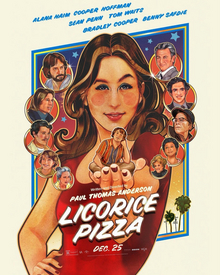
It’s apparent Paul Thomas Anderson lovingly pinches his opening shot from American Graffiti as his boyish hero Gary Valentine (Cooper Hoffman in his debut) primps in front of a bathroom mirror, a toilet all but exploding behind him. The whole movie is born out of a chance meeting at a school picture day, but it would come to nothing if Alana Kane (Alana Haim also in her debut) does not take him up on the proposition to meet at a local watering hole. Why does she do it? She’s 25, at least. He’s 15.

It seems suspect, and the film never tries to explain. It feels like a bit of nostalgic, rose-colored wish fulfillment, and yet we come to understand Alana doesn’t know what she’s doing with her life. Perhaps it’s Gary’s charisma that draws her in. He’s got a lot of nerve, but he also knows how to hustle and people gravitate toward him. She acts as his chaperone on a press junket back east for one of his adolescent TV credits.

They get into the water bed business, and there are the expected hijinks involving deliveries; Gary even gets arrested momentarily. It’s the 1970s. Gasoline shortages have been hitting everyone hard. Although Anderson draws early comparisons to Graffiti, his film lacks the same fated structure. Graffiti is roving and far-ranging, yes, and yet it’s focused on one night in one town. Once it’s over, we know each of our characters will have changed in very specific ways. The moment is gone forever.  

Licorice Pizza looks deceptively disorganized and free-flowing. It continually combs in these vignettes bringing in other personalities like Sean Penn, Tom Waits, Bradley Cooper, and Benny Safdie. Here it’s no longer solely about our leading “couple” and comfortably pushes their relationship to the periphery to play out against this wacky, narcissistic, and sometimes tragic world around them. It’s a world that Anderson waxes nostalgic about because it effectively resurrects the periphery of his childhood and old Hollywood haunts. 

As time passes, it feels more and more like a Hal Ashby flick – a filmmaker who remains emblematic of the seventies – whether the politics, the music, or even for providing a precursor to our somewhat cringe-worthy leading couple. There’s also the hint of political intrigue along with the menace of Taxi Driver that suggests the paranoia of the contemporary moment.

Still, what prevails is the mimetic tableau and the warmer tones. Anderson’s film is also bathed in the glorious golden hues of the bygone decade. As Licorice Pizza progresses (or digresses), at times I felt like it had lost me. Where was our denouement and where was this serpentine trail leading us beyond its impressive display of period dressings?

Even Quentin Tarrantino’s somewhat analogous Once Upon a Time in Hollywood… has an inevitable ending that we know is coming like Graffiti before it. In Anderson’s film we do get something…eventually. It involves a lot of running, pinball machines, and our two leads reunited again.

Given the turns by Haim and Hoffman, it’s a testament to what they’re able to accomplish together that we do feel like we have some form of resolution. Boy oh boy, is this a casual movie and that’s generally a compliment. Thankfully our two leads are full of so much winsome charm and good-natured antagonism to make it mostly enjoyable.

The movie relies heavily on a killer soundtrack, and the era-appropriate humor feels uncomfortable at best. I like John Michael Higgins as much as the next guy. However, even if his oafish Japanese restaurateur with his revolving door of Japanese wives is based on a real entrepreneur in the valley, it doesn’t mean the casual racism doesn’t still feel queasy.

Especially when you can’t discern if the audience is laughing at him or with him. Because the implicit punchline could easily be misconstrued to be that Japanese culture feels foreign and weird without appreciating the cultural subtext of these scenes. 

Still, there are ample moments to appreciate the film and cheer for Gary and Alana. We need their charisma and they more than come through. I will say that Blood, Sweat, and Tears’ “Lisa, Listen To Me” might be my favorite deep cut of the year. It’s so good, in fact, that Anderson uses it twice. 

4/5 Stars

Note: This review was originally from 2022

His Motorbike, Her Island (1986) and The Rocking Horsemen (1992)

His Motorbike, Her Island (1986)

There’s an immediate aesthetic artifice to His Motorbike, Her Island. Our hero is cool and simultaneously cruel representing a husky-voiced, brusque masculinity that feels no doubt appealing and equally toxic. He recounts his life’s observations through voiceover — the monochrome dreams making up his memories — and as such the movie slaloms easily between black & white and color.

It feels perfectly at home in its moment as part ’80s biker movie full of style. Some of this no doubt comes from director Nobuhiko Obayashi who always seems to have a propensity for commercial pop culture imagery. I would hesitate to call him a technician, and yet since he both edited and directed many of his films, maybe I don’t want to use the label because it sounds too austere.

His films are suffused with a vibrant energy and although the comparison misses the mark, the only reference I could think of was Richard Lester. I’d be interested in hearing who others bring up.

The movie’s premise is quite simple. Koh Hashimoto (Riki Takeuchi) runs errands on his motorcycle part time. His idle hours are taken up with a docile beauty name Fuyumi. He even gets in a duel with the girl’s older brother, who’s worried for her honor. Whether the outcome impacts his view of her or not, Koh, breaks it off. By his estimation, she’s boring (all she knows is crying and cooking).

Koh is looking for the Japanese version of the aloof dream girl, and he finds it in Miiyo. She captivates him with her confident vivacity, taking pictures of him, chatting in the onsen, and ultimately taking up his first love of motorcycles.

Their relationship blossoms when he visits her hometown out in the country during Obon, and we witness how the summer holiday is rooted in both a veneration and a celebration of dead loved ones. Koh’s captivated watching Miiyo dance during the festival proceedings. It’s something about her spirit he finds so attractive.

It also signals the film’s dangerous edges. Because if I wanted to distill His Motorbike, Her Island, down to its essence, we would need to talk about the intoxicating and reckless abandon of youth. It’s mesmerizing when it’s projected up on the screen in all its glory existing without worldly consequence of any kind.

Miiyo follows Koh and becomes infatuated by his singular passion: a 750cc Kawasaki. But it’s not just a supercharged motorcycle, and it’s not so much about an object made of chrome and an engine. It’s the adrenaline hit and emotional high of riding a motorcycle and riding it fast. It’s almost a dare for life to come at you head-on. For them, living life on on the edge like this is an obvious antidote to the malaise.

It’s both what attracts them to one another and threatens their ultimate undoing. Live fast, die young, has a poetic inevitably to it. I feel like I will need to watch the movie again down the road sometime, but there’s a pervasive sense that this motorbike, this island, this young man and this young woman take on a kind of mythic proportion.

Just like I never caught onto a perceptible rhythm of the monochrome and color, what we witness is not always an objective, tangible world. It exists in the hinterlands of memory, love, passion, and emotions just out of reach. The irony is obvious.

Sometimes, to feel alive, people need to get as close to death as possible. I’m not sure if this star-crossed, high-octane hedonism is still en vogue, but it’s easy to understand how it could seem attractive albeit misguided. There’s a hubris to it.

3.5/5 Stars

The Rocking Horseman (1992)

When I lived in Japan, I was flabbergasted to learn that there was a group that was bigger in Japan during the ’60s than the Beatles. It was The Ventures! This instrumental act kicked off the “Eleki Boom” as their iconic onomatopoeic glissandos (deke-deke-deke) captivated a generation of youth. These teenagers subsequently rushed out to buy their electric guitars and start their own bands during the “Group Sounds” explosion.

Although I didn’t think about it at the time, I’m a sucker for a good musical coming-of-age movie, and this landscape was ripe for such a story. Recently, when I came upon The Rocking Horsemen, I realized a void in the cinematic landscape had been filled thanks to Nobuhiko Obayashi

Fujiwara (Yasufumi Hayashi) feels like the most innocent and congenial of Obayashi’s boy heroes, a Ferris Bueller-type who instantly takes us into his confidence by not only providing voiceover but speaking directly to us.

OB’s films are easily placed in this provincial milieu outside the hustle and bustle of the big city. This gives them a kind of comfortable intimacy, and it’s only a small jump to place them in the past. In this case, Japan during the 1960s. I already mentioned that the movie covers a subgenre I have a private preoccupation with: form-a-band origin stories. That includes That Thing You Do! and Sing Street to The Commitments, Nowhere Boy, and School of Rock. What sets this one apart is the unique context and cultural moment.

Now I’ve been inculcated from an early age that the Beatles had the greatest music, but Fujiwara is coming of age with an ear raised to the admonitions of his elders. Pop music is puerile entertainment, cultural dregs compared to the sophistication of classical music. The Beatles included.

Then, his radio played “Pipeline” and he is changed forever. Any kind of snobbery quickly dissipates. The new sound assaults him as he reclines in his bedroom. There’s no escaping its force, and he converted for good, caught up in the same boom I read about. It was electric liberation.

Since a rock musician can’t look like a Buddhist acolyte, the first course of action was to grow out his hair. It occurs to me that one of the reasons I find these movies compelling is it involves some kind of youthful industry. When you’re young you don’t need to be told the odds. If you want to start a band, and that’s you’re impetus, you can go ahead and do it. No permission is necessary (parents notwithstanding).

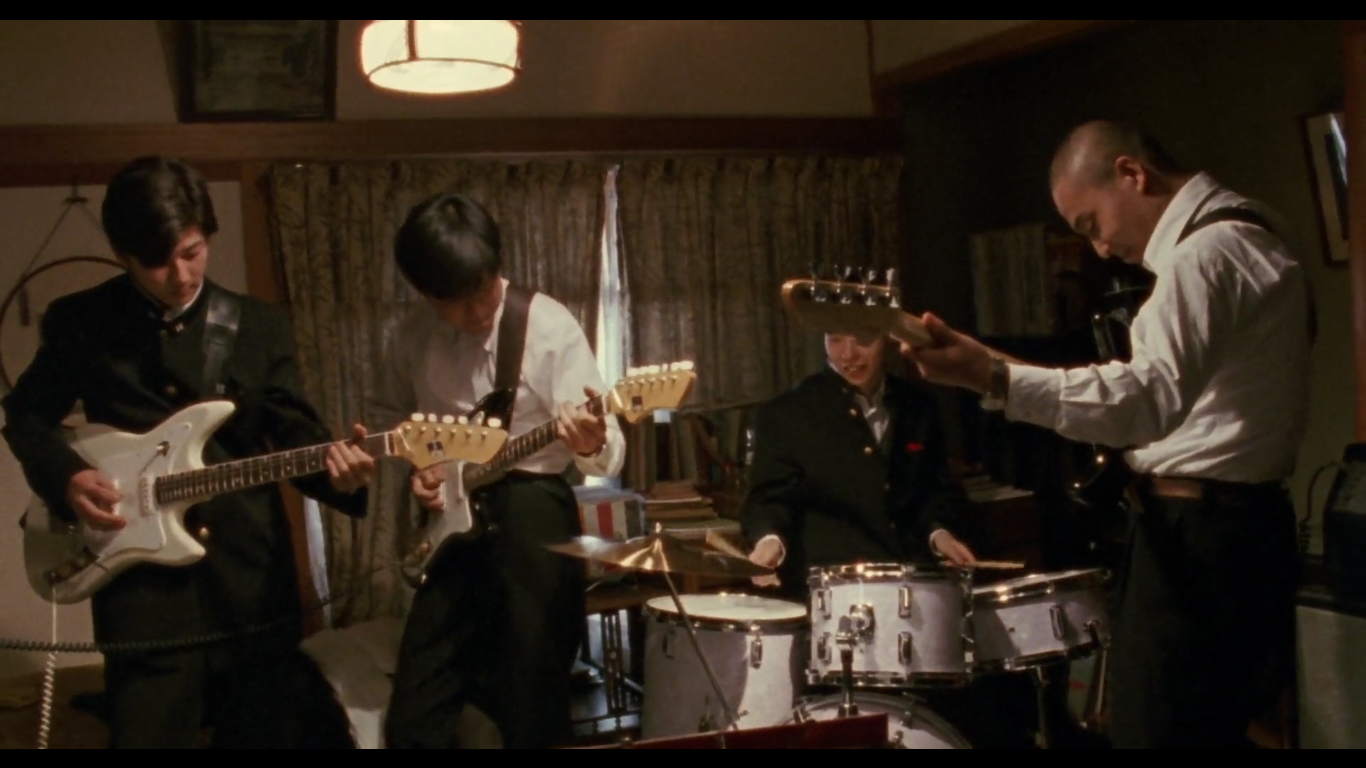
In this way, Fujiwara meets his future bandmates. The first shares his interest in rock and turns his back on the more traditional setlist the school club follows. The rest of the members include a priest’s son, who’s the band’s source of worldly wisdom, and then a gawky dork who gets coerced into playing the drums for them.

If initially they fall together organically enough, they also premeditate how to best go about their business. In the end, they resolve to get summer jobs at a local manufacturing plant to save up to buy their instruments. These scenes are mostly transitory — only an end to the means — but as “Woolly Bully” plays over their assembly line, there’s a sense of optimism. They’re getting closer to their goal.

Ittoku Kishibe shows up again after Lonely Heart as a good-natured teacher who supplies American lyrics and ultimately offers to become their club advisor. It’s a small addition, but his tacit affirmation of their endeavors speaks volumes.

I’m fascinated by how pop culture can infiltrate and suffuse through the cracks of a society, especially in an international context. I met Japanese folks with very specified knowledge about Korn or Olivia Newton-John, Sam Cooke, Jazz or Punk music. Or think of the two teens in Mystery Train who go on a pilgrimage to Memphis in search of The King. Where does this come from?

While I wouldn’t call the general Japanese populous particularly aware of world culture, you do find these hyperspecialized niches of expertise. These boys glean their inspirations thanks to radio and import records, even older siblings who pass down a love of Nat King Cole.

A perfect example is Jan and Dean’s “Little Old Lady from Pasadena” played as our hero rides his bike through his neighborhood. It’s a totally different context from the California surf culture I was born and bred in. But it still reaches them on the other side of the world. The same might be said of The Animals, “Don’t Let Me Be Misunderstood.”

It doesn’t feel like a mistake that the first time the new band convenes and brandishes their new name — The Rocking Horsemen — they start playing, and it’s a flawless rendition of “Pipeline” (exactly like the Ventures recording). They make their debut at a show during Christmas with mixed results, but they disregard the critics and play their hearts out. What’s more, they gel and become galvanized as a group. How can you not under the circumstances?

But as school comes to a close, their journey together winds down too. Their first and last big show comes at the annual school cultural festival and with a set list including “I Feel Fine” and “Johnny B. Goode,” they can’t miss. We’ve seen this moment before in many a movie so it’s a kind of expected wish-fulfillment watching them go out.

When you’re an adolescent these are the kind of memories that stay with you. And in a final act of solidarity, Fujiwara now listless and despondent over the future, has his newfound brotherhood to come around him. They christen him their “Bandleader for Life.” So even as their journey as a band might have met its logical conclusion more than an impasse (not many make it like The Beatles), The Rocking Horsemen do have some amount of closure. The music and those relationships will never leave them.

4/5 Stars

Lonely Heart (1985)

Lonely Heart is a film bathed in the golden hues of nostalgia (“natsukashii” in Japanese). It also boasts a rural landscape with a topography that’s the utter antithesis of Tokyo’s urban skyline. This in itself already evokes a certain quaintness, regardless of the story being told almost 40 years ago.

Hiroki (Toshinori Omi) envisions his world through the shutter of his camera — though he rarely has actual film to use — and so he imagines what he might capture. After school, he can be found scampering through the village streets in his school uniform with his two best friends doing backflips and cracking all manner of jokes. They have a youthful ingenuity that’s clever when it’s not getting them in trouble.

For instance, their use of Bunsen burners, forceps, and various pieces of lab equipment to cook up a delectable meal is inspired. Then, Hiroki’s friends razz him about following his father’s footsteps to be a Buddhist monk — he must give up meat lest he goes to hell for cutting corners on the road to enlightenment — and they’ll gladly eat his portion.

The next moment, they’re ushered off to the principal’s office to clean as a minor punishment. Instead, they teach vulgarities to the principal’s prized parrot and their mothers have the ignominy of coming into school to atone for their indiscretions. Hiroki’s mother is your typical portrait of a Japanese parent, at the very least because she’s always on her son to study more and pick up his grades. Their underlining failure to communicate is a universal adolescent struggle.

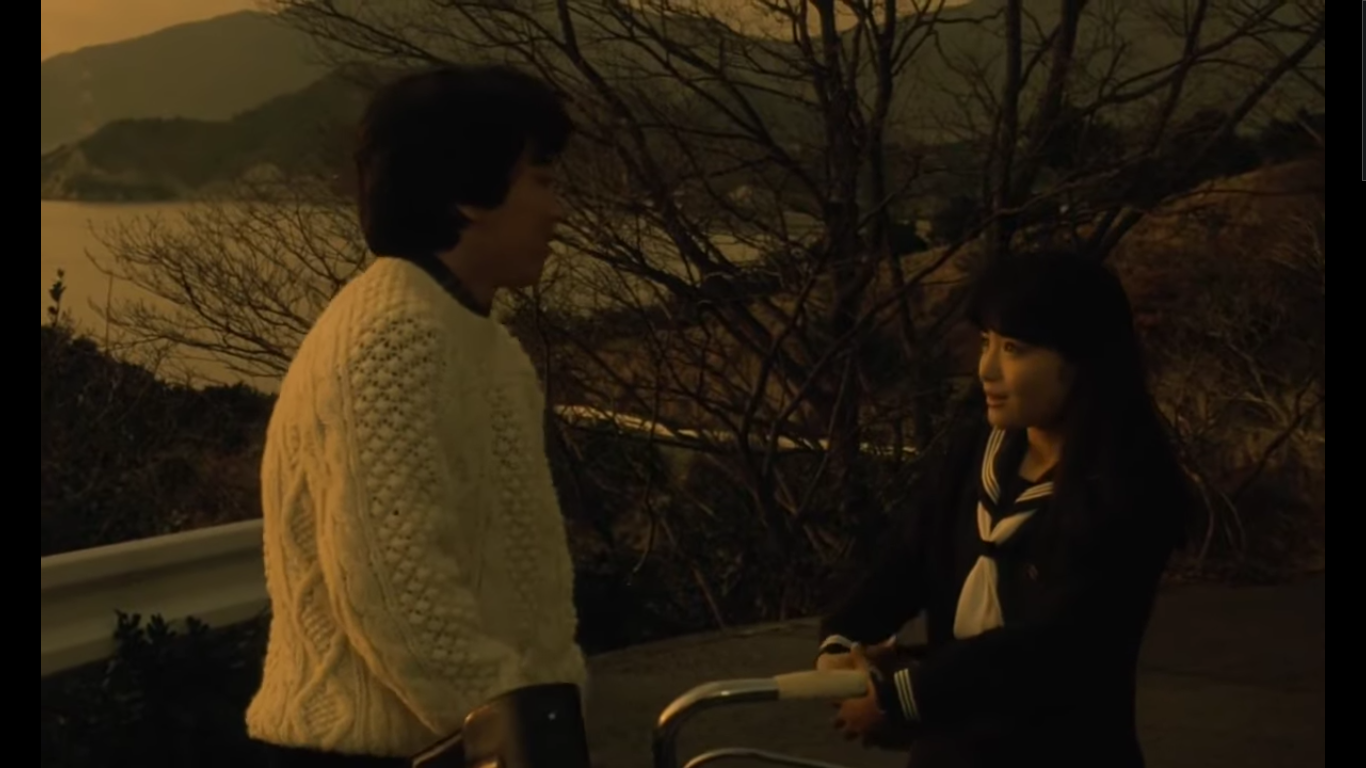
But his life stage is also about love, something that still feels naïve and untarnished by regrets and ample experience. He often looks through his camera viewfinder at the mystery girl, “Lonely Heart,” as she plays the piano, rides her bike, and takes the ferry home. If this was all it was, Lonely Heart might be a fairly rudimentary exploration of youth — another boyish awakening where the girl is cast as an object rather than a human being with a unique inner life.

Some of this happens in the movie with the ethereal Yasuko Tomita, but there’s also a parallel tale leaning into these themes in a more profound way. In fact, it takes them a step further. Hiroki receives a visitation from an impish ghost of a girl who materializes on numerous occasions even going so far as berating his mother and toying with her.

This seems like a curious development, but then Japanese culture has a greater tolerance for ghosts. If you’ve seen some of Miyazaki’s movies (arguably Japan’s most beloved cinematic export), you already know there’s a kind of acceptance of these things. They aren’t so much supernatural and if she’s labeled as “weird,” she’s also more or less accepted as fact.  Just as magical realism and surrealism can often permeate Japanese cinema.

This is easier to accept as I often have trouble with Japanese humor because it feels broad (whatever that means). The film is full of juvenile shenanigans and adult caricatures who overwhelm the screen from time to time blindsiding us with absurdity.

However, in juxtaposition, there are these instances of sensitivity playing out in Lonely Heart’s more pensive parts, personifying what Hiroki grapples with all throughout the film. It’s this long-lost love — the deep longing within all of us — resigning us to be these lonely creatures.

In Japanese culture, there’s also something innately beautiful about this sacrificial melancholy for the sake of some greater good or greater call. If I didn’t get my cultural signals crossed, it ties into the essence of “mono no aware” — an impermanence or transience of things. I’m not sure if Japanese culture would speak about love with these same terms, but please allow me to, even if only momentarily.

I’ve gotten to a juncture in my film-viewing life where, if I haven’t quite matured, I’m willing to take things on their own terms. Lonely Heart does not function within our western logic. If you asked me to explain everything away I’d be hard-pressed to say all the whys and wherefores. And yet something about this movie, mixed in with all its various forms and flights of fancies, left me with an indelible sense or feeling that will remain with me.

Somehow it reminded me of the more recent gem Petite Mamman. It has to do with honing in on a magical and poignant connection between parents and children. It developed differently than what I was expecting — the fantasy has a unique kind of functionality — and so by the time the movie’s over it has done work on us.

It’s offered up a quiet epiphany that we might tuck away for later enjoyment. Hopefully, if you get the chance to watch the film you’ll understand exactly what I mean. However, I wouldn’t dream of divulging that here.

3.5/5 Stars

La Bamba (1987)

I must have learned about Ritchie Valens through Don McLean’s “American Pie.” Because there was a time when I was fascinated by all the musical references that seemed so oblique to my young mind. Eventually, the songwriter’s ode leads you to “The Day The Music Died” and if you know about Buddy Holly, you soon learn about The Big Bopper and Ritchie Valens.

The song “La Bamba” feels like a definitive track of a certain rock n roll era, and only now does it become easier to realize what an important cultural milestone it represents. The Mexican language went mainstream blending the rock craze with folk traditions of a people who felt well nigh invisible if no less important in the ’50s.

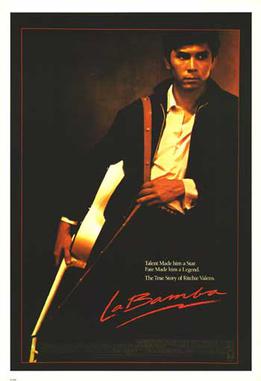
I do not know much about Luis Valdez, but as an emblematic figure in the Chicano movement of the ’60s and ’70s, he also gave us two of the most noteworthy Chicano movies of the 1980s. He turned his own play into Zoot Suit with Edward James Olmos, a film I was never able to fully connect with, but La Bamba feels like a more straight down-the-line biopic. He effectively brings to life one of the great Chicano heroes of the second half of the 20th century.

Lou Diamond Phillip’s vibrant performance glows with undeniable warmth and vitality. There’s not a disingenuous bone in his body, and he’s able to evoke the joy behind the microphone and the quiet fortitude that comes with his humble migrant background.

This is one of the most moving things about Valdez’s film because even almost 40 years on, these slices of life are still not always prevalent on the big screen. To see them in a period piece seems even more fitting because it’s a way of capturing the cultural moment for us lest we forget.

We see the plight and humble living conditions of migrant workers, there’s instability and broken families, but also the unbreakable bonds of extended families and communities looking out for one another.

La Bamba also has many of the beats of the biopic and since I don’t know the life of Valens intimately, I can only give conjecture on what’s fact and fiction. Part of the story involves his older half-brother (Esai Morales), who exists as the black sheep of the family opposite Ritchie. There’s the blooming of young love with the new girl in class, Donna (Danielle von Zerneck). His family and high school lives run in tandem with his meteoric rise after a record producer, Bob Keane (Joe Pantoliano), agrees to record some of his tracks.

Valens fear of flying, after a midair collision over his school, which killed his childhood friend and left him with recurring nightmares, has the ring of truth stranger than fiction. In keeping with this, the opening interlude of Santo and Johnny’s “Sleepwalk” feels apropos to represent the general mood of the era. What follows is a bit of a dream even as other moments sting with harsh realism.

There are so many narratives that could happen. There’s a bit of a Romeo and Juliet romance as Donna’s father tries to rebuff Ritchie’s sincere advances. Still, Donna remains devoted throughout the picture, and what a lovely thing is to see their euphoric joy together. The images suggest you don’t have to look like one another to fall in love. The fact the movie draws up this star-crossed romance between a 17-year-old and his 15-year-old beau feels of small consideration. It is a movie.

His brother knows how to make an entrance rolling up on his motorcycle, sunglasses on, cigarette between his lips. Or maybe this is only how we imagine him. Still, Bob’s demons could have been their own movie making him into a perturbing, abusive, drunken figure at the movie’s volatile center.

He’s effectively cast as Cain, never good enough or able to find favor in comparison to his thriving little brother. He spends the whole movie self-destructing and coming to terms with his brother’s burgeoning success. Later in life, it seems his real counterpart was able to resurrect his life and became a beloved member of his community.

Likewise, Bob Keane shows up in Ritchie’s life. We don’t really know how he got there or what all his motives are; still, there’s nothing too sinister in it. He helps Ritchie get big by recording and promoting him, and Valens is on top of the world.

It’s easy to see how all of these dynamics might have been either simplified or drawn up in such a way as to streamline the story or punctuate the dramatics. And yet I never begrudge the movie its choices, because it does feel like such a bountiful cultural artifact. The fact Los Lobos provided much of the soundtrack and even show up in a musical cameo is another notable distinction.

And the gutting, sinking feeling in the pit of our stomachs signals the dream cannot last. This talent taking the world by storm and rocking out with Eddie Cochran and Jackie Wilson will be snuffed out far too soon. So if everything else gets resolved in a Hollywood manner, our star is still going to be taken from us in the final reel. There’s no way to get around it.

McLean’s song mourned over it as “The Day The Music Died.” Thankfully, he was wrong. Yes, we no doubt lost out on years of musical output from Holly and Valens. Their young talents were undeniable, and yet their contributions to rock ‘n roll are far from dead. For their relatively short time in the public eye, they’ve cast very large shadows indeed. “La Bamba,” “Come on, Let’s Go,” and “Donna” feel like genre standards by now.

In his own way Valdez has guaranteed Valens won’t be totally disregarded (it was added to the National Film Registry in 2017), and Lou Diamond Phillips, bless his heart, made Valens far more than a hagiography of a deceased icon. He’s a young man with a warm, beating heart, a love for his family’s culture, and a love for rock ‘n roll. I can’t think of a better testament to Ritchie Valens than that.

4/5 Stars

Mask (1985): Eric Stoltz and Cher

Peter Bogdanovich lost his girlfriend Dorothy Stratten to tragedy in 1981 and after the release of their picture together, They All Laughed, it was anyone’s guess if he’d ever be able to return to directing.

I’ve heard an often-repeated anecdote that he ultimately decided to take Mask as his next project as a way to honor Dorothy. The reason isn’t immediately obvious. However, he explains that Dorothy was fascinated by the Elephant Man, who shared the same condition as Rocky in Mask. But she was a highly sought after beautiful woman. How could she relate?

It seems that extreme ugliness and extreme beauty by the world’s standards puts you outside of the normal purview of society. It’s not something individuals asked for. They are born with it or given it by circumstance, and as a result you have the world’s prying eyes looking at you. So both of these films are about this kind of social “others,” who must make an existence for themselves in a world where they’ll never quite fit in.

The greatest epiphany of Mask is how Rocky (Eric Stoltz) does exactly that. We’ve seen movies about people lashing out because of the hand they’ve been dealt. This is a reasonable reaction, but this movie is never about that.

It’s my own human inadequacies making it so I look at him and feel discomfort. But it’s a classic example of not judging a book by its cover. Outward appearance doesn’t define the mark of an individual.

The brilliance of this teenager is how he rewrites the script and subverts the expectations around him. He’s the personification of all our outcast inclinations when we’re in middle school and high school. None of us would have envied him during those formative years. And yet he rarely gets rattled by any of it, even when he might have the most excuse to do so.

Rocky has a level of supreme confidence so in a manner of weeks teachers know he can succeed and look after himself and his fellow students come to appreciate his wit and his near-Encyclopedic knowledge. He has a high view of himself and this allows him to be self-deprecating. I like the idea that we don’t think less of ourselves, but we think of ourselves less often. It makes our lives centered around others.

Part of this is the family unity around him. They support him and love him for who he is even as he does yeoman’s work to look after his mother. It’s almost as if he’s her guardian sometimes with the lifestyle she leads, a holdover from the ’60s with drugs and a conveyor belt of male suitors.

Cher is a powerful force and she always has a natural charisma in front of the camera that suggests so much about her. Although their relationship is the backbone of the whole movie, they have an entire motorcycle gang to watch out for them including the old family friend and Cher’s past lover Sam Elliot.

He’s a quiet enigma of cool, but with his laidback demeanor and a “Moustache Rides” tee, a character who could easily be a vehicle for outside conflict becomes more of a stabilizing force.

Rocky is even granted one of the loveliest adolescent romances of the 80s as he begrudgingly decides to spend his summer volunteering at a camp for the blind meeting Diana Adams (Laura Dern).

It’s reminiscent of City Lights with a love story based on personality and kindness as opposed to superficial appearance. In other words, it is a deeper bond and even as she’s an equestrian girl with an affluent background and he’s been raised on the road with a motorcycle gang, they relate on what’s most important.

I couldn’t help myself and seek out the writing on the wall. Rocky can’t last forever. In real life Roy L. “Rocky” Dennis passed away at 16 years old. If you didn’t know him you might think this was merciful and yet having watched his life play out on screen, we see the tragedy of it. He was such a loving, vibrant, jovial force to behold. He could have accomplished so much. And one can only imagine his mother was devastated. Because her boy was special and the bond they held was incomparable.

Bogdanovich augments the story with his trademark use of dietetic sound to fill out the world on top of some of Bruce Springsteen’s finest tracks. I watched the director’s cut which included a few extra scenes and all I can say is that I’m thankful to Bogdanovich’s conviction to get his version out there without compromise. This included working with Springsteen himself to get the original recordings licensed for the rerelease. It pays heavy dividends.

Regardless of the director’s shortcomings, I will dearly miss his classical sensibilities as a filmmaker. He made films imbued with joy and melancholy. Both speak to me and surely I’m not the only one because life becomes a subtle dance between a panoply of emotions.

Like the masters of old, he was able to take a story and personalize it so the core themes are somehow made manifest and evident in his own life. It’s a lovely brand of storytelling, and it allows Mask to constantly ambush us with some winsome surprises. This is how movies should be.

4/5 Stars

Running on Empty (1988): River Phoenix, Fire and Rain.

I know only very little about River Phoenix’s upbringing but somehow it’s easy for me to make the leap from his real-life existence to his family in this movie. Running on Empty has to do with an unconventional upbringing.

Danny Pope (that’s his real name) has grown up with his little brother and two parents Annie (Christine Lahti) and Arthur (Judd Hirsch), who have lived on the run from the feds since the early 70s. They were implicated in an anti-war protest at a napalm plant that left a janitor dead.

The Popes are a tight-night clan in spite of their unusual circumstances or because of them. Somehow in this environment of constant flux and fresh identities, they’ve managed to raise two boys who are loving and smart.

Danny enrolls in a new school and immediately distinguishes himself on the piano. He seems like an obscure prodigy because no one knows anything about him and his benevolent music instructor (Ed Crowley) gets little information on him. Still, he’s talented and generally considerate. He doesn’t play into the expected stereotypes of a malcontent.

He also makes the acquaintance of the teacher’s daughter (Martha Plimpton) who has a much more jaundiced view of education and musical appreciation. She’s used to a more typical lifestyle and yet she’s drawn to the new boy, not out of an act of rebellion against an overbearing father or anything like that. Danny is genuinely decent and kind. She immediately likes him, and they spend time together. She wants to get to know his family too and so she does.

I was a bit disappointed Jackson Browne’s tune “Running on Empty” has no place in the movie, but they may have done themselves one better with James Taylor’s “Fire and Rain.” Their celebration of Anne’s birthday turns into a dance party in the dining room; there’s something spontaneous and joyous about it.

It encapsulates the best aspects of the movie where we’re suspended in these moments of relational goodness. To be a part of the scene feels organic and the characters become all the more real in front of our eyes. We enjoy their company.

Martha Plimpton has a James Dean Rebel Without a Cause poster in her bedroom and somehow Phoenix carries some of the same ethos. There’s the morbid similarity in that they both died young and yet more than that, it has to do with a palpable emotional investment in their roles. It’s more like music than it is blue-collar craftsmanship and their brand of sensitive masculinity feels off the charts.

Phoenix has an emotional maturity and precociousness that feels wise beyond his years and still wracked with inner demons. Here he must carry the burden of his parents’ life. It also fuels the budding romance that Phoenix and Plimpton were an item in real life.

Christine Lathi still feels mostly underappreciated as an actress. She’s a loving mother, a strong wife, and the scene where she has a teary reunion with her father after many years is lachrymose but never totally saccharine. They supply just the right amount of heartbreak and tenderness.

Judd Hirsch deserves his plaudits as well though if you’re like me you appreciate him for being the stabilizing force on Taxi. He plays the part so well that sometimes you forget he’s an actor’s actor.

I’m reminded of his rapport with Timothy Hutton in Ordinary People and his scenes with Lahti and Phoenix here. He always gives off this aura of street smarts. He’s tough and able to spar, but it’s never totally untethered from his unerring heart. He cares and somehow he’s able to make his audience feel his concern.

What I appreciated most is that Running on Empty never feels over-reliant on its political elements which are often relegated to the background in favor of far more sensitive developments of character. It would be so easy to succumb to drama. Instead, it chooses a more nuanced road as Danny starts to put down roots and gets encouraged to apply to Julliard. Suddenly, his lifelong anonymity is bumping up against his youthful dreams of a normal future.

Director Sidney Lumet was always a fine filmmaker and one of the most enduring because he was a workman and he knew how to rehearse, he was smart, and made compelling movies. Running on Empty is never one of the most high profile mentioned, but it leaves space and feels attuned to the family at its center and their relationships. This is why I go to the movies to be shown people’s humanity up on the screen and then be uplifted by it.

The movie hardly dwells on its ending. Perhaps we could have done with a bit more resolution, but it does itself proud with a refrain of James Taylor’s “Fire and Rain” pulled from an earlier scene. It’s as if the chorus of singing voices — the family all joyful and gay — is a concrete reminder that that bond will never be broken even as they move on.

There’s something satisfying about discretely reaching back and referring to the movie’s most poignant moment. Because it means so much and these are the kind of memories we carry with us wherever we go. Family is forever.

4/5 Stars

Pump Up The Volume (1990): A Gen X Jeremiad

Pump Up The Volume is a movie that tackles the existential malaise of the generation beyond After Hours and Something Wild. I’ve never been particularly good at charting the shifts in generational demographics, but the film is definitely an adolescent jeremiad for Gen Xers.

In truth, I only learned about the movie from a work colleague who is a generation older than me. The sense of upfront and personal alienation spoke to him as a high schooler and probably a whole generation of the discontented.

Although Allan Moyle’s movie doesn’t make the rounds too often, you can immediately sense its cult appeal and also a certain level of prescience in speaking to the teenager’s dilemma. I’m not sure if it’s merely a post-war phenomenon, but it’s certainly something Millennials, Gen Zers, and whoever else follows can certainly resonate with.

Harry Hardon (Christian Slater) is a local DJ who hits the airwaves at 10 pm sharp every evening cued by his theme song, Leonard Cohen’s “Everybody Knows,” and backed by a steady flow of alternative music, personal commentary, and raunchy gags. He’s garnered quite a devoted following.

Within the confines of the film, he builds a cult of personality as a nighttime provocateur, and it’s so easy for him to represent the profane bombastic nature of youth. His viewership cuts across high school cliques to encompass nerds, punkers, beautiful overachievers, and everyone in between. Because everyone of a certain age can identify.

As he puts it, parents, teachers, TV, Movies, and magazines tell you what to do, but you know what you have to do — your purpose is to get accepted, get a cute girlfriend, and think of something great to do the rest of your life.

For those crying out for an alternative, less conventional existence, it can feel like a suffocating road to the American Dream. It’s easy to feel lied to or at the very least feel like school and the world haven’t fully prepared you for the brunt of angst weighing on your mind.

Christian Slater is required to do a lot of the heavy lifting throughout the film, and it relies on his charisma because in many of his scenes, he’s just speaking to an audience out in the dark somewhere (both over the radio and in the movie theater). Somehow it works though DJing is only a small aspect of his life.

By day, he’s Mark Hunter a disenchanted teen. His father is on the school board, they’re in a great district, but he’s also the new kid on the block and doesn’t have any friends. He exists on the outskirts mostly unseen as a diffident disciple of Lenny Bruce stuck in his own thoughts and unable to socialize. By night, well…he comes alive.

Samantha Mathis almost feels like a bad girl version of Molly Ringwald, dark-haired, pretty, and spunky as Nora De Niro. She, like all the rest of her peers, is captivated by Harry because of what he represents to all of them. It becomes her mission to figure out who he is as she scrounges around school and sends letters to his P.O. Box as bait. Eventually, she learns the identity of their mild-mannered Clark Kent.

It does feel like Pump Up The Volume is on the cusp of a new decade while still channeling the remnants of ‘80s film culture. There’s a War Games-like wunderkind ingenuity where a single teenager seems capable of taking on all manner of adults, government organizations, and what have you even as he muddles his way through the usual adolescent romance and alienation.

It escalates following a classmate’s suicide and a broader probe within the highly-touted school as the principal looks to bring down an iron fist on any troublemakers and keep her pristine reputation. The only problem is that the masses are getting more and more unruly and brazen as they rebel against the school’s primary enforcer, Mr. Murdock.

Then, the FCC is on Mark’s trail prepared to shut down his clandestine operation. It’s not a game anymore. We’ve gone large-scale. If you’re like me, you’re always under the assumption he’s going to be caught; they’re going to nab him, and still, he always finds a way to outsmart them.

I couldn’t help likening Harry to a prophet of the airwaves, a Howard Beale for the angsty teenage population as he exhorts them to “Do something crazy!” But what I appreciate about the movie is how he eventually kicks his version of a nihilistic spiral.  Early on he opined that “Being young is sometimes less fun than being dead.” Then, he changes his mind. Hang in there he says. It can only get better.

He and Nora take his radio show on the road for one last evening of insurrection before signing off for good as the local teenage population’s cult hero. He becomes a legend in his own time and even if his frequency dies, there’s a nation of others to rise up and take his place.

I’m not sure what the contemporary implications of Pump Up The Volume were; it could have been negligible at best, but even though this movie is not always talked about, there’s a sense it spoke into the zeitgeist of the times.

It’s not a large production, it didn’t make a ton of box office, and it hardly has the enduring reputation of John Hughes’s most prominent works. Part of this might owe to its coarser even darker subject matter, though it’s rarely bandied about with the same frequency as Heathers. But this very same punk mentality wrapped up in the anxieties of the suffocating structures of high school, middle-class meritocracy offers a foreboding portrait of the future.

It still manages to be a movie of common ground, reassurance that we are not alone, and that the days ahead can get better. It’s not a movie about stewing in death and insecurities but acknowledging them and putting them to rest. In their place, we can have romance, friendship, and camaraderie.

I’m not for glorifying delinquency per se, but it is a movie, after all, and Slater makes it quite an intoxicating thrill. Especially when we don’t have to witness the aftermath or live with any consequences. Somehow, he can ride off as the hero we always wanted, knowing deep down inside maybe we have something inside ourselves that can still be expressed — it’s waiting to be expressed. Whatever your opinion, it’s fairly optimistic, and this is in its favor all these years later.

3.5/5 Stars

Bill Forsyth’s Films: Gregory’s Girl, Local Hero, Etc.

Bill Forsyth is a director who has flown under my radar, and yet only after a week’s time and a handful of films, he’s quietly become a new favorite. Now I heartily understand why he’s one of Scotland’s most beloved directors. Part of his appeal is because he wrote and directed his own projects, but it also comes down to how he imbues his films with a certain sensibility that’s thoroughly disarming.

That Sinking Feeling (1979)

That Sinking Feeling was his debut, a microbudget caper about a pack of eccentric Glasgow youth who alight on a plan to make a buck stealing sinks. It follows the beats of a heist while straining them through a very specific experience.

What Forsyth brings out of his youthful troupe of actors are the lovely idiosyncrasies his films are all utterly replete with. It’s the kind of humor that feels honest in its truth and the good nature behind it. Many of the faces that show up throughout would crop up in some of his later works as well.

Comfort and Joy (1984)

For some, Comfort and Joy might be a new Christmas tradition. It’s a low-key movie finding its footing by focusing on a disc jockey (Bill Patterson) who’s a kind of local celebrity thanks to his good humor, jingles, and the fact he’s in people’s homes just about every day.

There’s a curious streak to the movie as Dicky becomes a kind of mediator between two rival families in the local ice cream racket. I’m not sure where these premonitions come from, but the way Dicky gets caught up in the late-night escapades in the feud between ice cream vendors, I couldn’t help but think of the milieu of After Hours. It’s probably because the situation escalates into this quirky absurdity with a touch of doom.

It has a few fanciful dreams and feels like it could be a sick nightmare. Still, Forsyth never allows any of this to totality derail the prevailing good nature of his characters.

Housekeeping (1987)

In 1987, he alighted on another journey, writing and directing an adaptation of Marilynn Robinson’s Housekeeping. Although it was his first American production, it also brought him together again with his fellow countryman, producer David Putnam.

It’s a film rather reminiscent of Jonathan Demme’s Swing Shift and it’s not simply due to the inclusion of Christina Lathi. It’s the way Forsyth hones in on a story of keenly observed moments and distinct characters rather than a fierce adherence to form and structure. Yet again, there’s a clear-eyed authenticity to it that feels far from being fabricated. It maintains this ethos, and time and time again succumbs to these quietly profound moments that are all too easy to disregard.

I’d like to take the rest of my time to highlight Forsyth’s two most noteworthy films because they all but embody my newfound appreciation for the director.

Gregory’s Girl (1980)

The opening tag immediately feels like the opening moment in any number of cringe coming-of-age films. A group of prepubescent peeping toms gape at a beautiful woman hidden behind glass. Gregory’s Girl looks destined to join the trashy, smutty cadre of ’80s locker room movies. And yet around every turn as I kept expecting the worst, here is a film that constantly surprised and left the dorkiest, most curious, and strangely poignant impressions.

Gregory (John Gordon Sinclair) is one of those iconic coming-of-age protagonists, meaning he’s a spindly dork with the most atrocious head of hair imaginable, and we’re already talking about the ’80s. Still, in a word that could easily be harsh and unfeeling, he makes it genial and a tad innocent.

He doesn’t have a killer instinct out on the football pitch. He loses his coveted striker spot only to bump his best friend, another loser named Andy, out of goal. They hardly seem to mind. Because they’ve made way for the school’s latest talent: the athletic blonde Dorothy (Dee Hepburn).

Again, this brings with it all sorts of potential problems. The male population is quick to rally around her — cheering her on ardently — though it could be a lot worse. It suggests girls can excel in many facets. However, it does run the danger of turning her into a regressive object where the girl is a trophy to be won.

On more than one occasion, it bends away from the expected gauntlet of crude jokes giving us something lighter, more agreeable. It comes with how it conceives of a very particular version of adolescence: small-town Scotland outside the urban decay of the big city. It feels quieter and more hopeful, even if the world itself and the time in life is incredibly transient.

Gregory’s Girl is nothing like what I expected. It was far better. Yes, it’s a slight film, but this plays to its strengths because it gives us these characters and these moments — observations we can appreciate — and then we get to leave them with a wealth of affection. It’s easy to see my estimation of this one rising after future viewings. Even as I ruminate on the title Gregory’s Girl, it has new meaning, and it makes me smile. It’s a pleasure to have expectations subverted and then exceeded.

4/5 Stars

Local Hero (1983)

Local Hero is bolstered by a simple premise being subverted. A colossal American oil company looks to gobble up land in and around an idyllic Scottish village. However, there’s no malevolent corruption and their eccentric benefactor, Mr. Happer (Burt Lancaster), would much rather chart the stars than deal with any amount of oil refineries.

Likewise, it’s never a story of the little guys trying to hold out against progress. The locals are delirious about the money coming their way. Instead, we come to appreciate what this kind of life has to offer as does our stand-in Mac (Peter Riegert).

It hearkens back to an era — the days that made my parents fall in love with the U.K. –where there were still pockets of the world seemingly untouched by modernity and true western influence. The Texas businessman and his Scottish sidekick (Peter Capaldi), pay a visit to the small town and set up shop in the B&B. The local pub is where the whole town pools their funds to make change for an intercontinental phone call.

At first they look rather out of place: two suits walking across the beaches with their briefcases. But then we get a passing sense of who they are as people. They are romantics even friends of passing rabbits. We come to like them. The same might be said of the town and why not? Wow, is the countryside breathtaking. I miss it so.

This is never a movie about board rooms or business, but the bits of business happening in a community. There are all sorts of people, and the quaint elements prove utterly charming.

What a lovely connection between Star Wars and Local Hero to have Wedge Antilles be the town’s main accountant and hotelkeeper prepared to cut a deal with the man from America. Though any amount of haggling or conflict never materializes and they quickly become best buds.

If there was any conflict, it all but evaporates and what is left is warm humor and the forming of lasting relationships. There are the cultural differences, the manifold eccentricities, but there’s also the congeniality. It’s part of what makes this unassuming movie such a pleasure.  Local Hero is gentle cinema, and it’s exactly what we need.

4/5 Stars

Afire (2023): A German Summer Movie a la Rohmer

Christian Petzold is a filmmaker I was introduced to over a decade ago, and I would consider myself a passionate fan. I’ve seen every one of his films since then, and I would gladly share him with anyone who might listen. There’s some pleasure in championing a director who’s not as much of a household name as one might hope. 

The other wonderful thing about Petzold is what an ardent cinephile he is, but he’s also quite loquacious and charismatic. Obviously, English is not his first language, but he always does wonderfully candid and thoughtful interviews all across the festival circuit. I can imagine he would be quite the person to grab a coffee with. He’s shared on multiple occasions how he crossed paths with Abbas Kiarostami in New York City under such circumstances. 

Forgive me for burying the lede, but I appreciated Afire because, like many of the director’s earlier films, it does feel like it’s deep in conversation with the vast annals of cinema. 

This one in particular feels like a paler, pudgier version of an Eric Rohmer movie. Something in the vein of La Collectionneuse, Pauline at the Beach, or even A Summer’s Tale. I felt vindicated hearing that Petzold was in fact consuming some Rohmer films during the pandemic, but that was only part of his inspiration. 

Reading an interview he cited a significant reference point for his latest effort in People on Sunday. It’s not a film I would have considered in a million years because it’s well, almost 100 years old. But in regard to this allusion, he makes a fascinating observation. 

Unlike Hollywood, Germany doesn’t have a lineage of summer movies about the last day of school or hanging out at the beach with no adult supervision. There’s also no Summer with Monica or Eric Rohmer. 

With men like Billy Wilder, Edgar G. Ulmer, Fred Zinnemann, and Robert Siodmak — all creative collaborators in People on Sunday, they were forced to leave Germany. And when they moved to Hollywood in the wake of the Nazi scourge, their work got harsher with the likes of Detour, Lost Weekend, and more film noir.

The summer had vanished not only from their filmographies but from Germany as a whole. The nation rarely got this opportunity with the ascension of the Nazis and this historical backdrop gave rise to many of the specters which have haunted most of Petzold’s oeuvre.

If you wanted to make a case, Afire is actually Petzold’s most comedic film to date and his closest to romantic comedy. Leon (Thomas Schubert) is staying at his friend Felix’s idyllic summer home out in the forest near the Baltic Sea. They think it’ll be a great place to get away: Leon needs to finish a manuscript and Felix (Langston Uibel) has an art portfolio to complete though he seems far more at ease and prepared to make the most of the tranquil surroundings. 

It starts out as the vacation from hell we might all be familiar with to different degrees. First, their car breaks down, they get lost taking a shortcut, and it looks like Leon might be stranded out at night in the forest with no cell signal. Felix goes off to make his way to the family cabin. 

Eventually, they get there. Except it turns out they won’t be alone. A co-worker’s daughter has set up shop; we don’t know for how long or why. We just know Leon’s plan for an uninterrupted getaway is catastrophically ruined. Strike two. 

The walls are thin and you can hear everything…It makes sleeping very hard and Leon’s even grouchier than he was before. The incessant bugs and the impending fires don’t do much to lighten the mood. 

Leon also seems genetically predisposed to be a moody, pretentious misanthrope of the first degree. Felix is good-natured and thoughtful. He would never think to impose himself on others or make a stink. It comes naturally to Leon. 

The camera takes on his surreptitious gaze which makes me uncomfortable as he spies on their housemate out in the yard before ever officially meeting her. Still, nothing he does can negate Paula Beer. In her work with Petzold, she always comes off as such a charming and intelligent performer who gives so much to the camera. 

Between her last film Undine where she played a modern-day mermaid, and Afire with its landscape ablaze, there’s this pervasive sense of the classical elements permeating the collaboration. It’s this lovely amalgamation of the deeply modern with the primordial. It makes one wonder where Petzold and Beer might go next. 

In the previous film, she was a docent focused on Berlin’s history of urban planning. Here Nadja works at an ice cream stand doling out flavors of “Smurf” sherbet. She’s disarmingly straightforward, cutting through any pretense. It makes her immediately attractive as a personality.

Whereas Leon’s a perpetual excuse machine. He never swims or takes anyone up on anything. He’s the kind of person you try to be nice to by inviting them to stuff even if you don’t want to, and then they decline so many times, you feel exasperated. They’re too blind to recognize you’re trying to do them a favor.  

Leon should be a lost cause, and yet even if we don’t particularly like him, we can empathize with him, and I think all his acquaintances in the movie make us appreciate him a little more. 

Later, at an open-air dinner, he lashes out at the rescue swimmer Devod. He feels like a stereotypical beefcake, and yet belies the image making Leon all the more uncomfortable. Because their new acquaintance was sleeping with Nadja, but he seems like a genuinely nice guy. These don’t have to be mutually exclusive. 

At first, Leon’s defensive about sharing his work; I recognize what a private and vulnerable thing it can be, and still, I wouldn’t give him that much credit. After Nadja asks to read Club Sandwich, he eventually relents. One suspects it becomes a mechanism to try and get closer to her and into her good graces — a way of covering his growing insecurities.

Leon’s also made a big deal of setting up time with his bespectacled editor (Matthias Brandt) to review his new work. He’s an older veteran, not unkind, but extremely busy. It turns out the full weekend they were meant to have together has been whittled down to one full day and some change. After Nadja invites Helmut to dinner, Leon grows jealous when it seems like everyone else gets a piece of him too. 

He takes great interest in Felix’s art portfolio – the one that Leon either didn’t get or totally disregarded. Then, Helmut trades poetry with Nadja; she recites her favorite poem, “The Asra.” It comes out she is working on a Ph.D. in Literature on Heinrich von Kleist’s The Earthquake in Chile (What she terms the “quake of representation”). 

Leon’s pettiness feels like a symptom of his own making. He knows Club Sandwich is crap. Nadja was honest enough to tell him as much. But he tried to dismiss her criticism; she’s only an ice cream seller. 

He never thought to ask her about what she might be studying. And now with the recognition that not only is this girl better looking than him but also perhaps smarter as well, it’s more than his fragile ego can take. 

Everyone else seems casual and comfortable, enjoying the throes of what summer has to offer. He’s the only one in obvious crisis, slowly imploding until the world around him joins in. 

The fire which was always hinted at continues to rage ever closer. Ash falls over their world like a ruinous dusting of snow. The boys go to tow their car with a tractor. Helmut starts to convulse on the lawn and Nadja takes charge to rush him to the hospital.

I noticed one particular jump cut in the editing involving Leon. He realizes he’s made a huge mistake; he’s been selfish and incapable of doing almost anything. What’s more, what will Nadja think of him? 

The raging conflagration brings with it human tragedy that strips away any remnant of sun-soaked vibes and focuses our story on its purest elements. As we should expect, it goes darker, but there’s another turn in the story. Our perspective changes subtly.

Nadja and Leon are called into the hospital again. There’s pensive voiceover narration to go with the images, and we realize intuitively even as the actions happen in front of us, somewhere in the present or future Leon is writing a new novel. 

I’m led to question if it’s still callous that he seems to be writing the story as the events seem to be happening or is it the most authentic thing he’s ever done? I’m not sure.

Later, he sees Nadja again from a distance. Some time has passed. We’d like to think he’s changed, and we know he’s wracked with guilt. Their eyes lock in recognition. Petzold cuts before there’s anything else, and it feels like the quintessential ending. We can fill in the rest with whatever we want.  

I’m still trying to get my feelings in order, but it delivered like Petzold always seems to. It’s deeply observed and engaging with its perceptive vision of humanity and interpersonal relationships. But what makes it richer comes with how the writer-director takes a simple premise and simultaneously imbues it with all this intertextual meaning. 

His references are not always overt, but couched within his stories are the echoes of his nation’s films as well as literature and mythologies – many of his projects over the years have been adaptations of much older work. In our current age of cursory knowledge and vapid fads, he’s a refreshingly thoughtful filmmaker. I’m still holding out for that coffee someday, preferably at Berlinale. 

4/5 Stars

Rushmore (1998)

Through his quintessential use of camera, space, and symmetry, we already see the formation of Wes Anderson’s now easily attributed style incarnated in Rushmore. It makes us aware we are watching a movie just as it makes us keenly aware of the filmmaker. There is a meticulous storyboarded quality to it with telling POV and overhead shots laying the groundwork for his unmistakable aesthetic.

For some, this is a turn-off. It totally ruins the so-called suspension of disbelief. You don’t want to be reminded you are watching a  movie. You want to disappear into it. But Anderson’s style is so particular it’s hard not to marvel especially because it’s not simply a case of form over substance. This movie is about something meaningful.

Jason Schwartzmann proves himself an exquisite choice to play our lead. Max Fischer is a young teenager with such an impressive array of extracurriculars and side hobbies, he has no recourse to fail all his classes at Rushmore prep school. He’s too much of a driven, daydreamy kind of person to get stuck with his textbooks for hours on end. His aspirations seem to be focused on something more. 

One of those might be romantic love as the ancients would come to understand it. I think of the scene where he first makes the acquaintance of the pretty literature teacher, Ms. Cross (Olivia Williams) on the bleachers. Anderson frames them in individual shots, but then Max keeps on sliding out and back into the frame. It’s not in a continuous camera movement. Instead, these orchestrated moments add together to give us a sense of what’s going on – both good-humored and slightly awkward. 

But we must also talk about Bill Murray. I’m no Murray historian, but Rushmore and with it, the actor’s continuous collaboration with Anderson, seems to mark a distinct shift in his career. It may not be a Reinnaissance, but it effectively took an SNL phenomenon known for comedy films like Caddyshack and Ghostbuster, only to provide him a fresh dimension.

Perhaps it was always there before, but whether it was Anderson seeing it in Murray or Murray finding inspiration in Anderson’s material, I don’t see his work in movies like Lost in Translation or Broken Flowers coming to fruition without a spark.

It’s not that Murray is unfunny in any of these roles. Instead, like Robin Williams, Jim Carrey, and the like, he’s able to somehow take those comic eccentricities with his own core humanity, and make it deeply impactful.

In Rushmore, Murray gets his Dustin Hoffman “Graduate” moment submerged in the pool at his son’s birthday party. The allusion is straightforward enough. Meanwhile, Max goes and falls in love with his teacher — resurrects Latin class and tries to procure her some new aquarium tanks all as devoted acts of affection. He has other passions too.

He directs his own stage version of Serpico and the lifelike train noise and walkie-talkie sound effects mimic the attention to detail Anderson would have admired. But these are not all the stage elements. Because there’s a recurring sensibility that brings attention to the performance nature of the movie, whether it’s the curtains being pulled away with the changing of the months or Max’s never-ending thespian endeavors.

I’ve never known Luke Wilson’s filmography well, but I found his cameo almost endearing as he becomes the target of Max’s jealous and impudent ire. He’s not willing to relinquish Ms. Cross to any man even if he has no hold on her either as her junior.

This and other shenanigans get him expelled from Rushmore. Being caught smoking or failing his classes is far too mundane. He tears up the baseball field for the ground-breaking of his new aquarium. Thereafter he’s off to public school with a wounded heart, though he encounters several sympathetic spirits including Margaret Yang (Sara Tanaka).

Still, the movie becomes a love triangle with a 15-year-old and Murray’s grown man(child) going at it in their attempts to hurt one another like vengeful kids in the schoolyard. It proves how fickle they can be. But that’s not to say unlikeable. Because Herman and Max became friends and then turned into rivals. 

In fact, there’s a precociousness to Anderson’s adolescent subjects even as his adults have flaws and insecurities. It’s as if all his characters are on the same plane of existence. This is not Peanuts. There’s no chasm between the relatable kids and the unknowable adults. I’m not sure this makes it more realistic; Anderson does not strive for realism, but it reminds us that we all are not too dissimilar as people.

Dirk, Max’s most faithful friend, and Herman share a conversation near his car that in any other film would probably feel ludicrous; here they are able to speak to each other as equals, and they are not the only ones given this luxury.

It’s easy to feel sympathy for Rosemary because she has lost her husband, and she did not ask for Max to fall in love with her. She tries to navigate their interactions with warmth, but his boyish impulses and irrepressible spirit mean he’s never going to let her be. He can’t comprehend how one does that.  For a teenager, she must feel like Mrs. Robinson. In her own world, she’s just another confused and lonely person trying to make sense of things. 

At first, I was trying to figure out the purpose of the soundtrack: It’s full of agreeable British Invasion tracks from the likes of Chad & Jeremy or The Faces. The easiest answer is how it comes to represent nostalgia but also the prep school malaise. It’s Anderson’s version of the Simon and Garfunkel soundtrack for Dustin Hoffman — compiled for a slightly different segment of society and an emerging generation. It exudes a contemplative melancholy not without its quirks and humor.

From my vantage point, I can only watch Rushmore retroactively, having seen much of Anderson’s career unfold, but it does give me a different way in which to appreciate it. Here we see him coming into his own; he has a Truffaut-like eagerness for the cinema, and money hardly seems to be the signifier or measure of his film’s success.

Now he commands larger budgets and even more intricate and sprawling productions, but Rushmore shows what he is able to do as a filmmaker with his own sense of inventiveness, flair, and surprising resonance no matter the restraints put upon him.

For me, this is often the measure of a sublime director, and Anderson signaled his ambitions to the world with this movie. I found myself instantly fond of the film, and I can see this affinity only growing with time. Again, I appreciate the allusiveness of his films — how they are steeped in movie tradition and what feels like technical virtuosity — but even more so I feel compelled by these particular characters. What’s more, I want the best for them.

4.5/5 Stars