
The Edge of Seventeen (2016)

The_Edge_of_Seventeen_2016_film_poster.jpgThere’s a moment in Kelly Fremon Craig’s The Edge of Seventeen where Nadine (Hailee Steinfeld) suffers the ultimate humiliation third wheeling with her older brother Darian (Blake Jenner) and her (former) best friend Krista (Haley Lu Richardson). Needless to say, the evening is less than stellar but it gets worse after Nadine feels like she’s been totally betrayed. She’s been hating her brother recently and her best friend is dead to her now. The fact that she sets up an ultimatum doesn’t make things any better.

It only gets worse when a fellow partygoer notes Nadine’s sibling relationship reminds her a little bit of the movie Twins — if Nadine was Danny Devito and Darian was Arnold Schwarzenegger. It’s a perfect illustration of how she feels.

Growing up is never easy for anyone and it’s little different for Nadine. Mean girls at school. No friends. Until the fateful day when she got one but by the time high school hits everyone’s doomed. Hailee Steinfeld manages the tall order of portraying this maladjusted, histrionic, neurotic teen with a pitch-perfect pout.

She’s simultaneously our Lloyd Dobler and our Molly Ringwald in any of the John Hughes vehicles and yet none of those things because she’s come out of a different millennium. She must put voice to every thought and emotion that comes ricocheting through her head as much as she constantly yearns for the not so pretty boy on campus to notice her existence.

Her family life is little better. The death of her father still lingers with hurt. Her brother is the devil’s incarnate (at least to her) and her mom (Kyra Sedgwick) is a little ridiculous–not to be taken seriously in the least. Did we mention that her best friend is hooking up with her brother?

What the film grasps so impeccably is that the teenage years are often defined by one word: Awkwardness. This film is the creme de la creme of awkward and for a coming-of-age film that’s very much a compliment.

There so many awkward conversations to be had. Steinfeld and Woody Harrelson share some of the best because she comes like a hurricane of emotion and he gives her nothing — only the driest retorts as her smart-aleck history teacher. Equally enjoyable is the budding friendship between Nadine and fellow classmate Erwin Kim (Hayden Szeto) who makes no attempt to hide his crush on her.

It’s easy to quickly assume Erwin is in the tradition of Long Duk Dong from Sixteen Candles but a particular Ferris Wheel conversation throws all those conventions out the window for good with a few self-aware lines of dialogue. It’s a pleasant surprise that this relationship is rife with laughs but not at the expense of the characters. Only in the sense that we have the age-old conundrum of the friend zone, still fretted about by teens to this day.

She thinks he’s nice but isn’t attracted. He thinks she’s the greatest girl in the world and dreams of making it into something. He takes all her signals to heart. She doesn’t. The Edge of Seventeen feels very genuine in these respects and the beauty of these themes are their universal quality. This isn’t just about a girl and a guy–one Caucasian the other Asian–they are two people just like us. It’s the universal unifier. We’re all human.

That’s one of the relationships modeled by Nadine in the film. But there’s another one that is far more unpleasant. The one involving her own crush on Nick a seemingly unextraordinary teen male that Nadine for some inexplicable reasons seems batty over. So much so she wants to get with him and sends him the longest, most explicit, and regrettable text message of her life. Still, it gets her some results–a ride in his car with some extra-curricular activities. Whether it’s exactly what she wanted is another thing entirely.

It’s sad really. Our culture is so saturated by sexual images teenagers think there is a need to play into those expectations, to use those same methods to get others to like them and be with them. When, in reality, that’s not right at all and the funny thing is that isn’t even what we want. It’s fairly clear Nadine finds this out firsthand. She doesn’t want just the sex in the first five minutes. She wants more. Conversation. Relationship. Intimacy. To be known. Anything would be nice. And that’s what we all want to some degree but we have an inherent ability to chase after the imposters and the imitations. They seem so nice and yet leave us with nothing.

We’ve been taught we need to lead with what’s on the outside — it’s our body that matters — as our hearts slowly die on the insides because we feel like no one understands us. Our family is made up of psychos and we have no friends. That’s part of what makes this film so revealing. But also the very fact Nadine, despite all her teenage drama, certainly has her moments.

Speaking into her mom’s life with certain candor at least on one occasion and actually opening up to Darian in a way she’s never been willing to do before. It’s the fact that she and Mr. Bruner can joust and yet by the film’s end you know full well they genuinely enjoy each other. It’s true that the acrimonious relationships with teachers somehow are the ones we remember and ultimately invest in most deeply. It’s those interactions that redeem Nadine and help her figure her life out, even if it’s only a little bit.

My only reservation is that although we greatly enjoy their characters, because of their economical amounts of screen time, it feels a little bit like Nadine’s dad and her best friend were used solely for the sake of the plot.

Still, the film’s ending makes no attempt to suddenly discover the meaning of life in some lightning rod of an epiphany. Instead, it contents itself in concluding its story not so much with endings but with the hint of new beginnings and that is oftentimes so much more rewarding. Can I simply end by saying Erwin’s quite the filmmaker?

4/5 Stars

20th Century Women (2016)

20th_Century_Women.pngIn his noted Crisis of Confidence Speech, incumbent president Jimmy Carter urged America that they were at a turning point in history: The path that leads to fragmentation and self-interest, down that road lies a mistaken idea of freedom. It is a certain route to failure.
This also serves as a viable entry point into Mike Mills’ intimate, pensive eulogy, 20th Century Women. This is a film on the verge of so many things. It frames its story in the context of the time and the people that existed in one particular moment. Mills floods his canvas with natural light but also paints it with bold colors and plants us in this world that’s somehow tangible and present while still only being a memory to look back on.

It’s 1979. Nixon is slowly fading. Reagan is coming with his conservative boon. You have the Talking Heads. You have hardcore punk. Feminist novels and the woman’s movement. Skateboarding down the empty Santa Barbara roadways. It feels less like a time of change and more of a moment on the brink of something new.

But this very self-awareness in the era is provided by the characters who live within that context because this is their life, these are their memories, and they connect them together delving into the past and soaring forward to all that is yet to come. They recount the world they know through matter-of-fact voice-over to match the images that undoubtedly play in their own heads. This is for them. Namely a son and his mom, Dorthea and Jamie. There’s is a generational difference but not so much a divide.

Dorthea (Annette Bening) is an eccentric, dynamic, empathetic woman who cares deeply about life and others. She believes in each individual person’s rights and volition–you might even say she’s progressive in some ways. But she’s also a mom and a woman bred in a different age. Her son Jamie (Lucas Jade Zumann) makes a point of the fact that she’s from the Depression.

Giveaways include her chain smoking habit, a penchant for Bogart, and a predilection for show tunes. She was an aviator and draftswoman in a male-dominated world. But She came out of a time where the community was expected to look after everyone and she searches out the same framework for her son because he’s of a certain age.

If you were pressed to pick out the story’s inciting incident it might be the moment where Dorothea gathers the instrumental women in Jamie’s life around her kitchen table to enlist their help. Because the men around him either don’t resonate (Billy Crudup as William) or they only make their presence known on birthdays (namely Jamie’s father).

She takes a near death experience to mean he’s going through his adolescent phase and she doesn’t believe she can be all things for him anymore. As she notes later, they are better suited for the role because they get to see him in the world as a person. She will never get that. Oh, the heartaches of parenthood–being so invested–while simultaneously trying to be hands-off.

And so in some sense, her tenant Abbie (Greta Gerwig) and their teenage neighbor Julie (Elle Fanning) make a concerted effort to press into his life. Julie is the one who sneaks up through his window sometimes, not to sleep with him, though they often share the same bed, for mere companionship, someone to feel safe around and to talk to. Because he’s someone she knows can be trusted amid the fray of highschoolers.

In one particular sequence, Elle sits on the bed her eyes looking sullenly at Jamie as she tries to talk through their relationship. She concludes, “I think I’m too close to you to have sex with you.” In one sense, it’s touching because it shows that their connection goes beyond this physical act that all the kids are doing, she holds too much respect for him, but it also points to the sorry state of affairs when something like sex is seen as dirty and degraded. That’s part of what she is wrestling with. That and the fact that her therapist mother tries to conveniently label her every action.

Elle Fanning leaves a startling impression casting herself in this film in a light that in one sense is the prototypical edgy, angsty teenager but there is also an undeniable vulnerability and genuine caring quality there that steeps her in unknown depth. That top layer is nothing new but that latter aspect is a testament to Mills’ characters.

Meanwhile, Gerwig provides her exorbitant supply of charismatic energy and panache that allows her to hold some of the most memorable scenes in the film in comedic terms and yet she also proves that there still is a certain tenderness in the red-haired, photography-loving, punk listening, new age modern woman, Abbie.

At the behest of Dorthea she tries to invest some of her artistic spirit into Jamie’s life, showing off the punk scene, introducing him to seminal feminist texts, and helping him to be comfortable around women but, of course, he’s more comfortable than most which is a sign of a certain amount of maturity. In fact, he impacts these women as much as they speak to him and that’s a testament to everyone involved, all flaws aside.

Even if Jamie is, in truth, our main character, perhaps a stand- in for Mills or for us, this film succeeds in crafting stalwart female characters with actual contours that are worth dissecting and with inherent worth denoted by their actions and what they care about.

I don’t know a great deal about Mike Mills but watching a film like 20th Century Women I feel like I know him better–not all of him certainly–but there are pieces here that are no doubt personal and give us a slight view into his experiences.

It’s intimate and there’s an unquestionable amount of vulnerability in his story that must be admired for its sheer honesty. It comes off as purely genuine and real. Because the bottom line is the fact that it never runs on agenda. It never tries to overtly get us to think something or feel something else. If it comes to any overarching conclusions at all it’s that life can be hard and confusing and the same goes for people.

Each one of us can come off as a complex enigma. Even the ones we know and love. It’s possible that we will never know and love them as much as we wish we could. It’s possible we cannot help them or guide them as much as we would like. Still, that’s okay.

For some, this will be a maddening, rudderless picture but to each his own. However, if I may be so bold, 20th Century Women is the kind of film I would want to make–a film wrapped up in its cultural moment in a way that feels so authentic–where the events playing out even if they’ve been made cinematic have real resonance for me as a human being.

Yes, it’s the kind of effort that won’t be received by everyone but a film so very personal rarely is. A film like this you don’t necessarily make for other people anyway. You make it for yourself and the ones you love and leave it at that. This is a love letter.

3.5/5 Stars

Review: The 400 Blows (1959)

400 blows 1.png

Being a great believer in context,  it was a wonderful thing watching 400 Blows once more because I felt like I knew this man behind the camera so much better and I knew this character Antoine (Jean-Pierre Leaud) even better than he knew himself. After all, he was just coming into his own in this initial film.  I was also aware of some cameos including Francois Truffaut himself, Jean-Pierre Brialy and of course Jeanne Moreau, all important forces in the French New Wave movement.

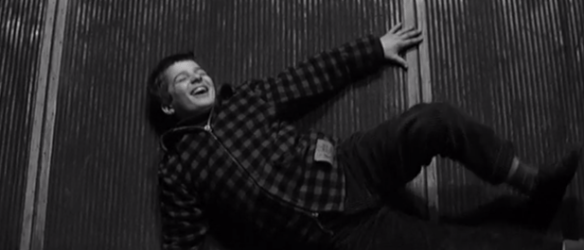
However, one the most powerful things is the degree of foresight we gain about Antoine Doinel. All the things that make up his life at this juncture in time have repercussions later on that Truffaut continued to examine as he matured. We can see the gears turning as the boy develops as an adolescent. He skips out on class to go to the cinema and the carnival. He purloins a bottle of milk out of thirst, steals little trinkets from the ladies room and finally a typewriter from his father’s work. He receives the ire of his teacher and goes home to the cramped conditions and turbulence of his home life. His mother and step-father are constantly bickering. His mother is having an affair. It’s not a very happy life or a firm foundation for a boy to grow up in. And it shows.

In many of these moments, the autobiographical aspects come to the fore. Before Antoine’s story was simply a depiction of realism but as time goes on it becomes more obvious that Truffaut is being very transparent in showing bits and pieces of his own experiences. What’s striking is that this is hardly a bitter film. Somber and melancholy, yes, but it hardly ever seems to cast blame. It shows the brief moments of reverie along with the pain and that’s why I am a great admirer of Truffaut. He’s a deeply heartfelt and personal filmmaker, no more evident than in The 400 Blows.

400 blows 4.png

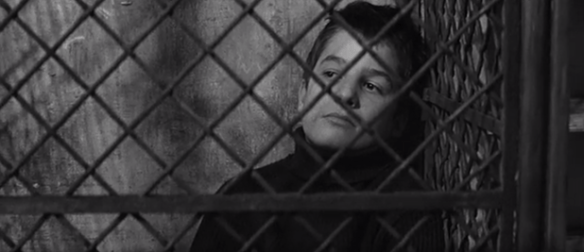
Antoine Doinel is a vagrant and pretty dismal kid, getting in all sorts of trouble and yet Truffaut makes us sympathize with him and to an extent we see the director’s point of view too. He’s the one trying to fall asleep while his parents bicker about what to do with him. He runs away from home and relies on the charity of a friend. He’s being locked up in a jail cell on his way to juvenile detention. He talks to a psychologist candidly about his parents never trusting him. All those moments have the power to move.

And the film is so easy to watch, so simple and wonderful and honest and unassuming, it’s almost hard to remember how influential this film was for not only jump-starting the French New Wave but for rejuvenating cinema in general. Hollywood didn’t make movies like this. That’s all I had ever seen for the longest time. But the likes of Truffaut, Godard and even Renoir, De Sica and Rossellini revealed to me that there are numerous ways to make an impassioned cinematic experience.

400 blows 3.png

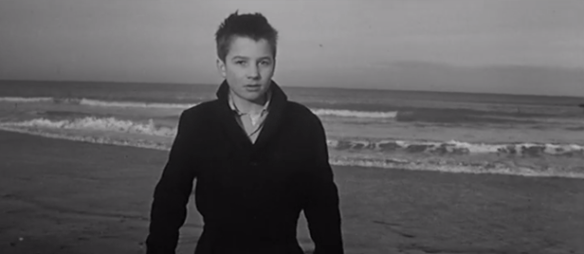
As always, my mind returns to the climatic freeze frame of The 400 Blows. It remains with me and part of its iconic status is undoubtedly due to how it sums up this boy so perfectly. There’s a sadness in the eyes that without saying anything denotes all that we have already seen. It’s the perfect summation of his story thus far and with that look, it’s difficult to forget his hardships–his flaws too. Perhaps it allows us to extend grace to him because we can see firsthand that he’s in dire need of some. He has not been offered much his entire life with true love and affection being traded for punishment and biting remarks. True, his story does not end here but it’s a telling chapter of his life. Arguably the most formative years for the rest of his existence.

Within the storyline, Truffaut includes passing references for his love of the cinema and even suggests his promise with his writing composition though his teacher accuses him of plagiarism. But from these troubled roots came a man who loved movies to an extent that few others could claim. He was passionate both as a critic, champion, and creator.

Thus, it makes perfect sense that this film was dedicated to the memory of Andre Bazin, the noted founder of Cahiers du Cinema. Truffaut undoubtedly owed a tremendous debt to the magazine and its editor but he also elevated it with his own amount of passion. That same passion comes out in The 400 Blows and really all the subsequent films he made before his death. His movies are wonderful because each one shows that he genuinely cares about the material on its own individual merit. That is the kind of director that I want to watch.

5/5 Stars

Mustang (2015)

Mustang_posterThere’s something inherently striking about the title Mustang. It signifies something about the title girls, their free-spirits, billowing brown locks, continually running in a type of a herd, constantly full of life, movement, and motion. But with a mustang and any other creature full of life and vitality, there’s always an opposite force looking to impede, tame, and prod the spirit into some sort of submission. Because being free, being wild is constantly challenged in the world that we live in and this story is a prime example.

The film opens when what can be called little else except for a “tribe of girls” leave their school to go traipsing along the beach with a group of boys. In these moments we begin to understand quite well since frolicking, laughing and playing chicken are the same in every culture. But that’s not how their elders see this seemingly innocent act. Instead, it’s full of passion, lust and moral depravity.

In many ways, although it’s set in Turkey, Mustang plays with some of the same themes of Sofia Coppola’s Virgin Suicides but it is a film that surges with vim and vigor rather than wistful detachment. And even though it has those aloof moments at times, they feel more personal because most of the time instead of being on the outside looking in, we’re constantly being shown the perspective of these girls, a far more frightening point of view.

Furthermore, this isn’t simply about one fundamentalist family that’s the outlier but an entire culture that holds women in a certain regard. There’s obviously something amiss in cultures that lack social mores and a sense of reality, but there’s something equally frightening in those cultures that are utterly repressed. Life is literally driven by fear and shame. Bringing dishonor and gaining the respect of your neighbors. A life like that can be nothing aside from taxing because you can never possibly measure up to the societal standards.

The television, the media, and everything else seems to reinforce exactly these points. Meanwhile, the girls go sneaking out to a football match only to miss the bus, only to hitch a ride with an unfortunate bystander who gets them there in time for the excitement.The images at the football match carry an almost infectious backbeat, hyperactive and frenetic with hair flying, hands flailing and bodies going every which way, but still, every action has a consequence. Every moment of freedom is met with an equal event of restraining power.

In this case, the girls are prepped and prepared for marriage, arranged between families like a shrewd business deal to save face. Their fearful grandmother and domineering uncle think it’s the best for everyone and the girls have little say in their fate.

The youngest girl, Lale, is a tomboy, a perpetual climber but she like the others feels trapped. And they are, as first one sister than another are hitched up in a marriage. But it’s when marriage no longer becomes a joyful union but a suffocating prison of unhappiness, something that it was never meant to be at all. True, one girl gets a bit lucky, the other is utterly unhappy. Still, two down and three to go. That’s the way grandmother thinks of it.

By this point, the three remaining girls are forced to find any little piece of rebellion they possibly can whether it be snickering at the dinner table or something altogether more audacious. Grandma and uncle are unrelenting in their matchmaking and finally, Lale and the only sister she has left are at a crossroads. They must take a plan of action or resign themselves to their impending fate. You can probably guess what their decision is but that doesn’t make executing it any easier.

Mustang is certainly a cultural commentary and you get the sense that it’s a very personal work by writer-director Deniz Gamze Erguven. However, within its portrait of youth, womanhood, and marriage there are also some universal truths to be gleaned. There’s something to be said for freedom — in youth and adulthood. To take it lightly is to commit a grave error

4/5 Stars

Tu dors Nicole (2014)

Tu_dors_Nicole_POSTER“Nicole, you’re sleeping…”

I admire a film that is able to linger and I’ve read enough scripts to know that there is a difference between filling up scenes with mindless dialogue and slowing the action down in a way that’s inherently more lifelike. In fact, I now have an increased fascination with the films that don’t rely so much on plot points at all but characters and the everyday situations that they encounter. Because, if I’m honest, everyday situations often make up most of my life and they are most relatable to me. They’re the stories that feel the most genuine.

Just looking at Stephane Lafleur’s Canadian drama, Tu dors Nicole, a little bit of the mundane is evident. Sorting racks in a clothing store. Lazy afternoon bike rides. Lifeless neighborhood streets. Long summer days with the sound of crickets outside the window. Hot nights where you can hardly keep your eyes clamped shut due to the miserable heat that keeps you tossing and turning.  It might all seem of little consequence and in many ways it is. But in the modern arena where every film must be the next big thing, the greatest spectacle imaginable and so on, it’s actually quite refreshing when someone dares to tone it down a notch.

There are some oddly weird moments throughout the film. Namely, Martin, a boy who has the vocal range of a 30-year-old man. And the traces of harp music whenever something especially enchanting comes to the fore. Then, there are the closing images of water spouting off into the atmosphere.

However, what’s at the core of Nicole is a story of adolescence coming into adulthood. It’s not so much a coming of age narrative as emblematic of that period of transition. And if Nicole had the fragments of a prototypical plotline it would be this.

The eponymous young woman (Julianne Cote) has recently graduated college and is working a menial job. Her parents have gone away for a little vacation leaving her behind with a list of tasks to complete in their absence. She would have the house to herself if it wasn’t for her older brother who is always jamming away with his bandmates in the living room and all throughout their house. Their backbeat is constantly reverberating through Nicole’s life. She hardly gets any peace and quiet.

And yet even in the tranquil moments, our protagonist still seems a bit melancholy. Mini golf isn’t as fun as it used to be. A trip to Iceland is more fun to plan for than it is to actually go through with. Nicole gets in a row with her best friend. She loses her job after taking a few articles of clothing home with her. But life continues like it always has.

In this case, black and white is not simply an aesthetic choice but an appropriate palette to reflect the underlying tone of this film. There is a listlessness, an apathy to Nicole’s life at the moment.  The thing is it’s due to nothing in particular, at least nothing spoken aloud or seen overtly onscreen, but like life, it just is.

Our main hint comes from the title itself. Could it be that Nicole is asleep? She cannot sleep at night, because, perhaps she does her sleeping during the day–going through the motions without a great deal of purpose — without a goal to drive her. We’ve all been there. Maybe even a few moments ago. Growing up in this fashion is not always all it’s cracked up to be.

The question to ask at the end of this particular narrative is this: Have things changed? Not really. But so it is with the vicissitude of life. There will be highs and lows. Moments of vibrant colors and grayish doldrums. Quarter life crises and galvanizing flashbulb moments. Still, we keep on living, latching onto what gives our confusions and doubts even a shard of meaning. We aren’t meant to live life asleep.

3.5/5 Stars

Everybody Wants Some!! (2016)

everybody wants some 3“Things are only as meaningful as the meaning that we allow them to have.” ~ Beverly
How can Sisyphus and baseball be connected? Budding lovebirds Jake (Blake Jenner) and Beverly (Zoey Deutch) tackle this question as they float contentedly in inter-tubes with college just beginning. Sisyphus is, of course, the mythical figure who tragically spent his entire existence pushing a boulder up a hill. How does that relate to baseball? Just like anything, if it becomes our sole focus, it takes on immense meaning. Looking at it one way or another it can either be seen as a blessing, a curse, a chance at a singular purpose or even an obsession. But without question, each individual person has a chance to latch onto what they find meaning in as they float through life fluctuating between contentedness and discontentedness. That’s not only what college but, what life in general, is all about.

But that’s enough waxing philosophical because as Richard Linklater has the penchant for doing, Everybody Wants Some is a romanticized, idyllic visual collage, of what it is to be in college, what it is to be a baseball player, what it was like to do all those things in the 1980s. Some will look at it disinterested because it seems to be a pretty narrow lens but as we already acknowledged, Linklater’s films always carry a fondness for their subjects — oftentimes capturing moments, little snapshots of time and space, the building blocks of life really.

We can even look at Richard Linklater, his past, his pedigree and there’s no doubt that this is another meaningful film for him. For some, there will be a similar meaningfulness to this time capsule of his. However, even for those who are not quite sold, there’s something deeply personal and heartfelt about his work that’s hard to take away from him. In that respect, his work is always universal.

In truth, Linklater follows in the tradition of many of the great European filmmakers where Plot is certainly not king. Because anything in screenwriting 101 or out of the Hollywood milieu emphatically declares that conflict is key. Watch most anything from the Texas native and the normal plot conventions go out the window since that’s not where his interest lies. And yet Everybody Wants Some still remains diverting during its entire run.

It follows in the footsteps of Dazed & Confused over 20 years its elder and it’s a film similarly ripping at the seams with song and dance. It’s another one of the vignette movies basking in nostalgia whether it’s Van Halen, Twilight Zone anecdotes, Gilligan Island punk music or any number of other things. These boys spend, not the last night after high school, but the waning days before college sitting around their house talking about who knows what, getting sky high, hitting golf balls off rooftops and taking part in endless competitions in ping pong, knuckles and anything else that can be needlessly turned into a game.

But to a lesser extent, Linklater’s latest film also has ties to Boyhood because although it might take place decades before, it picks up where the other film left off. It’s easy to forget but a big part of Everybody Wants Some!! is about a boy meeting a girl in the first days of college.

There’s still so much to be done and the film only briefly brushes on what it means to be in college but that’s not its main objective. Anyone who has played sports or went to college can identify with the camaraderie of being part of a team or the elation of all the excitement laid out in front of you the next four years.

Everybody Wants Some!! uses the typical Supers onscreen to denote the countdown until reality hits and school and sports begin for real. There’s a brevity to the moment that this film captures. Sure, in many ways, it’s filled with raunchiness and raucous fun but it also signifies a carefreeness that is very rarely realized at any other time in your life. It brings to mind one of the ballplayers Willoughby. It comes out that he faked his transcripts and is actually well over the playing age. Why would he do such a thing? We would think it’s for some competitive advantage, but no,  he just wanted to prolong this little piece of paradise. Partying and playing baseball with the world as your oyster.

Because whereas this is the beginning for some like Jake, it’s also nearing the end for others. That’s the scariness and in some senses the beauty of life. All of us are walking along our own roads like passing ships in the night but that does not mean we have to go it alone. The key is finding community and honing in on a purpose that gives our lives meaning. We have to live for the moment because those moments are transient and before you know them, they’ll be gone. Make the most of them. Enjoy them. This year as well as next.

3.5/5 Stars

Review: Rebel Without a Cause (1955)

_Rebel_Without_a_Cause_James Dean

You can wake up now, the universe has ended.” – Jim Stark to Plato in Griffith Observatory

James Dean’s “The Rebel Without a Cause.” It’s his image as much as it is a film for many people. But if we actually take the time to examine him,  Dean subverts expectations. There’s this aura built around him as that iconic rebel–cigarette in hand–a glint in his eyes. However, the beauty of his performance as Jim Stark is how broken and even gentle it is. Certainly, we remember the moments where he screams at parents, bashes in desks and kicks paintings, but really most of his screen time is made of quiet nuances. He has no friends. He’s lonely and reserved. He just wants respect.

He wants someone to listen to him–someone to stand up for what’s right. And he feels like a pendulum swinging madly between his bickering parents, constantly making him go this way and that, moving from town to town, time and time again. It sickens him and he reacts in the only way he knows.

Rebel is just as much a subversive film, being so daring as to suggest that juvenile delinquency is a sort of created social construct. Kids do bad things, sure, teens are no good, but if you dig around a bit and look in the closets, the skeletons reveal themselves in due time. We now conveniently call them “family of origin issues,” but that puts everything in a nice box when the reality is actually very messy.

That’s why the crucial scene in Rebel is when our three solitary teens go to Plato’s (Sal Mineo) abandoned mansion getaway in the dead of night.  Alone it would be a house of horrors, but in community, they make it a pleasant affair–even playing a game of “house” complete with stuffy honeymooners, who don’t want kids unless they never have to see or talk to them again and a realtor who is is willing to give them the place for $3 million a month (Thankfully the newlyweds have a budget!). In essence, amidst their jests, they’ve become one happy family, finding a bit of solace from the asphyxiation of the world around them. The world accentuated by not only their parents but their peers too. However, it cannot last.

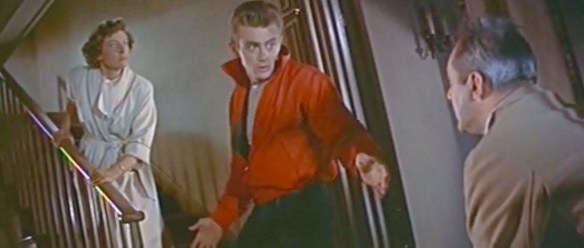
It’s these moments that feel so light and carefree and that’s the key. Blink and you’ll miss them. Look away and the bubble is popped. Focus on the drama and you’ll get it all wrong. Because the moments of drama are exactly the moments that you expect to get some deeper understanding of their psyches. You look at Jim in the now iconic scene on the staircase, quarreling with his parents or Plato running off like a frightened rabbit packing a gun. We can shake our heads and ask “why?” but if we only sit back and listen, it becomes all too obvious.

If Mr. and Mrs. Stark just listened, if Judy’s parent’s paid heed to her, if Plato actually had parents present in his life, maybe they could see what was “tearing them apart.” The suffocating hopelessness of the world that seems magnified tenfold in your adolescent years, as things are changing so rapidly. You’re getting pressured beyond belief and to top it off, it seems like no one understands you–not in the least.

Thanks be to Nicholas Ray for bringing such an intimate study of youth to light, because it’s certainly melodrama, elevated by the unpredictable magic that is James Dean. That’s often the spotlight of this film and quite understandably so, given the lore around his legendary career and tragic death.

But cull its depths and there’s even more if we look at how everything is initially foreshadowed at the Observatory, where the man in a droll tone nonchalantly summarizes the insignificant end of earth–only an infinitesimal speck in the patchwork of the universe (“In all the immensity of our universe and the galaxies beyond, the earth will not be missed. Through the infinite reaches of space, the problems of man seem trivial and naive indeed, and man existing alone seems himself an episode of little consequence”).

Buzz tells Jim before their “Chickie Run” that he actually kind of likes the guy now, but still, “You gotta do something. Don’t you?” It’s the despondency of their existence. Buzz soon dies and people hardly bat an eye.

Never before had I considered how this entire story unfolds in the course of one tragic day. It’s not realism by any means, but instead, it’s bursting with the passion and pain as reflected by Ray’s camera and impeccable use of color.  It’s as if the teenage experience is being wholly magnified and consolidated into a single moment. That’s what Rebel Without a Cause embodies.

5/5 Stars

Liberal Arts (2012)

liberalarts1Where to start with Liberal Arts? It’s one of those deep blue funk movies. Zach Braff tackled this issue in Garden State, and Josh Radnor does a similar thing here. Because the reality is that we live in a generation of early onset midlife crises. In the opening moments, 35-year-old Jesse Fisher (Radnor) has nearly every article of clothing he has aside from the shirt off his back stolen from a local laundromat when his back is turned. We can easily surmise that this single event epitomizes his life right now, and this is hammered home rather obviously when his unnamed girlfriend clears her belongings out of his flat. There’s no better symbol of isolation and alienation than a break-up.
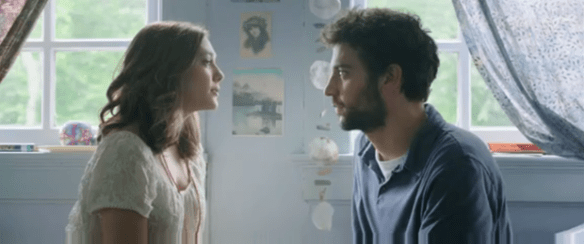
That’s when Jesse’s former professor the personable and witty Professor Peter Hoberg (Richard Jenkins) pays him a call that doesn’t so much change his life as it alters his course. The professor is preparing for his retirement and as is usually customary a dinner is being held in his honor. Jesse is one of the people he looks to invite and the former liberal arts major takes him up on it gladly as the nostalgia begins to waft over him. It’s excruciatingly corny at times even painfully awkward.

However, it’s no small coincidence that it was filmed at Radnor’s real-life alma mater Kenyon College in Ohio–a beautifully tranquil campus that reflects an idolized Middle America–a perfect place to rediscover youth and ruminate pensively on past endeavors. Jesse does all of the above, but while staying with the professor he also meets Libby (Elizabeth Olsen), a current college sophomore whose father and mother had ties with Peter as well.

Zibby has a self-assurance–the way she carries herself is completely disarming but in a good way. In fact, it intrigues Jesse (Radnor) sweeping him off his feet before he even knows it. But that’s not the only thing that affects him. Nostalgia is a powerful thing. I can feel it now as I close the books on my own college career, and I can only imagine this character who is looking back at those idyllic glory days when he was an optimistic, naive young man.This peaceful campus is completely different feel than the bustling public institution I became accustomed to, but the important things are not all that dissimilar.

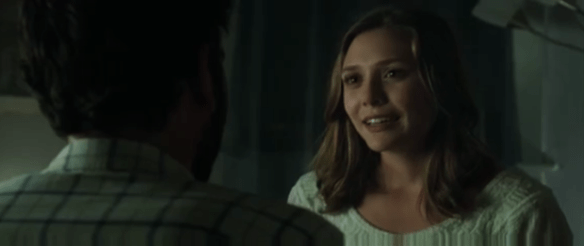
liberalarts2It’s crucial to note that at this juncture nothing substantive builds between these two acquaintances romantically, but they do foster an immense connection. While Jesse is taken by Zibby’s personality, she, in turn, is discontent with a contemporary culture where no one dates–everybody’s casual about relationships. She feels unequivocally millennial and yet she readily admits these areas of old-fashionedness.
As she and Jesse part ways, Zibby burns a CD of classical music for her new confidante and entreats him to write her correspondence with pen and paper–like gentlemen and ladies in days of old. It feels very much like a Jane Austen novel, perhaps a little pretentious, but it’s hardly a criticism of these characters. What it creates within the both of them is not only a deeper connection going beyond sexual attraction but an awareness or realization of being — what people these days often call mindfulness.

As they traverse this road together there are some obvious digressions that we could easily foresee, and yet the film takes a mature and altogether realistic path. It considers the relationship between various points in time, passing of the years,  looking backward and forwards. In one direction with nostalgia and the other with anxiety and maybe even expectancy. All these are the backdrop for this complicated friendship between a 35-year-old and a college student.

The conclusions of Liberal Arts perhaps feels a bit muddled, but that’s only indicative of life. We’re all set adrift in a world that we don’t know all the answers to. As Zibby so rightfully ascertains life is basically improvised. We’ve just got to step out and live it to the best of our capabilities. Pick ourselves up when we fall and do our best to make the most of what we have. A lot of that comes when we learn how to connect with the people around us in such a way that leaves us content with who we are. I think it can be said that we leave both Jesse and Zibby better off than they began.

3.5/5 Stars

This is the only time you get to do this. Read books all day. Have really great conversations about ideas. – Jesse Fisher

Sing Street (2016)

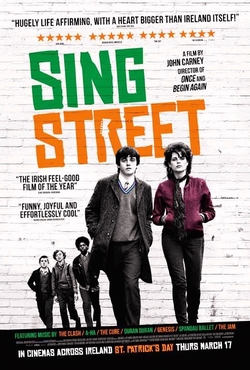
Sing_Street_posterA famed philosopher of the MTV age once sang “video killed the radio star,” and John Carney’s Sing Street is a tribute to that unequivocal truth. Certainly, it’s what some might call a return to form for the director, landing closer to his previous work in Once, and staging the way for some wonderfully organic musical numbers set against the backdrop of Dublin circa 1985. In this respect, it’s another highly personal entry, and Carney does well to grab hold of the coming-of-age narrative.

Our main point of interest is Conor, a lad thrown into a new school of hellish proportions and of course, there’s a girl, and he wants to get to know said girl. What follows soon thereafter is the inception of an entire band, the eponymous Sing Street. So in essence, the band forms so he can get the girl. It’s that simple and it works…sort of.

By all accounts, she’s an untouchable goddess, a year older than him, with a mature boyfriend and aspirations of modeling in England. And yet Raphina deigns to stoop to their level and take part in their first foray into music video-making. It’s in such moments that the film unabashedly hoists up its 80s sensibilities, suggesting Carney’s own personal affection for that day and age. Because amidst all the god-awful make-up, outrageous costumes and mimicry of the new wave scene, there’s a sense of amusement. Since every boy, at one time or another, has gone through these different phases and stages, like a sponge soaking up all conceivable inspirations. In this case, Conor’s older brother Brendan becomes his pontificating Buddha of rock n’ roll. His influences run the gamut from Duran Duran to the Cure and most definitely a little David Bowie.

But his band also develops into a wonderfully liberating beast to combat the furies of the world. Conor is consumed by grand dreams of Back to the Future themed prom nights at an American-style high school. Meanwhile, his parents are continually squabbling at home and his dream girl leaves for London without a word of goodbye. But he uses his newfound outlet paired with the guidance of his brother to turn his stray thoughts and accumulating angst into something of true substance. Namely, Conor and the versatile Eamon, have a bit of a Lennon-McCartney partnership going, as far as creative genius goes, proceeding to run with each spark of an idea that strikes. In fact, with all the boys, there’s a matter-of-fact gravity to it all, because forming a band is a serious business — it’s a concerted effort not to succumb to the grisly fate of yet another gutted cover band.

Like any formative tale about young men and women, Sing Street suggests the vital importance of personal identity and chasing after dreams in particular. You see it with Conor as he constantly dons new facades, not simply in a search for greater artistic expression, but personal freedom.

But where he breaks with his big brother, is what he actually does with the inspiration that has been passed down to him from the rock gods. He uses its whole potential as a gateway to the way of life that he desires — making the most of the opportunities that are afforded him — even if they are a long shot. As the movie progresses Raphina looks younger and younger, and it hardly seems by accident. Over time, she sheds layer after layer of makeup and manicuring to reveal a bit more of herself, until the tipping point where all her dreams come cascading down, and she has nowhere to hide. In fact, in these more fragile moments, Lucy Boynton is reminiscent of a young Felicity Jones.

Admittedly “Sing Street” has a ludicrous ending and there are moments that it tilts towards the plastic production values of  “Begin Again” rather than the sincerity of Once, but that’s a lot of what the 80s feels like. It’s fake. It’s this construction projected up on a screen. And that’s precisely what this film is saluting and celebrating, but that’s only the half of it. Raphina rightfully points out you can never do art half way. That’s what rock n’ roll is in a sense. It’s audacious exploration, risk-taking and a bit of foolishness in the name of chasing your dreams, usually involving a girl. Thus, the film is not wholly original, even for Carney, who has drawn from the same well three times over, but like any artist, he’s able to discover fresh inspiration from old cisterns. After all, every member of humanity is in one way another a broken work of art, beautifully complicated, and that’s worth returning to again and again.

4/5 Stars

Copenhagen (2014)

Copenhagen_film.jpegSometimes you attempt to make a mental pros and cons list to try and convince yourself in one direction or the other after watching something. Copenhagen was such a film for me. Bike rides through the city. Pro. At times this film loses its steam and flounders a bit. Con.

In truth, the narrative does feel pretty thin when it comes to the main character William trying to track down his grandfather in Copenhagen. William for that matter is a foul-mouthed and generally annoying jerk of an American for most of the film. Also, the weird romantic tension that builds between him and Effy is obviously uncomfortable, but the will-they-won’t-they component is key to the entire narrative. Because essentially this is a film about a grown man finally coming to age, with the help of a very mature 14-year-old girl, who acts as his guide through Denmark.

That being said, the scenery in and around Copenhagen is obviously a lot of fun to partake of, and it truly is the perfect place to ride a bike around, day or dusk. Furthermore, with her husky voice, feisty nature, and winning charm Frederikke Dahl Hansen makes this film with her turn as Effy. True, she’s playing a character quite a bit younger than herself, and yet she succeeds wonderfully and really thrives as the winning force in this film. Because, if we don’t like her this film has little hope of rising above its narrative foibles and the utterly annoying nature of its other main players. Effy makes us like William at least a little tiny bit by the end of this story. And that’s a major compliment to her. To his credit, Gethin Anthony is easy to dislike, but that undoubtedly can be credited to his acting. His character does come around in the end too, not so much because of the quest for his grandpa, but he learns what it is to be a man and to treat others with the respect they are due. Namely in this case a 14-year old girl, and also is his best bud, Jeremy.

So is this a film I would recommend… Yes, but I tried to lay all the cards on the table because you could easily enjoy this film or just as easily find it disconcerting and tiresome. I fell into both categories at different times, but there were some truly entrancing moments that are hard to forget. Effy is almost hypnotic during her singing session in the bar. And traipsing through an art museum becomes a fascinatingly intimate study of the human form. Perhaps now more than ever Denmark will be on my travel radar since it looked like an absolutely brilliant place to spend a summer.

3.5/5 Stars