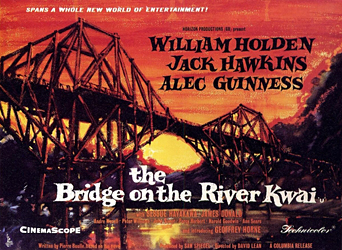
Bridge on the River Kwai (1957)

f1d1f-the_bridge_on_the_river_kwai_posterStarring Alec Guinness and William Holden with director David Lean, this is a World War II film that follows the exploits of British POWs and also Allies on a secret mission. Guinness is the proud and principled British Colonel who leads his men in a memorable entrance. With stubbornness he wages a war of wits against the Japanese camp overseer. He inspires his men and eventually reaches his goal of personally leading them in the completion of the bridge. At the same time an American soldier (Holden) attempts escape and somehow winds up alive and safe. However, all too soon he is sent right back with specialized commandos to destroy the bridge. In a chaotic and tragic finale, the British colonel puts a wrench in the plans and the implications are costly even though the objective is achieved. This is a magnificent and enjoyable film with good cinematography, interesting characters, a two-sided story, and of course whistling!

5/5 Stars

Inherit the Wind (1960)

Starring two battling greats in Spencer Tracy and Frederic March, with Gene Kelly as well, the film chronicles a fictitious version of the controversial Scopes Monkey Trial which acted as an allegory for the McCarthy era. March is the prestigious prosecutor on the side of Creationism and Tracy is the famed defense attorney fighting for a young schoolteacher (Dick York). The two spar back and forth on the touchy subject while staying friends outside the courtroom. The whole town backs Brady, condemning Cates and Drummond as evil. However, despite all that is against them, Drumond saves the case by bringing Brady to the stand. The two stars have commendable performances if not their best. Gene Kelly proves he can be a serious actor, playing the cynical newspaper man. The cast is rounded out nicely by Harry Morgan and Claude Akins. Here Stanley Kramer puts together a respectable movie version of the stage play.

4/5 Stars

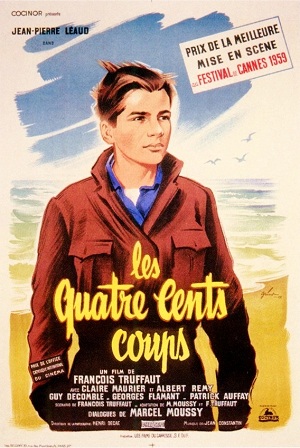
The 400 Blows (1959)

This French New Wave film directed by Francois Truffaut, more aptly titled The Wild One or Raising Hell, is about a young boy named Antoine. He comes from a working class family and his parents are struggling and frustrated. In school he gets poor grades and his teacher often punishes him. Annoyed with his life, he runs off for a time committing petty crimes and exploring the streets with a friend. That ends when he is caught stealing his father’s typewriter. Fed up for the last time his parents send him away to an observation center for boys. After he arrives Antoine escapes and runs to the ocean a sight he has never seen. With that the camera zooms in and we clearly see the face of this troubled, young boy. It is easy to appreciated this film because it does not glamorize the situation but tries to deal with it sensitively. Truffaut made a very good one here reflecting on his own experiences.

5/5 Stars

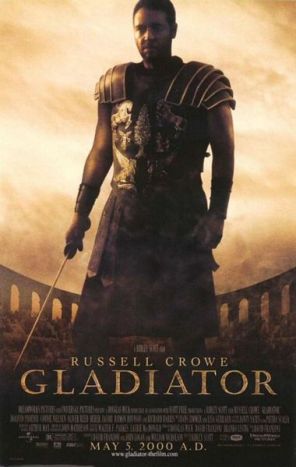
Gladiator (2000)

9db87-gladiator_ver1Starring Russell Crowe, Joaquin Phoenix, and Connie Nielsen, with director Ridley Scott, this film is set during the waning days of the Roman Emperor Marcus Aurelias. General Maximus is a great and loyal warrior who the old man wants as his successor. However, his jealous son will not have it, killing his father and then ordering the execution of Maximus. He escapes but is mad a slave and then a gladiator. Through this he gains the respect of the masses and is able to defy Commodus. Over time, Maximus is part of a plot to remove Commodus. Once again the enraged emperor wishes to quash the legend of Maximus forever. He does not win in the end and Maximus has aided Rome. This action-epic had a lot of exciting scenes and a good hero. The score was good too but sometimes it seems as if the cinematography could have been better. This film is reminiscent of the classic epic Spartacus and it was a pretty good in it’s own right.

4/5 Stars

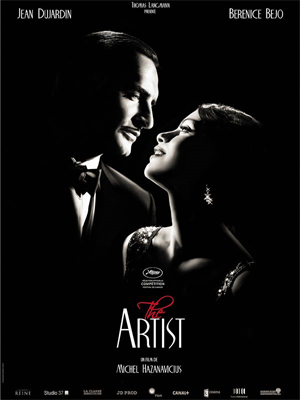
The Artist (2011)

7cfee-the-artist-posterWith a cast of all nationalities and backgrounds, this film is a breath of fresh air for many reasons. Ironically, this freshness comes in a contemporary age thanks to a look back at a former age. In black and white and almost completely silent, the movie begins in 1927. George Valentin (Jean Dujardin) is a Hollywood star of the silent era. Quite by accident he makes an up and coming star out of Peppy Miller (Berenice Bejo). Soon she makes the transition to stardom in talkies as Valentin slowly fades away. However, Peppy never truly forgets him and in different ways she tries to help him. Unfortunately, George is a proud man who loses his wife, sends his loyal chauffeur away, and will not accept the charity of Peppy. Eventually her kindness pays off however and George is no longer forgotten. All the cast including John Goodman and James Cromwell do a wonderful job at expressing emotion since this film is so unique. Because there is hardly any spoken dialogue, the score takes center stage and I think it succeeds wonderfully in setting the scene whether it is playful, dramatic, or simply silent. There are also many devices used by the director Michael Hazanavicius that help convey the story without a need for words whether it is staircases, sinking quicksand, or a trampled film poster. Furthermore, he draws great influence from films like Sunset Boulevard and Singin’ in the Rain to give this new film a touch of nostalgia. In fact, The Artist brings up so many names and films in my mind it’s wonderful. Douglas Fairbanks, Jean Harlow, the dog from The Thin Man and The Awful Truth, The Dueling Cavaliers and Lena Lumont, just to name a few. Perhaps most importantly of all the film causes me to be empathetic towards the forgotten stars like Buster Keaton and Norma Desmond. It makes Chaplin’s ability to make silent pictures during the talkie revolution seem even more impressive as well. In a year that also gave us Midnight in Paris, this film also revels in the past history of the 1920s, but perhaps more importantly it too is able to suggest a certain hopefulness in the future. In a world that is often loud and busy this film was a nice respite.


 5/5 Stars


Lincoln (2012)

a8b03-lincoln_2012_teaser_posterDirected by Steven Speilberg and starring Daniel Day-Lewis with Sally Fields, and Tommy Lee Jones, the film focuses on Lincoln’s 2nd term as the Civil War comes to a close and he fights to pass the 13th amendment.

At home Lincoln deals with his temperamental wife, argues with his older son about joining the war, and plays with his younger boy Tad. At the same time he must work behind the scenes to get enough representatives while also facing the prospect of a Confederate surrender. His life is beyond stressful, with cabinet meetings, speeches, inspections, and tough decisions to make day in and day out. However, despite the toll, he copes and in the process does great things. Within the film we also become familiar with William Seward, Thaddeus Stevens, and other leaders who must make their own difficult decisions on the issue of slavery.

Ultimately, the landmark amendment is passed but it is short lived with the assassination of Lincoln. He truly was “a man for the ages” and Lewis does a wonderful job of portraying his every aspect. His voice, his features, his parables, his political savvy, and even his frailty give us a crystal clear picture of the man. The supporting cast and the cinematography were both very good. It proves that a film full of drama and some humor does not need action to make it excellent. It is all about the characters and more importantly our very history.

4.5/5 Stars

The Rules of the Game (1939)

bcb9f-la_regle_du_jeuThis French film directed by Jean Renoir is a light comedy that turns into a critique of the Upper classes. The film involves the superficial events and racy love affairs as only the French can have. It opens as a famous aviator lands his plane only to be disappointed that his married lover did not come to see him. Soon we learn that her husband has a mistress of his own. Put these four together,  Renoir in his jolly role of Octave, all the other guests, then the many servants, and soon you have a major spectacle. They dine, hunt, gossip, put on a show, quarrel, and above all fall in love. It is all fun and games however until someone gets hurt. Although this film is not what we may be accustomed to in our present generation, it is easy to appreciate the satire, cinematography, and ensemble cast. Kudos to Renoir for making a very intriguing film.

4.5/5 Stars

Anatomy of a Murder (1959)

251e0-anatomymurder2Starring Jimmy Stewart, George C. Scott, Lee Remick, and a cast of others, the film follows a small town lawyer (Stewart) as he defends a man who has committed murder. The whole case is complicated by the fact that the Lieutenant’s beautiful wife was supposedly raped by the murdered man. Now Stewart must battle it out in court using every strategy he knows in order to save his client. With the help of witnesses and evidence both sides have substantial cases. However, Stewart finds the topper in the dead man’s daughter, hoping this will save his client’s life. Despite the valiant effort of the prosecuting attorney and Stewart, everything is in the hands of the jury so now all they can do is wait. With an interesting score, a methodical story, and a great cast, this movie was a good one. The judge especially made this film enjoyable for me and you certainly cannot beat Stewart. It should also be noted that this film has one of the most famous movie posters of all time which was designed by Saul Bass.

4.5/5 Stars

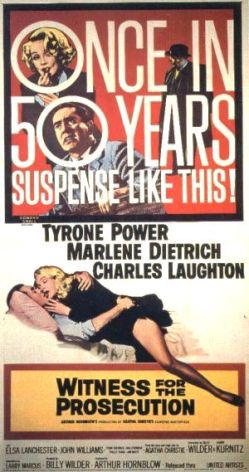
Witness for the Prosecution (1957)

Starring Charles Laughton, Tyrone Power, and Marlene Dietrich with direction by Billy Wilder, this courtroom drama follows the trial of a man accused of murder. Laughton is an English defense attorney just recovering from a heart attack. However, soon he gets so intrigued by Power’s case that he agrees to defend him. Power’s character Vole seems to be falsely accused for the murder of a widowed woman he hardly knew. He does have an alibi in his wife (Dietrich) but she seems to refute Vole’s words and the case takes a bad turn. Through a flashback we see into their complicated past. The befuddled Laughton finally catches a break and is able to prove Dietrich is lying. He has been victorious in defending Vole but then the plot takes a cruel twist. What was reality before now seems to be completely false. Adapted from a story by Agatha Christie, this film has good characters and a brilliant climax.

4.5/5 Stars

The Birdman of Alcatraz (1962)

Telling the semi-biographical story of Robert Stroud, Birdman relates his life from violent beginnings until his later years. Burt Lancaster superbly characterizes Stroud as a tragic hero. Despite a relatively simple plot following the progression in a man’s life, Birdman is worth seeing. Ultimately, it is the charcters played by Lancaster, Karl Malden, and Thelma Ritter respectively, that make this movie. Ironically, by the end of the film after all he has accomplished the Birdman is still not a free man. Even if it is not completely historically accurate, this movie tells a great story. Having actually toured Alcatraz after viewing this film, I have to say it resonated with me even more.

3.5/5 Stars