
Rain Man (1988)

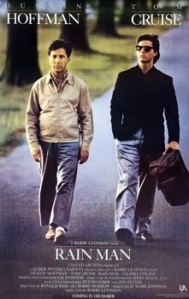
Barry LevRain_Man_posterinson doesn’t have a masterpiece per se, but he has some thoroughly enjoyable films in his filmography including Diner and Good Morning Vietnam as two prime examples. Rain Man is similar in that it is an interesting film and a heartfelt film, but not, dare I say, a great film.

Tom Cruise plays his typical stuck-up jerk named Charlie Babbit who learns what really matters in life, over time. He starts off as hotshot car dealer in Los Angeles who is trying to swing a big deal while balancing a vacay in Palm Desert with his girlfriend. However, when he gets news that his estranged father has passed away, he must change course for Ohio.

It’s there that he rehashes his old bitterness towards his father, and it is there that he learns something life-changing. He has a brother. An older brother to be exact, named Raymond. Except he never heard about him, since Ray is living in Wallbrook, a mental institution for individuals with autism.

He lives on a regimented schedule that he adheres to without fail. He loves books, baseball, and Jeopardy! among other hobbies. Whenever he gets nervous he starts into a monotone monologue of “Who’s on First.” He seems completely at odds with the world of his younger brother, but the catch is that all their father’s wealth is essentially given over to Raymond.

So in the name of equality, Charlie takes his brother away and holds him at a kind of ransom so Ray’s doctor will hand over half of the family fortune. The doctor doesn’t budge, however, so Charlie is left to travel with his brother to California. Matters are complicated because Ray will not fly on planes, citing the many fatalities in the past. Thus, this story of two brothers turns into a road film where Charlie begins to learn how special Ray really is.

True, he constantly sticks to his regiment (ie. Lights out at 11 and such), but he also has amazing abilities including doing extraordinary calculations and having tremendous recall ability. At first Charlie’s girlfriend, Sussana is upset with how he treats Raymond and she leaves. That was unfortunate because she for a time was my favorite character. However, it does allow for Cruise and Hoffman to share more scenes together. They take Vegas by storm and Raymond is a success while Susanna finally rejoins them. Most importantly Charlie has a newfound respect for his brother and what he is able to do. Dr. Bruner wants to take Ray back to the institution, and despite his objections, Charlie can do little about it. He will have to find solace in the fact that he will be visiting his brother next Wednesday.

In Rain Man I found Tom Cruise to generally be a jerk because that was the part he was playing and he was made for that type of role. Dustin Hoffman, on his part, gave an extraordinary performance which managed to be emotionless and robotic at times. However, he seemed to capture the humanity and reality of an individual with autism so well. Just because they act differently than what we are used to does not mean they are not just as human and relatable. They have feelings and emotions too that matter. That being said, it is understandable why he would be hard to deal with sometimes. Valeria Golino was a fairly good addition because she brought some more energy and seemed to generally care about Raymond. Although Charlie did eventually come around, thanks to a few revelations about his “Rain Man.”

3.5/5 Stars

Nobody’s Fool (1994)

NobodysfoolEarlier this year I wrote a piece on the evolution of acting that I envisioned as a case study of sorts. The second wave of actors I attempted to analyze included the likes of Marlon Brando, James Dean, and Paul Newman.

It is this last figure I wish to look at again in the context of Robert Benton’s 1994 film Nobody’s Fool. In all areas, this drama meanders along following town grump and crotchety ne’er do well Sully Sullivan (Paul Newman), who works as a freelance construction worker in a peaceful, snowy New York getaway. So, by all accounts, it seems like it should be a complete and utter bore, but it is not thanks, in part, to Paul Newman and his array of supporting players.

As I have watched more and more films in the last half a dozen years or so, there has been an ongoing trend where I tend to care less and less about substantial plot and more and more about characters. Don’t get me wrong, I love a taut thriller or an engaging mystery story, but the films that really do it for me have memorable performances that reflect a bit about the world we live in. Sometimes I even feel like a broken record, because I reiterate this fact so often, but I believe it to be the truth.

In other words, it feels utterly superfluous to go in depth about this film’s plot. It’s about a no-good Paul Newman, who left his wife, left his son, and never turned back. Now he must accept the path he chose and decide whether or not to spend his waning years finally getting to know his son and grandkid. It’s not rocket science by any means, and the film certainly feels dated, but Newman strangely does not, although his hair is a little bit whiter.

Now back to the generation of actors he came out of. They were the young, moody band of men brought up on the method that taught them to grab hold of emotions and experiences to be projected on the screen in each role they took. Dean was legendary, but his career was cut short. Brando was a giant, but slowly fell from grace and his waistline grew. Newman was famously married to his wife Joanne Woodward for over 50 years, started the charity Newman’s Own, and continued having a media presence in the late 20th and early 21st century. In other words, he aged gracefully compared to many of his contemporaries.

nobodys1

Nobody’s Fool falls closer to the tail end of his career, but he has the same gleam in his eye or maybe it’s that sour smile with a hitch in his giddy-up. But it feels genuine, it feels relatable, and it feels very much like the Paul Newman many people know and love. I know I do. He’s so often a malcontent or a bum and yet we cannot help but root for him.

He also has some wonderful moments to work with the likes of Jessica Tandy, Bruce Willis, and Melanie Griffith, among others, because first and foremost this is a film about relationships. These are people who have made mistakes and who are not always the wisest, but somehow we still appreciate them with all their faults and peculiarities. I guess that’s what the small-town mentality does, in a way.

You get to know everyone and you come to accept them for who they are. Stealing a snowblower, playing cards, drinking a beer, or buying your daily trifecta ticket just feels commonplace. That’s life.

3.5/5 Stars

Silver Linings Playbook (2012)

silverlinings1There was something rather therapeutically soothing about coming back to Silver Linings Playbook. I must admit this time around I was not quite as drawn to the direction of David O. Russell, because in some scenes it felt like too much attention was brought to his camera. However, I loved Jennifer Lawrence, Bradley Cooper, and Rober De Niro, since each one of them is screwed up in their own unique ways. Although their story takes place in Philadelphia and a lot of talk is made about the Eagles, what these characters really are is a cross-section of humanity.

I was just thinking recently how I dislike the term “escapism” referring to watching movies and going to theaters to get away. I do not often consider that I go to movies to escape my life. Maybe I do sometimes, but I am fascinated by movies because they can tell us more about ourselves. More about what it is to be human and coping with all that is messed up — all that is broken.

Tiffany (Lawrence) and Patrick (Cooper), are both screwed up. There’s no getting past it. She’s a widow who got fired from her job for sleeping around and now she does dance as a sort of therapy. He just spent an 8-month stretch in a Psych ward after he caught his wife in the shower with one of her coworkers. Now whenever he hears his wedding song, he goes into an enraged fit. He tries to look for the silver lining in everything, but that does not stop him from hurting the ones he loves.

Tiffany and Patrick are made for each other, even if Patrick refuses to believe it. They both know what it is to be put through therapy, drugs, and the like after personal trauma. They both lack the common filter or etiquette that humanity usually requires. We love them anyway, in spite of these reasons or more likely because of these reasons.

De Niro is Patrick’s father and a man so invested in betting on Eagles football games that it drives his life. Superstitions run rampant in his household, but he refuses to acknowledge them, just like his son refuses to accept his own problems. It makes for some familial fireworks and interesting altercations, but at the end of the day, they are still family.

The whole film culminates in a dance competition that Tiffany and Patrick have been working up to for a long time. It has the big stakes that you would expect for a climatic event, but most importantly it is this moment in time where Patrick finally realizes Tiff is the girl for him. He finally sees what most of the audience saw all along. They are made for each other, and they can accept each other with all their idiosyncrasies. He continues living his life by The Silver Linings Playbook and it makes both Tiffany and him very happy.

4.5/5 Stars

Rabbit Hole (2010)

Rabbit_Hole_PosterRabbit Hole is a modest film — a film based off of David Lindsay-Abaire’s original play that he adapted for the screen. However, that is not to discount the big performances that fill up the screen from Nicole Kidman and Aaron Eckhart to Miles Teller.

The film finds its drama in the story of a seemingly perfectly successful couple Becca and Howie, except the pair is still trying to get over the death of their four-year-old son. It’s been 8 months now, but Becca still seems far from ready to move on with her life.

She doesn’t want another kid. She can’t bear to see the dog that Danny was chasing into the street. She does not want to go to a support group, and she remains mostly aloof with her mother and sister, who hardly run in her same circles.

The moment the story takes a turn begins when Kidman’s character takes a great deal of interest in a boy. This is not some strange obsession or desire for a tryst. It’s nothing like that at all, but we begin to wonder why is she so interested in this seemingly ordinary high school student on the bus.

It might be clear to some right off the bat, but for others, it will take a few moments…Yes, that’s right. He was the one driving the car! He was there when it happened. That’s horrible. That’s awful. How are you even supposed to deal with that? How can you handle meeting face to face? Except Becca does meet with him in the park, and it may not seem like therapy, but it is just what both of them needed. They want things to be made right again, but they can never quite go back to the way they were before. They want someone to talk to and so they do, about whatever they want, whether it’s comic books, prom, or something else.

However, the news of their meetings finally becomes too much for Howie. The roles get switched as she becomes the cool and collected one while he seems to be losing it himself. It even gets to the edge of a precipice that almost drops into the chasm of an affair. But he doesn’t fall in. He and Becca slowly begin to patch things together, and their life slowly begins to fall in place.

Rabbit Hole is engaging because it speaks of how to cope with death and the kind of loss that tears your life apart. It considers what it is to mourn well and how we still must move on with our lives in a healthy way. The hard part is that there is hardly an easy progression, and sometimes it feels very subjective as to what a “healthy” way to grieve even entails.

Honestly, I watched this film out of curiosity in Miles Teller’s performance, thanks to Whiplash and especially The Spectacular Now, but I ended up being treated to two turns by Nicole Kidman and Aaron Eckhart that really commanded my attention.

3.5/5 Stars

The Battle of Algiers (1966)

The_Battle_of_Algiers_posterBeing rather oblivious to the relations between France and Algeria as well as the battle of Algiers, this documentary-style film proved to be an enlightening and thoroughly engaging historical exercise. I certainly cannot corroborate all the facts, but the reality is, The Battle of Algiers is one of the most well-paced films that I have ever seen coming out of Europe. There is a great deal of drama, harrowing intensity, and it all brings up numerous political questions that parallel the world we live in even to this day.

It’s the story of 1950s Algeria and specifically the Casbah Muslim district of the city. It is there between 1954 to 1957 that the National Liberation Front waged war against their perceived oppressors from France. And they certainly had a point that imperialism has left an indelible mark on them. However, their own strategies include bombings and assassination that utilize civilians and people loyal to the front. You don’t know when the next attack will come, and they sweep across the land like wildfire. The leaders of the FLN include the fiery Ali la Pointe and El-hadi Jafar, who recruited la Pointe early on. A Lieutenant Colonel named Mathieu is brought in to bring down the enemy, but it proves to be a difficult task since the FLN, much like a tapeworm, will never die until the head is destroyed. Otherwise, it’s extremities will keep rebuilding in the form of loyal underlings.

The film is rather shocking in its straightforward depiction of violence, whether it be bombed buildings, gunfights in the streets, or French authorities being gunned down by insurgents. Somehow these images feel still very relevant to the contemporary age. You have the imperialists clashing horns with the locals. There’s racial profiling. Women and children are involved in the violence just as much as anyone else, and destruction pervades the public squares. There is no refuge from bomb or evil. Anyone coming around a corner could be carrying a bomb or looking to shoot you when you least expect it. Really it is amazing that a film like this was even made, and it was undoubtedly a lightning rod for controversy.

In the film’s epilogue, the unrest continues and it is finally noted that Algeria did eventually receive their independence. The French may have won the battle, but they ultimately lost the war. The audience is left to develop their own opinions about this conclusion. As for me, I find Gillo Pontecorvo’s film fascinating, because he takes a point of view that does not seem especially biased. This is not noticeably propaganda in its depiction, but instead, it is a thought-provoking document of civil unrest developing questions on war and race relations. Maybe we can even learn something from it as well in this modern age that still includes so much human conflict.

5/5 Stars

Through a Glass Darkly (1961)

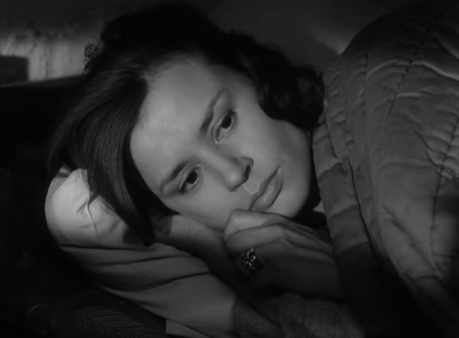
througha2There is so much that could be talked about with Through a Glass Darkly, but I feel the need to point out the more obvious, to begin with. Ingmar Bergman, in retrospect, envisioned this film as the first installment in his 1960s trilogy. As such, the film is a chamber piece that takes place entirely on a single island with only four main players. It lets go of some of the symbolism of many of Bergman’s films, but it still surges with religious content that reflects Bergman’s own background and spiritual conflict.

Through a Glass Darkly is one translation of 1 Corinthians 13, essentially suggesting that at the present time we only get a poor reflection of what is to come. In other words, we cannot fully understand the ways of the world and the ways of God. But how does this theme relate to the film you ask? That’s what I wanted to know as well.

At a basic level, this is yet another story about family and interpersonal relationships. Karin is staying on an island with her husband Martin (Max von Sydow), her father David (Gunnar Bjornstad) who is an author, and her baby brother Minus. She recently was released from a hospital for schizophrenic-like symptoms while her father has recently returned from Switzerland trying to combat a fierce case of writer’s block.

In a day’s time, these four individuals try to parse through all that is going on. Though they initially attempt to shroud it with morning swims and silly stage productions, they cannot completely disregard their reality.

througha3Minus feels he is lacking love and affection. He feels like his sister makes fun of him while his father is aloof and withdrawn from his life. Meanwhile, David is grief-stricken in private, realizing that his daughter’s condition is incurable and yet he also regrets his morbid fascination with it. David tries to cope with his wife’s condition, but although she seemed jovial and fine at first, Karin’s situation begins to decline.
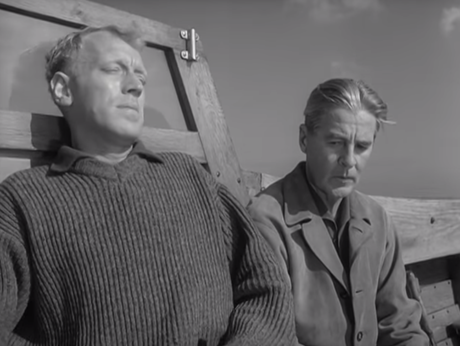
She hallucinates, speaks of going through the walls, and faints. Matters are made worse when the voices in her head tell her to go through her father’s diary. There she reads about his thoughts on her and her “incurable” state. When they take a boating outing Martin asks his father-in-law about what he wrote on the request of Karin, and they get into a discussion. As Martin surmises he seems to be a man with all the right words, but no clue about life itself, and David does not try and object.

Back on the island Minus is with his sister, who confides in him about the voices, and when a storm hits she hides dejectedly in the hull of a boat. Minus follows soon after along with his father. They send for an ambulance to fetch Karin and in a penultimate moment, she speaks candidly with her father one last time before she is to be taken to the hospital. In these final moments she goes up to the attic and while being observed by her husband and father, Karin, breaks into hysterical fits. The visions she has seen are obviously too horrible to bear

througha5This is a film about brothers, sisters, husbands, wives, fathers, and daughters. All revolving around four characters wrapped up and intertwined in this complex spider web of relationships. The spiritual content is great and there is also a lot of minutiae in Through a Glass Darkly. It shares some of the same mind-bending moments as Persona (1966) and yet this film felt even more personal if that is possible. As the title suggests and David even tells his son, we cannot fully understand what is happening, but we can be certain that someday we will know if only we grasp hold of love and the love that God has for his people.

Ingmar Bergman’s type of film-making seems foreign to us now and I don’t mean simply since it’s Swedish, but due to the fact that it is so connected to issues of spirituality and deep questions of faith and love. He cannot and will not allow his work to be cut and dry, because he cares about delving into the human condition. And that condition by default is chock full of ambiguity and complexity. Through a Glass Darkly. The title fits aptly indeed.

4.5/5 Stars

The Bravados (1958)

The_Bravados_-_US_film_posterThe Bravados opens with an ominous stranger in black riding towards a town. He doesn’t say much, but his presence alone creates tension enough. He gets led into town by the local deputy and after a meeting with the sheriff, he is allowed to stick around. His only reason for coming to the city of Rio Arriba is to watch the hanging of four outlaws, at least that’s what he says. But when he asks to see the prisoners, he surveys them and there is nothing but anger in his eyes.

As they wait for the hangman from out of town to arrive, Jim Douglas (Gregory Peck) gets reacquainted with the beautiful Josefa (Joan Collins). And nothing is said about their backstory, but there is obviously something between them. He at first refuses her offer to go to church, but requests to walk her over before reluctantly joining her in the chapel.

However, back at the jail, the hangman is not who he appears and stabs the sheriff in the back with the four outlaws getting away taking a local’s daughter with them. So the town is in a fury sending a posse after the fugitives led by Douglas.

And one by one Douglas tracks down the culprits. First, ambushing Parral (Lee Van Cleef) who he shoots after the man begs for his life to be spared. Next, he takes down Taylor and hangs him from a tree after dragging him behind his horse. The posse does eventually get the kidnapped girl Emma, but Douglas is far from satisfied, crossing the border to Mexico to finish the job. He guns down Zachary in a bar and his only target left is Lujan (Henry Silva). But that’s when things change. Douglas is knocked out of his blind rage for a moment. Because this whole vendetta began after his wife was raped and murdered. He went on an obsessive quest to find the four culprits and although these four no-goods constantly denied seeing his wife, he just went after them anyway.

It is Lujan who finally makes Douglas realize he made a mistake. In this epiphany, Douglas realizes he is little different than these four outlaws, willing to kill mercilessly, even in the name of justice. He goes back to town a hero, but he heads straight for the church where he confesses his wrongs to the local priest. He is a man with a lot to wrestle with, but also a lot to live for thanks to his daughter and Josefa. Although not quite as iconic and memorable, The Bravados, in a sense, is Gregory Peck’s version of The Searchers. This Henry King western in CinemaScope is noteworthy for allowing Peck to play another morally ambiguous character. He is no Atticus Finch.

3.5/5 Stars

All Quiet on the Western Front (1930)

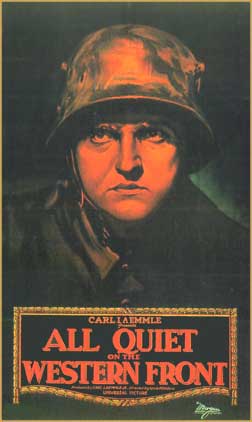
c7ab8-all_quiet_on_the_western_front_1930_film_posterDirected by Lewis Millstone and starring an ensemble cast headed by Lew Ayres, this archetypal anti-war film based on the novel of the same name, begins with a group of school boys during the dawn of WWI. This group of patriotic German youth is hungry for adventure and the glories of war. 

Then they arrive and begin their training which causes them to despise their commanding officer and they also lose some enthusiasm. It gets worse when they head to a combat zone and join a company of veteran soldiers without any food to eat. They finally head to the front and after a day in the trenches their number is fewer. 

Trench warfare proves to be hardly as glamorous as it seems with constant bombardment, rats, lack of food, and most of all the shedding of blood. One of their pals loses his leg and his boots, then slowly more get knocked off or wounded. Now Paul is one of the only ones left but after a bout of hand to hand combat with a French soldier he becomes even more disillusioned. Paul too gets wounded and is sent home on furlough to his family but he finds his friends and family have no concept of the gritty, grimy reality of war. He returns to the lines one more time and a few of his old comrades are still alive. 

However, in a fateful moment Paul reaches out for a butterfly in his trench and just like that he is dead. The last of this school room full of young, naïve boys is now dead or injured. That is the horrible scar left by not only by WWI but any such conflict. 

Despite the fact that all the main German characters are played by Americans, this film has a sharp sense of realism that extends all the way through the film. Even though many of these young actors were unknowns and are not well known today, together they made a powerful ensemble. The themes of this film were so powerful in fact that it was banned in Germany.

5/5 Stars

Stage Door (1937)

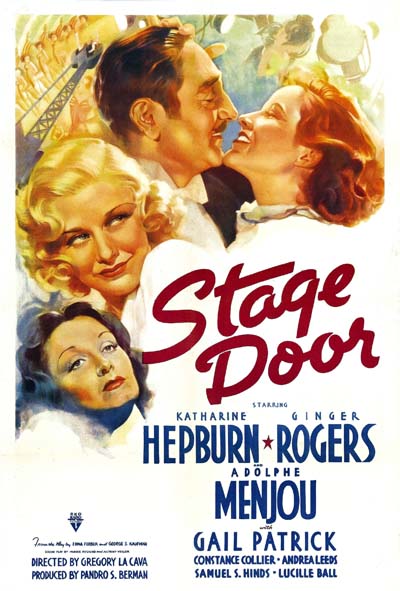
Stage_Door_(1937)Watching Stage Door illustrates one of the pleasures of film because it’s an unassuming classic that very easily could be overshadowed by other films. Its main stars are Ginger Rogers and Katharine Hepburn, who both have numerous films more well known than this one.

However, this story about a boarding house for aspiring stage actresses is a light piece of sassy fun while still finding moments for poignancy. Rogers is a cynical dancer named Jean, and she is not too pleased to be getting a new roommate. The last one moved elsewhere after constant fighting. But the new girl, Terry Randall (Hepburn), is different. She is from a well to do family, but she is pursuing a career in acting so that she might stretch herself.

The other girls look on with an air of contempt thanks to her fine clothes and pristine manners. She doesn’t fit the mold of many of the other struggling actresses looking for their big break. Many spend their evenings trying to grab hold of a sugar daddy such as famed theatrical producer Anthony Powell (Adolph Menjou). Several of the girls have their eyes on him as they try and land a role in his next big production.

Kay Hamilton is the most well-liked girl in the house and arguably one of the most gifted performers. She opened the year before in a production that won her rave reviews, however, a year later she has yet to get another break, and she is running out of funds. Powell’s show is her last big chance. Thus, when Powell cancels her audition last minute for a trivial reason, Kay faints and an irate Terry bursts into his office to confront him. He is initially turned off, but then he chooses her for the lead role of the upcoming Enchanted April.

Although the girls were beginning to warm to Terry, Jean has trouble forgiving her as tragedy strikes. In fact, Terry almost refuses to go on stage altogether, and yet she goes out and gives an emotional performance that is hailed by critics. In the end, Terry and Jean are reconciled which is far more important than any type of fanfare.

In many ways, Gregory La Cava’s Stage Door feels similar to The Women (1939). Both films have casts with women in the primary roles and the stories are at times volatile, with so much drama and many zinging comebacks. Some of this was courtesy of the supporting cast which included such legendary comediennes as Lucille Ball and Eve Arden. Ann Miller is even present, but at its core Stage Door is Ginger and Katharine’s film. Pardon my curiosity, but did Fred and Spencer ever do a film like this?

4/5 Stars

Dinner at Eight (1933)

220px-Dinner_at_Eight_cph.3b52734Dinner at Eight is another all-star slug fest from MGM meant to capitalize and top the success of Grand Hotel from the previous year. This time around, well to do wife, Millicent Jordan is setting up a charming dinner party for a wealthy English couple Lord and Lady Ferncliffe who are traveling to New York. The hostess is frantically trying to figure out dinner guests for the big occasion because everything must be perfect. Observant viewers will notice that the high strung lady of the house is played by Billy Burke (more widely known as the Good Witch Glenda). Her husband Louis (Lionel Barrymore) is a kindly shipping magnate, who was hit hard by the depression, and his health is also failing as a result. Their daughter has problems of her own since she does not really love her fiancee and has fallen for the much older, and washed-up alcoholic actor Larry Renault (John Barrymore).

Next on the list of probable invitees is Carlotta Vance (Marie Dressler), the formerly prominent actress, who is now still in the twilight years of her career, but she still carries on a lavish lifestyle with furs and all. She is old friends with Louis, and she is always ready and willing to reminisce, fish for compliments, and offer a little sage advice on the side. She’s a character we like.

The most dynamic pair is most certainly Wallace Beery and Jean Harlow. They play the gruff, crooked businessman and his equally feisty wife, Dan and Kitty Packard. They’re hardly together because he’s working and she’s buying up clothes and caught up in an affair. When the two of them finally are together in the same room, they are constantly at each other’s throats. No punches or barbs are spared. And yet on the invitation to the Jordan’s they both pull their act together. He wants to meet the highly prestigious Ferncliffes, and she wants a chance to get dressed up. They’re quite the match.

With a title like Dinner at Eight, you expect the drama to take place around the table with the guests all seated together. However, that would be rather stuffy, I suppose, and instead, the dinner only acts as the culminating event to push the plot along. We actually never see the guests at the table, only the action leading up to it. Millicent is in a tizzy, especially when she hears the Ferncliffes have a change of plans. Her husband’s health is slowly deteriorating at the same rate as his company. The arrogant actor Larry Renault bickers with his agent about his next role. Honestly, this was the most unsatisfying of the threads, and it did ultimately end in tragedy. However, I’d be interested to know how close this parody actually came to John Barrymore’s actual life, because sometimes it’s hard to know how to parse the fiction from the reality when they seem to overlap.

Once all the guests are assembled it’s a rather ragtag group, but it is a fun mix of characters, and Millicent gets her cousin Hattie to attend along with her Garbo-loving husband who is unenthusiastic about the whole affair. It’s a satisfying overall result and an enjoyable enough ensemble that George Cukor directs with relative ease.

4/5 Stars