Grand Hotel (1932)

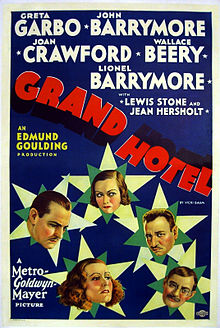
GrandHotelFilmPosterGrand Hotel is the epitome of a Hollywood superstar ensemble, and it would set the bar for all the films that would try to imitate and surpass it. Thanks to Irving Thalberg and the studio with more stars than there are in the heavens, MGM delivered a film that was a smash hit and after well over 80 years, it still remains an important visual relic.

The cast was beyond a contemporary viewer’s wildest dreams. It was that good. You had Greta Garbo, John Barrymore, Joan Crawford, Lionel Barrymore, and Wallace Beery among others. Nowadays many of these names do not carry as much clout (I must admit even to me), and the idea of a film starring numerous big names seems almost mundane. Just take a look at Oceans Eleven or The Avengers. But we must understand that at that time it was a stroke of genius because usually only one or two stars were set aside to be in a certain film. It was seen as the most commercially viable philosophy at the time.

Then came Grand Hotel: As Dr. Otternschlag (Lewis Stone)  muses it’s “always the same. People come, people go. Nothing ever happens.” It’s counter-intuitive but in some ways, that’s what makes this film so much fun. People love stories with fun vignettes that criss-cross and weave in and out. It’s even better when the stories contain the likes of Garbo and the Barrymores. Not to mention Joan Crawford.

It’s a fun world and a lasting tradition that many films have attempted to replicate because honestly, most audiences love these types of realities that they can escape to and in turn, be a part of. In this case, it’s this opulent hotel in the heart of Berlin full of bustling bellboys,  lavish suites, and all the pleasures life could afford.

Furthermore, the guests come from every walk of life imaginable making it all the more enjoyable to watch their intermingling and chance encounters. There is the prima ballerina (Greta Garbo), who has recently gotten cold feet and even canceled a show in her melancholy. It allows for Garbo to utter her famous line, “I want to be alone.”

Then there’s the baron (John Barrymore) who is also in desperate need of money. You might label him a cad because he resorts to theft several times, but if he is a thief he also has a heart of gold befriending and comforting nearly everyone he meets. He especially makes Ms. Grusinskaya very happy and it allows for some amorous scenes between John Barrymore and Garbo.

Next comes Mr. Kringelein (Lionel Barrymore) who is the lowest of all the individuals in the hotel, but since his imminent death is ahead, he is finally going to live a little and he finally gains some of the friends and respect that he has always wanted. On the other hand, Wallace Beery plays Preysing the big magnate who is trying to swing an important deal to keep his company afloat.  Mr. Kringelein is one of his nameless underlings who keeps his books. Preysing has little concern for the “little man,” until he is desperately in need of help.

Last, but not least, is a radiant and spry Joan Crawford as the stenographer. She’s far from the star, but she does seem to steal many of the scenes that she pops up in. Also, despite all the ups and downs, she gets the happy ending she deserves.

I must admit that Grand Hotel takes a little time to set the scene and pick up steam, but when it does it’s a lot of fun. You know it’s a special film when the two Barrymore brothers are acting together, playing two so very different individuals. Yet underlining every scene they share together is the indisputable fact that they are related.  You also have Garbo and Crawford in the same film without either sharing a scene with the other! For an updated take on this type of story give some attention to Wes Anderson’s Grand Budapest Hotel. Otherwise, this lavish 1930s production is worthwhile, because it really does feel like you’re watching film history.

4/5 Stars

Heaven Knows, Mr. Allison (1957)

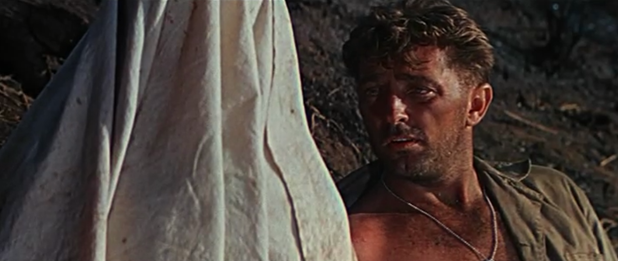
heavenknows3From John Huston comes another film about a woman of principle and a man who seems to be everything she is not. This time instead of Katharine Hepburn and Humphrey Bogart aboard The African Queen in WWI, we have Deborah Kerr and Robert Mitchum stuck on a deserted island together during WWII.

Kerr is Sister Angela who was on the island only a few days with a priest before he passed away. Now she is alone taking care of herself in solitude. That is until castaway Marine Mr. Allison washes up on her shore in a raft. For a time it is just the two of them as the Sister offers the marine food after his long, arduous journey. But after getting rest and some nourishment, he returns the favor proving his resourcefulness at scrounging up food on the island. For a while, they live in relative ease like this.

But they are reminded that the war is still going when the Japanese set up camp on the island. The unlikely pair finds themselves living in a cave together. Allison invades the camp on the sly to acquire food for them, and they continue to manage in hiding. Once the enemy is gone, the exuberant marine gets drunk on some sake and professes his love to the novice nun. Although the situation had never quite been awkward up to that point, it quickly becomes so. Sister Angela, in a tizzy, flees out in the pouring rain and winds up getting sick as a result.

heavenknows5To add to the predicament, the Japanese forces return, and back to the cave, it is. This time Mr. Allison must kill a soldier in order to get a blanket for Sister Angela. Soon the Japanese are burning the underbrush in pursuit of the culprit. It’s dire straights certainly, but then help comes.

Mr. Allison once again proves himself and regains the faith and admiration of Sister Angela. Once the marines roll in Mr. Allison is able to leave the island on a stretcher with the faithful novice by his side. They are a strange pair, but their relationship makes this story actually engaging. In a way, the life of a marine and a nun have some similarities, although they fall at completely different ends of the spectrum. In the same way, Mitchum and Kerr are adept at playing their roles to that degree. Allison is rough around the edges, a Joe Palooka type, and yet he means well. The nun is devoted to her calling, proper, and it never seems as if she could ever approve of Mr. Allison. And yet, in the midst of all the divides that seem in place, a true bond forms. It’s an entertaining relationship and these two stars,  led by John Huston’s direction, made it thoroughly enjoyable.

4/5 Stars

99 River Street (1953)

99river4This is a Sam Fuller type crime film that’s not pretty, it’s full of gritty realism, and it ends up being an unassuming little gem that is a great joy. However, instead, this film comes from director Phil Karlson pairing him with John Payne. In film-noir, boxers always seem to take a center stage and it is never (or hardly ever) the champs. It’s the near misses or the bums. Ernie Driscoll (Payne) falls into this category as well.

After his big fight and an unfortunate conclusion to the bout, Driscoll is all washed up and he and his wife know it. He relives the moment in agony and dejectedly takes a job as a taxi driver, while he tries to figure out a future without boxing. You can tell his wife is fed up with this way of life, and she’s getting awfully snappy. Driscoll is unhappy, with his marriage going down the tubes, so his only encouragement comes down at the coffee counter with his buddy Stan and the bubbly actress Linda.

Things get worse when Ernie sees his wife with another man who also happens to be a real thug. Ernie is humiliated and looking for revenge, but on Linda’s bidding, he follows her to the theater because she is in desperate trouble. He obliges and yet again he feels like he’s been made a fool of. He cannot even seem to trust her.

Ernie wants desperately to get back into the ring, against the better judgment of his former manager. But he still is caught up in the whole mess with the cunning tough guy Victor Rawlins who stole Driscoll’s wife. The man shows how little the girl meant to him in comparison to the money and after getting a payoff for a fat load of diamonds, he waits for a freighter to take him away.

Linda wants to help Ernie after what happened on the stage, but she cannot stop Rawlins. It’s up to Ernie to duke it out on the docks, and it turns into a real brawl where he struggles not to get his bell completely rung after a gunshot to the chest. It’s the biggest fight of his career and somehow he wins. Really 99 River Street sounds like a run-of-the-mill noir, but Payne’s performance is rather good. It feels rather like Edward G. Robinson in Scarlet Street where no one seems to be on his side. However, he does ultimately have two solid allies in the faithful dispatcher Stan and the always vibrant Linda. Ernie finally follows Stan’s earlier advice and whispers sweet nothings into the ear of his love. It’s a happy ending for a noir.

The cast is rounded out nicely by a wonderful group of character actors including Brad Dexter, Jack Lambert, and Jay Adler who all work as the scum of the earth-dwelling in New York. The contrast of the bubbly Evelyn Keyes with the more aloof Peggie Castle was also very effective in the film. Now I need to see Kansas City Confidential as well.

4/5 Stars

Kiss of Death (1947)

kissof1Film-Noir gets interesting when the stylized, more formalistic world of this dark genre begins to seep into the familiar human drama that we as an audience are more used to. Many of us have families. We have jobs so we can provide for our families.  Or maybe some of us don’t and that makes for some tough decisions.

In Henry Hathaway’s Kiss of Death, Nick Bianco (Victor Mature) has been out of work for a long time now, so on Christmas Eve, in order to get presents for his two little girls, he robs a jewelry store with a few other accomplices. What sets him apart is he’s not your stereotypical ruthless criminal. He’s a family man, but he’s also bought into the idea that you don’t squeal. So inevitably after he gets caught and booked, Nick will not talk and he gets sent to the clink. The assistant D.A. (Brian Dunleavy) tried to help him, but Bianco took the three years in Sing Sing instead.  After all, his wife is doing fine and so are his daughters.

While he’s in the clink, however, he gets tragic news that his wife committed suicide and his two girls were sent to an orphanage and that changes his entire outlook. He needs to get out of there, and he’s ready to sing if that means getting to see his girls. He begins communication with D.A. Louis D’Angelo again, and he also begins to receive visits from a pretty young woman named Nettie (Colleen Gray), who used to babysit his girls back when his wife was still alive. As his relationship and gratefulness in Nettie grow, Nick also comes in contact with Tommy Udo who is also serving time. He’s a thug with a maniacal laugh and psychopathic personality if there ever was one. He’s not a good guy to cross.

The dkissof2ay finally comes when Nick gets out and he has Nettie waiting for him with his two girls. They are a beautiful happy family and Bianco has remade his life possibly better than it ever was before. However, he’s still beholden to the D.A. and they want him to get dirt on Tommy Udo. They don’t know what they’re asking, but still, Nick goes through it reassured that depending on what he can get, Udo will be put away for good. But of course, the slimeball beats the rap and Nick’s now a sitting duck. He sends his family away and waits for a confrontation with Udo.
His home life has all of a sudden been shattered, and he’s a wreck. Udo’s sadistic laugh undoubtedly ringing in his ears. In a different era, this film could have spiraled deeper and deeper into the darkness after the final confrontation. Supposedly there was one cut of the film where Widmark’s character actually got away and Mature was left for dead. The ending that was decided upon is still harrowing but holds a Hollywood silver lining as Coleen Gray’s narration ties up the story in a nice bow.

There potentially was also a scene in Kiss of Death with Mrs. Bianco where Udo took advantage of her and drove her to commit suicide, but it was deemed too graphic at the time. Although I would admit that such a scene would have made Udo even more despicable, he really did not need much help. Widmark plays him to a tee with a chilling laugh that would make the Joker proud. Mature is certainly not the standout, but he’s a necessary every man who we can empathize with. The demure Colleen Gray (who unfortunately just left us) is also fun to watch as the girl who stands by him. She also serves to narrate our story informally. Maybe it’s just me, but I really do not grasp the importance of this title. It gave me major misconceptions going in, but that’s not necessarily a bad thing.

4/5 Stars

They Were Expendable (1945)

They_Were_Expendable_posterThere’s nothing very intriguing about a film entitled They Were Expendable. In essence, we already know what the conclusion of the film is, however it is important to understand the context of when this John Ford World War II docudrama was coming out. In 1945 the Nazis and Japanese had finally been quelled, and the Allies could look back at the sacrifices that had been made.

One such example was in the Philippines after Pearl Harbor. Despite being undermanned and without much support, the brave men in the navy wreaked havoc against the enemy trying to hold onto their strongholds as long as possible before being forced to evacuate. It is far from a glamorous moment in the war because the war seemed to favor Japan and our forces were made to flee. However, in those moments of distress and tragedy, bravery seemed to flourish and our resolve only greatened. General Douglas MacArthur summed up the sentiments of every man when he promised, “I shall return.”

That being said, John Ford’s They Were Expendable is not always easy to follow; it can feel slow and deliberate, however, it exudes a gritty realism that is hard not to appreciate. It certainly is patriotic, but it does not often over sentimentalize war with high drama. We see it for what it often is. It means smoke, explosions, shipwrecks, death. It means breaking apart friends, crews, and men and women who care about each other.

Part of that realism is probably helped by Ford’s work filming a documentary of the Battle of Midway and lead Robert Montgomery (who plays Lt. Brickley) also fought on a P.T. boat during the war. Although he was not ever in the military, John Wayne always has a knack for reflecting American ideals of grit and determination. That’s why he was made for westerns as well as war films. This time around playing the fiery but loyal Lt. Rusty Ryan. Donna Reed on her part has a rather small role, and yet it is an integral part because she represents the brave nurses who support the military. She is the lifter of morale, the girl next door, all these ideals that fit this pretty young lady from Iowa. It’s hard to know if she’s just playing herself or not.

At times it’s a hard film to follow because it often seems to jump or skip events. Maybe it happens in an attempt to cover more story or maybe Ford did not want to hold his viewer’s hand, I’m not sure. I do know that I am far less of an informed viewer about this time period or this moment in World War II history. It often seems like most of the limelight is given to mainland Europe and not the Pacific.

As much as I was drawing connections and finding similarities, this film is far from McHale’s Navy. The story is far more somber, more realistic, and at times depressing to watch. It’s the kind of film that could only be made after we had won. It affirms our American resolve and honors those who paid the ultimate sacrifice. That and the film’s beautiful low lit images make it worth watching. The cinematography makes numerous scenes far more interesting by layering characters in darkness and accentuating the shadows in a hospital corridor for instance. Rather than making everything feel stylized, it only helps to augment the realism that makes They Were Expendable a worthy testament of WWII.

3.5/5 Stars

Review: Breathless (1960)

breathless2Breathless is such a fresh, smooth piece of cinema that feels as cool now as it was back then. The transcontinental French vibe paired with the revolutionary production is strangely still appealing. It does so many things with such style that is always unique but never quite off-putting. Not to mention the score which is playful in an elegant sort of way. The film has an array of quick cuts, it’s discontinuous, abrupt, and it literally jumps between images. Actions, like shooting a cop or sitting in a room with a girl, become more interesting than we could ever give them credit for.

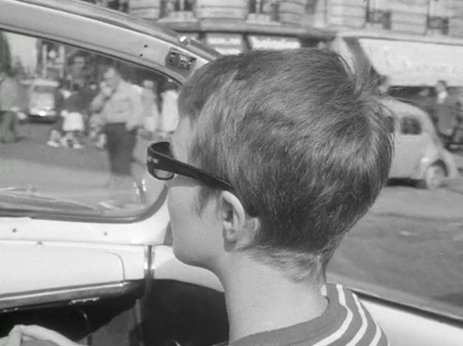
Godard is known for saying that all you need for a film is a girl and a gun and that’s basically all Breathless is. Michel (Jean-Pierre Belmondo) is a low down, no good hood who also happens to be quite funny at times. He shoots a cop for no good reason and after that, the police are after him on the streets of Paris.breathless5He’s also broke and all his buddies are either unavailable or in some trouble of their own. He swipes money from one girl and rendezvous with his latest fling, the aspiring American journalist Patricia (Jean Seberg). They do very little except drive around the city or lounge around her room. In one memorable shot, jump cuts piece together scenes of the back of Patricia’s head as she sits in the passenger seat observing the world around her pass by.

Michel, on his part, seems only to want sex and yet he says he’s never loved a girl before. He’s continually drawn to Patricia, and he never can quite pull himself away.

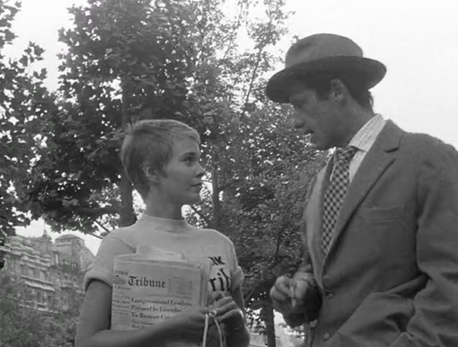
She, meanwhile, has another man with an eye on her, and she hopes to propel her fledgling journalism career. Her one assignment happens to be interviewing the highly philosophical and somewhat pompous Mr. Parvulesco (Jean-Pierre Melville).breathless10The billboards around town even foreshadow the impending doom of Michel. Patricia later learns from the police that her lover is wanted for murder, and she must decide what to do about it. In a memorable scene, Patricia is shown pacing around the room in a wide circle. In the end, she does turn in the hood to prove to herself that she doesn’t truly love him.

Michel looks utterly pitiful, like a wounded deer after he gets winged by the police and collapses in the middle of a quiet avenue. Patricia stares straight at the camera giving the queerest of looks as Michel breathes his last. If you wanted narrative clarity you’re definitely looking in the wrong place.

breathless9In some ways, Jean Seberg’s iconic look reminds me a young Audrey Hepburn another gamine glamour girl. The photography of Seberg is iconic from the reflection in her sunglasses to her donning Michel’s hat. Breathless proves film is not just entertainment, but it can also be lastingly stylish. There’s nothing wrong with that, and it still seems to work after over 50 years. Honestly, when I was starting out, Breathless helped open up all of European cinema to me and for that, I am indebted to Godard and The French New Wave.

4.5/5 Stars

Young Mr. Lincoln (1939)

youngmr1Hailing from a year laden with numerous American classics, Young Mr. Lincoln is undoubtedly overlooked in deference to other titles like Gone with the Wind and The Wizard of Oz. Even John Ford’s own Stagecoach, starring John Wayne, overshadowed this autobiographical work headed by Henry Fonda. Then the next year they came out with The Grapes of Wrath and that title garnered praise for both men. But again, it seems like most have forgotten about Young Mr. Lincoln.

It really is a shame, because this is a quintessential Ford film, and Henry Fonda gives an iconic turn as one of the great historical giants of all time. Except instead of focusing on his major accomplishments, trials, or fatal death, this story contents itself with a simpler story. The focus is the fledgling law career of Abraham Lincoln, who back in 1857 is only a lanky country boy with a hankering for learning. He sees tragedy at a young age when people pass away around him and yet out of those formative years rises a man who is wise beyond his years, because he understands his fellow man and cares deeply about justice.

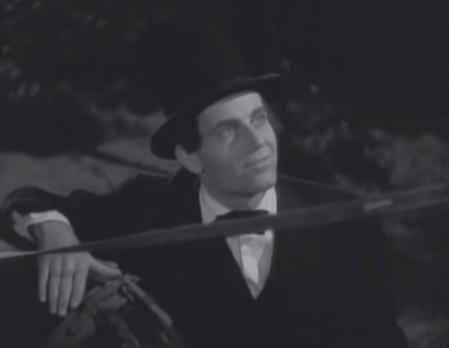
Lincoln is hardly a lawyer of any repute, and he seems hardly a political figure compared to the likes of the great Stephen Douglas. But the people respect him because he wins them over with his common sense and homespun witticisms. Aside from his ubiquitous top hat, he willingly judges pie eating contests, and play the Jew’s harp with feet reclined at his desk.  One of his dear admirers is the young socialite Mary Todd who takes an immense liking to him. He’s the kind of figure that the elite and common folk alike can truly respect.

So when two brothers are accused of murdering another man after a fight one night, it is Mr. Lincoln who avoids a lynching and appeals to the morals of the locals. He, in turn, promises the mother of the boys that he will do his very best to win their freedom and he does all he can to gain her trust.

When the trial begins he carefully picks the jury and faces off against a venerable prosecutor with much greater experience than himself. The mother of the accused saw the squabble, but she cannot bear to implicate her sons. Lincoln pleads on her behalf.  It also looks like the key witness and friend of the deceased man will put a seal on the case, but young Mr. Lincoln is not done yet.

Thus, the film ends and Lincoln is most certainly on the rise, but we get to imagine his future knowingly, on our own, because none of that length of the story is told. In that way, it’s rather interesting to juxtapose Ford’s film with Spielberg’s more recent biography Lincoln, starring Daniel Day-Lewis. They represent different generations of filmmaking, because the latter film takes a monumental moment in history, the passing of the 13th amendment, and places a magnifying glass to it. Focusing on all the individuals involved, and it is certainly going for an amount of period realism, starting with the impressive performance by Day-Lewis as our 16th president.

Young Mr. Lincoln is a lot simpler because it does not need to focus on the highlights. It takes as great of an interest in Abe’s origin story so to speak. On his part, Henry Fonda plays the role wonderfully using his mannerisms and plain speaking delivery to give a homey quality to Lincoln. He’s believable, but in a different way than Day-Lewis. It’s not better or worse necessarily, just different. That being said, Young Mr. Lincoln deserves a place among the exulted classics of that legendary year of 1939. Hopefully, it will continue to receive the respect that it deserves, because it is a moving and surprisingly very witty film. Probably in the way Abraham Lincoln was.

4.5/5 Stars

Love & Mercy (2015)

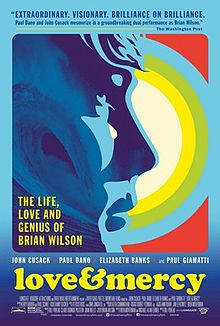
Love_&_Mercy_(poster)It’s a tough one. How do you do justice and even begin to scratch the surface of a living legend like Brian Wilson? His songs have brought joy to countless millions and numerous generations of music lovers. And yet out of all the joy he gave people, his life was steeped in so much pain and suffering. If anything became all too clear, it was the harsh reality of his life back then, but thankfully not now. At first, I didn’t understand the significance of the title (It’s the lead track of one of his albums back in 1988), but the words it hoists up are so perfect in describing his character.

I must say that I was a little skeptical of two actors playing Wilson. For those who don’t know, Paul Dano plays a young Wilson in the ’60s during his creative peak and familial turmoil. Then John Cusack picks his portrayal up in the ’80s when a messed up Wilson is being controlled by his quack psychiatrist Eugene Landi. They seem like two starkly different touch points, displaying two very different actors. Again, how could a director, in this case, Bill Pohlad, find cohesion out of this narrative chaos? But it works and ironically, that’s exactly what Brian Wilson did in his lifetime. That’s why he was such a mastermind.

As a young man his father abused him — hounded him to death. He suffered panic attacks, stopped touring, and embarked on some of the greatest musical odysseys anyone could ever hope to imagine.  We are thrown headlong into his genius during the Pet Sounds and Smile sessions. It might be a reenactment, but it feels like I am watching an artist at work. He’s on a different level, and it makes me appreciate each one of his songs even more. On a side note, I recently saw the documentary The Wrecking Crew, about the famed group of session musicians. And while they brought the skill in their craft, Wilson did truly bring artistic genius that was unique to him. That’s what, in many ways, caused a rift between him and his bandmate cousin Mike Love.

We are tossed back and forth from earlier past to later past as Wilson meets cars saleswoman Melinda Ledbetter (Elizabeth Banks) and embarks on a new journey as the manipulative Landi continues to drag him deeper and deeper into hell. In fact, sometimes it’s hard to imagine that this is the same Wilson and that is helped by Cusack’s performance. He is jumpy, helpless, muted, almost in a haze. But in him, you can see there is an immense vulnerability and capacity for love. That’s what Melinda sees as the layers get peeled back and that’s why it tears her apart seeing Brian suffer so.

As it turns out, Brian Wilson’s mind is not only a place of musical creation, but of fear, pain, and confusion. He was stuck between an antagonistic father and Landi’s manipulating presence. Whether it was the abuse, the drugs, the hallucinations, or a little bit of each, his story is one with a happy ending, and the film plays out that way. Isn’t it fitting that his immortal tune “Wouldn’t It Be Nice” closes the gates on this chapter of his story? It certainly is not over, still going, forever hopeful, and continuing to soar ever higher on a wave of positivity.

His genius astounds and now his resilience amazes me. He finally has found the Love & Mercy he deserved. Thank you Brian Wilson for gifting us such immortal tunes.

4/5 Stars

An Affair to Remember (1956)

anaffairto2An Affair to Remember (1956) has always been noted as a great American romance as far as I can ever remember, and I figured out that part of that was because it gets a mention in Sleepless in Seattle (1993). Whatever the reason, I finally got around to watching it and it is certainly an enjoyable weepy. Any film with Cary Grant as a romantic lead is usually, at the very least, charming and this one is too. He is a famed man on an ocean liner who has finally gone and gotten himself hitched. It’s big news and as soon as the ship touches down he is going to meet his love.

Quite by chance, he meets Deborah Kerr’s character and they are immediately taken with each other. Soon their friendship grows into an affectionate romance, and yet they feel uncomfortable in front of the other passengers who seem to be watching their every move with interest. They both know that once the boat reaches New York things will not be the same between them for some time.anaffairto4And so it is, but they had made one last plan to meet each other at the top of the Empire State Building. Grant makes it, but Kerr is detained for a very good reason. After seeing her in an awkward situation at the theater, Grant resolves to go see her and get to the bottom of what happened. It’s a tearful, albeit happy, reunion as they come back together.

If any of this feels familiar, like a rerun, that’s because it is. Leo McCarey actually made An Affair to Remember (1956) as a scene for scene remake of his earlier film Love Affair (1939). I never thought I’d say that I like a film with Charles Boyer more than a comparable one with Cary Grant, but it’s the truth. I’m not sure if it’s because I saw it first or that the film feels more intimate, but I really enjoyed Love Affair. An Affair to Remember is certainly elegant in color and Deborah Kerr gives a fine performance, but I was personally blown away by Irene Dunne as an actress. In fact, back in the day, Dunne worked quite a bit with Cary Grant (The Awful Truth, My Favorite Wife, and Penny Serenade).

So my advice is, go back and give Love Affair a watch. It’s still by McCarey with much of the same story so it’s really a personal preference what film you like more.

3.5/5 Stars

Kiss me Deadly (1955)

kissmedeadly1Set in L.A., the film stars Ralph Meeker as the callous and often corrupt P.I. Mike Hammer, adapted from the Mickey Spillane novels. One night while driving, Hammer picks up a frightened woman who begs him to remember her. They are forced off the road by thugs and the girl is eventually killed. Hammer wakes up in the hospital to his secretary girlfriend Velda (Maxime Cooper). He makes it his priority to find out what the mysterious woman was talking about. He meets up with opposition and a femme fatale, but Hammer keeps on going using strong-armed tactics. He finally tracks down a mysterious whats-it but then discovers that Velda was kidnapped. In the final confrontation, he finally learns who he was looking for and he finds out the consequences of the Pandora’s box in the hands of a deadly female.

Out of most of the prominent works in the canon, Kiss Me Deadly is probably the pulpiest of L.A. Noir. The images are rather like a historical time capsule of 1950’s Los Angeles with locations on Wilshire Blvd., Sunset Blvd, and even near Angels Flight. It has crisp black and white cinematography with many noticeably low angles underlying the sleekness, but also the paranoia wrapped up in this story. It arguably has the queerest cold open and ending of any noir, which I cannot help but remember.kissmedeadly2Ralph Meeker plays’s Mickey Spillane’s P.I. Mike Hammer to a tee. His husky voice perfectly fits the bravado of Hammer, a misogynistic brute prone to coercive action. Out of all the private gumshoes we’ve met, Hammer is probably the lowest — he’s a real scuzzball.

 Hammer throws women around like playthings and even his girl Velda has a double purpose. Yes, she is a lover, but she also makes a keen asset for business. As a P.I. specializing in divorce cases and marital problems, he’s not below giving business a little help. Velda willingly works on the husbands for him and he’s not above playing around with their wives. It’s a cozy little set-up.

kissmedeadly8That’s Hammer’s level and so when he gets caught up in the story of the mysterious girl Christina (Cloris Leachman), he has no idea what he gotten himself into. It’s a lot bigger than him and when the authorities throw around words like the Manhattan Project, Los Alamos, and Trinity he finally understands what its all about, but not really. In essence, Kiss Me Deadly is the quintessential film of paranoia in the Cold War nuclear age. We have a MacGuffin in the form of the mysterious Whats-it, but aside from that, we get few answers. Only a few deaths and some mighty destruction.

kissmedeadly4

Kiss Me Deadly has some great characters aside from Hammer and Velma. The thugs are played by the perpetually cross-eyed Jack Elam and the glowering Jack Lambert which turns out to be great casting. Also, the lively Greek-American Nick (Nick Dennis) is a great deal of fun with his enthusiasm and a lot of “Vavavoom!”

It’s an interesting dilemma because I have never loved Kiss Me Deadly, but director Robert Aldrich developed a film that is so persistently interesting. It was a film that was supposed to ruin young viewers for its moral depravity, sensuality and who knows what else. This film literally screams “Remember Me” and honestly I will not be forgetting about it anytime soon.

3.5/5 Stars

Christina: You have only one real lasting love.

Hammer: Now who could that be?

Christina: You. You’re one of those self-indulgent males who thinks about nothing but his clothes, his car, himself. Bet you do push-ups every morning just to keep your belly hard.