While the City Sleeps (1956)

whilethecity1While the City Sleeps has a brilliant cold open followed by a pounding title sequence, courtesy of Fritz Lang, that brings to mind a bit of Diabolique and Psycho. The rest of the film turns into a case to find the wanted lipstick murderer (based on a real killer), but that only holds part of our attention.

When newspaper magnate Mr. Kyne dies suddenly, his begrudging son Walter (Vincent Price) takes over intent on shaking up the status quo and putting his mark on the company. He soon turns three men against each other as they desperately fight for the new position of executive director. The first is veteran newspaper editor John Day Griffith (played by the always memorable character actor Thomas Mitchell). The second candidate is chief of the wire service Mark Loving (George Sanders) who is Griffith’s main competitor. Finally, in the third spot is Harry Kritzer who happens to have a secret ace in the hole. Each of them is tasked with finding out the real scoop about the serial killer, and it turns into a real tooth and claw ordeal. Within the glass cubicles, everything can be seen, but not everything is heard and that’s where the secrets get disclosed.

On the outside looking in, so to speak, is star TV reporter Edward Mobley (Dana Andrew), who agrees to help his friend Griffith by doing a little digging around about the murderer. He gets some tips from a cop friend Lt. Kaufmann (Howard Duff), and Mobley tries to smoke the killer out on air. However, it leads to the potential endangerment of his fiancée Nancy, who also happens to be Loving’s secretary. Loving has his love directed towards a female reporter named Mildred Donner (Ida Lupino), who attempts to needle Mobley for info. At the same time, the killer is on the move once more, with Nancy being an obvious target. Mr. Kritzer’s own romantic entanglements get him in trouble because he is seeing Kyne’s beautiful but detached wife Dorothy (Rhonda Fleming). Mildred finds out about them and they have some talking to do. Mobley also has some making up to do with Nancy after she finds out Mildred came to see him. It’s a big mess.
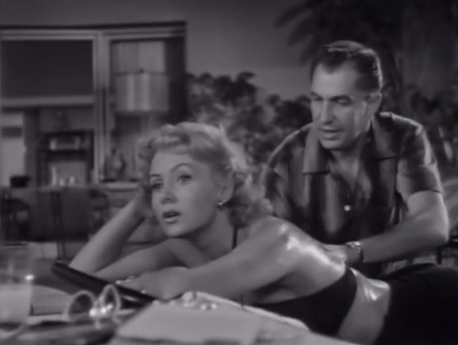
whilethecity3Mobley juggles everything from his love life to the big scoop and they apprehend the killer, but things at Kyne’s don’t wind up exactly the way they expected. Mobley looks to move on from the paper with Nancy, but even he cannot get away that easily.

While the City Sleeps is an underrated tale from Lang that is positively stacked with big names. Its pacing can be deliberate at times, but it is just as much an indictment of journalism as it is a thriller. The office is a web of deception with so many interconnections between these work factions. Those you would normally expect to be scrupulous seem to give up their honor in the face of this new promotion. In a sense, Mobley seems to be outside of this fray and yet he cannot help but get involved in it. It doesn’t help that nothing turns out the way it’s supposed to. Everybody seems to gain something, but nobody really wins the game.

I must say it was great to see Dana Andrews in one of these leading roles again and although their roles were smaller, Ida Lupino and George Sanders still were a deliciously stuffy and corrupt pair. I was never really a fan of Vincent Price due to the roles he normally plays, but I was inclined to like Howard Duff (Lupino’s real-life husband) in his turn as the policemen. It goes without saying that Rhonda Fleming is positively beautiful, but she also cannot be trusted. I guess that applies to about every character in this film. It’s certainly a cynical world out there that Lang paints, where the killer might be caught, but corruption is never fully quelled.

4/5 Stars
Review: The Big Heat (1953)

bigheat2The Big Heat is not a noir where the darkness comes from the shadowy visuals, but from within its characters themselves. In fact, some of these individuals are so subtle in their corruption that it easily gets overshadowed. Homicide cop Dave Bannion is, rather ironically, the straight-arrow trying to do what is right, and he becomes the most vengeful character in Fritz Lang’s film. It’s a subversion of the typical noir arc because his greatest help ultimately comes from the former femme fatale. That’s not how it’s supposed to happen, but then again a lot of things happen a little differently in The Big Heat.

The film opens and within a second a man has shot himself and left a confession on his desk. The cues tell us that he’s a cop and he’s just committed suicide. His wife comes downstairs strangely composed and shuffles through the pages he has written. She goes to the phone, not to call the police, but she talks to a third party. We quickly forget what’s she’s done, but the fact is Mrs. Duncan represents the corruption that reigns supreme in this film. She’s used a juicy piece of blackmail to receive large payoffs from someone and she’s not the only sellout.

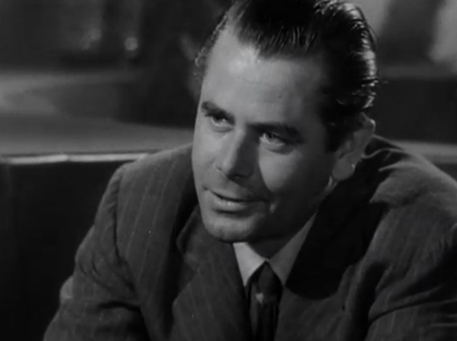
Bannion (Glenn Ford) is a cop by day and a family man at night with a loving wife and a beautiful little girl. By convention, he is supposed to be the moral compass of this film — the emblem of good conquering evil. He takes on the straightforward case of Officer Duncan’s death, but it gets convoluted when a B-girl named Lucy Chapman calls him up to say she knew the deceased, and he would never kill himself. Initially, Bannion takes little heed of this girl, because she is hardly as respectable as Mrs. Duncan, or so society says.

He gets pressure from his superior Wilks to lay off, but Bannion is discontent with loose ends, especially when he receives news that the Chapman girl has been brutally murdered. This can’t all be all coincidence, and he begins sniffing out the truth like a bloodhound. Bannion leads us into the home of this empire of crime literally. He confronts local businessman/crime boss Mike Laganna, who he accuses of involvement in the corruption. Things are beginning to heat up, and they start to infiltrate the sanctity of his home life. The dark recesses of the noir world can never be subdued, and Bannion dives deeper into the labyrinth that is created by his own obsessive vendetta. He has no tolerance for his colleagues who don’t take a stand, in favor of their pensions. He can’t stand tight-lipped locals who give him no help and most of all he hates Laganna’s guts.

bigheat3At the local shady nightclub “The Retreat,” Bannion has his first run-in with the hired thug Vince Stone (Lee Marvin). Afterward Vince’s girl Debby is genuinely impressed by Bannion’s methods, but he will not give her the time of day. He expects her to be the same superficially ditsy dame that we have all seen before. Hardly a femme fatale, but still there is the potential to be deadly. The one character who seems to conform to the stereotype is Stone, and yet he is even more brutal than most, burning girls with cigarette butts and splashing scalding coffee on Debby’s face.

Bannion gets to one of the other hired guns named Larry and both Stone and Laganna decide that something must be done to stop Bannion in his tracks. The obvious target is his little girl, but this time the family life prevails over the noir world. His family and colleagues rally around him and yet Bannion is not done with his obsession.

In fact, it is Debby who actually finishes off Bannion’s work by paying a visit to Mrs. Chapman and then Vince. Bannion arrives soon after to reprimand Vince, but Debby has already done the dirty work. The nightmare is over and everything that is good and right comes to the forefront. Debby proves her allegiance, the criminals are put away, and Bannion gets a new position with the homicide department. But underlying this seemingly happy ending is still a sense of tension. The film ends as Bannion heads out on a new homicide case with the cycle continuing and it seems like he will never be free of it.

The world will continue ripping away the ones he loves. Before he knows it, he will be left with only his personal vengeance to drive his future. Bannion very easily could cross the line between righteousness and corruption. He already almost strangled two characters and was not opposed to slugging it out with others. It’s only a matter of time before he totally blows his cool and collected exterior. It’s a dark assumption, but then again that is a lot of what film-noir is. Fritz Lang seems to get this and that’s what makes his characters here so powerful because he knows that the root of all evil can be in everyone.

4.5/5 Stars

The Spiral Staircase (1945)

spiral5The Spiral Staircase plays out like an Agatha Christie murder mystery with a moody, old mansion acting as the backdrop and numerous individuals filling out the cast. It seems to be some type of gothic-noir hybrid, with its ghostly interiors, torrential thunderstorms, and creaky shutters. However, with director Robert Siodmak at the helm, I am inclined to call it noir, not just because of his pedigree, but it certainly has the atmosphere and dim interiors that are expected of the genre.

The action opens at a movie hall after a woman is murdered by an unseen killer. But most of the actual drama takes place in the before mentioned mansion of the sickly Mrs. Warren (Ethel Barrymore). She resides with her son Steven and step-son Professor Albert Warren (George Brent) who never see eye to eye. Nearly on her deathbed, Mrs. Warren distrusts her nurse and only allows the mute girl Helen (Dorothy McGuire) to even help her. The rest of the cast is rounded out by servants, a secretary named Blanche (Rhonda Fleming) who Steven loves, and the constable and a young doctor who cares about Helen. It’s a wide array of figures and we quickly begin to analyze them for any hint of killer tendencies.

spiral3In fact, Helen is our main character and we experience much of the film from her perspective. The truth of the matter is that all the girls who were killed had some sort of defect, so the line of reasoning is that Helen might be next in line. It seems all too possible with a pair of mysterious eyes constantly watching from the shadows, but Helen does not heed Mrs. Warren’s advice to flee.

The film ultimately spirals into darkness as the killer takes one victim and looks for another. Helen must protect herself, while also confronting her past where the source of her muteness lies. Although simple in conception, The Spiral Staircase is no less an engaging mystery. It is not the best from Siodmak either, but Dorothy McGuire gives an expressive performance that deliverers so much heart and feeling without the use of words.

However, the film does ultimately allow her to find her inner voice in the midst of all the silence. She finally conquers the fear in the moment when it is most harrowing. Although her role is rather minor, Rhonda Fleming is as strikingly beautiful as ever. It’s a rather expected resolution, but there are enough quirks and twists to makes things enjoyable to the end. It goes without saying that gothic noir most definitely should be a thing if it isn’t already.

4/5 Stars

Late Spring (1949)

latespring1Late Spring is a film that I found in some ways more rewarding than Tokyo Story, another acclaimed classic from Yasujiro Ozu. Both films share a few of his trademarks. They are home dramas with basic, everyday plots, termed Shomin-geki. Also exhibited are a stationary camera and low camera angles that Ozu often used to focus on his characters while sitting. In this way, he invented the quintessentially Japanese viewpoint known as the “tatami shot.” We see it most certainly in Late Spring as the daughter Noriko interacts with her widowed father or when they have friends over in their home. It may look somewhat similar to Tokyo Story, but it does differ in subject matter.

Late Spring is a film about fathers and daughters. Marriage and divorce. All the things that make up a life that remain the same whether you’re in modern America or post-war Japan. Noriko is a pretty young woman who is devoted to her aging father through thick and thin. He likes having her around and she likes being there for him.

It’s the culture, namely aunts and friends, who tell Norkio that she must get married. She’s 27 years old, and she needs to find a husband before it’s too late. Her father won’t be around forever. She’ll need to make a new life for herself. But Noriko is content with not listening to the voices trying to sway her. Only when her father talks to her about marriage does she finally begin to listen. He makes conversation about getting remarried and encourages her to think about an arranged marriage that her aunt has waiting for her.

We never meet this man who supposedly looks like Gary Cooper, but Noriko seems to genuinely like him. And yet there still is something that isn’t quite right. In Japan there is great importance in “reading the air,” and it seems like some of the characters in Ozu’s film fail at this or they see only what they want to see.

latespring3In the end, Noriko gets married and it should be no surprise because it was what was ultimately expected of her. Her father, on the other hand, acknowledges to a friend that he had no intention of getting remarried, it was only to prompt Noriko. Professor Somiya took on a great sacrifice in the eyes of society and goes home alone.

This is a bittersweet tale that is surprisingly funny on many occasions, but it is also topped off with human tragedy. Not death or dying, but something potentially worse in loneliness and discontentment. It is only a thought, but it seems like Noriko and her father would have both been happy with the status quo. However, their sensibilities and society said otherwise, so they acted as they were expected to. From this simple drama comes one of the most powerful films on father-daughter relationships ever.

I must admit, at first, I really was not fond of Chishu Ryu’s character, but over the course of the story, he grew on me. As for Setsuko Hara, she is an amazing example of kindness and servility, but also the undisputed muse of Yasujiro Ozu.  Late Spring also plays off the conflict between the old and new not to mention the traditional Japan and western culture. It’s not a blatant presence, but the allusion to Coca-Cola and Gary Cooper reminds us that this is a post-war Japan still recuperating from an awful war. That’s the backdrop of this film and its part of what makes Ozu’s human drama all the more striking. Despite, where it is situated in the historical context, Late Spring is a timeless film giving calculated insight into human relationships.

4.5/5 Stars

Bay of Angels (1963)

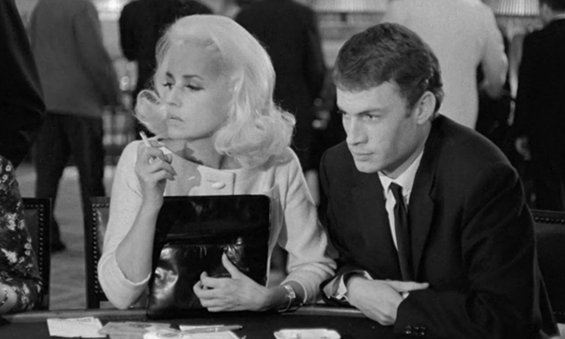
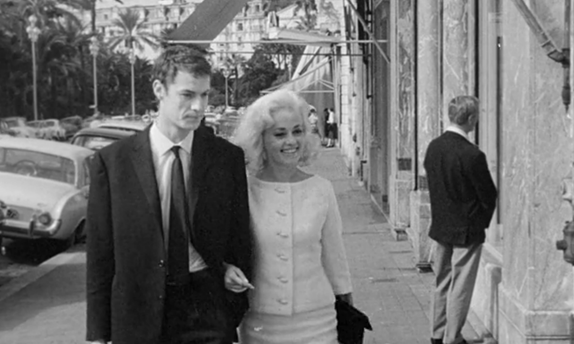
bayof3Bay of Angels is quite different than anything else I have seen by Jacques Demy. Similar to Lola (1961) it is shot in starkly beautiful black and white and it has a kind of love story, but it lacks the music or general whimsy that often characterized Demy’s later works.

This film finds its subject matter in gambling, and it follows one woman’s obsession and another man’s growing interest in roulette. At first, Jean is a rather bored young bank employee, who is coaxed by a colleague to take up gambling.

bayof2

Initially, he is skeptical, looking down at the pastime as a frivolous waste of time and money, after all, he is a sensible young man. However, he parts with the sensibilities that his father would have for him and instead take a few weeks of vacation to spend some time in the casinos of Nice and Monte Carlo.

Soon he gets bitten by the gambling bug and he’s hooked. He finds an equally enthused companion in Jackie (Jeanne Moreau), who has had a far longer history with roulette. Jean falls for her very quickly and Jackie holds onto him like her good luck charm. Their many days spent in the casinos are constantly fluctuating roller coasters of luck. Once gambler’s fallacy has taken hold it’s hard to kick the habit, and Jackie constantly blows her money. If not at the wheels, it gets spent on fine dining and clothes. She has no restraint when it comes to spending and Jean indulges her willfully. It gets so bad that Jean begins to get as reckless as his companion, and he cannot bear to leave her, although she really does have a problem.

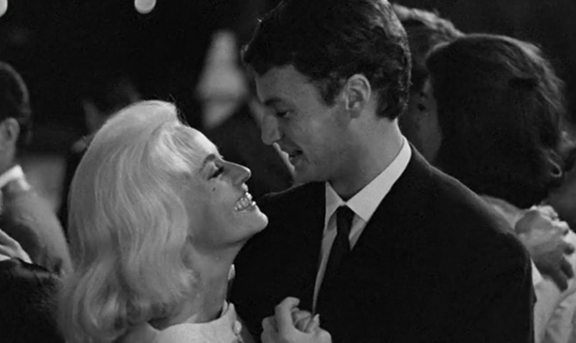
bayof4The formally reserved persona of Jean becomes violent and passionate for Jackie’s affection, but she’s not quite as ready to give it out. The ending felt a bit forced, but yet again Demy delivers a story that is riddled with feelings of love and passion.

It is an interesting observation that his male characters pale in comparison with his female leads ranging from Anouk Aimee, Jeanne Moreau, and Catherine Deneuve. These ladies who are always the object of affection, steal the screen with their mesmerizing performances. In fact, Claude Mann has a rather slumping posture, a glum face, and not particularly good looks. Thus, in contrast, Jeanne Moreau looks like an especially alluring beauty, who seems at home in gaudy gambling houses billowing with smoke or seaside promenades.

Bay of Angels is supposedly the place that brings the pair luck, but the reality is that this film is all about chance. Not fate so much as Demy usually explores, but a topic that is still somewhat similar. It is also a film that makes me never want to play roulette. I do not want the mundane lifestyle of Jean, but I would like to find my excitement somewhere else. I suppose that’s what made Moreau’s character so fascinating because her obsession was so great and yet she simply accepted it and thought little of it. But it drove her life.

“We’re partners in a game. Let’s leave it at that.” ~ Jackie

4/5 Stars

Brute Force (1947)

BruteForceImage873Potentially one of the weaker Jules Dassin films noir, Brute Force is still a worthwhile film exploring the dynamics of a prison during the 1940s. The inspiration comes from the rebellion at Alcatraz in 1946 and this film was shocking at the time for the amount of violence it portrayed. It stars Burt Lancaster as the glowering leader of a group of prisoners in block K17. His main antagonist and the villain of the entire yard is the authoritarian Captain Munsey (Hume Cronyn in an especially icy role).

The story follows the inmates as they make due with prison life and bide their time waiting for parole. However, Joe Collins, who is fresh off a spell of solitary confinement, seems bent on escape. The prison warden is an older fellow struggling to keep tempers from boiling over. The likable but often inebriated doctor (Art Smith) can see the writing on the wall. Things are reaching the end of the line if Munsey continues to hike up his tactics that are making the men resent him more and more every day. It’s positively a powder keg and it’s not going to be a pretty sight if the pressures get to be too much.

The entirety of the film takes place within the confines of the prison except for a couple flashbacks as four men recall the women they left outside in the real world. They are played by Anita Colby, Ella Raines, Yvonne De Carlo and Ann Blyth respectively, reflecting the hope, memories, and loved ones who are pulling at these men and ultimately led them to get into trouble. Perhaps it’s a stretch, but you might even be able to call them the femme fatales in an otherwise very male-centric film.

One man hangs himself afterward from Munsey and another gets it for causing problems for Joe. Neither of these men is looking to stand down anytime soon as Joe cautiously begins enacting plans of escape with another prisoner named Gallagher (Charles Bickford). Munsey continues to hound prisoners for information while halting all privileges.

Ultimately, the finale turns into the most electrifying moment of the film, while simultaneously Munsey is made the new warden and Collins puts his plan in action. Guards are waiting for him and his crew, but Gallagher has plans of his own in the compound. It leads to a handful of explosions, endless mayhem, and more than a few deaths. This is what happens when you use brute force.

4/5 Stars

Force of Evil (1948)

Forceofevil

“This is Wall Street… and today was important because tomorrow – July Fourth – I intended to make my first million dollars. An exciting day in any man’s life. Temporarily, the enterprise was slightly illegal. You see I was the lawyer for the numbers racket”  ~ Joe Morse

Not in recent memory has a film left such a different taste in my mouth. Force of Evil has all the trappings of a thoroughly engrossing noir crime film. There’s the crooked lawyer Joe Morse (John Garfield), looking to get ahead by helping a top level gangster named Tucker take over the numbers racket in New York. There’s his estranged older brother Leo (Thomas Gomez) wanting nothing to do with his brother’s dirty money. It’s a classic Cain and Able type conflict. Add realistic location shooting inter-cut with voice-over, and a David Raksin score to make a real winner.

Yet Force of Evil is a dangerous film to take at face value because on that level alone it is highly entertaining. However, director and screenwriter Abraham Polonsky created something special here at only 78 minutes in length. His film has a certain rhythm that is hard to pinpoint. John Garfield especially delivers his lines impeccably, drifting in and out of common everyday jargon and moral convictions. It’s a slightly higher level of dialogue that deserves more digestion and thought. He even gives a taxi cab soliloquy that gives On the Waterfront a run for its money.

As a big picture, the plot makes sense for the most part. Joe is on the verge of making millions on the Fourth of July, and he wants to cut his brother in on it. But his brother works one of the smaller rackets which is bound to be pushed out. He has his own sense of morality, where he can bear what he does but not what Joe will hand him.

Leo reluctantly agrees to join the big operation out of necessity until things get way too involved, and this time Joe is in a place where he has to get out himself, with no way of protecting his brother. His resolve to watch over his brother is to no avail when the Ficco Gang tries to push their way into the racket. Meanwhile, Joe still finds time to flirt with the innocent and proper Doris Lowry (Beatrice Pearson), the former secretary of Leo, who is in complete juxtaposition with Mrs. Tucker (Marie Windsor), who Morse keeps company with initially.

However, this whole mess is constantly being complicated. There is “Freddie” Bauer (Howland Chamberlain), the nervous fellow who used to work with Leo and now, with the big takeover, is looking to blow the whistle on whoever he can to stay out of the fray. There’s the police who seem intent on getting their hands on everybody they can and not showing favoritism towards anyone. There’s Leo who is righteously indignant while also taking his brother’s offer of a better position begrudgingly. There’s Doris who is in all ways sensible and yet still falls for Joe, not in your typical passionate way, but it still happens nonetheless. There’s the line between legitimate business and criminal activity that is constantly be zig-zagged.

Finally, there is Joe who deserves the greatest amount of scrutiny. John Garfield apparently could not pinpoint his character’s deal initially either, but he must have figured it out because he nailed it. It’s probably his greatest performance. He’s the kind of guy who blows the whistle on his own brother in order to help him in his own way. It doesn’t quite make sense, and he seems so often blinded, but he keeps pushing forward in a vain attempt towards success. All the caustic words and aggressive come-ons don’t work. Ultimately, he has to come to reality. When Joe does, that’s when he realizes what he has started and what he has done to Leo. By that point, it’s nearly too late for him, and it’s most definitely too late for Leo.

4/5 Stars

Body Heat (1981)

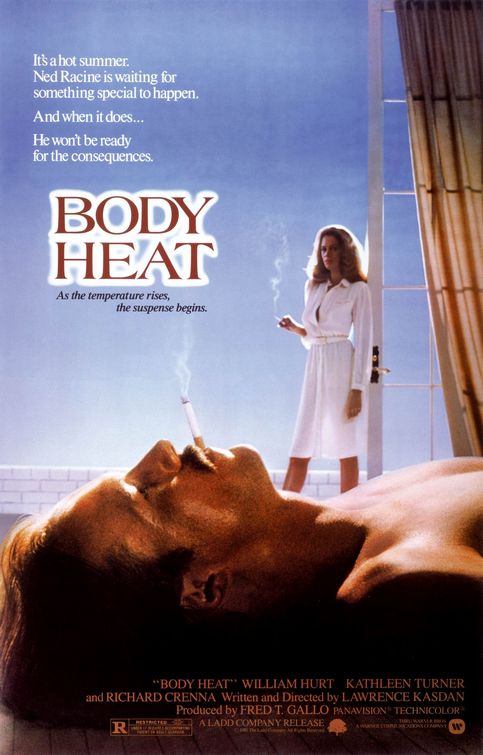
Body_heat_ver1In his directorial debut, Lawrence Kasdan (screenwriter for Empire Strikes Back and Raiders) brought us a neo-noir burning with passion and positively dripping in sweat. Quite the combination indeed.

It opens with the seductively jazzy score, courtesy of John Barry, dancing over the credits. It brings to mind cool afternoons with cool drink in hand. The first shot we are met with is a man driving in his convertible, top down and shades up. He’s a cool and collected looking young man, but we know that there must be something lurking underneath all of this. This exterior is soon dropped and we are met with a reality that is heavy with humidity and sticky days.

Our protagonist is Ned Racine (William Hurt) who is a struggling lawyer working in Florida during an especially sweltering Florida heat wave. One indelible evening he has his first encounter with a beautiful, cool blonde named Matty (Kathleen Turner) whose temperature runs a little hotter than most. He makes a pass or two even after finding she is married, and she rejects his attempts at first. However, during a point of no return, the two give into their cravings and spiral into a passionate tryst. Their affair is fairly easy to keep hidden from Mr. Walker (Richard Crenna), but an old high school friend of Matty’s and Matty’s niece unwittingly find them out one way or another.

They’ve had enough of secrecy and Racine resolves they must kill Walker so that Matty might be freed and so she might also get money due to his impending death. Not satisfied with that, Matty wants to alter the will so she gets more. Racine is completely against that idea.

The night of the murder comes and they act it out with precision and Racine gets rid of the body.  He finds out only afterward that Matty had a new will drawn up and he doesn’t like it one bit, but he is forced to play along. The prosecutor and police detective involved in the case (Ted Danson and J.A. Preston) happen to be friends with Ned through work. They spend many a sweaty afternoon chatting it up at the local diner. That’s what makes it hard when all the facts begin to pile up and slowly but surely Ned’s involvement becomes more suspect. His alibi and the degree of his relationship with Ms. Walker is being questioned.

Meanwhile, he and Matty must find a pair of glasses that might incriminate them. It becomes clear all too soon that things are not as they seem. Matty ultimately abandons Ned, and he winds up behind bars, happier without her. In one final revelation, he starts to put some of the pieces to together in prison. He’s a hot mess.

It’s difficult not to make comparisons between a film like this and classic noir such as Double Indemnity. In both films, there is a man who seems fully committed to going through with a crime, but it is really the woman who has the most to gain from the situation. Furthermore, Ned as the Walter Neff character has his Barton Keyes in the form of Lowenstein and Oscar, who are friends but also the ones who must bring him to justice. However, Body Heat can get away with more, such as sexuality and allowing certain crimes to go unpunished. It’s a rather surprising ending that is nonetheless very interesting.

Body Heat also has the cigarette prevalence of a film-noir (which Ted Danson comically will not take part in). It’s as if Lowenstein is the only character who realizes this habit is out of place in a world of 1980s sensibilities, not to mention crimes of passion.  It was odd seeing Ted Danson in a pre-Cheers role gulping down ice tea after ice tea. Kathleen Turner and William Hurt were a good fit as the gorgeous siren and her partner in crime. They are two attractive people and yet that did not put them outside of the law as they would find out. Body Heat certainly wrenched up the heat a couple of notches and never let off. It positively burns with frenetic energy and unbridled passion.

4/5 Stars

Review: Mildred Pierce (1945)

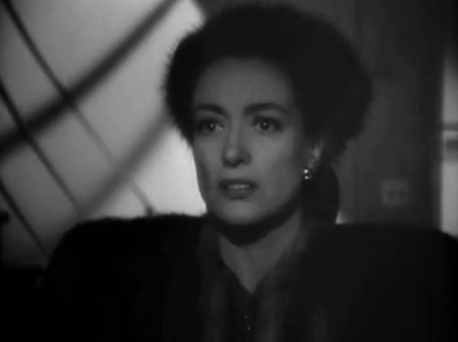
mildredpierce1Mildred Pierce is a hybrid between two genres in a way. It most certainly could be categorized as a weepie 1940s melodrama, a so-called “woman’s picture,” and yet it has the undeniable framing devices of a typical film-noir. It’s unique in other ways as well. It features a strong, independent woman as the lead, the eponymous Mildred Pierce and her aspirations and the struggles in her life become the focal point of this story.

Before any gun was fired or a dead body was found at a beach house or any of that happened, Mildred was a stay at home housewife with two daughters and a husband. It becomes all too clear that all is not right in the Pierce household as Bert becomes annoyed with Mildred, who spends so much time doting over eldest daughter Veda (Ann Blyth). It’s as if she needs to earn Veda’s love and Bert realizes the issue early on. They separate and soon after they watch their youngest daughter die of pneumonia suddenly.

What happens next is Mildred’s big break. She starts out all alone and discouraged before finding a job as a waitress, and ultimately, starting up her own restaurant with the help of the hapless Wally Fay (Jack Carson). She finds a loyal friend and employee in Ida (Eve Arden) and a rejuvenated love life thanks to the socialite Monte Beragon (Zachary Scott).

Veda on her part is ecstatic to finally have a life of nice things with the stream of income coming in from her mother, however, she still does not approve of her mother working in the restaurant business. Mother is so Philistine after all.

Thus, despite all the work and effort, she has put into holding onto her one remaining daughter, Veda begins to drift farther and farther away from Mildred until a fight causes Veda to leave home. Most people would say good riddance, but Mildred Pierce is not like that. She has an unhealthy, almost obsessive need for her daughter’s affection. She will do anything to get her back and most of it has to do with giving Veda stuff.

She is far from happy but finally marries Beragon, because she thinks it might bring Veda back to her home. It works but what she doesn’t know is that she is getting forced out of her own company by Bergaon. That evening she found her gun and then Beragon got murdered on the premises of his beach house.

Back in the station, the shadowy noir sensibilities are still present and Mildred abruptly finishes up her tale. Except for the police investigator and the audience know better. That was not the end of the story. There’s one last cruel twist.

In my mind, Joan Crawford is rivaled only by Bette Davis in giving me the shivers, except in this film her eyes are so expressive, giving off emotion without her even saying anything. Within this film, I find the character dynamics and gender conflict to be quite interesting and there are really 6 main characters we can look at:

Mildred: A strong woman who gains her independence the hard way by putting in work to earn her honest wage. She is not a bad person per se, but her weakness is an unhealthy love for her daughter, or rather, a need to have the affection of a girl who never can be satisfied. It leads to divorce, a loveless marriage and a lot of heartaches.

Veda is a little spoiled brat and most of the pain and problems in the film stem from her. She constantly plays on her mother’s emotions heartlessly and even goes so far as to steal her man. That is perhaps the ultimate slap in the face after all she has already done.

Ida: Along with Wally Fay, Ida is perhaps one of the more likable characters in the film, because she is a strong woman who also holds a lot of wit thanks to the performance of Eve Arden. She also utters the famous line that shines some light on the Veda situation (Alligators have the right idea. They eat their young).

Bert: Although he takes part in an affair and is not the perfect husband, I think Mildred and the audience realize how right he was. He saw all the drama with Veda coming, and he remained civil with Mildred through it all, continuing to look out for her.

Monte: He may not be a “villain,” but Beragon is ultimately another corrupt character who is driven by money and his social status. However, it is interesting to ponder whether it was his own avarice and playboy instincts that led him to do what he did, or was he wholly influenced by Veda?

Wally: Finally, we have Wally Fay played the always enjoyable Jack Carson. He too has his eye on Mildred, but although he can be forward and a little annoying, he ultimately looks out for her much like Bert. And yet to call him an angel would be an overstatement because he still has his own interests in mind.

That’s what makes these characters so fascinating since there are some obvious antagonists, but each character, at their core,  has faults. Thus, it makes sense that this film has melodrama brought on by familiar conflict and the like, only to descend down into the noirish world brought on by vice and greed. Whatever you label this film as, the fact of the matter is, it was a major hallmark for the fading Joan Crawford as well as the ever versatile director Michael Curtiz.

4.5/5 Stars

Review: The Postman Always Rings Twice (1946)

Lana_Turner_in_The_Postman_Always_Rings_TwiceThe first time I saw this gripping noir, my least favorite part of the film probably was the title, and it still is. That’s saying a lot, and the film is adapted from the James M. Cain crime novel anyways, with the title included free of charge. Otherwise, Postman is a wonderful example of the film noir canon, and yet it lacks the elements of your more typical private eye mystery.

It trades dark streets of crime for a small roadside burger joint owned by a shrewd man and his noticeably younger wife. Bring a drifter searching for a quick buck and you have everything set for the deadliest of love triangles. At the tips are John Garfield as the rambling man Frank who initially couldn’t care less for his boss’s pretty wife. Then there’s Cora, the alluring girl who seems out of place in her life. Then you have the money-grubbing Nick (Cecil Kellaway) who seems naively oblivious to the whole situation.

At first, nothing seems to be afoot, and Cora is adamant about not getting involved with the new hand. However, ultimately things evolve. That’s not necessarily the exciting part. We expect the rapid and lurid love affair that soon besets Frank and Cora.  We expect, more likely than not, that Nick will either catch them or they will knock him off first. They choose the latter and its far from preferable. Soon the district attorney is down their throats with his own suspicions about the forbidden couple. He’s pretty smart too.

Sackett plays Frank and Cora off of each other. They’re both scared. Neither one wants jail or worst the gas chamber. Nora ends up being the only one prosecuted, but her sly lawyer (Hume Cronyn) is able to call his opponents bluff and get Cora off with hardly a hitch. The only problem is that Frank and Cora hate each other guts now. They are positively poisoned to each other.

The story could end there and it would be ironic enough, but it doesn’t. It has yet another act where Frank and Cora make up following the illness of her mother, the flourishing of her establishment after the trial, and a bout with blackmail. All seems to be better than it ever was, but fate can have a cruel sense of humor.

On one out of the ordinary car ride, Frank crashes and in the aftermath, Cora is left dead with Frank on the fast track to the gas chamber. And that’s where the title comes in. The Postman Always Rings Twice. In other words, if you don’t pay for your crimes the first time around, you always end paying up one way or another. Cora was killed and Frank faced execution. Neither one got off in the end.

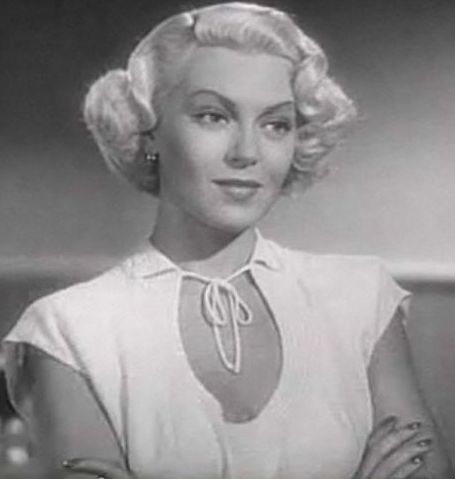
Putting aside the Hay’s Codes need for justice to be dealt, this is a wonderfully sardonic tale and ultimately sensual noir for the 1940s. Lana Turner was never better dancing with relative ease between amorous sweetness and acidic intentions. And the moment she first shows up on the screen is one of the most eye-catching entrances by a femme fatale period. Although not the greatest of leading men, John Garfield is surprisingly credible opposite, Turner. He plays the hard-working everyman incredibly well. Hume Cronyn, for his part, plays his wily prosecutor wonderfully with a sly smile all the while. I cannot quite put a finger on it, but I like him.

4.5/5 Stars