Jerry Maguire (1997)

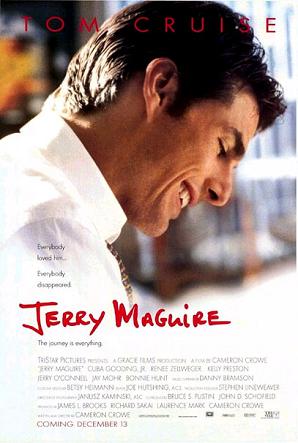
Jerry_Maguire_movie_posterJerry Maguire is your typical feel-good sports story, but it has a different angle. The eponymous character, Jerry (Tom Cruise), is on top of the sports industry. Not as a player, executive, broadcaster, or anything like that, but as an agent. His job is to make his clients the big bucks and protect their interests while also thinking about his own. He’s constantly on the phone cajoling and soothing big time egos so they stick with him and do as he desires. A lot of it is a flattery game, and Jerry is the best of the best whether it’s face-to-face or over the phone. He knows how to play the game.

In a brief moment of so-called weakness, however, he writes an impassioned memo after he realizes he has gone away from his initial values of being a sports agent. The idealistic magnum opus he comes up with late one night is well received and yet it signals a real hitch in his career, even if he doesn’t know it yet.

He gets let go at his agency, and he struggles to hold on to any clients he can, but slowly, bit by bit, they leave him. First one, then two, and then on and on they went. When a top prospect leaves him it looks like Jerry is sunk. And then there was one. Loud-mouthed, prima donna Rod Tidwell (Cuba Gooding Jr.) known for famously uttering the phrase, “Show me the money!”

All the while, unassuming single mom Dorothy Boyd (Rene Zellweger) buys into his dream when no one else will and in the process, she begins falling in love. He’s not quite at the same place she is however.

Jerry Maguire is invariably sad, but it is an ultimately uplifting look at the sports drama told from the sidelines which are still chock full of drama, conflict, and romance in its own right. By consolidating and getting smaller, Jerry learns what is truly important. He finds who his true friends are in Rod and Dorothy. And he learns what it means to truly love someone, not only in a cheesy romantic sense (You had me at hello), but as a true blue friend.

So although not always a great film, Cameron Crowe’s story holds some of the same sensibility of Say Anything… and Almost Famous. It shows that something as big and blown up as professional sports can always be brought down to a more basic level of humanity. It falls somewhere in between films like The Blind Side and Moneyball and that’s not necessarily too bad a place to be.

3.5/5 Stars

“And I’m free, I’m free fallin'”

Act of Violence (1948)

ActofViolenceAct of Violence is an interesting post-war moral tale from director Fred Zinnemann. Frank (Van Heflin) returned home from war a hero. He now has a small child with his pretty young wife Edith (Janet Leigh) in the vibrant California town of Santa Lisa.

Little is known about his P.O.W. past and all his comrades were killed. Except one. His friend Joe (Robert Ryan) is still alive but he is plagued by a crippled leg now. He finds out about Frank’s whereabouts and it become his personal vendetta to straighten him out. The innocent Edith is in the dark about the whole ordeal and with the shadow of Joe constantly haunting him, Frank must family face the specter of his past.

He goes off on a business trip to escape and there out of desperation he winds up hiring a hit man to get Joe off his back. The two former buddies set up a meeting (which is really a trap), But as would be expected it does not work out as planned. Justice is dealt but there is still a strange sense of moral ambiguity. This is  certainly not Zinnemann’s best work, but it brings up some interesting questions about moral scruples and personal conflict.

3.5/5 Stars

Me & Earl & the Dying Girl (2015)

Me_&_Earl_&_the_Dying_Girl_(film)_POSTERI can say unflinchingly, without a single waver in my voice, that this is the best new release I’ve seen this year. Truth be told, I have not seen a whole lot of new films this year, but even if I had, Me and Earl and the Dying Girl would be the best by far.

The title in itself exudes a quirkiness that continues in a steady stream throughout the film. The same quirks can be found in our main protagonist, the self-proclaimed awkward, pale, rodent-faced high school senior Greg (Thomas Mann). He’s gone through high school with the mission of ingratiating himself to all and befriending no one. At this point in his high school career, the closest thing he has to a friend is Earl, who he simply considers his “co-worker,” since they develop homage short films together (ie. A Box of ‘Lips Wow). That’s another thing. Greg is obsessed with film: He eats up anything from Werner Herzog or The Archers thanks to the influence of his father (Nick Offerman). His other “friend” is the chill history teacher Mr. McCarty with an office that is the lunchtime oasis for Greg. But that’s about it.

That is until his doting mother (Connie Britton) forces him to go visit a girl who has been diagnosed with Leukemia. It’s a very forced scenario and both Greg and Rachel know it right from the get go. They haven’t even hardly talked since kindergarten. But, despite that, the two of them hit it off and Greg begins this doomed relationship with this dying girl.

The next 209 odd days or so Greg navigates this friendship and all that goes with it, while also developing a film for Rachel on the urging of the classmate that he is infatuated with. But do not get me wrong, this film does not fall into some contrived love triangle or sordid high school drama. It has a far broader more mature scope than that.

Yes, this is a high school teen film. Yes, it is a coming-of-age story, but it boasts so much more. It’s a film about films, a film about friendship, a film about regret, and most importantly a film about what it means to be alive. And yet, all the while, it tries to sidestep the normal tropes we expect.

Greg and Rachel have two very different perspectives. Two very different lots in life, but somewhere in between all of that, amidst the fear, laughter, and even anger, they find some special connections.

There is so much to appreciate about the film and for me, it starts with the character of Greg, because in some ways he was analogous to me in high school. I too was a nomad who traveled from group to group never being fully known. I found a passion for film and slowly began to learn about Kurosawa and Bergman among others. It was not until senior year where I finally began to feel comfortable in my own shoes and that was the perfect time for a new adventure in college. Thus, I resonate with Greg, because although he is certainly not me, he’s the most relevant high school character I have seen in a long while.

As for Connie Britton and Nick Offerman, both of them have some nice scenes that add a lot to this story. One as the over-involved mom who generally cares and the other as a free spirit of a dad who likes exotic food, bohemian garb, and art-house, not to mention the family feline Cat Stevens.

With great films, it is always difficult to pin them down, and the same can be said for this one. It has an awareness of film history that is unequivocally refreshing and unheard of for a genre potentially aimed at teenagers during the summer months. It has its own heartfelt crescendo that in some respects reminded me of Cinema Paradiso. In all other facets, it works beautifully as a teen dramedy and it does a better job in that niche than most. Miraculously, it couples humor and quirks with touching notes that are relevant to the here and now, while somehow still being universal. Also, do not get me started on the music, which is absolutely fantastic.

I look forward to seeing it again sometime soon!

4.5/5 Stars

They Drive By Night (1940)

They_Drive_by_NightThis is a surprisingly nice little film-noir that follows two brothers (George Raft and Humphrey Bogart) who make their meager living transporting loads of produce by night on a big rig. Despite the seemingly mundane topic, They Drive by Night has some juicy bits of drama as the brothers struggle to survive and make their way in life. Along the way there is disaster and treachery. Ida Lupino is absolutely psychotic in her role opposite George Raft and Alan Hale. Then Ann Sheridan plays the nice girl role. I wouldn’t say that this is a great Noir but it certainly is far from boring.

Raoul Walsh proves just how adept he was at making entertaining melodramas and Humphrey Bogart is yet one step closer to his breakthrough with The Maltese Falcon (1941).  The truck drivers can always be found at the local diner getting their burger, talking up the waitress and maybe playing some pinball. When there time is up, it’s a long night ahead hauling fruit crates. The film is a slice of Americana reflecting a bygone era, at least for most of us.

3.5/5 Stars

Review: The Shawshank Redemption (1994)

ShawshankRedemptionMoviePoster (1)This film originated from a Stephen King novella called Rita Hayworth and Shawshank Redemption. The actress actually does play into this movie and her famed hair flip from Gilda even makes a memorable appearance. However, the shortening of the title not only simplifies things, but it refocuses the film on what it is all about. You guessed it. At its core, Shawshank is about the redemption of one man who would never let his hope or ardent spirit be quelled. That man is the memorable, but generally unassuming, Andy Dufresne (Tim Robbins).

His story began back in 1947 when he was put on trial after being accused of riddling his unfaithful wife and her lover with bullets in his drunken rage. We see bits and pieces of what happened, but not everything. Andy quietly maintains his innocence, but he is dealt two back-to-back life sentences in the Shawshank state penitentiary.

When he gets there initially he looks to be a pushover, not ready for the dark recesses and the harsh reality that is prison life. In his typically smooth mode of voice-over, Morgan Freeman, as camp grifter Red, recalls when he first set eyes on this man. He didn’t know it then but Andy would prove to be a life-changing acquaintance, and he also proved to have more guts than Red was expecting.

They first cross paths when Andy comes to Red inquiring about getting a rock hammer and Rita Hayworth. Red obliges and these trinkets allow Andy to shape rocks to form a chess set. The poster goes up on his wall and others soon follow. He’s a man who always strives to stay busy, and he never lets his circumstances get him down.

It doesn’t come easy though because the local prison gang christened “the sisters” are used to getting their way with any inmate they cross paths with. Andy is not one such individual, and he pays the price, receiving beatings on multiple occasions. Still, he keeps on living and ultimately makes a name for himself by providing tax advice for one of the most notorious guards. It’s after this specific moment when he wins a round of beers for his mates that they begin to see the extraordinary individual in their midst. He goes by the credo, “Get busy living or get busy dying.”

Following his own words to a tee, Andy begins to prove his worth and earn respect as he gives tax advice to many of the prison attendants and guards. Even the hypocritical warden uses his services to keep his finances and office in order.

Andy is also transferred from doing grunt work to helping the aged prisoner Brooks in the library. It’s a step up and unprecedented in the history of the prison, but then Andy is truly special. After Brooks is released and tragedy strikes his life, Andy continues to improve things. He regularly writes his representative for funding so he can get more books and his work finally pays off. He also sets up a program so prisoners and workers alike can gain the equivalent of a high school education.

As the years pass, the prisoners get older and the posters change on Andy’s wall from first Rita, to Marilyn, and finally Raquel. About that time, a young prisoner named Tommy finds himself in prison and all the old timers like his energy. Andy resolves to get the young man an education and Tommy, in turn, shares some potentially life changing evidence with Andy. But it all comes to naught. The warden maintains his tyrannical reign and the defenseless Tommy is struck down.

Andy begins to lose some of his privileges as the warden starts to clamp down on him again by throwing him into solitary confinement for two months. When he gets out, Andy’s hope is still alive, sharing with Red about his dream of someday going to Zihuatanejo in Mexico to live in solitude. Red thinks it’s all folly, but agrees to do something for him if he ever gets out.

Then during an upcoming roll call, all of a sudden, just like that, Andy Dufresne is gone for good. To add insult to injury, he used his business acumen to stick it to the warden who is investigated by the police. Andy has the last laugh.

After so many rejections and denials, Red finally gets his parole and he looks like a mirror image of Brooks, a man who grew to know the Shawshank as his only way of life. It looks pretty fast and grim on the outside now. But Red has a purpose that Brooks did not, in Andy. He keeps his promise to Andy and rendezvous with his old friend.

Shawshank is a thoroughly engaging film and it works because of the performances of Tim Robbins and Morgan Freeman. Robbins acts as such a bright light despite his solemnity and subtlety. He is unceasingly upright;  the perfect contrast to this prison which is a vile, disgusting place full of corruption and violence. Freeman is the cynic and in many ways, he stands in for the audience. He wants to believe in a man like Andy as much as us, but the world initially tells him he cannot. However, Andy proves Red and the world wrong, by redeeming what has fallen. I can never get over that truth because it is such a powerful message told in such an engaging way.

4.5/5 Stars

Lost Horizon (1937)

LostHorizonPosterCertainly this is not the most well known or the best film of Capra. It is, in fact, quite different from a lot of his filmography. That is not to say that it is not an enjoyable film about a man who finds a little piece of Utopia called Shangri-La. Ronald Colman was certainly a likable fellow in the lead role and Jane Wyatt was pleasant during the time she was on screen.

What I really enjoyed in this film was the quibbling and bickering of Thomas Mitchell and Edward Everett Horton’s characters. These are two tremendous character actors who represent all that was great about the stock characters of Hollywood’s Golden Age. They are so recognizable and though not the stars they seemingly steal their scenes.

Because some of this film was lost, parts were understandably choppy since there was no visual aside from photos to go with the dialogue during certain moments. Despite this, the film is an enjoyable, albeit dated, 1930s fantasy.

4/5 Stars

Moonrise (1948)

MoonriseHere is a low budget yet artistic film from Frank Borzage. I will be honest that I had never heard of Borzage before a year or two ago and he seems to have lost some of the respect he had early on in the 20th century. The same can be said for his stars Dane Clark and Gail Russell who are unknowns to most unless you hailed from those times. I was saddened to find Russell struggled with alcoholism which contrasts with the surprisingly hopeful ending of this melodramatic noir.

Ultimately, Danny Hawkins (Clark) was able to let go of all his hatred and accept justice. Instead of throwing away his life he got the girl and came to terms with reality.

Perhaps the most striking moment of this film was the highly stylized and dark opening showing the hanging of Danny’s father and his early childhood afterwards. In only a few minutes Borzage told us so much about Danny. Thus, during the entire films those images stuck with us and we could still feel a sense of empathy for him.

Despite there small parts, I was excited to see Lloyd Bridges, a young Harry Morgan, and Harry Carey Jr. All in all this was an interesting film and it causes me to want to see more from Borzage.

3.5/5 Stars

Zodiac (2007)

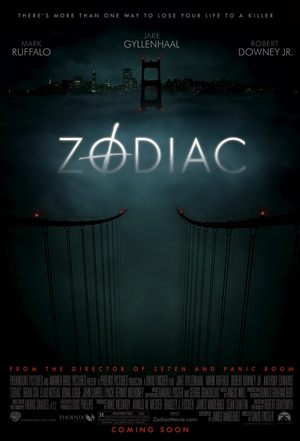
Zodiac2007PosterAfter watching this film I was certainly intrigued but I thought that it was a rather slow film in many respects. However, when you think about it this film is really intriguing. One reason is that as a procedural the film utilizes this pacing to its advantage as it covers the events of the case.
Another reason is that Zodiac is based on the true events that took place in Northern California in the late 60s and early 70s. Furthermore, the culprit was never truly found even if there are a number of suspects who seem the most probable based on circumstantial evidence and testimony.

The point is we still don’t know who the Zodiac killer is even at the end of the film and this adds to the legend, mystery, and intrigue that surrounds the whole story.

Most definitely deserving of a movie adaption, director David Fincher, Jake Gyllenhaal, Robert Downey Jr., and Mark Ruffalo, make Zodiac work as a engaging albeit plodding procedural.

4/5 Stars

Enter the Dragon (1973)

Starring Bruce Lee in his last major film before his death, Enter the Dragon has Lee going to a martial arts tournament on the isolated island of a former nemesis in order to infiltrate the proceedings and uncover what is really going on there. Along with Lee two other men are invited and we learn early on that they are chums and both very skilled in martial arts. 

Following the first set of bouts, the evening is extremely extravagant and each guest is treated like a king. While the other two revel in this grandeur, Lee tries to make contact with someone who was planted on the island. That same night Lee sneaks out to try and see what he can uncover with some luck. However, the next morning Han gives a stern warning to his visitors before the competition begins again. Later one man is accused of leaving his room and then Han tries to entice the other to join his operation. Lee again sneaks out and this time to messages for help but not before the alarm is sounded. 

What ensues is an epic display of martial arts mastery but Lee is finally quelled. The next morning things are looking bleak but Lee and his fellow competitor join forces against Han’s men and they eventually gain some help. This is the final showdown and while the all out fight continues Lee must chase down a fleeing Han. In a secret room of mirrors their conflict concludes but not without a great deal of devastation. 

This film is an unorthodox combination of a martial arts film and a Hollywood production. Bruce Lee is the undisputed star in an era where Asians were usually only supporting characters. For this reason as well as the action, this is a pretty good one to watch.

4/5 Stars

Lost In Translation (2003)

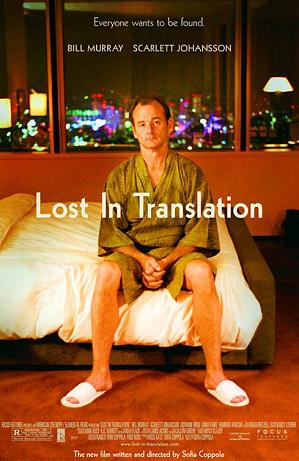
Lost_in_Translation_posterStarring Bill Murray and Scarlett Johannson with direction by Sofia Coppola, this film is set in the fast-paced, technological, and modern world of Tokyo, Japan. That is where Bob and Charlotte find themselves and they both are lost, simply going through the motions of life. He is a middle-aged, former movie star filming a whiskey commercial. She is a newly-married wife of a fashion photographer. Despite their age differences, they find out that they have a lot in common. Over the week they spend time together in Tokyo and become friends. When the time comes for Bob to leave neither one wants their time to end. They say goodbye but do not forget each other. This film was enjoyable because it portrayed two people who could be good friends without getting romantically attached, at least in the conventional sense.

I must say that this type of friendship intrigues me. It is understandable that if you go to a foreign country alone it would be nice to have someone you could at least converse with, without any barrier getting in the way. It might be at Narita airport for a moment, at a Hotel, or walking the streets of Shinjuku.  It would act as a comfort in a world like Tokyo that is so fast paced and high stress. These unusual circumstances could throw together two very different people, with little in common except the language they speak. That is something that does not happen every day.

Needless to say, after gaining the opportunity to visit Tokyo two years in a row it has given me some new insight. I can now wholly empathize with Bob and Charlotte because although I knew a few people, Tokyo is such a highly populated, fast-paced world that seems so easy to get lost and overwhelmed in. There is so much to see, so many lights, so many hurrying folks, so many subway lines, so many surgical masks, so much etiquette, and so much technology. True, some of my ancestors were Japanese but the language still baffles me, making it very easy to get “Lost in Translation.” Being in Tokyo it also helped me realize that it is not only tourists who get lost. It has been over 10 years since this film came out and a lot can happen in that time like more Starbucks and McDonalds on every corner.

Despite the westernization and technological advancement, Tokyo also has a time-worn aspect, and its people are often worn as well. They might not be lost because of a literal language barrier. However, they, like Bob and Charlotte, are often lost because they have difficulty getting close to their peers. Often they, like the two protagonists, seem to be searching for someone to talk to, but in their case manners keep others at arm’s length. Coppola’s film gained an even more personal note now that I have walked in these places and interacted with or at least walked alongside the Japanese people. They like anyone else can be “Lost in Translation,” it just might be a different type of “language” than what we struggle with. They too are humans who have their share of struggles, worries, joys, hopes, and dreams. Hopefully, this type of understanding will help us transcend any barriers so we no longer find ourselves “Lost in Translation.”

4.5/5 Stars