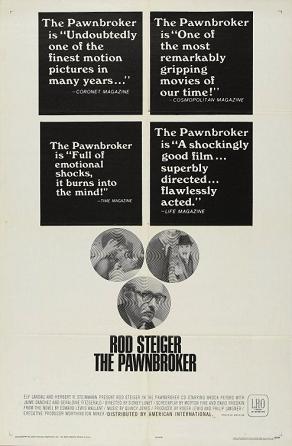
The Pawnbroker (1964)

Starring Rod Steiger with support from Jaime Sanchez and direction by Sidney Lumet, the film chronicles the present life of a Holocaust survivor turned pawnbroker. Sol Nazerman is a man who keeps to himself and he is callous to everyone who enters the doors of his shop. Under the surface, it is evident that the reason for his demeanor are his constant tormenting memories of the death camp as well as the loved ones he lost. In present day Haarlem Sol feels fear for the first time in a long while when he learns his shop is being used as a front for illegal activities. The energetic Ortiz (Sanchez) who eventually got fed up with his boss, shows his loyalty in the end. Despite his specters, Sol seemingly feels humanity after such a long time of being cut off from the world. Steiger gives a stunning performance and although sometimes it seems confused, I think this is an important film to see.

4/5 Stars

Bonnie and Clyde (1967)

b1a0c-bonnie_and_clydeStarring Warren Beatty and Faye Dunaway, with director Arthur Penn, the film chronicles the crime life of a group of notorious gangsters during the 1930s. Clyde Barrow (Beatty), a small time thief meets the beautiful young girl Bonnie Parker (Dunaway) and together they begin robbing banks. Soon they enlist the help of a dim-witted mechanic C.W., and then Clyde’s brother joins the fray bringing along his wife. They have a string of successes and they become infamous nationwide. Soon they begin to bicker among themselves and the police start to buckle down. In a shootout Buck is shot dead and Bonnie, Clyde, and C.W. just barely escape. However, their actions eventually do catch up with them and thus ends the story of these two figures depicted as anti-heroes. This film is significant because it was influenced by the French New Wave but it in turn ushered in a new era of American film . It has a unique combination of comedy, romance, violence, and of course banjo music.

5/5 Stars

Midnight in Paris (2011)

8d293-midnight_in_paris_posterDirected and written by Woody Allen and starring Owen Wilson, this film is a nostalgic piece of romantic fantasy. 

Gil is a successful screenwriter, who is attempting to finish his first novel, and he is in Paris with his wife (Rachel McAdams). She dismisses his work on a nostalgia shop because she feels it is not as worthwhile as his screenwriting career. Gil is infatuated with everything about Paris, while his wife is content with fine dining and shopping with her parents and wine tasting with stuffy friends. 

Then one evening Gil wanders the streets of Paris, and at Midnight a 1920s style car pulls up and he is invited in. Over the course of the evening, he meets the likes of F. Scott Fitzgerald, Zelda Fitzgerald, and even Ernest Hemingway, who agrees to read his manuscript. The following night he brings his wife but she leaves and he is picked up once again at midnight. This time he talks with Hemingway, meets Gertrude Stein, Pablo Picasso, and the beautiful Adriana (Mario Cotillard). Gil continues to return at night much to his wife’s annoyance and his father-in-law’s disapproval. He meets legendary surrealists such as Salvador Dali, Man Ray, and Luis Bunuel, who he inspires with his conversation. 

He finds Adriana’s diary in the present and meets a fellow aficionado (Lea Seydoux) of the olden days. Gil returns to the 1920s and Adriana convinces him to go back to the 1890s where they meet Toulouse-Lautrec, Gauguin, and Degas. This is where Adriana is happy and despite their love, Gil realizes that even though nostalgia is good it is best to live in the present. Gil gets some final feedback on his manuscript and then breaks up with Inez, realizing it was not meant to be. However, Gil finally does find someone who shares his love of Paris in the rain. 

Allen made this film really enjoyable for me because he brought to life many people such as Hemingway, Dali, Bunuel, and others. This type of history fascinates me much like Gil, and it was fun to see these figures represented in the flesh by the likes of Tom Hiddleston, Kathy Bates, and Adrien Brody. That being said, this film carries a good lesson about living your life in the present. I would have initially said that Owen Wilson seemed wrong for this film, but I think he did a wonderful portraying Gil as a man mesmerized by the golden days of Paris.

4/5 Stars


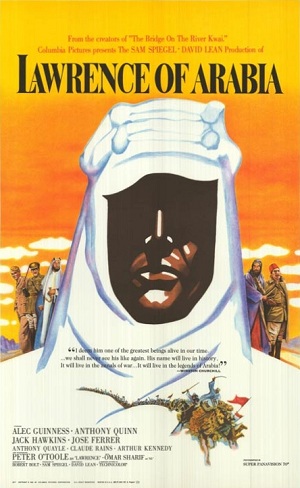
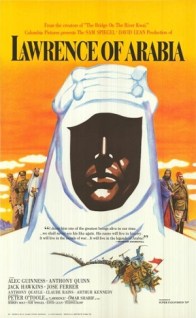
Lawrence of Arabia (1962)


A film of truly epic proportions, in length, scenery, and brilliance, Lawrence of Arabia is essential cinema. Peter O’Toole delivers a stellar performance as T.E. Lawrence, a British soldier during World War I. The movie begins with his death from a motorcycle crash, which gives an early glimpse of the character.

Then, a flashback goes to his time in Arabia where his task was to unite the Arab tribes, and lead them in rebellion against the enemy so the British might win. Against the better judgment of his commanding officer, a Mr. Dryden of the Arab Bureau suggests Lawrence be sent to assess the possibility of an Arab revolt against the Turks. Lawrence heads with his guide to pay a visit to Prince Faisal. However, his guide is shot by another man and Lawrence resolves to make the journey alone. Their paths cross again in the camp of Faisal. There Lawrence interests the Prince because his ideas are far different from his commanding officer.

Showcasing his audaciousness Lawrence suggests a bold attack on Acaba which would allow the British to bring in supplies. He leads a group of men across the brutal desert knowing that this will be less expected. Sheriff Ali (Omar Sharif) doubts it will work and disapproves that Lawrence takes two young outcasts as his servants. It is later during the journey that Lawrence truly wins over the other men, including Ali, because he is relentless, even going back for a lost straggler. With some luck, Lawrence is able to gain the help of Auda Abu Tayi, but it is not without tension. Ultimately, his forces are able to take out the Turks, and Lawrence heads back to Cairo to relay his progress. However, on the way back he must struggle with the loss of a servant and the guilt of executing a man.

Lawrence is sent back to Arabia and there he leads his forces in guerrilla operations against the Turkish railroads. His exploits are documented by an American newsman, and by this point, he has become a mythical hero among his followers. However, after going to scout a town the seemingly invincible Lawrence is ultimately flogged and tortured, leaving him a broken shell of a man. He insists on leaving Arabia but his new commander, General Allenby orders him back for one final push towards Damascus.

This final mission sees a change in Lawrence, who has hired killers and missionaries to help him in his siege. Against the better judgment of Sherif Ali, Lawrence leads a massacre of Turks as they move onward. He takes Damascus, but his fragmented counsel of Arabs are unable to unite, and the city is given back to the English. Major Lawrence is promoted once more to Colonel, and then gets shipped home because his services are no longer necessary.

This is one of those films you want to see on the big screen because the scenery and cinematography is just that impressive by itself. David Lean had a skill at making epics, and this is perhaps his masterpiece. The desert is often stark and desolate, and yet striking in the same instance. The expanse of space that is viewed in a single shot is often mind-blowing. A human being on the horizon is hardly a speck, and the ever-present camels are hardly any more substantial. To complement these grand images is an equally magnificent score by Maurice Jarre, complete with overture and all. The cast must be mentioned too with such supporting stars as Omar Sharif, Anthony Quinn, Alec Guinness, Claude Rains, Jack Hawkins, and Anthony Quayle.

Then, of course, there is the man who played Lawrence. As portrayed so wonderfully by Peter O’Toole, Lawrence is an intelligent and, at times, arrogant man, who can be odd, distant, audacious, and also unscrupulous. That being said, he was an extraordinary man who was a mover and a leader of men. A very unique, at times controversial, and long unheralded man, who contributed to the war effort in a far different way.  In many ways, he was an adopted brother to the Arabs, and their country was also his. He was “Lawrence of Arabia.”

5/5 Stars
Mr. Smith Goes to Washington (1939)

84a24-mrsmithgoestowashingtonposterAs both a political drama and feel good movie, this film cemented James Stewart as an acting powerhouse. Furthermore, despite its age, it acts as a timeless reminder of the evils of political machines. It makes us root for the underdog, and it is distinctively American. Here is a cast and a story that seemingly could never be equaled, but what this film really had going for it was an idealistic outlook. I can, myself, often be a cynical person, and still Mr. Smith never fails to make me acknowledge the numerous attributes that make our country great, whether it is through montage, monuments, music, and of course Jefferson Smith himself. 

In one of his best performances, Jimmy Stewart is an idealistic, naive boy’s troop leader named Jefferson Smith. The starry-eyed Smith trusts that our nation is founded on some very noble principles that should be fought for tirelessly in government and in society. Above all, he is a likable fellow, who earnestly believes in the merits of this country, and he is beloved by boys all across the state. Now, this all sounds fine and dandy, but it would never have come across on the screen if it had not been for Stewart. He emanates this awkward and innocent energy that puts life into the idealistic creation of Jefferson Smith. 

When the film opens, everything is in turmoil when a senator suddenly dies and a replacement is needed fast. Believing Smith will be a pawn, a powerful man named Taylor (Ed Arnold) gets Smith a seat in the nation’s Senate. There he joins the respected Senator and old family acquaintance, Joe Paine (Claude Rains), who is also a cog in Taylor’s machine. However, although he is out of place in Washington, the patriotic Smith does his best to be worthy of his position. He realizes that the press will not give him a break, and the other Senators do not take him seriously.

So, on the urging of Paine, he decides to come up with a bill for a boys camp back in his home state. He requires the help of the world-weary secretary Saunders (Jean Arthur) to get his bill done. Initially, she is disgusted by his naivete, but as she grows to know him, she realizes he is only going to get himself hurt. His action to propose a bill soon find him face to face with the political machine that elected him. Taylor also has stakes on the piece of land where the boy’s camp would be, and he wants it for a dam. 

Smith finds himself being accused of using his position for his personal gain, and pretty soon he is before a committee with false evidence piling up against him. With all odds and seemingly everyone else against him as well, Smith makes one last monumental effort. Thanks to the help and guidance of Saunders, Smith fights to plead his case through a filibuster.

Fatigued by many hours of giving impassioned speeches and reciting the Constitution, Smith finally collapses, but not before effectively succeeding at his task. I doubt this would ever happen in real life, but in the film, it is fantastic watching the Senate break out into complete and utter mayhem. Ultimately, a young man with “a little bit of plain, ordinary, everyday kindness and a little looking out for the other fella,” was able to win. True, it may be overly sentimental, but it is a wonderful piece of sentiment all the same.

Frank Capra was wonderful at these type of cheering tales and his stars were in top form. There is an absolutely wonderful supporting cast here including Claude Rains, Edward Arnold, Eugene Pallette Thomas Mitchell, Charles Lane, Harry Carey, William Demarest, Beulah Bondi, and numerous other familiar faces I don’t even know the names of. That’s the beauty of the studio system I guess. It may have the same director, same leading man, and some of the same general themes, but Mr. Smith Goes to Washington covers completely different territory from Capra’s later classic It’s a Wonderful Life. Mr. Smith should be seen as a unique, and very much American film.


5/5 Stars

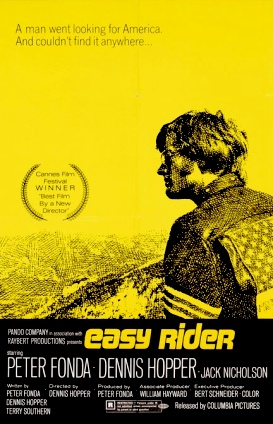
Easy Rider (1969)

d395a-easyriderStarring Peter Fonda and Dennis Hopper, this road film follows the two young men traveling across country from L.A. after a drug deal. Along the way they meet a Hippie colony, experimenting with drugs, and simply live life as they please. Much of the movie comprises of the many pit stops they take as they make their way to Mardi Gras. Some people welcome them, and still others are hostile, especially in the South. This film does a wonderful job of portraying the counter culture generation and the experiences they had. In some ways it seems that Dennis Hopper and Peter Fonda are not really acting, but partially embodying the existence that they are already used to. One of the highlights in the film would be Jack Nicholson’s odd ball, hick lawyer who crosses paths with the two hippie bikers in a Southern jail. A stellar soundtrack including such 1960s groups like the Byrds and the Band take potentially boring biking sequences and make them some of the best moments of the film. They also often express the mindset of the generation including anthems such as “Born to Be Wild” and “I Wasn’t Born to Follow.” Although it is not the greatest movie, it holds historical importance in order to help us remember this past generation.

4/5 Stars

Judgment at Nuremberg (1961)

This epic court drama relates the true story of the War Crime Trials after World War II. With Stanley Kramer directing, this cast is amazing. Spencer Tracy, Burt Lancaster, Richard Widmark, Marlene Dietrich, Montgomery Clift, Judy Garland, Werner Klemperer, and even William Shatner all play a part. However, Maximillian Schell is by far the standout because he is such an amazing defender of his country’s honor throughout the entire film. He wants the Holocaust to be known and yet all the while he goes through the case with dignity even though the pressures are so great. For every intense moment the viewer is stuck in their seat and when the verdict comes it is hard to contain the emotion. This movie should be seen by all not only because it is great but it also chronicles an important event in history. Whatever happens we should never forget the events surrounding the Judgment at Nuremberg.

4.5/5 Stars

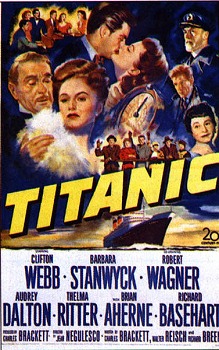
Titanic (1953)

30704-titanic_1953_filmStarring Barbara Stanwyck and Clifton Webb with a solid cast of others, the film follows different people before and during the sinking of the infamous ocean liner. Stanwyck has taken her son and daughter away from their wealthy father. He gets on board however and the relationship gets strained. Meanwhile a young man falls for their daughter trying to win her affection. The viewer also sees the captain who seems to be a good man and we come to known a priest turned drunk who is in disarray. When the ship strikes the iceberg everything changes instantly and the estranged pair show their love while others show their courage. This film is not historically accurate and some people will find it unspectacular compared to the modern blockbuster. However, it is all about the characters and they make this a very moving if not underrated film. It seems fitting that I first watched this film exactly 100 years after the fact.

3.5/5 Stars

The Last Crusade (1989)

3299e-indiana_jones_and_the_last_crusade_aStarring Harrison Ford with Sean Connery, this is the exciting final chapter of the original Indiana Jones trilogy. The film opens with the young Indy and we discover more  about him. Then, in 1938 we rejoin him as he begins his quest for the Holy Grail. He is introduced to an avid artifact collector named Donovan who then tells him his father Henry Jones Sr. has vanished. Indy winds up with his father’s diary and then heads to Venice where he meets a beautiful Austrian colleague of his father. Indy uses the clues and his knowledge to advance the search. However, all too soon he realizes his father is in trouble and the Nazis are behind it. After a twist the Joneses get away and continue to Berlin. however, their foes are already headed for the Grail. Indy is once again put in a difficult place as he is forced to evade the traps on his way to the very dangerous artifact. This film has a lot of great moments full of action and great dialogue. Ford and Connery play well off each other and we are also given a bit of an origin story for Indy.

4/5 Stars

Raider’s of the Lost Ark (1981)

This film is a nod to all the old time serials and it put us face to face with one of the greatest cinematic heroes of all time . Raiders is wonderful because it is a pure and simple adventure with wonderful characters, a great score, and intriguing scenes. This truly is one of the best action films of all time.

*May Contain Spoilers

Introducing a great hero in Indiana Jones this movie is a blast every minute. With his whip, pistol, and iconic fedora, Indy travels the world in order to track down the Ark of the Covenant. However his arch rival Belloq is also searching for it backed by the Nazis. Indy’s search kindles an old flame in Marion Ravenwood (Karen Allen) and reunites him with his friend Sallah. Jones has a knack for adventure and despite constant obstacles he is never truly beaten. However Belloq does seem to have the last laugh by testing the uncovered Ark. Its power is so great though it destroys all who look at it. So Indy and Marion escape narrowly with their lives. With its great combination of George Lucas and Steven Speilberg along with a great score, this film is a lot of fun. It is difficult not to like the adventures of this classic hero.

5/5 Stars