Ugetsu (1953)

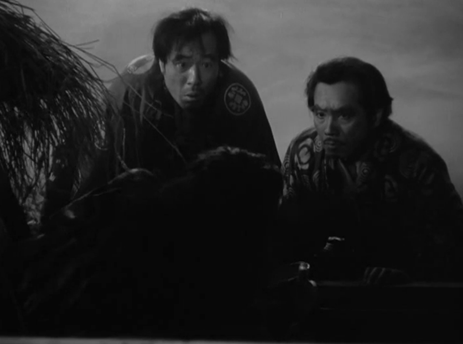
ugetsu1During my film odyssey, I first met Kurosawa, then Ozu, and finally Mizoguchi. Each with similarities and most importantly their own personal touches when it comes to the language of cinema. Kenji Mizoguchi seems especially at home with Japanese folk tales in the jidaigeki mode of Japanese period-dramas. Ugetsu finds its inspiration in such a fable from 18th-century author Ueda Akinari, and it also gathers some inspiration from scroll painting. As the narrative arc begins, it’s as if the story is slowly getting rolled out bit by bit with the camera slowly tracking with the action.

In this case, our subject is a group peasant villagers who live with their wives. Genjuro is a farmer with a penchant for pottery, who has a little boy together with his wife Miyagi. Then, there is the often buffoonish Tobei, who has fantasies of one day becoming a samurai. His wife Ohama often becomes annoyed with his obsession. When marauders come and uproot them from their homes and yet they remain together. However, with the progression of time, Genjuro has become more obsessive over his pottery as avarice overtakes him, and Tobei can no longer quell his desire for military honor. Miyagi particularly notices a change in her husband, because money has become his everything and he has put his heart and soul into that kiln of his. True, it seems to pay heavy dividends when he takes his wares to the marketplace and gets a pretty penny, while also meeting the ravishingly beautiful Lady Wakasa.
ugetsu3For our male protagonists, their wildest dreams begin to play out. Genjuro has begun a euphoric fling with his new mistress with little concern for his wife and child he left behind. Simultaneously Tobei in a stroke of good-fortune captures the severed head of a high ranking general. Although he’s a nobody, he gets in with the right crowd and his greatest wish is granted. He becomes a big shot samurai complete with weapons, armor, tassels, and an imposing entourage.

Meanwhile, unspeakable things are happening to the women in their lives, but the men seem to be lost in their dreams. When they finally are given a heavy dose of reality, it can be painful, even violently chaotic at times. And yet the reality check proves necessary because in a way it allows these men to shake off the ethereal and live in the present — allowing them to be more fully realized versions of themselves.
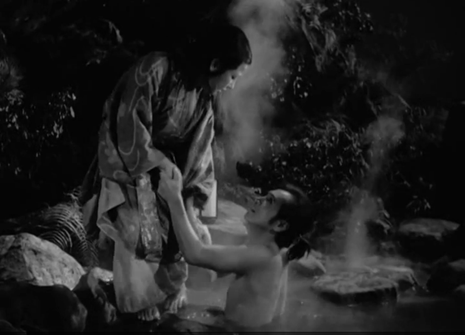
ugetsu2Mizoguchi rather like Fellini has a great interest in the supernatural or at least dream worlds. It’s far from nightmarish horror at least in the modern sense, but it is an everyday type of horror, where husbands act out on their darkest desires, family members die, and so on. Some would say this is far worst because it hits closer to home. The world of dreamscapes and ghosts overlap with reality.

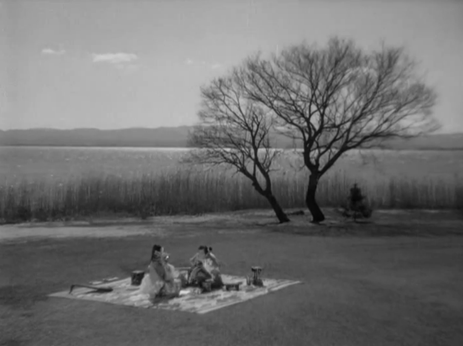
The director is also constantly utilizing long takes, but they’re far from stagnant, very often panning to the left to accentuate the feel of a scroll being unfurled. Especially in the marketplace you get the sense that you could easily be lost in a sea of people, but Mizoguchi only goes to close-ups at the most opportune moments. Otherwise, he is best suited in pseudo outdoors settings — integrating architecture and nature in perfect cohesion. These facades are put up for people to interact with whether it’s a hut or an outdoor pool, but it never loses its naturalistic beauty.

It feels quintessentially different than his contemporaries, allowing for a thoroughly unique view of the human condition. Certain types of ghosts haunt all of us whether they are choices that we wish we could take back or the hand we are dealt when our lives began. Thus, Ugetsu is remarkably poignant even in its antiquity.

5/5 Stars

Shall We Dance? (1996)

shallwedance1Shall We Dance is a film with important ties to American culture such as the King and I and The Drifters, but it has far more important roots in its native Japan. Thus, its remake starring Richard Gere and Jennifer Lopez undoubtedly loses some of the cultural significance of the original film.

Because Japan is a nation of etiquette, good manners, and the like. They act as a whole society, not as individuals. They care about honor, modesty, and how others will perceive them. They work hard for long hours. Men bring home the bacon and wives faithfully serve their husbands and families. Ballroom dancing in a culture like that is about as compatible as oil and water. Men and women are not to show affection — sensing it instead — and holding hands or saying “I love you” is out of the question. Thus, a mode of expression where men and women are meant to be so close and intimate has a stigma attached to it.

When a seemingly successful businessman, Mr Sugiyama (Koji Yakusho) spies a girl in the window of a dance studio, he has no intention of learning the art form. All he wants is to get close to this mysterious beauty. Of course, he has a wife, a daughter, and a good job, but he feels trapped in his life. He has nothing to give him joy, nothing to make him feel alive, just the monotonous rhythms of office life.

shallwedance2In fact, his first jaunts in the dance studio are rather comical, because his ineptness is magnified by his two classmates, one rather rotund and the other short and squat. It’s as if he’s learning to dance with Laurel and Hardy by his side. In fact, a great many characters have tremendous personality on the whole. Ms. Tamura is Shohei’s sagely teacher, who constantly builds him up with encouragement. Mr. Aoki is one of the work colleagues, who also moonlights an extravagant aficionado of the rumba. They are only a few in a vast company of supporting players.

But of course, this is a sort of faux-love story. Think Ginger Rogers and Fred Astaire and you get the idea. Except in the Japanese society, the only place you dare talk about dance is in the men’s room with no one around. Stripping away everything else this film is about finding self-expression, especially in a society that has a complex relationship with such an idea. Mr. Sugiyama eventually revels in his chance to dance, practicing steps on the platform waiting for the subway, improving his posture in the rain, or even conspicuously tapping his feet on the ride home.

Mai the beautiful object of his desire is aloof, with glassy eyes, and often feels like the antithesis of Japanese women in many ways. She is strong, straightforward, and physically imposing in a graceful way. As an audience we know essentially the road this film will traverse. Mr. Sugiyama must go through a transformation just as Mai must because they are not the same two people we first met looking out from their prospective windows.

shallwedance3What became most interesting to me was this idea of the affair. Mr. Sugiyama’s wife feels like she has been cheated on and her husband agrees with her openly. However, as an American audience, we look at this plotline and see no sex or anything like that. In essence, it depends on how you define an “affair.” For instance, if we look through the lens of an Astaire & Rogers film, their musical comedies were romances, but they could never show characters sleeping together due to the production codes. So the evolution of a relationship had to be illustrated through dance – the courtship, the conflict, and ultimately the passion. Perhaps Shall We Dance is a little different, but if we look at dance in this symbolic way, this was a film about an affair.

More importantly, however, it is a film about reconciliation, self-expression, and really breaking out of the status quo. Those are themes that ring true, although they might be easier to swallow in an American society.

4/5 Stars

Late Spring (1949)

latespring1Late Spring is a film that I found in some ways more rewarding than Tokyo Story, another acclaimed classic from Yasujiro Ozu. Both films share a few of his trademarks. They are home dramas with basic, everyday plots, termed Shomin-geki. Also exhibited are a stationary camera and low camera angles that Ozu often used to focus on his characters while sitting. In this way, he invented the quintessentially Japanese viewpoint known as the “tatami shot.” We see it most certainly in Late Spring as the daughter Noriko interacts with her widowed father or when they have friends over in their home. It may look somewhat similar to Tokyo Story, but it does differ in subject matter.

Late Spring is a film about fathers and daughters. Marriage and divorce. All the things that make up a life that remain the same whether you’re in modern America or post-war Japan. Noriko is a pretty young woman who is devoted to her aging father through thick and thin. He likes having her around and she likes being there for him.

It’s the culture, namely aunts and friends, who tell Norkio that she must get married. She’s 27 years old, and she needs to find a husband before it’s too late. Her father won’t be around forever. She’ll need to make a new life for herself. But Noriko is content with not listening to the voices trying to sway her. Only when her father talks to her about marriage does she finally begin to listen. He makes conversation about getting remarried and encourages her to think about an arranged marriage that her aunt has waiting for her.

We never meet this man who supposedly looks like Gary Cooper, but Noriko seems to genuinely like him. And yet there still is something that isn’t quite right. In Japan there is great importance in “reading the air,” and it seems like some of the characters in Ozu’s film fail at this or they see only what they want to see.

latespring3In the end, Noriko gets married and it should be no surprise because it was what was ultimately expected of her. Her father, on the other hand, acknowledges to a friend that he had no intention of getting remarried, it was only to prompt Noriko. Professor Somiya took on a great sacrifice in the eyes of society and goes home alone.

This is a bittersweet tale that is surprisingly funny on many occasions, but it is also topped off with human tragedy. Not death or dying, but something potentially worse in loneliness and discontentment. It is only a thought, but it seems like Noriko and her father would have both been happy with the status quo. However, their sensibilities and society said otherwise, so they acted as they were expected to. From this simple drama comes one of the most powerful films on father-daughter relationships ever.

I must admit, at first, I really was not fond of Chishu Ryu’s character, but over the course of the story, he grew on me. As for Setsuko Hara, she is an amazing example of kindness and servility, but also the undisputed muse of Yasujiro Ozu.  Late Spring also plays off the conflict between the old and new not to mention the traditional Japan and western culture. It’s not a blatant presence, but the allusion to Coca-Cola and Gary Cooper reminds us that this is a post-war Japan still recuperating from an awful war. That’s the backdrop of this film and its part of what makes Ozu’s human drama all the more striking. Despite, where it is situated in the historical context, Late Spring is a timeless film giving calculated insight into human relationships.

4.5/5 Stars

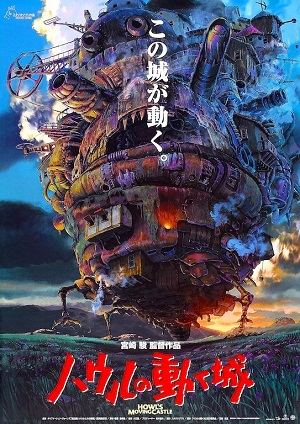
Howl’s Moving Castle (2004)

Howls-moving-castleposterCertainly this newer addition to the work of Ghibli Studios and Miyazaki is not his best due to a lack of cohesion within the story-line and the rapid coming and going of characters.

However, with that aside, as always the animated landscapes and backdrops are as beautifully breathtaking as ever. It is yet another whimsical world that came partially from Miyazaki and also from its British source novel.

It is occupied by some wonderfully fascinating characters including the eponymous Howl, Calcifier, Sophie, and cute little Markl. I ended up watching the dubbed version with the voices of Christian Bale, Josh Hutcherson, and the always comical Billy Crystal. I think I was perhaps most appreciative to hear the voice work of Lauren Bacall and Jean Simmons. Their work in this film exemplified that their illustrious careers spanned well into their 80s. That is quite the feat.

I have to say that the dog and Turnip Head had to be two of my favorite characters. I’m not quite sure why… Still I would recommend this film and it is certainly a must for Anime or Miyazaki fanatics.

4/5 Stars

My Neighbor Totoro (1988)

7eaa5-my_neighbor_totoro_-_tonari_no_totoro_movie_posterFrom the famed Japanese animator Hayao Miyazaki, this enchanting film is about two little girls and their very unusual neighbor Totoro.

The film opens with Satsuki and her little sister Mei arriving at a new home out in the country with their father. They are two energetic and rambunctious girls, who are excited by this new adventure. Their father is a kindly man, who spends a great deal of time with them when he is not working. Several other characters play a part including the elderly lady Nanny, the young boy Kanta, and of course the girls’ mother who is in the hospital. First, the girls chase dust creatures through their supposedly “haunted house.” Then, one day Mei follows a strange furry little creature under their house and then into the depths of the woods nearby.  She takes a tumble and all of a sudden she finds herself in the dwelling of a big fluffy Totoro spirit and falls asleep on its belly. When she tries to show Totoro to Satsuki and her father she cannot find him.

However, one evening as they wait for their father’s bus, Totoro comes to the stop, and this time Satsuki is introduced to the spirit who leaves them with a gift. After they spend another magical night with Totoro a few days later, the girls learn to their dismay that their mother is not coming home as planned. An annoyed Mei decides to take some corn to the hospital many miles away. Her disappearance causes a panic in the town, especially with Satsuki. She searches tirelessly for her little sister until her feet are sore. Her only other option is to plead with her neighbor Totoro to help her. Thanks to Totoro Mei and Satsuki are reunited and they see to their delight that their mother is in high spirits at the hospital.

This is certainly a film for children, but it would be unfortunate to call this a childish film. I must take a brief moment to praise the animation led by Miyazaki too. Every single image could almost be a painting they are so beautiful.  In my limited knowledge of anime, it is far above anything I have seen before. It was great to see this film in the original Japanese because it seemed more authentic, but what really struck me was the realistic nature of these young girls. Perhaps they speak a foreign language (to me) but their moods are universal. They can be extremely loud, they pout, share moments of laughter, and they love their parents.

Furthermore, this story does not need some major conflict to drive the plot. Their father is a loving open-minded man who does not even briefly doubt their adventures. I was even thinking that the obvious turn of events was that their mother would die and yet that is not the case. What this film really has is a wonderful innocence which can be appreciated by all ages. Instead of creating some major pathos we are simply able to enjoy this magical friendship between this remarkably cute fluffy spirit Totoro and these two girls. I certainly cannot wait for more from Studio Ghibli and I’m sorry that such an artist is retiring soon.

 
4.5/5 Stars

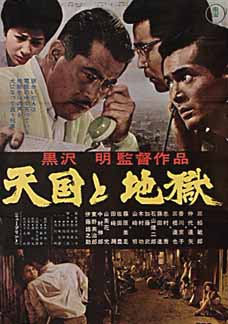
High and Low (1963)

Directed by Akira Kurosawa and starring Toshiro Mifune, the film opens with a wealthy shoe company executive as he tries to struggle for control of the company. He makes a big gamble, waging everything he has to try and succeed. However, things take a bad turn when he believes his son has been kidnapped and the culprit wants an enormous payoff. It turns out that the son of Mr. Gondo’s chauffeur was taken but that makes no difference to the kidnapper. Mr. Gondo finally resolves to make the payoff and then the police who have been advising him take it from there. They work diligently to gather all the evidence they can and the net slowly begins to close  The police finally find the culprit, catch him in the act, and recover most of the money. However, in a meeting with Mr. Gondo the man who is about to die wants no pity at all. Despite the relatively long length of this film, it held my interest. All I had seen of Kurosawa before this were samurai films and so this gave me a different look at his work.

4.5/5 Stars

Seven Samurai (1954)

fde86-seven_samurai_movie_posterDirected by Akira Kurosawa, this is often considered one of the greatest films of all time. The story begins in a small Japanese village that is constantly being tormented by marauders. The bandits are about to strike again but decide to return after the harvest. The village elder advises the people to find some samurai in the time they have. Although they have no money, several men go to a town to look for help. There they witness the skill of an experienced samurai. He agrees to help them and also gathers five other skilled men who have no allegiance. They are followed by a seventh, wild samurai. The rest of the film follows the difficult relations between the anxious villagers and their protectors. The samurai fortify the village and also train the farmers for combat. Three samurai make a raid on the enemy and then later the bandits attack. They are hindered by the fortifications but still wreak havoc. The following day the climatic battle takes place. After the showdown, the village is safe but only 3 of the 7 are still alive.

4.5/5 Stars

Tokyo Story (1953)

42390-tokyo_story_posterThis critically acclaimed Japanese film directed by Yasujiro Ozu has a relatively simple plot having to do with a kind elderly couple going to Tokyo to visit their adult children and extended family. They are excited to see the big city but it is not quite like they had expected. Furthermore, all their relatives and family have very busy lives making it difficult for them to spend time with the couple. The eldest son who is a doctor and then a daughter who owns a salon decide to send their parents off to a spa. Unhappy, the elderly couple return to Tokyo but they feel like they are imposing. Finally, the two of them head home and there the wife becomes ill. Because she is dying, her children do decide to visit. However, after she has passed away it seems they all too soon forget her and go on with life. This film is an interesting study of the void between generations. It also uses realism and focuses on the manners of the Japanese without fully criticizing them.

4.5/5 Stars

Ikiru (1953)

4b946-426px-ikiru_posterDirected by Akira Kurosawa and starring Takashi Shimura, this drama is loaded full of irony. As the film opens, right away we learn the protagonist has stomach cancer, except he has yet to find out. He has spent 30 years of his life working at a monotonous job as a bureaucrat. Only after he discovers that he barely has 6 months left does Watanabe-san actually begin to live his life again. He tries the night life of Japan and it does not satisfy. Then he starts spending time with a lively, young worker that he used to know. All the while he thinks about telling his son about his condition but he cannot bring himself to do it. However, Watanabe-san finally finds a way to leave his mark on this life. And yet 5 months later he is dead and his fellow bureaucrats seemingly dismiss his accomplishment  Through a series of flashbacks they ultimately realize what he really did. I found this film to be powerful because this idea is so powerful. It makes me question if I am really living my life to the fullest extent.

5/5 Stars

Rashomon (1950)

Directed by the famed Akira Kurosawa, the film starts off with two men eventually joined by a third. Both seem very melancholy and they explain this is because of something that happened three days earlier. Apparently a bandit met a husband and wife on the road and raped the wife with the husband being killed. However, this event is shown in four different accounts all varying greatly and we never learn what is fact and what is actually fiction. Because of this horrible event, one of the men who is a priest loses faith in mankind. The film ends just as it began with the two men alone under a pagoda watching the driving rain. However, an act of kindness quickly renews the priest’s belief. Kurasawa’s film certainly has an interesting plot device and camera work. Historically, it is also important because it introduced the world to Japanese cinema

5/5 Stars