The Love Parade (1929): Ernst Lubitsch’s First Talkie

the love parade 1.png

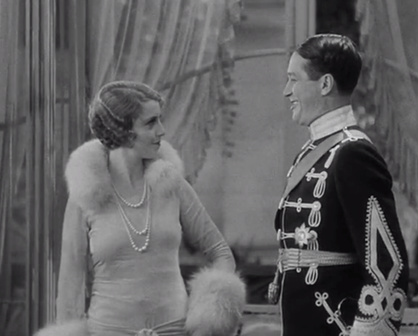
Looking over it now, The Love Parade just might be one of the finest pre-1930s musicals, capitalizing on the rising trend thanks to the success of The Jazz Singer and Broadway Melody. Whereas many of its contemporaries are mainly interesting as historical relics, this Lubitsch comedy still has some inspiration to offer, riding on its own merits alone.

The acclaimed German director’s first sound project shows no signs of a needed learning curve all but translating his command of the medium into the sound era with ease. Yes, the set-ups appear choppy due to the editing of sequences.  True, the action is often static because the camera was yet to be truly mobile. But this is also part of Lubitsch’s deceptive skill in incisively drawing our eye to whatever will give us the clearest visual cue to the jokes that he’s staging.

It’s rarely a cluttered experience though Chevalier adds to it by breaking the fourth wall, even intermittently speaking in French and English. In fact, a separate cut of the picture was made in the French-language. Also, much of the sound design was synced afterward. Both are realities of the changing times and what talkies meant for the evolution of a global industry.

But what is most striking of all is, again, Lubitsch’s impeccable handle of the visually comic because that’s something that translates from the silent days exquisitely and far from using dialogue as a mere crutch or idle chatter, in its very best applications, it’s used to punctuate the scenes with a gag.

The same goes for noises and sounds. Far from oversaturating our ears, Lubitsch almost uses them strategically giving each more import whether a whistle, a song, or erupting cannon fire. There’s a cadence in the use of noise to underscore scenes, and it feels succinct and genuinely artful.

It’s true that it’s difficult to go backward, but sometimes you wonder if filmmakers should.  Allow me to explain. The likes of Lubitsch and Hitchcock had substantial success in the modern era of filmmaking and yet they never lost their early sensibilities. It goes allow with this innate principle suggesting moviemaking was a visual medium above all else. Of course, for Hitch that meant he was the master of staging thrillers. Lubitsch will always be remembered as the king of sophisticated comedies of manners. The Love Parade is little different.

Sylvania is a country with marriage on the mind. It seems like everyone from subjects to royal courtesans are constantly obsessing over who is to be married and when. Most important of all is their Queen Louise (Jeanette MacDonald) who has yet to tie the knot. It’s very much an unfortunate circumstance for the honor of the kingdom.

However, their savior just might come in the form of Count Alfred Renard who resides as the military attache in the Sylvanian embassy in France. But he also happens to be quite the lady’s man. It is true that the somehow deeply-rooted stereotype of Frenchmen as witty, suave romantics must at least, cinematically, start with Maurice Chevalier, before making its way through Charles Boyer and later generations.

He and the Queen gladly trade repartee in the winking song “Anything to Please the Queen” and the comic conundrum proceeds from there. He is sent before her to be reprimanded for his indiscretions, and she finds she rather likes him.

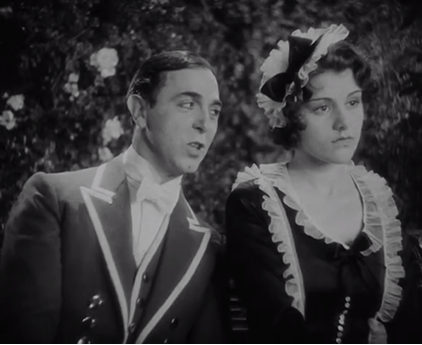
Their first dinner together carries the rapt attention of many invested onlookers from all walks of life and any number of perches, from ladies in waiting to cabinet members, and then lowly servants played uproariously by Lupino Lane and the ill-fated Lillian Roth.
the love parade 2.png

However, an onslaught of bad luck comes in full force on the wedding day including whistling, mirrors, and the piece de resistance: a cross-eyed man. Chevalier shudders at the thought until his worst nightmares come true in the form of a palace guard (Ben Turpin). The vows are spoken with a twist as the minister confirms, “I pronounce you wife and man.”

It’s summed up succinctly by one of the portly advisers (Eugene Pallette) as such, “Man is man and woman is woman. No man can be a wife.”

Perhaps it seems a silly bit of conflict and yet even now, it feels cutting-edge for the day because men still feel emasculated for such a thing. We are still so used to being the breadwinners and in positions of power almost a century later. Yes, it’s played for a certain comic effect, but the fact is MacDonald has the position of true influence as ruler of the kingdom, while Chevalier is brought up to her station in life by the title bestowed upon him when he becomes her husband.

Jacques and Lulu revel in the fact that they can get married without the complications of class in “Let’s Be Common,” backed by some stellar physical acrobatics verging on vaudeville-style slapstick. And still, marital discord exerts itself behind the palace doors. Renard is unhappy with his pointless life. Meanwhile, downstairs the male and female servants quarrel over whether or not “The Queen is Always Right.”

Is it a spoiler to admit that some concession is arrived at in the end, for the sake of love? I don’t think so, and Chevalier and MacDonald shine in the first of several pairings together. What we are left with is that unprecedented blending of sauciness and sophistication afforded to Lubitsch, particularly at this time in history, without the harsh enforcement of production codes for a few more years. What is more, the films arguably only became richer over time from The Smiling Lieutenant (1931) to Rouben Marmoulian’s Love Me Tonight (1932) and finally The Merry Widow (1934).

3.5/5 Stars
Maytime (1937): Starring Jeanette MacDonald and Nelson Eddy

maytime 1.png

The arrival of a local May Fair celebration brings back a flurry of bittersweet memories for elderly Miss Morrison (a made-up Jeanette MacDonald). She fondly recalls some past romantic dreams that we have yet to discover, which color how she sees the young lovers before her, caught in a quarrel.

There is the young woman who has aspirations for a career in the big city and the faithful boyfriend she looks to leave behind. The spat between them looks to be the end of it, but in her tranquil way, Miss Morrison finally opens up about her earlier years, setting up the flashback composing much of the picture.

Once she was living the dream as a pupil to a well-respected member of the French cultural elite Nicolai Nazaroff (John Barrymore) who was, in one sense, an exacting individual but also a highly knowledgeable mentor for her. His shrewdness quickly trains her up in the ways of the art world and soon enough an opera is being written specifically for her. Marcia is on her way to stirring success.

In truth, she’s heavily indebted to her voice teacher, grateful for everything he has done for her, and so when he proposes marriage, she excepts not out of romantic love but due to a certain amount of gratitude and platonic affection.

In another life, it’s easy to imagine that Maytime might have been a precursor to Gone with The Wind (1939). Actually, the production was meant to be shot in color initially though this was later overhauled in deference to black and white.

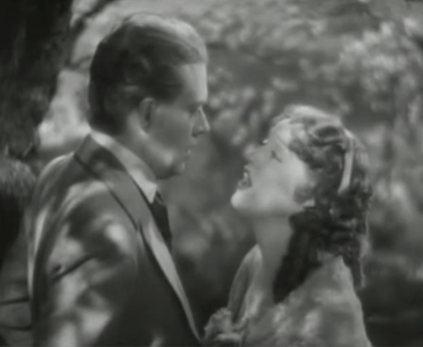
Still, the costuming and lavish sets carried over, and we do still have the contemporary star power of Jeanette MacDonald and Nelson Eddy, who did so much for the modern popularity of opera, channeling it through the medium of film. To put it another way,  what Astaire and Rogers did for dance, these two did for operettas.

Previously, I never gave much respect to MacDonald, but somehow the winsomely attractive appeal she exudes is more evident now, even as she wows with her vocal talents. However, part of this newfound geniality is also due to Eddy who makes a stirring impression from the get-go in a rousing role that bowls you over not only in song but with the outright fervor he takes to every moment on screen. It’s infectiously disarming.

I indubitably do our stars a major disservice because I’m no musical protege or deep opera aficionado. Regardless, they certainly have a pair of pipes. My word! Together there is something deeply affecting coursing through them (purportedly both onscreen and off). But now’s the time to mention Paul Allison (Eddy) who doesn’t show up until well into the picture.

The first time she sets eyes on him, following a restless jaunt to clear her mind, his passionate charisma sweeps her up along with everyone else in the local tavern she finds herself frequenting. Of course, she has her career ahead of her with rehearsals and the like, and he’s only a lowly singer, but he also happens to be a very persistent gentleman.

He inquires about her coming to lunch with him — a connection made between two Americans in a foreign land — and she reluctantly agrees, partially to assuage him. But that’s not the end of it. He finagles any way he can to possibly be close to her, and it earns him another outing.

Together they share in a May Day carnival conjuring up images of not only the Naughty Nineties but the Rococo confections of Fragonard. There’s certainly something lovely in the air, full of gaiety and amusement, underscoring the time spent between the two singers. They top off a glorious day with a lovely rendition of that beloved standard “Santa Lucia.”

It becomes increasingly obvious that Barrymore has a bit of a thankless part. He’s part tyrant, part taskmaster, and yet strangely affectionate and thoughtful at times. It’s at the crossroads of such a life as his where you find such individuals who prove complex characters indeed.

He is the lover scorned by the most benevolent woman who ever lived so it seems and still somehow, we cannot bring it within ourselves to hate him. Because he hardly did anything wrong and yet he is getting the short end of the stick. His reactions are understandable if not completely prudent.

It’s a heartbreaking albeit touching sentiment that the film obliges with as we return back to the present. It almost makes you forget the somehow implicit moral of the story: It seems to be saying that, for a woman, the love of a man surpasses any aspirations of career advancement. There’s a dichotomy.

One is good and the other inevitably leads to tragedy. But why get caught up in that? Maytime has some lovely moments of genuine repute. MacDonald and Eddy were a big deal during the 1930s for reasons made obvious herein. Song and romance were rarely this passionately elegant, and they make it continually rapturous, even as it ultimately turns tragic. One could wager that it, in some ways, mirrored life.

3.5/5 Stars

Shall We Dance (1937): Fred, Ginger, and The Gershwins

shall we dance 1937.png

The name Gershwin is synonymous with “The American Songbook” and part of the draw of Shall We Dance is how it included two of them: both the brothers, George and Ira Gershwin. Ira would tragically pass away that same year. However, together they provided the compositions and lyrics for the film which, in some sense, feels like an atypical Astaire and Rogers vehicle.

While Mark Sandrich is in the director’s chair once more following The Gay Divorcee (1934), Top Hat (1935), and Follow The Fleet (1936), there are some unprecedented deviations from the normal foolproof formula. Namely, Astaire plays Peter P. Peters, an American who trades in his taps for a Russian ballet company. He’s certainly will always be a hoofer in most people’s eyes, and it does feel oddly out of character.

What hasn’t changed is his instant infatuation with Rogers, a famous tap dancer in her own right, named Linda Keane. But he must contrive some sort of gimmick and thusly takes up the persona of the touchy Russian dancer “Petrov” to antagonize her on the road toward love. Meanwhile, he tries his very best to evade the flirtations of his former dance partner Denise (Ketti Gallian) who looks to snatch him up.

Of the earliest offerings, Astaire gives us the treat of his cane dancing like he did in Top Hat and then there’s a fine boiler room number, “Slap that Bass” supported by a host of African-American performers thrumming with a healthy dose of character.

The film’s most catastrophic mix-up comes when the newspapers begin promoting a secret marriage between our two stars, thanks to a cockamamie story Peters cooked up on the spot to keep his former suitor at bay as he leaves on an ocean liner.

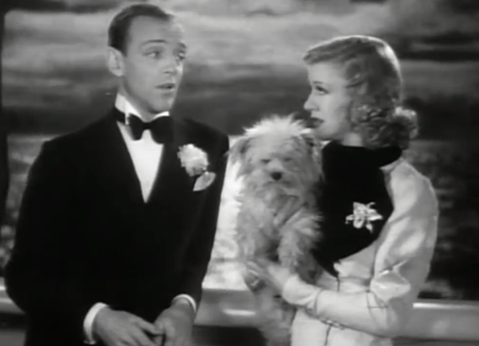
Petrov and Keane develop some chemistry dog walking together on the deck of the ship only for the gossip swirling about to reach a fever pitch. Astaire’s bumbling boss, Mr. Beard (Edward Everett Horton) uses it as the perfect chance to get rid of her for good. Meanwhile, Eric Blore as his ever-huffy hotel clerk tries his best to figure out the marital status of Petrov and Ms. Keane when preparing their rooms. They leave him ceaselessly befuddled.

Then, a second nefarious scandal is cooked up by Keane’s road manager (Jerome Cowan feeling out of place with the screwball elements), who does his best to kill the upcoming marriage his star has embarked on.  Thanks to some late-night photography and a mannequin bearing a striking resemblance to Linda, the news spreads like wildfire. What are his motives, you ask? He’s got his own reasons.

shall we dance 2

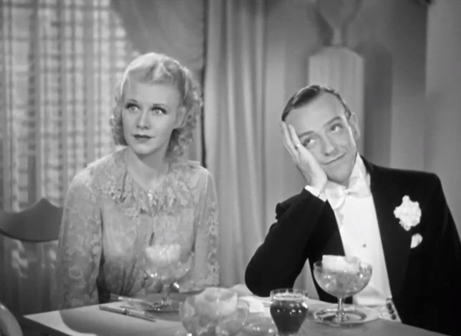
Not surprisingly, the closest thing we get to the Astaire and Rogers numbers of old are also the film’s finest entries, including the comic tune “They Laughed at Me” sung by Rogers before being joined in a routine by Astaire. After they sneak out to get away from the publicity hounds, “Let’s Call The Whole Thing Off” proves a handy follow-up number.

The extended sequence purportedly took a plethora of takes, upwards of 100, while the final fall into the grass left Fred and Ginger with black and blue backsides. They suffered and yet as the audience, we no doubt reap the benefits, especially because Shall We Dance hardly has their traditional big numbers like a Top Hat (1935) or Swing Time (1936) so seeing them on skates together is nearly consolation enough.

They show everyone by getting married, making it easy enough to get divorced so Linda can marry the man she’s meant to. Since their movies always took a page out of screwball comedies anyway, it makes sense this picture is another riff on the comedy of remarriage, which could be a sub-genre all its own.

Ultimately, two shows are merged in an instance of inspiration and yet that doesn’t mean that Petrov’s got the girl. An oddly disconcerting final number follows as Astaire dances with a host of gals all donning Ginger Roger’s face, disrupted by a shushing war instigated by our favorite misfits Blore and Horton. Though the picture could have used a feisty female like a Helen Broderick or Alice Brady, there’s also never enough of Blore and Horton to suit their faithful fans. They make every film a little more colorful, and it would hardly be an Astaire-Rogers picture without a stellar supporting cast of veteran jokesmiths.

Surveying Shall We Dance, it’s certainly not at the top of the pantheon of the movie musicals that these two icons made together, but it’s ripe with some of the usual delights in spite of a laborious plot and a different brand of dancing than we’re used to. It’s hard to complain too much about the results. There’s no doubt the entertainment value for true aficionados still remains.

3.5/5 Stars

The Gay Divorcee (1934): The Astaire & Rogers Foolproof Formula

the gay divorcee.png

The plots to the Astaire and Rogers musicals are usually deceptively simple. Thus, thanks be to their dancing transcending it all. The affair opens in some posh corner of Europe where the always dithering Edward Everett Horton is sitting with Fred Astaire who has to prove his identity to get out of paying a check. They’ve both conveniently misplaced their wallets. After a routine complete with pretty girls and dancing fingers, he gives an impromptu performance of his own bringing down the house and proving he really is world-renowned performer Guy Holden.

Later on, at the docks, a fellow American, arriving in England (Ginger Rogers), is meeting her lovably fatuous aunt (Alice Brady) only to have her dress accidentally caught in a travel trunk. The man who comes to her aid and subsequently rips her garment is, of course, Astaire. Being a gentleman and genuinely taken with her, he gives her his coat to cover up, but the damage has already been done. She finds him a bit bothersome. You can tell it instantly by every look of disdain she throws him. Meanwhile, he eats up any pretense to talk with her, though she dismisses his advances. It’s how the story always goes.

He turns his resolve to find the girl, matched with the everyday occurrence of getting dressed to go out on the town, into the number “Needle in a Haystack,” which has Astaire exuding his typical elan on taps. Of the millions of women around, he’s looking for one very particular needle, and he’s not above canvassing the streets, even if it’s an insurmountable task, made increasingly apparent through montage. It goes to all this trouble only to very coincidentally rear-end her as he’s rubbernecking (adding yet another reason for her not to like him much).

Meanwhile, Egbert (Horton) is looking to make his father proud of him in the family law firm, though he’s never seemed to have much gumption or stomach for the trade. His worst nightmare, Hortense (the same Alice Brady) comes back into his life also bringing with her the proposition of a case that just might be his opportunity to assert himself. Mimi, the same woman constantly harried by Holden, is looking to get out of a loveless marriage and so the inept lawyer suggests setting up a rendezvous with a professional gigolo to end the union for good.

He invites Guy along for the ride knowing the sunshine, gaiety, and girls might do him good as a distraction for his lovesickness. He needs to forget this girl he’s so taken with. However, they’ve failed to compare notes. It doesn’t take extra-sensory perception to read where the picture will go from here, in fact, there’s hardly a need to continue. The human mind might do a finer job in its vivid imagination to derive what complications will arise from such a premise.

It’s a pleasant surprise to see Edward Horton doing a little saucy jig, “K-nock K-nees,” which also proves an early showcase for 40s wartime superstar Betty Grable if you’re able to recognize her. Likewise, in the subsequent scenes, Eric Blore is delightful as ever, this time as a waiter with his typical crisp & snooty delivery, ably sparring with the comic foibles of Horton.

Fortuitously, he turns up in several more instances to serve up the tea things along with idle chatter to anyone who will lend an ear. Astaire and Rogers’s first number together is the Cole Porter standard “Night and Day,” only to birth further misunderstands thanks to one ironic code phrase, “Chance is the fool’s name for fate.” Don’t ask for an explanation.

“The Continental” is an impressively glossy number that until Gene Kelly conjured up his American in Paris (1951) dream sequence, clocked in as the industry’s longest continuous dance number. Some of it involves our leads, but not the whole thing. It feels much more like a Busby Berkeley extravaganza.

And yet right there you understand the exquisite nature of Astaire and Rogers because they made dancing into something intimate and personal. It was between two people as much as it was a lavish production number, and that’s what resonates with us even after the curtain falls and we’ve been wowed by the expansive nature of the staging.

Yes, the geologist husband finally makes his token appearance as expected and the hired romancer Tonetti (Erik Rhodes) continues to bumble along in an effort to play his raffish role. Of course, Astaire proves far more convincing in the part of the lover finally getting the girl as expected.

Does any of this matter? Hardly. But it’s one final opportunity to get Astaire, Rogers, Blore, Horton, and everyone else in a room together. That’s surely enough to recommend this frolicking trifle of gaiety starring everyone’s favorite couple on taps. There’s nothing better to lift your spirits than Astaire and Rogers.

4/5 Stars

The Story of Adele H. (1975): Starring Isabelle Adjani

L'histoire_d'Adèle_H.I didn’t think about it until the movie began, but the only person I’ve ever known to only go by the initial of their last name was for the sake of keeping their anonymity. If you’re a nobody, it doesn’t matter who knows your name.
In this case, if you’re the great Victor Hugo’s daughter, they stand up and take notice. Especially if you run off to Halifax Nova Scotia to pursue a British soldier named Albert Pinson of some dubious repute. Hence Adele H.

This is her story based on the diaries she left behind. It’s during the American Civil War. It’s still left to be seen if the Confederacy will be able to succeed. Adele’s father is currently exiled from his homeland, and she is intent on receiving the invitation of marriage from the man she once rebuffed.

When she lands in the new environment, there’s a timidity furled about her to go with her obvious affluence. She picks up a coach and converses in impeccable English with the driver looking for adequate lodging for someone like herself.

The place settled upon is a boarding house run by a Mrs. Saunders, and there she finds a welcoming albeit humble abode, the perfect home base to begin her inquiries. It seems a noble mission in the service of love.

I’ve come to like Francois Truffaut’s brand of economical period piece. Because usually we come to equate them with ballooning budgets and grand narratives, but Truffaut seems more interested in the character studies. If The Wild Child and now The Story of Adele H. are any indication, it’s the personal relationships he’s invested in and this allows the director to step into the cultural moment and still somehow make them highly resonate with us in an altogether different era.

Isabelle Adjani is the portrait of youthful innocence and she is so young, so beautiful, and full of emotional fervor. It’s hard not to be carried away by the passion of her performance.

Her first meeting with her beloved Lt. Pinson (Bruce Robinson looking like a British incarnation of Alain Delon) blooms with this candor even as it becomes obvious he’s moved on — he no longer has feelings for her, if he ever did — and what’s even more heartbreaking is how madly she still desires to be with him.

Even as the film cuts back and forth between French and English, one is reminded how French really is a romance or romantic language. English sounds so blunt and harsh, at times, in comparison. Maybe as a native French-speaker Truffaut’s not attuned to his actor’s tones in English. Maybe he’s playing off these very elements. No matter, the French is quiet, melodious, and even rapturous in the most passionate declarations.

I don’t understand the literal translation (without subtitles) but the underlying feelings are crystal clear and devastatingly powerful. Her zealousness, the pleading professions of love, met by a soldier whose stoic aloofness only draws out her urgency even more.

One is reminded of a scene where she enters a party — dressed in the hat and tails of a gentleman — but she doesn’t seem to bother hiding the fact she’s incognito, and she gets inside. We see in through the glass as someone goes to fetch Pinot, and he’s forced to make a show of the whole thing by pulling Adele outside and trying to make her listen to reason. Through Nestor Almendros’ fluid cinematography and Truffaut’s intentionality, we understand the whole dynamic without hearing the words spoken.

Or there’s another instance where Adele is presented with a couple volumes of her father’s works by a bookkeeper who is more than a bit smitten with her. But her eyelashes flutter in the most mesmerizing manner, and she proceeds to lash out at him. She doesn’t want to be reminded of who she is and where she comes from.

By now Adele has crossed over to the point of desperation, tears, and, ultimately, obsession. The story begins to sink and devolve into something else entirely. For the first time, we realize what might really be going on.

This might be the most propitious time to insert a morsel about the real Adele Hugo. She most certainly would have been diagnosed with schizophrenia. Truffaut doesn’t actually make his film about mental illness per se, and that is problematic if we are clamoring for a wholly authentic biopic.

Instead, we must watch Adele’s descent without much explanation. At night she’s overtaken by terrors and during the day she doggedly pursues any means to bring her eternal back to her. First its vague thoughts of hypnotism, then deceit, and character assassination, effectively besmirching her lover’s reputation with anyone else who tries to wed him.

It’s these interludes which somehow evoke the possessiveness of Ellen in Leave Her to Heaven and yet far from being vindictive, Francois Truffaut casts them in the most pitiful of lights. The film is spellbinding for much of the outset, and Adjani remains steadfast through it all. She carries it along based on her immense graces alone.

However, as the dirge-like rhythms drag on, it can hardly maintain its running-time, following Adele through events that feel like foregone conclusions as she becomes more dismal and delusional. It feels like most of the ideas have been expressed to their full potential, and now we must wallow in her trail of unrequited love.

Finally, she follows her man to Barbados only to be left as a shell of her former self escalated by her complete and utter deterioration. When the film ends it feels like a courtesy to all parties. To Adele because she needn’t suffer anymore and for the audience because we could hardly be more woebegone.

If anything, The Story of Adele H. touches on the darker caverns of Truffaut’s creativity, and yet maybe it’s simply because we always remember the youthful giddiness in his pictures instead of the forlorn aspects. More than anything it makes one appreciate how eclectic his body of work is and the through-line connecting every picture is authentic humanity — even humanity unhinged — in some way, shape, or form.

It just so happens Adele Hugo’s humanity was a bit more depressing. The sad thing is, probably few people actually know her name or, frankly, care about it. In spite of this, Truffaut manages to cast her as a creature of unwavering love on the scale of Wuthering Heights or other comparable works.

At 20 years of age Adjani already had completed a role for a lifetime. If you didn’t get the impression already, she has a magnificent aura about her, half spectral beauty, half tragic heroine.

4/5 Stars

The Cheat (1915) and The Story of Sessue Hayakawa

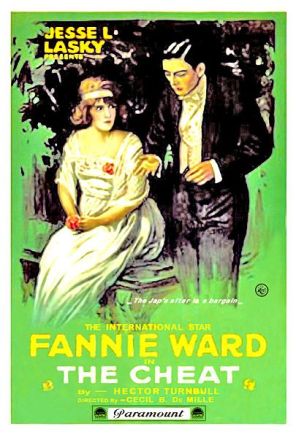
405px-The_Cheat_FilmPoster.jpegEast is East and West is West and never the twain shall meet.
The cinema landscape was still in its utter infancy in 1915. Thus, beyond the monumental impact of D.W. Griffith, The Cheat is another subsequent landmark production for a couple of the talents it helped align.

There would be no Cecil B. DeMille without The Cheat. It was his coming-out party with the viewing public, slating him as a craftsman of delicious dramas gorging themselves on all sorts of sensual themes and pleasures. It meant bang-bang box office receipts and kept DeMille inexorably at the top of Hollywood for years to come.

Sessue Hayakawa must also receive a nod not only as a groundbreaking pioneer in an industry that still doesn’t boast too many Asian performers but also as one of the most important stars of his day. Period.

Simply comparing his style of acting with many of his peers during the silent era bears telling results. In an age, of not only discrimination and stereotypes but also extensive overacting for the camera, his parts are almost reserved in comparison. No doubt this understatement derived from the Japanese attempt to strive for the so-called absence of doing or “muga,” when it came to performances.

Because the teleplay on its own is fairly rudimentary. A well-off wife (Fannie Ward) is pouting because her husband (Jack Dean) won’t give her the funds for a new dress. He needs his investments to pay dividends first.

In being so impatient, she resolves to leverage the red cross funds she’s been entrusted with by her woman’s group  — $10,000 of assets — and hands it over to an acquaintance who promises a sure thing in return. Of course, no one needs to be told it doesn’t bode well and as a result, the wife is out $10,000. She’s willing to turn anywhere, even her regular companion the suave foreigner Prince Haka Arakau (Tori in the original release).

Although gentlemanly and innocent enough at first, the lascivious prince looks to press his advantage, agreeing to give her the money — with strings attached. Extramarital drama and blackmail ensue with the tyrant putting his literal stamp on her as a sign of ownership. It’s actually quite perturbing, especially in a modern world finally looking to cast light on the sexual predation of women.

Beyond this caveat, The Cheat no doubt accentuated contemporary fears of the Yellow Peril as much as it titillated with the handsomeness of its foreign star. So while it’s playing into the long-accepted narrative including diatribes against immigration, it’s also taking advantage of the situation for pure entertainment value. There’s little discounting the purpose.

There’s a shooting that the husband admits to and a subsequent court trial full of sordid scandal-worthy confessions. The problems are ultimately amended and a happy ending found, making for an abrupt denouement meant to satisfy the masses. Given the customary, even archetypal trails the story takes, it feels much more rewarding to consider The Cheat most specifically from its place as a crucial historical time capsule outside the realm of mere plot.

Accordingly, Sessue Hayakawa was such a lucrative star during the early 20th century, it’s almost ludicrous to consider. He was making millions of dollars a year as one of the highest-paid actors of the age to rival the likes of Douglas Fairbanks or even Charlie Chaplin!

The fact that he is barely known in this day and age is a shame though it makes some sense given the cultural climate then and now. He became a screen idol in an age wrought with racial discrimination. His place as a box office smash was based mostly on his foreign allure and attractiveness as a forbidden lover. He was the toast of the town with white audiences as a fantasy character though he was rarely ever allowed to break out of the mold created for him in films like The Cheat.

We are presented with this perplexing dichotomy of this world-renowned actor who feels like an outlier in a tradition that normally emasculated Asian characters, and yet there’s still problematic perpetuations in Hayakawa’s own characterizations. It’s a two-sided issue that, regardless, is nothing short of intriguing given how early in the nascent stages of film he became a star. Dig into his history even a little bit and you are met with a continually fascinating career. For one, he entered acting on a near fluke.

After arriving in Chicago to study to become a lawyer, he was waiting for a tanker to take him back to Japan from California only to bow out and take up with a local theater. He subsequently caught the acting bug. One of the crucial figures in his early breakout was fellow countrywoman and future wife (anti-miscegenation laws forbid cross-cultural marriages), Tsuru Aoki.

Eventually, Hayakawa would emigrate back to Japan in the 1920s and slogged through WWII in occupied France of all places. After the war years, he experienced a resurgence and came to be known to a new generation of audiences for the likes of Tokyo Joe, Bridge on The River Kwai, and Hell to Eternity. For this body of work, he deserves an audience, even today, because there’s no discounting the crucial part he played, not simply in Asian representation, but in the very fabric of Hollywood history itself.

3.5/5 Stars

The Heartbreak Kid (1972): Elaine May’s Graduate

the heartbreak kid 1.png

I was aware that this was an Elaine May film and for a brief moment I saw Jeannie Berlin and mistakenly believed our director was making an appearance. Berlin is, of course, May’s daughter, and she’s the spitting image of her mother. The same look. The same lilt in her voice. The same comic timing.

In a sense, we have this weird frame of reference now. I’m not saying Lila (Jeannie Berlin) is a stand-in for her mother per se, but we nevertheless have a curious dynamic to cull through. If we didn’t know any better, we would say this is a typical Hollywood film told from the male perspective.

Charles Grodin is an attractive young man and a newlywed who has just married a nice Jewish girl. They’re headed out on their honeymoon in Virginia Beach. What happens next is not the honeymoon phase at all. It’s the sinking feeling he’s made a mistake. Can he really spend the next 40 or 50 years of his life with this woman?

At first, they’re having a grand ol’ time singing “Close to You” on the freeway, and I couldn’t help but thinking of the inro to The Mary Tyler Moore Show or closer yet The Crocker Bank commercial that spawned another Carpenters’ hit. Here we are headed for new beginnings — a life together — and we’ve only just begun.

However, normal rhythms must be interrupted. It starts when Lila starts getting too lovey-dovey in the car. Then, she’s eating Milky Ways after they sleep together or she’s taking eons getting ready to go down to the pool deck. You get the sense her husband is just getting to know her for the first time. It’s really disconcerting if the moments weren’t equally hilarious

He’s already hustled and harried. For the most part, Grodin must push through the picture in deadpan because the film is much more a tempered affair (with a few piercing outbursts).  He responds to his romantic counterparts impeccably, first the unacknowledged goofiness of Lila and the cool flirtation of blonde, collegiate siren, Kelly (Cybil Shepherd). There’s both a rhythm to his diction and a gigglyness that overcomes him — like a little schoolboy — completely selling his double life and the comedic situation.

It’s partially the fact the scenario gets so outrageous. Because from her first toying with him on the beach, Kelly won’t stop ribbing him to death. First, it’s her “spot” on the beach then it’s her “seat” at the bar, and she’s got him playing along. He doesn’t mind getting trifled with. In fact, he instantly goes fawning over her, despite being very truly married.

Of course, that sets up the blackness of this comedy given the situation. There’s not any kind of spouse murdering or anything grotesque, just infidelity… And I say this facetiously because obviously a situation like The Heartbreak Kid played real and straight would be devastating. In real life, such scenarios don’t come with laughs.

However, Elaine May observes it beautifully and while Neil Simon’s script is mostly spot-on, it feels not so much uncharacteristic of his work as it does a creative departure. The collaboration is as much May’s as it is his, and she puts her unmistakable imprint on the material.

Soon Lenny is already planning his second life and, he hasn’t even gotten finished with his first, married to his current wife a whopping 5 days. His arguments and excuses in keeping Lila bedridden and out of the know are so fluid and self-assured it’s astounding. It’s easy enough to do with Lila.

Still, Kelly’s father (a supremely obstinate Eddie Albert) is another matter, a domineering paternal figure who’s made his position on Lenny’s pursuit of his daughter quite clear. He vehemently opposes any such actions with every fiber of his being. Over his dead body as it were.

Lenny, however, is all in. He makes the trek out to Minnesota, of all places, where the Corcoran’s reside and where Kelly currently attends university. When they get a moment alone together, he pleads with her, “Don’t play games with my life.” It’s pitiful really. A comedy such as this must continually tread the lines of tragedy as much as humor. He’s certainly a real shmuck.

They each treat their romantic partners horribly and yet by the end, it’s easy to find the story weirdly sincere. Amid all the zaniness, Lenny somehow manages to get what he was searching after — the dream girl — to right the supposed mistakes of his life.

In one sense, I cannot help but use the same lens as The Graduate. The scenarios are in some ways strikingly analogous. However, The Heartbreak Kid also owes a greater debt to the remarriage comedies of old, albeit without the imposition of the production code.

The Graduate dynamic might be partially coincidental and yet we have directors in Mike Nichols and Elaine May who famously came into the public eye as a comedic duo.  The creative realizations of the two films make sense because their type of specific, deeply insightful humor can rarely help but enter satirical territory. It comes with the intelligence and perceptiveness they bring to everything whether stand-up, directing, what have you.

The Graduate, of course, has this chaotic crescendo where Benjamin storms the church and runs off with the girl. The Heartbreak Kid is arguably even more devastating and yet it manages it through subtlety. In the lingering moments, Lenny is sitting on a couch in his second wedding reception. He’s gotten his prize — the girl he gave up everything for — but it’s strangely unsatisfying or at least when we look at him and the expression on his face, he seems unfulfilled.

Why is that? Maybe it’s some unnameable force, but I saw it to a greater extent at the end of The Graduate as well. Benjamin Braddock went through hell and back again to get a girl. Lenny’s journey was bumpy, but it also felt lighter, even low-key. Still, it goes out with a pop song too; again, more subdued and still, there’s a concerted effort to lead us obliquely into the unknown future.

The Graduate rode the pensive waves of Simon & Garfunkel while The Heartbreak Kid is provided a through-line by a cover version of The Carpenters’ “Close to You.” Although there is no comparison, we have a similar connection to a cultural touchstone. May’s film couldn’t find a more straight-laced song to keep on calling on only succeeding in further contributing to the unsettling dissonance.

I’m no authority to cover this topic in-depth, but I recall reading something to the effect that Nichols was very cognizant in casting someone very un-WASP-like in Dustin Hoffman. We could say the same of Lenny and all the locales he finds himself in, especially Minnesota. Whether merely implied or not, he is the outsider, both physically and culturally, in a similar manner.

May does well to take the dippy setup that feels very Neil Simon and push it deeper still. How a film about such a topic can be genuinely funny and somehow still manages slivers of warmth is beyond me. It’s a screwy feat of acuity, a true testament to the minds behind its creation.

4/5 Stars

Little Women (2019): Gerwig’s Spirited Adaptation of An American Classic

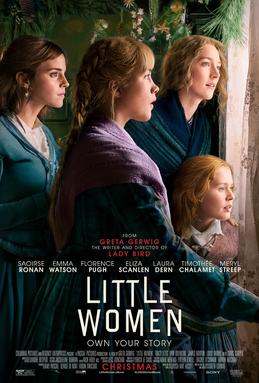
Little_Women_(2019_film)I once had the opportunity to tour Louisa May Alcott’s house on a family vacation. It’s one of those experiences I’m not sure you appreciate until you have the time and space to look back on it.

However, even then I think there was this innate understanding of how this beloved book was sewn into the very fabric of Alcott’s life and her family home in Concord, Massachusetts. You cannot begin to separate the two.

What’s so intriguing about Greta Gerwig’s adaptation is how it almost conducts an intertextual dialogue with the source material. It frames its story — the creation of a novel and its main character of Jo March (Saoirse Ronan) — in order to map out something of Alcott’s life too. Because, again, they are very much intertwined. 

From what little I know about her, she seemed an equally driven, independent, and brilliantly-minded individual. In her own life, she never got married (unlike her characters) and she also provided for her family.

The movie itself has a brazen free-flowing structure taking material some of us might know intimately (and others not quite so well) and finding renewed meaning. To explore plot feels inconsequential — and not just because it is so familiar — Little Women is, by its very nature, anecdotal. It’s about the passage of time as girls evolve into women without ever being totally beholden to any singular event. 

If I might make a wildly unsubstantiated reference it comes off a bit like Francois Truffaut’s Jules et Jim (1961), at least in form, where wild expanses of time are chopped up and compressed into these fluid increments. It feels like a young person’s version of an old person’s book. It courts the timelessness already present but, far from being stodgy, the movie burst with its own vigor, always lithe on its feet.

But this also funnels down to the staging and characterizations as well. Especially for the scenes set during their early years, it’s obvious the writer-director tries to capture the near-spontaneous, giddy energy that’s often the fuel of sisterhood. It can be an overwhelming force of nature full of emotion, affection, and contention in all the most meaningful of ways.

Even as someone with only a modicum amount of knowledge about Little Women (mostly from previous movie versions) Greta Gerwig shows such an immense appreciation for the material, she almost willfully carries us along with her. Even when we’re not quite sure what she’s doing or where she’s taking us, we learn to trust her decisions. If nothing else, she cares about these characters as much if not more than we do.

It’s true her version starts in what is normally considered the end of the narrative, as it slaloms back and forth from past to present with ease. All the moments, as far as I can recall, have antecedents in earlier versions, but as Gerwig stitches them together, it’s as if they are rejuvenated and given rebirth — a new context in which to be understood.

Perhaps the greatest accomplishment is how each sister in this newly minted construction is given their own definition and the ability to stand on their own two feet. Because, if you recall, Jo March has always been the undisputed star of these movies; she has provided the central protagonist and P.O.V. from which to understand these stories. If we are to believe Gerwig, Jo essentially wrote them after all.

There’s no denying Saoirse Ronan is our through-line in the narrative here as well amid all its undulations and purposeful digressions, and yet it feels like I get to appreciate the other March girls in ways I never have before. I don’t think it has much to do with star power — because traditionally there have been big names in most of the roles. Again, it is Gerwig who gives each a platform and her players graciously oblige.

Florence Pugh modulates wonderfully between moments of girlish cattiness and whining while simultaneously setting her eyes on mature ambitions, whether it be marriage as an advantageous business proposition or aspiring to be a great artist taken to Paris by Aunt March.

Far from simply capturing the past and the present of Amy, Pugh somehow makes the most complicated, even unlikable sister come out, in the end, gaining our deepest admirations (and sympathies). For those unaware of Pugh’s talent, it stands as yet another breakout performance.  

Emma Watson is able as the decent and contented Meg whose life still spills out of the mold of propriety she’s always been relegated to. There’s a bit more to her. Then Amy (Eliza Scanlen) remains the gifted musician and somehow the purest and most naive of them all. Her purpose is to fill the world with goodness and beauty. Some things never change.

Marmy (Laura Dern) — the family’s moral anchor — might come off an angelic goody two shoes quoting scripture judiciously (ie: “Don’t let the sun go down on your anger”). It could be a little much, that is until you realize her love is genuine, and she’s worked on it for an entire lifetime. Meryl Streep could probably play Aunt March in her sleep, and it’s not just a figure of speech; she does. Her performance is generally prickly and imperious while also belying a suspected soft underbelly. 

Laurie (Timothee Chalamet), as always, is found on the outside looking in at the March’s household. Their brand of enveloping community is so attractive you yearn to be a part of it, drawn into the fold as one of their kindred. After obliging with a token of his good-will, he quips “man is not made to live on books alone.”

In truth, I’ve never appreciated Chalamet more. There always seemed to be a pretentiousness drawn about him. Here there was something a bit different. It might have been the merit of Laurie teasing it out, but he felt slightly more animated and alive in a way that makes him likable. Although he is a man bred in affluent spheres, he nevertheless, hates their stuffiness.

He would rather dance a jig with Jo, and he calls out the March sisters when they falter into the general public’s pettiness because he knows the people they really are in the familiarity of their own home. In fact, he has tussles with nearly every sister, but never out of malice; there’s always such genuine care, even love, in its multifaceted forms. 

What I truly appreciate about Gerwig’s relationship with the text is how she openly courts contrasting ideas. Specifically, there are threads of feminism coursing through the narrative even as they extrapolate off ideas Alcott dealt with years ago.

And yet in the same instance, she does not shy away or completely dismiss romantic love or a more traditional desire for marriage. Case and point is Meg who is genuinely glad to be courted by a decent man she loves before raising a family together, in spite of their poverty. For Meg, this life fills her up with joy

So in some sense, Gerwig’s having her cake and eating it too paying deference to a timeless piece of American Literature while still perceiving it through her own personal creative lens.

You might say this even from a casting perspective with Ronan, Chalamet, and Tracy Letts all being holdovers from Lady Bird (2017). It might be the importance placed on female relationships, or the buoyancy frolicking with a sweeping passion through the storyline.

We get the happy ending if we so choose while also being allowed the space to consider an alternative. It doesn’t feel wishy-washy. Instead, it’s engaged with the enigma of Louis May Alcott herself even as it’s engaged with the process of creating art.

For me, it has the best of both worlds. Little Women has not been compromised and yet we have not been gipped of Gerwig’s own cinematic vivacity. While it’s not a perfect adaptation — not always intuitive to follow — it never scrimps on life-giving vitality.

You can note the humanity in profound new ways mined from a novel that’s been culled through and cherished for generations. I’ve never believed Little Women was a “women’s picture” or just for an American audience.  It is, in fact, universal. 

4/5 Stars

Arabesque (1966) with Gregory Peck and Sophia Loren

arabesque 1.png

I was trying to recall if the actual word “arabesque” was ever uttered in the movie. Granted, in a narrative like this, it’s just as easy for something to fly over your head. There’s comparable lingo bandied about pertaining to ciphers and hieroglyphs, mentioned in the context of coded messages and bits of secret information. You can hardly have an international spy thriller without such prerequisites, and yet this isn’t the fun of it.

Nor is it a foreign prime minister’s plight or the dubious intentions of a peregrine falcon-loving mastermind who holds a ravishingly beautiful woman in house arrest (in all cases Middle Easterners are played by Westerners). Because for any such story, the lasting enjoyment comes in the road traveled and the people we get to follow along with through every twist and turn.

It’s the saving grace of Arabesque, a movie with an overhauled and doctored script tinkered on by many hands including Peter Stone (writer of the similar Charade and Mirage). All this work produced a simultaneously mind-boggling and messy plotline. It doesn’t take a genius to recognize the particulars barely add up.

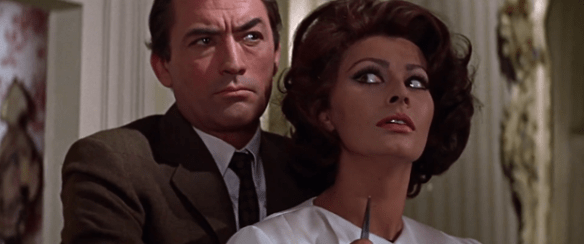
All that must be know is Professor David Pollock (Gregory Peck) finds himself on the run from any number of villains, all with their own selfish, nefarious schemes to employ. At the center of this sinister web of mayhem is an alluring spy (Sophia Loren) who is constantly switching and shape-shifting under every given circumstance. Our protagonist doesn’t quite know what to do with her.

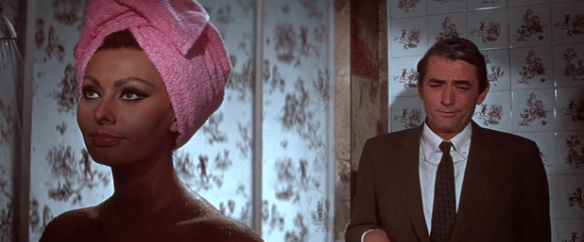
One might note Arabesque has another memorable shower scene after Charade’s. However, this rendition is decidedly more awkward and tense as Pollock finds himself under the hospitality of a sinister man, and Yasmin Azir (Loren) is under his watchful gaze as well. They wind up playing footsies with the soap in an effort not to raise suspicion.

arabesque 2.png

Arabesque tries to make it extremely evident all this peril is being thrust upon our heroes as they travel through the heart of Britain. It can be little more than a nod to The Master of Suspense to have our characters running through first a zoo and then a local aquarium, recalling the museum pieces in Blackmail (1929). There’s even an overt nod to North by Northwest, complete with cornfields, this time patrolled by deadly threshers instead of a crop duster.

Stanley Donen’s solution to the so-so storyline is to do just about anything he can to mix things up with kaleidoscope prism shots, angles through glass tables, reflections, unique framing, and on and on. In one sense, it is inventive, but there’s no unified purpose to it. It feels precisely like he’s trying to do whatever he can to distract from the material when it gets dull. Of course, the fact that this is the 1960s doesn’t hurt the aesthetic with enough drugs and hallucinations to pass the decade’s quotas.

In one particularly otherworldly vision, Peck becomes a hallucinogenic bullfighter on the motorways causing a major traffic jam. It adds little to the plot, but it certainly creates an impression. Still, I’m not sure if the merits of form over substance apply in this situation, even if Donen is ceaselessly creative. It gets to be almost too much. It could easily verge on out-and-out camp — considering the ludicrous nature of scenes — though it knuckles down when it matters most. An assassination plot must be averted, and it does offer a decent payoff in the thrills department.

Peck admittedly feels a bit miscast, although this could just as easily be my subconscious speaking since Cary Grant was earmarked for the role. Because one can imagine, even with his advanced years, Cary could have pulled off the wit marvelously. God love him, but Peck is almost too regal, and he has too much presence if that can possibly be an impediment. Sometimes it’s difficult to take him lightly. He does make an admirable go of it and the hint of Indy, an educator by trade, does not hurt his image.

Sophia Loren is absolutely scintillating carrying scenes with her usual poise owning every line and effortlessly building the needed chemistry with Peck, even as she sends him bouncing all over the place. He needs her for this picture to work, and she delivers.

When it ends, there’s some amount of contentment. Not because we saw a perfect movie by any means or even anything quite on par with Hitchcock or Sean Connery’s Bond, but we got to spend some quality time full of mayhem with two sublime personalities. It is all worthwhile because Peck and Loren are together.

After all, who wouldn’t want to swim in Oxfordshire with them? Maybe the days haven’t quite left us entirely, but I do crave more pictures that could coast on the charisma of their stars. Without question, Arabesque overrides its flaws through sheer star power.

3/5 Stars


Transit (2018): Casablanca in The Modern Day

Transit_(2018_film)Ever since the days of his James Cain-infused Jerichow, it’s been apparent German writer-director Christian Petzold is indebted to the written word when it comes to his brand of filmmaking. However, this time around he takes an oddly unnerving stroke of brilliance by setting his usual period piece in a version of the present, or is it a version of the present trapped in the past? Regardless, outside police cars — sounding eerily similar to Gestapo automobiles — rush through the streets while a pair of men have a hushed conference at a bar.

The scenario could nearly be mistaken for a dystopia if it weren’t for the cold hard facts the story was adapted from Anna Seghers eponymous wartime novel from 1944. What drives it forward is this compelling simplicity in the manner Petzold always seems so capable of. It’s part of the reason it’s so easy to be drawn into his films once you’re accustomed to the cadence.

The men bandy about talk of a letter and papers giving the hush-hush feel of a Casablanca, but Transit has the same restraint as Barbara (2012) and the wartime malaise of Phoenix (2014), albeit without the inimitable Nina Hoss. Georg (an unadorned yet haunting Franz Rogowski) is our protagonist, and we surmise soon enough he is on the lam from the authorities. Like many others, he has experienced the unknowable horrors of mechanized oppression.

He lives in a constant state of police-fueled paranoia brought on by the occupation, the details of which are kept purposefully murky. What we note are the resulting factors. The hotels are crammed with displaced folks trying to get out of the country, clinging to the faint wisp of hope in escaping to some far off place: the port of Marsellaise then Mexico or maybe America.

He is one of the displaced even as he’s aided in fleeing by cattle car and has a wounded colleague huddled next to him. It gives rise to the kind of pulse-pounding life or death scenarios reliant on both ingenuity and bouts of good fortune. It’s also perturbing to watch them unfold in the present.

His flight leads him to an abandoned roadside where he’s nevertheless invited to play football (soccer) with a precocious neighborhood kid named Driss. They build an instant rapport and their connections run deeper still, as we soon find out.

Whenever Georg stays within the confines of the city limits, he’s subject to the related police raids casing each room. If you don’t have your papers, you’re unceremoniously dragged away. By now it’s a daily occurrence. What becomes apparent is the rising sense of shame among the onlookers who watch and do nothing. What power do they have in such a world?

Georg lends a reluctant ear to fellow sojourners telling him their stories. Everyone seems weighed down by worries and troubles brought on by the tribulations of the times. They’re surprisingly forthcoming or rather they seem vociferous compared to individuals in Petzold’s previous movies. Although another distinction must be made.

His hero is fairly guarded as are a couple of the other central figures. It is the supporting characters who gladly use them as sounding boards to cast their thoughts on in this restless age. Even the narrator — an uncommon device for Petzold’s brand of restrained observational filmmaking — has his own insights to bring to the events.

The key again is how those central characters carry a bit of this pervasive despondency — this enigmatic nature holding us off but not completely alienating us. On the contrary, we want to know more about them as viewers transfixed by the fateful decisions they make and the encounters that befall them.

To begin with, Georg falls into a bit of luck donning the identity of a deceased writer and with it, the coveted opportunity at transit out of the country. The deceased man’s wife (Paula Beer) is a woman who drifts uncannily through his life throwing him glances as she motors on about her dutiful pursuits. What they are we have no idea. Although, with time, it’s easy enough to imagine.

That’s just it. Petzold is always toying with the arcane both in plot and characters because it’s in the ambiguities where his stories seem to come alive. It could be the first glance of the smartly dressed young woman on the street who touches Georg’s shoulder when the whole rest of the passing world seems not to pay him any heed. He’s invisible. And yet for some inexplicable reason — some cinematic kismet — she reaches out to him.

True, for the majority of the picture, it feels like she spends the movie walking in and out of places to build this air of mystique. Is she more of an object than a person? It’s easy to cry foul if only for the comfort of Petzold’s earlier collaborations with Nina Hoss. A mystifying woman put front and center can still stump us. What’s more, in the final act Marie becomes a living, breathing human being of fears and passions that turn strikingly palpable.

After she lost contact with her husband, she never gave up hope checking the consulate every day for any sign of news. Along the road, she was given a kind turn by an altruistic physician (Godehard Giese), and in a bedeviling world, they looked to one another for some amount of solace.

Their Rick’s Cafe becomes a corner pizzeria. Georg would always eat a Margherita there and find Marie stopping by. Later it becomes a meeting place with Richard — so mundane and typical, and yet it fits the context of the story.

As we find out, noble decisions aren’t so cut and dry here; they’re not capable of making our heart swell in the same romantic manner of Casablanca. We are constantly left questioning. What if the matrimonial ties aren’t so strong and beholden to the Hays Codes? What if Ilsa or Laszlo decided to stay behind at the last minute, making a grand sacrificial act null and void. What if the plane crashed en route? After all, the very thing happened to Glenn Miller over the English channel in 1944…

Speaking of music, it’s been so very long since I’ve seen Phoenix. Aside from the Vertiginous thematic elements and this same lingering sense of malaise, it seems I remember very little. It’s the impression that lasts and one scene — the scene where Nina Hoss sings “Speak Low” to her husband — imbued with so much subtext and bewitching power.

Down the road, years from now, the same lapses might happen with Transit. But I will remember the mood, this very concrete Casablanca-like mentality, and then another song. In a similar manner, the normally delphic Georg has a breach in character and shares the lullaby his mother used to sing to him. Hearing it on the radio brings the memory flooding back.

Or perhaps I will recall the other moment when, impersonating another man, he tells the consulate officer he’s done writing after all he’s seen. He wrote too many essays in school about vacations, holidays, and experiences to totally quash and trivialize everything substantive about those times.

To write about the atrocities he faced would be akin to that same sin. He’s not about to write another school essay. Even as the lines are spoken under an assumed identity, the words once more ring with an underlying resonance to denote a shared world.

The chilling edge of Transit is how it brings these obvious markers of the Holocaust into this out of body representation of our certain present. They feel poles apart until that creeping voice whispers doubts in the back of our minds. This is what I will remember. This is what will stay with me.

4/5 Stars