It’s Love I’m After (1937): In Honor of Olivia De Havilland

Screenshot 2020-07-01 at 8.42.44 PM

There is a very significant reason to be watching It’s Love I’m After at this time. Her name is Olivia de Havilland, and by some brilliant piece of Providence, she has just recently turned 104 years old! She, of course, was in her early 20s when this movie came out and what a charmer it is.

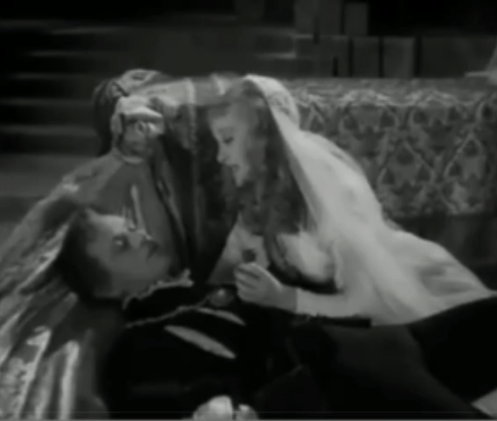
A few years before To Be or Not To Be, here is another movie hamming up Shakespeare on the stage. This time it’s Leslie Howard and Bette Davis as they act out their version of Romeo and Juliet for a rapt audience. What makes the sequence is the dueling couple whispering snide asides to one another mid-performance. Barbs about garlic breath and upstaging come out because they’re both conceited and jealously in love.

But where is Olivia in all of this? She’s up in the balcony swooning over the sublime eye candy down on the stage. She’s seen all of his performances and is positively devoted to his very essence. Her boyfriend (Patric Knowles) looks on with frustration as he’s having to compete with a rival who has never even met his girl before.

This is soon remedied when she promptly goes backstage to pay her respects. It’s all quite innocent. Basil and Joyce continue their incessant bickering from their adjoining dressing rooms, still at each other’s throats, despite the wall between them.

Then, Marcia West presents herself positively agog by the image of her idol thoroughly in the flesh before her. He’s flattered but he hardly knows what he’s doing when he accepts her compliments. Worse still, Joyce sees the young woman on her way out. Harmless or not, it adds further fuel to their relational fires.

What a delight it is to see such beloved thespians and titans of dramaturgy like Howard and Davis doing comedy, of all things, and doing it quite well in the screwball vein. After all, this would be their third picture together following Of Human Bondage and Petrified Forest. There’s no comparison.

The movie is totally overtaken by bipolar swings in fortune. First lovers’ quarrels — it’s the worst New Year’s Eve ever — then there are marriage proposals, and finally, Basil resolves to help a young fellow out.

They do have some handy support. There were few better in this department than Eric Blore, and he has a readily available supply of birdcalls and advice on his master’s matrimonial habits on the “precipice,” as it were.

Being your typically theatrical, philandering type, Basil resolves to shirk his impulses and pursue his own moral salvation. In this case, his good deed is for a lovesick fellow whose best girl is smitten with the stagebound Romeo. The actor doesn’t know it’s the same girl. How can he? No one in these movies ever stops to compare notes.
Screenshot 2020-07-01 at 8.46.48 PM

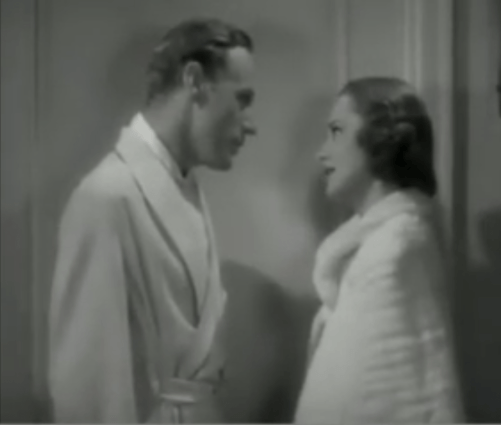
Still, he resolves to turn up on her doorstep and rudely ruffle her illusion of him. He and his man Digges (Blore) pay a late-night housecall to the West residence. Their shouts of “ire” soon become “fire” and brief pandemonium sets in as an impromptu round of “We’re here because we’re here” comes out sounding a lot like “Auld Lang Syne.”

He schmoozes his way into the house, making himself at home in the company of the avuncular father, befuddled mother, and a gossiping sister (Bonita Granville) always peeping through keyholes. But in Marcia’s eyes, he can still do no wrong. Now he’s got quite the prompting audience, and he’s all but ready to do his part.

His bit of showmanship has him playing up his image as an egotistical malcontent tearing through the guests and their breakfast table with ferocity (and some help from the Bard). Digges does his best to complain about the lack of kippers and other inadequacies. None of it congeals as they were hoping, in fact, it has an adverse effect. Marcia agrees with his every word.

As someone fed on a steady diet of P.G. Wodehouse and Jeeves and Wooster, there’s something familiar and comforting about the picture’s comic situation. Basil is no Bertie Wooster. Digges is no Jeeves, but they are stuck in the same madcap realm of romantic entanglement mixed with comedic hijinks.

Whatever Basil tries is quite unsuccessful in quelling the ardor or the affection of Ms. West. The best-laid plans all too quickly go awry and poor Digges can do little to stop the inevitable. Joyce makes her reappearance at precisely the most inopportune time. She catches her man in the arm of another. The jealous boyfriend feels affronted as he watches his girl be ripped away from him, albeit unwittingly.

The story couldn’t look bleaker and further from its agreed-upon happy ending and yet, eventually, it comes, like any good rom-com. Don’t ask me how it happens. Maybe it’s the youthful fickleness of De Havilland’s ingenue. Perhaps cinematic serendipity gets in the way. Regardless, the partners shuffle around only to get back together with their ordained.

Leslie Howard and Bette Davis are, again, madly in love, then yelling and screaming and pushing each other across the room. Digges is busy packing the suitcases only for the contents to come tumbling out as future husband and wife make up and share a passionate embrace. What light through yonder window breaks? It is the East and Juliet is the sun! End scene.

3.5/5 Stars
 

It’s Always Fair Weather (1955): A Musical For The TV Age

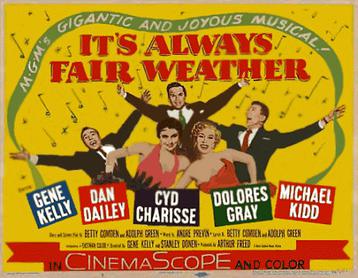
It's_Always_Fair_Weather_(1955_film)_poster_(yellow_background)

Conventional wisdom tells us you don’t make a musical quite like this. It’s a bit of a nostalgia piece and already it seems like American was ready to move on with life after WWIII.

It’s relatively straightforward to assume that It’s Always Fair Weather (1955) was a harbinger of a change in appeal with the general public because if we look back to Good News (1947), that’s arguably where the run of great MGM musicals began and they could hardly be stopped. There’s nothing drastically different about the foolproof formula or the players behind the scenes, for that matter. We still have Arthur Freed, Gene Kelly, Stanley Donen, Cyd Charisse, Adolph Green & Betty Comden, as well as any number of integral folks I failed to mention.

Well, we do have one primary demarcation, deserving some acknowledgment. Here is a musical with a cynical streak — something that feels incongruous, like oil and water almost. In the opening minutes, I don’t mind saying that I was of the same sentiment. It doesn’t seem like a musical.

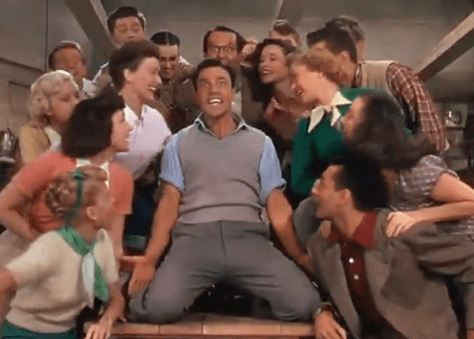
We have three boys marching home: Ted (Gene Kelly), Doug (Dan Dailey), and Angie (Michael Kidd), victorious from the war and frequenting the bar they always called home before. But at some point, reality hits — the emering complications at home in a drama such as The Best Years of Our Lives (1946) or an insidious film noir a la The Blue Dahlia (1946) or Act of Violence (1948).

But you see, this picture sets up its premise when the three inseparable war buddies bet the hard-bitten bartender, come rain or shine or sleet, they’ll get back together in 10 years, because they’re the real deal. Time won’t dampen their friendship.

They share a drunken cab dance, escalating in a garbage can crescendo that’s got that same panache of old. However, the merriment dies dow,n and they realize they’re civilians now. The inevitable parting arrives, and they go there separate ways. Only time will tell what happens next…

The production itself shows parallel issues involving the passage of time to mirror the plot. Even in casting. Initially Green and Comden envisioned this project as a spiritual sequel to On The Town, reteaming that film’s stars. They got Kelly, but with new leadership at MGM headed by Dore Schary, Sinatra was out and Munshin wasn’t a big enough name. Thus, we got the underrated pair of Dailey — a quality dancer in his own right, and Kidd, a workhorse choreographer, who blessed audiences with the Barn raising scene in Seven Brides for Seven Brothers, among other efforts.

Still, undoubtedly, times have changed. Behind the scenes, Kelly was chafing with Donen. I suspect because the younger man had proved he could handle a highly successful picture on his own (Seven Brides with Seven Brothers), and he would continue to do so. The cracks in the collaboration were beginning to show.

And yet even as the film settles into the contemporary era, the ensuing themes become surprisingly resonant. The day is October 11th, 1955: 10 years to the day they split up, and things couldn’t be more different.

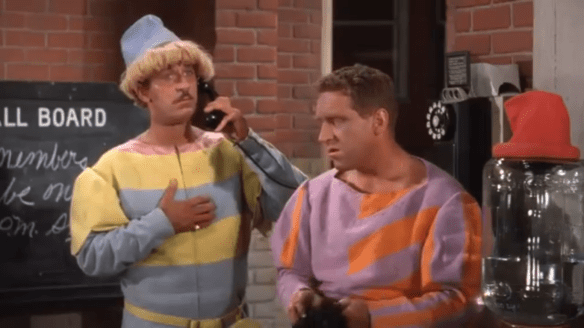
Ted never got married after his best girl dumped him and has stayed in Chicago working the crap tables, romancing dames, and recently winding up in the boxing racket with a young bull named Kid Mariachi. Doug has done well for himself, despite giving up his passion for painting, becoming a highly lucrative television advertising man. His sponsor spots for Molly Mop (voiced by the ubiquitous June Foray) are currently all the rage.

However, though married with a comfortable life, it doesn’t take a Sherlock Holmes to tell the years have left his stomach soft and his heart hard. Meanwhile, Angie’s married too with a whole house of kids and a loving wife who helps him run his burger joint: The Cordon Bleu.

The miracle is that they all keep there promise to be there! But as the euphoria subsides, they realize they have nothing in common. Beyond that, they can’t stand each other now, and it begins to gnaw at them. They’re ready to get on with their lives and accept this is how it goes when time marches on. Fate has other ideas.

It’s one shrewd advertising executive (Cyd Charisse) who spots an opportunity to reunite the boys on live television in the popular segment featured on Madeline Bradyville’s (Dolores Gray) nationally syndicated program. Ms. Jackie Leyton takes it upon herself to get Ted to the showing and enlists her colleagues to do the same with the other men.

She really is a marvel. Heading off any of his initial amorous advances and then taking on the male initiative to his complete bewilderment. On top of that, her Encyclopedic knowledge of any number of subjects has him speechless and wows the crowd at his boxing gym. Charisse doesn’t get too much time to flaunt her skill, but nevertheless, “Baby You Knock Me Out” is a comically upbeat number that does the trick.

Though the picture was shot in widescreen, it doesn’t necessarily lead to revolutionary musical numbers. However, much like Will Success Spoil Rock Hunter? the canvass is used on multiple occasions to draw out the limitations and satirize the “idiot boxes” fast becoming all the rage in the American household.

Meanwhile, things are just not going Ted’s way. Not only is he getting emasculated by this beautiful, befuddling woman, he learns from a dumb lug that a local gangster (Jay C. Flippen) has fixed his match. Kelly fails to have a truly singular moment until he pops on a pair of roller skates. We know it when he does the same charming shoulder shrug from Singin in the Rain that we are in for an indelible moment.

Sure enough, he goes gliding around studio street corners with ease, rolling and tapping his way along gayly until his curbside antics bring everything to a standstill — the masses cheering him on. It’s one of the first signs that fortunes might be turning.

It’s Always Fair Weather gets better and better with every passing minute maybe because it doesn’t ride the disillusionment all the way to the end. Even with commercialism, advertising, corruption, and whatever else, when we get out on the other side there is an underlying satisfaction to the ending.

Dolores Gray’s humorous “Thanks but no Thanks” complete with trap doors and rocketing male suitors off the stage, is another outrageous comic aside. Then, the three old buddies are brought together as part human interest story, part ratings gimmick. We think we know how it’ll go. It spells trainwreck in big, bold letters.

Well, that’s not quite right. Instead, we get a brawl captured by the candid cameras and broadcast the country over, complete with a confession by a top-level thug. It’s uproarious, fatuous, and far-fetched, but it’s also the exact catharsis we were begging for.

It reinforces values that we desperately hoped to be true, and it does it with a wink and a smile (along with plenty of broken tables and chairs). When friendship actually meant something. There was no Facebook or Skype or any faceless form of communication. To be with those people in the same space and share memories and go through galvanizing experiences together. That was all you had and sometimes, I would take one of those types of days over a boatload of the internet age’s connections.

Because I think most of us have gotten over Television. The medium has become status quo even quaint. It’s not killing us slowly (or maybe it already has), but the web is the new frontier just waiting to be eviscerated by a musical such as this. I would gladly watch that, but of course, such a project wouldn’t have names attached to it that mean so much to me: from Gene Kelly and Stanley Donen to my new favorite star Cyd Charisse.

Maybe It’s Always Fair Weather spelled that the classical Hollywood musical, as such, was dead, but even if contemporary reception was not stellar, it comes off today as a regularly insightful musical and satire. By now, I’d probably follow Kelly and Charisse to the moon and back again anyway.

4/5 Stars

The Band Wagon (1953) with Fred & Cyd

the band wagon 1.png

Some may recall the opening titles of Top Hat (1935). They play over a man’s hat only for the head under it to move as the names subside, and we find Fred Astaire under its brim in his coat and tails. Now, well nigh 20 years later, the same imagery is being called upon.

There’s an auction going on, including the sale of, of all things, a top hat evoking the same Astaire and Rogers musicals of old. It’s not in much demand as the man who formerly wore it, to much acclaim, is now a has-been. In fact, the biographical aspects of the picture are striking even when we can’t quite discern the fiction from the half-truths. Maybe that’s the key.

Already Fred Astaire himself had announced retirement several times, though one could hardly concede his career had stalled. In another bit of fitting parallelism, Adolph Green and Betty Comden penned a husband and wife duo for the storyline much like them (sans marriage). The head maestro character had some inspiration in Jose Ferrer who at the time had at least three shows on Broadway and was starring in a fourth.

The dashes of authenticity are all but undeniable as is a minor cameo by fawned-over heartthrob Ava Gardner. Consequently, I always thought the actress shared some minor resemblance to Cyd Charisse who was promoted to leading lady in this movie.

Out of these details blooms a picture that’s a fascinating exercise in touched-up reality because we see the ins and outs of a production with a behind-the-scenes narrative akin to Singin in the Rain. It makes us feel like we’re a part of something on an intimate level.

The early “Shoeshine” number with Astaire checking out a penny arcade, shows the inherent allure of a Minnelli-Astaire partnership. Because it was Astaire who made film dancing what it is, intent on capturing as much of the action in full-bodied, undisrupted takes. The focus was on the dancers, and there was an examination of their skill announcing unequivocally that there was nothing phony about them.

But as technology began to change and more complex camera setups became possible, this newfound capability was seen as an aid to the art rather than a detraction. Gene Kelly was of this thought as well. With the combination of sashaying forms and a dynamic camera, there was a greater capacity to capture the true energy that came out of dance. One could argue reality was lost, but some other emotional life force was gained.

And we see that here with Astaire grooving around past fortune-tellers and shooting galleries with the world tapping along with him. He and the real-life singing shoeshiner, Leroy Daniels, build an indisputable cadence through a momentary collaboration. It proves infectious.  Minnelli who himself had a background in set design seems most fully in his element surrounded by extras, colors, and any amount of toys to move around and orchestrate.

When Jefferey Cordoba (Jack Buchanan) finally signs on to direct and joins this dream team, he brings an endearing brand of histrionics with him. At his most quotable, he says, “In my mind, there is no difference between the magic rhythms of Bill Shakespeare’s immortal verse and the magic rhythms of Bill Robinson’s immortal feet.”

“That’s Entertainment!” captures his pure enthusiasm for the industry, giving anyone free rein to tell a story, where the world and the stage overlap and as the Bard said, all the various individuals are merely players.

However, this show previously envisioned as a happy-go-lucky musical hit parade soon takes on a life of its own, morphing into a retelling of Faust. We see Tony Hunter stretching himself as an actor, something Astaire himself was probably uncomfortable with. Likewise, he’s equally nervous about starring with Gabrielle Gerard who is a rapidly rising talent, thanks to the controlling nature of her choreographer boyfriend (James Mitchell).

Aside from her skill, her height is also something that the veteran dancer is self-conscience about. He smokes incessantly. She never does. So they each bring their insecurities and nerves to the production, erupting in a series of miscommunications during their first encounter. Still, the show charges onward regardless.

Even as the production proves to be a trainwreck and opening night approaches, it is the joint realization that they’re both out of sorts helping Tony and Gaby right their relationship. They take a ride through the park and wind up in arguably their most integral dance together.

Because it says, with two bodies in motion, what every other picture that’s not a musical must do through romantic dialogue or meaningful action. And it’s like the Astaire and Rogers films of old. Similarly, dance is not simply a diversion — something pretty to look at —  but it becomes the building blocks for our characters’ chemistry.

I find their forms marvelous together, both equally long and graceful side-by-side and in each other’s arms. The movements are so measured, effortless, and attuned, leading them right back into their carriage from whence they came.

Cordoba gets progressively carried away with his vision in what feels like tinges of The Red Shoes. Pyrotechnics and an excessive amount of props mask the core assets of the show, which are the performers themselves. What was purported to be a surefire success, just as easily becomes a monumental flop as the social elites walk out of the preview like zombies leaving a wake. Even if the image is laughable, it also acts as a reminder that all great forms of entertainment start with human beings.

“I Love Louisa” is a kind of musical reprieve as the whole gang, from the stars to the bit performers, try to shake the shell shock. The fun is put back into the players, their art, and this whole movie as Tony resolves to take their production in a new direction — as a musical revue.

I couldn’t help watching Cyd Charisse, for some reason, during the song. No, she’s not the focal point, but there she is prancing about and having a merry old time with all the extras in the background. They’re all a community of people enjoying their failure together. Bonding over it. It’s bigger than one individual. It’s easy to acknowledge The Band Wagon might be thoroughly enjoyable for these periphery elements alone.

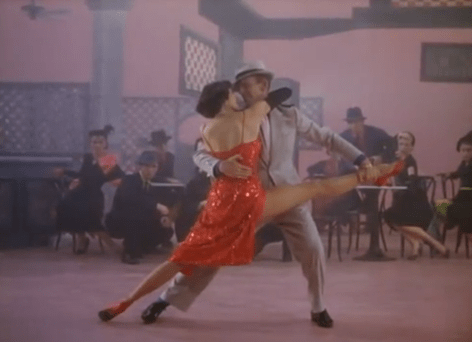
There are a couple, dare I say, throwaway placeholders to follow. Certainly, not the best of musical team Schwartz and Dietz. But “Girl Hunt — A Murder Mystery in Jazz,” is a labyrinthian sequence capturing the essence of the dark genre through voiceover and stylized visuals being interpreted through muscular dance. There are dual roles for Charisse as the deadly female. The action culminating in a seedy, smoke-filled cafe complete with a final showdown with a femme fatale in drop-dead red.

In this redressed form, they’re a stirring success. We are reminded sentimentally that the cast has become a family and Tony is their unlikely head. There’s one rousing reprise of “That’s Entertainment!” and Fred and Cyd (not Ginger, sorry folks) share a kiss.

The Band Wagon is a testament that Astaire was far from washed up and Charisse proves herself ably by his side as one of his best co-stars.  What imprints itself, when the curtains have fallen on this backstage musical, is just how congenial it is. There are few better offerings from MGM, capable of both exuberance and something even more difficult to find these days: bona fide poise. Singin in the Rain is beloved by many and yet The Band Wagon is deserving of much the same repute, whether it’s won it already or not.

Just watch Astaire and Charisse together. Her beauty is surpassed only by her presence as a dancer. He might be 20 years older and yet never seems to break a sweat, pulling off each routine with astounding ease. Look at his elasticity in the shoeshine chair as living proof. And when they strut, extending their legs with concerted purpose, it’s immaculate. We call them routines but they are not, imbued instead with a gliding elegance that looks almost foreign to us today. There’s nothing else to be said. It’s pure class personified and they make it deeply enchanting.

4.5/5 Stars

Review: An American in Paris (1951): Gene Kelly’s Love Letter to France

an american in paris 3.png

It’s no secret that Gene Kelly had a deep, abiding affection for France. He was fluent in the language also becoming the first American ever bestowed the honor of arranging a show for the Paris Opera. He would be honored with the Chevalier of the Legion d’Honneur in 1960 and, of course, made a memorable appearance in Jacques Demy’s Young Girls of Rochefort (1967).

Without deep knowledge of his life, I cannot attest to whether or not this affection has roots in An American in Paris or sprouted earlier. But watching the film, it’s easy to surmise it captures the unrealized dreams of Kelly’s heart. No, he was never a painter named Jerry Mulligan, but in his lifetime, he was an artist.

When we first hear his instantly placeable voice, providing genial narration, it’s not difficult to believe. Images of Parisian romance are brought to the screen, and he recounts how he, Jerry Mulligan, went from being a G.I. to a struggling painter in love with France. He’s not the only one, as his pianist friend (Oscar Levant) is in much the same boat, though a little less jovial.

There’s an incessantly bouncy theme playing intermittently at any time our protagonist walks down an avenue with a spring in his step. Does it get a bit tiresome? Emphatically so. Still, we are reminded that Kelly is constantly on the move like a giddy schoolboy.

However, it’s a woman named Milo (as in Venus duh) who spots his work out on the street and takes an immediate liking in it. He’s not quite buying what she’s selling. First of all, no one’s ever given him a break before, and secondly, she proceeds to invite him to a party that winds up being a very cozy affair: just the two of them. It’s not the type of patronage Jerry was hoping for, but her money is real enough, and he needs it.

And yet in this Parisian backlot, as evoked by director Vincente Minnelli, it’s easy to envy such a carefree life full of benevolent locals, lazy cafes, and a plethora of song and dance to brighten any day. If hardship is spoken of, it’s very rarely seen in the flesh. People speak flippantly of their lack of funds or food because they always seem to get by. There’s an agreeableness to the facade.

an american in paris 2.png

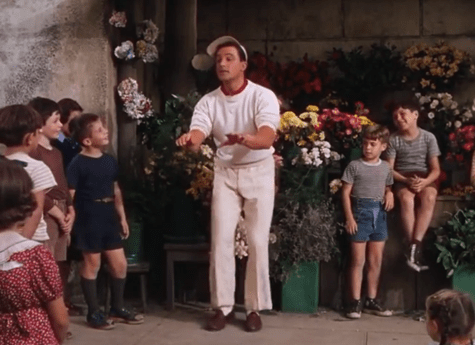
Gene Kelly with the kiddos is priceless. He becomes their impromptu English teacher, playing a game of “Repeat After Me,” which is in the toolkit of anyone who has ever taught a language. His pupils are eager and so what’s next but introduce an American song: “I Got…Rhythm.” Though the Gershwin tune wasn’t born in An American in Paris, it became fully rejuvenated in the hands of Kelly — arguably reaching a new apex.

He makes it more than a song — a malleable plaything for him and the kids to have a bit of fun with — goofing off and prancing about like cowboys and soldiers, then swirling like airplanes for good measure. The most important artistic movement in the picture might be its finale, but the most delightful one is found right here. Because we feel our own childhood antics rushing back.

As his relationship progresses with Milo (Nina Foch), it becomes more complicated since he’s not about to be a live-in companion even as the prevailing need for money remains in the front of his mind. One evening, in particular, he spies the most beautiful girl he’s ever seen (Leslie Caron), an enchanting vision, and immediately drums up some pretense to dance with her. He comes off too strong and alienates her in the process. Not to mention the lady he came with.

One might gather that in the real world, Mulligan would be rather problematic and yet Kelly’s characters never seem to exist in the real world, and so his romantic diversions are easy to dismiss. That irascible Kelly charm comes in handy.

Meanwhile, we have the stunning paradox of Leslie Caron, that talented waif-like creature with the cherub face. Effervescently youthful in one moment and yet composed with an undoubted maturity about her even as Kelly comes off as the boyish suitor. She is initially showcased in a sequence meant to describe the contours of her personality as a ballerina, and each moment fittingly paints her in contradictory shades and subjects. She is all things and then none of them.

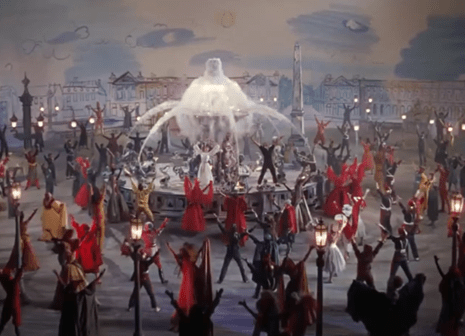
The most formative number, in terms of the blossoming of their love, is the Gershwin classic “Our Love is Here to Stay” danced gracefully at the water’s edge of the Seine, soaked in soft lamplight. But alas, it was not meant to be. There are too many obstacles in the way, and Mulligan fades into his fantasies — Kelly’s pride and joy — a 17-minute extravaganza.

an american in paris 4.png

Minnelli’s roving camera is in tandem with Kelly’s choreography. An apt illustration of how much Kelly’s work differs decidely from Fred Astaire. Ballet takes precedent in his work as much as inflections of jazz, and he was not averse to such cross-pollination, as it were.

The sets are brimming with constant kinetic energy, splashes of color, and elaborate costuming with tones inspired by French masters. It devolves into a dazzling cornucopia carousel of dance, freely flowing against Gershwin’s title composition. All efforts are to elicit the French landscape with cafes, fountains, and chambers full of mirrors.

But it’s not simply a substantial musical routine dashed off or cut together from various interludes. Or if it is, then we can concede there is a certain purpose to its ebb and flow, like a dream existing in some ethereal world both of love and bittersweet uncertainty.

Kelly’s greatest gift to us as an audience is probably putting some form of physical expression to very human emotions, and he did it in a way that feels genuine and to a small degree, attainable for all of us. The love story onscreen is a fairy tale, but he is just the man capable of suspending our disbelief and charming us into fully enjoying the experience.

Perhaps he tries too hard in An American in Paris. How can you not like him? Perhaps Minnelli’s camera dances too much and Kelly and Caron, not enough. I’m not sure. But there are specific instances exceeding the constraints of straightforward narrative fluff. When it enters into the momentarily euphoric, mirthful, or even the deeply regretful. Those emotions stay with me indelibly and this is what the most earnest, most evocative movies are capable of at their best.

4/5 Stars

Summer Stock (1950): MGM on a Farm

summer stock 1.png

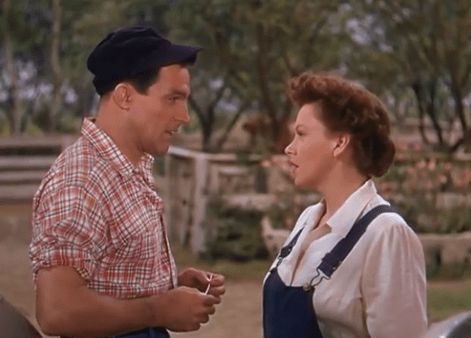
Idyllic imagery with dogs barking, chickens clucking, and trees rustling in the wind introduce the setting. Judy Garland can be found singing in the shower or helping in the kitchen, alongside the faithful Esme (Marjorie Main). After their hired help pulls out expectantly, the brunt of the work falls on the industrious Jane Falbury (Garland), who is not about to let their crop go unpacked, even if she has to do it herself.

The local store clerk Orville Wingait (Eddie Bracken) has harbored feelings for Jane since youth, and it’s all but settled that one day they will be betrothed. Once more the actor plays a variation on the small-town schmuck he always seemed to do for Preston Sturges in his heyday.

Except for, this time, he’s constantly being scolded and pushed around by his exacting father Jasper (Ray Collins). The elder Wingait pulls some strings to get Ms. Falbury a tractor so she can work her land without any assistance. Being the proud individual she is, Jane’s not about to let the debt go unpaid. She’s not married yet and so she’s not seeking out unsolicited favors.

The mirthful “Howdy Neighbor (Happy Harvest)” is an ode to all farmers toiling for an honest day’s work. Waving on locals with her rousing tune, Garland decked out in bibbed overalls piloting the tractor, looks the picture of a Midwestern farm girl. She’s grown up a tad since her days as Dorothy the Kansas farm girl. You would think that, apart from the marriage proposal that might be coming her way, Jane’s settled into her life.

Inevitably, something breaks into her newfound reverie. There would be no mother otherwise. Her preening sister, Abigail (Gloria DeHaven), bred at finishing schools and a little too prissy for her farm roots, comes back bringing in tow a whole troop of performers.

She’s promised them the use of her family’s barn as a home base for their roadshow. It’s just that she never thought to give her family any notice. Jane’s in for a colossal surprise when Joe Ross (Gene Kelly) and his players move in on the land as if they own the place. His cohorts include the rowdy goofball Herb (Phil Silvers) and the slightly entitled professional actor (Hans Conried), who was hired on to star opposite Abigail.

summer stock.png

To mollify her sister’s schoolgirl pleading, Jane finally relents letting them stay, if only they pull their weight around by helping with the daily chores. Kelly gives the gang a rousing pep talk in the kitchen after the dishes have been cleared with “Dig-Dig-Dig Dig For Your Dinner.”

It can’t be that hard. After all, many hands are meant to make light work. But Jane doesn’t have a bunch of cowhands, and the out-of-towners make a shambles of their daily tasks. Namely, Herb with his typical antics not only losing a basket full of the day’s egg crop but also managing to completely decimate Mrs. Falbury’s pristine new tractor.

With the new lodgers, there’s also an obvious conflict with the town at-large. The beloved Country Dance with rich traditions in the community’s historical society is their pride and joy. Nevertheless, the town has long forbidden theatrical performances in their backwoods society since eons ago for some unknowable, arbitrary reason, aside from the fact that they are all uncultured country bumpkins, of course.

The culture clash commences as the unwelcomed outsiders bring their hot jazz to a prim and proper barn dancing affair, with Jane caught between the factions. Her boyfriend and huffing father on one end, and the magnetic Joe on the other.

Summer Stock agreeably gives itself over to the urges of the music, culminating in a giddy dance-off between Kelly and Garland breaking any of the tension they might have on-screen for a momentary jolt of peppy All-American goodness. They’re having a grand time together, indeed, we all are, until we must return to the mechanisms of the storyline.

The pressures of Orville’s marital intentions are now full force even as Abigail quarrels with Joe over their show as he tries to bring all the pieces together. Garland belting out a love song as Kelly sits unseen in a chair, taking it in on the porch, about sums up the dynamic.

The poles are drifting apart in the form of Orville and Abigail, even as the lovers in the middle begin to feel their own form of electricity. If the film is to right itself, the change must happen right there. I’ll allow you to fill in the rest.

summer stock 2

A moment that many remember, for good reason, is so very simple. Kelly stands on the stage, alone, lights low, contemplating, and in those moments, he integrates the sounds around him. Soon the creak of a floorboard, an old newspaper, melded with his own whistling, taps, and a few meager piano notes, take on a life all their own.

He synthesizes them into a rhythm and out of those comes a primitive dance, seemingly built from the ground up right in front of our eyes. I’m not sure if people called Kelly a genius at this point, we still had yet to get An American in Paris and Singin’ in the Rain, but wowee he’s sure struck on something.

And what truly reveals itself is not only his cinematic charm, in such a moment, but the visible relish he seems to be having with every successive revelation. Whether he liked it or not or whether it was easy for him or not, for a suspended instance, we believe we could do this too and get the same joy.

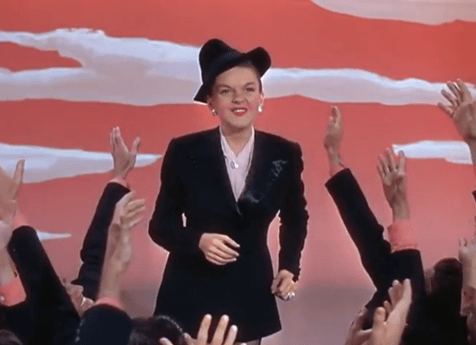
Garland’s most iconic number “Get Happy” finds her dressed in fancier duds in a sequence that was actually shot much later and finds a trimmer and fittingly livier singer delivering one of her trademark anthems. It was the end of an era. Garland would agree to terminate her contract at MGM, and she and Gene Kelly would never work on another picture together. I gather that’s show business. It’s not quite the same as a farm.

3.5/5 Stars

Review: On The Town (1949): MGM’s New York Musical

on the town 1.png

There is an immediate understanding that goes with the opening image of a construction worker arriving at the docks, still sleepy, as the world wakes up with him. And he does something that while still theatrical has roots in a very human urge, to bring in the new day with song.

If we look at the MGM catalog many of them have themes based around stage productions, film, or the arts. In their own way, such topics make completely logical sense as they make it much easier to transition into song and dance that feels pertinent to the performers in front of us. And yet when you think about it, at least for me, some of the most sublime of these old numbers are never connected with the big opulent stage productions being put on with giant routines.

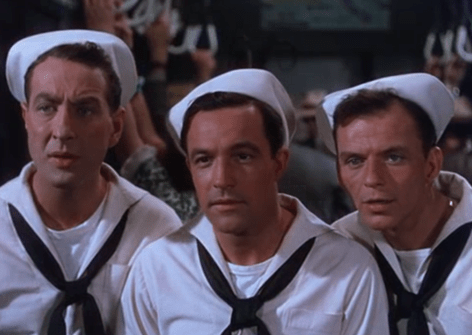
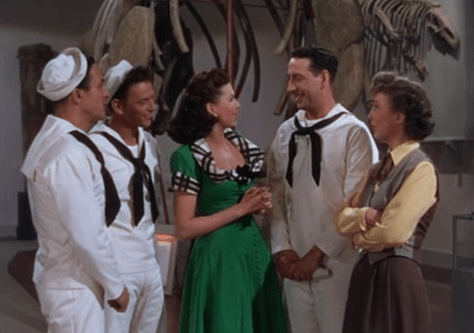
Certainly, they are impressive for their scope and the intricacies of their execution, but where is the real magic? It’s Gene Kelly dancing in the rain because he’s in love and he’s got to articulate it. It’s Fred Astaire dancing on the ceiling overcome with joy of his own in Royal Wedding (coincidentally directed by Stanley Donen). And so when three sailors burst into view, scampering off their ship gleefully, with a whole day to gallivant around New York City, those emotions come across as incredibly genuine.

Gabey (Gene Kelly), Chip (Frank Sinatra), and Ozzie (Jules Munshin) break into a chorus of “New York, New York” no doubt heard all across town. Their subsequent adventure, tailored by the dynamic duo of Adolph Green and Betty Comden, truly is the quintessential, streamlined MGM musical.

It was plucked from the stage play dream team of choreographer Jerome Robbins and eminent composer Leonard Bernstein. The film itself was directed by Kelly and Donen who would maintain a fruitful yet increasingly bitter partnership together until It’s Always Fair Weather (1955). It’s nearly impossible to assume where one man’s influence began and the other’s ended. All we have are the results that speak for themselves.

Maybe I’m simply a sucker for ambling films like this where the prospects seem endless. Because, after an initial clip show and a decent amount of on-location footage, taking them all over, the boys finally settle on the fact that they need to find some girls while they’re in the big city.

Kelly is especially girl crazy when he spies, “Miss Turnstiles” (Vera-Ellen), plastered all over the Subway on posters, only to run across her moments later, getting her picture taken nearby. She’s quick to head off to her next engagement, and yet he’s immediately smitten and intent on reuniting with this beautiful, cultured girl who seems way out of his league.

Meanwhile, Sinatra is the one intent on seeing the sights. Much like Take Me Out to The Ball Game, he feels miscast in the naive role as their lady cabbie (Betty Garrett) chases after him, all but chauffeuring them around town free of charge as long as she’s compensated in male companionship. Poor Chip finds himself forced into the front seat constantly subjected to the lady’s amorous assaults. He’s a goner.

on the town 2.png

As the search for the local celebrity continues, Ozzie runs into Claire (Ann Miller), a woman conducting research at the Museum of Anthropological History, ceaselessly fascinated with prehistoric man,which Ozzie seems to be a perfect descendant of. It seems like everyone else is striking it rich as Gabey searches hopefully. And in its most movie-like moment, he’s rewarded for his tireless casing of the city. Sure enough, he wanders in on her as she balances on her head as nice you please.

It turns out that Ivy Smith is more of a girl-next-door than a big-name socialite and yet when Gabey finally tracks her down, she leads him on, playing the part to impress him. They solidify their chemistry with the winsome “Main Street,” personifying a universal portrait of small-town American, pretty girls, and light-hearted, good-natured romance. Later, their swiveling and maneurving on a ballet barre somehow manages to be seamless while further instilling their relationship.

Like all fated New York romances, a rendezvous for the top of the Empire State Building is planned. It’s a party! It also provides the backdrop for the deceptively romantic “You’re Awful,” allowing Sinatra to break out of his film persona for just one moment to croon as only he can croon. Betty Garrett proves she’s far more than a cab-driving clown, with tenderness to give as well.

Now everyone is together. You have the three sailors and their three All-American gals, each wonderfully color coordinated in bright Technicolor-worthy dresses and we finally feel as if things are complete.

The sense of camaraderie by this point is undeniable, and along with the New York setting, On The Town is bolstered by such a sentiment. Not only does it mean that we have a plethora of quality performers, but there’s a sense that they’re all in on this big beautiful extravaganza together, and they all have something to bring to the party. It makes for a delightful showing.

on the town 3.png

“You Can Count on Me,” says as much even as Gabey’s Cinderella rushes off without an explanation and his friends find it necessary to cheer him up.

“A Day in New York — A Comedy in Three Acts” seems a rather strange aside, and yet here you see an instance where Kelly (and Donen) gets to exercise a specific vision, aided by dancer/choreographers Carol Haney and Jeanne Coyne. Because this whole film is an ensemble piece and still, even this single scene shows glimpses of some of Kelly’s more inventive numbers ,which would come to fruition in the near-future. Again, deciphering the dividing line between Kelly, Donen, and the involvement of others is nearly impossible. But why bother with quibbling at this point? The results speak for themselves.

When the storyline wraps up and the three sailors have to bid adieu to their girls, the bittersweet melancholy of saying goodbye is unavoidable as is the continuity of life. Even on the way out, a new group of sailors is already bursting forth to see New York — the same crane operator observing their eagerness with a smile. The daily cycle begins again. What a city it is! Such a wonderful town. In fact, “Ol’ Blues Eyes” would sing about it again one day.

4/5 Stars

Kiss Me Kate (1953): A Musical and Meta Entertainment

kiss me kate 1.png

The film version of Kiss Me Kate, helmed by MGM’s perennial musical director George Sidney, is a translation of Cole Porter’s rousing Broadway success. We must play a game of two degrees of separation because the stage smash was itself a comical backstage adaptation of Shakespeare’s Taming of The Shrew. I cannot necessarily attest to where one begins and the other ends, between stage, film, and original play, since my own knowledge is shoddy at best. So I will contain my thoughts to the story at hand.

At its core are the strained relations of a formerly married couple composed of two prima donna stage performers: the devilishly handsome, barrel-chested baritone Fred Graham (Howard Keel) and his equally strong-willed, alluring, and talented ex Lilli Vanessi (Kathryn Grayson). In all regards, a match made it heaven. They undoubtedly deserve each other.

The undisputed peppiness of Ann Miller, as she bursts in on them and Cole Porter (Ron Randell), is an immediate jovial assault on their relationship as she flaunts her attributes in “Too Darn Hot” and gets a little lovey-dovey with the self-absorbed leading man. I’m not sure if any audience member is shocked when she’s seen playfully prancing about with her other boyfriend (the always impressive Tommy Rall) in  “Why Can’t You Behave?”

To needlessly mix metaphors, the production is nearly sunk before it gets off the ground. And yet a mixture of persuasion, jealousy, and the quality of the material coaxes Grayson’s character into the fragile reunion. Wunderbar!

Lilli’s rendition of “I Hate Men” proves a blatantly pointed number where on stage sentiments are mirrored in her life; she doesn’t mince words raging through the set, flinging props to her obvious satisfaction.

In fact, she’s far more suited for the flaming red wig she wears on stage than her actual modest cut. The 3-D qualities come to bear thanks to the tossing of beer steins and flower bouquets. It’s one of visual cues to suggest this very purposeful sense of the off-stage and on-stage lives merging and colliding with one another.

kiss me kate 2.png

We have the backroom interludes and then the continuous sequences of the performance photographed straight on until little discrepancies come into play to make everything run afoul.

Breaks in characters. Personal vendettas playing out on stage with each minor slap and smack in the stage directions supplied with ample fury from years of pent-up rage. Deviations in the actual production also come to pass. Namely, a cringe-worthy spanking as the midway curtain drops.

It’s in the intermittent period where Kate utters that immortal Shakespearian retort, “Thou Jerk.” In fact, there’s great fun to be had with this conscious collision of Old English prose and the contemporary vernacular. The number “Brush Up On Your Shakespeare” suggests as much.

Keenan Wynn and James Whitemore are brought on to thoroughly liven up the second act as a pair of neighborly enforcers sent to visit Fred in his dressing room. They go so far as becoming a part of the production as it continues to go off script and off-the-rails. Because Kate is intent on running off with her rich boyfriend Tex (a Ralph Bellamy-type), and Graham connives to keep her around, pulling the heavies into his plan.

It feels strikingly like a His Girl Friday (1940) deal as we see our leads gravitating toward others while never finding it within themselves to completely forsake their former spouses, in spite of the mutual distaste. It’s indisputable, but it also suggest the fire still kindling between them.

Hermes Pan adds to his illustrious body of work while Bob Fosse’s choreography is almost a blip on the radar. Even then,  it’s strangely singular and expressive, charting his course toward The Pajama Game and many, many more projects to come.

Meanwhile, Ann Miller’s dancing reminds us that she’s the purest performer on taps within this picture and when given free-range, she follows up her first routine with continued verve. She does feel all over the place, but that can mostly be attributed to her character. In fact, one could affirm that she rightfully earns some of the most memorable screen time based on the uninhibited vivacity she showcases.

In its waning moments, it looks like the fictional production has finally met its inevitable end: a crash-and-burn finale, as the understudy has to rush on to take the place of the departing Catherine. In an off-the-cuff moment, playing opposite his future father-in-law’s question of where his daughter might possibly be,  Fred mutters, “Right now she should be flying over Newark.”

kiss me kate 3.png

Thus, Kiss Me Kate, at its most inventive, is hyper-aware of its meta qualities; this story-within-a-story tracing the line between the artificial and the reality projected up on the screen that is itself a fabrication of light and images. It reaches out further than most films of this type because its original release in 3-D, while admittedly a gimmick to snag the TV generation, also accentuates this razor-thin dividing line between the cinematic space and the space that the viewer occupies.

However, ultimately the production though laced with humor and vengeful lovers, quality choreography, and flamboyant set design and costuming, comes off strangely hollow in its landing. Because the ending feels false and inherently wrong.

Here is a man who is conceited and has no sense of self-sacrifice or concern for others, as farcical as he might be. Again, we could argue that Kiss Me Kate is solely entertainment, only occupying cinematic space. And yet we brushed up against everything thus far. How are we to make distinctions? In the real world, even in the 1950s and especially now, there is no excuse for Graham.

Surely, like any person, he deserves a second chance and the grace that comes from a person willing to forgive. However, one might question the way in which Lilli flies back to him. There seems to be no regard for his past indiscretions just as there’s no conversation to be had about the flings they’ve both been having on the sides. Because Kate is herself a bit of an entitled snob. And there you have this falseness most fully realized.

Life is a lot more complicated than film reality. Kiss Me Kate cannot quite pull it off because it inserts the uncluttered, picture-perfect Hollywood framing on the storyline.

Ironically, it’s actually the performance that gets continually disrupted while so-called real-life falls into place nearly seamlessly. So in the end, it matters whether you care about making a distinction between the stage and what happens backstage in the purported reality.

Because at least we can all agree that none of it is actually before us in the flesh where real lives are at stake. We can keep it at an arm’s length and laugh along with it without allowing it to influence our perceptions of this world.

Taken as such, Kiss Me Kate is a coruscating delight bursting forth, rather agreeably, with comedy and song. It can be absorbed merely as diverting Technicolor entertainment for sure. However, when we allow it to reach out and influence our worldview in other ways that’s where we might falter.

3.5/5 Stars

Easter Parade (1948): Judy & Fred Together At Last

easter parade 2.png

There’s a slight disclaimer that must go with Easter Parade. It has very little to do with Resurrection Sunday. More so, it’s a premium excuse for a lavish musical. At least in this regard, it thoroughly accommodates its audience.

The show starts off gloriously, not with dialogue, but with song, reminiscent of the great operettas of old or the future works of Jacques Demy where the film is buoyed by a range of voices imitating the joyous chorus of life. Here we have the seemingly ageless Fred Astaire strutting down the street greeting folks, doing some window shopping, picking out a hat as models file by and everyone chimes in with “Happy Easter!”

What becomes immediately apparent, even as we are thrust right into song, is the immaculately colored world, bright and cheery, personifying the holiday festivities and simultaneously satiating audiences who come to expect such glorious decadence from Technicolor movie musicals of the age. It rarely disappoints in terms of pure opulent set design.

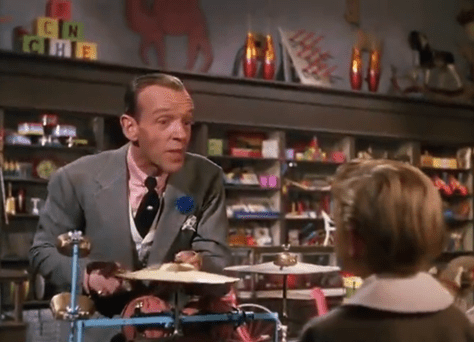
When Astaire spies a bunny in a toy store window, it inspires his finest number in the picture, a worthy precursor in fact to his shoeshine number in The Band Wagon (1953). Because what sets it apart is how alive, lithe, and playful it is. Gene Kelly was imbued with this ability too, but you have to witness it to completely understand the magic when environment and inspiration coalesce.

They could animate the world around them by taking lifeless objects and turning them into tools to personify emotion. Like all the preeminent performers, they take the tirelessly rehearsed and make it feel like the epitome of the organic, in a way that suggests we are discovering something precisely at the same moment they are. We are part of the magic born out of the moment.

Astaire banging on drums and xylophones. Twirling sticks and tossing toys like, well, a kid in a toy store. The story hasn’t even started yet, and he’s already made Easter Parade into something special. It’s when you’re reminded that these lavish musicals were at their best when they momentarily lost their plotlines through acts of artistry and inspiration that still managed to somehow advance the narrative.

easter parade 1.png

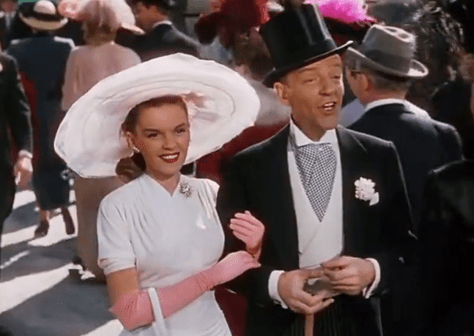
At some point, the exposition must arrive and with it a plot. It comes in the form of Don’s ravishing and vain dance partner. Nadine (Ann Miller) is intent on striking out on her own and commanding a larger audience. In fact, she’s already made up her mind and signed a contract with Ziegfeld, leaving Don to start from scratch with a new partner. Regardless, there’s no denying the chemistry they had together. Astaire and Miller absolutely light it up in “It Only Happens When I Dance With You.”

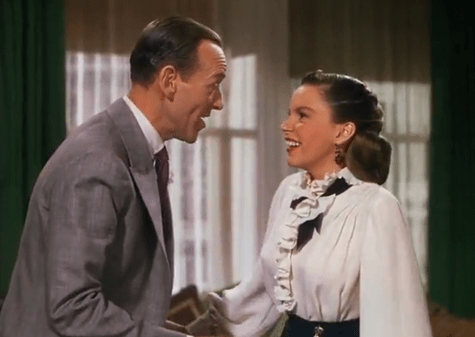
However, now feeling betrayed and saddled with a bit of a Pygmalion complex, he convinces himself that he can turn any second-rate performer into his costar, and he just happens to pick Hannah Brown (Judy Garland). The unassuming starlet splits her time as a waitress at a local bar while struggling to differentiate her left foot from her right. She looks like a hopeless case. Not so!

Fresh off his quality success in MGMs Good News (1947) from the year prior, Peter Lawford is inserted in the storyline as the close friend of Don and Nadine, caught in the middle of their personal and professional squabble. When he meets Hannah in the rain, it only makes things more complicated. One could wager that the handsome and youthful Lawford is partially miscast, but he has a good-natured charm that makes us disregard any of that. We like him as much as we’re supposed to.

From their initial encounter, the Astaire and Garland relationship is front and center, evolving into the film’s most important dynamic. So far the movie is coming through on its promises. Again, we’re not all that interested in their acting per se, unless I’m just speaking for myself.

What actually strikes my curiosity is seeing them perform in tandem because they were consummate professionals who knew the Hollywood circuit like the back of their hand by now. Astaire, though still looking so spry, had years already logged with Ginger Rogers and others, not to mention stints on Vaudeville and the stage. Garland of course, though still quite young, had, since adolescence, been trained up and groomed in the ways of Hollywood. The shining examples early on, of course, being The Wizard of Oz and then her onscreen partnership with Mickey Rooney.

“Couple of Swells” endears itself as a delightfully corny number with our stars ruefully ditching the fine attire for artful dodger, tramp-like garb. Buying into their affectionate relationship by this point is no difficult task. They’ve made us believe in it.

easter parade.png

In truth, Garland had never met Astaire before their teaming though she had purportedly wanted to work with him for many years because he was the tops — the best of the best.

The rest of the production’s background is tumultuous, and the actual details sketchy at best. Scriptwriters Frances Goodrich and Albert Hackett were initially called upon only to have their draft touched up by Sidney Shelton. Vicente Minnelli was removed as director at the behest of Garland’s psychiatrist, deeming it better for her to work without her husband.

We might also call it an odd chance of serendipity as Gene Kelly (Garland’s co-star in many MGM musicals) was also slated for this project until he broke his ankle playing volleyball (right before production commenced).

Who was coaxed out of retirement to take on the role instead? Only the best: Fred Astaire. And Astaire would retire numerous other times thereafter, but you just cannot keep a man who was born to dance like he was away from the floor. Thank goodness he would come back for numerous more efforts. His successes in the 50s are too innumerable to count.

Simply put, he makes every movie he’s in worth watching for the mere chance that you will glimpse something spectacular. Paired with Garland, a world-class performer in her own right, there’s no missing, even if both have more iconic pictures. That’s probably more a testament to their iconic careers than the merits of Easter Parade. Because it all but delivers on everything you come to expect from the two names written above the title.  There’s a good chance you’ll be left with a broad smile on your face.

4/5 Stars

The Harvey Girls (1946): The Painted Desert Meets The Musical

Harvey_Girls_poster

It was during a pit stop along a cross-country trip through the Petrified Forest that I first became aware of The Harvey Girls. Because you see, The Painted Desert Inn is a bit of a relic of the past, and it preserves a history of the famous waitresses who helped pave the way for a certain brand of civility in the Southwest. They brought the sensibilities, respectability, fine china, and world-famous sirloin steaks from back east to forsaken lands normally ruled by saloons and brothels.

So while The Harvey Girls (1946), a cheery musical directed by George Sidney, does not have the same mythological quality in the taming of the West as a John Ford picture, the same process is being captured, albeit in more practical (and more musical) terms.

We get a taste of where all these girls come from thanks to the very catchy, “On the Atchison, Topeka, and the Santa Fe,” which suggests the vital importance that the transcontinental railroad played in such an endeavor. The recording would prove a viable hit for star Judy Garland and many others, taking on a subject akin to “The Trolley Song” out of Meet Me in St. Louis.

In that regard, Garland is out of sorts residing on the pioneering prairie with their dive saloons and floozies of ill-repute. But that’s exactly her charm. She traveled to this far-off, unknown destination as a mail order bride; her only correspondence with her future matrimonial partner is through letters.

He’s quite eloquent with a pen and yet she meets the colloquial but good-natured H. H. Hartsey (Chill Wills) and receives the shock of her life. All of a sudden they’re both a bit flustered and decide to dispense with the marriage on amicable terms.

As a result, Susan decides to join The Harvey Girls in their newly formed restaurant to bring entertainment and quality diversions to this godless territory of Sand Rock. Their main competition comes from a man named Ned Trent (John Hodiak) who runs the local watering hole replete with gambling, drinking, a whole host of dancing girls. One of them, Em (Angela Lansbury) is deeply in love with him, and it shows.

Trent conveniently has a partnership with the local Judge who has made it a practice to scare off anyone with a smidge of decency. He even ran a preacher out of town and his scare tactics include a gunshot fired into the Harvey Girl dormitory.

Though only a recent recruit, Susan soon mobilizes the women who are trained up by (Majorie Mann) ready to fight back against their opposition. Her distaste and inexperience with guns are endearing just as her plucky fearlessness gains her a certain amount of admiration.

Trent proves to be a far more complex man than he’s given credit for even as he tries to distance himself from the Judge and push the Harvey Girls out fair and square. It’s still a competition, but at least it’s honorable. Simultaneously, Em begins to see the twinkle in his eyes as he becomes enamored with Susan. Her principles and feisty nature are attractive, but Ems not about to lose him without a fight nor does Susan particularly fancy Trent. The romantic triangle is firmly in place.

In one sense, Lansbury feels poorly miscast, no fault of her own because they all but dubbed her singing voice to make her seem American. Her charm has to do precisely with the fact she is not one of us. And yet remarkably, she does a fine job as a sympathetic antagonist, if you will, that we grow to admire.

John Hodiak is easily clumped with actors of the 40s like Brian Donlevy or Cornel Wilde who are not quite buried in obscurity. However, because there is nothing that can be deemed electric about them, it’s easy for them to get lost in the fray. All that being said, I rather like Hodiak opposite Garland. He’s both slightly antagonistic but genial when he has to be.

“It’s a Great Big World” provides a fine showcase for Garland and her companions to dream together. On her own, Virginia O’Brien provides a comic aside singing “Wild Wild West” and giving the town’s jumpy new blacksmith (Ray Bolger) a capable helping hand. I must say I hardly recognized the young Cyd Charisse who earned her first speaking role to kick off a shining career in Hollywood as one of its preeminent dancers.

The most comedically gratifying scene has to be when the two rival factions resort to physical catfights to exert their dominance and show that they have a right to stay. The Harvey Girls also throw a party where Bolger’s length on taps is positively charming. It’s the old story that a dancer must be highly skilled to make their style look so very idiosyncratic, and I kept on thinking how I would never in a million years be able to pull of such a routine.

What follows is a Waltz that has everyone dancing even as the town is plagued further by arsons and a heated fistfight to right a few wrongs. We are getting down to the wire. However, with the outbound train about to leave, decisions must be made and one could wager that our leads make the right one, though fate and Em give them a helping hand in the end.

The Harvey Girls, produced by the Arthur Freed unit, and blessed with the song-smithing of Harry Warren and Johnny Mercer, delivers a repeatedly delightful western musical experience, despite the very fact that it was not initially supposed to be. However, a drama earmarked for Lana Turner got a facelift and pulled Judy Garland away from working with Vincente Minnelli and Fred Astaire to score her a low-stakes, lightweight hit.

To make things even better, she would finally get her chance to work with Astaire two years later in Easter Parade (1948). For now, let’s relish this one for the frothy pleasures it affords. My sojourning through the painted desert was almost 10 years ago, so it’s a pleasure to finally get around to see The Harvey Girls. 

3.5/5 Stars

Ziegfeld Girl (1941): See It For The Stars

ziegfeld girl 1.png

Thank you HOLLYWOOD GENES for having me in the Ziegfeld Blogathon!

Few would claim Ziegfeld Girl to be anything close to a landmark masterpiece, but it’s got star power in spades thanks to MGMs robust lineup during the war years and that alone, followed up with a few spunky numbers, backstage melodrama, and minor laughs, is a fine starting point.

Ziegfeld was wildly popular with Hollywood in that day and age from The Great Ziegfeld and Ziegfeld Follies, both bookending this musical extravaganza.

In this particular tale that shares beats with any number of backroom industry dramas from 42nd Street to Valley of the Dolls, three women from very different walks of life find themselves given the once-in-a-lifetime opportunity to be part of the biggest revue in the land: Ziegfeld’s Follies.

Though Ziegfeld himself goes all but unseen, he has a couple talent hounds sniffing around and more important than talent are beautiful girls. Edward Everett Horton is one of the men who follows up on a pretty elevator operator who made a striking impression.

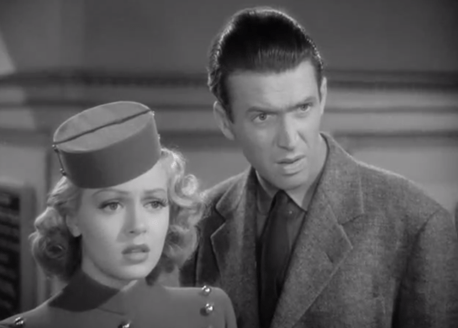
Pretty soon Sheila (Lana Turner) goes from obscurity, living in her family’s humble home with a boyfriend (James Stewart) trying to eke by as a trucker, and all the sudden she’s hit the big time with a salary and a new class of men calling on her. At first, life seems like the best of both worlds until the glamorous one wins out and Sheila begins to be completely disenchanted with the old ways. Gilbert diagnoses her problem; she’s trying to be two places at once and winds up not being any place at all.

She watches her loving boyfriend distance himself as he joins the company of bootleggers at first to hold on to her and then just to make the money that comes with such a life. But the stakes are high, and he winds up in prison. Whether you buy Stewart taking on such a seedy vocation is slightly beside the point.

ziegfeld girl 2

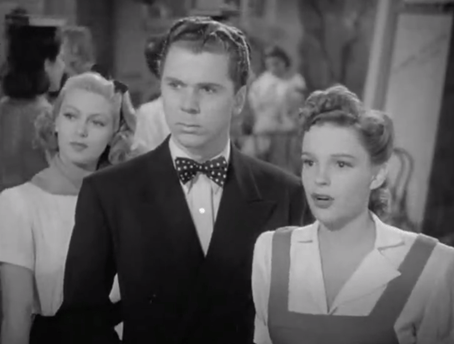
Susan Gallager (Judy Garland) was born and bred on the Vaudeville circuit, trained up by her journeyman father (Charles Winninger) and part of their inseparable family act. The thought of breaking up the team plagues her even as the bright lights of the Ziegfeld Follies beckons her on. Her stirringly melodic rendition of “I’m Always Chasing Rainbows” all but seals the deal, without her father attached.

Figuring out what to do with Pop is of utmost importance to her as she knows full well he would do everything to promote her success even if it means failing out on the road by himself. Her struggle is balancing the dreams that she has always aspired to with a proud father she wants to support as best as she can.

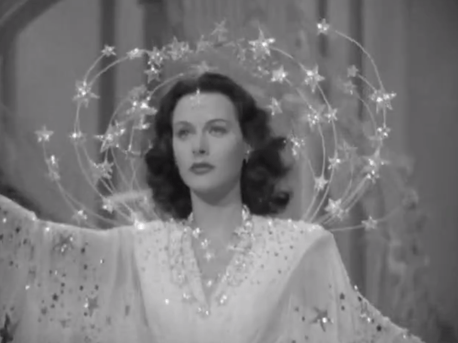
Our final star, Sandra (Hedy Lamarr), is compelled to take a role not from want or desire but out of necessity as her husband (Phillip Dorn) is a struggling violinist who is too skilled for the gigs he’s trying to win. He needs to be in Carnegie Hall not some saucy song and dance routine with a menagerie of pretty girls. To provide for them and keep his beloved violin from being hocked she joins the Follies. Her beauty is unsurpassed and it brings with it the friendly advances of another man. It’s relative fluff. The best moment comes when she meets the man’s loving wife. They both realize they love their husbands and they leave it at that. There’s no homewrecker between them.

ziegfeld 3.png

Sheila undergoes a stunning downfall into drunkenness that finds her tipsy on stage and ultimately canned for good. It’s a decline that feels all too real because we know that the same meteoric rise and subsequent demise plagued numerous such figures.

A subsequent reunion with Gilbert follows at the family homestead. There’s something about Stewart feeding Turner soup that’s endearing with the gangly fellows textbook brand of nervous muttering called upon to fill the space. She’s just looking up into his eyes and seeing the person that she once loved — the person she still loves.

This is not an offering that will earn new converts to the glories of the classical Hollywood system but for those already firmly engaged with its stars, its nevertheless a treat. Lana Turner is perky, Judy Garland proves as sweet as ever, and Hedy Lamarr remains dazzlingly aloof masking an inquisitive brain well on the way to inventing frequency hopping which would provide the framework for WiFi. No big deal.

However, look at the real lives of each lady and there are obvious strains of personal tragedy that present themselves in each case. It’s the undeniable undercurrent to the movie that cannot be ignored.

Though it seems like it’s really the gals who own the picture, rightfully so, James Stewart still garners top billing and it makes partial sense given his latest forays included Mr. Smith Goes to Washington and The Philadelphia Story. However, he was getting WWII fever as well and after joining the military that same year, he would not be back to moving pictures until a little box office flop called It’s a Wonderful Life in 1946.

Although the nation was on the cusp of an event that would redefine human history and inject a patriotic tinge into all film productions, Ziegfeld Girl seems content to hang onto the opulent nostalgia just a little bit longer. It’s far less appealing now, but if any of the many names on the marquee catch your fancy, then give it a watch, and enjoy it heartily for what it is.

3/5 Stars