Meet Me in St. Louis (1944)

meet me in st louis 1.png

One thing that can be said of Meet Me in St. Louis is that it captures the milieu of an era while simultaneously being quintessential Vincente Minnelli. Every man, woman, and child is dressed to the tee and enraptured by love and the grand promises of the World Fair full of dancing the Hoochie-Coochie with their special Tootsie Wootsies.  It’s cheerfully opulent in such a fashion that some might consider it almost garish and others will deem it the height of turn-of-the-century elegance.

There’s no doubt that the director had one of the most phenomenal palettes of any filmmaker from any time period. Certainly, this extends to the mise en scene and the costumes adorning his stars — pulled right out of Sears Roebuck circa 1900. But the other crucial aspect is that Minnelli seems to handle his talent with kid gloves or at least he creates an environment for them to flourish.

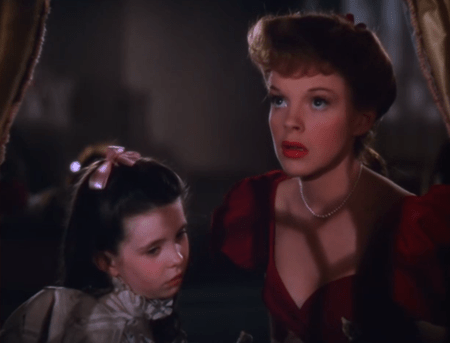
Of course, front and center of the Technicolor extravaganza is Judy Garland who would marry her director the following year and you get the sense that she had fallen in love with how beautiful he was able to make her on film. It’s true that she’s a striking sight to behold, only magnified by the world she traipses through, surrounded by her kin and singing to her heart’s content.

Still, if the set design is such a grand expression of the film’s potency and visual appeal, it’s necessary to point out again that this is far from a Judy Garland show; there is an ensemble component even if she’s the scene-stealer.

Margaret O’Brien is a riot because she plays little Tootie in the most ingratiatingly precocious way possible. Though it must be admitted she has a bit of a morbid side too. We meet her on an ice wagon telling a man how she’s going to give her doll a nice funeral and later on, of course, she takes the heads off all the snow people.

However, there’s also a whole Halloween interlude starring Tootie and their sister Agnes that feels more like a ghoulish Guy Fawkes day than its modern incarnation of door-to-door candy grabbing. Maybe Halloween has gotten tamer than we give it credit for. Put up against the film’s more mirthful moments, it comes off a tad alarming.

But then again, the story continually goes back to its roots in the centrality of the family unit. Its very integrity is in jeopardy of being disrupted when Father (Leon Ames) drops the news that they will be moving to New York from St. Louis. It comes off horrifically. It’s imperative to remember that in order for those heights to be so gay there must be a steady stream of romantic heartbreaks and personal roadblocks which the picture gladly provides.

There’s a lovely scene staged around the piano between Mr. and Mrs. Adams (Ames and Mary Astor) where like in so many other instances song becomes the perfect expression of the current mood. Based on where the camera is situated, the stairwell in the back is visible and you see the shadows of figures before they inch back into the frame and subsequently back into the family room. It’s a visual representation of the family staying rooted together even after a spat — constantly retracting — then contracting back together in continuous motion.

Without question, the well-remembered “The Trolley Song” is a giddy number that outshines any of the others but that’s because it is the summation of romantic euphoria that Esther (Garland) is feeling for her beau (Tom Drake). Meanwhile, “Have Yourself a Merry Little Christmas,” though hauntingly melodious, is quite easy for me to rip out of the context of this film.

meet me in st louis 2.png

Meet Me in St. Louis has never been a yuletide film for me in a similar fashion to how Holiday Inn (1942) is not so much attached to “White Christmas” or holiday cheer as the Michael Curtiz picture from 1954. Perhaps its influence isn’t as deeply rooted in my childhood recollections as some of its contemporaries. But then again, Meet Me in St Louis evokes Christmas in the same way that some of the cinematic adaptations of Little Woman (1933, 1949, or 1994) conjure up the season in the context of family. Perhaps that’s how it should be.

In its day, the film was a smash hit only to be outshined by that prior behemoth from David Selznick Gone with the Wind (1939) and it’s easy to draw up parallels if not simply visually speaking. Both films boast breathtaking imagery and extraordinary color photography for the era that even today can rightfully be considered landmark stuff. Still, that doesn’t mean that everything else has improved with age. Make the concessions where you will and the film can be a good-natured classic or even a Christmas perennial favorite. In my estimation its middling in both categories. Still, that can’t completely detract from its finer attributes. Namely Minnelli’s striking color scheme which remains second to none.

4/5 Stars

Zoo in Budapest (1933)

zoo in budapest.png

Once more we have the Hollywood rendition of Budapest that would turn up again in other pictures like Ernst Lubitsch’s Shop Around the Corner (1940). English is spoken perfectly and individuals generally act as we would expect them to in our neck of the woods. It’s simply their story and setting which have any bearings on the real Hungary. But after all, that’s what we’re generally most interested in anyway.

Because Zoo in Budapest is everything its title promises though I admittedly know woefully little about the director Rowland V. Lee. Despite the lean narrative, a refreshing amount of time is actually spent in developing the vast menagerie of animals within the zoo. And there are many of all colors, shapes, and sizes. Elephants, monkeys, lions, tigers, ostriches, giraffes, everything that one might expect. The people are a diverse bunch as well.

For one man, in particular, the zookeeper Zani (Gene Raymond), he couldn’t be happier with his daily regiment. The film is his whimsical tale of paradise. In fact, we could just about call it Eden.  He’s a friend of every four-legged creature and he plays with them all like they’re his family. Furthermore, he slyly steals furs from snooty ladies who see animals only for their pelts.

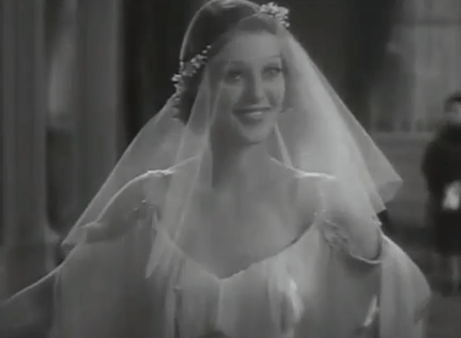
He even coaxes a timid young orphan (Loretta Young) to make a break for it as she’s already planned an escape with the help of her girlfriends. The reason being, she is about to be hired off as an indentured servant on her 18th birthday.

But it looks like she’s lost her nerve. In one crucial instant, one girl jumps from the bridge to draw attention. Thus, the diversion has been created and Eve instinctively makes a dash for it. She’s on her way to spend an eventful evening in the zoo.

She’s not the only one. A little boy sneaks away from his governess because he wants to ride the elephants and Zani himself becomes a fugitive after purloining one fur too many. They are a trio fleeing from the powers that be, the zoo authorities, the den mother, and a governess.

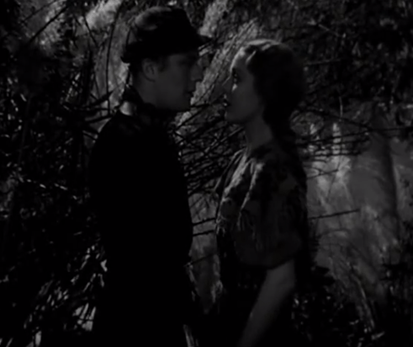
After she’s gotten over her initial apprehension, Loretta Young’s eyes glow dazzlingly in the moonlight and she’s the perfect helpmate for Zani as they carve out a bit of an oasis for themselves, away from the prying eyes searching for them. In one sense, the parallels to the Garden of Eden are well-founded.

There’s also a startling amount of imagery spent on simply documenting the life around them. Swans gliding on a pond. The play-wrestling of a friendly monkey. But of course, the tranquility cannot be sustained forever. The world at large breaks in disrupting the perfect cadence and the order of beings inside the Zoo’s walls.

I can’t help but think that if the picture were remade today with our technological advancements and subsequent narrative laziness, all that provides a real threat and a true sense of danger in the film’s finale would be lost. Because as humans we know the difference inherently between CGI creations and living breathing handiworks of flesh and blood. It’s the real lions, tigers, and bears that can tear you to shreds. The computer-generated ones just provide the illusion. So Zoo in Budapest might have a bit of a scrappy, melodramatic ending but there’s something to it.

It’s almost like a reality check. We get a taste of what the Garden of Eden might have been like but of course, paradise was lost. We can still have love and romance but there must be violence and turmoil thrown in our midst as well. The lion laying down with the lamb isn’t quite actuality. The question is whether or not you believe that one day it will be so.

3.5/5 Stars

Employees’ Entrance (1933)

employee's entrance 1.png

Not only is Employees Entrance a film made for the Great Depression, but it’s also a project that would have no life if it were not for the lax enforcement of the Production Codes at the time. The same could be said of its protagonist — if he can dare call him that.

Warren William embodies the mercilessly driven businessman named Kurt Anderson like few men before, or even after him, could. He’s a brutal taskmaster who has no sense of integrity. A John D. Rockefeller except less religious. So he has even less of a moral framework. His main purpose is to crush other people because he’s running a business, not a charity ward.

He throws out the weak and surrounds himself with like-minded people. It’s how he’s managed to keep Monroe Company Department Stores a flourishing enterprise even after “The Crash.” Not everyone can say that.

An ambitious, young man named Martin West (Wallace Ford) impresses the autocrat with his idea of upping sales of men’s drawers by selling them to women. Meanwhile, Anderson finds time to sink a clothing supplier who can’t deliver on a shipment and fires a senile department head who nevertheless has stayed with the company well-nigh thirty years.

Thus, we get this sense that he wields a two-edged sword. Anderson is surprisingly generous and accommodating to those who fit into his scheme of things. For instance, increasing a certain models salary if she distracts his colleague next door. Yet he will just as quickly dump someone who is not pulling their weight. That’s how survival of the fittest works. We know this already.

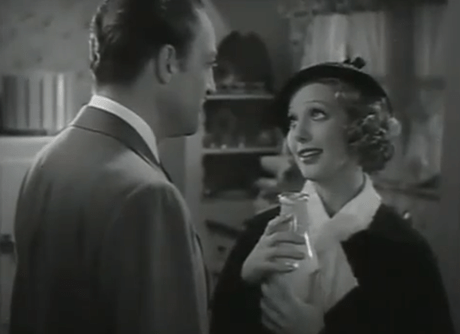
What suggests this more than anything, however, is his treatment of women. Loretta Young sporting those luminous doe eyes of her is gorgeous as Madeleine, a woman who is nevertheless down on her luck and looking for work at Monroe’s. She meets Mr. Anderson quite by chance, after hours, as she has made the stores home decor section her temporary domicile. He’s immediately taken with her. Is there a tenderness unveiled perhaps?

employee's entrance 3.png

Ultimately, he rewards her with a job and she’s quite the success on the floor. Even catching the eye of Martin. He professes his undying affection wordlessly through adverts. And they do the one thing that if he knew about it, Mr. Anderson wouldn’t approve of. They fall in love. In his estimation love is for saps, marriage gets in the way, and he wants his people to be enamored with their work as much as he is.

Young proves adorable even when she’s tipsy, bopping and popping balloons. But as often happens, people make decisions that they will come to regret while inebriated at parties. This film is little different.

The tone and trajectory break with the entire order that the Production Code soon set in place such that we never would see the likes of this again in Hollywood, at least not for a very long time.

It’s this seemingly admissibly trenchant material that makes navigating Employees Entrance onerous, similar to problems I have with more modern works. It comes down to not only issues of tone; because this is a humorous film undercut by some severely dark realities, even suicide and rape, but it also has to do with the integrity of our lead.

For all intent and purposes, our anti-hero hardly has an ounce of likability. The best that can be said for him is he’s enormously successful and good at his job in a tyrannical, ruthless sort of way. Otherwise, he has no heart, no soul, and he’s a misogynistic lout to boot. The fact that any of those characteristics got put into a man who is not cast as a villain truly is a marvel. It’s definitely worth taking note of.

But this is also a somewhat saucy Pre-Code number and the certain playful impertinence is personified best by Alice White who burst onto the stage during the flapper craze of the 1920s. In one particularly rewarding moment, she tells a stuffy old crone that the basement is on the 12th floor as nice as you please. It’s classic lip.

However, there’s this instant realization that Warren William was made for films such as this. The implications hit like a ton of bricks. He all but disappeared from movies since Joseph Breen literally excised his entire character type out of Hollywood’s new imposed master narrative.

Others might be able to do a far more convincing job of making the case but like his contemporary Kay Francis, it’s time for the likes of Williams to be resurrected from near obscurity. Certainly, not everyone will like him, particularly in this film, but there’s no question that he has something. It allows him to play those scathing characters with an unparalleled precision.

But I’ll be honest, I’m genuinely beginning to think that Loretta Young deserves a spot as a Pre-Code icon as well. In 1933 alone she was featured in nine films! The only problem is her efforts from the 1940s are more well-known. The Stranger (1946) and The Bishop’s Wife (1947) seem to overshadow most anything else. Yet another reason to uncover Employee’s Entrance.

3.5/5 Stars

The Bitter Tea of General Yen (1933)

bitter tea of general yen.png

The Bitter Tea of General Yen is no doubt a perplexing film to come at today but, in some respects, that makes the experience all the more gratifying. There’s still something within it 80 years on that will simultaneously rub up against our contemporary perspective while also surprising us with a certain adroitness. So many issues are stacked up one on top of another, it’s a weighty task to begin trying to unpack them all.

Certainly, we have the strains of colonialism driven by western missionaries looking to share the Christian faith with the outer reaches of the world. In fact, we can probably derive some similar themes from films such as Keys to the Kingdom (1944) and Silence (2016) which provide a myriad of questions in their own right. Are these missionaries really making a difference? Is their Gospel even being comprehended? Should they be so bold as to force their beliefs on other people groups? All of these are up for valid consideration.

Racism must also be tackled whether it is shown to prove a point or is simply a casualty of a previous generation’s approach to Asian portrayals. We hear the words of one elderly lady who in one moment is going on about how lovely a wedding is going to be and then the next she shares her true sentiments about the Chinese.

“They’re all tricky and immoral. I can’t tell any of them apart. They’re all Chinamen to me.”
It’s this kind of narrow thinking, this blatantly obvious cultural insensitivity, laid right out in front of us. Thus, it seems likely the film’s main thesis might be to prove the exact opposite. That in itself seems monumental.

We have the casting of a Scandinavian in Nils Asther for the role of the Chinese general to contend with as well. And while it’s easy to get stuck on this or go the complete opposite end of the spectrum and take it for granted given the cultural moment it came out of, I hope to arrive at another conclusion. “Yellowface” always perturbs me and yet I also realize we have to understand the intentions and so I’m apt to read this picture much as I would Broken Blossoms (1919).

Whereas Mr. Moto and Charlie Chan work in stereotypes and the Fu Manchu archetype is the demonizing of a race, you do not quite get the same sense here. Even with the problems inherent in the characterization, what comes through emotionally is resonant. Then, further still is the landmark consideration of interracial romance, no doubt a turn off for many contemporary viewers — or at the very least taboo.

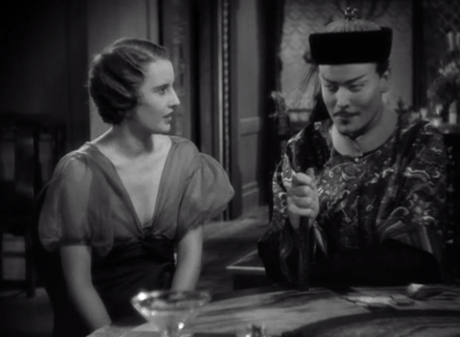
The whole narrative is really about the steadily evolving relationship between an American woman (Stanwyck) and this Chinese General (Asther) who keeps her in his domain on the pretense that it is for her own safety with the civil war still raging at large.

Megan is one of those naive yet well-meaning individuals who comes to a foreign land to do good. This is the imperative of “The Great Commission” and bless her soul, she takes her faith seriously, coming to join her soon-to-be husband wherever he may go.

But soon she is struck with a reality check. Her fiancee and she try and rescue some orphans caught in the middle of the hellish war zone, but the pass they’ve been provided is no good. In the ongoing turmoil, Megan finds herself brought to the palace of General Yen for safekeeping, her husband lost in the chaos.

What follows is an exercise not so much in polarizing romance, which would be the easier road to traverse, but instead cultural understanding through candid dialogue. He criticizes what he sees as a flaw in her man, that he will betray her every time for his God. Meanwhile, the idea all humanity is one flesh and blood is almost laughable to him.

And yet, again and again, he is drawn not only to her exquisite appearance but the undeniable sincerity that guides her every action. She, in turn, recognizes something of a hidden sensitivity welled up inside his soul. As he notes, “There has never been a people more purely artist, and therefore, more purely lover, than the Chinese.”

The most straining circumstance involves the General’s lowly concubine Mah-Li (Toshia Mia) who has all but disobeyed him. Megan chides him to forgive her even in her insolence (“I want you to see the beauty of giving love where it isn’t merited”) and for the greater offense of passing secrets which gives him the grounds to have her killed. You can either say he softens or finally lets down his guard. It’s semantics really.

This might very well be the Capra picture people don’t expect because it flies in the face of all the criticisms usually leveled against him. Specifically, that he always made overly sentimentalized films without a shred of hard reality. I’ve tried to push back against this presupposition countless times and I think The Bitter Tea General Yen is another fine counterargument. Look no further than the excruciatingly frank depictions of military executions, soldiers decimated by Gatling guns,  betrayal, suicide, and near surrealistic dreams that invade a woman’s consciousness.

However, it’s difficult not to begin comparing it most obviously to Shanghai Express (1932), a picture that reveled in its atmosphere and featured Josef von Sternberg’s visual infatuation with Marlene Dietrich. Frank Capra does Stanwyck justice in his own right because there’s no doubt she’s vibrant and alluring throughout. It’s brought into sharp relief through numerous stunning close-ups that capture the softness of her features. Not to mention the tears. Something that makes her different and more vulnerable than her German contemporary.

But we must ask the question. Is it a type of Stockholm Syndrome? Is it a true romance or simply an affection for a man who had more beauty, more artistry, than she would have initially given him credit for? I’m not sure we know and the ingeniousness, I realized retrospectively, of the film’s ending, is that we never hear Barbara Stanwyck’s thoughts on the matter.

Walter Connolly just won’t shut up and he’s supposing all these different things. Recalling what a great guy the General was, considering what Megan will do next, and summing up the General’s spiritual proclivities. Maybe he’ll come back in some new incarnation. But the lady says next to nothing and there is a cryptic power in this. Because The Bitter Tea of General Yen allows us to ruminate over the material and draw out conclusions of our own.

3.5/5 Stars

Taxi! (1932)

taxi! 1.png
Taxi! is indubitably parked in the pantheon of misquotes and few people probably realize it. Yes, this is the film where Warner Bros. tough guy James Cagney purportedly sneered, “You dirty rat, you killed my brother!” I remember hearing the line in everything from The Monkees to M*A*S*H and it no doubt showed up in just about every show from here to eternity. Right up there with Cary Grant’s apocryphal line “Judy, Judy, Judy.”

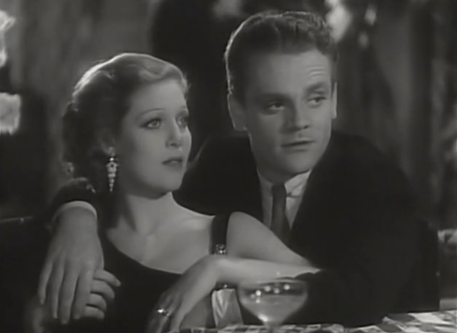
But none of that speaks to this film or what it’s actually about. Well, the title says it: Taxicab drivers. So let’s talk about the talent instead and when I say talent that mostly means two people, James Cagney and Loretta Young. They’re the main draw.

In the opening gag, we see James Cagney using his Yiddish to placate a customer who can’t seem to get any help from a policeman. But he’s also back to running off his mouth and throwing his fists because after all, this is the same man that electrified the world with his portrayal of a gangster in William Wellman’s Public Enemy (1931) of the previous year.

The crucial event in this film is a rash of strong-armed maneuvers pulled by a taxi conglomerate in New York City looking to shoulder their way into the industry through scare tactics and willful sabotage of their competitors.

One of their victims is a veteran cabbie (Guy Kibbee) who isn’t about to take this lying down and he guns down one of the perpetrators of injustice. Justice is swift and he is given a prison sentence in lieu of death. But it might as well have been. His life is all but over.

In the wake of this outrage, Cagney begins a call-to-arms for his fellow colleagues to fight back and fight fire with fire as it were. The incarcerated man’s daughter (Young) stands tall as well and calls for action by peaceful means. She receives the disdain of Nolan for behavior that he sees as selling out her own father. Of course, he doesn’t know the whole story.

For some inexplicable reason, maybe it’s his animal magnetism, Sue falls for the cad of a cabbie. What follows are dates at the picture show which provides some free publicity including a weepy starring Donald Cook and a poster for The Mad Genius (1931) starring John Barrymore.

Sue’s fellow waitress at the local grub hub, the oddball chatterbox Ruby (Leila Bennett) even makes a passing comment to her beau about Frederic Marc though Joe E. Brown is still here personal favorite. It makes sense.

Next, comes a Peabody contest at the nightclub, featuring an appearance by George Raft, where the fiery Cagney tries to wail on his real-life friend. If it’s not that then it’s a fat man in an elevator or most obvious of all Buck Gerrard the big oaf who had a part in the shady tactics that landed Sue’s father in jail.

Matt’s not a happy camper for most of the film and yet he still manages to keep his gal. After a lover’s quarrel, a silky smooth Cagney takes his love in his arms and they dance while he slips a ring on her finger. He’s also a self-confident son-of-a-gun.

But as electric as Cagney is, one of the best to ever light up the screen — there’s no doubt about that — I’m not sure if I can forgive him slapping around someone as loving and as innocent as Loretta Young. Especially today, it just doesn’t come off very well. She deserves someone better.

3/5 Stars

Baby Face (1933)

baby face 1.png

Even in its opening moments, Baby Face made my heart heavy. I look at Lily, this young woman played by Barbara Stanwyck and sadness wells up within me. Because her environment is so oppressive. Getting constantly pawed at and manhandled with a father who has no conception of love. Then, she opens the window to get away from the asphyxiating haze of cigarette smoke only to be met with more smoke from the steam engines outside. This isn’t a life that anyone should be subjected to and it’s brought into sharp relief because she is surrounded by so many filthy men: Mangy scuzzballs, if you want to get scientific.

But the picture, even in this opening moment, before it gets to the nitty-gritty at hand, grieves me because it still has increasing pertinence in the present world we find ourselves in. Isn’t that strange? But I am met with this fact time and time again. You would think I would be less surprised there is still nothing new under the sun. In such an environment, Lily is essentially perceived to be worthless and the men around her keep her down.

However, there’s one man in particular who rallies her to get off the trash heap. In fact, Bragg is a man who broadens her perspective and helps her to realize her own worth.  The only unfortunate part is that he bequeaths her the philosophy of Nietzsche. And I say unfortunate very purposefully because the language he provides her is like so.

“You must be a master, not a slave. It’s about exploitation using men and being strong to get the things you want.” It’s laid out as overtly as you could possibly expect. This remains only the root of a wider problem that is exasperated because, of course, this is exactly what Lily ends up doing.

baby face 4.png

She goes to New York with her constant companion Chico (Theresa Harris) and subsequently charms her way into a job, slowly moving up the ranks due to her ambitions and calculated manipulation. There’s no other way to put it. She’s systematically sleeping her way to the top.

The funniest anachronism of them all is seeing John Wayne, young and handsome, behind a desk in a corporation. He is one of Baby Face’s early conquests. But believe me, there will be more. No sooner has one top employee lost his job due to Baby Face then another man has become seduced by her inviting eyes and soft touch. There’s one particular mirror shot from the ladies’ room that says it all. The man is saying one thing and when he sees her his whole demeanor changes. Like putty in her hands.

But there’s another running gag easily understood with a little inference. A close up on the exterior of the mortgage department with a soft pan to the accounting department or wherever else ambition takes her, the score playing “St. Louis Blues” saucily to say all that needs to be said. And you get the sense that it’s for these very interludes that the film was marketed.

It pushed the boundaries of the censor’s board at the time and many have supposed, rightfully so, that Baby Face was one of the pictures which actually led to greater enforcement of the production codes in 1934. Certainly, all this is true.

But more than anything, the most troubling thing for me is her Nietzschean code of conduct continually dictating her worldview. He is the man who most famously said “God is Dead,” not as a derisive proclamation but more so a disillusioned fact. There is no hope or grace found in such a point of view. But of course, Lily never received any of those things in her formative years so how is she to know? She just keeps plodding on using her attributes the best she knows how to make a comfortable life for herself.

To quote Proverbs, “her lips drip honey and yet her feet go down to the grave.” She’s nothing but trouble and yet I would never hold it against her. She makes us so conflicted because there is so much manipulation there — even vindictiveness — while she still nurses wounds from youth that we cannot even begin to understand.

Stanwyck never ceases to amaze me with her incredible range of performances and the deep truth she seems to mine in each and everyone to make them charming, funny, or heartbreaking — whatever the tone calls for. She always seems to have it in ready supply. It’s little different in Baby Face.

As far as the film itself, what we have here is the epitome of efficient Hollywood filmmaking that somehow is still laced with a potency of emotion, at times heartbreaking and at others verging on the salacious. Still, it’s a picture that leaves you with something. There’s no way that any of the Barbara Stanwyck faithful would forget her, but this picture gives another reason to stand up and take notice.

It’s a striking image as the phonograph turns and all the men in her life flash by. In such a short time there’s been so many and yet some passed by like a blip we almost forget they were there. George Brent is the most substantial and even he comes into the storyline far later. That’s purely a testament to the picture’s ability to really fill out the entire scenario with surprising depth.

However, it’s crucial for the film to end on a realistic and deadly note because anything else would be untrue to the life that Lily has lived thus far. It was never pretty. The denouement cheats a little bit by leaving events open-ended but all that’s left to say is Stanwyck is devastating. She just might bowl you over.

4/5 Stars


Miracle Woman (1931)

miracle woman 1.png

“Beware of False Prophets which come to you in sheep’s clothing” – Mat. 8:15

The Miracle Woman is offered as a rebuke to anyone who, under the cloak of Religion, seeks to sell for gold, God’s choicest gift to Humanity —- FAITH. 

There are title cards that open up Miracle Woman to make it crystal clear what its intentions are. Though pointed, they hardly seem necessary given the motion picture we are about to witness. The images speak for themselves.

Inside an old-fashioned church building, we hear the opening throes of “Holy, Holy, Holy.” Most every contemporary audience knew that standard hymn well — cherishing its heavenly imagery. But when Barbara Stanwyck steps into the pulpit to pass along her father’s final words as pastor she breaks into the reverie and brings the house down. If there’s ever been a stirring depiction of righteous indignance she is most certainly it.

Like Jesus clearing out the temple of all those peddling their goods, Stanwyck empties out the entire building condemning the pews of hypocrites and lukewarm believers who sit before her. They willfully tossed her father aside for a younger man once they had no use to him. He died of a broken heart and Florence feels affronted.

A few voices chime in on her behalf but she’s all but left to wallow in her sorrows alone. One man stays behind and he’s important for this story. Bob Hornsby (Sam Hardy) was just passing through town and stopped by the church but was impressed by Fallon’s knowledge of scripture and charisma up in the pulpit. With his streetwise business acumen and her stage presence, he thinks they can really make something for themselves.

They soon resurrect a “Temple of Happiness” from a converted barn and it has the words Florence Fallon, Evangelist, and FAITH boldly emblazoned on its front for all to see. The main thing that has changed in 85 years is that the Christian faith has become less widely practiced compared to back then. But this narrative puts a voice to issues that have long plagued the organization of the church in the United States.

Namely, people make a near sideshow attraction out of the whole thing with brass bands and showmanship while simultaneously promoting selfish gain over any kind of advancement of the pronounced commandment to “love God and love thy neighbor.” I am grieved to say those root issues look very much the same all these years later.

We watch as Florence is slowly persuaded into getting back at the fickle people who sold her father out and she’s very good at it, even sincere, while Hornsby runs everything else from hauling in donations to dreaming up the next gimmick.

miracle woman 2.png

However, whether she meant to or not, Florence’s voice on the radio convinces a blind man (David Manners) to not give up on his life though he is struggling mightily. For that he is grateful but it becomes even more personal when he gets up on stage with her and then after that meets her face to face. There’s something inside of him that’s so genuine and attractive to a woman who is used to working with shifty characters.

The boy shows her a good time with some parlor tricks including a music box, cards, and his roommate a very forthright dummy named Al. In many ways, it’s this wooden doll who speaks for him from the depths of his heart. The things he doesn’t know how to say outright start spewing out of the little man.

While Florence finds herself falling for John, her partner who was so warm and genial that first day they met has started to get more demonstrative — even aggressive. Because Florence means a lot to him, not only as a companion but also his current livelihood. She’s fighting against him but it looks like he’s got her where he wants. She will have one final swan song and then has no choice but to go off with Bob, never to return.

However, John looks to manufacture his own miracle for her but unlike her other man, it’s not to sell tickets or pull the wool over the eyes of the public. It’s purely an act of love. He takes it a step further by fearlessly saving her life in the face of a hellish conflagration.

Capra never struck me as a terribly religious person but there’s no doubt he believed in humanity and he had faith in their capacity for good and their ability to love others. I think that perhaps this is the core of the whole “Capracorn” slogan. Because Capra as a director ultimately dwells on what he perceives to be the inherent good in people. That is not to say the conniving, corrupted, licentious side isn’t given any screen time. No place is that more clear than in Miracle Woman.

And yet the final image is of Barbara Stanwyck parading with a Salvation Army band singing “Glory, Glory, Hallelujah.” True, she gave up a lucrative career worth more money than she could imagine but she gained something worth exponentially more — her soul. She has learned how to love again and how to trust a man who in turn loves her deeply. That’s enough of a miracle.

One does have to question where her belief in God stands or if she deems the romantic love of her life to be enough. Regardless Stanwyck gives a stirring ever-impassioned performance that put her on track for continued success. She was a wellspring of talent even at this early juncture in her career.

4/5 Stars

“What God? Who’s God? Yours? This isn’t a House of God. This is a meeting place for hypocrites!”

Impact (1949)

Impact_1949_poster.jpg“In this world, you turn the other cheek and get hit by a lug wrench.”

Impact is literally bookended by a dictionary that is opened and then closed with a concise description of the titular phrase to frame our narrative. It couldn’t be more uninspired but the word “impact” gives us some reason to hope the movie within those covers will offer some thrills.  We must brace ourselves.

The story follows Walter Williams (Brian Donlevy) the world’s most perfect industrialist and husband. He can overturn deadlocked board meetings with his stunning entrances and continually rains down affection on his wife looking forward to a weekend away in Tahoe together.

Of course, his wife (Helen Walker) has other ideas. She plays the docile and lovey-dovey wife but really she’s up to something. We see it all too quickly. Mrs. Williams is looking to get rid of her husband with the help of her boyfriend and her hubby isn’t any the wiser. He’s a sitting duck.

The script penned by Jay Dratler relies on the fact that though he gets left for dead at the side of the road, it’s a botched attempt and while disoriented, Mr. Williams is still alive.

The film is mostly encumbered by its length as it starts to sag in the middle so that even Ella Raines’ entry about halfway through the picture isn’t enough to salvage the wreckage. She shows up in all places as a mechanic in a small Idaho town and business hasn’t been good lately.

Once again Mr. fix-it Walter Williams is there to save the day. Conveniently, he keeps his past a secret. He’s happy with this simple life away from the drama that’s happening back home. Here he can go to church on Sundays and have lazy strolls out in nature. One frenzied sequence involves the volunteer fire department stirring into action which Walter readily joins.

Back home a Lt. Quincy (Charles Coburn) is making a routine going over of the case and Mrs. Williams is making arrangements of her own unaware of the unfortunate turns her plans took.

The film would have done well to have a leaner line of action because it comes out of the mayhem feeling like 2 or 3 separate movies. There are the delightful noir bits of an unfaithful wife trying to work with her lover to end her husband a la The Postman Always Rings Twice (1946). Then, there’s an ensuing court case where Williams finds the murder rap turned on him. Again, not unlike the high stakes scenario in the former film.

But in the middle, bisecting the picture in half is a warm slice of Middle America by way of Idaho with its palpable geniality acting as an oasis. It could have used with some shaving down. Otherwise, we have some great location footage of San Francisco and the Sausalito area circa 1949. The performances are fine though neither Donlevy or Raines particularly pop.

Anna May Wong essentially plays the movie from the sidelines as a maid until she’s absolutely necessary to save the story; it’s a major pity she was not utilized better. Helen Walker, however, gives a deliciously malicious performance as the wife who never denies loving another man and yet looks to get out of her fix to save her pretty little neck. It’s individuals such as herself that make film-noir a veritable breeding ground for truly degenerate reflections of humankind. However, Impact could have been so much more potent.

3/5 Stars

Clash By Night (1952)

clash by night 2.png

Clash By Night comes from a stage play by Clifford Odetts and, in one sense, it’s extremely evident. However, being blessed by a still capable director in Fritz Lang and bolstered by quality talent does wonders for this squallish RKO drama. The portentous symbolism of Lang is on full display from crashing waves to billowing clouds in the skies up above.

We spy circling seagulls and seals perking up, creatures obviously hungry for something — in this case the fish being harvested on the trawler right nearby. Here we have our environment, a cannery that sustains an entire community with work. One of the seamen is Jerry (Paul Douglas) a teddy bear of a man who works on a fishing boat as his father did before him. He now supports his senile father along with his idle good-for-nothing uncle.

When Mae Doyle (Barbara Stanwyck) comes back to her family home after being away well nigh a decade, the summation of her activities is terse, “Big dreams, small results.” She’s very dismissive and aloof in every interaction; she’s not about to give herself to anyone or fall in love. But when the good-natured Jerry comes to call on her she actually accepts. Maybe she can learn to like a nice guy and have a home and a family. They try on all accounts and get married. Every attempt is made to convince herself that this is what a normal woman is supposed to aspire to.

However, Jerry’s buddy, the local projectionist at the movie theater, the outgoing, slightly patronizing stiff Earl (Robert Ryan) offers an inkling of something else. He has raw even carnal energy and a cynic’s outlook on love. Mae despises his personality type probably because it’s too close to home — too akin to how she sees the world. But his raffishness can easily get contorted into something volcanic, flaming with an attraction that draws in a wife desiring something more.

What’s staged thenceforward is a showing that hits the throttle on several occasions to heated extremes. It’s the utter epitome of ’50s hothouse drama that can feel overwrought and stagy; the emotions at times become heightened to an unbelievable degree. Sweat and manic attacks of rage that lead to blows ensue. Not to mention countless mentions of the rise in temperature.

Even the early dialogue at times feels too cute, manufactured to be read off and yet to their credit the stars come with fury at times heartless and tender and full of self-loathing. Stanwyck is a mess of tortured dissonance subjecting herself to emotional whiplash, never truly contented. However, feeling completely sorry for her proves difficult.

Though Marilyn Monroe received her first prominent billing, she comes off as more of a side note than an integral part of the picture at least in front of the camera. There’s little doubt she was causing her usual media frenzy behind the camera and headaches for her director due to her often temperamental ways. Those would hardly change but superstardom would only continue to descend upon her.

Always the consummate professional, Stanwyck was in the middle of divorce proceedings with Robert Taylor and as art often mirrors life you get the impression that just possibly she might be channeling some of that emotion into her performance. If she is, it’s nearly impossible to tell as she carries herself with the same self-assured composure in every scene, touching every note, regardless, with her accustomary ease.

Even for a black and white piece filmed by Nicolas Musuraca, Clash By Night is not necessarily a typical Lang exhibition in expressionistic, noirish tones but the expression comes boiling up from within his actors. That is enough. The picture could have done well to smolder until the end. Instead, it chooses a more forgiving road. Jerry relents saying, “You gotta trust somebody. There ain’t no other way.” He’s taking a beating and yet his heart is still large. There’s no word on whether it will be torn out again.

3.5/5 Stars

Daisy Kenyon (1947)

daisy kenyon 1.png

Otto Preminger always moves through space so fluidly with his camera, and Daisy Kenyon is introduced with a single scene, but it’s the perfect post for the film to hang its hat on.

There’s Dan O’Mara (Dana Andrews) trying to get the cabby to keep the meter running only to relent when the cabby gives him the statistics on New York’s taxi shortages. Joan Crawford’s punching pillows as Daisy Kenyon, a successful artist who has had an amiable fling for some time with the man. He already has a wife and kids. It’s not where she wants to be. She’s not looking to be a homewrecker. But it’s partially O’Mara’s fault, a successful lawyer who walks in and grabs himself a cup of coffee as nice as you please — all part of his normal routine.

Moments later, another cab appears with Henry Fonda, the understated G.I. Peter Lapham, who winds up on Daisy’s doorstep to call on her for a date. In this opening moment, it takes us so long to know how these characters relate to each other. Maybe it’s the fact that for two people not married to each other Crawford and Andrew’s characters have such a casual, even comfortable, relationship. This isn’t the passionate tryst we’re accustomed to seeing. That’s a beginning and it only gets more fascinating as time marches on.

Henry Fonda feels like he should be the third wheel of the picture and though recognized as a phenomenal actor, he had been out of the game so long like his buddy James Stewart; it’s hardly possible to know what to expect from him. We have My Darling Clementine (1946) and that’s about all. When he pops up, we almost lose him behind the personality of Crawford and Andrews’ own brand of charisma.

But that’s why I’ll always admire Fonda as an actor, because his natural delivery leaves an impression that’s a perfect counterbalance, almost to the point of undermining what his costars are doing.

Meanwhile, Dana Andrews doesn’t appear to make a very convincing father, because every time you hear him say “Baby” to his daughter, a noir dame like Gene Tierney or Linda Darnell springs to mind. The associations have already been made long before this picture. It makes it hard to go back now. Remarkably, in all other respects, he fits the bill and he hardly places a foot wrong. It’s the side of Boomerang (1947) that’s rather more interesting. A big-time lawyer’s family life going to shreds outside the courtroom, spilling into his work as well.

Thus, Daisy Kenyon rolls out the carpet in the fashion of a romantic love triangle and we can make that assumption right off the bat with the stars whose names flash above the title. But what sets this picture apart mostly has to do with the account of the ensuing melodrama. Because it’s hardly melodrama at all, or at least, it’s a more authentic, even honest strain that feels noticeably genuine compared to what Hollywood generally seemed capable of in the 1940s.

daisy kenyon 2.png

Case and point is a very simple sequence around a table at a bar. Our three stars are gathered there together to talk things out like rational-minded adults. They’re the kind of conversations that can be unpleasant and most certainly of a private nature. Still, in another picture, they might have continued the dialogue as the waiter comes up without a second thought, but here the conversation ceases because that’s more like real life. The film itself seems openly aware of this fact as well.

What becomes equally noticeable is the lack of the kind of soppy manipulative scoring we might see in other works. Embraces and kisses and sweet nothings but none of the same mood created. Again, a little like the real world. Choirs only play in lovers’ heads.

I do greatly appreciate David Raksin’s score, his work in Laura (1944) being transcendent, and here it fits the mood with its sparing arrangements around certain moments to accent nightmarish attacks and more tranquil interludes. It’s almost counter-intuitive if not refreshing.

Subsequently, we witness the most painful sequence of infidelity. Just watching things unravel gives me a heavy heart and I want to grieve even if this is only a cinematic space within which the events are taking place. Because it feels so brazenly real as the lines get crossed and irreparable damage is done.

A part of this messy process is the ensuing complications like divorce, settlements, splitting up custody of the kids, and all the future roadblocks that make people more embittered and jaded when it comes to life.

Though by title and content alone it doesn’t let much slip, there were also murmurs that Daisy Kenyon featured Japanese-Americans in its storyline and as one myself I usually jump at the chance of any such story. Because normally, they are few and far between in Classic Hollywood. That makes any picture with such content a minor revelation for me whether it was Preminger’s impetus or not.

At any rate, The Civil Rights Association comes a calling on O’Mara to represent a Nisei war veteran named Tsu Noguchi who came home to find his farm had been legally taken away from him. We never see the man and there’s not that much more said on the issue except that “It isn’t anyone’s kind of case” but Dan takes it up, assumedly because he wants to impress Daisy and there’s an inkling that he has a shred of decency in his being too.

Now here is another picture to add to that modest but still formidable list including The Steel Helmet, Go for Broke!, Japanese War Bride, and The Crimson Kimono. It proves to be a victory for even conceding that such a world and such a history existed. That is enough for me.

It’s an extension of the entire film really, constructed of minor intricacies that succeed in making this picture an unprecedented example of 1940s Hollywood. It’s ending is wonderful for how it defuses everything we expect from a courtroom drama or a woman’s picture or any other genre convention. It ends on a natural, smooth note like a nice glass of bourbon cradled in the palm of your significant other. Like clockwork, there’s Henry Fonda again. The man we should never, ever write off. What is the age-old adage? He who laughs last, laughs loudest? Yes, indeed.

4/5 Stars