Review: Casablanca (1942)

It was over 70 years ago that Casablanca hit the silver screen for the first time. All the main players are dead and gone now. The Golden Age of Hollywood, where pictures were being churned out with factory-like efficiency, has given way to a modern era of blockbusters. To borrow a quote from the movie, it doesn’t seem that one little film would “amount to a hill of beans” in our present world. Still, somehow Casablanca is beloved to this day, despite the numerous other films that have undoubtedly entered the black hole of film oblivion. It seemingly will not die and for good reason.

Considered one of the greatest films of all time, this well-loved classic deserves to be here. It is the hallmark of Humphrey Bogart and Ingrid Bergman’s careers. It also has one of the greatest scripts of all time, and it has achieved legendary status over the years. Many consider it purely the best film ever made and in all honesty, I would never try to refute that.

The film opens quickly and we are immersed in a world that is at the height of the Nazi terror, and many people are fleeing Europe by way of Casablanca. It is a treacherous place full of pickpockets, corrupt authorities, refugees, and naive tourists as well. Two German couriers have been murdered and some invaluable letters of transit have been stolen. That’s when we are first introduced to Rick’s Café Americain and its cynical proprietor Rick Blaine (Bogart).

A shady fellow named Ugarte (Peter Lorre) comes to Rick with the letters and asks Blaine to keep them for him. However, later that night Ugarte is taken into custody, and things begin to get even more complicated. Wanted resistance leader Victor Laszlo (Paul Henreid) is now in Casablanca, however, a Major Strasser has arrived from Germany to take him in. To top it off, Laszlo’s wife Ilsa (Bergman) was Blaine’s old flame in Paris and, needless to say, it didn’t end well.

Laszlo desperately needs the letters of transit to escape, and he inquires about them. Soon he is led to Blaine, but as Rick often admits he sticks his neck out for nobody. Knowing all too well that he is in danger, Laszlo still shows his defiance against his enemies by leading the people in a round of “La Marseillaise” and as a result, Rick’s is shut down.

All the memories of Paris begin flooding back, and then Ilsa confronts Rick in order to get the letters. This is possibly the most critical point in the film because this tense altercation ultimately renews the relationship between Rick and Ilsa. Rick asks her to trust him, and he begins to take things into his own hands. The results of his actions created one of the great romantic and cinematic moments in the history of film. The whole film leading up to this point hints at it, but Rick truly is a sentimentalist at heart. He can live with the notion that they will always have Paris and that leads him to commit a selfless act of love.

This film holds such a tremendous presence in movie history, and upon seeing the movie it makes complete sense what all the hype is about. What more could you want than Bogey, Bergman, Casablanca, and some of the greatest quotes ever uttered? Do not forget the corrupt, but nevertheless lovable French Captain Louis (Claude Rains), who delivers some terribly witty lines. Honestly, he may be my favorite character in the whole film, and that’s saying a lot!  Then, of course, there is the immortal tune of “As Time Goes By,” sung by Dooley Wilson which will forever be ingrained in film lore.

However, you also gain an appreciation for the other interesting characters of Casablanca, some comical, some sympathetic, and others despicable. We have a rogue gallery of everybody under the sun from Peter Lorre, Sidney Greenstreet, German soldiers, various guests, and all the staff at Rick’s Place. This movie has conflict and the uncertainty of war in practically every scene because at the time World War II was in full force. There are a broken romance and a forlorn hero who shows his courage in the end. As an audience, we come to realize the transformation of Rick into a truly great man. Ilsa on her part has the most radiant face I have ever seen.

It is wonderful that Casablanca succeeds as entertainment despite the fact that it is not modern. In fact, part of its charm is the black-and-white cinematography that helps make Rick’s Café so atmospheric. It effectively makes each interior shot moodi34 and every romantic scene even more striking. I am very doubtful that they would ever be able to pull this film off in color. It just wouldn’t work.

You do not need explosions and violence either, only great characters and a story with both drama and humor to reel the audience in. Up until the final moments of the movie you are captivated the entire time. Then, fittingly, you are left with the two men walking off into the night with the words, “Louis, I think this is the beginning of a beautiful friendship.”

In fact, with this film, my thoughts always go back to the script. Lines like “Here’s looking at you kid,” “We’ll always have Paris,” and “Round up the usual suspects” are so rampant that you cannot possibly remember them all, and I doubt there will ever be another film that is so immersed in American cultural lexicon. Still, many of my favorite lines in the film are those that get overshadowed by the more famous ones. That is the sign of an amazing film that never grows old. Even those who have not seen this classic film like to think they have, because the influence of Casablanca reaches everywhere. I guess I’m rather an idealist myself, so I would like to think that even if 70 more years pass, we’ll always have Casablanca.

Bringing Up Baby (1938)

In this mile-a-minute screwball comedy directed by Howard Hawks, Cary Grant is forced to deal with Katharine Hepburn’s ditsy socialite character. A Paleontologist (Grant) has been trying to assemble a dinosaur but he is missing a bone. On top of that Huxley is about to enter into an unhappy marriage and he also must impress a museum donor. The next day he meets a socialite (Hepburn) by accident and through a mix up he finds himself being taken to her home in order to help take care of a tame leopard named Baby. In the following chaos a dog buries the bone needed for the dinosaur, visitors come, Baby runs away, a wild leopard is on the loose, and the free-spirited girl finds herself falling for “Mr. Bone.” To complicate matters, the pair wind up in jail trying to explain their story to a quirky constable. In the end everything works out and despite the craziness, Huxley realizes he cannot live without this girl. This may not be  my favorite screwball comedy, but I would say it definitely is the zaniest and that stands for something.

4/5 Stars

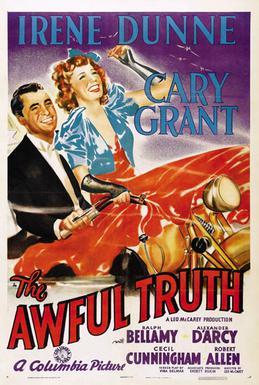
The Awful Truth (1937)

99f81-theawfultruth1937Starring Irene Dunne and Cary Grant, the film revolves around a couple after they split up over unfounded assumptions of unfaithfulness. The divorce is granted and after the wife gains custody of the beloved dog Mr. Smith, the 90 day waiting period begins. First she tries to get over him by spending time with a kind but dimwitted man from Oklahoma. Then Grant gets involved, and at first he gets enjoyment seeing his wife uncomfortable, but he soon becomes a bit jealous and sad. He then takes up his own relationship with an heiress and on the eve of their divorce they seem to be parting ways. However, Dunne’s character will not let it end that easily and she poses as his sister, eventually getting him away from his fiancee. Needless to say that in the end they get back together. This screwball comedy has very funny dialogue and Grand does some wonderful slapstick. It probably is one of my favorites from the genre.

4.5/5 Stars

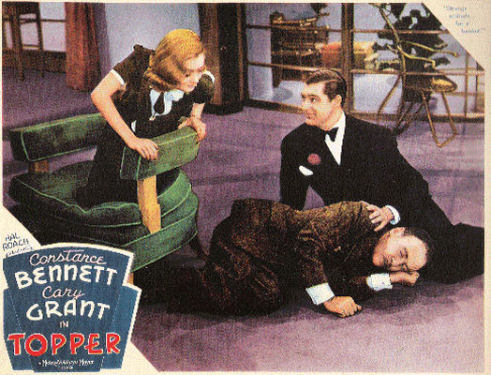
Topper (1937)

e1812-topper_lobby_cardThis fantasy comedy starring Cary Grant and Constance Bennett opens with a married couple flying down the road in their automobile. The unusual thing is that George Kerby is driving with his feet and that pretty much sums of this pair straight from the beginning. They live a wild, fun-filled life full of wealth and parties. However, all this craziness gets them killed when George takes on a curve in the road too fast. They decide as a good deed they must brighten up someone else’s life. Their subject of choice is Mr. Topper, an older fellow from the bank where George had acquired a great deal of stock. He is rather like a grumpy but lovable old dog who just does not want any excitement. The ghosts’ of the Kerbys change that however causing “Toppie” to get his name in the gossip columns after a stay at a chaotic vacation spot. His stuffy wife is dismayed, and his butler is peeved, but finally Topper is starting to enjoy life thanks to the prodding and trouble making of the Kerbys. This film has some good moments, but I would say that Grant’s comedy roles would just keep getting better after this one. 
 
3.5/5 Stars

Spellbound (1945) – Alfred Hitchcock

Directed by Alfred Hitchcock and starring Gregory Peck and Ingrid Bergman, the film follows the complicated story of an intelligent lady doctor skilled in psychoanalysis. Bergman’s character is very focused on her work and often withdrawn. That soon changes when she meets the new doctor (Peck) whom she falls for. However, soon Bergman realizes he is not the real doctor and further uncovers his state of amnesia used to forget his past. Trying to keep him out of the hands of the police, she takes Peck to her former colleague and they try to delve into his dreams. When Bergman finally seems to have all the answers unexpected complications arise. Now she must save her patient and lover before it is too late. Hitchcock’s directing, a great score, collaboration with Salvidor Dali, and good acting make this film worth seeing. Michael Chekhov is certainly good for a laugh or two as well.

4/5 Stars

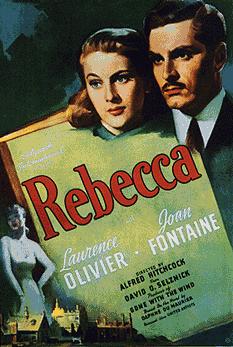
Rebecca (1940) – Alfred Hitchcock

This film directed by Alfred Hitchcock and starring Laurence Olivier with Joan Fontaine, was adapted from the Daphne du Maurier novel of the same name. The story begins in Monte Carlo where Max De Winter (Olivier) and a young woman (Fontaine) have a chance meeting as she is working for an older lady. Soon she learns that his previous wife died the year before. Fairly soon the two of them are attracted to each other and Max has plans of marriage and returning to his Manderley. However, back home the fairy tale is over and the new Mrs. De Winter is constantly tormented by the housekeeper Mrs. Danvers. Pretty soon Max himself seems to have changed. Confused Mrs. De Winter must learn what happened to Rebecca, the lady who was so enchanting. When she actually finds out the truth it is almost too much to bear. Like many Hitchcock films this one is certainly worth watching and it was actually his first American film. Olivier, Fontaine, George Sanders, and Judith Anderson all have very good performances.

4.5/5 Stars

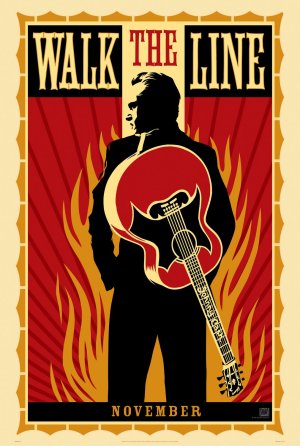
Walk the Line (2005)

Walk_the_lineStarring Joaquin Phoenix and Reese Witherspoon, this biopic opens with Johnny Cash recalling his past as he gets ready to perform at Folsom prison. JR is the son of an abusive share cropper and his brother Jack dies when he is just a boy. He goes off to Korea and comes back with a few songs under his belt. Cash marries his girlfriend and they move to Memphis where Cash tries to get work. On a whim he tries to form a gospel band to audition at Sun Records. Initially it goes poorly until Cash begins to Sing Folsom Prison Blues. Soon Johnny Cash and The Tennessee Two are signed and touring with many different artists. There Cash meets the likes of Jerry Lee Lewis, Elvis Presley and of course June Carter. Cash begins to fall for the recently divorced Carter but she rejects his initial advances leading Cash to go to drinking and drugs. They part ways but then later on they begin to tour again. His music is a success but his relationship with June causes his marriage to go down the tubes. He continues to takes more pills. This is the low point in his career but June gives him a second chance. They perform together at Folsom in 1968 and then after one rejection of marriage, June finally accepts while they are performing a duet. The two of them continue to perform and raise a family together. Phoenix was commendable as Cash and Witherspoon’s vivacious performance gave life to this film. One things is for sure, johnny Cash had a hard life that was full of mistakes. That’s what made his music so good. It was often personal and most importantly human. Because humans make mistakes. Thank you Man in Black for giving us what you did. 4/5 Stars

Vertigo (1958) – Alfred Hitchcock

acaeb-vertigomovie*May Contain Spoilers!

Vertigo is an intriguing Hitchcock thriller, set in San Francisco, that has you cheering for Jimmy Stewart as he falls in love and struggles with his fear of heights. Right away you are met with the haunting opening credits and the dramatic opening sequence where Scottie (Stewart) acquires his vertigo. From then on Scottie must cope with his dizzying condition however, he has no time to remedy it since he suddenly finds himself tailing a beautiful woman for a friend. Much of the rest of the film seems surreal with minimal dialogue and interesting cinematography, leading up to the death of Madaleine (Kim Novak). Then the film switches gears and is mostly about the impact on Scottie who had become infatuated with Madaleine. Often he appears to be in a trance and he becomes obsessive after meeting Judy who looks strikingly like Elster’s dead wife. Scottie becomes controlling, trying to make Judy into the image of the woman he loved. She just wants him to love her for who she is but that cannot be. Fittingly, the film ends the way it began with drama and tragedy. This certainly is a fascinating view of human psychology and complex emotions. In order to appreciate this film it is almost necessary to watch it at least twice, once to understand the plot and then another time to spot the little details. Of all of Hitchcock’s work, I would say I still enjoy Rear Window or North by Northwest better but this film at least deserves a viewing or two.

5/5 Stars

Groundhog Day (1993)

01498-groundhog_day_movie_posterStarring Bill Murray and Andie MacDowell, this romantic-fantasy-comedy is about a conceited weatherman named Phil Connors who goes to cover Groundhog Day. After coping with the day once, Phil wakes up and goes through it again realizing he is in a time loop. At first since there are no consequences Phil memorizes every occurrence, takes advantage of situations, and romances any woman he wants. However, over time the novelty wears off and it soon gives way to monotony. He even starts committing elaborate suicides to get out of each day. However, as he continues to fall for his producer, Phil begins to change and decides to use all he knows for good. After one day he is the most loved man in town and surprisingly enough he finally is free. The concept of this film is certainly interesting and it brings up hilarious and thought-provoking situations. Phil Connors begins as a self-serving jerk, hits rock bottom, and finally finds redemption in showing kindness for others. And the best part is he no longer has to listen to I Got You Babe!

4.5/5 Stars

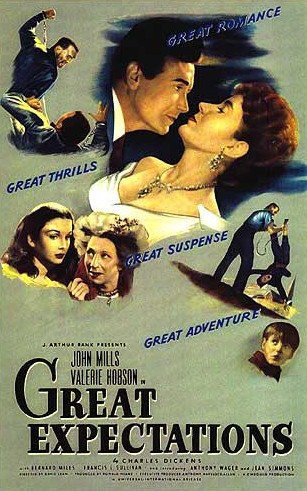
Great Expectations (1946)

ad366-great_expectationsWith director David Lean, and starring John Mills as Pip, the film begins with Pip as a young boy. Upon meeting a fugitive, Pip show him kindness and the man promises he will return the favor. A year or so later Pip begins to go to the home of an eccentric, rich widow to call on her. There he meets the lady’s adopted daughter Estelle and he falls for her. Now an adult, Pip learns he has a mysterious beneficiary who is paying for him to move to London to be a Gentleman. There he interacts with Mr. Wemmick, the attorney of Mr. Jaggers, and also Herbert Pocket (Alec Guinness). Then, someone shows up on his doorstep and changes his world. Soon he is orchestrating an escape for his friend, saying goodbye to the cold Estelle, and showing his displeasure for the elderly Ms. Havisham. However, in the end he learns a happy truth and reunites with Estelle. This moody, Dickens adaption actually has an optimistic side which is a nice change.

5/5 Stars