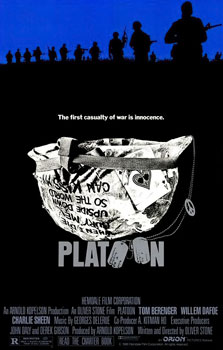
Platoon (1986)

platoon_posters_86It’s a rather interesting parallel that Charlie Sheen is playing much the same role his father did in Apocalypse Now. At least in the sense that they become our entry point into the mire of war, specifically in Vietnam. But where Apocalypse seemed to belong more so to Brando or even Duvall, Platoon is really Willem Dafoe’s film. At least he’s the one who makes it what it is. His final moment is emblematic of the entire narrative.

But it is also striking that the film opens with an excerpt from Ecclesiastes as follows, “Rejoice young man in your youth…” But the latter half of that same verse has major implications that will come into play later.

For now, these soldiers muddle their way through their tours of duty the best they can. Smoke, beer, and Smokey Robinson is the perfect way to combat the insanity and humidity right outside your tent.

Oliver Stone conjures up themes of politics and government conspiracies. The first word is uttered several times throughout Platoon but in the general sense. When you get a group of people together vying for positions and attention there’s bound to be politics. As for government conspiracy, Stone doesn’t quite scrape that barrel, although to be sure as a Vietnam veteran himself perhaps he has a lot to be disgruntled about.

Instead, he has a cast of characters who get to reflect all the angst and disillusionment for him and it’s a fairly impressive bunch. Aside from Sheen and Dafoe, John Bergener, Keith David, John McGinley, Forrest Whitaker, and even Johnny Depp make appearance wading their way through Vietnam.

It’s been far too long since I’ve seen Apocalypse Now to draw too many comparisons. However, although Platoon is a perturbing film it’s not the same type of expansive labyrinth that I recall from Coppola’s epic.  Charlie Sheen’s voiceovers attempt to add an introspective tinge to the entire narrative, but that is not where the strength of the film lies.

Platoon also has its share of pyrotechnics, in fact, it succumbs to them too often but that’s not the reason the film is affecting either. It’s the aftermath of those explosions. The carnage that is left in the wake of the barrages of RPGs. The bodies maimed and the images that haunt these young men.

And as audience members, it’s hard not to feel something. Repulsed. Angry. Frustrated. Confused. Perhaps that is the film working — giving even a zenith of the taste of what it was to be in the jungles of Vietnam back in 1967. This is one of those experiences I cannot take too often because it’s almost too much.

My initial hope was that Stone would not inject this film with his own brand or message and I will say that when I watch Platoon I am not left with the feeling that I am listening to Oliver Stone but instead I am watching something terribly volatile unfold. That’s certainly a testament to this film. In the end, Platoon is bolstered by its sheer intensity.

But back to Ecclesiastes, the earlier verse ends “and let your heart be pleasant during the days of young manhood. And follow the impulses of your heart and the desires of your eyes. Yet know that God will bring you to judgment for all these things.” And it’s this final bit that is important in suggesting that young men are laid low due to their joy. But it’s hard to make that type of assertion. If anything, a film such as Platoon is perplexing because the answers are unclear and the reasons the world works the ways it does are not known to us.

Young men will continue to walk through life naively and he will struggle through life questioning the presence of God as much as this seemingly apathetic indifference towards the suffering in the world. Whether Stone was grappling with those same questions is up for contention but the beauty of film is that it very rarely works on a singular level. It can mean many things to many people. So it is with Platoon.

4/5 Stars
Go for Broke! (1951)

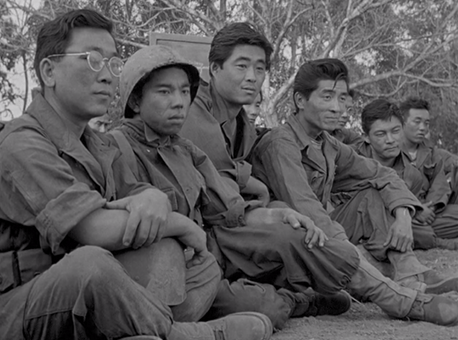
goforbrokeWWII is always a fascinating touchstone of history because it has some many intricate facets extending from the Pacific to the European Theater to the American Home Front and so on, each bringing with it unique stories of everyday individuals doing extraordinary things. One of the best-kept secrets is the 442nd Infantry Division later joined with the 100th and effectively making the first all Japanese-American fighting unit which served over in Italy and France.

But perhaps the most striking thing about this band of men was the inherent hypocrisy they unwittingly pointed out within America’s own society. As their loved ones sat enclosed in tar paper barracks and barbed wire fences within internment camps, these courageous lads went off to prove their allegiance to their country. Reflecting the very freedoms and liberty that America was founded on, in spite of the injustices that were thrown their way.

But really instead of simply reflecting the bad, Go for Broke! is a far more empowering story and Robert Pirosh’s film does a stellar job at showcasing these men with a great deal of respect. He had previously shown an aptitude for realistic war films like Battleground, and joining forces with Van Johnson once more, he delivers another authentic picture.

Going so far to fill out the rank and file of the film with real 442nd veterans, Go for Broke! begins with a newly promoted officer born and bred in Texas. At first, he shows a slight distaste in being called upon to lead a unit of Japanese, partly due to the fact that he was torn away from his buddies, the other simply a result of his own narrow-mindedness.

After all, he becomes the stand-in for the prototypical viewer and as his character slowly begins to evolve as they go through boot camp, then Italy, then France, the impact on the viewer is duly noted. Thus, although he proves to be an important figure, it should not be forgotten that in many ways the 442nd is front and center.

Among the men we get to know are the level-headed Sam (Lane Nakano) who has a girl waiting for him back in the states while his family remains interned as public aliens. Tommy is the runt of the group, a funny sort of fellow, who makes the ultimate sacrifice when he gives his beloved pig to a starving family. There’s the bespectacled college boy who was in the process of becoming an architect and the defiant Chick (George Miki), ready to fight with whoever crosses him. Far from being stiff, these men lend a certain realism to the film that elevates it to that of a fascinating historical artifact.

There are some wonderfully humorous moments that diffuse the conflict of cultural identity. The recruits of the 442nd walk up the gangplank as the soldier in charge struggles to read off their family names and as each man passes by he responds with a very basic anglicized name. George W. and Thomas H. In another moment an angry Van Johnson looks over at his second in command Oharra during a patrol to inquire what a Japanese word means. Without skipping a beat the man quickly apologizes, “Sorry sir, I don’t speak Japanese.” Only later as these soldiers become his loyal comrades does he learn what “Backatare” means. It becomes a film where soldiers from California and Texas can poke fun at each other, but that’s only because mutual respect builds between the 36th and 442nd.

Lt. Grayson reveals his final transformation when he enters into an altercation with his old pal Cully who has a heavy dose of bigotry. By the end of the film, the man’s still not exactly a saint, but his eyes are opened at least a little bit. And in the end, the 442nd comes to the aid of their brethren. The film concludes with one of their greatest triumphs, rescuing the lost battalion pinned down by the enemy on all sides. The casualty tolls were high, but in such moments the Japanese-Americans proved their grit and determination right alongside all the other fighting men. This is the film they deserved and the type of recognition that they deserve even today. It’s a shame that more stories like Go For Broke! have not been told, but it makes this one all the more important.

3.5/5 Stars

Catch-22 (1970)

catch221It’s the bane of my literary existence, but I must admit that I have never read Joseph Heller’s seminal novel Catch-22. Please refrain from berating me right now, perhaps deservedly so, because at least I have acknowledged my ignorance. True, I can only take Mike Nichol’s adaptation at face value, but given this film, that still seems worthwhile. I’m not condoning my own failures, but this satirical anti-war film does have two feet to stand on.

It reads like a cast of millions: Alan Arkin, Martin Balsam, Richard Benjamin, Art Garfunkel, Jack Gilford, Buck Henry, Bob Newhart, Anthony Perkins, Paula Prentiss, Martin Sheen, Jon Voight, Bob Balaban, Peter Bonerz, Felice Orlandi, Jack Riley, Marcel Dalio, and even Orson Welles. And in truth, no one character disappoints, because no one character has to carry the brunt of this narrative.

Certainly, Yossarian (Alan Arkin), the disillusioned WWII bombardier, is our protagonist, but he needs people to react to and bounce off of. It’s the likes of Colonel Cathcart (Balsam) and Lt. Colonel Korn (screenwriter Buck Henry) his neurotic superiors and the pragmatic wheeler-dealer Milo Minderbender (Jon Voight) who make him that way.

Their world of bombing missions, valor, medals, and “The Syndicate” are utterly absurd just as they are, but they don’t seem to recognize it. That’s where the satire stems from, the critique of war, and all the wit. It seems like no coincidence that Mike Nichols released this film during the Vietnam Era. Like its compatriot, Robert Altman’s M*A*S*H, it finds a wickedly dark sense of humor in war. Because what is there to do with death and violence, but laugh and try to find some way to grapple with it?

catch222The Chaplain (Anthony Perkins) doesn’t feel like a man of the cloth at all, but a nervously subservient trying to carry out his duties. An agitated laundry officer (Bob Newhart) gets arbitrarily promoted to Squadron Commander, and he ducks out whenever duty calls. Finally, the Chief Surgeon (Jack Gilford) has no power to get Yossarian sent home because as he explains, Yossarian “would be crazy to fly more missions and sane if he didn’t, but if he was sane he’d have to fly them. If he flew them he was crazy and didn’t have to; but if he didn’t, he was sane and had to.” This is the mind-bending logic at the core of Catch-22, and it continues to manifest itself over and over again until it is simply too much. It’s a vicious cycle you can never beat.

In fact, each man involved must cope with their duties one way or another oftentimes through prostitution, jokes, or an obsessive almost numb commitment to duty. Yossarian tries all of the above rendezvousing with an Italian beauty and receiving a medal without any clothes on.

catch224But the tonal shift of Catch-22 is important to note because while it can remain absurdly funny for some time, there is a point of no return. Yossarian constantly relives the moments he watched his young comrade die, and Nately (Art Garfunkel) ends up being killed by his own side. It’s a haunting turn and by the second half, the film is almost hollow. But we are left with one giant aerial shot that quickly pulls away from a flailing Yossarian as he tries to feebly escape this insanity in a flimsy lifeboat headed for Sweden. It’s the final exclamation point in this farcical tale.
M*A*S*H  certainly deserves a reevaluation, but Catch-22 just might be the best, or at least one of the best, anti-war films of the 1970s. Mike Nichols delivers once more with a wickedly funny indictment of global conflict using a classic of American literature for inspiration.

4/5 Stars

Ashes and Diamonds (1958)

ashesanddiamonds1We’re used to getting our hands dirty in the thick of World War II, whether it is in the European theater or the Pacific, but very rarely do we consider the consequences that come in the wake of such an earth-shattering event. Things do not end just like that. There must be periods of rebuilding and rehabilitation. There is unrest and upheaval as the world continues to groan in response.
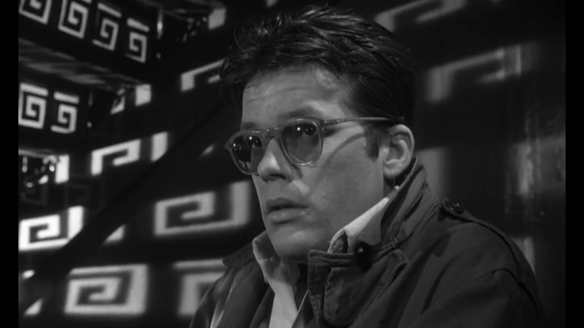
Ashes and Diamonds is one of these stories. It’s a film that rumbles from its core depicting a post-war wasteland in Poland that has been trampled by the Germans and overrun by the Soviets. People want peace and there’s seemingly none to be found. At least not at the present.

The film’s main attraction, Zbigniew Cybulski, plays the nationalistic soldier Maciek, who along with his superior Andrzej are charged with assassinating an incoming Communist commissar named Szczuka. Cybulski’s exhibits the hesitant, insecure movements of James Dean similarly hiding behind a persona overflowing with palpable coolness. In one sense we want to be this guy, but we also feel sorry for him.

From its opening notes, Ashes and Diamonds proves to be a dynamic piece of realism as our two protagonists start off with guns blazing before inconspicuously leaving the scene of the crime. But their work is not done, in fact, their mission has been bungled, and so they must wait around tensely for another chance. They take up refuge in a local hotel which also happens to be awaiting the arrival of the most esteemed guest, comrade Szczuka.

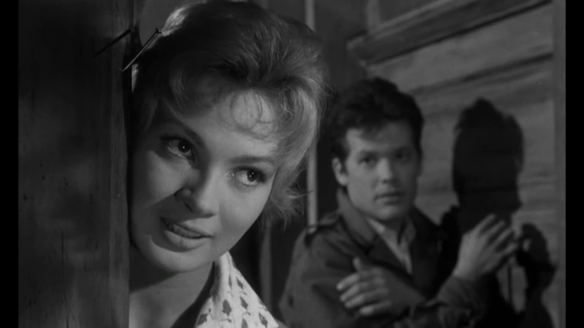
This is not solely some political drama either. Andrzej  Wajda’s final film in his WWII trilogy certainly has roots in Poland’s historical past like the Warsaw Uprising and the changing of the guard as the Germans surrender and the Soviets move in. However, Ashes and Diamonds is woven together by a human component — a romance that is at odds with all things political. Because while he plays the waiting game at the hotel, smoking cigarettes and lounging, Maciek begins to fall for the woman on the other side of the bar named Krystyna. You assume from their initial flirting and Maciek’s come-ons that this will only be something superficial, but such moments of tension seem to heighten passion and the need for intimacy. These two individuals so recently introduced become so close in a matter of hours.

ashesanddiamonds2There are love scenes that are quiet, subdued, and truly intimate. In fact, it feels rather like Hiroshima Mon Amour where the camera lingers so closely on two figures in such close proximity. There does not have to be great movement or dramatic interludes because having two people next to each other should be enough. The historical context in itself seems to be enough. For that film, it meant Japan post-1945. For this one, it’s Poland after the clouds of war have lifted.
Certainly, the film is bookended by two high-octane bangs of fiery drama, but even in the moments in between Ashes and Diamonds is ceaselessly interesting. It might be a meandering horse on a quiet road or a fire extinguisher at a gay party or even the late night impromptu improvisation by an orchestra that is slightly off key. They make for wonderfully delightful additions to the narrative being told. It feels organic and rich with the tidbits that make up everyday life. It’s just that this slice of life happens to be in post-war Poland with high stakes hanging in the balance.

As Maciek battles his own inner turmoil to match the turmoil outside, the words of a poem inscribed on the wall of a bombed-out church spring to mind:

So often, are you as a blazing torch with flames
of burning rags falling about you flaming,
you know not if flames bring freedom or death.
Consuming all that you must cherish
if ashes only will be left, and want Chaos and tempest
Or will the ashes hold the glory of a star-like diamond
The Morning Star of everlasting triumph.

4.5/5 Stars

The Hurt Locker (2008)

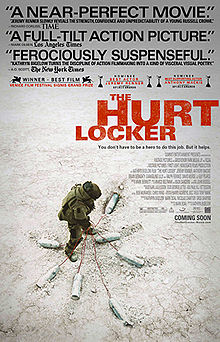
220px-HLposterUSA2Being ignorant of the term “Hurt Locker,” I did a reasonable thing and looked it up. According to IMDb:

To put someone in a “hurt locker” is to physically mess someone up, badly. It is roughly synonymous with causing someone “a world of pain.” According to the movie’s official website, “In Iraq it is soldier vernacular to speak of explosions, as sending you to the hurt locker.”

Well, that about sums it up, and it does so, beautifully by getting to the core energy that pulses through this film. It gets dicey and intense when these highly trained individuals are put into the most volatile of situations. It doesn’t get more volatile than bomb detail, and how they maintain composure in such circumstances is a miracle, a testament to grit and willpower. That’s not to say they don’t go through their own moments of turmoil. How could you not, at least at some juncture?

It struck me that this film does not feel like a political statement, even less so than Bigelow’s other war epic Zero Dark Thirty. In a sense, that would be a major disservice to the men who fight, by taking all the attention off of them and instead placing it on agendas and politics. However, all of that is left to the politicians, and we simply are given a very small taste of what those fighting the War on Terror experience. Can we fully comprehend it? No, but at least now we have a better idea of how post-traumatic stress disorder can develop. The constant strain that these people are going through takes its toll physically and emotionally. Yet they still push through their tours in order to do the job that has been handed to them. They brave a world of suicide bombers and ambiguity that could quickly send you into the hurt locker. In that way, it reminds me of a modern take on Battle of Algiers, because not everything is as clear-cut as we would like it to be.

The Hurt Locker follows Bravo Company during the tour of duty. Their first disposal expert (Guy Pearce) meets with tragedy and his buddies are forced to welcome a new member to their team, Sergeant William James (Jeremy Renner). He hasn’t disarmed 873 bombs for nothing, but he maintains such a streak by being very cavalier in his conduct. He’s a maverick, a man who will unflinchingly ditch all communication in order to focus on the task at hand. He’s a bit of a loose cannon and that’s not always the best type of personality for such a tightly knit group. They have to be if they want to survive since such behavior can be the difference between life and death. There’s a camaraderie and a rapport that builds over time, but before that he causes his compatriots to squirm more than once, and when they squirm we’re positively crawling out of our skin.

Shot in Jordan, quite close to the real-life locales, there is a gritty and raw quality to how Kathryn Bigelow frames the world with the help of cinematographer Barry Ackroyd. It manages to be personal and unsettling all at once. In comparison, it’s invariably striking how stagnant American life is when James returns home.That’s potentially a good thing, but does it mean that we’re taking life for granted, or living eternally thankful for each day that we still have breath in our lungs? That’s what The Hurt Locker does. It gives us a deeper respect for these men and a deeper appreciation for life.

4.5/5 Stars

Stage Door Canteen (1943)

stagedoorcan2

Director Frank Borzage’s Stage Door Canteen is a gentle-handed piece of propaganda. It plays out rather like a scripted 1940s wartime reality. It’s less a film and more of a historical relic commemorating the eponymous Stage Door Canteen in New York City. Thus, any effort to give it some sort of rating almost seems beside the point, because it was meant to be a rallying cry of comfort, entertainment, and escape from the war right outside. It met the general public right where they were and inundated them with mega star power. This wasn’t the only nightclub or film to do this either. The Stage Door’s west coast counterpart was the Hollywood Canteen, and it received a film treatment of its own in 1944.

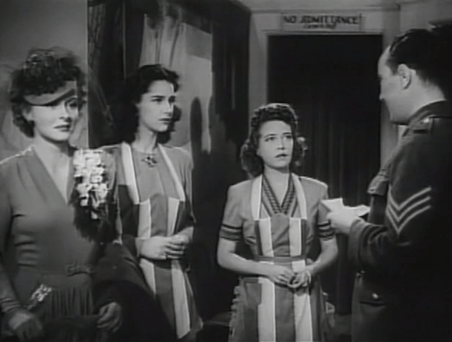
In truth, the real nightclub was still in full use every day so the next best alternative was the RKO Lot in Culver City. That’s where it all happens like a day in the life. We follow three soldiers: the perfect cross-section of white red-blooded American G.I.s. Each one gets to dance and talk their last days away with a pretty girl serving as a hostess at the canteen. Each one of them will never forget it.

The entertainment is full of partial cameos, pop-ups, and performances from a plethora of stars. For even the most well-acquainted modern viewer, it’s hard to recognize all the faces and names that show up. Katherine Cornell, Count Basie, and Yehudi Menuhin are a few such figures who come to mind.

stagedoorcan1There are also strategic vignettes sprinkled throughout to boost morale and the camaraderie between allies. A few Brits can be heard taking part in the gaiety and making friends with our protagonists. A table of Hispanic soldiers takes in a floor show. One of our hostesses gets a moving letter from her older brother in the marines who is bent on returning to his family and proving that his training can outlast any “Jap” out there. There’s a last-minute marriage ceremony that we are privy to. Sam Jaffe introduces the audience to a few Russian allies, an Australian soldier has just returned from the front, and several Chinese air cadets get a rousing appreciation. Merle Oberon (the only actress close to being Asian in the film) gives them a stirring sendoff. Finally, Katharine Hepburn drops in for the premier cameo, to tie together all the loose ends and rally her fellow men and women to keep on keeping on for the sake of the country, so that the Allies might win the war.
From our modern day perspective, this might all come off like saccharine hogwash, but that’s not giving the material its due sensitivity. For that point in history, it was exactly what the American public was looking for. Today it’s a fascinating piece of remembrance. Then, it was still a story with a “to be continued” ending.

3.5/5 Stars

The Steel Helmet (1951)

steelhelmet1“What a fouled-up outfit I got myself into” – Sgt. Zack
Samuel Fuller always had an eye for the visually dynamic and a nose for controversy. His war picture The Steel Helmet was at the forefront of films about the Korean War, in fact, it was probably the first.

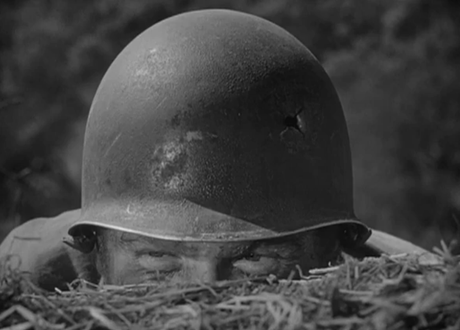
Despite, being shot in a few solitary days in California, he somehow managed to develop a generally atmospheric terrain overflowing with fog of war and overgrown with foliage. It’s an unsentimental, gritty, sweaty storyline. In other words, it’s very Fuller and its cynical lead is Gene Evans as the thick-headed Sergeant Zack weighed down by war-induced pessimism. He’s got a bullet hole in his helmet to prove it. He’s been good enough to last through this game of survival of the fittest thus far, and he hopes to keep it that way.

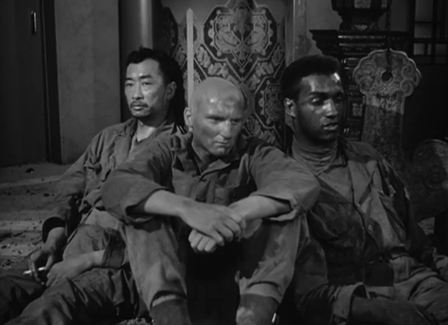
Zack picks up a peppy young South Korean, the original “Short Round,” and the sergeant reluctantly allows him to tag along as he continues his pilgrimage. Next, comes the African-American medic Corporal Thomson, who like Zack was the sole survivor of his unit. In the forest depths, they run into a band of soldiers led by the experienced Lt. Driscoll. Although Zack wants nothing to do with them, he agrees to stick around after they get pinned down by a couple snipers.

Their mission: to set up an observation post at a nearby Buddhist temple.  However, the road ahead includes booby traps and other menacing perils of war. They have one of their hated “gooks” waiting for them, and he causes some havoc before being captured. However, perhaps more insidiously he tries to undermine the men by going after Thompson and the “Buddha head” Nisei vet named Tanaka (Richard Loo). The wily enemy, in perfect English mind you, notes the hypocrisy of an American society where African-Americans can die on the battlefield, but then only get to sit on the back of a bus. He then suggests how he and Tanaka have a great  more in common, aside from their eyes, especially since the American government put Japanese-Americans in Internment camps

steelhelmet2But the old WWII vet simply acknowledges the facts and retorts with his own piece of trivia. In the all Japanese-American regiment the 442nd 3,000 Nisei “idiots” got the purple heart for bravery. All he knows is that he’s an American no matter how he’s treated. That doesn’t change. Once more Fuller delivers some of the most engaging portrayals of Asian characters ever and the discussions of race relations were way ahead of their time. Both Richard Loo and James Edwards are honorable characters who hardly fall into any common stereotype.
After staving off this psychological warfare, the band calls in an artillery barrage on some nearby snipers. But soon the enemy is swarming them and it’s a wildly thrashing, blasting battle to the death.  The fight scenes are sheer chaotic madness, but then again isn’t that what war often escalates to? It just doesn’t make sense. Billows of smoky haze engulfing the war zone. Whirrs, bangs, explosions, and every other sound imaginable except silence. That comes when the bodies are dead and strewn all over the battlefield. In truth, silver stars mean very little when you’re just trying to survive.

Fuller was prophetic by suggesting that there is no end to this story. He was right. It went on for a couple more years and ended in a cease-fire that still continues between North and South Korea to this day. He’s also one of the great economical filmmakers where less is most certainly more. What a stroke of brilliance that he could use a weeks time, the grounds of The Griffith Observatory, and a few minor actors and extras to create such a fascinating film.

4/5 Stars

Grand Illusion (1937)

GrandeIllusionI’m not sure if it’s because I’ve been bred on a certain brand of war movie, but I naively went into Grand Illusion expecting a typical P.O.W. drama. In the back of my mind, I was even ready to compare this title to later works like Stalag 17 (1953) or The Great Escape (1963). Honestly, what was I thinking? With a Jean Renoir film no less.

But that’s the marvelous quality of this film. On the surface level, it looks like an archetype that we are used to. War is being waged. Soldiers are captured. Soldiers are trying to escape. In this case, the particulars are a group of French P.O.W.s in a German camp during WWI. You have the basic idea certainly, but you will not understand the power of this film with such a description. With such a set-up you expect Germans to be the craven villains and the French to be the courageous boys making their nation proud. But that’s not quite the case. It’s more complicated than that.

It’s no surprise that this film was banned by Mussolini, confiscated by Goebbels after the invasion of France, and shown in a private screening to FDR. Certainly, WWII had not started yet, but in 1937 Hitler was on the rise and a wave of fascism mixed with patriotism was flooding Europe. In the midst of such a climate, Jean Renoir, a master of so-called poetic realism, lays down a film like this. It has war, it has patriotism, and it even has enemy factions, but the difference is that Renoir gives them humanity. He casts even his “enemy” in a sympathetic light and suggests that there is a humanity that lies inside of human beings of all different classes, creeds, and nationalities (but he also acknowledges racial discrimination still exists).

Early on in the film von Rauffenstein (Erich von Stroheim) shoots down two enemy flyers in Captain de Boeldieu (Pierre Fresnay) and Marechal (Jean Gabin). However, instead of sending them away to the prisoner of war camp, he shows them the ultimate form of hospitality by inviting them to dine at his table. The cynic inside of me thought, “this must be a trap, a gimmick of some kind because he is a German after all, and they’re supposed to be the villains.” Pretty narrow-minded of me, and of course nothing happens. They share a meal and even find some common ground before going off to the camp.

This next part of the film reminds me the most of a film like Stalag 17 because there is the camaraderie, the mixing of all sorts of different people, but they are all fighting against a common enemy so there is a solidarity between them. For instance, Rosenthal (Marcel Dalio) shares his lavish care packages from back home, Cartier keeps things lively as a former vaudeville performer who is constantly cracking jokes, and even Boledieu, who is of an aristocratic background is generally well liked by everyone. Together they undertake the project of escaping the camp.

Of course, there’s still time for musical performances with song and drag and impromptu renditions of “La Marseillaise.” For such a disturbance Marechal (Gabin) gets solitary confinement, but there never seems to be any malice behind it. It feels more like the protocol of war, and he is let out soon enough. The way things work out the gang is transferred all to different camps and their tunnel is utterly wasted.

De Boldieu and Marechal’s final stop is literally a fortress that is run by their old acquaintance, the now badly maimed Von Rauffenstein. He is as civil as he has ever was but still advises them not to try escape. All the same, he regrets his reassignment and seems generally wistful about the whole situation. Meanwhile, the two officers once again come in contact with Rosenthal. The trio puts together a planned diversion led by De Boldieu which will let the other two escape. It puts von Rauffenstein in another regrettable position, but Rosenthal and Marechal do get away.

As fugitives, their dispositions fluctuate from positivity to loathing, and finally a contented state of comfort when they stay at the farmhouse of a young German woman named Elsa (Dita Parlo from L’Atalante). This is another section of the film that highlights human relationships in an extraordinary way. We expect her to be totally poisoned against “the enemy” and yet she is not. Elsa seems to see the human beings behind the French uniforms and comes to trust and almost rely on their companionship. As Rosenthal recovers from a leg injury, Marechal and Elsa get closer and closer. The time comes for the two men to leave and it is an absolutely heart-wrenching goodbye. It’s so different than our initial preconceptions.

And soon after the film ends, not with some dramatic capturing or even really a chase. But the two men get across the border to snowy Switzerland and that’s where we leave them. Except not with the usual jadedness or even the adrenaline rush of a run-of-the-mill war thriller. Grand Illusion is more piercing than that, speaking to the relationships that can cross war zones if we are only willing to see them.

Jean Gabin is a wonderfully honest-faced actor and the closest description I can give is a man with a Spencer Tracy-like visage except more imposing. Marcell Dalio did some wonderful work with Renoir, and it is unfortunate that he was relegated to such small roles in films like Casablanca, but he is nevertheless even memorable in that. Erich von Stroheim was a titan in his own right as a director and actor, but he was somewhat of a fading star by this point. However, he plays his character with a civility and sense of honor which I have never quite seen equaled before. It was a special performance that reflects a dying breed. The aristocratic soldier of the highest order in all circumstances.

Renoir himself summed up the film years later as being about human relationships and fittingly said the following: “I am confident that such a question is so important today that if we don’t solve it, we will just have to say ‘goodbye’ to our beautiful world.” Here is a master recognizing such a vital key to our very humanity — our personal interactions with one another.

5/5 Stars

Atonement (2007)

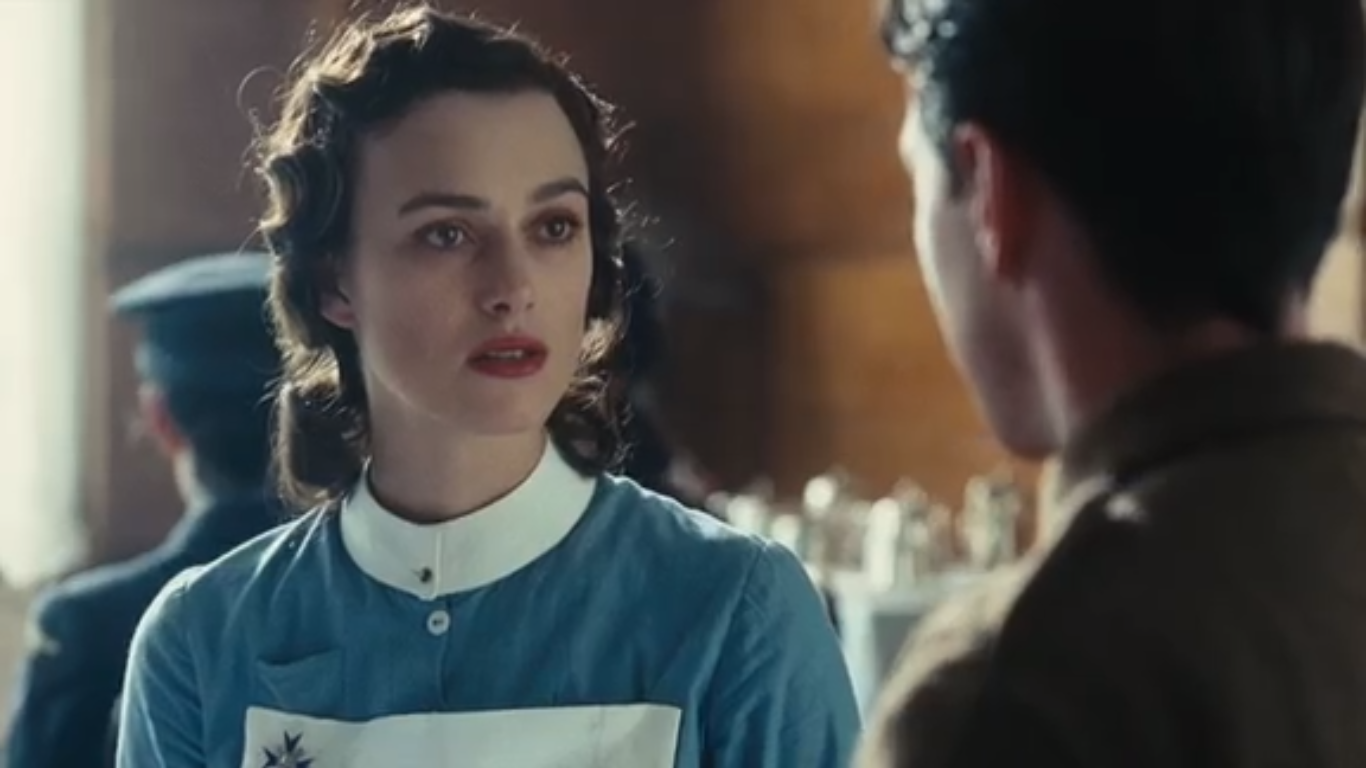
atone2Without any prior knowledge and given what we know to begin with, it looks like Atonement will be a love story revolving around the characters of Keira Knightley and James McAvoy. They are, after all, the big stars in this WWII era romance based on the Ian McEwan novel. We expect to become enraptured in their passionate love affair that is to be indubitably broken up by war. However, it becomes evident very quickly that this is really a tale about a young girl  and budding author, played through the years in succession by  Saoirse Ronan, Romola Garai, and Vanessa Redgrave. It is her point of view and her part in this narrative that becomes most important, although we do not have any indication as to why to begin with.

So in front of the peering eyes of Briony Tallis, her older sister Cecilia (Knightley) and the son of the family housekeeper Robbie Turner (McAvoy) start something which Briony cannot fully comprehend and understand. What is it that is really going on around her? An intricate manipulation of time and place begins, relating the story from a number of perspectives, but always returning to Briony. How does Cecilia really feel towards Robbie, who is in a sense below her, but still proud? Briony knows she has feelings for the housekeeper’s son, but how is she to react when she finds her sister and Robbie crammed up against the bookcases together. Then, when a pair of pesky twins goes missing a search party begins. Again Briony sees something that she cannot fully understand, and yet she makes a judgment that will unwittingly tear apart two lives. There is constantly an inquisitiveness, a confusion in her expressions that is absolutely spot on.  And in these moments the score is suffocating with its pounding, clanging, and banging.

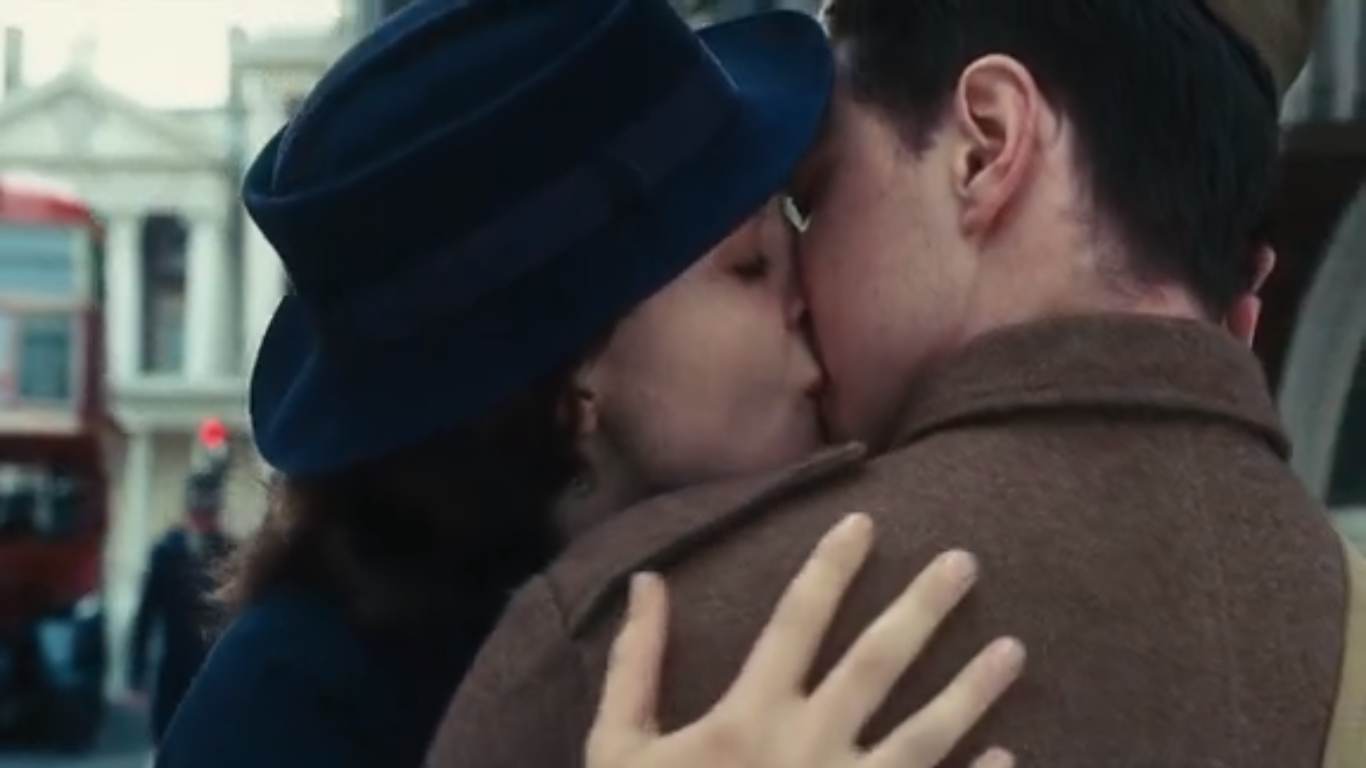
atone3Robbie gets sent away, torn from his love Cecilia, and Britain is on the brink of war. When the two lovers finally get a chance to see each other, he has joined the army in order to be released from prison, and she is working as a nurse.  But it’s a heartbreaking separation because although the passage of time is condensed for us, we can easily see the reserved, hesitant quality in both of them. How are they supposed to react? It’s difficult to hold onto the same feelings, maintain the same type of passion when you’re separated by the years. Cee reaches out to touch his hand, and he avoids her slightly. You cannot exactly blame him, but there is a tinge of sympathy for her.

But their romance is quickly renewed and heightened once more in a matter of days, only to have the war this time pull them apart. And it’s something that’s very hard to rebound from. Robbie ends up in the middle of France and when he finally discovers the coast with a couple of comrades they come across all the forces at Dunkirk getting ready to retreat. For those engaged with WWII history, Dunkirk was in one sense a wounding blow to the English ego, but also a testament to their resilience. The men are beaten and battered, but escape the Nazi onslaught to fight another day. And yet we don’t see the fighting. With a wonderfully dynamic tracking shot director Joe Wright gives us an eye into the tired and wounded masses. And it’s somber, chilling, melancholy, and still strikingly beautiful in the same instance.

atone5Back home, Briony is now working in a hospital almost as penitence for wrongs and soon the hospital is inundated with wounded from the retreat. She is quickly thrown into action comforting a dying French soldier with a penchant for the soft refrains of Debussy. Then, comes the pivotal confrontation where Briony, now older, faces her sister who has refused to talk with her. And Robbie is there too. Together they painfully and angrily point out what the young girl had done to both of them. It’s heart-wrenching to the nth degree and yet the final revelation makes it all the more painful.

Now many years down the line, Briony, who is now much older (Redgrave) and an author of 21 books, is interviewed about her final novel Atonement. It lays out the events of the whole film, and she explains her reason for writing such a story. She wrote it to be read by the public certainly, but most importantly she wrote it for Robbie and Cee. To give them closure and the dignity that they deserved.

So you see, it’s the book within the book really or more correctly Ian McEwan writing a novel called Atonement featuring a fictitious version of the same work. In a sense, I do feel manipulated by this film, but do I mind? Not really. I don’t hold it against the film because it tells its story with so much beauty and grace.

4/5 Stars

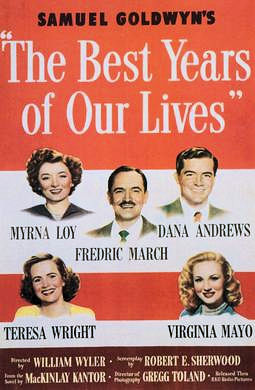
The Best Years of Our Lives (1946): The Forgotten Counterpart to George Bailey’s Story

The_Best_Years_of_Our_Lives_film_Inherent in a film with this title, much like It’s a Wonderful Life, is the assumption that it is a generally joyous tale full of family, life, liberty, and the general pursuit of happiness. With both films you would be partially correct with such an unsolicited presumption, except for all those things to be true, there must be a counterpoint to that.

Upon watching both these films on subsequent days, that became markedly evident. George Bailey (James Stewart), of course, must go through a perturbing alternate reality where he never existed, and the consequences are catastrophic to all those he knows and loves in his community. But such a paradigm shift or new perspective, does truly revitalize his entire existence. It’s as if he sees the whole world through an unfaltering lens of hopefulness thereafter.

Although it lacks the dark fantasy that engulfs the latter half of It’s a Wonderful Life, Best Years has its own heavy dose of foreboding, that while more realistic, is no less disconcerting. All the boys have returned from the theaters of Europe and the Pacific, including our three protagonists Fred (Dana Andrews), Homer (Harold Russell), and Al (Fredric March). Upon getting back to their old abode of Boone City, sons talk about nuclear fallout in Hiroshima and men at drug store counters warn of the imminent threat of “The Reds.” Some soldiers like Fred have trouble landing work. Others struggle with getting the necessary loans from banks like the one Al works at,  or they come back to far less glamorous lifestyles. Homer copes with being a double amputee and simultaneously closes himself off to all those who love him, including his longtime sweetheart Velma (Cathy O’Donnell). He must learn not so much how to love, but the equally difficult life skill of allowing others to love him.

Derry also struggles in a loveless marriage with his superficial wife Marie (Virginia Mayo), while also battling with PTSD symptoms like recurrent nightmares. Even the subtle reality that the only African-Americans in the film work behind soda fountain counters or in nightclub jazz bands has greater implications. Theirs is a relegated status, even in a country of liberty like America. Unlike the former film, we do not see any ghoulish human cemeteries, but we do see plane graveyards like ghost towns where metal is slowly rusting just waiting to get demolished and re-purposed. At this point, it is only a sobering reminder of all those who fought and died in the war years.

Many of these topics are only mentioned for a brief moment or we can only infer them from visual cues, but still, they lurk there under the surface or better yet, right in plain view. These real-life unsettling concerns are worse than It’s a Wonderful Life because they fall so close to home even today.

Wounded veterans are still coming home to a country that doesn’t know what to do with them, or a country that seems ungrateful for their service. Married folks still struggle through marriage and divorce. Single people still struggle with figuring out if they should get married and so on.

I think part of the reason I admire The Best Years of Our Lives so much, despite its nearly 3 hour running time, is its ability to captivate my attention rather like a day in the life of someone I would meet on the street. Although Virginia Mayo and Mryna Loy seem the most Hollywood, most everyone feels rather ordinary. Certainly, Dana Andrews is handsome and Teresa Wright, as well as Cathy O’Donnell, are wonderful as multidimensional girls-next-door, but I feel like I could potentially know people like them. And of course, Harold Russell was unusual since he wasn’t a trained actor. That casting choice pays off beautifully in moments such as the final wedding scenes where in a dyslexic moment he switches up his vows. But it works wonderfully as an authentic addition.

Although Gregg Toland worked on revolutionary fare like Citizen Kane, and William Wyler dabbled in all sorts of genres from westerns to period dramas, they have all the necessary sensibilities for a perfect presentation given the subject matter. The visuals are crisp and beautiful, but never flashy or overly conspicuous. The use of deep focus concerns itself with the overall composition of the frame -never attempting to focus our attention on any singular action.  It all becomes equally important. Meanwhile, Wyler directs with a sure hand that makes the actions flow organically and at the same time his ensemble is given the space and the time to grow and evolve before our very eyes.

It’s a timeless film for what it brings to the forefront and also because of what it evokes out of the audience members themselves. There is an underlying somberness to it at times, but most importantly it rings loudly with the high unequivocal notes of hope. In the post-war years, it was a pertinent film, and it still has something to offer even now. More people need to know about The Best Years of our Lives.

5/5 Stars