 In my profession, there is neither good nor bad. There is innocence and guilt. That’s all. ~ Denis O’Dea as the Police Inspector
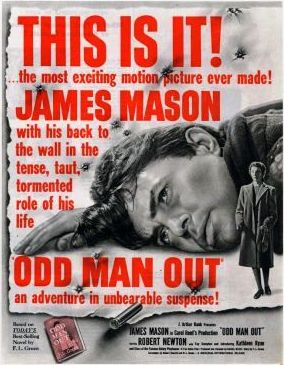
What Carol Reed did so impeccably with The Third Man and here in Odd Man Out is developing a very specific atmosphere. He made the worlds of Vienna and in this case, the unnamed avenues of Northern Ireland come alive not simply by developing the setting in such a way that’s full of character and intrigue but still managing to craft a compelling story within that very same framework. It sets the stage for numerous vivid individuals to come alive because all the contours are colored in and filled out for the audience to enjoy.
Particularly in Odd Man Out, you can visualize Reed taking a certain historical moment and broadening its scope. Because his story, based off a novel by FL Green, is really about the IRA in Ireland who some would call patriots and most would call terrorists. Even some of their fellow people. Still, the majority would shower them with indifference but that’s where the narrative finds its footing. It opens with the following interlude:
“This story is told against a background of political unrest in a city of Northern Ireland. It is not concerned with the struggle between the law and an illegal organisation, but only with the conflict in the hearts of the people when they become unexpectedly involved.”
In this sense, a highly charged situation is pulled from its cultural subtext and Reed masterfully focuses on the universal aspects of the human experience that are found there. James Mason gives one of the most stirring performances of his career both vulnerable and strangely reserved. For much of the film he takes a back seat, almost working on the fringes of the storyline and yet it works quite well. I suppose in some ways, like Harry Lime, a couple years later, even when he’s not in the frame he’s of paramount importance because his name is on everyone’s lips.
The reason is this. Following his release from prison, Johnny has begun the planning stages of a bank heist in broad daylight. It’s never stated very explicitly but the assumption si that they need some capital to bankroll their cause. Still, Johnny and three buddies hold up the joint. But on the way back to the getaway car Johnny gets detained by a guard and a discharging gun leaves both men mortally wounded.
The whole film hinges on the aftermath of this even and the fact that this is a heist film is quickly forgotten because it surpasses the basic parameters of a crime movie destined for grander aspirations altogether. Look at it more closely and again and again Odd Man Out reiterates the fact that this is really about all people. Because any given conflict will always and forever elicit some sort of response from any single person. That’s how we are wired and one conflict will cause a ripple of interpersonal conflicts in any person who becomes involved. That’s where this film is coming from.
It’s such a classic menagerie of figures each with their own distinctiveness. Moments where they reveal even a very little bit about who they are. Whether it’s the old crone who invites the fugitives into her parlor only to call the cops of them. Maybe it’s a cabbie or a bar owner or a vagabond obsessed with birds who lives with a delusional painter. The story takes us through the bar halls, the streets, private homes, trams, carriages, churches, and wherever else the general public spends their waking hours. Much of Dublin’s Abbey Theater was called upon to star in the film and they certainly are a colorful lot.
At first, it was off-putting that the film sunk into almost hallucinatory territory as Johnny drifts in between delirium, visions, and bits and pieces of memories that all come to the fore as he struggles with his excruciating pain. The hourglass is slowly winding down. But his faithful love Kathleen (Kathleen Ryan) is resolutely looking to save him from the clutches of the police and anyone else who might want to do him harm.
In one particularly stirring moment, Johnny can be heard recounting a few jumbled tidbits from 1 Corinthians 13:
When I was a child, I spoke as a child, I thought as a child, I understood as a child. But when I became a man, I put away childish things. Though I speak with the tongues of men and of angels, and have not charity, I am become as sounding brass or a tinkling cymbal. Though I have the gift of prophecy, and understand all mysteries and all knowledge, and though I have all faith, so that I could remove mountains, and have not charity, I am nothing.
Meanwhile, Kathleen is seeking counsel with Father Tom and she seems to come to much the same conclusion. She opts for love over his religion because that is what she feels pulsing through her with all its overwhelming strength. Her faith is in her love. Nothing else.
It all culminates in a deadly finale. We could not expect anything less still that does not make the film’s conclusion any less jarring. Even today it’s a surprisingly candid denouement. There are no two ways about it. No ambiguity left. We know what fate befalls someone such as Johnny. This is a tragic human drama after all.
So in some scenes, it indubitably has twinges of film noir. Visually it’s indisputably noirish, atmospheric not only in lighting but with the additions of elements from pelting rain to falling snow. Still, the philosophy that runs through its frames feels far different than your typical hardboiled cynicism. There’s something else working here and that’s just a bit of what sets Odd Man Out apart from its various contemporaries. Johnny and Kathleen represent something slightly different. Still, it does beg the question, can their love (or charity) be their ultimate redemption?
Religious hard lining or legalism is hardly the answer and you could never possibly accuse someone like Father Tom of such a crime anyways. He seems a far more humble individual than that but that does put Kathleen’s decision as well as Johnny’s citing of the good book into some question as well. How far can you go in saying that love can be your salvation or does their need to be something further still? I guess you could say that’s the inner conflict in the hearts of many of these people who get involved: Love, charity, and innocence versus guilt.
4.5/5 Stars


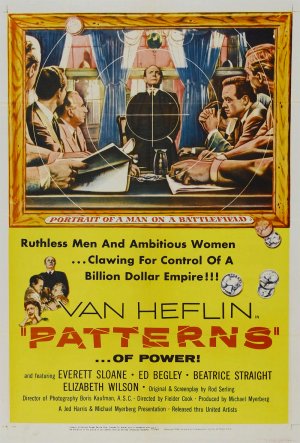 Patterns has little right to be any good. It takes place almost exclusively in interiors. Boardrooms, offices, hallways, at desks, and in elevators. But thanks to a fantastic teleplay from Twilight Zone mastermind Rod Serling, this little picture exceeds the meager expectations placed on it. In fact, it was a major hit when it came out as a live television drama, so successful that it was performed a second time and subsequently developed into this film version.
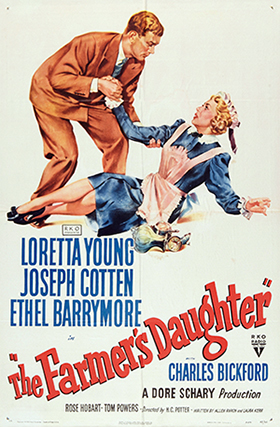 Whatever our criticisms of the previous generations, there’s still something within me that sees something uniquely compelling about films of old. Hollywood in the 30s and 40s could sugar coat, they could oversell the drama, but there was also a general decency that pervaded many of those films.
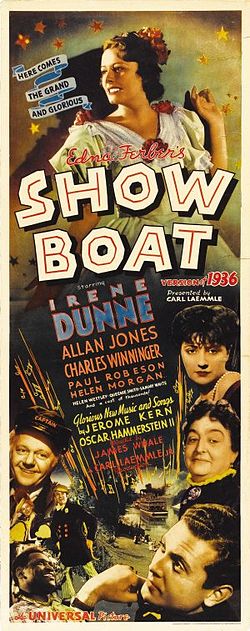 Most of what I know about riverboats can be gleaned from Mark Twain, Davy Crockett and the River Pirates, and that ever beloved Snoopy incarnation The World Famous River Boat Gambler. The 1936 musical Show Boat falls into that very same rich tradition but some clarification is in order.
 Like the fella says, in Italy for 30 years under the Borgias they had warfare, terror, murder, and bloodshed, but they produced Michelangelo, Leonardo da Vinci, and the Renaissance. In Switzerland they had brotherly love – they had 500 years of democracy and peace, and what did that produce? The cuckoo clock.
  Joseph Cotten is surprisingly compelling as the poor, unfortunate stiff and it’s hard not to feel sorry for him in his ignorance because we can relate with him. Alida Valli is striking as the aloof beauty who nevertheless has an unswerving affection for her former love that remains the only joyous thing in her current existence. Then, of course, there’s Orson Welles as the charismatic myth of a man–arguably the most intriguing supporting character there ever was even if it’s mostly thanks to the legend created by those who knew him.
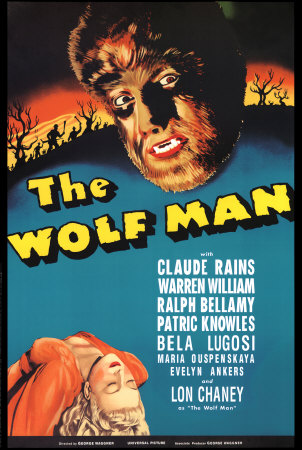 Even a man who is pure in heart, and says his prayers by night; May become a wolf when the wolfbane blooms and the autumn moon is bright.
 What’s fascinating about this film is how it manages to give voice to those who are normally silenced and even in her subservience this narrative powerfully lends agency to a young Senegalese woman’s perspective. Because even when she is silent and words are not coming out of her mouth and her status ultimately makes her powerless, the very fact that her mind is constantly thinking, her eyes observing and so on mean something. Inherently there’s a great empowerment found there even if it’s only known by her and seen by the outside observer peering into her life. That’s part of her. We are given a view into what she sees. We can begin to understand her helplessness and isolation. Where she came from and the life she left behind. Giving up the master narrative of the entitled and shown the flip side of the world for once.
 Prior to the making and release of Monsieur Verdoux Charlie Chaplin had undoubtedly hit the most turbulent patch in his historic career and not even he could come out of scandal and political upheaval unscathed. To put it lightly his stock in the United States plummeted.
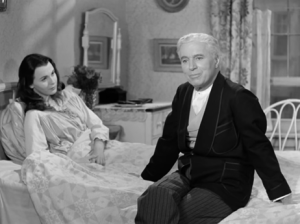 The glamour of limelight, from which age must pass as youth centers
 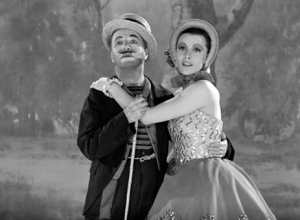 But now no one’s there. The seats are empty, the aisles quiet, and he sits with a dazed look in his flat the only recourse but to go back to bed. It’s as if the poster on the wall reading Calvero – Tramp Comedian is paying a bit of homage to his own legend but also the very reality of his waning, or at the very least, scandalized stardom. It adds insult to injury.
 It’s important to know that he writes off such an assertion as nonsense and one can question whether this is Chaplin’s chance at revisionist history or more so an affirmation of his life’s actual trajectory–working through his current reality that the world questions (IE. Marrying a woman much younger than himself in Oona O’Neil who he nevertheless dearly loved).
 4 Star Films