
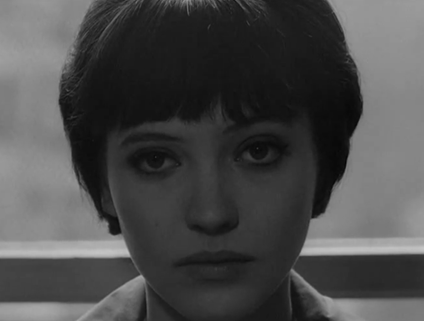
 The opening credits of Vivre sa Vie commence with the opening note “dedicated to B-movies” and indeed many of Jean-Luc Godard’s best films could make the same claim. They’re smalltime stories about little people living rather pathetic lives if you wish to be brutally honest. This isn’t Hollywood.
Opening titles aside, we meet our main characters from behind, their backs to the camera in the throes of a minor spat. It acts as the subject for the first of the director’s 12 tableaux that make up the film rather like chapters in a book following the life of our heroine Nana (Anna Karina). Next, comes pinball games, Nana’s occupation as a Record Shop attendant and other mundane moments.
The passage of time caused me to forget that Nana goes to a screening of The Passion of Joan of Arc. Her own life witnessed in the eyes of Joan–a heroine that she easily empathizes with for her own amount of suffering and pain. It’s difficult to decipher who Nana feels more connected to, Joan of Arc or the actress Maria Falconetti herself. Because the truth is, Nana too was trying to make it as an actress, even being featured in a film or a play or something or other. It didn’t work out.
As the story evolves, we gradually begin to see her plight more clearly. It comes slowly at first before fully establishing itself. She goes down the rabbit whole quite by chance, taking on a very different occupation. It’s pitiful really, she looks more like a frightened rabbit than a woman of the street.
Her aspirations of catching the eye of some director are instead channeled towards Raoul, the pimp who gets her started and shows her the ropes of the trade. In some ways, it feels like he owns her, and yet Nana still strives to lead her own life. One of the moments she gives the illusion of happiness is in all places a pool hall as the jukebox grooves away and she shimmies with it. But in this moment as with so many others, it seems as if she’s constantly under the gaze of men. She’s constantly trying to earn their affection and in some sense earn her own worth. Whether or not they give it is another matter and that’s the great tragedy of Nana’s life.
In some of the film’s final interludes, she finds time to wax philosophical with an old thinker on a number of topics from personal responsibility to issues of free will. He further asserts that the more one talks, the less the words mean. Perhaps Godard took that to mean form over dialogue.
At times it’s as if Godard’s camera is constantly on a swiveling axis or even a pendulum, focusing on a figure and swinging back and forth between it’s two subjects. No cuts are necessary and it’s oddly compelling.
Look at his work hastily here and it could be misinterpreted as shoddy and that could be but more likely is the fact that Godard was always thumbing his nose at convention. He was never beholden to classical Hollywood but he did have heroes. The likes of Sam Fuller, Fritz Lang, and Nicholas Ray. Men with their own aesthetics and Godard was forging his own path. Only someone like Godard would have the audacity of having us watch the entire transcription of a letter. Why? Because he wanted to.
Vivre sa Vie did not ignite the Nouvelle Vague but in many ways, it stoked the flames and Godard perhaps unwittingly gave nod to another landmark film from his compatriot Francois Truffaut, Jules et Jim, which finds its way up on a movie marquee.
Perhaps what’s easiest to take away from Godard’s work here with longtime collaborator Raoul Coutard is that he’s constantly messing with our classical cinematic sensibilities. The way he cuts (or doesn’t), the way he interrupts sound, the way he moves between intertitles and so on. It’s still his and it still disrupts the status quo that we are used to even as seasoned viewers of visual content.
For some, it can come off as tiresome, even pretentious but it’s undoubtedly Godard and highlighting the entire narrative is the quietly yet still evocative performance of Anna Karina. Her doe eyes speak volumes by themselves. They truly were the power couple of the French New Wave. He being the audacious artist, she his inspired muse. However, it begs the question, if there is any stock in the parallelism between film and reality. Nana/Anna being controlled by the men in her life or was it truly her life to live?
4.5/5 Stars
 There’s a moment in Kelly Fremon Craig’s The Edge of Seventeen where Nadine (Hailee Steinfeld) suffers the ultimate humiliation third wheeling with her older brother Darian (Blake Jenner) and her (former) best friend Krista (Haley Lu Richardson). Needless to say, the evening is less than stellar but it gets worse after Nadine feels like she’s been totally betrayed. She’s been hating her brother recently and her best friend is dead to her now. The fact that she sets up an ultimatum doesn’t make things any better.
 It’s a joy to watch Agnes Varda dance. Or, more precisely, it’s a joy to watch her camera dance. Because that’s exactly what it does. Her film opens in color, catching our attention, vibrant and alive as the credits roll and a young woman (Corinne Marchand) gets her fortune read by an old lady. She’s worried about her fate. We can gather that much and this is her way of coping. Superstition and tarot cards but she’s trying and the results are not quite to her fancy.
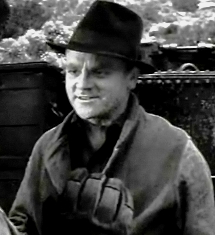 White Heat burns like hot coals even today as the epitome of incendiary cinema. It’s a gangster picture from master Warner Bros. craftsman Raoul Walsh that’s volatile and intriguing, highlighted by the always fiery James Cagney as a crazed man-child with a mom complex.
 In his opening introduction, Kumail (
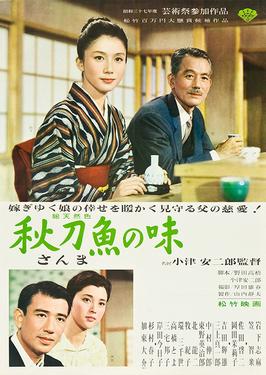 There’s something overwhelmingly soothing about Ozu, simultaneously slowing my pulse and calming my nerves. Yes, An Autumn Afternoon stands as his final film. Yes, he would sadly pass away the following year. But there’s a comfort to watching his films unfold — even his last one. The drama is everyday and somehow disarming and pleasant. We often take for granted that Ozu was not planning to end here. This was not supposed to be his last film. It just happened that way.
 Whaddya hear, whaddya say ~ Jimmy Cagney as Rocky Sullivan
 John Garfield was never the most dashing of leading men but nevertheless, he was always thoroughly compelling as ambitious working class stiffs during the 1940s. He had a straightforward tenacity about him like he had to fight his way to the top. At the same time likable and destined for trouble right out of the gates. You can cheer for him and still rue the decisions that he makes. That’s what makes his foray as boxing champ Charlie Davis all the more believable. His aspirations are of a very real nature and they give his character a genuine makeup.
 Father hear my prayer. Forgive him as you have forgiven all your children who have sinned. Don’t turn your face from him. Bring him, at last, to rest in your peace which he could never have found here. ~ Ida Lupino as Mary Malden
 Films Noir often find their hooks in lurid titles but also in metaphor. Ride the Pink Horse fits into the latter category as pulled from the pages of Dorothy B Hughes and adapted by Ben Hecht & Charles Lederer. The horse can be taken in the literal sense as one of the wooden animals that go round and round on the local carousel but there’s some symbolism in this opulent creature. In some distant way, it’s the fantasy of a different life that every man seems to crave when he doesn’t have it. But still, he strives and grinds to get closer and closer to it. More often than not he does not succeed in finding so-called contentment.
 And it’s from these opening moments that we try to get a line on Gagin by watching his every move and word. He’s brusque and abrasive with almost crazed features — constantly suspicious, demanding, and sour. He had a little too much cyanide for breakfast (although he does like fruit cocktail). Just as we watch him with interest, his probing eyes case every joint and every person he comes in contact with. Because, if it’s not obvious already, he’s not come to San Pablo for R & R. He’s come to town to avenge his dead army buddy, who was double-crossed and put out of a commission by a very big man (Fred Clark).
 Just as there is a cultured femme fatale (Andrea King), her counterpoint is the tentative Pila (played sympathetically but rather unfortunately by Wanda Hendrix), who floats in to watch over Gagin even when he doesn’t want her around. She stays anyways.
 4 Star Films