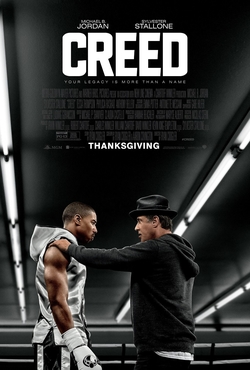
 There’s a very special place in my heart for Rocky (1976) and I choose those words very carefully. The reason being, subsequent films lost the appeal of the original and I simultaneously lost interest in the franchise. Perhaps it’s because, after Sylvester Stallone’s breakthrough film, the series lost much of its unassuming charm. It was no longer an underdog story. It no longer felt as personal and intimate.
It’s true that I cannot pass any kind of judgment on Rocky II, III, IV, V, and Rocky Balboa. But it’s so easy to lose your guiding light, for a franchise to drift away from what made it good by simply relying on blockbuster status, star power, and a robust fanbase. These very things kept me away and yet Creed made me extremely happy that I came back into the fold.
This is by no means a rehash of the original Rocky, that beloved classic in the pantheon of sports movies, but it knows its lineage and maintains the same spirit of that narrative. But when you have such a strong sense of your roots, that makes it all the easier to head out into new terrain.
Creed is, of course, about Apollo Creed’s son. Because whether you know it or not (I didn’t) Apollo Creed has passed away. He was (SPOILER) killed by Ivan Drago. All he left behind was his wife, an illustrious boxing career, and crucial to this story, an illegitimate son who has grown up much of his life in juvie. But his widow tracks down the boy and looks to rehabilitate him, like a prodigal son gone astray.
Over time, Adonis “Donnie” Creed (Michael B. Johnson) grows in knowledge and stature, landing a job in a company where he is rising up the ranks, but he’s discontent. He does some boxing on the side behind closed doors, in places that no one of any repute has heard of but he strives to be like his deceased father. He wants to be a boxer, ditching his job, leaving his step-mother’s lavish home behind to start on his own hero’s journey.
And unsurprisingly his dreams take him to that gem of a city — the City of Brotherly Love — Philadelphia, to seek out a man who now runs a humble Italian restaurant christened “Adrian’s.” Donnie walks into this establishment with a mission, to get to know the former rival of his father, to get this aging man to train him in his own boxing career.
Rocky Balboa (Stallone reprising his role) is not about that life anymore. Content with simplicity and the memories that are left from his many years in the ring. If his restaurant is any indication, it stands as a testament of the love he still holds for his wife, who passed away. He visits her every week at the local cemetery still sharing his life with her like his closest confidante.
It’s moments like these that suggest that director Ryan Coogler’s film is a cut above some of the previous offerings. It’s this fascinating idea of a transgenerational film — it’s Rocky for the millennial generation but it shows a certain deference and even wistful reverence for its past — even the music constantly hinting at Bill Conti’s iconic score. But that should not be mistaken for being stuck in the past because with Michael B. Jordan in the lead, he motors the story forward with his own Rocky-like resolve.
Yes, his daddy is Apollo Creed, but he’s looking to make a name for himself apart from that. He starts calling on the girl downstairs — the local singer-songwriter Bianca and his relationship with “Uncle” Rocky quickly grows. They’re family now. And for boxing fans, Creed has its fair share of training sequences, buildup, and such, as Creed himself becomes an underdog facing off against world champion Jack Conlon. But if that’s all that Creed was, I would have been content going back to the original Rocky.
However, Creed suggests something very powerful as noted by Rocky early on. Time takes everyone out, time’s undefeated. There are affectionate callbacks to Adrian (the restaurant) and Paulie (Adonis stays in his old bedroom), even Apollo. But all of them are gone now. All of them lost against time. And Rocky nearly does as well. It’s inevitable. However, with the story of young Adonis we are reminded that there’s still room for hope and dreams and love and caring about other people. Those are things to be treasured.
Here Ryan Coogler has proven once more that he is a rising director crafting compelling films. Teaming up again with Michael B. Jordan after the searing Fruitvale Station, he fills the blockbuster with the same ambiance of an independent film with hot dog vendors and little bits of everyday authenticity. There’s a certain amount of documentary realism that still manages to be cinematic and at the same time surprisingly personal. So if you love Rocky go see Creed. If you love boxing go see Creed. But beyond that, it’s a film with a great deal to offer and I was heartily impressed in how it balances the past and the present with so much poise.
4/5 Stars
 Sophie Scholl: The Final Days is a film that people need to see or at the very least people need to know the story being told. For those who don’t know, Sophie Scholl was a twenty-something college student. That’s not altogether extraordinary. But her circumstances and what she did in the midst of them were remarkable.
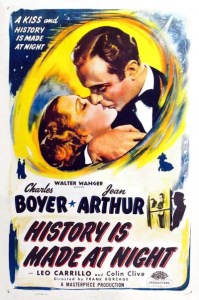 History is Made at Night molds love into the grandest of pursuits and it wouldn’t be altogether wrong in that assertion because for humanity it is one of the most euphoric, confounding, beautiful entities known to mankind. I have no qualms with saying that whatsoever.
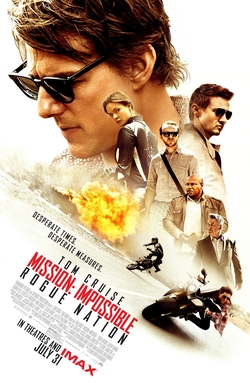 n the last decade or so arguably the greatest action/spy/thriller franchises have been Jason Bourne, James Bond, and Mission Impossible. To their credit, each series has crafted several passable films fortified by a few real stalwarts of the spy thriller genre. Although many of these series thrive on gadgetry, set pieces, and a cynical tone more at home in the modern millennium, one thing that set some of the better films apart were interesting female characters.
 Early on, when she is growing up, it seems very easy to read Stella (Barbara Stanwyck). She is a young woman born into a humble background with a family that could at best be called earthy. Still, Stella wants to know what it feels like to live in the lap of luxury. She wants a more refined life and it’s easy for all the cynics to assume she’s making eyes at the handsome mill executive Stephen Dallas (John Boles) for what he can give her.
 You could say that Fritz Lang was fascinated, even preoccupied with issues of justice. M, Fury, and You Only Live Once all take a particular interest in crime in relation to systems of justice while still functioning as tense thrillers. Although Fury was his first film across the pond in Hollywood, Lang maintained his fine form in a potent debut.
 Our introduction to The Mortal Storm feels rather flat. Bright and bland in more ways than one as we become accustomed to our main storyline. Professor Viktor Roth (Frank Morgan) is held in high regard all throughout the community as a prominent lecturer at the local university and beloved by his colleagues and family. The year is 1933 and the Bavarian Alps are still a merry and gay place to live. That’s our understanding early on as the Professor celebrates his 60th birthday with much fanfare and receives a commemorative memento from his class.
 Its title suggests that this film might be something like Lubitsch’s Heaven can Wait but The Devil and Miss Jones could easily hold the title as the original version of Undercover Boss. Although its main function is on the romantic and comic planes, it also has a bit of a social message behind it that signals for change.
 They Drive by Night is a surprisingly engrossing picture and I only mention it for its obvious relation to High Sierra. It came out a year earlier, helmed by Raoul Walsh starring George Raft, Ann Sheridan, Ida Lupino and, of course, Humphrey Bogart. The important fact is that if Walsh had gotten his way, he would have cast Raft again as Hollywood’s perennial tough-guy leading man.
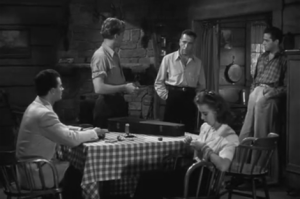 He’s not about to lose his nerves or take his eyes off the objective but the two young bucks he’s thrown in with (Alan Curtis and Arthur Kennedy) carry the tough guy bravado well but there hardly as experienced as him. He’s not too happy about the girl (Ida Lupino) they have hanging around either because she’s an obvious liability. In his experience, women squawk too much. The man on the inside (Cornel Wilde) is even worse, a spineless hotel clerk with even less nerve.
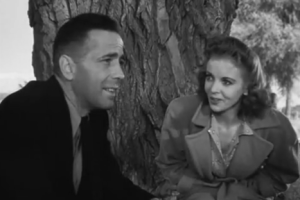 In an unassuming act of charity, Roy has a doctor friend take a look at Velma and ultimately pays for the surgery that heals her ailment completely. Still, if the story ended there it would be a happy ending but with the heist in the works, Roy is not so lucky. He pulls off the job and makes his getaway but with most any cinematic criminal activity in Hollywood’s Golden Age there must be repercussions. After all, that’s what keeps things interesting and it’s true that Roy and Marie are able to lay low for a time but soon the word is out and the gangster is a wanted man.
 The film opens with a dead end drifter being ushered off a bus in the little every town of Walton, wedged somewhere between LA and SF. Although in actuality it was shot partially on location in Orange, California, serving up a perfect representation of quaint Middle America. You can almost hear Paul Simon singing from the future (Got off a greyhound to look for America) as Dana Andrews gets off the bus. Except he winds up at Pop’s instead. There he sizes up the town and gets his first eyeful of the alluring waitress Stella (Linda Darnell).
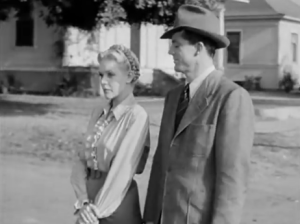 Being blessed with a certain amount of charm, Stanton strikes up a relationship with the untouchable gal, the churchgoer, the book reader, the generally good human being, June. He knows how to pull her out of her shell. Catering to her necessity to get out and live life (All the things you look down on are the things that make up life. Little things, like a game of bowling..or a swim at night, or a dance, a kiss, stuff that bubbles). It works and she begins to be swayed. Conveniently she also has a great deal of money. The outcome seems obvious and yet the story twists in unexpected ways.
 Fallen Angel undoubtedly gets a bad rap because it does not reach the rapturous, beguiling heights of Laura (1944) from the year prior, but it deserves to be seen in its own light. It’s true that both films are murder mysteries but while Fallen Angel isn’t all that interesting in that regard it has a surprisingly sharp script in other ways. Preminger works through his story with a certain dynamic assurance and like its predecessor, it’s the characters that are by far the most fascinating. Laura was a superior mystery, character study, etc., but Fallen Angel gleams brightly thanks in part to its classical chiaroscuro cinematography and an engaging menagerie of locals including Charles Bickford, Percy Kilbride, Bruce Cabot, and John Carradine.
 4 Star Films