
 The original title in Italian is Ladri di biclette and I’ve seen it translated different ways namely Bicycle Thieves or The Bicycle Thief. Personally, the latter seems more powerful because it develops the ambiguity of the film right in the title. It’s only until later when all the implications truly sink in.
Vittorio De Sica’s film is unequivocally emblematic of the neorealist movement.The most notable traits are the images taken straight off the streets of Rome, depressed and forlorn as they are. The setting truly does act as another character, adding a depth to the film that cannot be fabricated. You can’t fake some of these scenes either whether it’s Antonio scavenging for his bike in the pouring rain or the sheer mass of humanity that is found in places like the Piazza Vittorio.
It’s all there out in the open, with an apparent authenticity. In its simplicity, it feels like a real story with real people. This too is aided by De Sica casting non-actors in the main roles. In fact, Lamberto Maggiorani’s gaunt face is somewhat unremarkable (sharing some resemblance to Robert Duvall). Put him next to a poster of Rita Hayworth and it becomes even more evident. Still, he too feels human in a way that Hollywood stars just cannot quite pull off. It’s easy to believe him and invest in his story.
The same goes for his young son Bruno. He’s one of the cutest precocious kids you’ve ever seen, reminiscent of Jackie Coogan in Chaplin’s The Kid. But it’s also his point of view that makes this film even more tragic later on. This father-son relationship has weight to it.
And that makes Antonio’s dilemma that much more perturbing and ultimately so traumatic for the audience. De Sica’s film is so humble and yet its depths are ripe with so many universal truths and moments of sincerity.
Here is a man trying to provide for his family. His wife, his son, and his baby. Work is hard to come by in the post-war years. Any opportunity is a good one and Antonio gets that. But he needs a bike. His wife sacrifices her sheets so he can get his bike — so he can maintain their whole livelihood as a family.
That’s why it’s so crushing. Everything hangs in the balance of this unfortunate but seemingly mundane event. When Antonio’s bike is stolen it truly means tragedy because there is no lifeline, no direction to turn.
And he does his best to recover his stolen property. Going to the authorities, rounding up his friends to search for it, even tracking down the boy who undoubtedly nicked his bike, but none of it leads to a successful conclusion.
Another day finished with no hope for tomorrow, no money to bring home to his family so they can eat and live. He’s got nothing — a reality that’s made painfully obvious when he and Bruno sit down for dinner at a restaurant. They eat a meager meal as those just behind them gorge on a full buffet of courses. Bruno eyes them longingly and his father tries to lift his spirits, secretly knowing that he can never offer that to his boy.
It puts his lot into a jarring perspective, suggesting the state of the affairs in Italy. But what makes the Bicycle Thief truly timeless is not its scope or what it says on a grand, majestic scale. It’s an intimate film and perhaps the most personal story ever put to film. In a matter of a few moments, it says more with the moral dilemma of Antonio than many lesser films conjure up in a couple hours.
And because this is not a Classical Hollywood film, it does not sell out to its audience. There is no obligation to the viewer to keep them from being downtrodden — because that might rub them the wrong way and actually evoke a searing response. But there can be beauty in that and De Sica’s film is certainly beautiful for precisely those reasons.
It feels real, it feels honest, and rather than sugar coating the world, it draws up a reality that is almost as old as the world itself. So yes, this film is so-called “Neorealist” and yes, it most certainly makes good use of its contemporary setting of Rome in the 1940s. But if any film can claim timelessness Bicycle Thief might just be the best bet because at its core are the type of issues that are not unique to time, space, language, or any other man-made barrier. Every person knows what it means to steal — to battle with their conscience — upending the moral framework that guides their lives. That hasn’t changed even if the context has and that makes The Bicycle Thief continually relevant.
It ambushes us with the same emotional wallop each and every time. I mentioned Chaplin before briefly, but it didn’t occur to me until some time later that we leave our characters walking off into the sunset rather like Chaplin’s Little Tramp, except it’s a very sad sunset indeed.
5/5 Stars
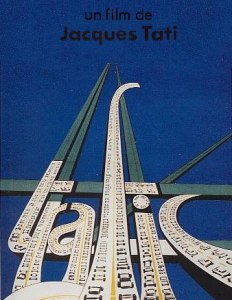 Watching films with French treasure Mr. Hulot (Jacques Tati) is a wonderful experience because, in some respects, it feels like he brings out the child in me. And if history is any indication — I’m not the only one — others feel this sensation too.
 “You can’t just do anything at all and then say ‘forgive me!’ You haven’t changed a bit.” ~ Colette
 Antoine Doinel is a character who thinks only in the cinematic and it is true that he often functions in a bit of a faux-reality. He seems normal but never quite is. He seems charismatic but we are never won over by him completely. Still, we watch the unfoldings of his story rather attentively.
 Why do you watch me? -Magda
 And despite the clandestine nature of his activities he still somehow remains innocent in the eyes of the beholder. Daily he works at the post office behind the glass and in the evening he studies languages. But he’s continually drawn to this lady across the way. He feels like he knows her. He wants any pretense to meet her and so he creates a bit of fate anytime he can.
 However, often times sex and love become synonymous terms and that is the underlying tension between Tomek and Maria Magdelena’s relationship. Though innocent, he wants true love, a love that transcends a simple physical act and is summed up with affection, intimacy, and an inherent closeness. He is taken with her beauty certainly but even more so he is invariably alone. Meanwhile, she is so enraptured with sex and denigrating such a grand (and admittedly messy) thing as love, to a simple physical act. She can’t understand this wide-eyed boy and his delusions. She’s ready to open him up to the way the world actually turns. And her callousness ultimately crushes Tomek’s tender heart. She broke it not by simply rejecting him, because this is a ludicrous love story, but truly obliterating any of the naive aspirations he had for love.
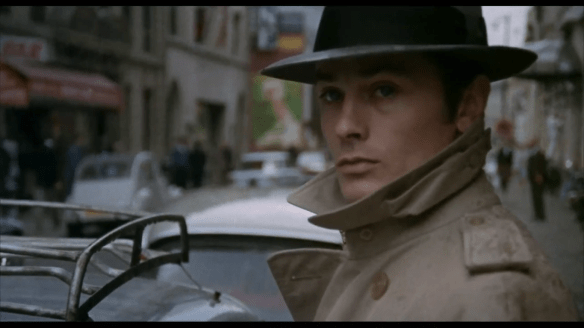 There is no solitude greater than that of the samurai unless it be that of a tiger in the jungle… perhaps…
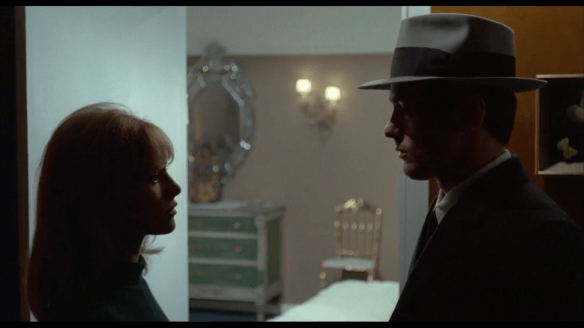 And though he does call on his lovely girlfriend (Nathalie Delon), who is absolutely devoted to him, as well as making eyes at the nightclub pianist who is the main eyewitness to his hit, Jef for all intent and purposes, is alone. It’s a kind of forced solitude, a self-made exile created by his trade. After he goes through with the hit, he must shut himself off more and more. That is his job.
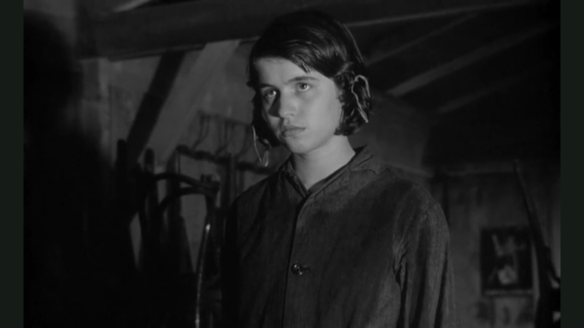 Robert Bresson’s film is an extraordinary, melancholy tale of adolescence and as is his customs he tells his story with an assured, no-frills approach that is nevertheless deeply impactful.
 I’ve heard people like director Jean-Pierre Gorin say that there is little to no distinction between documentary and fiction. At first, it strikes us as a curiously false statement. But after giving it a moment of thought it actually makes sense, because no matter the intention behind it, the medium of film is always subjective. It’s always a created reality that’s inherently false and even in its attempts at realism — that realism is still constructed.
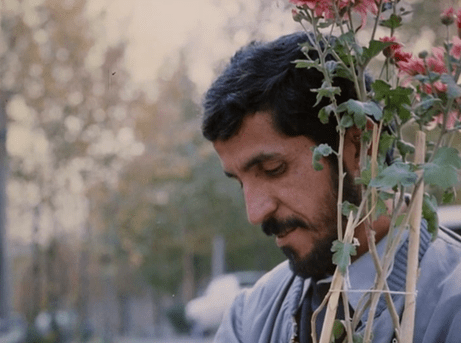 The beauty of Close-Up that not only does it feature the real individuals involved in this whole ordeal: There’s Sabzian playing himself, the Ahankhah family who brought the case to court, and Kiarostami appearing as well. But it blends the actual footage from the trial with reenacted scenes set up by the director as if they are happening for the first time.
 At face value, Model Shop is an ordinary film of little consequence but look a little deeper and it’s actually a fascinating portrait of the L.A. milieu in 1969. Part of that is due to the man behind it all.
 John Donne is noted for writing that no man is an island, but if this film is any indication, there might be a need to qualify that statement to suggest that some women are islands — at least when portrayed by the elegiac Monica Vitti. Red Desert begins with blurred images and a high-pitched piercing melody playing over the credits. From its opening moments, two things are evident. It gives off the general sense of industry and it features one of the most extraordinary uses of color ever with the blues and grays contrasting sharply with the brighter pigments.
 However, even if this word does reflect its share of beauty, it is Monica Vitti’s character who still embodies paranoia and disorientation with the modern civilization. In other words, she is the one out of step with the contemporary world that she finds herself in, due in part to an auto accident and a subsequent stint in a hospital. She is struggling to readjust to reality.
 As per usual with Antonioni, his film invariably feels to be altogether more preoccupied with form over content and that’s what is most interesting. It’s fascinating some of the environments he develops. Atmospheres full of billowing fog, wispy trees, stark alleyways, gridiron structures, and all the while the color red pops in every sequence. There’s no score in the typical sense, instead, the dialogue is backed by foghorns, machinery, and an occasional electronic sound effect.
 4 Star Films