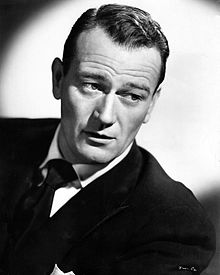
 Contrary to popular belief, I wasn’t always a classic movie aficionado or a western lover but you do not have to be either of those to know and love the Duke because he is more of an American icon than a simple movie star in the conventional sense. He’s so integral to the very cultural fabric of our country. For instance, by watching I Love Lucy or M*A*S*H (and Radar’s impressions) or having one of your dad’s favorite film being True Grit, you can get to know him by simple osmosis. It’s just a fact. Even words like “Pilgrim” and “Baby Sister” begin to sneak into your everyday lexicon. You cannot help but hear them and by association use them (I’m not speaking from experience at all).
Even from an early age I had an awareness of John Wayne and I’m not quite sure where that began but I certainly do recall knowing who he was. However, I’m not sure if I had ever seen one of his films or at least not one of his famous ones. Watching the likes of Stagecoach, The Searchers, The Man Who Shot Liberty Valance, even True Grit came years later. However, from early on I think it was evident that in many ways I almost subconsciously grew up walking in the footsteps of John Wayne. It’s only now that I realize the undeniable facts.
To start, it must be noted that Wayne was a transplant to Southern California, my home for many years now. He actually was born Marion Morrison, larger than life even at birth in the town of Somerset, Iowa in 1907. It’s true that I got to visit his home, now a makeshift museum that memorializes his career in humble fashion (On a side note: I too have family from Iowa so that’s yet another small connection to the Duke’s beginnings).
 But it’s from these roots that he ultimately moved out to sunny California, a noted member of the USC football team before a career-ending injury. This is a part of his life that I will mostly gloss over. Because it was the next part of his life that always resonated with me on a personal level. His very persona seems imprinted on the world that I grew up with from an early age. His name and likeness could seemingly be found everywhere. I grew up seeing his statue and even passing by his personal boat The Wild Goose and seafront home on family excursions (also featured in a Columbo episode).
Rumor has it that his son Ethan roamed the same hallways and the same classrooms as I did in high school. By association, I even hold a personal anecdote of the Duke that my father has often regaled me with. Once, in a local shop, he saw Rooster Cogburn himself in all his imposing glory, sans eyepatch, patronizing the local establishment. That was probably only a few years before he passed away in 1979 — only a single momentary occurrence.
Although that was still some years before I even became acquainted with him, there’s no doubt that John Wayne is a timeless figure and I will enjoy him on film for many years to come because there’s something personal about his persona both on screen and off. I truly feel like I do walk in his incomparable footsteps, looming large even now, so many years after his final film The Shootist in 1976.
Because he is far more than a movie star. He’s not simply John Wayne, Marion Morrison, or the Duke, he’s a multifaceted, colorful figure, polarizing but also so personable. In every role, you knew it was him and he never felt like he was faking one word or action. He’s authentic, straight-talking, and true. He held unswervingly to certain convictions and fought tirelessly for those who did not pack a shotgun as well as he did. And I admire that. Thus, John Wayne is not simply an actor who I enjoy seeing for his sheer timelessness but I’ve also had the enjoyment of walking some of the paths that he frequented and blazed. They certainly are big boots to fill but it’s fun to see their impact even today.
For the John Wayne Blogathon HERE…
 Citizen Kane is so often lauded for the simple fact that never before had a director had so much creative control on a project and exercised it in such an unprecedented fashion, especially given the state of affairs in the Hollywood studio system. It’s an enigma, a stunning debut and really an astounding miracle where all things aligned for an instant of so-called perfection.
 At first glance The Trial is a bare-boned parable, feeling gaunt and cavernous with empty sets and even emptier words. Everyone Josef meets talks him in circles, tirelessly — never leading to any significant conclusion, only the next diversion in his journey.
 If The Trial is a hodgepodge of talent, with the presence of Americans Orson Welles and Anthony Perkins, international sirens Jeanne Moreau, Elsa Martinelli and Romy Schneider, with European backing and source material from Kafka, then it is a thoroughly intriguing marriage all the same. This film is perhaps the greatest adaptation of the work of Kafka and not due necessarily to its faithfulness to its source material, but because it displays an unmistakably Wellesian vision. The cyclical nature of the legal system pales in comparison with the fascination that comes with watching the continual creativity that is projected up on the screen — this is a hollow dream of a film.
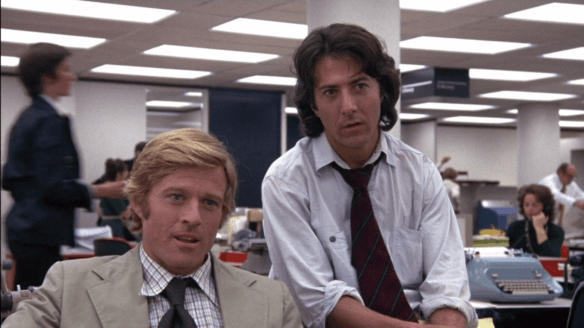 You couldn’t hope to come up with a better story than this. Pure movie fodder if there ever was and the most astounding thing is that it was essentially fact — spawned from a William Goldman script tirelessly culled from testimonials and the eponymous source material. All the President’s Men opens at the Watergate Hotel, where the most cataclysmic scandal of all time begins to split at the seams.
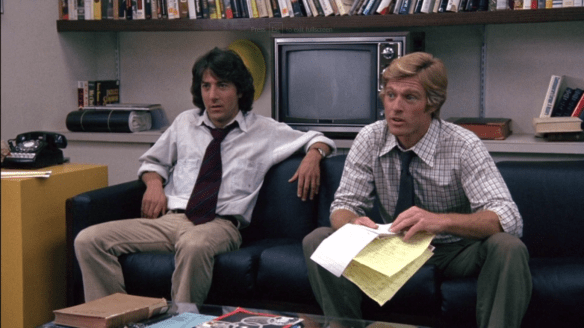 But it only takes a few breakthroughs to make the story stick. The first comes from a reticent bookkeeper (Jane Alexander) and like so many others she’s conflicted, but she’s finally willing to divulge a few valuable pieces of information. And as cryptic as everything is, Woodward and Bernstein use their investigative chops to pick up the pieces.
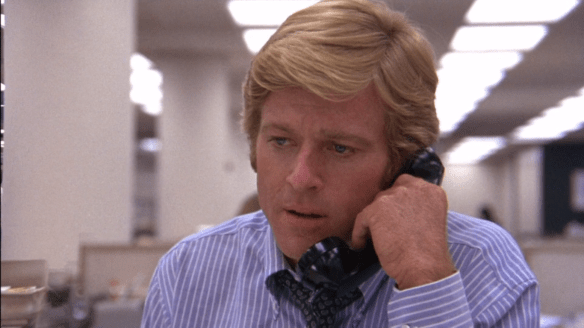 Gordon Willis’s work behind the camera adds a great amount of depth to crucial scenes most notably when Woodward enters his fateful phone conversation with Kenneth H. Dahlberg. All he’s doing is talking on the telephone, but in a shot rather like an inverse of his famed Godfather opening, Willis uses one long zoom shot — slow and methodical — to highlight the build-up of the sequence. It’s hardly noticeable, but it only helps to heighten the impact.
 The opening notes of Joan Jett hollering “Bad Reputation” made me grow wistfully nostalgic for Freaks & Geeks reruns. The hope budded that maybe 10 Things I Hate About You would be the same tour de force narrative brimming with the same type of candor. It is not. Not at all. But that’s okay. It has its own amount of charms that forgive the obvious chinks in the armor of this very loose adaptation.
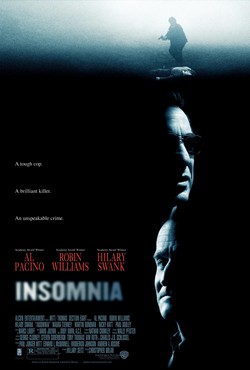 “You and I share a secret. We know how easy it is to kill somebody.” – Robin Williams as Walter Finch
 This was not the film I expected from the outset, and oftentimes that’s a far more gratifying experience. Nostalgia was expected and this film certainly has it, even to the point of casting the legendary funny man and cultural icon Don Knotts in the integral role as the television repairman.
 One of Jean-Luc Godard’s strengths is his capability of feigning pretentiousness, while still simultaneously articulating humor. His film opens with its first of many inter-titles, “A film adrift in the cosmos,” followed by the equally poignant “A film found in a dump.”
 Conflagrations engulf cars and human bodies while above the din comes the piercing screams of a woman bemoaning the loss of her Hermes handbag. We cannot take this anyway but humorous because it once again is yet another moment of utter insanity.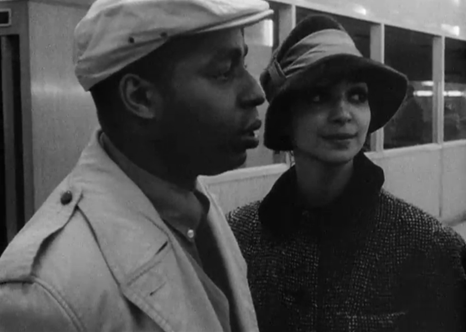


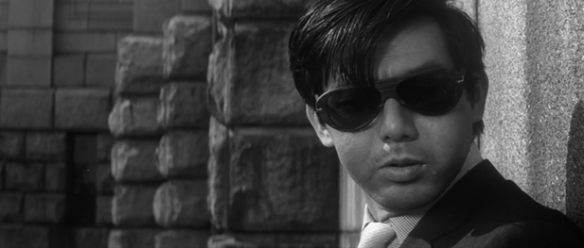 Branded to Kill is the stuff of legend inasmuch as director Seijun Suzuki offered up this wonderfully wacky, perverse, dynamic film and was subsequently dumped by his studio. At Nikkatsu they accused Suzuki of crafting an oeuvre that made “no sense and no money.” And if we watch it with the eyes of a rational, money-grubbing business mind, there’s a point to be made. Because this film is ridiculous on so many accounts, absurd in plot and action, starring an unlikely cult hero — a silky smooth hit man with prominent cheekbones and a hyper-sexualized penchant for steamed rice.
 Phase two follows Goro as he flaunts his tireless inventiveness as a hit man. Hiding inside a cigarette lighter advertisement and shooting his target through an adjoining water pipe for good measure. Then the femme fatale Misako slinks into his life and after a botched job, his life is in jeopardy, an unlikely adversary being his wife. She rightly characterizes them as beasts and their home life is pure chaos.
 By now we have the total dissolution of the character we have known as he begins to sink into an all-out state of sniveling paranoia. He finally meets the mysterious number 1 and far from being a tense showdown, it turns into a rather pitiful scenario. They go arm and arm to the toilet, not allowing each other out of sight as number 1 decides how to finish off his hapless foe.The final showdown comes and it’s all we could ask for. Brutal, perplexing and above all undeniably unique – accented with the brushstrokes of an utterly creative mind.
 4 Star Films