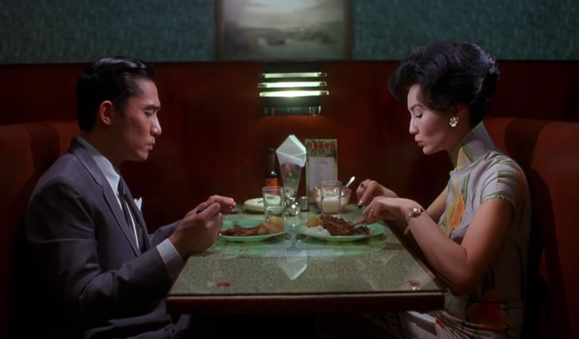
Late Autumn (1960)

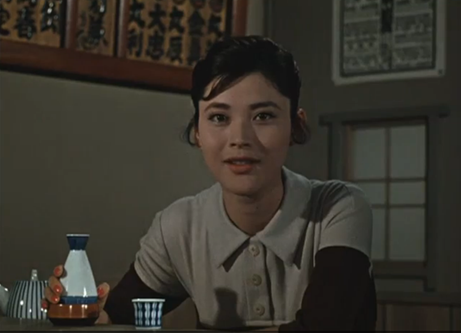
lateautumn1Yasujiro Ozu has the esteem of being christened “The Most Japanese Filmmaker.” It’s certainly a high honor, but at first, it can feel rather counter-intuitive because after all, such a great master of cinema cannot be considered average or a composite in the scheme of Japanese film history. And I don’t think that is what this title is trying to get at. The fact is that Ozu, over time, really experimented with the conventions written by classical western filmmakers and he built his own unique aesthetic that is quite evident later in his career. That being said, his film’s are very Japanese in the way they interact with and dissect the culture that he comes out of, and I think that is paramount to understanding and ultimately appreciating his work.

It’s no different with Late Autumn, Ozu’s penultimate film, a social-familial drama that shares a great deal of similarity to some of his earlier work. The fact is, he’s constantly returning to these ideas of marriage, family, generational differences, and the underlying etiquette that is so prevalent in Japan and Asian cultures in general. But of course, much of what he examines is universal and that’s what allows his films to remain timeless.

With Late Autumn, in particular, it’s easy to marvel at how the director frames his space because he seems to have tremendous spatial recognition. He’s confident in his aesthetics which he highlights with colors and axis lines, which are then further embellished with human subjects. Not many directors are brazen enough to show us an empty room, a hallway, or the mundane facade of a building, but Ozu is so self-assured in his composition. They are too long and occur too often to be establishing shots. He wants to continually convey to us the space that his characters inhabit and he’s meticulous. Everything is placed with pinpoint precision just the way he wants. And it shows.

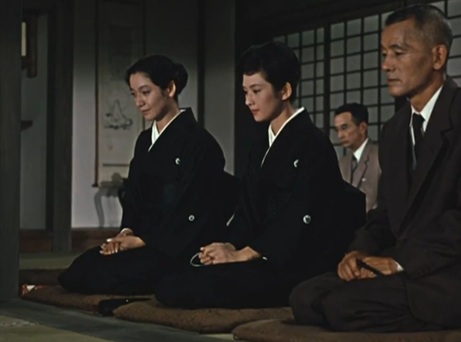
On a basic level, Late Autumn can meld nicely with many of the director’s other works also based around the seasons. In this color installment, three adult men gather for the funeral of one of their mutual childhood friends. It’s a sad occasion as they wistfully remember the good old days when they were young and in love. But as a service to their deceased friend, they agree to find a husband for his sweet sunshine-faced daughter Ayako (Yoko Tsukasa). However, they also worry for his widower Akiko (Setsuko Hara), who is equally beautiful, since the years have been very good to her. What follows is the typical fumbling attempts at matchmaking, trading manners, and so on. When Mr. Mamiya inquires if he should ask for a young man’s picture and resume, we assume it’s a joke, but he’s quite serious.

What makes Autumn different than earlier classics like Late Spring or even Tokyo Story, is that it shows the next generation of young people.  The kids embrace the rockability of Elvis while reading Mickey Mouse cartoons. The young adults are folks who have grown up in the specter of WWII. They want to leave behind the world of useless honor and restraint.They speak their minds and show their discontent.

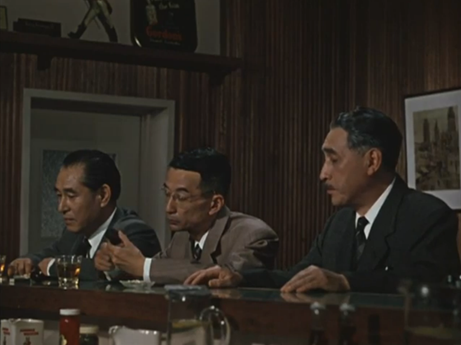
lateautumn2I enjoy the light touches of humor injected into this film because the three chums sit around the bar making observations with a bouncy score that seems more at home in a Tati comedy. Sometimes they’re genuinely trying to be funny, but more often it’s hilarious because they’re actually so dysfunctional. They take on this task of watching over their friend’s family with all seriousness, but they get sidetracked by their own desires and personal concerns. They stir up rumors, make waves, and ultimately cause a lot of trouble. Everything gets muddled and it’s the blunt and frank assertions of young Yuriko (Mariko Okada) that points out their failures. She sees how they have made a mess of things and calls them out for it. Perhaps it feels abrasive, but I think they like her for it and the audience does as well. She’s a reflection of this new generation that’s not looking to mince words or hide behind social etiquette. They’re fed up with that type of lifestyle. In fact, Yuriko is the one who says marriage is the worst. The ideal would be if love and marriage always went together, but they don’t.

lateautumn3Thus, although the relationship between Ayako and her mother takes center stage as the film progresses, Yuriko is extremely pivotal. It’s the lives of the first two women that are affected by the unintentional bungling of these men, but it is Yuriko, who signifies change for the better. In many ways, this story feels very similar to Late Spring in particular, but the interest is not so much in original ideas as it is in re-imagining ideas. It’s a film for the 1960s where men are slowly losing their vice-like grip and societal norms are changing as women move to the forefront. But what remains are the suggestion that it’s alright to push back against societal pressures, and interpersonal relationships are delicate flowers that must be cultivated with care. So easily they can be trampled and destroyed. It takes a certain type of person to acknowledge their own faults while persistently loving those around them.

This is the utmost compliment, but in many ways, Setsuko Hara reminds me a great deal of my own grandmother, a woman who radiated a genuine kindness that was apparent to everyone who walked through life alongside her. Bless their souls. Both of them.

4.5/5 Stars

Hannah and Her Sisters (1986)

hannahand1Recently I was thinking about who I would characterize as favorite directors versus directors that I simply respect. In the latter category, I would stick the likes of Quentin Tarantino, The Coen Brothers, and Wes Anderson. Because truth be told, I do not always like or even enjoy all their films, but I can still appreciate them. They have their own unique artistic visions when it comes to making movies and that comes out of the fact that they know the lineage that they are derivative of. That’s something that cannot be taken lightly.

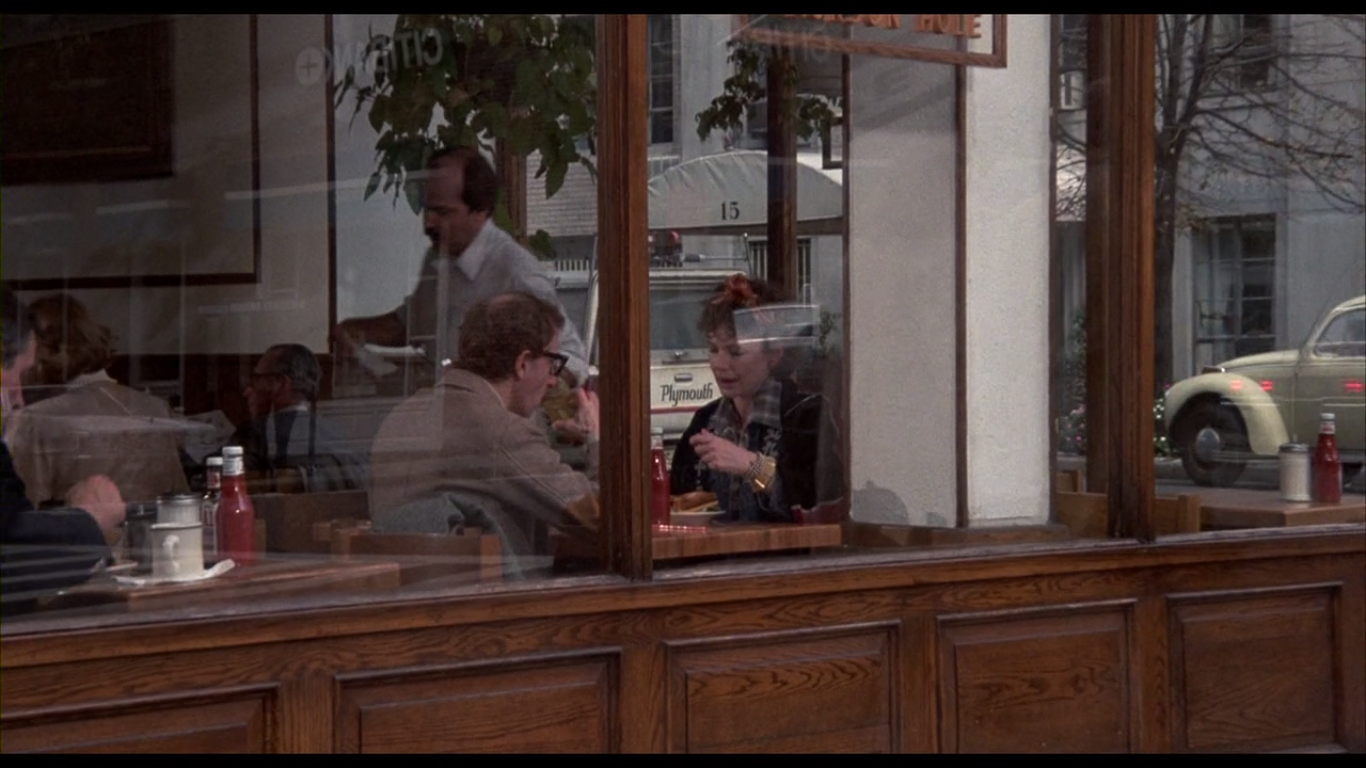
I think I would same the same of the work of Woody Allen, and he truly is a special icon of film. There’s no saying that his work is not original because each film bears his mark, but it also takes cues from the past.The utmost compliment I can give Hannah and Her Sisters is the fact that it might be one of my favorite Allen films thus far, behind Annie Hall. It does noticeably take cues from the likes of Bergman and Bunuel however, but that does not detract from its own charms.

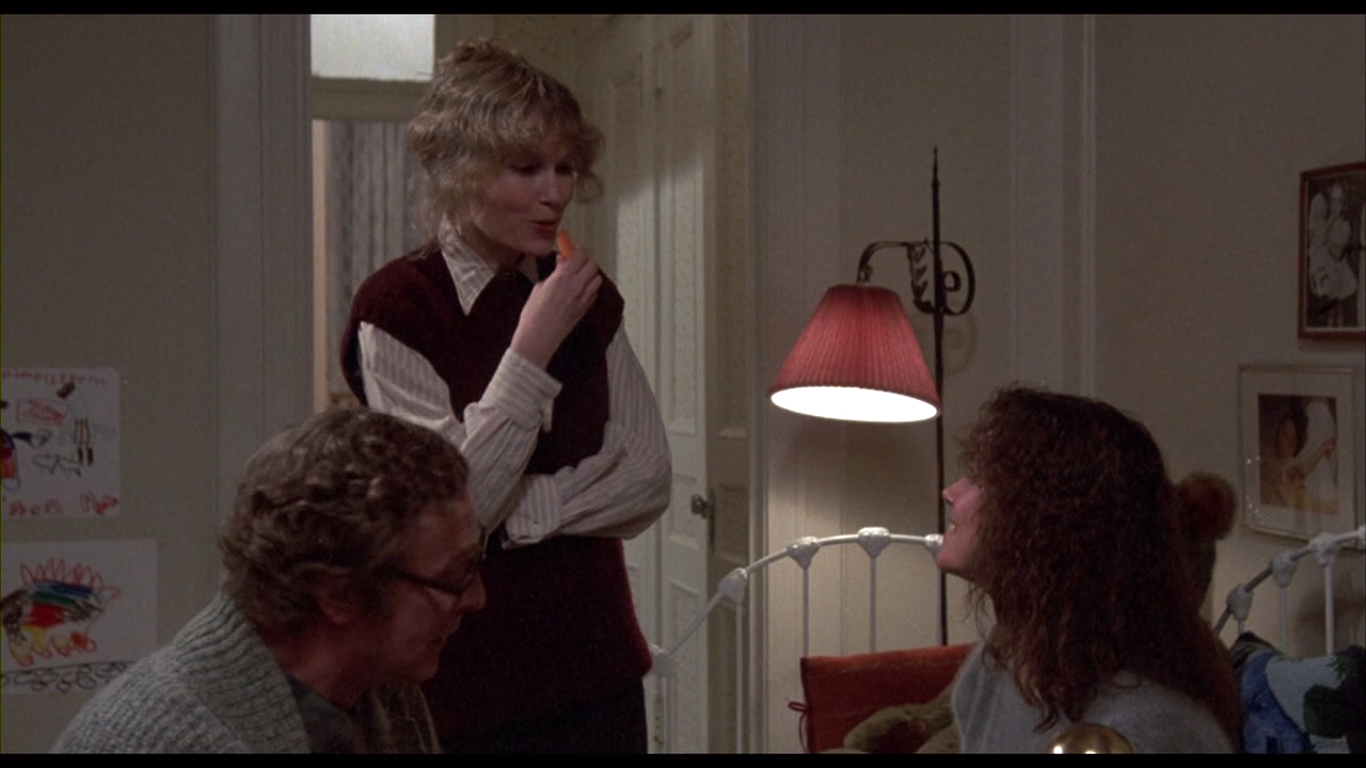
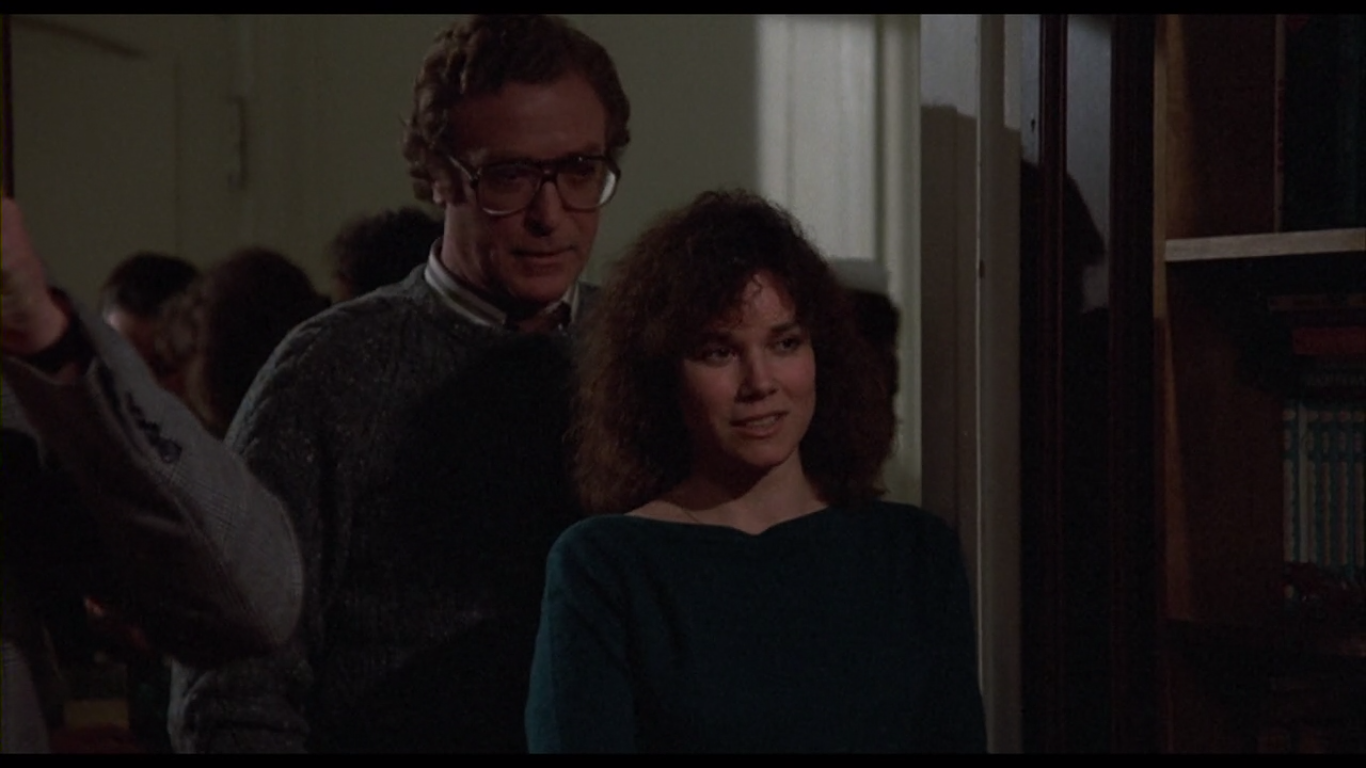
hannahand4It begins and continues throughout with rather arbitrary inter-titles written in white letters over a black background. But it’s the perfect embodiment of Allen’s style of writing to go along with his typically anachronistic scores that nevertheless elevate the charm of his films. What follows is an engaging storytelling set piece extended over three Thanksgiving dinners with Hannah (Mia Farrow) and her two sisters. Holly (Diane Wiest) is the aspiring actress, who has run a catering service on the side while fighting a drug problem and trying to figure out her love life. Lee (Barbara Hershey) is a natural beauty, who lives with an older intellectual named Frederick (Max Von Sydow). She has also unwittingly made a conquest of her sister’s respectable husband Elliot (Michael Caine), who nevertheless gets quite nervous in her presence.

This is a film about their families — their interconnected lives that constantly fluctuate and change dynamically with every passing month and holiday. Their lives go from the invariably awkward, to the tragic, and finally, find their perfect equilibrium. The voices inside their heads are constantly active with fears, thoughts, and desires.

hannahand5What’s perhaps most striking about this film is the great depth of the cast. Maureen O’Sullivan stars next to her real-life daughter. Carrie Fisher makes an appearance as Holly’s friend and rival. Even Daniel Stern, Julie Louis Dreyfuss, and Allen regular Tony Roberts pop up in various moments. Perhaps most spectacularly of all, Allen himself commands the spotlight as anxious hypochondriac Mickey Sacks. Essentially it’s the character that Allen always takes on, but in this case, he stuck himself in almost a B-plot. He gets his chance to swim in his fatalism, pessimism, and philosophical dialogues about God and religion. In fact, it is quite reminiscent of Bergman in this respect, but from a uniquely Allenesque perspective. His awkward jokes (eg. I had a great time tonight it was like the Nuremberg trials) make me crack a smile or let out a genuine chuckle in spite of myself. Bergman would never do that to me, but Allen enters that territory while going so far as casting von Sydow in a slight nod to his Swedish hero.

But really all of this is set to the greater backdrop of the familial drama. That’s where the meat and potatoes of this story lie and in this dynamic, there is a lot of genuinely great moments. One of the most memorable is also one of the most difficult when the three sisters gather together over lunch and their relationships seem to be falling apart in front of our eyes. As it goes with the passage of time, things eventually turn out okay and another holiday gathering comes. Each sister is content with where they’re at and so are their spouses. It’s probably one of the most upbeat Allen movies I can think of, if only it were not besmirched by his own personal life. But that’s a dialogue for a different time. After all, this film is really about Hannah and Her Sisters.

4.5/5 Stars

Venus (2006)

Venus_ver2“God, he was gorgeous.”

When the waitress looks at the image in the obituary, she’s talking about Maurice Russell, but for all intent and purposes, she might as well be talking about Peter O’Toole. In some ways, they’re one in the same. He certainly was a ruggedly handsome young man with piercing blue eyes. Certainly capable and epic enough to play the inscrutable title character in Lawrence of Arabia. But his life had as much turmoil as it did success. O’Toole in his present incarnation looks wrinkled, perpetually tired, and dare I say, somewhat decrepit. It’s not just the fact that he is so many years older, but his life was a hard one involving heavy drinking and many related health issues.  In many ways, it was a miracle he was still alive, but the fact is he persevered and gave us Venus.

I must admit the idea of Venus intrigued me perhaps more than the actual film. Here we have O’Toole, arguably one of the greatest actors ever to come out of the British Isles, playing a version of himself well into his 70s. The opportunities abound for reminiscing and deep soul searching as he looks back at the life he has led. Pair him with another British star like Leslie Phillips and the chance for fun little moments between two old pros seems all the more likely. And Venus is a bit like this; certainly boasting moments of immense depth of character, sadness, and emotional sequences.

However, I had some trouble parsing through the other side of aging star Maurice Russell (O’Toole). In many ways, he just looks like a dirty old man. The assumptions begin when he begins to make small talk with Ian’s (Phillips) grandniece Jessie (Jodie Whittaker), who isn’t too keen on living with her great uncle. But a sort of dysfunctional friendship forms thereafter. Maurice gets immense vigor out of spending time around Jessie, who he encourages to model, buys clothes for, and takes out for drinks. But as he deals with his illnesses and ailments, he also seems to have a deep desire to be close to her, bequeathing her the name Venus, the goddess of love, after taking her to his favorite piece in the National Gallery.

However, this symbiotic relationship that they build at times feels excruciatingly uncomfortable and it turns destructive more than once as they have one falling out after another. If you put aside a few scenes of awkwardness — Venus really does have goodness to offer — you just have to be patient. In fact, perhaps Maurice is not dirty-minded but is greatly enraptured by beauty. He notes the most beautiful thing a mortal man can ever see is a woman’s body. But when asked about the woman’s perspective, he candidly replies that their first child is the most beautiful thing they could ever imagine.

I am quickly reminded of the moment where the two old-timers begin to wander the halls of the church acknowledging plaques inscribed with the names of Boris Karloff, Robert Shaw, Laurence Harvey, and Richard Beckinsdale among others. They must come to terms with the fact that someday they too will be up there, but for right now they resign themselves to dancing joyously together. There’s another moment when Maurice drops in on his ex-wife played by a genial Vanessa Redgrave, who has long forgiven him for the hell he put her through. Now as the years have gone by, they have become friends once more, and there is an earnestness in Maurice because he knows he might not be around much longer. Finally, the film comes full circle returning to the tranquil shores in Kent, where it all began, and Maurice is reconciled with Jessie as he feels the water between his toes one last time. His work here is done. R.I.P. Peter O’Toole. You were a true romantic of Shakespearian stature.

3.5/5 Stars

Hombre (1967)

hombre1“You don’t get tired, you don’t get hungry, you don’t get thirsty. Are you real?” – Jessie

“More or less” – John Russell 

How to function within Western culture. That’s what John Russell must figure out as a man who was raised by Apache and then is forced to enter the “white man’s world” to collect his deceased father’s possessions (a watch and a boarding house). He starts out complete with long locks and a bandanna but soon switches over to more traditional western wear in a way blending into society — while simultaneously beginning to look more like the Paul Newman we know.

But he’s far from the affable ne’er do well. In fact, he hardly even utters a word. He’s not agreeable and about as terse as they come. He’s not looking for any favors and he’s not looking to hand out any charity. He’s also not going to take the white man’s flack. But his decision to sell his boarding house for horses is not too popular with the home’s residents, including the fiery Jessie (Diane Cilento).

hombre2Ultimately, Russell boards the local stage with a few other individuals. The destination doesn’t seem to matter much, but the people do. Leading the coach is affable Mexican Henry Mendez (Martin Balsam) and along with the two aforementioned, the other two misplaced tenants, young Billy Joe and his wife join the contingent. The coach is rounded out by Indian Agent Alexander Favor (Frederic March), his well to do wife, and finally, the vulgar tough-guy Cicero Grimes (Richard Boone).

When Dr. Favor learns of Russell’s background he requests that the Indian sit up top and such a reaction embitters Russell. But there’s not much time to worry about the prejudice because Cicero’s cronies hold up the stage in an effort to swipe some ill-gotten gain from the esteemed doctor. The survivors are left to die and Russell heads off on his own with a few stragglers trying to catch up with him. He has no sympathy to offer, but they follow him because he is the most knowledgeable among them.

Of course, the film must reach a crescendo and it occurs with Russell dealing with Dr. Favor and then Boone. Both men are crooked in their own ways. Grimes is sadistic in nature, but Favor is also a despicable and sorry excuse for a human being. And yet Russell himself has his own streak of heartlessness. What it means is that each man must face justice and in some way, shape, or form pay for their deeds. Just as the men come in different incarnations, they are complemented by varying degrees of women from all across the gamut.

Director Martin Ritt’s Hombre really feels like a riff off of Stagecoach and feels somewhat reminiscent of Boetticher’s western The Tall T (also featuring a no good Richard Boone). But it’s no doubt a western for the 1960s, coloring the West with more liberal and revisionist tones. However, the film deals not only with prejudice but morality. For although John Russell has a gripe with the world and its hypocrisy since his people are getting pushed out by men who call themselves “Christian,” he’s not without fault. Jessie so rightly points out, that if the whole world didn’t lift a finger then the whole world would go to hell in a hand-basket. And in many ways this world does.

3.5/5 Stars

Blue Velvet (1986)

bluevelvet1It’s certainly not a news flash that I often have immense troubles dealing with black, satirical comedy. I think the difficulty for me lies in the dividing line between comedy and tragedy. Oftentimes, although I’m not always fond of violence or profanity, I can make a concession if there’s something deeper behind it. With Schindler’s List, this means watching the scenes of the Holocaust, because there are vital realities to be gleaned from that. In a Scorsese film, aside from being well made, I often see them utilizing profanity in such a way that shows the corruption and baseness that lies within mankind. Take Goodfellas for instance.

All this to say, Blue Velvet was hard to pronounce a verdict for. Without a doubt, David Lynch is a worthy director with his own surrealist vision, that is nevertheless polarizing to the viewing public. There is no doubt that his films are fascinating and in moments mesmerizing; there’s no arguing on that account.

However, Blue Velvet is a dark and brooding film, as are many others, but the big difference here is that all of that is buried under a thinly layered caricature of suburbia. These scenes are so superficial; almost stupid, because the dialogue seems torn off some billboard or magazine cover. There are flowers, white picket fences, and robins denoting the changing seasons. It reminded me of some precursor to American Beauty, except the ending was brighter and the depths seemed darker.

Under the surface lies something sinister and it all comes to a boil when Jefferey Beaumont (Kyle MacLachlan) returns to his hometown of Lumberton to visit his injured father in the hospital. The college boy comes across a severed ear, and it leads to stakeouts, and eventually brazen attempts to break into a mysterious woman’s apartment.

And as you would expect Jefferey gets in too deep, getting sucked into a twisted, subversive spiral that includes singer Dorothy Vallens (Isabella Rosellini), a sociopathic maniac named Frank (Dennis Hopper), and a whole lot of ambiguity. All things return to the status quo in this suburbia and we can go back to singing “Blue Velvet” and “In Dreams” in peace. But there’s this nagging sensation that Lynch’s treatment of this topic is utterly cruel. Isabella Rosellini gives a stellar performance that is a constant emotional roller coaster, while Dennis Hopper is the definition of a screwed up, drugged up, lunatic. These individuals have so much darkness and twisted caverns in their characters that it’s hard to leave them like this.

After all, this isn’t a big joke, and it shouldn’t be, but it’s hard to get away from that idea since the dichotomy between the two is separated here by a hair’s length. However, for others who find it easier to parse through the tonal problems I have with Blue Velvet, there’s undoubtedly a lot to take note of. This is one of those enigmatic films we leave with more question than answers; more confusion than clarity. It’s not always the easiest, but it can certainly be rewarding.

3.5/5 Stars

Museum Hours (2012)

Museum_Hours_posterThere are few films where art and film more obviously intersect than Museum Hours. In fact, its director and general mastermind Jem Cohen blends the line between filmmaker and multimedia artist. His generally deliberate piece on Kunsthistorisches Museum of Art follows two figures in the vibrantly beautiful city of Vienna, Austria

Johann (Bobby Sommer) is a museum guard with a reassuring face full of kindness and good humor. He spends his days in the museum, a place where he finds tremendous tranquility and great contentment in the vast intricacies of the beauty around him. For others, this would be wearisome work. From his perspective, it’s an immense joy. His eyes are constantly taking in the world around him, bright and full of awe. Always ready to help.

In one such occasion, his gaze happens upon Anne (Mary Margaret O’Hara), an obviously frazzled traveler, lost in a world that is foreign to her. In truth, she came to Austria after receiving news of the deteriorating health of a distant relative. Johann willingly gives her directions to the hospital and soon enough the museum becomes her little oasis too.

So if the film did have a plot that would be it. Two people finding a connection in a great big city. And yet this film is hardly Coppola’s Lost in Translation. The arrival of Anne in Austria is seemingly only a pretense for the audience to spectate. In some ways, it’s quite reminiscent of the contemplative nature of Christ Marker’s Sans Soleil, at times blended with the naturalistic visuals of Malick’s Tree of Life. It operates as part film, part documentary, with voice-over often playing over images. Everyday scenes mixed with works of art, and ultimately leading to a greater appreciation of both.

Often the camera is stationary and as such it watches the world of Austria rather like the patrons who wander through the halls of the museum surveying the most mundane things with a degree of awe, peering at the beauty that lies there within. We can use the same critical eye we use to look at art for life. Not to find fault but on the contrary, to develop a greater appreciation for all that is around us.

The likes of Cranach, Rembrandt, and especially Bruegel bring to light the beauty that can be found in our world, even in the smallest of instances. Different people take it different ways. A tour guide will become didactic, patrons in a tour group will try to come up with all the answers, and kids are content sitting in a corner to stare at their phones as the world passes them by. But Johann has the right idea. It really is rather a child-like perspective, in the sense that each day brings new excitement and he garners great joy out of the little things.

Obviously, I’m a bit biased as someone who likes paintings and art history, but Museum Hours is a powerful film that truly elicits a greater appreciation for art, but more importantly life itself. Really, there’s no need for a score, because that would almost detract from the pensive nature of Cohen’s work. It’s about the juxtaposition of visuals. That’s where it gets its power.

4/5 Stars

Claire’s Knee (1970)

claireskneeClaire’s Knee is a film made for color. Eric Rohmer’s other films up to this point had almost exclusively been black and white, but it’s as if he knew that his newest oeuvre deserved different treatment. It’s vast countrysides and glistening lakes abundant with flowers and fruits fill up our senses. We get to watch and see and experience the beauties of this oasis. And there is no music because the songs of the birds suffice.

Jerome (Jean-Claude Brialy) is a reserved but genial diplomat, who also pulls off his beard quite well. He’s taking a peaceful holiday at Lake Annecy as he prepares himself for marriage with his longtime sweetheart. Quite by chance, he bumps into an old friend named Aurora during a jaunt in his speedboat. Through her, he meets her landlady Madame Walter, the lady’s daughter Laura, and finally Claire, Laura’s older half-sister. It’s an increasingly interesting chain of acquaintances.

The course of the film follows the progression of the summer days signified by white inter-titles expressing the date and time. During these days Jerome, in a sense, willingly becomes Aurora’s “Guinea pig” for her next novel as they discuss love, life, relationships, desire, and the like. Early on, Aurora notices that young Laura has taken some liking in Jerome, and he good-naturedly pursues the relationship, to see what happens.

clairesknee2She’s a young girl who has some big ideas. Laura admits feelings for Jerome, but it’s seemingly only fleeting young love. She still has many years ahead of her, and yet her opinions on love and friendship are already forged. She’s willing to discuss them in depth with her much older counterpart. They take a hike through the mountains together, dance together on Bastille Day, but it’s not a romance. She moves on to a younger boy more fitting for her.

But that’s enough skirting around the uncomfortable. It’s the entrance of Claire that feels integral to the film, if not simply for the fact that the film’s title revolves around her. The fact is Claire is a beautiful girl, who intrigues and disturbs Jerome for the simple fact that her physical appearance is all he knows about her.

The moment he witnesses her picking fruit off a tree up above him, he cannot stop looking. He’s absolute powerless around her. She intimidates and casts a spell that mystifies him. The fact he wishes to touch her knee is hardly a thing to be taken all that seriously. By this point, we know that Jerome and Aurora are not all that serious. It’s almost as if they’re playing a game. And yet Jerome still earnestly wishes to touch Claire’s Knee.

In a moment of sincerity he even acknowledges he is drawn to thin delicate girls, but having a girl made to order would hardly be a recipe for true love. Because the fantasy could never equate to actual compatibility and joy for two individuals. The perfect moment does finally arrive, and it seems like Jerome can finally act out on his desire. He is caught in the rain with Claire and they must wait, taking refuge from the rain. He has news about her boyfriend that brings her to tears. In an instant, he caresses her knee, but soon enough all the desire is gone and it gives way to a good deed.

clairesknee3Thus, somehow Jerome maintains his good-natured personality despite his potentially disastrous relationships with the two girls. It’s as if he knows that inconsequential flings and fantasies can never measure up to true love. He heads off ready to marry his bride to be. We never get a feeling that this is some odd ploy to get a dramatic rise out of its audience. Rohmer’s moral tale is genuinely curious about love. In truth, it’s packed full of musings and revelations on the issue. It draws the conclusion that love means nothing without action.

To his credit, Brialy pulls off the role nearly flawlessly, because he could have so easily seemed like a perverted jerk, but somehow he still comes out of this film with his reputation intact. Perhaps it’s because Laura and Claire are such striking characters. Jerome somehow pales in comparison, despite his age. Although young, Laura seems beyond her years and then there’s Claire. A young woman so exquisitely beautiful in a natural, carefree sort of way. She is perfect to be the subject of this film.

4/5 Stars

101 Dalmatians (1961)

One_Hundred_and_One_Dalmatians_movie_poster.jpgDisney is, by now, a gargantuan media empire of parks, merchandise, and movie magic. It’s easy to forget that there were days when the studio was in desperate need of a hit. 101 Dalmatians proved to be just what the vet ordered.

The film enters the story originated from the Dodie Smith novel, by utilizing the point of view of our protagonist, the Dalmatian  Pongo (Voiced by Rod Taylor). He’s intent to get his faithful “pet” Roger the songwriter hitched, in order to liven up his life a bit. His escapades eventually end in success with Roger landing Anita and Pongo winding up with Perdita. They live in a humble little home perfectly happy with the kindly maid Nanny and a litter of puppies on the way.

In walks one of Disney’s most glorious creations in Cruella De Vil, the witchiest, cruelest, villain you could ever happen to encounter. With billowing furs and long cigarette holder, her presence is hard to avoid and she’s very eager to get some puppies for her nefarious purposes.

15 little bundles of fur arrive, but Roger puts his foot down and won’t give them up. Not about to be foiled, De Vil gets her two hired cronies Jasper and Horace to swipe them. And so begins Pongo and Perdita’s journey across hill and dale to rescue their children. They utilize the “Twilight Bark” to spread the news about the missing pups to try and get any help they can.

The word spreads and they are led to an old mansion in close proximity to a shaggy sheepdog “The Colonel” and his cohorts “Captain”  the horse, and “Sergeant Tibbs” an adroit tabby. Together they begin the operation to extract the pups. Although after doing recon, Tibbs realizes there are a few more hostages than he was expecting. Still, they put the plan into action trying to flee from the two menacing buffoons.  Jasper and Horace look threatening but only succeed in hurting each other. Pongo and Perdita arrive just in time to lead the pilgrimage back to London, but the snow and the adversary are nearly unrelenting. It’s in these moments that the tension is built up because on one side we have 10s upon 10s of these cute puppies fleeing in the snow with Cruella De Vil hot on their cute little tails. It’s enough to make kids young and old get invested in this animated classic. The most important part is that it ends happily ever after — at least until they have to feed all those dogs.

Although the animation is certainly not their most polished effort, Disney once more develops a setting in London and the surrounding countryside that is thoroughly engaging as a visual feast for the eyes. The voice work from the likes of Rod Taylor, J. Pat O’Malley, and Betty Lou Gerson is impeccably spot on. Perhaps most importantly of all, this film gives the dogs and other creatures of interest the perfect balance of reality and anthropomorphism. And of course, the pups like Rolly, Patch, Penny, and Lucky are endearingly cute with their baby British accents. Yet another reason Cruella De Vil is so evil. How could she ever want to harm cute bundles of joy like that?

4/5  Stars

“Cruella De Vil, Cruella De Vil
If she doesn’t scare you, no evil thing will
To see her is to take a sudden chill
Cruella, Cruella De Vil”


3 Women (1977)

3womenposterSupposedly Robert Altman’s inspiration for 3 Women came from a dream he had, as with many of the most original ideas out there. Admittedly, in some ways, the resulting project feels like his rendition of a European art-film. It has some roots in Bergman and Polanski while transposing the action to his usual locales that are inbred into the fabric of America — places like the California deserts and Texas.

The film revolves around two rather pathetic individuals who meet while working at a facility for the elderly.

One is passive and dependent, the newbie trying to learn the ropes as she becomes acclimated to her new position. The other believes she is independent and exists self-assured, but really she is an oblivious outcast in her own right. Millie Lammoreaux (Shelley Duvall) becomes the teacher, in a sense, and savior of timid young Pinkie (Sissy Spacek). She offers her a home and makes countless recipes that are meant to be enlightened, but were probably even antiquated in their day.

Furthermore, Millie drinks, smokes, shoots guns, and likes to have a good time, because that’s what you’re supposed to do. Except, the only problem is, no one seems to want to interact with her. All those in the apartment complex avoid her like the plague, talking about her quietly in their little enclave. Meanwhile, she likes to tell herself that all the boys are fawning over her. She’s one of those people.

Pinkie makes her seem important, but Millie also grows tired of the other girl’s constant presence. She’s so needy, so withdrawn and homey. That is until the film reaches its main turning point…

Pinkie ends up in the hospital and Millie stands by her faithfully, even going so far as getting in contact with her roommate’s parents. They come and they go. Eventually, Pinkie returns home a different person.

It is around this point where the film’s constant foreboding finally reaches its apex. Pinkie has nightmares following her disconcerting transformation. In this stretch, it’s akin to Persona and Repulsion as she simultaneously becomes a version of Millie and begins to enter psychological distress.

The film at times feels like an expansive lucid dream constantly steeped in symbolism and uneasy anxiety for no apparent reason. The narrative is constantly intercut with enigmatic underwater images of the human form lurking under the surface of the pool. It becomes a film swimming with psychological anxiety, estrangement, and identity disorder. However, it, unfortunately, deteriorates into an incoherent jumble at times. Although, if it is based on Altman’s subconscious, then perhaps he hit the nail on the head.

Its score also becomes overly theatrical, bringing to mind NBC movie mysteries like Columbo, but otherwise, 3 Women is a perplexing piece from one of the cinematic masters of subversion. We exit the film with the eponymous three women and no idea of how we quite got there.

4/5 Stars

Random Harvest (1942)

220px-Random-harvest-1942There’s not a mean bone in Ronald Colman’s body. He’s the perfect gentleman and Greer Garson is his perfect counterpart. Theirs is the story of Paula Ridgeway and Smithy, or Charles Rainier and Margaret Hanson, or closer yet, both of these stories together. But there’s need for some explanation.

A man (Colman) returned from the great war with no memory to speak of, barely able to talk, and no family to vouch for him. His life is one of isolation in an asylum. Until the day he escapes and happens to run into Paula (Garson), a compassionate stage performer who never lets him alone again. She sees it in his eyes that he’s a good man, and watches over him rather like a guardian angel. His war injuries inhibit his speech, but Paula’s vibrant personality is the best possible therapy he could ever receive. She brings him out of his shell, making him feel like a man again. Marriage comes soon after and they are deliriously happy with a child on the way soon enough.

Then comes the fateful day that “Smithy” visits Liverpool to inquire about a new job. But a street accident leaves him shook up once more, and this time around he has no recollection of his last 3 years of life. Paula is forgotten and all he can recall are the trenches and his old family name, Charles Rainier. His relatives are all in a hubbub upon his arrival with his young step-niece Kitty (Susan Peters) taking an especially great interest in her uncle. He tries his hand in the family business and finds himself very handy at the work while young Kitty continues to correspond with him as she goes through school. She pleads and coaxes him to marry her, and since he is genuinely fond of her, he agrees. It seems like ages since we’ve thought of Paula, but this is the true tipping point of the film.However, at the last minute, Kitty calls off the marriage realizing it was always a dream. It would never work out.

In this stage of his life, Ronald begins to confide in his secretary who is strikingly familiar to the audience. But he has no idea who she might be,  except for Ms. Hanson, a highly competent, very beautiful woman. She doesn’t dare reveal her identity but here lies the portion of the film that tugs at the audience’s heartstrings. Paula or Margaret (whatever you want to call her) is caught in such a delicate and maddening predicament. She wonders if her love even has the capacity for happiness now. There’s little hope of getting out of this cycle, and yet as we would surmise from the very beginning, love wins out.

This film hinges on these faint wisps of memories and near deja vu moments that Rainer encounters. They are what separate him mentally from the love of his life who he isn’t even capable of knowing anymore. Their tragedy is not of their own doing or even due to human depravity. It is fateful circumstances outside of their control that keeps them apart, reminding us that oftentimes the world is unjust for no apparent reason.

Ronald Colman is always a wonderfully restrained actor who nevertheless is a pleasant lead. He’s even more muted here, and it works beautifully in juxtaposition with the vivacious energy of Greer Garson. In her own right, Garson is photographed in such a way that is so pure and unblemished with softened features that captivate the screen with true Hollywood glamour.

You can easily toss around words like sentimentality or schmaltz with a love story like this, but sometimes it’s better to let all the emotions of the film pervade your mind and overwhelm your senses. It’s an easy film to give in to and an easy film to forgive, because it’s main players are generally so likable. If modern actors tried their hand at such a masquerade, more likely than not, we would scoff at their attempt and then throw them out with not so much as a second glance.

But not so with Ronald Colman and Greer Garson. It’s not a waste of time giving them a couple hours because in that time they make us believe in love. True, it is an over-trod cliche, but in a cynical world that edges more and more towards a worldview of self-preservation and pessimism, maybe Random Harvest is what we need. It undoubtedly pumped invigorating life into wartime viewers and if you give it a chance, it can do the same today.

4/5 Stars