Review: Vertigo (1958)

Vertigo_1958_trailer_embrace“The Greatest Film of All Time.” It certainly seems like an arbitrary title, but if nothing else it gives film aficionados something to discuss. And that’s what Alfred Hitchcock’s Vertigo is now being called for many reasons. Rather than join the debate, I wish to take a few moments to acknowledge what makes the film itself special.

On the surface, shall we say the first viewing, Vertigo is thoroughly enjoyable as a psychological thriller and mystery. The title sequence is haunting with an eye staring back at us from behind the credits and as an audience we are quickly thrown into the action, watching the opening chase scene unfold. In only a few moments one man is dead and the other John “Scottie” Ferguson (James Stewart) now has debilitating vertigo that takes him off the police force. We never learn why they were chasing a man on the rooftops. It doesn’t really matter. It’s a time later with his friend Midge (Barbara Bel Geddes) that we first see Scottie after the harrowing events. She obviously cares deeply for him, and he sees her simply as a good friend so we can undoubtedly expect her to be in the film more.

Then, rather mysteriously, an old school acquaintance named Elster (Tom Helmore) calls up Ferguson, hoping to get him to shadow his wife. It has nothing to do with infidelity, but fear, because the worried husband believes that something is wrong with his wife Madeleine. She disappears for hours at a time and is barely conscious half the time. He would describe her as possessed and Scottie is noticeably skeptical. But he relents and agrees to tail her sending himself spinning headlong into a mystery that will become his obsession.

Vertigo_1958_trailer_NovakHe gets to know Madeleine by following her, all throughout the streets of San Francisco, and much like Rear Window, this part of the film becomes a repetition of scenes followed by the reactions of Stewart. Hitchcock’s background in silents is seemingly at work here as he lets the images and score of Bernard Hermann take center stage along with Stewart’s expressions. We end up all over, from a flower stand to a cemetery, an art museum, and an old hotel. Madeleine goes from place to place like a solemn specter and we watch in expectation. Something must happen.

In an instant, she leaps into the water near the Golden Gate to commit suicide and that’s when Scottie swoops in to rescue her. He can’t lose her now because by this point he’s entranced by the icy blond who he only knows from a distance. And so their relationship progresses if you can call it that. They wander together and Madeleine shares her nightmares with Scottie.

The two of them head to San Juan Bautista and that’s when the nightmares become a reality for both of them. It’s devastating to Scottie, and the second phase of the film begins. He’s inconsolable and madly in love with this girl he cannot have. She’s hardly real. But then wandering the streets listlessly he spies Judy Barton, who coincidentally looks strikingly like Madeleine.

So he does the only thing that he can think of, meet her and try to turn into the girl he so desires. His obsessions are the only things that drive him, that and the haunting memories. Finally, he figures out the mystery, but the swirling cycle continues as he goes back to San Juan Bautista. A cruel twist of deja vu rears it’s ugly head once more.

Vertigo_1958_trailer_Kim_Novak_at_Golden_Gate_Bridge_Fort_PointHitchcock always was one for visual showmanship and it reveals itself whether it’s the parallel symbolism that Scottie notes in the painting of Carlotta Valdes or the out-of-body dream sequence that he suffers through. There’s also the dizzying zoom creating the so-called Vertigo Effect whenever Stewart looks down from a great height. These are obvious visual flourishes, but it’s almost more interesting to watch our main characters walk the streets of San Francisco, especially since there are so many real landmarks to work with (ie. Golden Gate, Mission San Juan Bautista, Muir Woods National Monument, and the Coit Tower among others). There’s something mesmerizing and trance-like about all these scenes that’s difficult to discount. It pulls us in as an audience. We want to see more. Bernard Hermann’s score is, of course, noteworthy and at its core, there is a constant disconcerting quality. It is strangely majestic and beautiful, but it pounds away menacingly. And it spirals in and out with the same sounds, the same crescendos. You think you would get sick of it, but strangely enough, you don’t. It enraptures us.
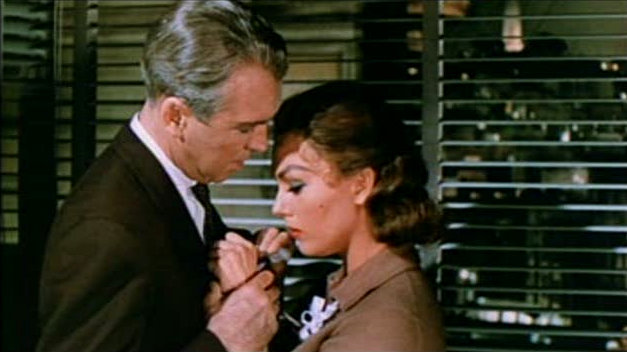
Vertigo_1958_trailer_embrace_2Then there are the players. Kim Novak has the dual role as Madeleine and Judy. She carries out both with the needed precision. Elster’s wife is elegantly beautiful, aloof and ethereal in a way that makes her the obvious fantasy of Stewart’s character. When she casts a sidelong glance or stares up at Stewart there is a faraway quality in her eyes. The clothes. The hair. How she talks. Even how she carries herself. She is spellbinding, otherworldly, and almost unattainable in all ways. Then there’s Judy, the epitome of a Midwestern girl. Pretty but not elegant. Smart but not cultured. But she falls for Ferguson as he falls for an impossible ideal.

Vertigo_1958_trailer_Stewart_on_a_laddderJames Stewart is an important piece in this film because it’s his character’s obsession that drives the plot. His instabilities, his desires, his anguish, his vertigo. It has been said that Stewart himself is a stand-in for Hitchcock and the own inner workings of the director’s being. His obsession and lusts. That may be true but something else that could be inferred is that Stewart is really a stand-in for all of us. After all, there was no greater every man than him, but there also is a universal quality to the baggage weighing on his being. Stewart’s every man is certainly being subverted, or could it be he is becoming a more accurate depiction of everyone? It’s a scary thought but what is buried inside of us? What are our own fantasies, obsessions, and lusts that lurk under the surface? Let me put it a different way.

For Stewart, he has three prominent women in his life. There’s the fantasy in Madeleine, the perfect ideal, who will ultimately ruin his life because intimacy with her is impossible. There’s Judy who has a passionate love for him, but it seems complicated in so many ways. She’s trying to measure up to his standards. The ideals and fantasies he has created poison what they could have. Then, there’s Midge who is practical, funny, and also completely devoted to Scottie. If his head were on straight he would go right to her because he would undoubtedly find the most satisfaction in that relationship, but his obsessions have undermined that.

There was an alternate ending of the film which showed Scottie with Midge once more, listening on the radio about Elster’s capture. The ending that was kept is more powerful, not because Elster got away scotch free, but because we don’t see Midge again. She all but disappears by the end of the film and with her goes all that could have been decent and good about reality for Scottie. He gets so caught up in fantasy and that tears his life apart. He’s literally spiraling in a web of never-ending hellish obsession.  Who knows what becomes of him? We can only guess.

5/5 Stars

Chariots of Fire (1981)

Chariots_of_Fire_beach“Now there are just two of us – young Aubrey Montague and myself – who can close our eyes and remember those few young men with hope in our hearts and wings on our heels.” ~ Lord Lindsay

I am hardly a world traveler but one of the places I fell in love with early on was the British Isles. London is a wonderful city with so many memorable landmarks from Big Ben to Buckingham Palace. Harry Potter to Sherlock Holmes. There are the Salisbury plains hosting the monolithic Stonehenge, and the Lake District which is undoubtedly some of the most beautiful country I have ever seen. No wonder Wordsworth and Blake were so enamored by it. However, St. Andrews Scotland has to be one of the most starkly beautiful places I have ever had the pleasure of visiting. It’s steeped in golf history due to the Old Course and despite being the home of a university, it is surrounded by a charmingly quaint town.

And of course, most pertinent to this discussion, its beaches became the perfect setting for the opening moments of the now iconic Chariots of Fire. Really it is so much more than its stellar theme by Vangelis because these sequences bookend a truly remarkable story. We enter the narrative in 1978 where two old men eulogize about the old days and their good friend Harold Abrahams who has recently passed.

Cross_and_HaversBack in the 1920s, a brash young Abrahams (Ben Cross) is about to enter university at Cambridge intent on becoming the greatest runner in the world, and taking on all the naysayers and discrimination head-on. He’s a Jew and faces the antisemitism thrown his way with defiance and a bit of arrogance. He’s a proud young man who loves to run, but more than that he loves to win. His best friend becomes Aubrey, a good-natured chap, who willingly lends a listening ear to all of Harold’s discontent. Soon enough Abraham’s makes a name for himself by breaking a longstanding record of 700 years, at the same time gaining a friend in the sprightly Lord Lindsay. Together the trio hopes to realize their dreams of running for their country in the Paris games of 1924. They are the generation after the Great War and with them rise the hopes and dreams of all those who came before them.

Charleson_as_LiddellSimultaneously we are introduced to Eric Liddell (Ian Charleston) a man from a very different walk of life. He’s a Scot through and through, although he grew up in China, the son of devout Christian missionaries. Everything in his life is for the glory of God, and he is a gifted runner, but in his eyes, it’s simply a gift from God (I believe God made me for a purpose, but he also made me fast. And when I run I feel His pleasure). His sister is worried about his preoccupation with this seemingly frivolous pastime, but Eric sees a chance at the Olympics as a bigger platform – a platform to use his God-given talent to glorify his maker while living out his faith. Abrahams is a disciplined competitor and he goes so far as to bring on respected coach Sam Mussabini (Ian Holm) to help his chances. Liddell is a pure thoroughbred with life pulsing through his veins, and of course, they must face off. It’s inevitable.
But this is only the beginning as all these men we have built a connection with travel across the sea for the Olympic Games grappling with their own anxieties and consciences. For Abrahams, it’s the prospect of failure and success. Failure will burn because his whole existence has always been about running — about winning. He has only a few seconds to justify his very existence. However, the fear of winning is almost greater, because at 24 years of age, where else is he supposed to go after winning a gold medal? It scares the life out of him. Liddell’s tribulation is of a different nature as he must stand true to his beliefs even if it seems to be sabotaging his own success. And of course, Aubrey and Lord Lindsay have their own successes and failures that run the spectrum. Perhaps most importantly these men prove their worth not only to their American opponents but the entire world. They can return home with their heads held high — champions of a feel-good tale to be sure.

Yes, this is a story about two strikingly different individuals, but Chariots of Fire becomes so engrossing due to all its characters. Aubrey resonates with me due to his general contentedness. Lindsay has an air of playful charm that is refreshing. Harold embodies my own hopes, fears, and anxieties. Eric reflects every person’s struggles with spirituality and personal conviction. In essence, the narrative goes back to the glory days to bring light to the universal and continual rise and fall of man. We’re far from perfect, but in spite of all our failures, there is still space for redemption.

The refrains of the theme music paired with William Blake’s majestic “Jerusalem” get me every time. I love being steeped in this atmospheric periodness and my heart yearns to be back in England so I can run on those very same beaches with wreckless abandon. But even if I don’t get there soon, I will be content in running life’s race to the best of my abilities wherever I am. That’s all that any of us can do.

“I have no formula for winning the race. Everyone runs in her own way, or his own way. And where does the power come from, to see the race to its end? From within. Jesus said, “Behold, the Kingdom of God is within you. If with all your hearts, you truly seek me, you shall ever surely find me.” If you commit yourself to the love of Christ, then that is how you run a straight race.” – Eric Liddell

4.5/5 Stars

Some Came Running (1958)

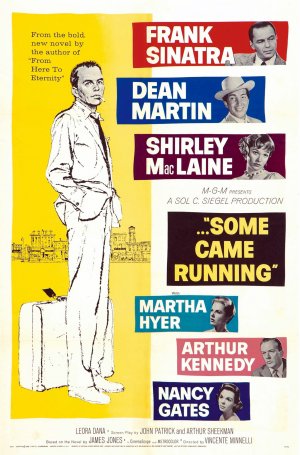
Poster_of_the_movie_Some_Came_RunningSome Came Running is a film that can so easily get lost in the shuffle of 1950s Hollywood. It’s hardly the most well-known picture of director Vincente Minnelli, known generally for his musicals and excellent set direction. Furthermore, this is most certainly a melodrama, certainly affecting, but not quite as falsely superficial to the degree of Douglas Sirk’s work. In a way, it feels like a 50s variation on The Best Years of Our Lives.

In the post-war years drifting vet and one-time author Dave Hirsh (Frank Sinatra) comes back to the town he skipped out on as a young kid. He’s a bit hung over getting off the Greyhound and realizes he has another traveler in his wake. The fellow passenger is the potentially disreputable and slightly dumb Ginny Moorehead (Shirley MacLaine), who came along for the ride from Chicago on his invitation.

Now that he’s back home, he just wants Ginny to head back the way she came, while he gets over with the obligatory meeting with his older brother. After handing his brother over to a boarding school, Frank Hirsh (Arthur Kennedy) did pretty well for himself. He married a wife (Leora Dana) from a good family and inherited a profitable jewelry business. By now he’s living the American Dream and his daughter Dawn (Betty Lou Keim) is growing up to be a beautiful young woman. In fact, you might call Frank a pillar of society, because everything’s working for him and people look up to him for what he has made for himself.

Thus, the arrival of Dave is not without its problems. The brothers have not talked for well nigh 16 years now. Frank looks to play things up like nothing’s changed and they’re both pals. He sets his brother up to an evening with a Professor French and his beautiful and highly intelligent daughter Gwen (Martha Hyer), who happens to be a literature teacher at the local high school. This is his way of trying to get his brother into good company. After all, he can’t bear that people should talk. He’s got a reputation to uphold.

But Dave’s not much for that type of company, although he takes a liking to Gwen, who avoids his advances while still taking a great interest in his work as an author. Furthermore, the cynical drifter begins to keep company with jovial gambler Bama Dillert, played by none other than a boozing, poker playing Dean Martin. Thus, there are some genuinely entertaining moments that feel like nothing more than a Rat Pack hangout.

But Some Came Running is quick to plunge back into dramatic turmoil. There are affairs, hypocrisy, unbridled passion, bar fights, parades, and carnivals all highlighted by the eye-catching staging of Minnelli. In fact, Minnelli always has an eye for his scenes, and there’s nothing different about this film. We are watching the players of course, but the space they fill, the clothes they wear, and so on are almost just as interesting. Colors pop making for vibrant viewing to match the spectacle. The climactic moments feel rather Hitchcockian with the pulse-pounding intensity set to the backdrop of a bustling carnival and the Elmer Bernstein score reverberates with his usual fervor.

Dean Martin is the comedy. Arthur Kennedy is necessary. Shirley MacLaine is the tragedy. Martha Hyer is rationality. But Frank Sinatra is the core of this film because he balances a surface level cynicism with genuine affection. He shows his interior on multiple occasions. His eyes watch over his niece with great care. His heart yearns for Gwen ardently, and he holds a deep sympathy for Ginny. Sinatra was in many quality films, but this is perhaps his greatest performance.

Is it blasphemy that in many ways I appreciate this James Jones adaptation just as much, if not more than, the long-heralded From Here to Eternity?  I suppose I am entitled to my opinion.

4/5 Stars

Ugetsu (1953)

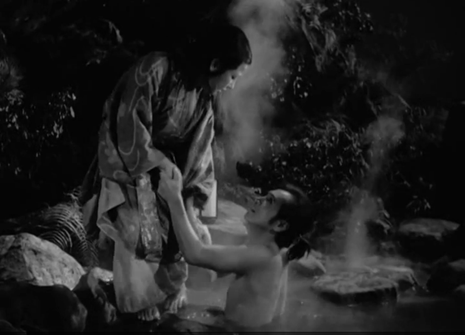
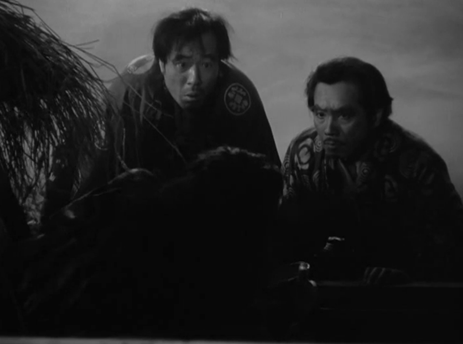
ugetsu1During my film odyssey, I first met Kurosawa, then Ozu, and finally Mizoguchi. Each with similarities and most importantly their own personal touches when it comes to the language of cinema. Kenji Mizoguchi seems especially at home with Japanese folk tales in the jidaigeki mode of Japanese period-dramas. Ugetsu finds its inspiration in such a fable from 18th-century author Ueda Akinari, and it also gathers some inspiration from scroll painting. As the narrative arc begins, it’s as if the story is slowly getting rolled out bit by bit with the camera slowly tracking with the action.

In this case, our subject is a group peasant villagers who live with their wives. Genjuro is a farmer with a penchant for pottery, who has a little boy together with his wife Miyagi. Then, there is the often buffoonish Tobei, who has fantasies of one day becoming a samurai. His wife Ohama often becomes annoyed with his obsession. When marauders come and uproot them from their homes and yet they remain together. However, with the progression of time, Genjuro has become more obsessive over his pottery as avarice overtakes him, and Tobei can no longer quell his desire for military honor. Miyagi particularly notices a change in her husband, because money has become his everything and he has put his heart and soul into that kiln of his. True, it seems to pay heavy dividends when he takes his wares to the marketplace and gets a pretty penny, while also meeting the ravishingly beautiful Lady Wakasa.

ugetsu3For our male protagonists, their wildest dreams begin to play out. Genjuro has begun a euphoric fling with his new mistress with little concern for his wife and child he left behind. Simultaneously Tobei in a stroke of good-fortune captures the severed head of a high ranking general. Although he’s a nobody, he gets in with the right crowd and his greatest wish is granted. He becomes a big shot samurai complete with weapons, armor, tassels, and an imposing entourage.

Meanwhile, unspeakable things are happening to the women in their lives, but the men seem to be lost in their dreams. When they finally are given a heavy dose of reality, it can be painful, even violently chaotic at times. And yet the reality check proves necessary because in a way it allows these men to shake off the ethereal and live in the present — allowing them to be more fully realized versions of themselves.

ugetsu2Mizoguchi rather like Fellini has a great interest in the supernatural or at least dream worlds. It’s far from nightmarish horror at least in the modern sense, but it is an everyday type of horror, where husbands act out on their darkest desires, family members die, and so on. Some would say this is far worst because it hits closer to home. The world of dreamscapes and ghosts overlap with reality.

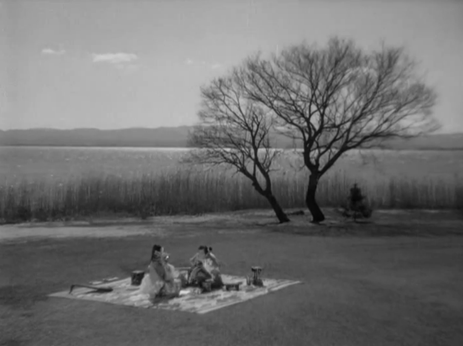
The director is also constantly utilizing long takes, but they’re far from stagnant, very often panning to the left to accentuate the feel of a scroll being unfurled. Especially in the marketplace you get the sense that you could easily be lost in a sea of people, but Mizoguchi only goes to close-ups at the most opportune moments. Otherwise, he is best suited in pseudo outdoors settings — integrating architecture and nature in perfect cohesion. These facades are put up for people to interact with whether it’s a hut or an outdoor pool, but it never loses its naturalistic beauty.

It feels quintessentially different than his contemporaries, allowing for a thoroughly unique view of the human condition. Certain types of ghosts haunt all of us whether they are choices that we wish we could take back or the hand we are dealt when our lives began. Thus, Ugetsu is remarkably poignant even in its antiquity.

5/5 Stars

Review: The Grapes of Wrath (1940)

Grapes_of_Wrath,_The_-_(Original_Trailer)_-_01The Grapes of Wrath is in special company with a number of literary adaptations where film and source material are both so highly regarded and culturally significant. A few other names spring to mind such as Gone with the Wind, A Streetcar Named Desire, and To Kill a Mockingbird.

However, even more so than all of those stories John Steinbeck’s novel of exodus during the Dust Bowl has a universal ring reverberating for the common man. The Joads are a humble, simplistic Oklahoma clan, but they are only one family out of many who are forced to make the migration out to California. The Dust Bowl and big business push them off their homes and their only hope is the distant promise land of California. They cling to that hope which keeps them going resolutely onward toward the Orange Groves.

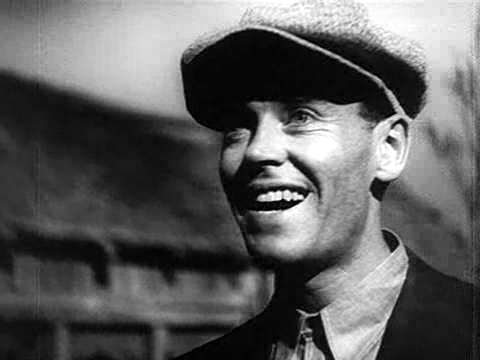
Tom Joad (Henry Fonda) who has just gotten out on parole is the figure from which we see the story through. He’s the focal point certainly, but he is defined by all those around him. Ma Joad (Jane Darwell) is the rock of the family, keeping them together, civil, and spirited even when the worst hardships of life hit.

Grandpa dies on the land that he called home. Grandma dies without the company of her lifelong partner. Rosasharn’s husband cuts out when prospects look bad. The family is slowly drained of money, food, gasoline, and hope when they see that the prospects in California are far from good. The book has so much to say politically and socially, using the Joads as a universal parable to reflect the reality of a great many people.

Obviously, John Ford’s film cannot contain all the exposition and commentary of the novel, but he uses the visual medium brilliantly and the Nunnally Johnson’s script fills the screen with all sorts of folks. There are no true villains and the only heroes are those who maintain their humanity and treat others well on a day to day basis. Ma Joad is one, offering food to starving children because it’s the right thing to do. A roadside waitress comes off brusque at first before extending a true act of kindness. You have the genial caretaker (Grant Mitchell) of the Wheat Patch Camp, who is angelic in comparison to so many of the other gruff people the Joads come in contact with.

There’s the scum of the earth. People just doing what they’re told, men just worried about profit, and crooked cops looking to run Okies out. There are those who just grin and bear it to feed their families. They’re part of the problem too and finally, you have Jim Casy and then Tom following in his footsteps.

Former preacher Jim Casy (John Carradine) is a critical figure because he, like so many of the other characters, has lost himself and yet over the course of the film he finds his purpose again. He’s the film’s Christ-like figure (with the initials JC), and yet he seems counter-intuitive to what we expect. But he has the most important things down. He fights for justice and lays down his life for his friends.

Rather like an extensive Dorothea Lange exhibition, cinematographer Gregg Toland shoots the film in beautifully austere and gritty black and white, which feels like a test run for Citizen Kane. However, it remains iconic in its own right with the ways in which it makes the plain, simple, and ordinary cinematic. It’s truly a visual snapshot of Americana with Henry Fonda as our All-American poster boy.

Speaking of Fonda, how could I have lost sight of his character here? Fonda in many ways synonymous with Tom Joad, and I always equate him being a kindly, true blue American. But that’s only part of him. That’s how he acts around his family, but he’s a young man disillusioned by the world. He speaks his mind and is not opposed to fighting back against the injustice. Because that’s what he sees around him. That’s why he kills the man who beats Casy and that’s why he goes out on the road; to be a champion of justice where there isn’t any. It’s an ending more suited for Hollywood at the time than Steinbeck’s original denouement, but it no less poignant or powerful. It doesn’t just stop with the Depression, but it ends up being a whole lot bigger and more universal than that. This is one of the great tales about the human condition, courtesy of one of America’s greatest directors starring one of America’s most legendary actors.

4.5/5 Stars

“I’ll be all around in the dark. I’ll be everywhere. Wherever you can look, wherever there’s a fight, so hungry people can eat, I’ll be there. Wherever there’s a cop beatin’ up a guy, I’ll be there. I’ll be in the way guys yell when they’re mad. I’ll be in the way kids laugh when they’re hungry and they know supper’s ready, and when the people are eatin’ the stuff they raise and livin’ in the houses they build, I’ll be there, too.” – Tom Joad

Garden State (2004)

gardenstate1Garden State was written and directed by Scrubs star Zach Braff before he made it big, while he was still struggling to get into the business. It’s one of those deep blue funk movies where a person has to find themselves in the giant mass of humanity. Andrew Largeman’s mom just died from drowning in a bathtub. He hasn’t seen his dad (Ian Holm) for about a decade because they haven’t really been on speaking terms. Now he lives in L.A. across the vast expanses from his native New Jersey. He works in a very zen Vietnamese restaurant and surreal daydreams clutter his apathetic mind.

The question is what will shake him out of his despondency because the death of his mom is only the inciting incident. As it is with a small town community, he’s constantly meeting all the old acquaintances from his high school days. Most are impressed by his foray in acting even though he hasn’t made much a career of it yet. The people he reconnects with include his old friend Mark (Peter Sarsgaard), who works at the cemetery and doesn’t have much of a life except smoking weed. Then there’s Jesse who made a killing off Silent Velcro and now has all the time in the world for parties in his huge mansion.

That’s not what does it though. It’s when Andrew is sitting in the doctor’s office, hoping to get checked, because he’s been having headaches after being off the meds he’s been prescribed all his life. There he meets Sam (Natalie Portman) for the first time, and he’s never the same. She’s a scatterbrained, off-the-wall personality with a lot of energetic pizzazz. That about covers it except she also has epilepsy and is a compulsive white-lier. But in her Andrew finds a genuine spirit, who can revitalize his life, by giving him sympathy in his pain, while also brightening up his everyday reality.

gardenstate2On his last day in New Jersey, Andrew obviously wants to spend the time with Sam, but it ends up turning into a daylong treasure hunt as Mark tries to track something down. It isn’t much, however, it’s the thought that counts, and on their odyssey, Andrew is finally able to let go of a lot of the hurt and pain he’s been harboring. He’s ready and willing to forgive his father.

Then, there he is in the airport terminal getting ready to leave Sam for L.A. He has to get back and he promises to call her, but he seems to remember he’s a different person now. It’s a delightfully sweet ending to the film and we absolutely want it.

gardenstate3Braff’s wistfully apathetic demeanor is so wonderfully personified by a memorable soundtrack including alternative rock groups like Coldplay and especially The Shins. His brand of acting is really just playing a wet noodle, but he does it well. Those beady eyes of his constantly scanning back and forth nervously around the space he inhabits. And the film certainly has some dirtiness around the edges, but our main couple is so endearingly sweet. I respect a film that respects its characters such as not needing to show them having sex all the time, but it can paint their romance in more playful, soft, even intimate shades. Andrew takes drugs and curses, but only to dull the pain or express his bitter frustrations. Sam’s the kind of girl who states that she’s not innocent, confirming our suspicions of just the opposite. We appreciate both of them exactly for those reasons. He rides an army issued motorcycle with a sidecar for goodness sakes, and she gets teary-eyed over a deceased hamster. They’re quite the pair.

3.5/5 Stars

Cry of the City (1947)

cryofthe1Cry of the City is a lesser noir from director Robert Siodmak with an often arbitrary plot, but since he is a mainstay of the genre it’s still an interesting foray on a number of fronts. It’s visually striking and features a number of interesting characters, especially female characters of all sorts of ranges.

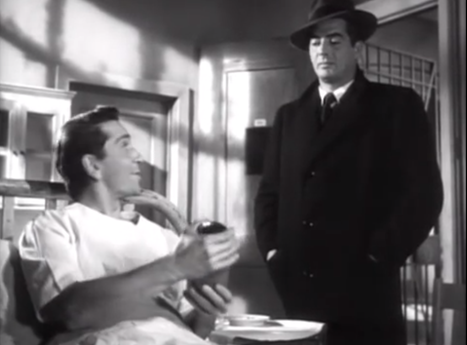
The film opens with thug Martin Rome (Conte) laid up in the hospital after shooting a policeman dead and receiving some crossfire. The police, including Lt. Candella (Mature), wait around uneasily wanting to make sure that the perpetrator will make it out alive, so he can pay for his crimes. He gets a visit from a specter of a woman (Debra Paget), who disappears as quickly as she arrived. Then a crooked lawyer tries to get him to take the rap for a robbery he didn’t commit. It would take the heat off one of his other clients.

The cops begin to canvas the streets for the mysterious girl since Rome will give them nothing. And then he escapes the prison ward, fearful that he and his girlfriend will be framed. But he’s still feverish and weak from his wounds so he calls upon the assistance of his family and an old girlfriend (Shelley Winters).

He then leads the coppers to the crooked masseuse (played by the imposing Rose Givens), but time is running out for Rome, and he is finally receiving retribution for the killings he committed and all the people he has used. It’s a chilling ending worthy of the noir world.

There’s something about Victor Mature that I don’t really care for. Maybe he just feels a tad plastic as an actor. However, it is a great deal of fun watching Richard Conte, because he can play meek fellows and baddies. In Cry of the City he plays someone in between who is wholly corrupt, but his family gives him a sliver of humanity.

The film has a Godfather-like Italian culture, and it draws a fine line between the good and bad guys since in many cases they come from the same background. In this case, Rome chose the road of excess and corruption while Candella took the so-called straight path that’s a lot less glamorous. The plot, on the whole, has uneven patches, unexplained jumps, and unanswered questions. Shelley Winters felt like a rather random addition to the storyline. And Debra Paget mysteriously shows up, disappears, and comes back again. Although the film doesn’t have much of a score, Alfred Newman’s music sounds vaguely familiar — could it be from another film? I think so.

3.5/5 Stars

I Wake up Screaming (1941)

iwakeup1So the title doesn’t have a bearing on much of anything, but who cares? It sets the tone brilliantly for this wickedly twisted noir. The film opens like other films, after the death of a beautiful young woman. Two people are getting grilled in adjoining rooms. Frankie Christopher (Victor Mature) is a promoter and the former love interest of the girl, so he also happens to be high on the suspect list. He lays out how he first met the pretty young waitress Vicky Lynn (Carole Landis). With the help of two conniving friends, he made her into the next big thing. The has-been actor Robin Ray (Alan Mowbray) helps her reach the higher echelon of society. Mustachioed gossip columnist Larry Evans (Allyn Joslyn) plasters her name and picture all over his paper until the world is bound to notice. They make quite the trifecta, all too happy to give this unassuming girl a break.

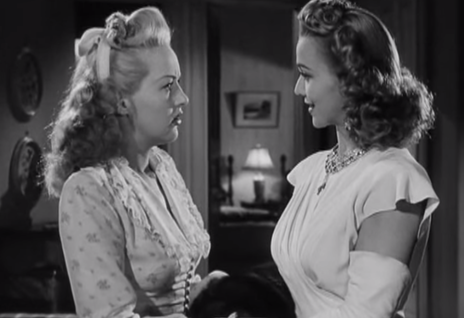
In the next room, Vicky’s sister Jill (Betty Grable) tells her side of the story: She saw how Vicky was beginning to change. She stopped working as a waitress, became entitled, and began to look down at all those around her. Now a real prima donna, she ditches her benefactors ready to head off to Hollywood for a screen test, and Christophers is understandably ticked. It doesn’t help that both Ray and Evans fell in love with Vicky. There’s also something going on between Jill and Frankie, because in the wake of the murder they turn to each other.

iwakeup2For a time the murder gets pinned on the switchboard operator — the always wide-eyed and nervous Elisha Cook Jr. But the menacing police officer Cornell (Laird Cregar), has an almost obsessive drive to find Frankie guilty of the murder. There’s something else going on here. Like so many films of this period, this story is full of men desiring women. Some of it is understandable, some of it is casual, and some of it is downright twisted.

Although she is out of the film early on, Carole Landis has the key role as the rising starlet and she is the closest thing to a femme fatale in this film. But there are a lot of characters of interest aside from our main couple of Betty Grable and Victor Mature. His two opportunistic friends are no-goods but thoroughly entertaining, and Laird Cregar is downright spooky. The film takes on another level of significance due to the tragic suicide of Carole Landis which occurred in 1948. There is most definitely an allure to her just like the women in prominent film-noir like The Woman in the Window or Laura (1944). Throughout some haunting refrains of “Somewhere Over the Rainbow” can be heard, helping to make I Wake up Screaming disconcerting from beginning to end.

3.5/5 Stars

Review: Bringing up Baby (1938)


bringingup2“Our relationship has been a series of misadventures from beginning to end, so if you don’t mind, I’ll see Mr. Peabody alone and unarmed.” –
David Huxley

Bringing up Baby is really and truly one of a kind, almost headache-inducing with its sure energy and dizzying with its scatterbrained tracks, but nonetheless it is a screwball masterpiece. From Hollywood master Howard Hawks comes arguably one of his greatest films, boasting the rat-ta-tat-tat of some killer dialogue, some fantastic comedic sequences, and a number of memorable performances.  Honestly, if I learned anything from this film, you can’t watch it just once, because you’re bound to get bowled over, and afterward you probably won’t realize half of what you saw. For instance, there’s so much talking you hardly realize that there’s not much of a score.

Young Katharine Hepburn is at her most radiant and almost smothering with her constant barrage of words. You either love her or hate her. There’s no way to ignore her performance here because it’s completely out there. It’s hard to believe she was a novice when she came into comedy. There’s no inhibition whatsoever. Not in the least.

Cary Grant is the bookish paleontologist who is content with constructing the skeleton of his prized Brontosaurus and then marrying his admiring, no-nonsense sweetheart Ms. Swallow. It sounds like a pleasant albeit mundane lot in life. In an effort to gather a $1 million in funding, he goes out to the golf course ready to do a little business on the side with Mr. Peabody. That’s when hell strikes in the form of one scatterbrained lady extraordinaire Susan Vance (Katharine Hepburn). First, she swipes his golf ball (quite certain it is her’s), then she batters up his car (sure it is her’s again), and to top it all off she causes him to sit on his hat when they cross paths again at a club. Poor Dr. Huxley doesn’t know what’s hit him. He just wants to get away from her and all the fury that comes in her wake.

Good luck with that Cary, because she’s a force of nature! She misunderstands everything, and he gets endlessly caught in her web of miscommunication.  Susan initially roped him into coming along with her, thinking he was a zoologist who could help her take care of “Baby.” Of course, it turns out to be a tame leopard that they must get to her aunt’s home out in Connecticut (Only in a screwball comedy). By now he’s bothered. She’s falling in love.

So she does what any resourceful girl would. She keeps him occupied. First, she swipes his clothes. Then the dog George runs off with his prized possession, the intercostal clavicle. Initially, they want to get rid of the leopard. Then they want to keep it. Auntie comes home along with her gentleman friend Major Horace Applegate. A not so friendly leopard escapes from a carnival. The police get involved led by their bumbling leader Constable Slocum.

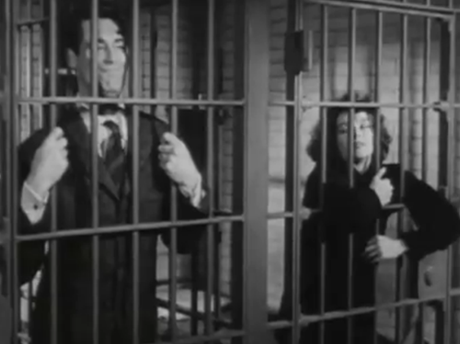
bringingup1It’s a doozy of a masquerade and most everything and everyone is utterly confused. It’s as if everything that enters the world of Susan Vance is further complicated. To her, it’s simply a day in the life and Huxley begins as an outsider, but despite all the madness, he becomes accustomed to it.  Running after the dog, getting soaking wet, tripping, falling, fending off a leopard, getting thrown into the clink. Dr. Huxley realizes that he’s never been happier and it ends pretty much as it began. Never a dull moment.

This has to be one of Hepburn’s greatest performances earlier in her career because she has everyone in a tizzy. Although he’s literally getting the run around from Hepburn, Grant is her perfect comedic foil. He dons the glasses at first and carries the sensibility that goes with them. However, he is equally equipped to go without them as a scatterbrained gentleman ready for all the pratfalls, quips, and escapades that ensue. And they are surrounded by a solid set of character actors including a drunken Barry Fitzgerald, the easily distracted Walter Catlett, the big game aficionado Charles Ruggles, and the peppy dog Asta (of Thin Man fame) among others.

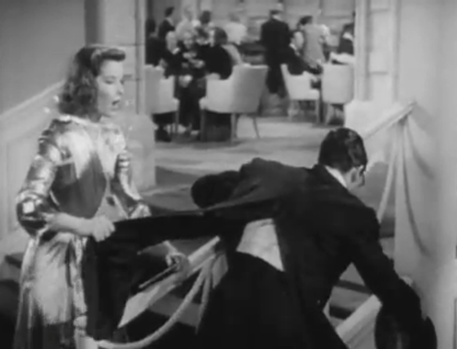
Howard Hawks once said that “a good movie is three good scenes and no bad scenes.” In Bringing up Baby some of the memorable moments include the fateful meet cute at the golf course, the chuckle-worthy encounter at the club, and of course the sequence leading up to jail. But it’s also the little comedic moments wedged in between. Maybe Hepburn’s parked in front of a fire hydrant and trying to pull the wool over the policeman’s eyes. Or perhaps Grant dons the only piece of clothing, a frilly bathrobe, and is forced to answer the front door. It’s utterly absurd. It’s become classic and it shows the ability of Hawks behind the camera to make the action flow so organically.

It’s amazing that this film was a flop, Hepburn was labeled “Box Office Poison” by this point, and Cary Grant had yet to become an established star. Oh, how things changed. Because this film, in a sense, was the beginning of something truly wonderful. When two of the greatest stars aligned with one of the great directors.

5/5 Stars

Like Crazy (2011)

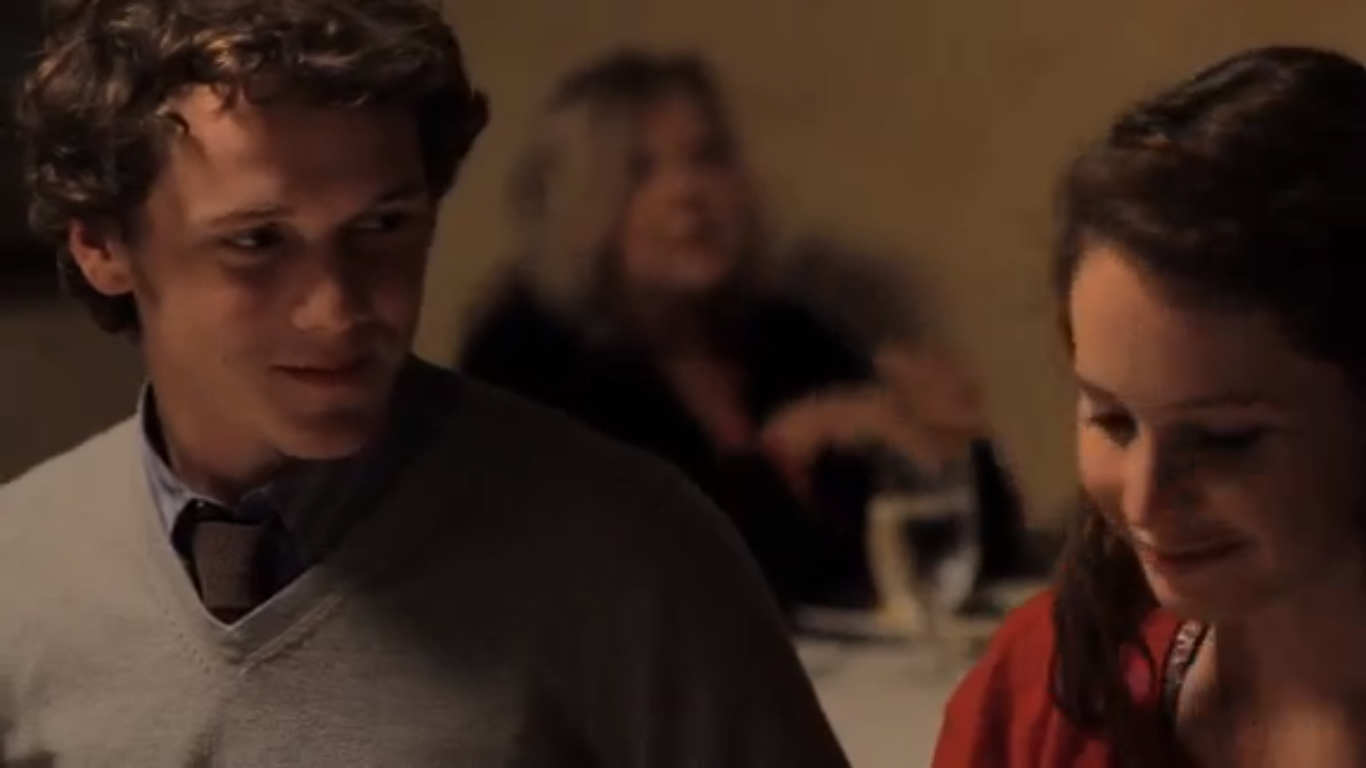
likecrazy7Like Crazy is the genesis, the passion, and the heartache of a romance all wrapped into 90 minutes of film. Our two subjects are filmed as individuals at first and the cinematographer opts for a handheld camera approach to capture their moments together. The loosely woven narrative is based on director Drake Doremus’s own experiences with a transatlantic romance. In the film Jacob (Anton Yelchin) is an American college student living and going to school in L.A. After her heartfelt confession of affection, Jacob begins a relationship with the British-born Anna (Felicity Jones), who is in country on a student visa.

The film slowly evolves into a montage of their time together as they grow closer and closer. It’s a beautiful picture of tentative and affectionate love coming into bloom. And with her visa about to expire Anna decides to forgo it all and stay with Jacob. But the Visa issues come back to bite her and continue to give the couple problems. Soon they are separated by an entire ocean dealing with the many challenges of long distance relationships.

For Jacob, there’s another girl (Jennifer Lawrence). For Anna a guy down the hall who asks to borrow her appliances. It’s so much easier having these people in close proximity, and it challenges their wills. Because airfare is expensive and talking through text message just simply isn’t the same. It works at first but it seemingly is not sustainable.

Marriage seems like the best option for them to hold what they have together as Anna’s Visa problems still loom overhead. But it’s hardly a quick fix and over time there’s a breakdown in what they have. Even when they are together they have trouble connecting, not shouting, and not getting annoyed. Because, more often than not, they are apart now. The best they can do is wistfully remember the intimacy they had before and try and go forward from there.

Likelikecrazy4 Crazy generally stays away from the constricting effects and inflexibility of your typical plot line. The script was more of an outline and the dialogue was essentially the two leads ad-libbing most of their interactions. But this lends an organic quality to this, dare I say, trendy indie love story. There’s vast distance juxtaposed with intimate close-ups. Emotions embodied by images become paramount over words. In a sense, we see their nakedness and not literally, but we see that vulnerability in those most intimate times in a relationship, sharing bits of bliss together. Whether they are in Santa Monica or London, the scenery is only a place in which the two of them are having moments. The type of times they remember in the shower or while they sit in the bar with their friends, or when they sit doodling at their desk. It’s those times that make them want to make this thing work despite the distance. It’s a difficult trade-off and I’m doubtful anyone has found the precise answer for it. Because all the countless advances in technology cannot give us intimacy only imperfect substitutes that will never fully replace the real thing.

likecrazy6It is a great joy watching Felicity Jones and Anton Yelchin play off of each other because aside from one occasion, their performances are quite subtle and refreshing. We even get an appearance from Jennifer Lawrence. For this reason, it’s fun to watch a film like this and see where the talents have gone in only a couple of years. The Theory of Everything, Star Trek, The Hunger Games. But there’s always a necessary niche for smaller films like this. I look forward to more takes on love from Drake Doremus and Felicity Jones has gained one new fan today.

3.5/5 Stars