(500) Days of Summer (2009)

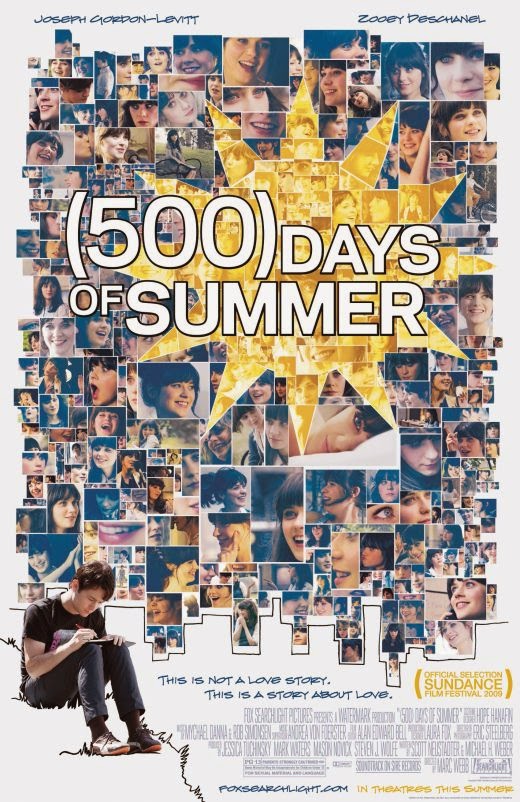
16ddc-five_hundred_days_of_summer“This is a story of boy meets girl, but you should know upfront, this is not a love story.”

This one line is uttered by the very thematic narrator of (500) Days of Summer and it describes an aspiring architect-greeting card salesman named Tom Hanson who meets Summer Finn at the office.

This often inventive and imaginative romantic comedy highlights the highs and woes that come with a relationship. You see Tom and Summer are seemingly two conflicting forces of nature from the beginning. He is a hopeless romantic believing in fate and love at first sight. She does not quite buy into that stuff, and she is only looking for “a friend,” nothing too serious. The so-called Summer Effect is what draws Tom to her. She is seemingly a normal everyday girl, but there is something extra special about her. But you will see for yourself.

The film’s scriptwriters do an excellent job at highlighting the minutiae that go along with any relationship. The Smiths are a point of agreement. Ikea is a place to fantasize about the American Dream, the copy room can be a place of romance, and Ringo Starr’s “Octopus’ Garden” will always be a point of contention. Mind you, all of this is out of sequence because that’s the way the memories come flooding back.

There are days when the whole world seems to be smiling with you. The birds are singing, you’re Han Solo, and it just makes you want to dance. There are days when you have bed head and your dreams are broken. There is no longer faith in romance. One day it seems like the walls are coming down and you are truly getting to know this significant other on an intimate level. Another day a small squabble over a punch and soon enough you hate everything about her. Her smile, her knees, her hair, they’re all awful.

All these things happen to Tom because Summer is not looking for anything more substantial, but he feels he is getting mixed signals. They are finally reunited and he thinks this might be his second chance. However, expectations seemingly never mirror reality. He is disillusioned realizing movies, pop songs, and even greeting cards are responsible for the lies society feeds us about love.

Now Summer has moved on in a big way, the wounds still hurt Tom, but they meet at that same bench overlooking Los Angeles for a final time. So you see this was not a love story after all. However, remember the date May 23rd, a Wednesday. We do not know the outcome but if nothing else it was the day that Tom reaffirms his belief in love.

(500) Days of Summer was different enough to be an enjoyable film which was instigated by a nonlinear storyline that pulled us along through a relationship ( day 1-500). Joseph Gordon-Levitt and Zooey Deschanel were both enjoyable and Tom’s friends and sister had enough personality to add something to the film. The music is often fitting (“Sweet Disposition” by Temper Trap helps the indie vibe), and both leads got an excuse to work out their vocal cords.  By the nature of the narrative, the story jumps around a lot, seemingly leaving loose ends. Perhaps that is just my own hangup. Because, like any love story, this film may have its imperfections, but that is not to say it is not worthwhile.

4/5 Stars


The Parallax View (1974)

1c362-parallax_view_“Fella you don’t know what this story means”

The first shot and we know where we are. We’ve been here before. It’s Seattle. The occasion is a Fourth of July parade honoring Senator Charles Carol. Any viewer paying attention knows something fishy is afoot and in perhaps the most intense moment of the whole film the man is violently assassinated. A committee deliberates and comes to the conclusion that the perpetrator was acting alone. And so begins The Parallax View.

Second rate journalist Joseph Frady is known for getting into trouble or causing it most of the time. So when he is interested in rehashing the old story his long-suffering supervisor is skeptical (Hume Cronyn). It all starts because news reporter Lee Carter comes to Frady fearful for her life. It turns out that 6 of the people who were there during the assassination have all died one by one. It’s all very circumstantial and seemingly harmless enough. Soon Carter herself is dead due to barbiturates and alcohol. Frady heads first to the town of Salmon Tale (in search of the elusive Austin Tucker), where he runs into trouble with the local authorities and stumbles upon the Parallax Corporation. He gets his rendezvous with Tucker who is also fearful for his life. Minutes later Kabooom.

He continues winding up with more questions than answers as new bits and pieces crop up. It turns out Parallax is in the very lucrative business of recruiting assassins, so he goes off the grid to join them. His training includes a montage of images to condition him, and the audience is submitted to the process as well. Frady diverts a bomb threat thanks to a stack of napkins, but still another one bites the dust. He finally finds his way to a convention hall where a big to do is in the works for a senator. In a perfect bookend, another man is shot and after deliberating the committee concludes Joseph Frady acted alone. The biggest conspiracy in the country gets away with murder again and slinks back in the shadows.

Gordon Willis’s cinematography exhibits beautiful wide and long shots framing his subjects in their environments. Beatty is fit to play the somewhat rogue reporter but very few of the other characters are memorable. Perhaps that’s precisely the point. The film has extremely deliberate pacing (ie. Two men ride up an elevator one after another in no immediate hurry). However, the paranoia elevates as the film progresses, because we have little idea what is going on, we just know that something is going on. I am partial to The Manchurian Candidate, but here is a film that represents the 1970s, a decade still fraught with political unrest and a myriad of recent assassination attempts.

3.5/5 Stars

A Raisin in the Sun (1961)

d69d4-raisin_in_the_sun_1961_poster_horizontal_bStarring Sidney Poitier and adapted from a stage play, the film chronicles the lives of an African American family residing in Chicago. The whole family including the matriarch, her unsatisfied son, his wife, his son, and his sister wait excitedly for an insurance check for $10,000. The mother receives the money and resolves to use it in order to buy a nice home for her family in a white community. She then gives the rest to her son who has big plans for it. However, he loses it all leaving the family bitter and worried. In the end Walter does show his integrity and despite the bad situation, the family remains close. A great deal of this film is about the conflict of ideas and interests of the different individuals. It is also memorable since the cast is almost all African American. Poitier is good but it seems the mother steals the show.
 
4/5 Stars
 

Good Morning Vietnam (1987)

4eba0-good_morning2c_vietnamGoooooooood Mooooooorning Viiieeetnammm! I’m a little late to the party I know, but I wanted to take a look at a film that in many ways personifies Robin Williams. In the last months, I have gotten to read a lot on William’s as a comic and as an actor. When I watch this film which showcases his many skills, I am especially drawn to what I call his bipolar comedy. Let me explain. On the surface, he seems like a pleasant-faced average Joe with a little twinkle in his eye. Maybe there are even moments of emotion or sadness that make their way out. Then, bing pow! The lights go on, the sirens sound, and all chaos breaks loose.

Adrian Cronauer is the perfect embodiment of William’s quick wit and off the wall antics. He has a constant supply of new voices and old reliable ones, not to mention cultural and political jokes. It all gets thrown in so fast you hardly get to bat an eye, and he does it all with that rye smile and one defiant attitude.

This is yet another nostalgic 1980s classic directed by Barry Levinson. The story begins in 1965 with the jockey getting shipped in from Crete, and soon he is the hero of all the underlings especially his young compatriot Private Garlick (Forrest Whitaker). Immediately the power dynamic is rather odd. The General overseeing everything loves his zany, sometimes crass, take on comedy. His two immediate superiors are less than pleased with his early showings of insubordination. If the General is any indication, Cronauer’s mix of humor, (censored) news updates and groovy rock n’ roll prove insanely popular.

In his spare time, Cronauer pursues a young Vietnamese girl while teaching an English class to locals. They soon enjoy his more slang-based approach to English, and he befriends a boy named Tuan. He also has some time to start a brawl at a local hangout and eventually see it blown to smithereens. It’s after this one occasion where he gets fed up with the censors controlling what he says because it doesn’t seem right. It seems too regular army, and he is certainly not that. Cronauer is suspended but during his hiatus, he gains a new found zeal performing for the boys in the field.

Due to popular demand, he gets reinstate,d but his superior, who has always had it in for him, connects him with a wanted South Vietnamese terrorist, and Cronauer soon gets the boot with an honorable discharge. The former disc jockey realizes Tuan lied to him all along, but after confronting the boy he fulfills one last commitment with his English class. Cronauer flies off into the wild blue yonder, but not without leaving a gift with Garlick for all the boys. Gooooodbyeeee Vietnaaaam!

This was a grade A performance by Robin Williams and the soundtrack was absolutely superb, full of big and small hits alike. Louis Armstrong’s “What a Wonderful World” was especially impactful due to the images that were juxtaposed with it. Furthermore, just as much of what Cronauer was lost to his students, I feel like many of his cultural quips might get lost to newer generations. I sincerely hope they do not and his political commentary will always swirl around like any of the controversy surrounding Vietnam. The magic of the character is his ability to make men laugh despite their circumstances. The magic of Robin Williams is that he was a man who made us laugh in all circumstances.

4/5 Stars

Beauty and the Beast (1991)

7bdf2-beautybeastposterMy affinity the past decade has gradually turned from the classical Disney formula to the seemingly more inventive storytelling of Pixar. However, Beauty and the Beast certainly has all the makings of a great Disney film, and it is perhaps one of the last classics to come out of the canon.

As per usual, the story gets its inspiration from books and fairy tales. This time from France. Of course, any good fairy tale must have a prince and this specific prince was unfortunately turned into a great ugly beast by an old woman-turned-beautiful enchantress who he insulted. After that trauma, he is resigned to that awful fate until he learns what true love is. Until then he lives locked away in an enchanted castle with no human contact and only a magic mirror to gaze into.

Belle is the most beautiful girl in her little French village where she devours book after book and deflects the increasing advances of the handsome yet conceited Gaston. She lives with her quirky father who has a knack for crazy inventions. One such contraption actually works and he rides off to show it off, but on the way he gets lost out in the wilderness. Lo and behold he ends up at the Beast’s fortress and is soon imprisoned. His daughter goes after him and receives a warm welcome from the enchanted staff of the castle, but the Beast will only let her father go if she stays. So she tearfully agrees. The drama is heightening.

It is slow at first, but over time the Beast’s timid side is revealed, and he begins to fall for Belle. The breaking of the spell seems imminent and yet he reluctantly lets the homesick Belle go see her father again. However, Gaston has been working in the shadows and riles up a mob to lock Maurice away and then go after the child-killing Beast. Humanity must be saved from such a villainous creature after all.

In typical Disney fashion, the final act is a wholly entertaining conclusion with an often uproarious skirmish between the villagers and the enchanted inhabitants of the castle. Top that off with a necessary final showdown, some passionate kisses, and some sumptuous final sequences, and everyone is happy. Disney has always been adept at making films with a wide range of appeal and they do it again here with their foolproof formula. They take a universal story and fill it with mellifluous music and absorbing visuals. The animation is often inventive and fun while the characters fill all the necessary spots. You have your villain, your beautiful girl, your anti-hero, a bickering clock and candle, along with a kindly teapot. What more could you want?

I must say I am curious to watch the original French version La Belle et la Bete (1946) by Jean Cocteau to see how this version varies. Until then I am happily content with this film. This is the type of animated film audiences deserve to see and hopefully they will. Bonjour and Be Our Guest!

4.5/5 Stars

Review: Forrest Gump (1994)

950b6-forrestgump1If you want to start out on the broadest level possible, the film is a lesson in 20th century American History. It charts the turbulent course of mankind including assassinations, counter-culture, Vietnam, Anti-War Rallies, The Cold War, Watergate and much much more. The substantial soundtrack dials back the clock to fully immerse the audience in that time and place.

It is the dream movie for pop culture fanatics and history aficionados. That’s why I enjoy it. However, much like the feather that flutters in the breeze drifting this way and that, Forrest Gump is a character who floats through history as it is made. It begins with his leg braces which give inspiration to the Elvis phenomenon. Ultimately, he plays football for Alabama, sees the school desegregated, and becomes an All-American who meets JFK.

Soon it’s off to Vietnam, followed by a Medal of Honor, and a trip back home thanks to a million dollar wound. Forrest gets a taste of the nation’s capital and soon becomes an accomplished ping pong player, makes it big in the shrimping business, and heads home back to Alabama once more after buying Apple stock. All these moments are absorbing to be sure, but that alone would make the film just okay as a historical drama.

Tom Hanks‘ Forrest Gump is the important piece in the entire equation because of the people that gravitate towards him. Forrest himself only has an IQ of 75, but he is so unlike many of the characters we are used to. Not because he is “simple” so to speak, because he is far from it. Perhaps it’s the fact that he is wholly genuine, loyal, and innocent. That’s almost unheard of these days. He seems to stand at complete odds with the history that is happening all around. Sometimes it looks very different from his eyes or he is completely oblivious to what is happening.

However, in some ways, he seems to have things figured out better than most. He loves those close to him, does what he loves, and never loses his positive spirit. His observations on life might be plain, but they are nonetheless powerful to those around him. To Hank’s credit, he infuses the character with a slow-witted charm and gives him a deep southern drawl. He’s Forrest, Forrest Gump. That’s all he needs to be.

Sally Field has a relatively short screen appearance, which is still extremely important because Forrest’s mother is the one who helps guide his whole outlook on life. She encourages him to make the best of what God has given him and to realize he is no different than other “normal” people. Her love, cultivation, and homespun knowledge is what seemingly allows Forrest to lead a full life, though pithy sayings only go so far, at some point you just have to live.

Jenny (Robin Wright) is another character who is perhaps a greater drifter than Forrest himself. She is constantly trying to find her way through the turbulent times while Forrest’s feet always seem firmly planted on the ground (Rather ironic since he is always running). She is a prodigal and always prone to return to Forrest who always welcomes her back with open arms no matter the circumstances. It might be a stint in a nightclub, living the hippie life, joining the Black Panther Party, or being with other men. Forrest is forever loyal and protective of her. She cannot always handle having him in her life, and she wishes to find her own way. He is always there for her, though, even up to the point of taking care of a son.

Bubba and Lieutenant Dan are Forrest’s best good friends and both men are greatly impacted by Vietnam. Bubba dies and Lt. Dan loses his legs (not to mention his self-respect). Forrest is fiercely loyal to both comrades, starting up Bubba Gumps Shrimping in honor of his late friend and giving work to Lt. Dan when he needs it most. He is a friend for the ages and he takes the title seriously.

Calling Forrest Gump just a historical drama or even sentimental tripe might be partially accurate and yet it cohesively adds up to more than its parts. 20 years have gone by, true, and some of the luster may have gone away, but certainly not all of it.  Though it might be far from perfect, it is a story that is worth any shortcomings, because it has heart and a fantastical telling of American history that is still worth watching.

4.5/5 Stars


The Best Films of James Cagney

1. White Heat
2. Angels With Dirty Faces
3. Yankee Doodle Dandy
4. The Public Enemy
5. The Roaring Twenties
6. Footlight Parade
7. One, Two, Three
8. Strawberry Blonde
9. Mister Roberts
10. Ragtime
11. G-Men
12. City For Conquest

Forty Guns (1957)

6fb70-fortyguns1Samuel Fuller has got an eye for style, cinematic scope, and at times, subversive mayhem. It’s no coincidence that Forty Guns was shot in Cinemascope, and it is one of the enjoyments of watching this film, which constantly bounces back and forth between long shots and close-ups. To start things off, Barbara Stanwyck is Jessica Drummond, the “High Ridin’ Woman with a Whip,” and she is the heiress of a self-made frontier empire.

It helps to tote forty guns around with her, but she is not as unethical as she would appear at first glance. On the other side are the Bonnell brothers, former gunslinger Griff (Barry Sullivan), number two man Wes (Gene Barry) and then the baby Chico. After they arrive in town, on behalf of the Attorney General, the nearsighted sheriff (Hank Worden) is gunned down by a drunken troublemaker who just happens to be Drummond’s kid brother. Then his buddies proceed to trash the town all in the name of good fun.

Soon Griff straightens Brockie out and Jessica comes into town to retrieve him. Next, Griff comes with a warrant to Jessica’s ranch and in a memorable scene, literally made for Cinemascope, the warrant gets passed down the table. Jessica wants no trouble but soon a crooked sheriff named Logan (Dean Jagger) want to finish off Griff. It doesn’t go so well and he gets more and more jealous of Jessica’s increasing love for the oldest Bonnell brother.

Ultimately, Brockie ends up in the clink, but he uses his sister as a shield in an attempt to escape. For once Griff loses his cool and sprays him with bullets and that’s not all. For good measure, Fuller has Griff ride solemnly off in his buckboard only to have Jessica scamper after him. The power dynamic see-sawing once again.

Yet again, Fuller never seems to do anything conventionally or demure. His film has a reformed gunfighter who calls his former profession that of a freak. The leading female character dominates most everyone else and has a ballad written about her. There are tornadoes that envelop the screen. Then, only Fuller would have the audacity to kill someone during their wedding ceremony, and he does it without skipping a beat.

Among other things, it is a film about guns, brothers and sisters, and love. Griff packs a gun on him. Jessica always has guns behind her. Griff has a younger brother who has much to learn. Jessica’s brother will never learn. That being said, the inventive visuals, typical brutality, and the memorable casting of Stanwyck were all in a day’s work for Samuel Fuller.

4/5 Stars

A Letter from an Unknown Woman (1948)

8cc43-letter_from_an_unknown_woman_posterThe place is Austria. The time around 1900. This tearful romance is framed by a lovely plot device in the form of a circular narrative. As the title suggests a woman writes a letter to the man who she has always loved. As she relates their story, he slowly pieces it all together.
Lisa was a shy and timid girl. She becomes acquainted with dashing piano prodigy Stefan Brand (Louis Jourdan) from afar as he has moved in next door to her mother’s home. She is a quiet observer of all he does, sharing in each one of his musical triumphs and seeing his friends (mostly women). Lisa even goes so far as to attend dancing school, so that she might learn good manners to impress him someday. Most of all his playing enchants her each and every evening as she silently listens to his gifted hands.
Thursdays were rug beating day and on one such day, she got her chance. She met Stefan’s kindly mute servant and secretly enters the shrine of her love for one blissful moment. However, things quickly change as Lisa’s widowed mother has a beau who wants them to come and live in Linz. So they move away from the oblivious Brand, but the wistful Lisa takes one last visit to her old home.
Soon she is introduced to the stately Liet. Leopold and as time passes he graciously asks for her hand. Taken aback, Lisa balks and mentions another in Vienna who her parents do not know of (and who does not know her). No one understands the reason why, only she does, and she is not one to tell. Lisa, however, moves forward and begins to model dresses for rich clientele. Finally, as a grown woman she has her first true face-to-face encounter with the man whom she worships.

Thus, begins their enchanted time together. He does not quite understand the gravity of the situation, but she is content in just being with him. That is enough. No explanations need to be made. Their evenings are spent eating lobster, walking through the streets, taking a train ride all over the world, and munching on caramel apples. Top it off with a passionate embrace followed by a kiss and the fairy tale ending seems to be imminent. But as we already suspected, it is not that easy, and a train rapidly takes him out of her life.

As time passes, she has a son who is Stefan’s boy, but she resolves not to tell him and raise him by herself. For a while, it is a struggle, but she gets remarried and she seems happy enough with a comfortable lifestyle, a gentlemanly husband, and a cute son. Stefan Brand is now a washed up has-been who used to have a wealth of talent 10 years ago. At the opera, he happens to cross paths with Lisa, a strangely familiar figure, and she realizes that she must go to him. She is absolutely ecstatic to be reunited with her first love, but all too soon it becomes evident he cannot remember her. He is fascinated by her the same way he was 10 years ago, but he has forgotten. Unrequited love hurts too much and a broken marriage is already upon her. As her son before her, Lisa’s life is taken by Typhus and all that is left of her is this letter for Stefan.
 
All that’s left for him to do is hit his head in despair. He let her slip through his fingers, if only he had known. If only his servant had not been mute, because he knew who the girl was. Brand has new resolve, however, and instead of running away he faces an unpleasant fate with honor. 
Joan Fontaine is as sweetly demure as ever, and she fits this role so beautifully with her narration being a wonderful guiding hand to the film’s story. Her character slowly grows and matures in front of us, and yet one thing remains unchanged, her love of Stefan Brand. In some ways, the label of a “woman’s picture” has a negative connotation, but really all it refers to is a film that takes the point of view of a woman, or it focuses specifically on women. These stories crafted by men during the 40s and 50s were meant to be weepy tales for women audiences. Looking back now, however, they can resonant with all audiences and in this case some of that is due to the direction of Max Ophuls. 
Ophuls camera is hardly ever stagnant, following Joan Fontaine as she moves, with gracefully smooth sweeps and tracking shots. Give him a staircase and it becomes almost a playground for him to move about as he sees fit. What we are left with is an elegant look, because the movement does not take away from the elegance but actually accentuates it. No one could accuse the camera of being hurky-jerky, and it makes the impact of the stationary camera that more potent.
At an approximately 86 minute running time, A Letter from an Unknown Woman is a marvel because it is laced with character development, romance, and drama that builds steadily and reaches a teary crescendo.
 
4.5/5 Stars

Review: His Girl Friday (1940)

25148-hisgirl1It all happened in the “Dark Ages” of the newspaper game — When to a reporter “Getting that story” justified anything short of murder. Incidentally you will see in this picture no resemblance to the men and women of the press of today.”

Hildy Johnson (aka His Girl Friday) is making her return to the Morning Post but not to get her old job back. She came to pay a visit to her former husband (and paper editor) who she divorced because she is newly engaged and wants to break everything off for good. It means she can go off into the sunset with her new beau, but it also means no more paper. She drops the news and it turns out the wedding is set for the next day so Walter has very little time to go to work. He soon begins a sly barrage of subtle and not so subtle jabs, ridicules, and put downs aimed at the easy target Bruce Baldwin (Ralph Bellamy). Walter cuts him off, plays dumb, and is in general condescending and conniving. Hildy sees it all unfolding and half watches with bemusement, while also trying to stop Walter from causing any major trouble.

You see he’s a wonderful fellow in a loathsome sort of way, but you cannot help but like him. Because as Hildy notes he comes by charm naturally since “his grandfather was a snake.” These are the kinds of barbs and witty put downs we deal with the entire film. Besides being good fun, it also is quite extraordinary, since they never stop coming. It’s also fascinating to simply watch the many expressions of Cary Grant, whether it is a smirk or straight face, it always has a tinge of mischief which suits his character just fine. He seems more like a little boy at times, trying to win back his girl, and in many ways, that’s what he’s trying to do. But back to the action.

Hildy unwittingly falls into Walter’s trap, and from that point on there’s no stopping her, or Walter’s scheme for that matter. When the wheels of journalism start turning there’s no stopping someone like Hildy with newsprint in her blood. Walter lets her catch wind of a man who pleads innocence though he is to be hung for shooting a black policeman. Hildy puts up a fight, but she doesn’t last very long.

Soon she’s gotten into talk to the nervous prisoner Earl and gets his point of view on the whole messy ordeal. The other newsboys are callous to the world, and as the gallows goes up outside their window, all they can do is play cards and think about the best scoop. Hildy is a little different but she’s still leaving…or is she?

Next, Williams escapes and the mad search for the fugitive is on as the newsroom goes into an uproar. The mayor and sheriff are in a tizzy and then a reprieve for Williams comes, but they ignore it because they need this hanging in order to get re-elected. By a stroke of luck, Hildy finds Williams and stashes him away in a desk. Now she is hooked, and when Walter hears about her stroke of luck, everything begins again like old times. Bruce and his mother are soon disregarded as Hildy types feverishly, and Walter wheels and deals on the telephone. Then, the sheriff and mayor burst in with the rest of the boys. Williams’ hiding place is uncovered and the two reconciled lovebirds look like they might wind up with a jail sentence. But the honorable air-head Mr. Pettibone saves the day. All that’s left to do is depart on a two-week honeymoon to Niagara Falls or maybe a workers riot in Albany. All is right with the world again. Walter’s got His Girl Friday, and she’s got her lovable wiseguy husband back.

I’m not quite sure why I am so often drawn to this movie because it is more than it being readily available in the public domain. The dynamic of Grant and Russell is certainly superb. Walter can be an absolute cad, but Grant’s charm makes him bearable to the end. Russell is the true star of this film and she deals the punches with the rest of the boys. It really is the perfect role for her. The film is blessed with the great supporting cast including Porter Hall, Roscoe Karns, Gene Lockhart, Billy Gilbert and a host of others who populate the film with colorful faces and voices.

After seeing Nothing Sacred (1937) it was also interesting to see another script from Ben Hecht about journalism. Again, it might be a screwball comedy but there are also political undertones. Most blatantly about journalism itself, but also about corrupt leaders (like the mayor and sheriff), the Red Scare, gender roles, capital punishment, and even WWII.

Of course, it must also be noted that this is a film directed by the great Howard Hawks. I have always had difficulty pinpointing his trademarks, because the reality is, he was so versatile, trying his hand at so many different genres. All I know is that I more often than not enjoy his work behind the camera because it is seamless and it feels quintessentially American. His Girl Friday is no different. Although, this one is just a tad faster than most. It’s sure to raise your blood pressure so be warned.

5/5 Stars