Mon Oncle (1958)

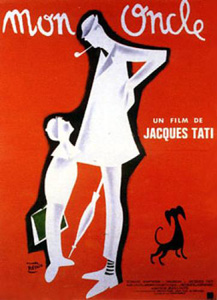
32cfb-mononcle_posterStarring and directed by Jacques Tati, the film revolves around the bumbling but kind-hearted Monsieur Hulot, as he interacts with his relations and young nephew. We follow Hulot as he navigates through his life in France. His sister and brother-in-law live in an ultra modern home complete with automated machines, a fish-shaped fountain, and cold-looking furniture. In contrast, there’s the carefree Hulot whose only possessions seem to be his ever present pipe and umbrella. He struggles to cope with everything modern and bungles in his brother-in-law’s factory. However, most importantly he seems to enjoy life and he is liked by all including Gerard, his nephew. This film is enjoyable because of the little things. You have the often repeated theme that brings to mind Parisian cafes. There is satire, odd architecture, little dogs, the use of or the lack of sound, many caricatures, and most importantly of all Hulot himself. It would seem to me he bridged the gap between Chaplin and Keaton with Mr. Bean. Too bad more people do not know about him.

4.5/5 Stars

Mr. Hulot’s Holiday (1953)

01c54-les_vacances_de_m_hulotDirected by and starring Jacques Tati, this is the original film that introduced the bumbling but kindly Mr. Hulot. He finds himself staying at a beach side hotel full of various different tourists. The film is not so much about plot but instead it focuses mostly on Hulot’s many antics. Whether he is paddling a kayak, playing tennis, changing a tire on his beat up car, trying to mount a horse, or accidentally setting off fireworks, Hulot is bound to cause laughs. This film is unique because as with Tati’s other works the pacing is not fast. That means we are able to relax and enjoy this vacation along with Mr. Hulot. We can take in the many sounds and images while we also watch this likable bumbler. Maybe Tati did not know it at the time but he created a memorable persona in Hulot who has his own distinct movement and attire. Without talking at all he leaves such a tremendous mark. If there was ever an influence on Mr. Bean I think the origins would definitely start with Monsieur Hulot.

4/5 Stars

One Flew Over the Cuckoo’s Nest (1975)

This is a powerful film from the 70s that has such an intriguing conflict between Jack Nicholson and Louise Fletcher. There have been many chilling villains in the annals of cinema, but Nurse Ratched was arguably the coldest and yet understated of them all. She makes this a true battle for supremacy. Nicholson is supported very nicely by the rest of the cast who he helps to rile up.

*May Contain Spoilers

Originally adapted from the novel by Ken Kesey, the film tells the story of a criminal interned in a mental hospital, because he thinks it will be “life on easy street” with a bunch of crazies. Jack Nicholson plays this Randle McMurphy, who goes in ready to live easy and challenge authority whenever he can.

Meanwhile, the doctors observe him seeing if Randle really belongs. As he grows accustomed to the institution, he becomes the instigator of the other patients. Whether they are playing cards, talking with the group, taking medication, getting their exercise, or taking a fishing trip, he always looks to get his way and have the other patients rally around him. However, he must deal with Nurse Ratched, a cold and iron-fisted woman, who keeps everyone at bay believing it is for their own personal well-being.

In fact, she chooses not to send McMurphy away because he is their problem and Ratched is ready to deal with him in the way she sees fit. Not even McMurphy seems able to prevail over Ratched and her tactics in the end. He starts a riot in the ward after they are not allowed to watch the World Series, and as the final straw, he holds a wild Christmas party with girls and alcohol. He plans to get away in the aftermath with his new-found friend “Chief,” only to wake up in the morning to a very displeased Ratched. Her pressure causes one unstable young man to commit suicide, and with the opportunity to escape right in front of him, an enraged McMurphy strangles the nurse, only to be subdued. Things quiet down and the patients revert back to their old ways with “Mac” nowhere to be seen.

One night he is returned and in a Deja Vu moment, the Chief goes to talk to Randle, only to see a blank look on his face. Ratched’s methods have seemingly won. However, Chief is able to use Randle’s plan to escape and keep the hope alive. Nicholson was backed by a stellar cast including Louise Fletcher, Danny Devito, Christopher Lloyd, Brad Dourif, Will Sampson, Sydney Lassick, and William Redfield.

Although this film is rougher around the edges, it reminds me of the earlier dramatic classic 12 Angry Men, because both films have wonderful casts that are able to create such tension through their collaborative performances. Much like Henry Fonda, Nicholson is the undisputed star, but all the other players make this movie truly extraordinary. Early on there are some definite comedic moments, but the film begins to get darker as the story progresses, and Ratched gets more and more strict.

Furthermore, this film is shot in a realistic almost bleak documentary-like style that really adds to the film. It is almost difficult to watch the scene where Randle chokes Ratched because it is up-in-your-face and graphic. Despite, the fact that the ending is depressing, there is still a hint of hope. It is one of the things that makes One Flew Over the Cuckoo’s Nest so riveting. Much like many of the patients that inhabit the facility,  the mood constantly swings like a pendulum from humorous, to calm, to bleakness, and finally hopefulness.

5/5 Stars


When Harry Met Sally (1989)

aa6b4-whenharrymetsallyposter1A romantic comedy directed by Rob Reiner, and starring Billy Crystal and Meg Ryan, the film opens in 1977 when Harry and Sally first meet and then share a long car ride to New York. They part ways not expecting to see one another again. Sure enough they meet again and they both are in serious relationships with others. But a few more years down the line they cross paths and they both are having trouble getting over their failed love lives. With the situation the way it is, Harry and Sally decide to become friends and they begin to confide in each other while also spending more time together. However, they want to remain just friends and they set each other up with their best friend respectively. This ends in their best friends becoming romantically involved and it leaves Harry and Sally where they were before. When Sally is going through a tough time Harry comforts her and in the moment they make love. In the aftermath their relationship becomes tense and it ends in a fight. All alone on New Year’s Eve they finally make up and share a kiss. They are finally a couple. This film has adult themes but Reiner makes this film a nostalgic feel in a way by using a flashback, voice-over, split screen, and conversations from married couples. Furthermore, the soundtrack by Harry Connick Jr. is reminiscent of crooners from a bygone era. In my mind, this film seemed very similar to some of the old romantic comedies including The Awful Truth (1937).

4/5 Stars

Annie Hall (1977)

Starring Woody Allen and Diane Keaton, the film begins with Alvy Singer (Allen), a comedian with a good career and two unremarkable romantic relationships. That all changes when his friend (Tony Roberts) introduces him to the lively Annie Hall (Keaton). Over time they begin to grow fond of each other and they spend lots of quality time together in New York. However, after a trip to Los Angeles, they decide to split up and Annie stays in California. Alvy realizes his love and goes to see her again. His proposal of marriage is rejected, however after some time passes he comes across Annie in New York and they remember all the good times. This comedy romance is a quirky Allen movie that uses sight gags, breaks the fourth wall, utilizes voice over, and has lengthy camera shots.This film is a lot about simply talking and it certainly has its moments of brilliance.

4.5/5 Stars

Rebel Without a Cause (1955)

A film starring James Dean, Natalie Wood, and Sal Mineo,  with direction by Nicholas Ray, Rebel Without a Cause follows three teenagers, who are confused and conflicted about their lives. 

The initial sequence rolling behind the opening credits has the inebriated Jim Stark lying in the street fiddling with a toy monkey. Then, he is brought into juvenile hall, and simultaneously the story gives us a glimpse of not only the rowdy Jim, but discontented Judy, and the distant boy Plato. Each one has their own personal pain, and thus this film from the beginning really focuses on three rebels, who embody the adolescent generation. James Dean is Jim Stark: the new kid on the block, who is constantly moving with his parents. In the station when his parents retrieve him, there is obvious tension on all fronts, which include heated arguments, and outbursts on the part of Jim.

The morning after being brought in he meets Judy only to get mixed up with her friends. Stark however also befriends the isolated loner Plato, who was in the station the night before. The trouble with the other teens starts with a switchblade contest during a school excursion to Griffith Observatory, but the stakes get bigger when they compete in a “Chickie Run” over a cliff. Stark lives but the other boy, Buzz, dies in the accident. Everyone flees the scene before the police arrive.

Stuck between a rock and a hard place, Dean and Wood’s characters gravitate towards each other. Their parents seemingly do not understand them, and so they find comfort in each other instead. Their new found friend Plato tags along as they hold up in an abandoned mansion for the night. They spend the evening lounging around, making light of their parents and just talking. 

However, all does not bode well when some of the high school thugs come looking for Stark. Plato flees the scene with a gun, and soon he has policemen on his tail. Plato is in a paranoid and unstable state. Jim tries to console him and bring him out peacefully. But despite his best efforts, tragedy strikes one final blow.  All is not wasted, however, because Jim’s father (Jim Bachus) vows to be a better and stronger parent than he was before. 

Following his breakthrough in East of Eden, Rebel would be the movie that defined Dean’s short but iconic career. His line “you’re tearing me apart!” would further define the angst felt by many teens at the time. There is a certain aura around this film for some reason, maybe because of Dean’s portrayal that is at times so moody, and at other times so subtle, but powerful nonetheless.

I think part of the credit must go to director Nicholas Ray, who gave Dean free reign to improvise and develop his character in the way he saw fit. The film is tragic in another sense because all the primary stars died at an early age. Dean’s is the most remembered, but Mineo and Wood, both died extremely young as well. In Rebel Without a Cause, they all gave memorable performances and there are other notable players in this film including the usually comedic Jim Bachus and a very young Dennis Hopper.

I think Rebel ultimately survives today because it tells a universal tale of a generational divide and a divide between young people fighting peer pressure. In the heads of teenagers the world can become jumbled and between school, fitting in, and home life it can be a struggle. This film dramatically illustrates that fact. So maybe the kids look different, the cars are older and such, but the struggles of Jim Stark, Judy, and Plato are still relatively the same.  I must say this film really makes me want to visit the Griffith Observatory too, because it became such an integral part of this film’s story, and it is still around to this day.

James Dean only had three major film performances and you could make a case for which was the best. I think it is safe to say that this role was his most iconic. It’s hard not to identify him with his red jacket, blue jeans, and the ubiquitous cigarette. He was the Rebel Without a Cause.

 
5/5 Stars

The Princess Bride (1987)

f1a6c-princess_brideDirected by Bob Reiner and starring an esemble cast this has to be the best action-comedy-romance-fantasy ever. It starts with a grandpa (Peter Falk), reading his grandson a fairy tale. In the story there was a peasant boy (Cary Elwes) devoted to a beautiful girl (Robin Wright). However, she treated him poorly and is eventually married off to the Prince Humperdink against her will. She is then kidnapped by a group consisting of a giant, a swordsman, and a self-proclaimed genius. Her devoted love comes to the rescue but Humperdink takes her back and has her true love tortured. Joining forces with the giant and the swordsman Inigo, along with the help of Miracle Max, Wesley leads a daring rescue. He arrives in the nick of time and his friends show great bravery. He saves his damsel in distress and they live happily ever after. This film is in a category all by itself and it is very quotable if not in fact inconceivable.

4.5/5 Stars

Tootsie (1982)

7425a-tootsie_impStarring Dustin Hoffman, Jessica Lange, Terri Garr, and BIll Murray, this comedy film follows a fiery actor as he tries to find work. Despite his skill, no one wants to work with Michael Dorsey (Hoffman) and so he masquerades as a woman to get a job on a soap. However, soon he gets so caught up in his role as Dorothy, he cannot get himself out. His character is so popular on the soap that she is renewed forcing Dorsey to endure it even longer. Then he finds himself befriending a shy actress on the soap (Lange) while he starts neglecting another actress friend (Garr). Along the way he has many awkward moments and romantic entanglements. The worst of these comes when he must reveal who he is (only his roommate and agent know). At first it causes pain but ultimately honesty is the way to go. This film was reminiscent of screwball comedies and it had some very hilarious moments. I have to say Hoffman pulled it off.

4/5 Stars

This is Spinal Tap (1984)


I have to say there were parts of this rockumentary that were very enjoyable. For every rock fan it salutes every group from the Beatles, Led Zepplin, and onward. Rob Reiner gives it a seemingly realistic feel, going so far as casting himself as the interviewer Marty DiBergi. As far as the band goes, Spinal Tap probably could be passed off as a real band as well, with real songs, album covers, and instrumentation. I think that makes the film so funny because we are seemingly the only ones who realize how silly they are. In their rock world amps that go up to 11 make sense and their everyday interactions are not even a bit funny. They didn’t mean them to be but for the audiences watching this epic failure of a U.S. tour unfold, we cannot help but smile at Spinal Tap. There was quite a lot of strong language but I thought the concept of the film was clever and there were some decently funny moments such as Stonehenge.
 
4/5 Stars

Out of the Past (1947) – Film-Noir

13659-outofthepastStarring Robert Mitchum, Jane Greer, and Kirk Douglas, this classic has every element of a good film noir.   Jeff Bailey (Mitchum) makes his living in a small town working at a gas station. He has an honest living and a girl. However, soon his past catches up with him when a man from his former life comes to see him, and he must explain it all to his innocent girlfriend.

Once he was a private investigator, who got mixed up with a powerful man named Whit (Douglas). He wanted some money found, but most importantly he wanted a deadly girl brought back to him. Pretty soon Jeff’s searching leads him down to Mexico. He has a chance meeting with the beautiful woman (Greer), and he understands why Whit wanted her back.

However, Kathie is not eager to go back, and they are attracted to each other. She and Jeff agree to run off together to San Francisco — away from the searching of Whit. They are nearly found out, but they get away. San Francisco is not a nice place, but they make do, until the day where Jeff is spotted by his old partner. He must split up with Kathie and they set a rendezvous. Only there is a hitch in the plan that Jeff did not foresee. He tries to deal with it in his own way, but Kathie takes more drastic measures. She left him there and went out of his life, or so Jeff thought. He had tried to forget his past dealings, and yet they creep back into his life. With a murder pinned on him, Bailey can do nothing but go along with Whit and Kathie. Soon he becomes embroiled in more treachery and backstabbing, which all has to do with the manipulative femme fatale.

With one last entreaty, she urges him to flee with her since they both have dark pasts. In the end, Kathie’s fanciful plan to escape is foiled by Bailey and it soon turns fatal. One last time she tried to control the situation, but this final time Jeff, or at least fate, got the best of her. After his violent death, Jeff’s girl wishes to know once and for all if he was running off with Kathie. A mute boy (Dickie Moore), who knew Jeff well lies so that the girl can continue her life. Because in Jeff’s case the past came back to haunt him. The kid goes back to the station, but not before looking up at Bailey’s name on the sign, because he did what Jeff would have wanted.

With its dialogue, extended flashback, voice over, and femme fatales played by Jane Greer and Rhonda Fleming, there are not many noir experiences better than this one. Obviously, the chiaroscuro cinematography is a major aspect of this film. Except for the shots in Bridgeport, it seems like every scene is veiled in shadow whether it takes place in Acapulco or San Fran, at day, night, inside, or out. Shadows are perpetual and they seem to reflect not only these characters but also the story. They are not easy to figure and none of them can ever be fully trusted.

Mitchum is perfect in the role of Jeff Bailey, thanks to his demeanor, his fitting voice, and the constant attire of a trench coat and fedora, with a cigarette clenched in his teeth. He is a man who looks like a saint compared to his acquaintances, and yet he is a man who can show a complex set of traits ranging from avarice, cruelty, love, and sometimes heroism. Kirk Douglas is great in his role as the crooked Whit, who acts the nice guy only to be cruel at heart. Every character from the henchman Joe, to the mute boy, the accomplice Meta  Carson, and even the loyal taxi driver are all memorable in the scenes they show up in. Jane Greer stands out, however, because she is one of the most notorious femme fatales in any noir. I think she toys with the audience as much as she does with Jeff. We find ourselves starting to believe her, then we have our doubts, and then we go on believing her again. It is a fine performance.

5/5 Stars

“She can’t be all bad. No one is.”
“She comes the closest.”
~ Ann and Jeff talking about Kathie