The Palm Beach Story (1942)

06b18-the_palm_beach_story_postrStarring Claudette Colbert and Joel McCrea with direction by Preston Sturges, the film opens with the chaotic marriage of a couple. As the story progresses we learn they are essentially broke because the husband is a lowly architect and his wife cannot do much anything. She resolves to divorce him so that he will not have to support her. She makes her way to Palm Beach by train, using her feminine charm on many men. One such millionaire is especially smitten with her. Despite his awkwardness, she continues the relationship as she wants to send money to her husband so his airport can be built. However, things get complicated when her husband comes for her and the millionaire’s chatterbox sister comes to visit as well. In order to save face Colbert’s character introduces him as her brother. Now her husband is being pursued by another woman and she is close to being proposed to. Finally, she explains what is going on leaving the brother and sister disappointed. However, there is still hope thanks to a hilarious coincidence. The film ends with there beautiful simultaneous wedding ceremonies. Preston Sturges definitely has a knack for the quirky dialogue and situations. I have to say I personally enjoyed the Lady Eve and Sullivan’s Travels more but this film was certainly all over the place.
 
4/5 Stars

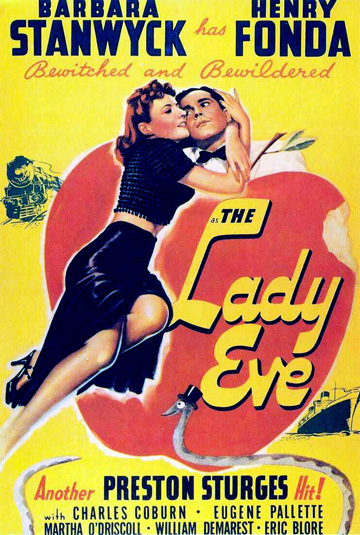
The Lady Eve (1941)

Starring Henry Fonda and Barbara Stanwyck with director Preston Sturges, this screwball comedy is a good one. The supporting cast is rounded out wonderfully by Charles Coburn, Eugene Pallete, and William Demarest. The story begins on a big ocean liner where a beautiful young woman (Stanwyck) tries to pull a con on a naive, rich bachelor (Fonda). Slowly however they begin to fall in love and they plan to get married. He catches wind of her notoriety and becomes cold and that ends their relationship. In an act of revenge she poses as someone’s niece, a Lady Eve, so that she can be close to him. Through a series of events he thinks she is a different person who looks similar and over time they decide to get married. When Eve tells him about all her boyfriends he feels he has made a mistake. Back on the ship he is ecstatic to see the first girl and they embrace. Fonda’s character feels guilty because he is already married but then again she is too…to him. This film has a great combination of wit and slapstick which makes it an enjoyable classic.

4.5/5 Stars

Ball of Fire (1941)

a5490-ball_of_fire_movie_posterStarring Gary Cooper and Barbara Stanwyck, the film revolves around a young man (Cooper) and seven older intellectuals compiling a Encyclopedia who get involved with a burlesque dancer (Stanwyck). They are interested in her constant use of slang and she is happy to use them as a cover to avoid the cops while she waits for her gangster boyfriend. However, things take a turn when the young man falls for her and proposes. Little does he know they are being used until they unknowingly transport her back to the gangster. He feels betrayed and she realizes her love for the corny intellectual. Although they are held by the gangster’s thugs, the intellectuals join their wits to overcome their foe. In the nick of time they stop the marriage and the true loves get back together. Howard Hawks directs a nice combination of humor and romance. The story by Billy Wilder, is Snow White and the Seven Dwarfs with some major twists.

4.5/5 Stars

Ninotchka (1939)

e937e-film_ninotchkaStarring a cast including Greta Garbo and Melvyn Douglas with director Ernst Lubitsch, the film opens in Paris with three quirky Soviet Russians. They are sent to sell some jewels and at the same time to marvel at the capitalist society. Their curt, robotic, and serious comrade arrives to help them. She meets a Parisian playboy and seriously hopes to learn about his society.  However, after he finally makes her laugh the two of them become romantically involved. A jealous duchess manipulates the situation and Ninotchka is back in Moscow. She is reunited with her friends there but still is somber because she is no longer with her love. That changes quickly enough though. Lubitsch gives us another witty comedy that plays off the conflict between ideologies and cultures. Garbo, Douglas, and the three Russians are all likable characters that help make this film fairly good.


4/5 Stars

Mr. Deeds Goes to Town (1936)

Starring Gary Cooper and Jean Arthur with director Frank Capra, this film follows a man from a small town who is left $2 million by a dead relative. Longfellow Deeds is thrust into a life in New York where everyone wants his attention in order to get money and support. However, this man they took for a stooge has common sense and grows fed up with them all. The only person he talks to is Arthur’s character who is actually a reporter. While she writes damaging articles, they slowly begin to fall for each other. He finds out what she did and eventually decides to give his money away. Fortune hunters try to claim he is crazy and they bring their case to court. Initially Deeds does not defend himself, but when his love speaks on his behalf he changes his mind and fights for his cause. Capra was wonderful at making the feel good films about the common man. Here he does it once again in a precursor to Mr. Smith Goes to Washington and Meet John Doe.

4.5/5 Stars

My Man Godfrey (1936)

24635-my_man_godfreyStarring William Powell and Carole Lombard with a zany cast of others, the film follows a funny socialite daughter who takes a “Forgotten Man” as her family’s butler. Godfrey takes the job and soon learns how to cope with the scatterbrained girl, her stuck up sister, their ditsy mother, their long suffering father, and Carlo who is the man patronized by Mrs. Bullock. On accident Godfrey comes in contact with an old friend and his secret almost comes out. In the cover up Lombard’s character believes him to be married with children. Because she loves him, she goes away to Europe to try and forget him. However, upon hearing the truth, she is ecstatic and Godfrey finds himself being married all of the sudden. This is a good example of the screwball comedies of the 1930s and I will admit, it is a pretty good film.

4/5 Stars

Twentieth Century (1934)

63742-twentieth-century-post1Starring John Barrymore and Carol Lombard with direction by Howard Hawks, this archetypal screwball comedy revolves around a frenetic impresario and the emotional girl he made into a household name on Broadway. 

Oscar Jaffe is the undisputed king of Broadway and after he christens the inexperienced Mildred Plotka, Lily Garland, she becomes his box office Queen. He makes her into a great actress and their numerous collaborations turn out success after success. However, as several years pass Lily is fed up and she ends her connection with Jaffe in a volatile falling out after she finds that he has hired a private investigator to keep tabs on her. Without his starlet Jaffe produces flop after flop and he is endangered of being jailed by his backers. He escapes in disguise and boards the Twentieth Century Limited train. He is accompanied by his two quirky assistants and it just so happens that Lily has boarded that same train. Jaffe sees it as a chance to make amends, but Lily will have nothing of it. They have some more frenzied confrontations on the train as Jaffe tries to convince her to star in his next project. In a last ditch effort he pretends to be deathly ill after a scuffle so that she will sign a contract in her distress. In the end she proves to truly care for him and once again they are back on Broadway, Lily Garland star extraordinaire, and Oscar Jaffe the domineering visionary. 

Along with It Happened One Night, this is one of the early examples of the screwball comedies. This was a perfect practice run at it for Howard Hawks who would direct the more well-known Bringing Up Baby in 1938. The leading performers are absolutely chaotic and over the top in their performances, but it’s the way it should be. Furthermore, like most screwball comedies the odd supporting characters are often a great source of laughs. The extended train sequence here reminded me somewhat of The Palm Beach Story another raucous film.
 
4/5 Stars

Trouble in Paradise (1932)

73432-troubleinparadise1932Starring Kay Francis, Herbert Marshall, and Miriam Hopkins with director Ernst Lubitsch, this film is a funny pre-code era romantic comedy. A man and a woman crook meet each other in Venice and after wreaking some havoc they fall in love and get married. The two of them move to Paris in order to pull a big heist on the elegant Collete perfume tycoon. Things get complicated when the male crook begins to fall in love with her. Furthermore, her two other suitors get jealous and eventually realize where they have seen him before! Then his wife learns what is going on and she is jealous. He sadly breaks off his relationship with the lady he meant to rob. But once a pick pocket always a pick pocket and he and his wife make up. For being an early 1930s film, I particularly enjoyed this one. Lubitsch did a fine job directing and there is a lot of wit.

4.5/5 Stars

Screwball Comedies

The Screwball Comedy came into existence in the 1930s probably with the release of It Happened One Night (1934). They are a unique type of romantic comedy prevalent in the 30s and early 1940s. Often the plot revolved around bizarre, crazy, or extravagant scenarios having to do with the love interests. Often the male character is challenged or humor can be found in class conflict. They are seen as escapist films that allowed Great Depression and World War II audiences to get away from their difficult lives in order to have some laughs and enjoy some fantastical situation. A number of directors including Preston Sturges, Howard Hawks, Ernst Lubitsch, George Cukor, and Frank Capra all had successes in this genre.

A Day at the Races (1937)

Starring The Marx Brothers, the film begins with a pretty young lady who owns a sanitarium near a racetrack. In danger of closing, she brings in a new doctor named Hackenbush (who specializes in horses) and at the same time her love buys a race horse. A powerful man wants the place closed down so he can build a casino and he is in cahoots with the financial adviser  a wily woman, and the police. However, wanting to help the two lovebirds out, Groucho, Chico, and Harpo lend a wild helping hand. It all culminates with an uproarious Day at the Races. This film is full of funny moments such as the code book sequence, the dinner and wall papering scene, the medical exam, and of course the final race. I felt that a lot of the music was an unnecessary added feature.

4/5 Stars