One Potato, Two Potato (1964): Love and Games

I was recently marveling how a theater actor I know predominantly from TV show appearances, William Redfield, could show up as an earlier incarnation of himself in an unorthodox film like The Connection. Then, about a week later, I had a similar revelation seeing Barney Miller’s wife, actress Barbara Barrie, doing something equally daring and landmark in One Potato, Two Potato.

Yes, it’s another black and white film of humble means, but it’s hardly short on ideas or purpose. Despite a childish title and production values that are a bit clunky around the edges, there’s still a fundamental sincerity to it in the tradition of something like Marty.

The very DNA of the picture is so fragile and tender, and yet it has a heart and exudes a kind of genuine candor capable of smoothing over a plethora of technical inadequacies. What I mean is that I like the movie — appreciate what it’s trying to do — and it feels bolder and braver than many of its contemporaries.

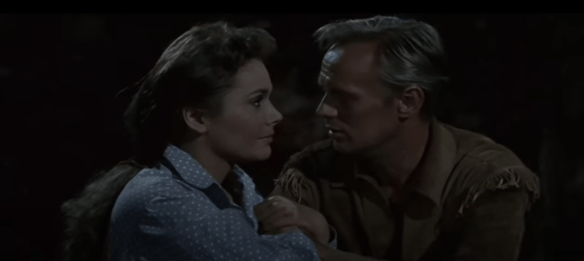
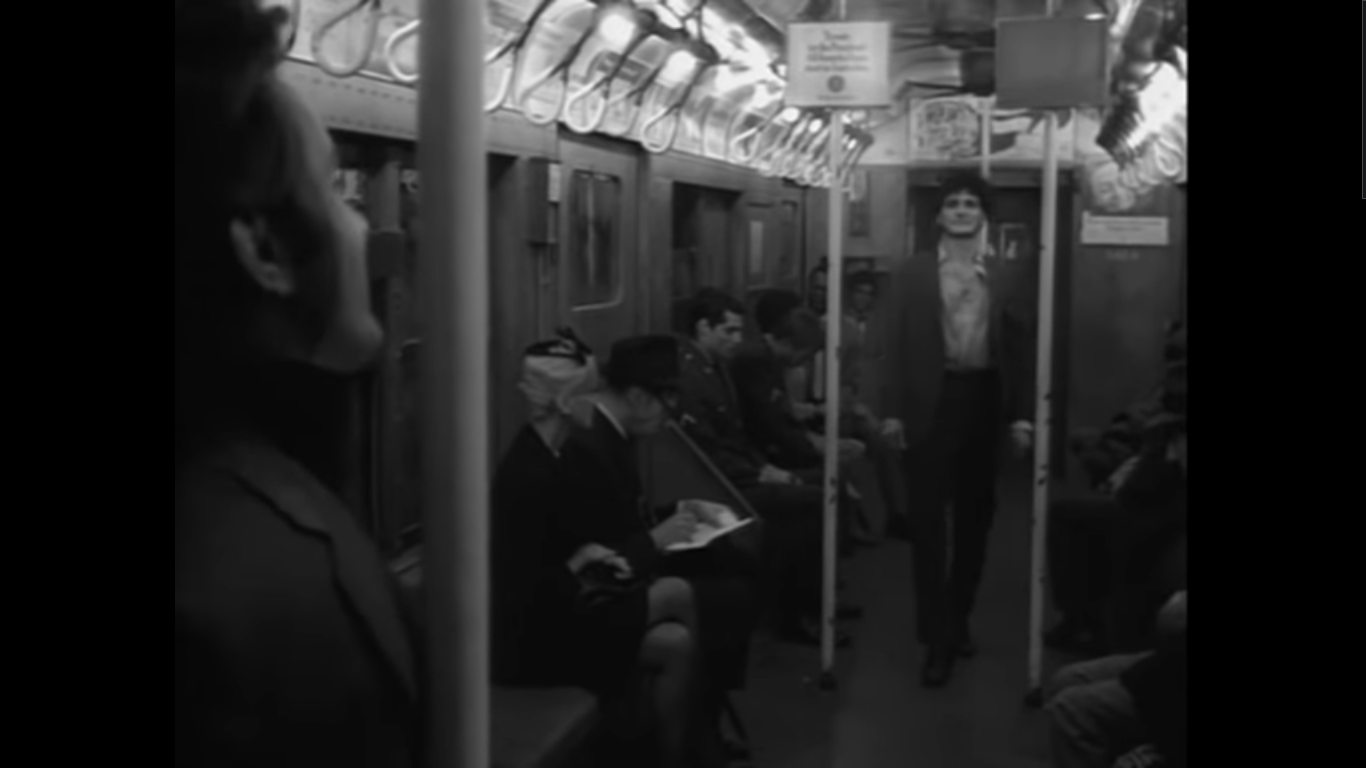
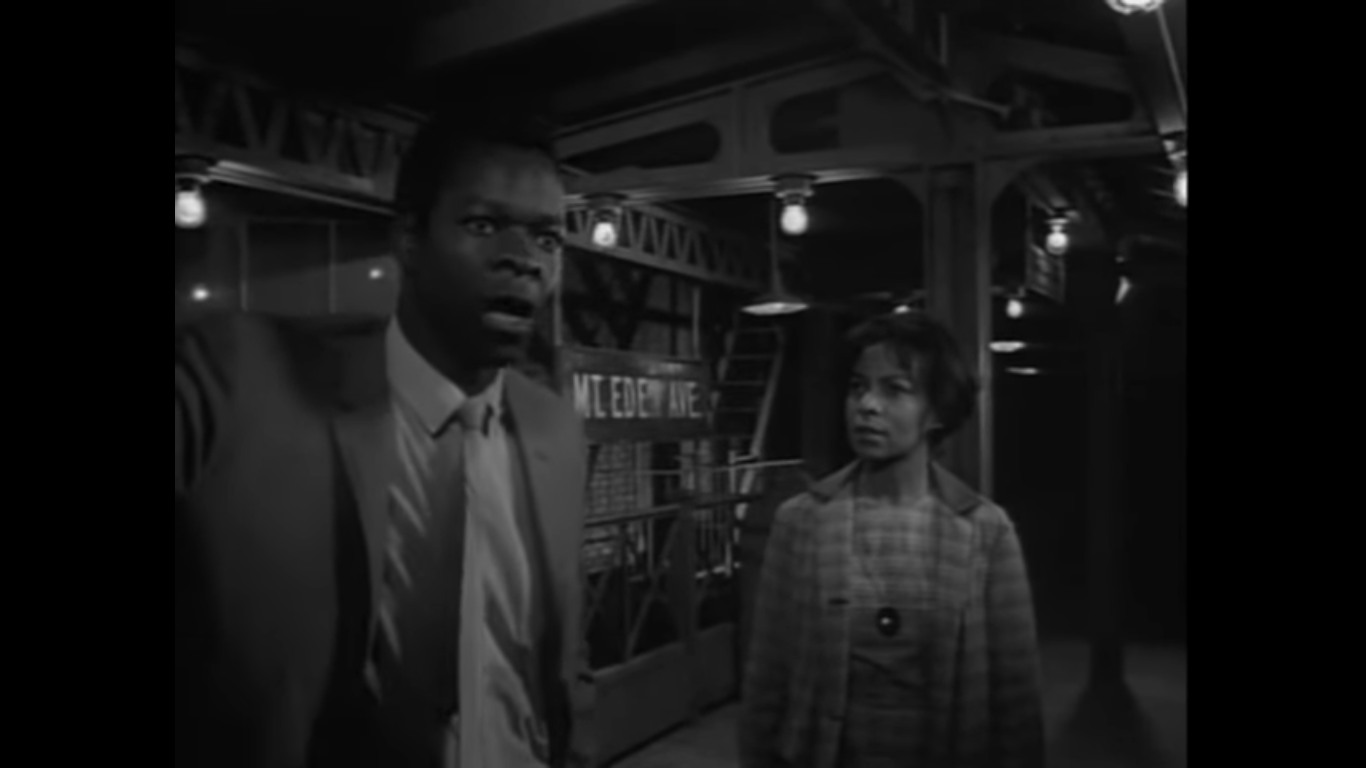
An all-knowing narrator helps bookend a story with court proceedings, but the crux of the matter must begin with Barbara Barrie and Bernie Hamilton. They meet in the carpool to work with their mutual friends, a pair of chatty lovebirds. Julie’s a white divorcee. Frank’s a black man who lives with his parents.

This is what the outside world sees, but in the movie, we watch how their temperaments meld as they are put in sharp relief with their friends. They gravitate to one another, not for some outlandish reason, but their simpatico and emotions are somehow attuned.

They have brief interactions. It’s tentative at first. There’s no intention on the part of either party. They have many walk-and-talks at night, quiet and pensive because they appreciate the company, and their demeanors are perfectly suited.

Then, in one of many grounding moments, maybe a policeman comes by, shining his lights on them, and ordering them away (what he sees as a black man and his prostitute). Either that or there’s some other sin of humanity, and they are shocked back to the debilitating frameworks that society has set up around them. These are blatant visual articulations, hardly subtle, and yet they acknowledge the prevailing cultural incongruities of the time: He’s angered; she thinks it’s funny, but together they must press on.

The resistance goes both ways because his own father (Robert Earl Jones) gives him a blatantly severe talking to. He brings up the questions of societal pressures and the prospect of kids: They’ll be outcasts, and it would be even worse to bring children into the world.

Frank almost buys it. He tells his beloved, “It won’t work.”

She responds, “What won’t work? Kindness and love?”

Yes, it’s true. The culture is entrenched with a deadly narrative of hate, riots, lynchings, and prejudice between their disparate people. But they want to push against this with their love. It’s all they can do.

In an earlier scene, after a friend’s wedding, they dance by lamplight, not like Astaire and Charisse in The Band Wagon, but like normal people would. Slowly and tentative, pressed up against one another. Instead, they play like a pair of kids with imaginary games of hopscotch and follow the leader. It’s a different kind of whimsical magic hearkening back to a world of possibility before children learn racism and are taught the limits placed against them by “reality.”

Their own wedding is punctuated not by joyous dancing and merrymaker but the jaundiced ire of a lady witness looking on in contempt. Because even if she’s not going to put a stop to it, we can read her face. She thinks this is repugnant, against nature or something. Her face is a canvas to reflect the peer pressure of an entire society. And it’s not the only one…

Julie’s ex-husband (Richard Mulligan) comes to visit his daughter after years away, and they have fun playing cowboys and shoot ’em up together. It’s another instance of play where the man is stripped of his responsibilities only for them to become firmly established again when he sees his estranged wife living in the home of a black man. He doesn’t want his daughter to somehow be sullied by such a sordid existence. One questions if it’s really for her well-being or his own reputation because people will talk.

It seems only realistic to encapsulate One Potato, Two Potato through the sum of its various sequences since it’s really a film of ellipsis as scripted by Orville H. Hampton and Raphael Hayes. Even when they feel a bit abrupt and unpolished, there’s an unparalleled potency to them because they speak into the moment like few films I’ve been aware of. What it lacks in fluidity, becomes bottled up in these perceptive moments that come to represent very specific even salient points of view and bits of trampled humanity.

Joe Cullen goes to a local preacher who admonishes him for wanting a God who has racial prejudice too. But God will not let him off that easy. His very commands adjure his people to “Love thy neighbor as thyself” without any kind of qualifying remarks or addendums. The man’s problem, along with so many cultural Christians, is reflected in their religion, which is such a self-serving construct rather than a way of life and relationship.

Then, the drama comes thick and fast. Julie confronts her former husband who still remains skeptical of her, full of outrage and insinuations (You talk about how he loves the girl, loves you, but can you love a black man?). And yet she remains resolute.

Frank feels successively beaten down as a husband, left emasculated and powerless because he cannot protect his wife based on the color of his skin. He goes to a college lawyer friend for help. He’s a jovial, accommodating fellow who grows scared and defensive when he learns about the parameters of the case. This is before Loving v. Virginia. Regardless of right or wrong, there is no legal precedent and a hot case like this could ruin him, and so he folds. Not because he’s a “bad person” but because he’s spineless and scared like you and me.

We stew in Frank’s powerlessness much like Ivan Dixon’s struggles in Nothing But a Man from the following year. They are kindred spirits. He gets some kind of catharsis by proxy watching the American Indians massacring the whites in the western at the drive-in theater. One can’t imagine he’s the first man to ever cheer for the other side even as he yells and shouts — slamming on his steering wheel.

The movie has an inevitable conclusion, if not an altogether just one. The judge (Harry Bellaver) makes a final decision predicated on economic viability rather than true measures of parental love and affection. It’s indicative of a culture that while acknowledging its fault lines — how a couple like that is made into social pariahs — nevertheless reinforces the status quo. Although it may be fictitious, this isn’t fanciful drama. It cries out with streams of all too apparent truth.

By the end, it feels like social horror, more heart-wrenching and harrowing than even something like Get Out because this was very real and no peppy nursery rhyme tune can wipe any of that devastation away. I still can’t believe this film. It feels like a small but mighty gem of a movie.

4/5 Stars.

In The Heat of The Night (1967): They Call Him Mister Tibbs

In The Heat of The Night is a testament to the collaborative nature of Hollywood. We watch Sidney Poitier step off the train. Haskell Wexler’s cinematography gives an instant texture to the world so the sweaty atmosphere is almost palpable around him.

However, one of my immediate recollections of the movie is always Ray Charles and Quincy Jones who help in creating a truly remarkable soundscape. Charles sings the title track (with lyrics by Alan & Marilyn Bergman) setting the mood for one of the formative movies of a turbulent decade.

Although Rod Steiger becomes one of the film’s primary focal points as the gum-smacking, narrow-minded Sherrif Gillespie, it’s Warren Oates, one of the generation’s finest character actors, who’s our entry point into this community.

He’s a police officer sitting at a diner drinking a cola as the scrawny, beady-eyed attendant shoots a pesky fly with his slingshot. It’s a sweaty night in Spartan, Mississippi and already despite these mundane activities, there’s an uneasy equilibrium to the place.

Poitier has to navigate the film’s space all alone for the majority of the movie. There’s a black family who puts him up for a night, a servant (Jester Hairston) who looks at him a bit disapprovingly, a phantom black woman (Beah Richards) who runs a business at night, and of course, the host of blacks working the cotton fields. Otherwise, he’s all alone, isolated and alienated from those around him as a blatant outsider. His only solidarity is in the score and soundtrack.

If it’s not apparent already, In The Heat of The Night continues a conversation that automatically puts folks at odds and in opposition to one another. You have blacks and whites. You have North and South. You have rich and poor. All of them are visible in the movie.

For blacks in particular there are these daily barbs of indignity pervasive throughout the southern culture and totally baked into the system. Norman Jewison’s film (and Stirling Siliphants’s script) only has time to acknowledge some of them, both explicitly and implicitly.

It’s plain that when an influential man is found murdered, the first person suspected is the black man sitting at the train depot. It’s a guilty ’til proven innocent economy. Black men must also suffer the subtle humiliation of being called “Boy.” An out-of-towner like Tibbs will never hope to get a hotel. And even after weathering any number of indecencies, he finds himself cornered and physically intimidated.

The whole movie is about this even as Poitier reluctantly stinks around to bail out the less-experienced, backcountry police force. He’s doing them a favor that very few people are ready to accept.

In The Heat of The Night can theoretically be distilled down to two defining moments. The first is in the police station where Gillespie is railing on him, badgering him for all he’s worth. He asks what they call him in Philadephia and he seethes, “They Call Me Mr. Tibbs! Poitier’s trademark intensity proves so gripping it’s maintained lasting resonance all these years later.

However, the film’s other defining moment is presaged by a lawn ornament calling to mind Flannery O’Connor’s wince-inducing short story “The Artificial Negro.” It’s found in an establishing shot of the Endicott Estate. Mr. Endicott (Larry Gates) owns the local cotton industry and effectively keeps the southern ecosystem alive and well from the antebellum days.

I hadn’t recalled how Tibbs trades small talk with Endicott when they pay him a house call in his greenhouse. They share a conversation about orchids, trading vernacular, and it feels amicable, at the very least. This is what they call southern hospitality. But then an ugly undercurrent is revealed and the conversation turns. Tibbs asks one question too many and gets a scathing response.

The old boy takes offense at being questioned on his own property, by a black man no less, and he lets him have it with the back of his hand. This is relatively unsurprising — another unseemly relic from the old days. What makes the moment is how Poitier strikes right back without a moment’s forethought or hesitation. It’s electric, and it’s as if all the years of southern tension are being brandished in one spontaneous reaction. It’s a show of righteous indignance, pride, and dignity. It’s also just such a human response.

Whether the moment was in the script, added later, or proposed by Poitier seems almost immaterial. It’s the fact that the moment is forever crystallized in cinema giving it a lasting cultural currency.

However, Norman Jewison’s movie does court a few more ideas. Oustide Gillespie prods Tibbs, “You’re just like the rest of us, ain’t yuh?” Poitier might be a shining knight, but his character is still wounded, proud, and simmering with pent of emotions submerged just below the surface. He wants to put Endicott away and make him pay. Gillespie’s just trying to do a job, but Tibb’s drive is something more personal. He’s looking for vengeance. It’s also enough to warrant deadly backlash.

I recently heard an interview with Jewison reminiscing about Poitier and the filming of In The Heat of The Night in the wake of his passing. The director said the following:

“I’d wanted to shoot in the South; the book takes place in Georgia and we’d moved the story to Mississippi for the movie. But we had to shoot it in a town in Illinois, called Sparta because Sidney would not go south of the Mason-Dixon line. He and Harry Belafonte…they had been arrested and attacked by guys in pickup trucks, so he refused to shoot down South.”

“Later in the shoot, I wanted to shoot some exteriors in actual Southern locations, so we talked about going to Tennessee. ‘I’ll give you four days, Norman,’ Sidney told me. So we all went down to this small town with one hotel…and it was ‘whites-only.’ So all of us, the cast and crew, ended up in a Holiday Inn a little ways away, which allowed both Blacks and whites.”

“And I’ll never forget, these pickup trucks came into the parking lot in the middle of the night, honking their horns and waking people up. I got a little nervous, so I called my crew and told them, “Get the biggest guys in the grip department and electrical department, get them over to Sidney’s room right now, we have to protect him.’ Then I called Sidney’s room and I said, ‘Don’t worry, Sidney, we will take care of everything.’ He said, ‘I’m not worried. I’ve got a gun under my pillow.”

“So the first one of them comes through my door, I’m going to blow them away.’ Thank god nothing happened, but this naive director from Canada suddenly understood the extent of American racism. I began to really get just how vicious things were.”

I’ve heard In The Heat of The Night labeled as a do-gooder film, but this seems to minimize not only the movie but Poitier in particular. I find it to be a fundamentally gripping police procedural and this is without thinking about a specific message potentially being crammed down our throats.

This is a testament to the unnerving milieu of the southern town being evoked. It’s the cinematography of Haskell Wexler that feels alert and alive in how it lights and considers the fully-colored spaces. It comes down to this antagonistic rapport of Steiger and Poitier, two very different actors who prove themselves to be exceptional sparring partners as mediated by Norman Jewison.

Surely Poitier had no illusions about what he was portraying. Jewison’s remarks make this very plain. And so he took his image and his part in the movie very seriously. Is it a fantasy about blacks bending over backward to help whites, and then irredeemable racists being redeemed right in front of us? You could say that. But even this seems to oversimplify the picture and sell it short.

This is the movie where Poitier burned with righteous anger and slapped a white man in retaliation, out of his own human pride. Surely isolated moments like these belie any facile interpretation. Because I can’t totally disregard how these scenes make me feel on a fundamental level — how they move me.

How can I have failed to mention Lee Grant, who was finally allowed to leave the Blacklist behind and prove her chops improvising some heart-rendering passages opposite Poitier. They show her ache and his tender concern toward a grieving widow, but also a fellow human being. It’s like some kind of dance they do together.

Or consider how Steiger, still chewing his cud, tells Virgil to “take care.” It’s not much; the exchange is almost sheepish, but it’s trusting we understand the implications. If it’s not an apology, then it’s some form of an olive branch.

This movie doesn’t remedy “the race problem” as it was called in generations past. Its fissures are still supremely evident and ugly. Still, these human exchanges with Poitier at the center, model something deeply healing. To see them on the screen feels validating and also like a balm. Righteous anger has its place, truth has its place, and so does seeing the inherent dignity in others. Rest in peace, Mr. Poitier. You were one for the ages.

4.5/5 Stars

Sidney Poitier: For Love of Ivy, Lost Man, Brother John

In honor of the inimitable Sidney Poitier, I spent some time revisiting a bevy of his finest films and also some underrated ones that were new to me. Because he was a prominent archetype for a black movie star, when he was often the only one, it’s fascinating to see the roles he chose at different junctures in his career and how they evolved and played with his well-remembered screen image.

He will be dearly missed, but he left a sterling career behind well worth our consideration. Here are three films you may not have seen before:

For Love of Ivy (1968)

As best as I can describe it, For Love of Ivy, features Poitier and Abbey Lincoln in their version of a Doris Day and Rock Hudson rom-com. It starts out a bit cringy. Lincoln is the maid of the most hopelessly oblivious white family. Mom and Dad are completely blindsided when she says she wants to quit so she can actually have a life with prospects.

Instead of listening to her, the two teen kids ( a hippy Bea Bridges and bodacious Lauri Peters) scheme to set her up with an eligible black man. They know so few, but Tim Austin (Bridges) settles on Jack Parks, a trucking executive because he conveniently has some leverage to get Jack to give Ivy a night on the town. Some awkward matchmaking (and blackmail) ensues to bring our couple together.

Hence how Lincoln and Poitier become an item. But even this dynamic has some unprecedented delights. They eat Japanese food together and visit a club that positively scintillates with ’60s vibes as seen through Hollywood’s eyes. It’s the age-old ploy where the transactional relationship morphs into real love until the truth threatens to ruin the romance. Again, it’s not exactly new hat from Robert Alan Arthur.

Still, with a happy ending and equilibrium restored, Poitier, who helped develop the story, is trusting his audience can read between the lines of all the dorky craziness. For what it is, the movie plays as a great showcase for Poitier and Lincoln. Since there are so very few movies like this with black leads, it feels like a cultural curio. If the mood strikes you, some might even find a great deal more agreeable than Guess Who’s Coming to Dinner because it doesn’t take its own social importance too seriously. It’s mostly wacky fun.

3.5/5 Stars

The Lost Man (1969)

The Lost Man features an edgier more militant Poitier because there’s no doubt the world around him had changed since he first got to Hollywood in the ’50s. He’s cool, hidden behind his shades, and observing the very same world with tacit interest. It’s a world ruled by social unrest as his black brothers and sisters picket and protest the racial injustices around them only to be forcibly removed by the authorities.

Robert Alan Arthur’s film shows a brief focused snapshot of the social anxieties of the age. It becomes more convoluted when Jason and some other members of the organization rob a local bank. Their motives are in some ways philanthropic as they hope to use the funds to get some of their friends out of prison and support their families on the outside. But it’s also an overt act of insurrection in their battle against a broken system.

It also puts lives in jeopardy, culminating in a frantic murder as the police hunt for the perpetrators in the botched aftermath. Jason flinches in a crucial moment and must spend the rest of the movie as a fugitive nursing a bullet wound. These all feel like typical consequences in a crime picture circa 1969.

However, one of the most crucial and fascinating relationships in the movie is between Joanna Shimkus, who is a social worker, and Poitier. We don’t get too much context with them, but it’s an onscreen romance that would predate their marriage in real-life. Their rapport complicates the story because she is a white woman who is so invested in this community like few people are, and she effectively brings out a gentler more intimate side of him.

Although it’s not necessarily pushed on us, their interracial romance puts them both in jeopardy because it’s not the way the world normally operates. The ending somehow gave me brief flashbacks to Odd Man Out, but Poitier’s marriage with Shimkus would last well over 40 years! It’s the best denouement this movie could ever hope to have.

3/5 Stars

Brother John (1971)

Brother John feels like one of those characters who is a cinematic creation. He joins James Stewart’s Elwood P. Dowd and anyone else who was ever sprinkled with something special that enchants the world around them, whether they’re angelic or extra-terrestrial. But Brother John is a different version for a different generation, and he’s played by none other than Sidney Poitier.

He provides a quiet catharsis for a black audience as a cipher of a man that no one can get a read on. The film itself has a no-frills TV movie aesthetic that somehow still gels with its ambitions.

John comes back to town when he gets news of his sister’s death. The last time he came back was when there was another death in the family. The local doctor (Will Geer), who brought John into the world, is curious about where he comes from and where he goes, but no one takes the old man too seriously.

Still, the police manage to hound him because they’re suspicious of someone they cannot easily intimidate and put in a box. The doctor’s self-promoting son (Bradford Dillman) also needles him in his attempt to gain local prominence. The town’s leaders are looking to quell a factory from unionizing. All of this feels rather mundane in detail. John seems to have nothing to do with any of it.

They remain uncomfortable with him because he’s so inscrutable, well-traveled, knows a myriad of languages, and finds no need to divulge all the shades of his character. He’s contented this way, spending time with family and even calling on a pretty schoolteacher (Beverly Todd) who asks for his company. He won’t play by their preordained script.

There’s one painfully excruciating scene where some cops pay a house call on a black family. The man of the house is left so powerless as he’s subjugated and persecuted in his own home in front of his kids. John is at the table too. Quiet at first. Almost emotionless. Is he just going to sit there or spur himself into action?

In this uncanny moment, he goes down to the basement with one of the officers and proceeds to whoop the tyrant wordlessly with a bevy of skills the backwater lawmen could never dream of. It’s the kind of power exerted over malevolent authority that one could only imagine in your wildest dreams.

As such, Brother John fits in somewhere analogous to the Blaxploitation space but as only Poitier could do it. He wasn’t the same bombastic militant cool dude a generation craved for and received in Shaft or Superfly. He still has his measured exterior, and yet he equally makes quick work of any antagonists: racists, malcontents, white, black, or otherwise. It’s a bit of a boyish fantasy watching a hero vanquish all evildoers quite spectacularly. But, after all, this is what movies are for.

3/5 Stars

The Slender Thread (1965) Connecting Sidney Poitier and Anne Bancroft

The Slender Thread feels a bit reminiscent of one of those self-contained film noir from a previous decade like 14 Hours or Dial 1119. It’s not a very ambitious scale, still, within its confines, it’s a rather enjoyable film. But, of course, the main attractions are Sidney Poitier and Anne Bancroft.

Like its predecessors, the film has a bit of a hook — a gimmick that everything else in the movie works through. He’s a university student, named Alan, who volunteers at the local suicide clinic. She’s a checked-out housewife. They never share the screen together, but they are marginally connected through the cord of the phone lines. He’s her last lifeline to the outside world and life. Under such duress in such a vulnerable space, an unmistakable bond is formed between two human beings. It’s also a convenient chance to show off some newfangled technology in Seattle’s crisis hotline, which still seemed to be a fairly new concept in the U.S.

The Slender Thread falters when it hews too close to melodrama thereby discounting a lot of the genuine work Poitier and Bancroft do to build real believable chemistry. I’m thinking of the moment where the housewife’s secret is found out by her husband (Steven Hill), instantly decimating their marriage and sending them into freefall.

His solutions are to show up at church on Sunday morning and then take a fishing trip to get away. She resorts to a state of catatonic fugue. Walking the streets of Seattle, along the seaside, and then ultimately looking to end her life.

And while the film does hearken back to earlier procedurals, it does suggest the movie is a bit of a relic, out of step with the times even as it tries to show off some cutting-edge resources. Ed Asner is part of the police force looking to track the housewife down and Telly Savalas is a respected doctor at the clinic who trusts Poitier with the night shift. Neither has much to do though if you’re familiar with the TV landscape of the ’60s and ’70s, it’s easy enough to divvy out some goodwill toward them.

Aside from a few scenes at a disco tech, the rest of the scenario and the black and white pictorials seem to denote an earlier era. It’s as if Hollywood, as is, is still in the past and has yet to fully comprehend the magnitude of the youth movements and counterculture percolating up through society.

The dancing sequences allow debut director Sydney Pollack to break out of the humdrum and come onto the stage into the emerging decade. Later, the film’s Hyatt finale evokes a bubbly gaiety of the time-honored work convention of the old world as the authorities frantically search for Inga with time running out.

There’s something traditional about all of this connective tissue even if in a year or two the whole industry would be flipped on its head. If you take stock of our primary players, you have Poitier’s ascension with arguably the greatest single year for an actor in film history during 1967. He starred in To Sir, With Love, Guess Who’s Coming to Dinner, and In The Heat of The Night! Anne Bancroft would become fiercely identified with the role of Mrs. Robinson, helping to define the generational malaise whether she liked it or not.

Pollack, for his part, would continue to rise up the ranks with pictures like They Shoot Horses, Don’t They effectively leading to more high profile projects in the ’70s and ’80s. Everyone seems to be on the cusp of something more, something dynamic.

But for what it is, in this moment and time, The Slender Thread is easy to appreciate now that it’s unstuck from that particular cultural juncture. Bancroft shows her capability for encapsulating human frailty and the despondency of the nuclear family with the raspy whisper of her voice.

Poitier is totally invested and makes us care just as dearly, with every syllable, every droplet of sweat on his brow, and every iota of his being engaged with Inga. When he lets out a boyish scream at the end of the picture, it almost feels out of place and yet after everything he does, he rightly deserves it.

The final bit of poeticism is the ending. He has the chance to meet this lady — a woman he went through hell and high water with, forever bonded together — and yet he declines. It’s not an anticlimax but something that feels right. She needed him for a time, and he reciprocated. Now they can return to their lives. Anything else might feel forced and disingenuous. In this manner, they carry the picture. It would feel empty and lacking without them.

3.5/5 Stars

The Defiant Ones (1958): Tony Curtis and Sidney Poitier

I can’t have made this up myself, but The Defiant Ones is a testament to the pithy axiom that proximity breeds empathy. Stanley Kramer has very clear intent when he builds the premise of his story out of a white and black prisoner, in the era of Jim Crow, who are chained together for the majority of the movie.

He’s not squeamish about hammering us over the head with the implications. These two men, who escape from a prison truck must work together in order to survive and evade the hordes of police dogs and trackers on their tails (led by Theodore Bikel and Charles McGraw). In fact, the push and pull between Bikel and McGraw in their carriage of justice is a mirror for our primary leads, a persistent reminder that these are four men separated mostly by circumstances.

At times, these circumstances all feel perilously didactic, but Noah (Sidney Poitier) and Joker (Tony Curtis) are the movie’s saving grace as it should be. What’s most phenomenal about Poitier and Curtis’s performances as they take on the harrowing terrain of the movie is just how taxing it seems, and there’s a definite physicality to their plight that fully manifests on the screen.

It’s torrents of rapids or getting trapped in a mud pit together and struggling to fight their ways up the sides These moments overwhelm us and at times feel excruciating. But they bring us into each moment and make them feel real and palpable even when the perfectly orchestrated set-up fails to do so. This is the underlying tension of the entire movie.

Although the two men could care less for one another, if not for self-preservation, there are momentary hints of altruism the farther they go along the trail together. They go through the wringer, nearly getting hung after making a desperate attempt to score some provisions in a local settlement after dark. Claude Akins is one of the warmongers with retribution on his mind. Again, Lon Chaney Jr. plays his counterpoint and a man with a timid reservoir of mercy.

In another prolonged interlude, after having survived, they sneak away to a rural homestead run by a widowed mother (Cara Williams). She at one time becomes their captive and then nursemaid, providing care and sustenance to a wounded Joker while only mildly tolerating Noah. It’s here in a formative moment where their physical chains are finally cast off, only for the bonds of camaraderie to cement between them. The once tenuous partnership has progressed toward something verging on mutual respect.

Even as the woman schemes to run off with her new man while leading Noah astray, Joker for the first time in his life fights against the color line. Because complicity is so easy. But his indignant conscience rumbles inside of him, and he goes after his friend to warn him of the hazards that lie ahead.

One of the most galling sequences occurs earlier in the picture when Noah recounts how he was always taught as a young man to “Be Nice” and then his wife went and taught his son the same thing. Of course, “Be Nice” feels like the coded language of deeply entrenched oppression with blacks having to play up to whites just for the sake of survival if not a seat at the social table.

What it engenders in Noah is deep-suited anger for all his natural life. It’s the kind of gall, Joker can’t quite understand. But when he follows Noah toward the Swamp, he’s showing incremental change can be a powerful thing in itself.

One could argue the ending shows how far the film was willing to go. In other words, The Defiant Ones could only go so far. James Baldwin talks in The Devil Finds Work (If my memory holds) about how Poitier’s character does the valiant thing in the end for the white man (while black audiences screamed at him to get away on the train car).

Obviously, if he did not sacrifice for his newfound friend it would sully the film’s theme while further complicating the resolution. The white world was not quite ready for that ambiguity even as black audiences clamored for greater freedom in life and on the screen.

But if I’ve learned anything about Stanley Kramer, his films very rarely aspire to social realism as much as they are parables under the guise of docudrama. Their purpose is clear and their messages unabashed. Years later we look at the Defiant Ones or Guess Who’s Coming to Dinner and we desire more out of them. Even Sidney Poitier as an actor was often admonished for never quite going far enough when it came to portrayals of his people. There was always something at fault.

Still, when I look at this picture, I see Kramer’s intentions and remember I am so quick to dismiss the past from my enlightened present. Because it’s so easy to do.

However, it feels apt to end with Poitier’s own words about his director:

“Stanley was always a forerunner of terribly good things; He was the type of man who found it essential to put on the line the things that were important to him. People have short memories: in the days he started making films about important social issues, there were powerful Hollywood columnists who could break careers. He knew this, and he said to himself, ‘What the hell’, either I do it or I can’t live with myself.’ For that attitude, we’re all in Stanley Kramer’s debt. He’s an example of the very best of a certain type of filmmaker.”

Kramer’s not one of the greatest filmmakers of all time, but perhaps as Poitier suggests he’s the best of a certain type of filmmaker. Surely that is enough.

4/5 Stars

To Sir, With Love (1967): Sidney Poitier As a Mentor

In the 1950s Blackboard Jungle was one of the early pivotal roles for Sidney Poitier where he plays a disaffected youth who is ultimately mentored and encouraged by his teacher: Glenn Ford. Thus, it seems fitting, at the height of his own powers in 1967, Poitier left the student behind and graduated with To Sir With Love leaving an indelible mark on a new generation.

By now it feels like a rather tame vestige of Swinging London. In this world, Poitier feels like a cultural anachronism. Yes, he’s black but there’s also a difference in class. Because he has a level of propriety that feels immediately at odds with the British working-class milieu that goes with grungy streetcorners and gossip on the double-decker in London’s East End.

However, director James Clavell envisions a story where Sidney Poitier fits seamlessly into a British world because he was himself a seasoned man of the world having grown up in Australia, gone to war in Asia, and made a career for himself in Hollywood. It does feel like a unique bit of casting for the time, but it also suggests Clavell’s confidence and understanding of his star’s capabilities.

It’s true Mark Thackeray comes to the school with a background in engineering and a world of experience, but he also has ideals and as he figures out his life, he wants to do something meaningful. His new class has a far different context — hard lives — where teachers are observed more like enemies than mentors. They distrust authority and look destined to revolt against yet another victim, first, sawing off a leg of his desk, attempting to drop projectiles on him, and generally undermining his authority by any means possible.

The score gets weirdly antsy, and it doesn’t do Poitier’s performance any favors when he fully blows his top, if not out of vitriolic rage then certainly righteous indignation. Still, he carries this turning point with aplomb, embodying everything I want to be but can rarely muster with a steely resolve.

Following in the footsteps of Ford, he’s strong. He has a backbone. But he also has a caring spirit, and he’s willing to help these kids when no one else will. He speaks to them not as cloying little children but as adults who are capable of rational thoughts and feelings. They employ a certain level of decorum and yet in response no subjects are considered off-limits.

The museum montage is a bit disruptive, but it feels like a relic of the ’60s overlayed by Lulu’s chart-topping theme. In truth, it was a product of necessity with the needed permits falling through. Still, it’s a sign of something greater. There is a trust that forms between a teacher and his pupils even as their horizons are broadened to things they would have never given a thought to before.

If the movie is about one teacher’s task of not simply subduing a classroom but winning their respect and admiration, then, there several specific test cases that prove prudent to consider.

The most precocious and romantic member of the class, Pamela Dare (Judy Geeson), begins to form a crush on Mark, and he does his best to cultivate her talents while at the same time encouraging her to reconnect with her mother.

Then, there’s Denham (Christian Roberts). He has the bad boy scruffiness of a wannabe Keith Richards or Jagger, and his redemption is another one of Thackeray’s ongoing projects. There’s a standoff with the P.E. Teacher where Sir teaches them a lesson about the unfairness of the world only to suffer for it. Then, of course, we’re reminded of lingering racism in all walks of life. This prevailing sentiment is no different here than across the pond.

One key to Thackeray’s success (apart from being Sidney Poitier) is because he actually shares their world and still rose out of it. Not a great deal of focus is given to it. Still, it’s hard not to see how Thackeray’s background mimics Poitier’s own, originating from humble means to become such a prominent and successful figure with extraordinary elocutionary powers. He’s able to command that classroom (and the screen) with the sound of his voice and the reason that lies behind it. He’s wasn’t born with all these abilities, but he certainly polished them.

I’ll be the first to avow, To Sir, With Love is not exactly auteur cinema, but it goes to show the weight a performance can have. I appreciate what the picture stands for and the way Poitier delivers it provides a genuine weightiness. He instills lessons about apologizing when you know somehow else is in the wrong and extending forgiveness to those who don’t deserve it. In a boxing match he exerts dominance quietly and not as an aggressor. Maybe elements of the movie feel antiquated, but I dearly hope that these do not.

In terms of his performance, the way he carries a briefcase or drops a letter into the red mailbox with a slight affectionate tap, you can’t sum them up, and they don’t mean anything by themselves and still, these are the hallmarks of his performance. And of course, there’s that dance. Somehow this is Poitier personified: he’s imbued with such dignity, and we receive that, but he’s also a man measured by joy as much as rage. Tenderness as much as ferocity.

The final “Lady’s Choice” dance where he takes up his spot on the floor opposite Pamela is one of the film’s sweetest culminations. And when the more traditional trappings evaporate into a raucous number by The Mindbenders, he’s more than game to groove along with it. In fact, he seems to relish the moment just as we do. It’s the film’s crowning gift of mutual affection and respect. I couldn’t help thinking that the life that each one of those teens offers up will be a testament to Sir. Because his investment reaped so much reward.

Yes, To Sir, With Love follows the expected trajectory and still it becomes more about the riches along the way expressed through minor victories and then incremental interactions leading to steady levels of understanding and growth. Do schools actually change like this? Do teachers actually make a difference? Can class rebels be reformed just like so? And does a man likely give up on ambitions for the greater good? I don’t know if I can answer these succinctly (or if I want to answer them), but perhaps that isn’t the point.

To Sir, With Love is an exhortation to never stop trying to be that difference. Is it futile? The world would have us believe it’s so. Am I cynical? Most certainly. I felt a particular kindred spirit to Mr. Weston. And yet movies come along and remind us we should have a go at a heartless world anyway.

Bar that opening scene and a jaunt to the market or a quick moment ironing clothes, we rarely see Poitier outside the four walls of that school. It’s as if he exists to be there as a beacon and a guide for those students. I wanted him and Suzy Kendall to really get together. There’s the semblance of romance and only a warm hint.

But again, I fall back on Poitier’s powerhouse performance, which makes us dream of something better. He bears all our hopes and cares, standing in for any teacher we ever had or wished we had.

I resonated with the movie anew because I spent some time in another country working at a school where many of the students might be classified as “rejects,” and yet on my best days, I felt such a connection to them. I wanted dearly for them to succeed, and Sidney Poitier as he is incarnated up on that screen is a far greater man than I. I can only imagine how he felt.

4/5 Stars

Lilies of the Field (1963): Starring Sidney Poitier

The ample joys of Lilies of the Field come out of it being a kind of modern-day parable. It’s a modest and simple story, shot over 15 days by director Ralph Nelson, with a source novel gaining inspiration from the passage of the Christian scripture:

“Consider the lilies of the field, how they grow: they neither toil nor spin, 29 yet I tell you, even Solomon in all his glory was not arrayed like one of these. 30 But if God so clothes the grass of the field, which today is alive and tomorrow is thrown into the oven, will he not much more clothe you, O you of little faith?”

It means different things for our two leads, one who keeps a handy pocket edition for easy travel and the other with a giant tome of a Bible ready to quash everything around it. The image becomes a pertinent one.

Because the film itself concerns itself with an itinerant handyman played by Sidney Poitier. His car is sputtering so he stops by the nearest establishment to get some water for his thirsty engine: it happens to be cared for by a troop of Nuns.

He wants to get out of their sphere of influence as soon as possible. They hardly speak a lick of English. They are Catholic and he is Baptist. And yet he finds himself doing work for them. At first, it’s hardly out of altruism but they are a persistent bunch.

Their leader, Mother Maria (Lilia Skala), has grand visions about what Homer Schmidt (Smith) can do for them thanks to his pair of strong arms. She’s resolute that God will build them a “shapel” and Homer is the readymade conduit.

Of course, he has no such ideas, and he’s interested solely in a buck. He’s ready to do one job for them, get a meal, and then move on with his life. Remember these were the early 60s. Poitier later in the decade would come off stately. He was a doctor, a police officer, a teacher. Here there’s a freedom and playfulness to his movements indicative of a different kind of man.

If there’s any major development to the movie it’s how they slowly teach one another something. Homer comes to understand what it is to slow down, to be present, and to bless other people with your skills. These sisters want nothing more than a place of worship, and he can give them so much. But it’s not just a selfish act of individuality and pride either. It becomes something when others join in to help finish what he began.

However, the Mother is a stern and unyielding lady in her own right. She believes in God’s daily Providence but sometimes at the expense of the human beings around her. She sees them only as tools in God’s plan rather than fellow human beings worthy of thanks and appreciation. Over time she too softens and admires Homer for the monumental thing he has accomplished.

Because ultimately he does bring their dream to fruition. He’s got the dogged resolve to make them their chapel, not because of monetary gain but just because he can. As alluded to already, it begins as a mission of self-aggrandizement.

Both Homer and the Mother can bear a little humbling, and yet in their corner of the world, they see some marvelous things. Homer uses his ingenuity to become the contractor for the project as the local members of the sisters’ parish help finish the building.

Although it’s not a movie of means, it makes up for it with heart and performance. On first look, it seems rather surprising the movie would be such an award boon for Poitier, and yet there’s something warm and appealing about his characterization. Years later there’s still something more to it. There’s a freedom and an energy imbued in him.

He can be exuberant with his shirt off, then badgered and forbearing. They feel like universally human traits that we can understand and relate to. The singing of “Amen” reverberates throughout the movie even if Jester Hairston’s resounding voice sounds nothing like Poitier.

Others like the affable bartender (Stanley Adams) are pragmatic when it comes to issues of faith, the local priest on wheels (Dan Frazer) isn’t overly pious, but he seems a decent human being with genuine aspirations and honest shortcomings. The one other solitary white man (Ralph Nelson himself), a local contractor, seems like he could represent a hedge of racism (Using the word “Boy”), but Poitier fires right back and readily treats him as an equal. They too form a mutual understanding even as he marvels at Homer’s accomplishments. He feels indispensable and Poitier certainly is for the movie.

Except for a rather conspicuous English lesson early on explaining what the colors “white” and “black” mean, from vinyl records to his skin tone, no reference to Poitier’s race is needed. It occurs to me this film, set out in the rural desert, feels like a tale of cultural outsiders, and if not outsiders then at least characters who rarely received Hollywood treatment in the ’60s. We have a black handyman, a parish of European nuns, and then a host of Latino workers.

They couldn’t be more disparate, and yet somehow their ecosystem comes together and blossoms. Whether it’s a shared sense of faith or even a basic human understanding, they gather together and create something beautiful. I can only imagine that this is part of what drew Poitier to such an unassuming picture. Today it still stands modestly alongside some of his best performances.

4/5 Stars

Pilgrimage (1933): A Mother’s Journey of Reconciliation

pilgrimage

It’s a private fascination of mine to consider the sanctity and sheer awesomeness of human life in a very particular context. How parents pass on their genes — a package of habits and physical phenotypes to their kids — that we can then witness before our very eyes. And this is even true of those who are dead and gone. Their children remain as a testament to who they were and still remain in our hearts and minds. By no means a carbon copy, but you can look into their eyes or see a photo and observe a brief glimpse of the person you knew before who is there no longer.

In some circuitous way, Pilgrimage becomes a story partially about this type of lingering memory. It is a journey and it involves certain people, but it evolves into something quite different than what I was expecting and this is to its credit. Allow me to explain.

It’s one of those rural tales set in Three Cedars, Arkansas on the farmland of Hannah Jessop (Henrietta Crosman). The dynamic is simple. She’s a hard-bitten mother who’s lived a rugged life running her farm. Her son (Norman Foster) is a strapping, fresh-faced man in love with the girl (Marian Nixon) down the road and remains discontented with a life in the fields. There’s a chafing between mother and son.

She’s not going to let him marry a “harlot,” though there’s a distinct possibility she would never agree to any girl he chose to marry. Furthermore, she can’t understand how her boy can be so ungrateful and would willfully defy her. It’s a generational divide opening between them.

Watching a Ford picture, you’re waiting for those individual moments you can take with you. I’m thinking of Henry Fonda leaning up against the post in My Darling Clementine. John Wayne trotting off into the foreground at the end of The Searchers. In Pilgrimage, I’m reminded of a man sitting on his bed as he plays around with his dog — playfighting and having the animal crawl through his open arms.

It’s actually a mechanism for biding time because he waits for his mother to fall asleep so he can drop out of his second-story window and race off to be with his love. Earlier, during their first official meeting in the movie, there are a pair of memorable subjective camera shots when the two lovers come upon one another with a pond between them.

I’m adding my own emphasis, but it’s as if to say this is supernal love — love supreme — and its not meant to be torn asunder. It has some of the poeticism of Sunrise and the pastoral imagery of The Southerner.

Screenshot 2020-07-05 at 6.07.04 PM

Still, ornery Mrs. Jessop vows to get in the middle of their marriage, and she does it quite handily. She signs her boy up for war — not out of any sacrificial heart and love of country — but purely out of selfish indignation. This act seems so egregious and totally indicative of her character.

What’s curious is how it is not so much dwelled upon as it becomes a reality in front of us. Perhaps her boy really wanted to go off to war and serve his country. We have some indication of that even as he only has a couple minutes with his betrothed before he ships out. It’s the first inclination that this is not about the lovers at all. Who does this event affect the most but Hannah herself?

It provides the needle in Hannah’s heart, and she has to live with her decision now for a lifetime. One of the film’s finest transitions comes with shots of enemy artillery caving in the trenches only to cut to a ferocious downpour at the Jessop farm. It’s two forms of chaos, one man-made and the other natural, but equally thunderous. In fact, the soundtrack is the same. They bleed into one another seamlessly.

Now the man we thought was one of our central characters is gone. It’s 10 years later and his mother is still there holding down her home. This might be when the lightbulb goes off. This was her story all along.

Soon a woman from the war department or some such organization shows up on her porch with the mayor to coax her to follow all the other Gold Star Mothers over to France bidding their sons one final tearful adieu. She surmises, “How reconciling it would be to stand beside the grave of one’s heroic death.” Of course, she’s doesn’t understand Hannah. It’s the bitterness and buried guilt still gnawing at her. She’s a proud woman, after all, and she’s adamant about not going. She very nearly doesn’t. However, if she never boarded that ship there would be no final act.

pilgrimage shooting gallery

Ford’s sense of war is exhibited in how he’s able to cast it as both this swelling, deeply patriotic thing and still something troubling. He is aware of the dissonance of the horrors of war. The most touching sense of it all comes with a procession around a grave inlaid in the ground and the ladies all lay their flowers down on the grave, even Hannah.

True, they do the tour of the whole place and build a kind of maternalistic camaraderie touring around the Bastille, and Hannah and one of her newfound companions (Lucille La Verne) even tear up a local shooting gallery for kicks. It’s a sign of Ford’s penchant for broad humor, and he can never totally mask it.

But the subject feels different. For one thing, Henrietta Crossman’s performance feels like one for the ages and deeply impactful even today in a medium where stories of the elderly often feel dismissed or invalidated. In her time, she was a giant talent on the stage and you cannot watch the picture without gaining an appreciation for her.

Because this is about her evolution more than anything else — this is her story — and she carries it with the kind of aplomb that’s capable of moving mountains. By that, I mean the audience’s heart. We eye her watchfully for the majority of the film, and she’s righteously stubborn and outright vindictive in her jealous affections. Although it takes time, she melts, and this progression is key. It becomes evident within her very being.

pilgrimage

The mode isn’t altogether subtle. She meets a boy on a bridge. Thoughts of suicide or something else might be swirling around in his half-drunken mind. She grabs him by the arm and by some force of compulsion takes charge of him. She feels a need to take care of him rather like with her own boy.

It’s true it’s a different actor and a different girl, but it becomes clear enough that they (Maurice Murphy and Heather Angel) are little different than her own boy and his girl a generation before. What has changed is her outlook. She sees their warmth, their fears, the hopelessly passionate affection they have for one another, and she sympathizes. Did she stop being a parent? Certainly not. Rather, her eyes have been opened just as she has been filled up with a far more benevolent spirit.

Finally, she comes to terms with being cruel. Finally, she realizes she had a convenient name for her attitude as “a God-fearing, hardworking, decent woman.” She talks some sense into another mother (Hedda Hopper of all people) in the straightforward manner she wished someone would have talked to her. It bears an incisive truth that’s hardly unloving. And it’s as if this is her slice of redemption because it is something we can see; Hannah sutures the wounds so they can heal. Both of another mother and her own.

She goes out to the Argonne somewhere and kneels before the grave of her son falling prostrate on it. For the first time, it feels she is actually able to grieve. It’s a cathartic release for a woman who has guarded her heart and buried her feelings and failures for years. What a glorious outpouring it is. All I could think of was that Pilgrimage has a sense of death Saving Private Ryan can never quite understand. The pain and relief of seeing this gravestone are so closely tied to our character. She is being made new in front of us.

There is only one thing left to do and as a final outward expression of her reconciliation and renewed heart, she reunites with the only family she has left on earth. Her estranged daughter-in-law and quizzical grandson. She overwhelms them and grabs her boy up in her arms. Because that’s what he is of course. Little Jimmy is a stand-in for his father and so Hannah smothers him with her love. It was a Pilgrimage to be sure. Hannah traveled across the sea only to come back home a revitalized human being. Now she can look into Jimmy’s eyes and know full-well she is forgiven and loved.

4.5/5 Stars

The Lost Patrol (1934): A Tale of Survival

Screenshot 2020-07-03 at 11.12.23 PM

The Lost Patrol comes out of the colonialist traditions of the era with the white soldiers in Mesopotamia doing battle with an Arab enemy who strike like ghosts. They are phantoms and rarely seen in the flesh. It’s an unwitting bit of commentary but it also simultaneously becomes one of the story’s most unnerving assets. There’s a tension born in an adversary who is all but invisible and still has a deadly sway on the story.

The film’s opening images are telling in establishing setting and the man behind the camera. Because this is a John Ford movie. It’s a fairly early offering, but there are elements that feel unmistakably relevant to his oeuvre. There’s the shadow of horses trotting across the sand, and then a line of riders snaking their way across the wide-open vistas of the dunes. It’s a variance on the western form or at the very least a transplant.

During this journey, their thick-skulled commanding officer is knocked off unceremoniously. He also never thought it prudent to tell his second-in-command what their orders were. With him gone, the remaining contingent is left wandering through the desert wasteland without any kind of direction.

The Lost Patrol is an expeditious drama with little time to waste and so survival becomes its primary focus. It’s not searching out a destination or looking to vanquish the foe as much as it’s about these men living to fight another day. It’s a windswept character piece more than anything.

We see Victor McLagen at his most restrained and sensible. His wealth of experience has taught him to keep his head, and he makes darn sure that all his men stay on high alert. Take, for instance, the euphoric scene where the mirage is real, and they finally settle on a spring of water. The men are satiated by a cool drink — a lifeline in the midst of such an arid and desolate terrain — and they fall into it with joyous elation. Their Sergeant is the one man who holds back, chiding them to take care of their steeds.

If McLagen is one of the stalwarts, Boris Karloff is uncharacteristic as Sanders, a jittery and spiritually inclined fellow clinging to his belief although he seems ever ready to spout off jeremiads. For him, their latest discovery is tantamount to The Garden of Eden.

It is an oasis, but they’re also stuck there. Instead of being excommunicated, they might as well die where they stand if they can’t get support. Much of the film at this juncture comes from digging in and waiting it out. We get to know the band of men and at the time same are brought into the tension of their prolonged campaign of survival.

A young lad, wet behind the ears, is crazy about Kipling and the glories of war. Whereas he’s woefully ignorant of the tough side of the life he’s chosen. Morelli (Wallace Ford) is a bit more jocular blowing off some steam with his harmonica even as he brushes off his own bad luck, calling himself the Jonah of their expedition. Still, their leader doesn’t see fit in tossing him overboard. They’re only going to prevail if they stick together.

Because this is a Ford picture, there also have to be a couple token Irish old boys to round out the company. They’ve seen much of the world thus far, and they have more or less willed themselves to fight another day. It’s baked into their stock.

By far the most intriguing has to be Boris Karloff as he’s taken over by his religious fanaticism. And he’s not the only one to totter toward the precipice of insanity or unrest. There are others. In fact, how does one not lose their mind under such dire circumstances?

Their situation is laden with the kind of dread of a who-done-it murder mystery. Men get knocked off or become lost to the elements, one by one, until their mighty group is dwindling with the unseen enemies still lurking just beyond the sand dunes.
Though the parameters of the drama come out of a bygone era that we have left far behind, somehow Ford’s film maintains some amount of its mystique. He’s already well-versed in capturing the panoramas around him in striking relief. He’s actually aided even more by hardly showing his villain at all. Time honors this decision because it falls away, and we forget the stereotypes as much as we feel the specters hanging over the patrol.

To the very end, McLaglen is a stalwart and you can see how Ford is able to fashion him into a reputable even idealized champion. He’s not unlike a John Wayne or other figureheads Ford found ways to fashion into his personal visions of inimitable manhood. There’s something admirable about them — found in their mettle and loyalty — even as they exude a persistently evident humanity.

3.5/5 Stars

The Criminal Code (1931): Howard Hawks in The Big House

Screenshot 2020-07-03 at 4.26.44 PM

Although this is still a very early talkie, you can already see Howard Hawks developing a more intricate sense of dialogue which he would be known for in his pictures — most notably His Girl Friday. In the opening scene at the police station, we have dialogue piled on top of each other between pinochle and the lastest crime being called in over the telephone.

It’s a wonderful melding of both character and exposition being delivered fluidly in a manner that supplies us so much in such a short amount of time. Soon the two quarreling cops are on the scene at a nightclub where a fellow was knocked off.

The by-the-book incumbent district attorney, Mr. Brady (Walter Huston), sees an open and shut case, although it’s a rotten break involving a kid and a girl, and another man is dead. He concedes this and yet the law is his Bible — an eye for an eye, somebody’s gotta pay mentality — going back as far as the precepts of Hammurabi in ancient times. He’s not willing to budge an inch.

He unceremoniously consigns a young man (Philips Holmes) to 10 years in prison as penance for his wrongdoings. Even it if was only one false step, the law says he has to pay for his deeds. There is no other recourse. Time passes and prison life has gotten to him, left him stir-crazy and ragged. He’s no longer the fresh-faced kid he once was and news of his dear mother’s passing is yet another blow.

His bunkmates try and watch out for him and settle his nerves, but they’re not totally sympathetic. How can they be? Some of the men put in there by Brady feel duped. There’s this pervasive sense of restlessness and unease.

This prevailing mood only grows worse when Brady takes on the role of the new warden in the prison. The incarcerated mob ignites with yammering in the jail yard because the new man has come to town, and he was instrumental in putting so many of them away.

Brutal law and order are maintained by Gleason, the paunchy head prison guard, who’s not above threats and psychological intimation. There’s one in every big house, and he has a standing appointment with Boris Karloff’s Galloway.

In fact, Galloway is loaded with the kind of menace Karloff thrived on throughout his career, and he becomes a stellar conduit throughout the movie even as Gleason represents all that’s wrong with authoritarian power trips. They have a mental duel going on that takes a while to come to fruition.

One bright light is Constance Cummings, a genial countenance of stylish propriety and beauty. Her very presence comes to represent so much in the movie, and it’s true she represents both a beacon and a sliver of hope for Robert. If nothing else, he wants to be in her presence — just to see her and talk with her — because she makes him feel human again.

Screenshot 2020-07-03 at 3.52.46 PM

The narrative wouldn’t be complete without a botched escape attempt, but what’s more intriguing are the consequences. Because the stool pigeon, a sniveling squealer named Runch gains the ire of the entire compound and there are rumblings of unrest. Retribution is brewing in some form.

Robert does his best to stay out of it, but he’s also not prepared to help the canary. In the resulting drama, he’s implicated while maintaining his innocence. It also puts him wholly at odds with the warden who looks to get him parole. Still, he’s beholden to the law in all things. It’s guided his entire life, his entire career. Leniency is not in his vocabulary.

Whereas Robert has become beholden to the other side and the honor among thieves, if we can call it that. You don’t rat and you keep promises because what good is it if you can’t keep your word? It shows his personal integrity. For his reluctance to speak he’s put in “the hole” and subjected to the malevolence of Gleason.

Although there is a standoff and the kind of finale we expect, the crux of the story — all its thematic ideas — come in this earlier portion. Because Mary returns from her time away and what it does is provide perspective. She loves this man, Robert, even though he’s never said it outright. She knows he is the one, and it causes her to confront her father with the truth.

Father and daughter have it out in civil discourse in the first moment where they aren’t pals and actually stand up for their personal prerogatives and what they believe to be right. While it’s not exactly Scarface, Hawks does a stellar job of grounding a tale of crime and punishment once again with a familial relationship. Phillips Holmes isn’t a particularly enthralling actor, but between the likes of Huston, Karloff, and Cummings, there’s a fine array of color. It more than deserves a spot as an unsung Howard Hawks picture.

3.5/5 Stars