Alphaville (1965) and Godard The Humanist?

alphaville 1.png

“That’s always how it is. You never understand anything and, in the end, it kills you.”

As a simple rule of thumb — a heuristic if you will — you can learn much about a person based on what camp they fall into when it comes to the Nouvelle Vague. For simplicity’s sake, let’s suggests we have Jean-Luc Godard, Francois Truffaut, and “Other” (We’ll unfairly stuff Rohmer, Chabrol, Rivette, The Left Bank, and all the rest here).

Many probably wouldn’t need this scenario. All it takes is a one-word, guttural response: “Godard” or “Truffaut” For me, it’s Truffaut. It’s as if the wavelength he operates on so often connects with me. Whereas with Godard it’s always more a matter of admiration for his prolific creative powers and the intellect buried in each of his projects. I appreciate him from an analytical distance.

From the outset, Alphaville epitomizes the dichotomy of Godard: both the brilliance and what can make him utterly maddening at times. He’s the perpetual visionary iconoclast and artistic maverick like few others before or after (and he’s still at it!).

We’re met with a blinking light, like an interrogation lamp, shining down on the audience. The opening voiceover relates, “Sometimes reality can be too complex to be conveyed by spoken word. Legend remolds it into a form that can be spread all across the world.” This is our introduction to the computerized brain and technological chimera: Alpha 60.

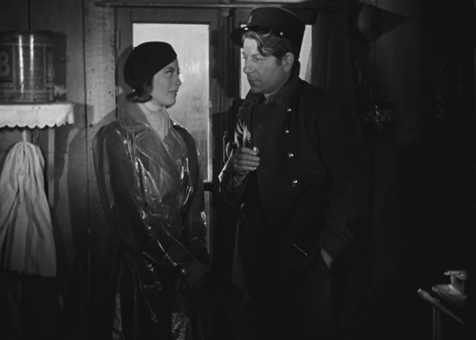
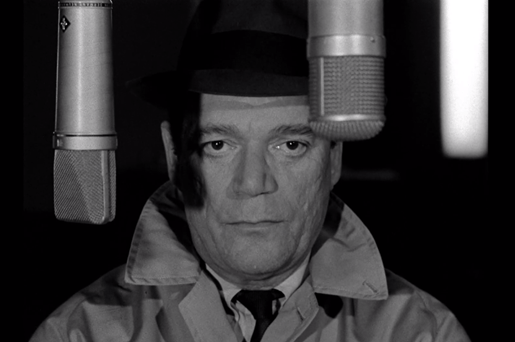
Godard’s protagonist functions a bit like a world-wearied Buster Keaton in his later years. Lines covering his stone face are perfect for suggesting that he’s seen the world. This alone makes him sufficient, but expatriate Eddy Considine was also known in France for his long connection with the serialized crime detective Lemmy Caution. Here he is tasked with missions, but as should be expected with noir storytelling, each successive leg feels more befuddling than the last.

Godard took Caution to the extreme, totally untethered out in his devised limbo of clunky Parisian sci-fi. It’s the profundity of taking the labels of the future (my labels, not his) and making them feel mundane, like the contemporary moment. Still, it’s hardly a stretch to call Alphaville a forerunner to HAL,  Blade Runner, or even Altman’s Long Goodbye, a film where you have a dissonance between worlds and time frames.

There is one moment when the all-knowing voice says something to the effect that there is never the past or the future. There is only the present — where we can exist right now. So, really, there is not an issue of incongruity because everything we see is accepted as it is, functioning in this landscape as one.

Godard, working with his famed collaborator Raoul Coutard, initially doesn’t even bother with chiaroscuro, but instead an utterly binary palette. Horizontal slats of darkness above strips of light or vice versa. A cigarette and gun in Caution’s hand are both visible, while his entire face is literally pitch black.

Getting to Alphaville and a hotel in the heart of this metropolis is a trip. The lobby feels conventional enough. This is a mere extension of the Parisian landscape. And yet he gets led to his room by a lady who looks suspiciously like a lady of a night (especially when her clothes start coming off), and Godard adds another lovely non-sequitur when a thug all of the sudden materializes in the bathroom leading to a stylized struggle.

Our tough guy runs for his gun on the bed and shots ring out through the room. He makes the agitated but lucid observation moments later, “Everything weird is normal” in this town. He’s never been more correct.

We get a suggestion of what Godard is playing with — the conventions and ideas he wants to tinker around with — as both an artistic and intellectual exercise. Beatrice, the first of several femme fatales, we find out, is a level-three seductress. It’s all too apparent the misogynism has not evaporated in this alternate world.

alphaville 2.png

Anna Karina appears next as the daughter of a high-ranking official with intimate knowledge of Alpha 60. Caution christens her a “pretty sphinx,” and she is an unsuspecting product of the disconcerting sci-fi dystopia that has overtaken society. Ironically, it comes packaged a lot like Paris in the 1960s run by capitalists.

As far as gadgets go, Caution employs a portable lighter-intercom slightly less ostentatious than Maxwell Smart’s shoe phone. There are government-sanctioned executions for those showing sentimentality, where the festivities are made into a bit of a water aerobics showcase. Another popular form of entertainment is theater executions — the electric chair in more diverting circumstances.

Logic is law. Tears and love are among those things outlawed. No one comprehends what “conscience” means anymore. I even made the initial assumption the books in the hotel rooms were Gideon Bibles. However, it turns out, “The Bible” is not theological but linguistic, in the form of a dictionary, as delivered by Jean-Pierre Leaud in a blink of a cameo. When words get eradicated from the cultural lexicon new editions are published and disseminated to the public.

As the tenets of society get more and more perplexing, Caution’s mission begins to spiral into chaos, toward the final destruction of the mechanical beast. Godard chops up cinematic reality with disruptive negative images that do feel otherworldly. There are car chases, murders, and corpses of those asphyxiated splayed on the floor. It seems Alphaville really is crumbling from the inside out.

The movie itself is full of these deconstructions, clever amalgams of Godard’s cultural proclivities, and his own personal wizardry. But if we are to fall back on my totally unessential litmus test, he rarely touches me to the degree Truffaut is capable of. There’s never the same laughter or warmth emanating from his characters.

Yes, in Breathless (1960) and Vivre sa Vie (1962) they come the closest and there are extended periods that speak to me, momentarily touching my heart and my soul, if I can be so transparent. But at a certain point, they end because Godard is not in the business of humanity as much as he is in the business of the mechanisms of cinema itself. He is the great artist. Truffaut the great humanist. In turn, each affinity made them into two of the most passionate filmmakers the world has ever known.

Both very avid, opinionated, obsessive cineastes. It even drove a wedge between them in later years after their catalytic collaborations in the early 60s. It’s not all that unsurprising. Arguably their most similar films conceptually, are vastly different in both vision and execution.

Consider Contempt (1963) and Day for Night (1973) or even Shoot The Piano Player (1961) and Alphaville (1965). The first pair act as two entirely singular odes to the art of filmmaking. The latter two are indebted to the glories of film noir and other cheap genre fare.

But again, it feels like Truffaut is far more capable of humanity. You never get the same sense of transparency from Godard. There is even a feeling he relishes his status as this cryptic figure — a reputation, I might add, he has maintained for most of his career.

And yet even Godard, with all his enigmatic stylings, can continually surprise me like so many others. This is his ability to morph with the times and take on new forms like a Bob Dylan — to make a flawed musical comparison. For me, it was the final line of his movie — all but forcing me to eat my words — forcing me to feel empathy.

Natascha remembers how to say “I love you” as they drive away from the hysteria of Alphaville back to the Outer Countries. For Godard, this is a heady statement, the height of sentimentality even. It’s unexpected but fitting, his constant muse throughout the 60s, Anna Karina, emblematic of his most fertile creative period, it’s her words that ultimately define Alphaville. I love you. Maybe Godard is a humanist after all. At the very least, Karina in all her affection helps to humanize him.

4/5 Stars

Note: Since writing this piece, Anna Karina passed away on December 14th, 2019. R.I.P. to a legend. 
Port of Shadows (1938) and The Face of Jean Gabin

port of shadows 1.png

“Like the movies. I see you. I like you. Love at first sight.” – Jean Gabin

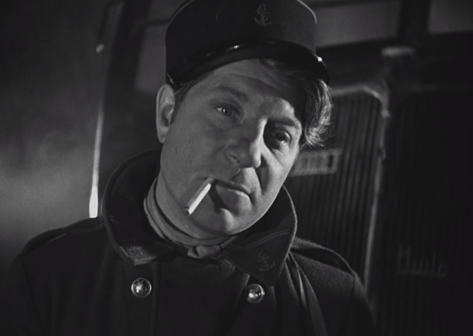
Jean Gabin has one of the great visages of the cinema. But in making such a statement you immediately run the risk of giving the wrong impression. To actually see him on the big screen is to know what I mean. He is not classically handsome in the Hollywood sense, fitting somewhere in between Spencer Tracy, Bogart, and Fonda when Hank had a chip on his shoulder. And yet set off in black and white as Gabin always was during his most prolific periods, there is something unmistakable about his face.

It is worn with the grooves, contours, and the residual sadness that come with life. He gives the impression of seeing the world, having his heart ripped out, being battered and bruised, while still choosing to press on anyway. You could say he has the entire French experience of the early 20th century on his brow. He’s simultaneously a projection of their best self in the face of hardship.

Historically, the cultural mood and the looming world war to come were ill-omens, as far as the release of the film was concerned. It was far too portentous to be met without some amount of resistance

In Port of Shadows, Gabin fittingly plays a jaded soldier who catches a lift to the nearby port town of Le Havre. In an opening act of clemency, he keeps his truck-driving benefactor from quashing a mutt masked by the billows of fog. It’s an instant flag. We know this man. His emotions are not obvious, but they are there; he concerns himself with the well-being of others. There is a heart under there somewhere. Scene after scene his constant companion is the runty little dog, a continual reminder of who he is as a man.

Along with setting up its star, we soon learn director Marcel Carne cares about his characters and takes care of them. Not that the environments are unimportant. Between the pitch darkness of the highway or the smoky and garish interiors of the club, there’s atmosphere aplenty. But Carne is focused on his players; their faces and distinct movements, allowing them to be focal points of scenes in a generally clean, uninterrupted fashion.

Between the instantly palpable world and the menagerie of players cycling in and out, Port of Shadows cannot help but feel like a prototype for everything from Casablanca to the entire film noir movement with its smoky brand of realism.

I don’t know much about the time frame of when the picture takes place. In all honesty, I’m not all that concerned with that so much because instantly you are pulled into a world’s depth of field with its shadow and fascinating figures. There’s a compulsion to fall into the story and be as fully involved as possible.

He’s in town, flat broke, and there’s an unspoken understanding he’s not looking to get noticed by the local gendarmerie — most obviously a deserter. This is one of those picturesque places where you can fall in with drunken vagabonds and find yourself on the receiving end of neighborliness.

As is, everyone who is down-and-out or in trouble seems to go to Panama’s, though it serves as little more than an old shack with a couple of rooms.  A sorry excuse for a hangout and yet it has far more life than the fancy club in town. It’s the people there who truly make it worthwhile.

port of shadows 2.png

Jean (Gabin) is given a meal by the ragged proprietor, gets some fancy talk from an amiable artist, before meeting the most important person: Nelly (Michele Morgan). She’s young but precocious, mature beyond her years. The same might be said of Morgan who assuredly holds her own against all her male costars. She’s thoroughly outnumbered yet she handles it poise.

It’s a testament to the strength and varied colorfulness of the characters that the illustrious Michel Simon almost becomes of less interest as Nelly’s despicable godfather, especially compared to the peculiar sots he was tasked with portraying in Boudu and L’Atalante. His big scenes come near the end of the picture anyway.

Mostly this is a love story. In a rare moment of self-reflexity, Jean mentions how theirs is a movie romance. It’s this heightened sense of romantic reality. If we put it up against anything we experientially know to be true, it’s poppycock, but between the eyes and embraces of Morgan and Gabin, it just feels right.

We also learn more about Jean. Not only is he capable of deep measures of love, but he has no tolerance for lowlifes and scum — those lacking a sense of honor or principle. You have it out with a man face-to-face with fists, not from behind. One of his main targets is the local gangster Lucien who is nothing more than an arrogant rich kid with too much time on his hands. He wants his hands on Nelly. Jean is having none of it. He cuts directly through the artifice, slapping him around for his impudence.

The story comes to a head on the docks and again, of all places, at the bumper cars in the middle of a carnival. You do not mess around with Jean Gabin when a girl is involved. This could be the movie’s ending; the romance would be the euphoric and the hero would remain triumphant. However, it is a movie and so a greater, darker, more wistful avenue of drama is in order.

Because Jean knows he is not safe, though he has gratefully taken another man’s identity. It is better for him to leave on the latest vessel shipping out to Venezuela the following day. His love for Nelly is great, but there is a need to move on, to let her be while also keeping her away from the trouble that would come from knowing him. He does the selfish or heroic thing (depending on how you look at it), in cinematic terms, and he doesn’t tell her. He holds off as long as possible.

One fine sequence is at the waterfront bar with kegs of alcohol lodged right outside the door. There’s a conversation at the bar between the bartender and an old acquaintance we’ve already met. At a distant table, our protagonist, with his new identity bequeathed him by the philosophizing painter, charts his course for Venezuela aboard the freighter now sitting in the harbor.

These seem like mundane enough scenarios, but instead of a normal cut, Carne rides an extra with his camera, acting like the seamless segue between the two conversations. It’s a classy and efficient way to keep the scenarios fluid even in a seemingly sedentary state.

These lulls lead up to what can only be seen as the film’s inevitable tragedy. Like the most sublime expressions of cinema, Port of Shadows is a visceral, emotive experience capable of so many things. It’s a piece of art: humorous, tragic, brooding, and searingly romantic. In short, a sheer pleasure to take part in.

4.5/5 Stars

Floating Clouds (1955): Capturing Japan’s Post-War Zeitgeist

floating clouds 1.png

The Odyssey to finally get to Mikio Naruse has been a long and arduous one. I must admit, like many before me, his name carries none of the recognition we commonly lavish upon Kurosawa, Ozu, Mizoguchi, and a select few. So, for the longest time, there was no pursuit. His name was totally unknown.

However, as you begin to familiarize yourself with Japanese cinema (and I must admit to still being a relative novice), there are certain names that you keep coming back to. Masaki Kobayashi and Kon Ichikawa fall right behind the illustrious trifecta. Certainly, you have the Japanese New Wave directors like Shohei Imamura, Nagisa Oshima, Masahiro Shinoda, and Hiroshi Teshigahara.

However, for some reason, I just could not stop thinking about Mikio Naruse. It seemed like I was always being reminded of him. Whether it was Kurosawa praising his writing or Hirokazu Kore-eda saying his style was more akin to the lineage of Naruse and not Ozu. Again, it reflects an oversight on many film aficionados. We do not pay Naruse much respect because, frankly, there’s not much access to his work in America.

In fact, because I am so fortunate to come of age as a cinema lover in a world that is so globalized, with content so accessible, it is not a form of helplessness that I have felt too often. It’s not simply a matter of his film’s being hard to come by; it felt like only a few were readily available.

This absence of his work made it all the more imperative to reach him. Finally, I can attest to dipping into his filmography and finding myself deeply fortunate to have made his acquaintance. If it’s allowable to use a German word to describe a Japanese condition, Floating Clouds captures the zeitgeist of Japan in the aftermath of WWII.

The film’s structure feels as fluid as its title. It trusts the audience to follow along without voiceover cues of any kind, drifting in and out of the present and flashbacks set before the war had ended. This is the fashion in which we get to know our two “destitute expatriates” now reunited in 1946.

They met for the first time in Indochina. It’s a world we can contrast with another romance like Red Dust. An outpost out in the forests of Asian proves a far more bearable place to pass the war.  If you recall, the earlier film is made by the red hot chemistry between Clark Gable and Jean Harlow (and with Mary Astor).

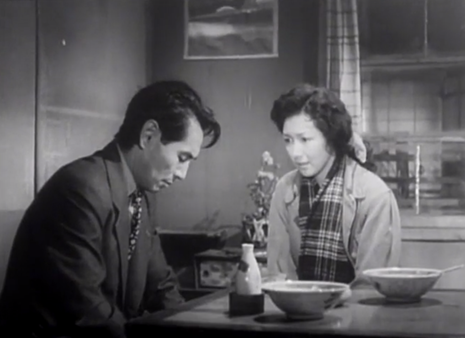
Except in such a patriarchal society, like Japan, it always seems to be the man who has the say. Tomioka (Masayuki Mori) begins his acquaintance with Yukiko (Hideko Takamine) with slight jabs at her, all but solidifying his gruff character for the entirety of the film. These rocky foundations give way to passionate romance and Naruse does something dynamic by cutting right between a kiss in the past to one in the present. So much has changed and yet nothing at all. Much of Floating Clouds is about this reconciling this past with the present.

The pensive serenity is one of the unifying hallmarks of the picture. This is another point of departure with a Hollywood romance like Red Dust. This, paradoxically, feels like a grand statement — choosing a tranquil path in a medium that is so often filled with noise and a world full of constant turbulence.

Even in considering his countrymen, Kurosawa is often more dynamic in composition and action. Thus, it seems most obvious to contrast Naruse with Ozu. However, whereas Ozu heralds his presence within the frames through the meticulous craftsmanship and attention to detail, you do not necessarily see this to the same degree in Floating Clouds.

It is stripped down to a near Verite approach, which still cannot be mistaken for shoddy work. In fact, it boasts beautiful interludes between two people on par with a picture like Late Spring. It’s not a perfectly ordered fabrication of reality where human drama plays out. The spaces feel rich with the impoverished and worn layers of Japan as it lay. The people are much the same, unadorned yet imbued with truth.

Hideko Takamine is extraordinary for how she is able to manage a spectrum of emotions — exuding an inner strength and individuality — while still giving way to honest feelings of regret. She can be the adulterer, the nagging lover, the broken heart, all of the above , as they cycle through time.

No less important is Masayuki Mori as he acts as her perfect counterpoint. He gives her nothing, or at least very little. Every potentially thoughtful action is dismissed and any form of commitment is avoided doggedly. There is even so much about their preferred temperaments putting them at odds. It seems like circumstance and they’re own interactions together all but destined them to part ways and move on with life. He returns to his wife “nobly,” while she is supported by the brother-in-law who formerly took advantage of her. Every relationship is riddled with these personal dilemmas.

There is another brief snapshot that resonated with me — both in its mild humor and how it proved indicative of the times — when Yukiko is walking down a street alone. In the periphery, we see what looks to be a Japanese woman with an American G.I. He seems to be at least a head taller than everyone else. Then, almost on cue there comes a voice, speaking my native tongue: English.

It’s a second G.I. looking for a date, and he affably asks her in broken, bastardized Japanese (rather like what I’m capable of speaking), if she’s alone and where she’s going. She simply smiles and moves on, either to brush him off or resign herself to a superficial evening of companionship. He exists as more of an archetype than a fully defined character even given that his name is “Joe.”

However, what it provides is a fascinating counterpoint to what we are used to in our little universe, where everything commonly revolves around the western world, if not America. Pictures like House of Bamboo, Sayonara, Teahouse of the August Moon, they all give us a very specific and tailored experience.

It’s somewhat strange and fascinating to feel like the “other.” The soldier here is the sailor in Lola (1961) or the soldier in The Marriage of Maria Braun (1979). In fact, they all serve much the same function. They come to represent a different type of relationship and with it a diverging life, even if it’s only meant to be a momentary fleeting fancy. 

This is not a picture where we see the chaos and the bloodshed. After all, these two were the “lucky ones” stationed in Indochina. And yet we see the shadowy imprint of a former life involving suffering, poverty, and the ignominy of surrender. It doesn’t seem too farfetched to claim Floating Clouds somehow channeled the thoughts and feelings of a generation. The Best Years of Our Lives might be similar to a generation of Americans.

Consequently, as a viewer in this contemporary moment and an American on top of that, there is a realization of how much I take for granted in this story. I am more like the American soldier than I am this couple. It proves a humbling observation, carving a path toward some sense of empathy.

floating clouds 2.png

 Eventually, her lover turns up again — still as brusque and egocentric as ever, looking around at her plain surroundings and commenting on how well she’s doing. These types of evasive, indirect proclamations are all she ever gets. So she’s hanging on his words, getting whisked this way and that with partial promises and empty hopes, never going anywhere. Later on, he has his eyes on the pretty young wife (Mariko Okada) of an acquaintance (even soaking in the public bath together). After all, in superficial terms, she is much more “desirable.”

To consider the American soldier again, he was on leave for two months before shipping home. Even in the short amount of time, he was overflowing with geniality. If we take Floating Clouds as indicative of all of Japanese society, it proves a telling portrait. There is no affection or sense of vulnerability within men. Endemic to the society and more so a holdover of the war. It’s not simply about women being overly emotional, though this is often the cultural expectation. More emphatically so, the men lack any type of emotion. They are ingrained with this stoic (sho ga nai) mentality.

There are numerous walk-and-talks, and the scenery and setup might as well be interchangeable, but the subtext and junctures in their lives are starkly different each time. So we have all these snippets wedged in between their life events as they orbit in and out of each other’s lives.

It’s easy enough to juxtapose it with Citizen Kanes dinner table scene where a relationship is seen crumbling in a matter of minutes. Stretched out as it is, within Floating Clouds, these walks continue this metaphor of progression. It is the progress of life, of a relationship, and of the world existing around us. Because while the steps might remain the same, the circumstances are different around every bend. Time marches on with each footfall.

It’s not about being ships in the night either — that they missed out on one another’s company — simply put, they are abrasive together. Their traits and identities are constantly causing them to attract and repel each other again and again.

The lasting image is a bent head, but this is not one of Ozu’s quiet forlorn scenes where a father has just made the honorable decision to give up his daughter. These are ugly, bitter tears. He is weeping. And this man, for the first time in his life, is providing physical acknowledgment of how much another individual human being meant to him. In a Hollywood picture, the action would be meaningful, but not unprecedented. In this movie, it feels heart-wrenching because we have yet to anything so transparent.

It’s an evocative final note in a work rarely prone to this kind of overt outpouring. It’s the cathartic release in a bittersweet tragedy. All we can do is bemoan the fact this man was never vulnerable enough to admit the depths of his love during life. Unfortunately, in this particular life, there is no resurrection.

4.5/5 Stars

The Stooge (1952): A Martin & Lewis Biopic?

the stooge 1.png

If the story holds, Jerry Lewis named The Stooge among his favorites of the work he did during his famed partnership with Dean Martin. This was the sole reason for watching it and this is probably the most effective lens in considering what to make of it.

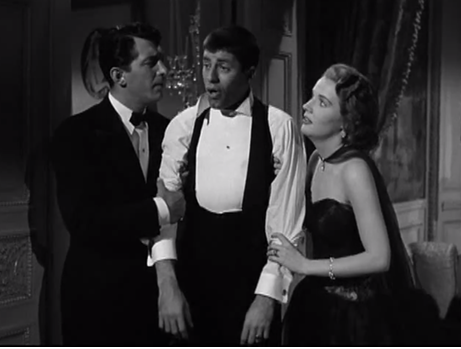
The plot itself follows a show business narrative and draws up a fictitious story about how they needed each other or how they managed to perfectly complement one another’s talents. Except that’s not entirely right because it’s really about how Bill Miller (Martin) is a bit of an arrogant control freak, using someone else’s talents to bolster his own career. He somehow carries this dissonant belief Ted Rogers (Lewis) is the secret weapon of his act and still of secondary importance. He, Bill Miller, is the real draw.

To provide some context, Miller has recently wed his best girl (Polly Bergen), who foregoes her own career as a performer to sit in the cheering section of her husband, so he can make a go at the big time. It’s the all-absorbing preoccupation of his entire life as he works with his agent (Leo Lyman) to become a star. Despite others giving him advice to the contrary, he wants to be a single. And even when he finds his missing piece, he still considers himself a solo act.

Lewis gets his opening in a hash house giving the man behind the counter real grief. Then, he pays off a cynical cabby with crumpled up bills hidden all across his person. It only gets more outrageous.

Obviously, it’s toying with the dynamic integral to the Lewis & Martin formula with Lewis making a racket from the balcony in his attempt at song, only to start up the patter between Dean down on the stage with his skimmer and accordion. It feels like they were meant to do together. The perfect counterpoints to each other’s images and strengths.

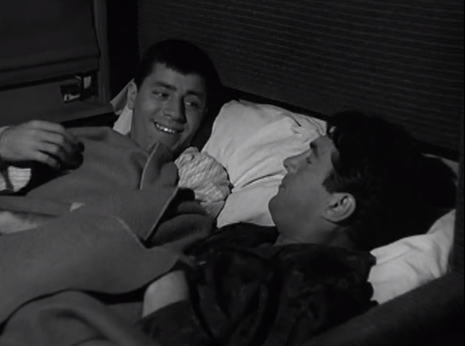
However, there are all these perfectly manufactured moments and thus nothing feels truly spontaneous, like catching lightning in the bottle. With the gags being set up, we have a sense of what is going to happen before they actually occur. One exception and somehow an immaculately hilarious image (not that it was ad-libbed,) is Martin bouncing Lewis continuously on the bedspread like a human pogo stick. The mental picture it conjures up is enough.

the stooge 2.png

It’s true Dino does feel like a bit of a tyrant. One can only surmise the picture was held out of circulation for a time so he could build an initial rapport with the audience. They released two other features before sending The Stooge off the assembly line.

All told, the most gratifying moment might be right at the end for the simple reason the picture no longer has to make a pretense of the drama because it’s just been resolved. The one zany off-the-wall man-child runs his crazy interference while Martin looks on with mild befuddlement, and they find some wry equilibrium in there somewhere. There’s no element of Miller’s colossal ego getting in the way so we go to straight to the heart of what made Martin and Lewis a lasting comedy team.

It’s a shame the film was plagued by a plot gumming up their routines. Not only was Dean Martin intermittently unlikable, it really dices up the film. The saccharine moments of applied drama are mostly throwaway. The comedy works slightly better. Though I must admit my personal preference for Dean over Jerry.

As a very subjective observer, I am drawn to consider The Caddy instead. Not only does the premise feel more conducive to gags, but the chemistry also allowed for our stars, as characters, to feel richer. They are part of a close-knit community and when their world includes Donna Reed and a snappy rendition of “That’s Amore,” it’s hard to ask for much more with already meager expectations in place. It’s the simple pleasures and, for me, The Caddy offers more of them.

In hindsight, The Stooge feels harrowingly close to loose biography. This is not to suggest the two men were their characters, but we have Dean’s drunkenness and Lewis’s own persona upstaging any and every bit of Martin’s talent. We could even wager a guess these are portentous moments, given their own eventual breakup. Certainly being the insane energizer bunny bouncing all over the stage has its drawbacks, but you do get a great deal of attention.

Most of the other Martin and Lewis pictures during their prolific run brought genre and camaraderie together. This was their charm bottled up so easily and then delivered to the masses. The Stooge doesn’t always employ the same brand of simplistic comedic commoditization, probably to its detriment.

In truth, it suggests my own reluctance to parse through the reality of the men behind the characterizations. A typical Paramount vehicle for the pair might be the perfect portrait of 1950s idyllic America on the outside and yet underneath there were festering issues. The country’s most beloved comedy duo was plagued by discord just like everyone else.  No fabricated sitcom setup can completely smooth over reality.

3/5 Stars

The Nutty Professor (1963): Jerry Lewis is Jekyll and Hyde

the nutty professor.png

I can bemusedly remember more than a few trips out to the high school football fields as our designated evacuation point for fire drills. The other times we ended up out there was more likely than not due to the chemistry department setting them off with some supernal explosion of their own devising. You can only imagine it being a giddy badge of honor among these grown-up nerds.

In full disclosure, I must admit being indebted to Disney’s Absent-Minded Professor for creating my paradigm for the mad scientist. Jerry Lewis takes this readily available archetype to set up an analogous comic cocktail — albeit to the utmost extremes — marrying it with one of his own creations: Julius Kelp.

The Nutty Professor‘s gloriously campy color schemes are all the better for this wonky Jekyll and Hyde riff. Rooms look like they’re all but made out of cardboard and as such, every interior and visible prop feels expendable. School officials (Del Moore) and secretaries (Kathleen Freeman) are either high-strung or chatty cartoon characters.

In one exemplary moment, Lewis all but railroads the usually fastidious chancellor into doing an impromptu rendition of Hamlet on his office table. A modicum amount of ego-schmoozing effectively makes a complete mockery of the man with typical Lewis lampoonery.

Likewise, the interminable supply of handsomely-clothed, virile male co-eds all look like they either play quarterback or shooting guard for their respective sports teams. And all the pert young women are a similar picture of All-American, bright-eyed ideals.

Considering these elements, The Nutty Professor is derived mostly from performances more than being gag-driven; the jokes come organically out of character. I’ll fall back on my normal diagnosis of Lewis comedies, namely, the plot too often gets in the way.

Kelp is a walking stereotype, but he’s also an endearing Jerry Lewis creation, complete with outrageous buck-teeth, googly glasses, a lexical vault full of spoonerisms, and probably the worst excuse for a haircut in the history of the movies. If we can risk being facetious momentarily, these are all very calculated decisions. It’s a visual statement made all too obvious; this man is a loser.

The childishly simple premise digs into these same themes. Although there might only be one or two isolated occurrences we can think of, Kelp attempts to combat a bully in his class who pushes him around. Since it’s not altogether overwhelming conflict, we must consider this to be partially his own inferiority complex speaking.

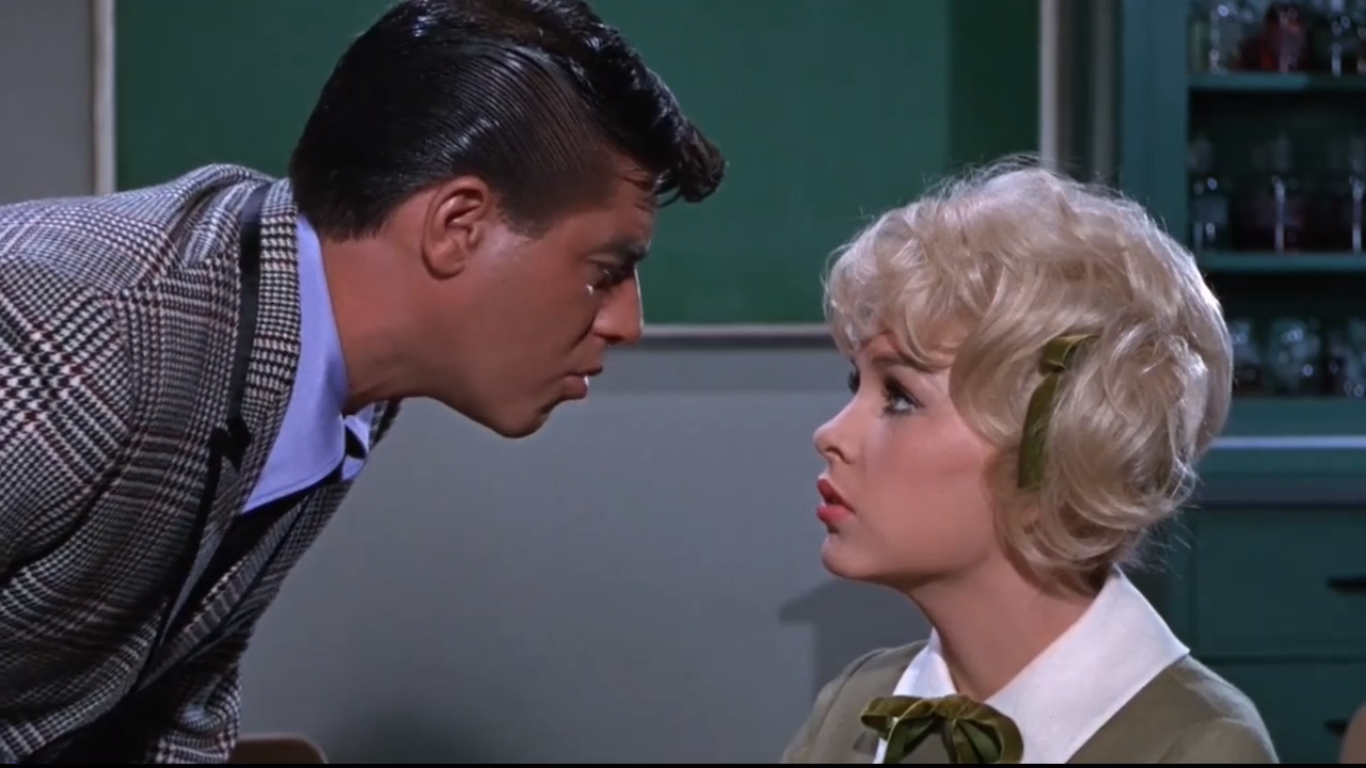
It doesn’t help a pretty student like Stella Purdy (Stella Stevens) simply reinforces all of his inadequacies. Because she is yet another paradigm with her hairbows and schoolgirl charms.  She is caught between the dorky loser and the vain, devilishly handsome lady killer. The question remains: Where do her values lie?

the nutty professor 2.png

If I haven’t spoiled the punchline already, there is an obvious road the zany tale must traverse. Around his new fitness regimen, Julius acquires a carload of books from the library; his results spawn a most curious potion. One would think he’s transforming into a werewolf or something. Actually, it’s far worse: Enter Buddy Love (also played by Lewis).

If you don’t hear the imaginary notes of “Love Potion No. 9” performed by The Coasters or The Searchers (depending on your preference), then your brain isn’t as formulaic as mine.

Regardless, Kelp’s alter ego soon finds himself waltzing into the local collegiate watering hole, the aptly christened Purple Pit. There Buddy Love makes his self-assured debut, hair plastered down, smoking a cigarette, and owning his outrageous duds. He catches everyone gawking on the street, and it’s much the same on the inside — showcasing a Lewis POV shot allowing us inside his conceited head.

It’s easy to consider The Nutty Professor a vanity project on a cursory level. Because Jerry Lewis is always at the center of this universe. Take the moment he’s supposed to be the devilishly handsome Love and literally, the whole club comes to the standstill. It’s absolute absurdity.

But in some ways, this perspective just doesn’t take because although Lewis is at the center of everything, he’s willing to look like a dorky, bumbling, idiot just as much if not more so. Someone who can do that has to be at least somewhat comfortable in their skin or at least content with putting on the charade of an utter doofus.

It relies completely on his dual role and Lewis’s own capacity — having the world constantly revolve around him — self-promoting himself and simultaneously tearing himself down. The tightrope walk is a compelling one.

Some have posited Buddy Love is a not-too-subtle shot at Dean Martin as the former compadres were still broken up after a fairly acrimonious split. Lewis instead denied these assertions by suggesting it was a knock on all the vainglorious phonies he had met on his long stint in show business. It seems just as likely The Nutty Professor could even function as a dialectic to examine Lewis’s own persona.

One can only imagine, in some outrageous universe, where the fulcrum between Lewis’s own worst and best selves would fall along the spectrum of his two cinematic creations. On one side, he has this image as a klutzy uncouth man-child and yet we must reconcile this with his authoritative vision as a director and a subsequent product of the same show business machine.

He was the one who could brazenly claim so much fame, success, and accomplishment at such an early age. It’s difficult to envision a world where circumstances didn’t go to his head even a little bit. And if there is not already a piece of Love in him, then at least we can acknowledge there is a risk of such a persona cropping up.

If The Bellboy had a family-friendly moral tacked on at the end, then The Nutty Professor is much the same with a few more lines devoted to a theme. Because the inevitable happens and the worlds collide — Jerry or Love or Kelp is ousted as his true self, after masquerading in front of all these people. What a horrible ordeal to slog through.

However, he finds some words. They go like this: “You might as well like yourself. Just think about all the time you’re gonna have to spend with you. If you don’t think too much of yourself, how do you expect others to?”

It’s a compelling message even if the preceding content is all over the spectrum. Along with the science-fiction, we have the audience-appointed fairy tale ending with the guy getting the girl. There need not be more explanation. The Nutty Professor rumbles through all our expectations.

I do find it strangely compelling having all the main players bow in the end credits. It’s like the curtain call in a play where everything is far more intimate. Of course, Jerry Lewis puts his lasting mark on this one by falling into the camera and shattering it. We would expect nothing less.

3/5 Stars

It’s Love I’m After (1937): In Honor of Olivia De Havilland

Screenshot 2020-07-01 at 8.42.44 PM

There is a very significant reason to be watching It’s Love I’m After at this time. Her name is Olivia de Havilland, and by some brilliant piece of Providence, she has just recently turned 104 years old! She, of course, was in her early 20s when this movie came out and what a charmer it is.

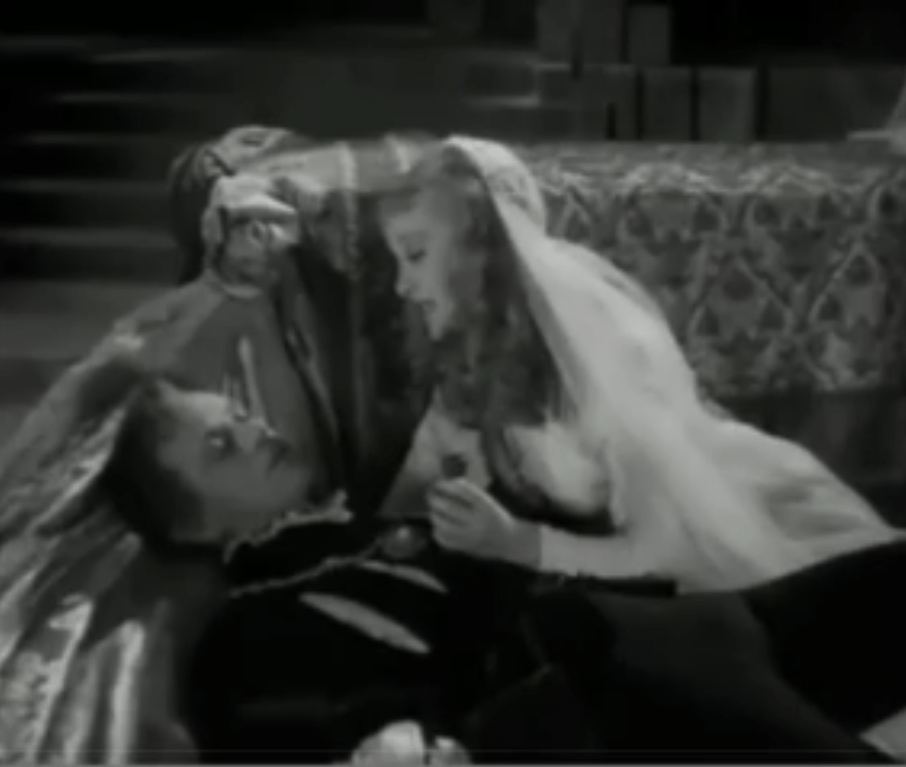
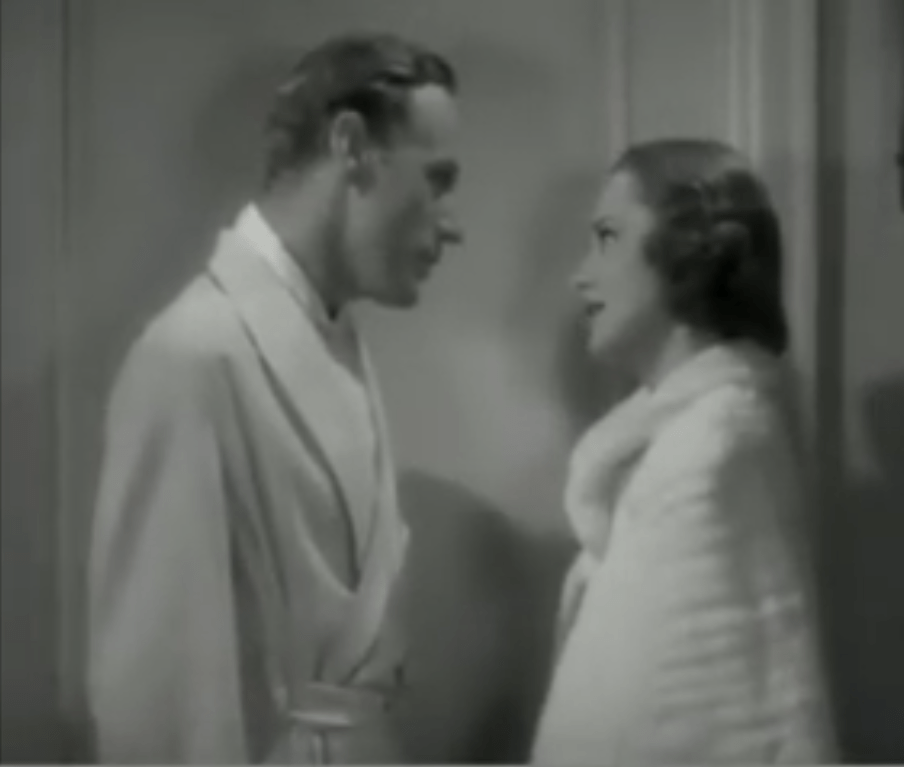
A few years before To Be or Not To Be, here is another movie hamming up Shakespeare on the stage. This time it’s Leslie Howard and Bette Davis as they act out their version of Romeo and Juliet for a rapt audience. What makes the sequence is the dueling couple whispering snide asides to one another mid-performance. Barbs about garlic breath and upstaging come out because they’re both conceited and jealously in love.

But where is Olivia in all of this? She’s up in the balcony swooning over the sublime eye candy down on the stage. She’s seen all of his performances and is positively devoted to his very essence. Her boyfriend (Patric Knowles) looks on with frustration as he’s having to compete with a rival who has never even met his girl before.

This is soon remedied when she promptly goes backstage to pay her respects. It’s all quite innocent. Basil and Joyce continue their incessant bickering from their adjoining dressing rooms, still at each other’s throats, despite the wall between them.

Then, Marcia West presents herself positively agog by the image of her idol thoroughly in the flesh before her. He’s flattered but he hardly knows what he’s doing when he accepts her compliments. Worse still, Joyce sees the young woman on her way out. Harmless or not, it adds further fuel to their relational fires.

What a delight it is to see such beloved thespians and titans of dramaturgy like Howard and Davis doing comedy, of all things, and doing it quite well in the screwball vein. After all, this would be their third picture together following Of Human Bondage and Petrified Forest. There’s no comparison.

The movie is totally overtaken by bipolar swings in fortune. First lovers’ quarrels — it’s the worst New Year’s Eve ever — then there are marriage proposals, and finally, Basil resolves to help a young fellow out.

They do have some handy support. There were few better in this department than Eric Blore, and he has a readily available supply of birdcalls and advice on his master’s matrimonial habits on the “precipice,” as it were.

Being your typically theatrical, philandering type, Basil resolves to shirk his impulses and pursue his own moral salvation. In this case, his good deed is for a lovesick fellow whose best girl is smitten with the stagebound Romeo. The actor doesn’t know it’s the same girl. How can he? No one in these movies ever stops to compare notes.

Screenshot 2020-07-01 at 8.46.48 PM

Still, he resolves to turn up on her doorstep and rudely ruffle her illusion of him. He and his man Digges (Blore) pay a late-night housecall to the West residence. Their shouts of “ire” soon become “fire” and brief pandemonium sets in as an impromptu round of “We’re here because we’re here” comes out sounding a lot like “Auld Lang Syne.”

He schmoozes his way into the house, making himself at home in the company of the avuncular father, befuddled mother, and a gossiping sister (Bonita Granville) always peeping through keyholes. But in Marcia’s eyes, he can still do no wrong. Now he’s got quite the prompting audience, and he’s all but ready to do his part.

His bit of showmanship has him playing up his image as an egotistical malcontent tearing through the guests and their breakfast table with ferocity (and some help from the Bard). Digges does his best to complain about the lack of kippers and other inadequacies. None of it congeals as they were hoping, in fact, it has an adverse effect. Marcia agrees with his every word.

As someone fed on a steady diet of P.G. Wodehouse and Jeeves and Wooster, there’s something familiar and comforting about the picture’s comic situation. Basil is no Bertie Wooster. Digges is no Jeeves, but they are stuck in the same madcap realm of romantic entanglement mixed with comedic hijinks.

Whatever Basil tries is quite unsuccessful in quelling the ardor or the affection of Ms. West. The best-laid plans all too quickly go awry and poor Digges can do little to stop the inevitable. Joyce makes her reappearance at precisely the most inopportune time. She catches her man in the arm of another. The jealous boyfriend feels affronted as he watches his girl be ripped away from him, albeit unwittingly.

The story couldn’t look bleaker and further from its agreed-upon happy ending and yet, eventually, it comes, like any good rom-com. Don’t ask me how it happens. Maybe it’s the youthful fickleness of De Havilland’s ingenue. Perhaps cinematic serendipity gets in the way. Regardless, the partners shuffle around only to get back together with their ordained.

Leslie Howard and Bette Davis are, again, madly in love, then yelling and screaming and pushing each other across the room. Digges is busy packing the suitcases only for the contents to come tumbling out as future husband and wife make up and share a passionate embrace. What light through yonder window breaks? It is the East and Juliet is the sun! End scene.

3.5/5 Stars


The Bellboy (1960) and Jerry Lewis The Goofball Auteur

the bellboy 1.png

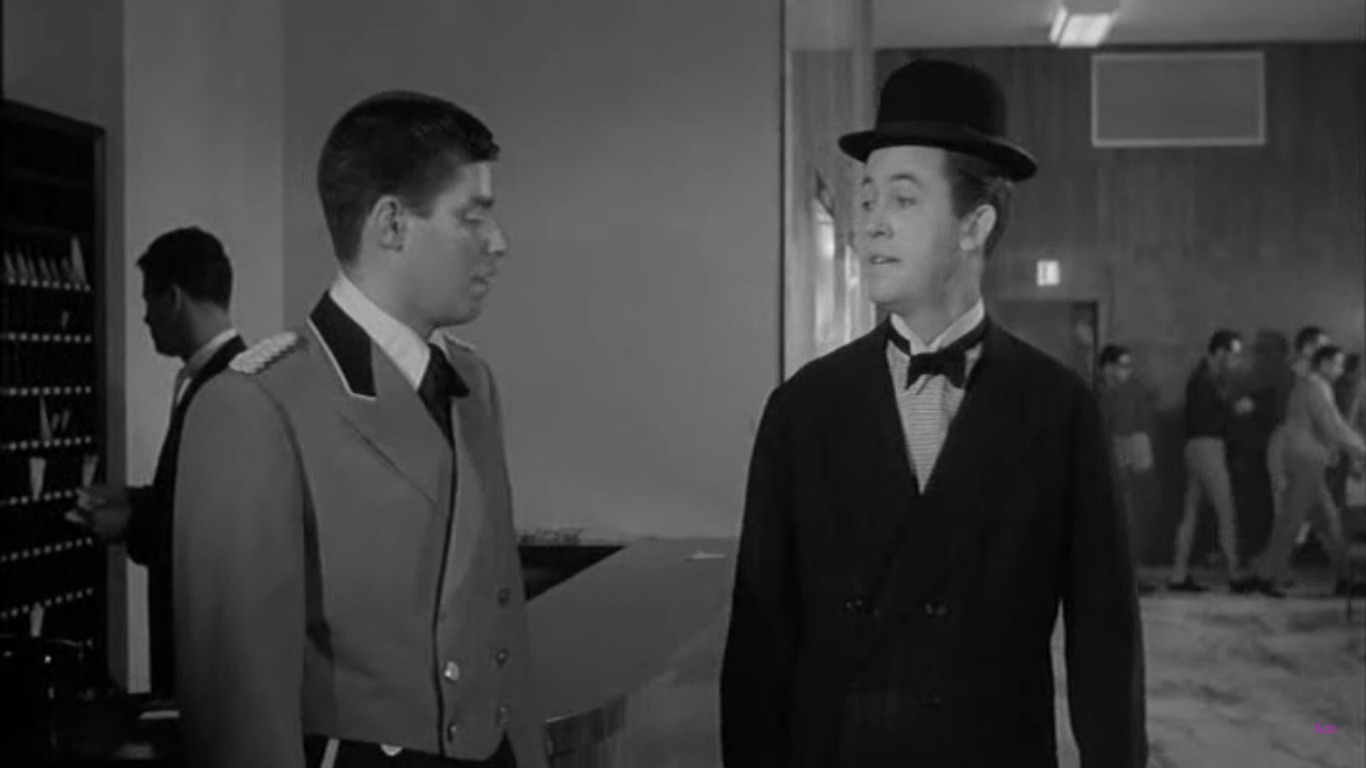
The Bellboy is introduced by a witty disclaimer as a studio executive (Jack Kruschen in a cameo) explains this is a film based on fun. There is no story. No plot. Instead, it acts as a visual diary in the week of a real nut! He subsequently reels about in his chair laughing hysterically.

It breaks the normal precedence in movies, something Lewis may have learned from Frank Tashlin, and yet it also is a clever mode of conditioning the audience. With their expectations tempered, The Bellboy is allowed to excel on its own merit as something entirely unique. That it is.

What becomes evident is that we are witnessing the beginning of the next stage of Lewis’s artistic career, effectively blurring the accepted lines between major goofball and auteur.

Paramount was bucking for his next picture to be released for the summer crowds. Being the consummate professional and insanely efficient, Lewis needed only 4 weeks (26 days of filming) to crank out the movie, while simultaneously playing the stand-up circuit. He would get the movie out in time for the summer rush, and it would continue his successes at the top of the box office.

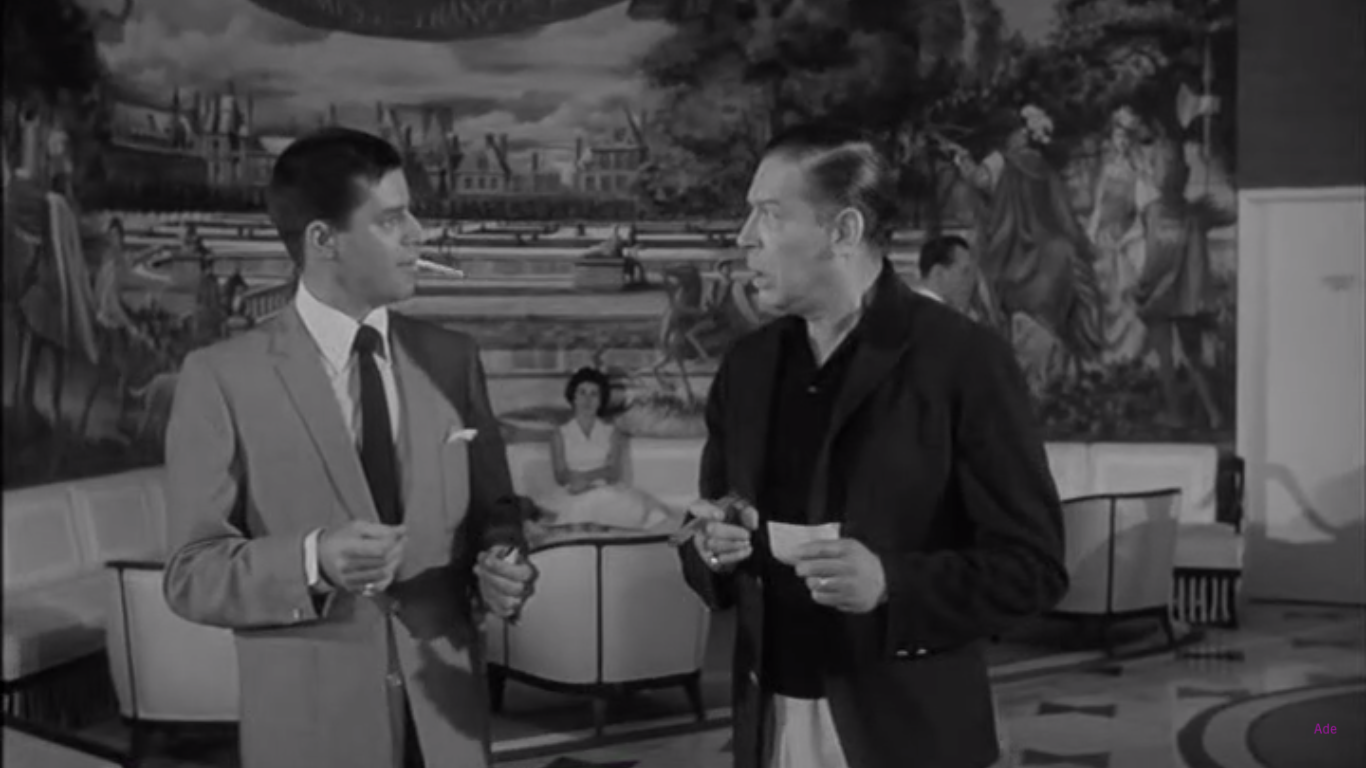
His inspiration was the Fontainebleau Hotel in Miami Beach, conveniently located in the vicinity of his current nightclub act. It proved a ready-made environment ripe for gags of all sorts. One must only remember the red-hats in Hitchcock’s North by Northwest or the shenanigans at The Hotel Del Coronado in Some Like it Hot to see the obvious potential for comedy. Lewis even asked Billy Wilder to direct at one point. Wilder fired back with the advice that Lewis should do it himself. The rest was proverbial history.

One creative element of the palette is missing: color cinematography. Lewis would rectify the situation with his next movie, The Ladies Man. For now, he has exorbitant amounts of fun with the freedom afforded him, designing a character who is a none-too-subtle nod to the titans of yesteryear.

His mute (and dumb) bellboy Stanley muddles his way through work at the hotel, getting pulled into all sorts of tasks. In one moment, he’s tricked into setting up a giant ballroom full of chairs. There’s one dizzying unbroken shot of Lewis charging across the floor disappearing for a solitary moment to bring back two chairs to begin filling up the space at a snail’s pace.

His colleagues are cackling at his gullibility only to peek in on his progress. The punchline being the chairs all set up immaculately. They are gobsmacked but we know better. It shows the power of a cut, where separate images are given so much meaning by even a brief disassociation. Lewis has gladly leaned into a sense of surrealism to augment his usual dopey slapstick shtick.

Another vignette follows the movie star Jerry Lewis (played by none other than Jerry Lewis) whose envoy is met at the hotel entrance by a host of gawking onlookers. His absurdly large entourage files out of his limousine and nearly suffocates him with their well-wishing. He’s had it with their constant hovering. The scene is capped with everyone cramming into the elevator together with similar absurd results. This gag might easily be a nod to The Marx Brothers and Wilder as well.

Milton Berle does his pal a favor by turning up in an isolated sequence. A moment is traded between Milton and Stanley only for the real Lewis to bump into Milton and send him for a loop. The final twist is Berle has a bellboy doppelganger of his own.

As the picture is never beholden to a plot, these loose and free situations keep on coming. Stanley might be trying to go on a dog walking detail only to get tangled up by a plethora of constricting leashes. Maybe he’s on phone duty, and it’s a bit like playing whack a mole where the call is never coming from the telephone he expects.

All the bellboys become unhinged at the sight of pretty girls, and Stanley finds himself all but maimed by an arguing couple who find a point of resolution when they join forces to beat the crud out of him. He conducts an unseen, but very raucous orchestra a la Bugs Bunny created entirely through the merits of sound design and Lewis’s own physical abilities.

My favorite sequence might be when he all but mutilates a sculpture, still wet, sitting out in the lobby for an art exhibition. Don’t ask why it was there. This is the wrong question. Just know the results are riotous.

The same might be said of Lewis all of a sudden showing up at a major golf classic just in time to flashbulb Cary Middlecoff as he’s trying to sink his climactic putt. Or he finds himself airborne and causing quite the stir after commandeering a plane.

the bellboy 2.png

These digressions are nonsensical but since it’s not faulty advertising, the scenarios succeed quite spectacularly. Because Lewis has leaned into this conceit and let his zany brain run wild with all the harebrained bits he can dream up. It does feel like the Marx Brothers at their best — at least in the sense we never go to their movie for a plot. It only exists as something the gags can hang their hat on. But foregoing the normal premises for pure comedy is to Lewis’s benefit.

The legend goes Jerry Lewis asked one of his idols for advice on the script, naming his protagonist as a nod to him and even having a shuffling, bowler-wearing doppelganger appear throughout his movie. The mentor was, of course, Stan Laurel, who had all but stopped performing since the death of his inseparable partner Oliver Hardy. Lewis, for all intent and purposes, had died to his partner, Dean Martin, but reimagined himself bigger and better.

At its best, The Bellboy is an audacious experimental pantomime accentuated by surrealism liberally borrowing from the tradition of Stan Laurel and Jacques Tati. Sound plays such an important role in the comedy as do these continually incidental encounters. They become the origins of genuine laughs.

But there’s also this element of outrageous even impossible scenarios being played straight.  It probably has as much in debt to the animated logic of Bugs Bunny and Daffy Duck as it does to the aforementioned comedians. However, at the end of the day, this can only be Jerry Lewis. If I only had a modicum amount of respect for him before, my esteem for him only grows with every effort. I might relish his forefathers more, but Lewis still has some claim at comic immortality in his own right.

3/5 Stars

The Ladies Man (1961): Herbert H. Heebert

ladies man 1.png

The French (and Europe in general) have unparalleled esteem for Jerry Lewis.  It no doubt allows them to put him in conversations with their own beloved Jacques Tati as the true heirs to the Chaplins and the Keatons of comedy.

It’s no major revelation most Americans, flagged from the general populous, might scoff at such pronouncements. Because Jerry Lewis was just the comic with that obnoxious voice doing bits with Dean Martin and screwing around. This is my own bias acting out. He’s undoubtedly wildly popular with many.

Still, his type of comedies and routines feel like a dime a dozen. His most renowned picture, after all, is The Nutty Professor, and then his string of comedies with Martin, while successful, were never critically reputed.

What our friends across the pond take into account is how Lewis made himself into a holistic artist capable of many things — not simply performing. We saw this goofball. Whereas they rightfully recognized a visionary director, a prolific writer of material, who simultaneously helped to expand the language of film. It hardly seems like we’re talking about the same person, and yet we are.

the ladies man 2.png

What he manages to accomplish starts with taking comedy back to its purest roots, making it into a totally visual experience. There’s no better example than his stark departure with Frank Tashlin: The Bellboy. The Ladies Man builds off these ideas further, nevertheless, developing them with the same persona some adored since childhood and many, like me, will grow weary of after a couple of minutes.

However, this reaction easily clouds what Lewis is actually doing. He effectively turns the American Dream into a satirical, at times, surrealist fantasy playing upon his already solidified persona and allowing himself greater verisimilitude to explore ideas around the slapstick. At its core, The Ladies Man (with no apostrophe s) is an absurd tale of emasculation.

The inciting incident occurs in a small town where Herbert H. Heebert sees his best girl kissing a mostly unseen suitor following their junior college graduation. It’s a devastating blow. He takes this as a sign he must shrug off girls forever and try and find an occupation as far away from them as possible.

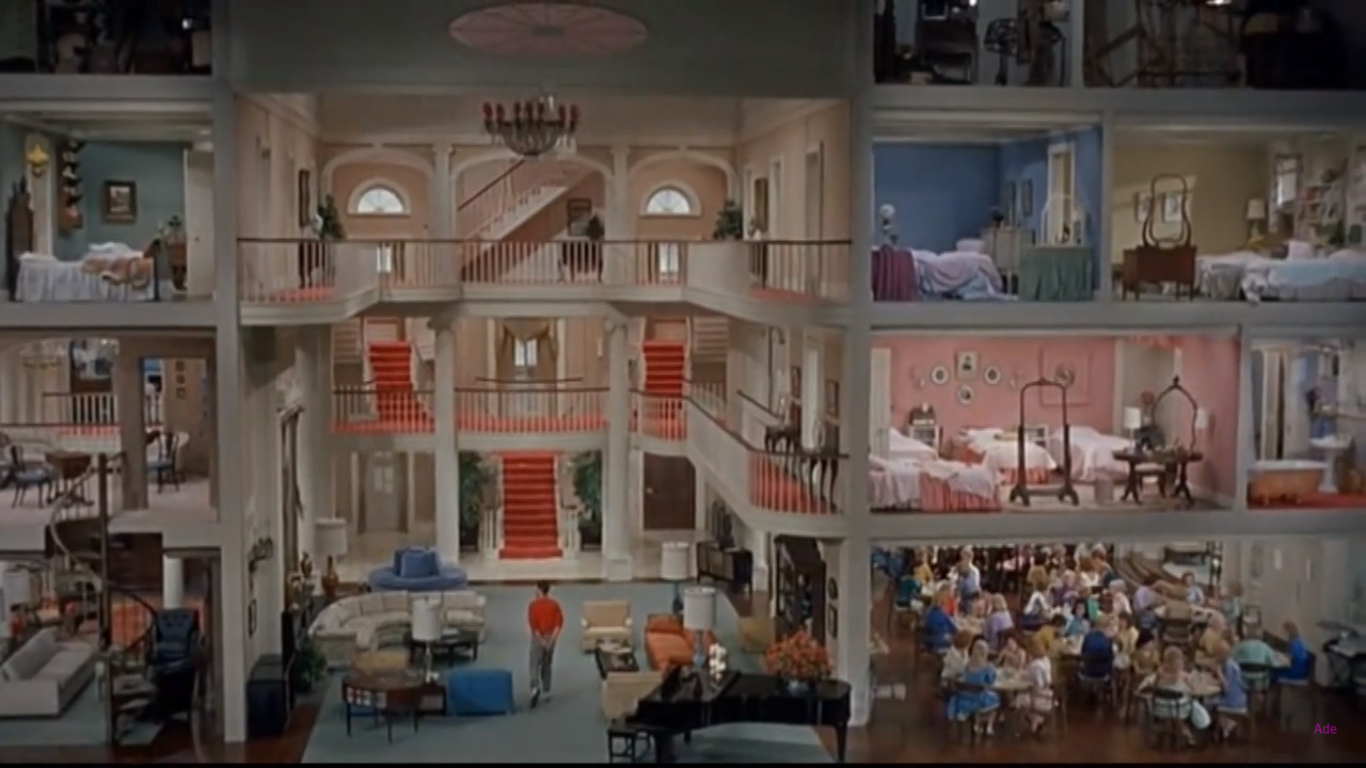
Of course, there’s then nowhere else for him to end up but a giant dollhouse full to the brim with attractive, young women of all shapes and sizes. It’s inevitable. Sure enough, Herbert is hired on by a housekeeper named Katie (Kathleen Freeman) who takes all his foibles in stride. Freeman is also one of the few characters who can stand up to the antics of her leading man. The indelible image occurs when he jumps into her arms out of fright. She’s there to be a foil emblematic of all things maternal and sunshiny.

Meanwhile, the introduction of the female tenants, unbeknownst to the slumbering Herbert, plays out as an intricate morning ritual complete with a jazzy accompaniment and of course, a whole host of alluring women.

This is our first taste of the film’s obvious choreography, and it is executed on a grand scale. The dizzying set made up of rooms upon rooms, multiple stories, and spiral staircases is a veritable jungle gym for Lewis to play with. This pertains both to the actor and the director, realizing elaborate crane shots as his hapless hero is put up against this colorful, campy backdrop.

The glut of the film, by one means or another, follows his daily duties. Of course, they’re only an excuse for a range of gags. They involve a butterfly collection,  passing out the mail, and being the in-house doorman. His most daunting task is taking care of “Baby.” One minute he’s sloshing milk through the living room in a bucket, the next minute dragging a huge slab of meat to feed the beast his breakfast.

Herbert has his own breakfast sloppily fed to him in a high chair by Katie. Yes, it’s strange. It is soon overshadowed by the film’s finest cameo by George Raft, who proves his authenticity to Herbert by showing off his dancing prowess — cheek-to-cheek.

The next extended aside is the picture’s most surreal moment when Herbert enters a “forbidden room” only to encounter a willowy woman suspended from the ceiling. He starts fleeing the slinking woman in black only for Harry James’s Orchestra and a dance floor to appear, facilitating their game of cat and mouse. Any meaning is oblique at best, but that makes it no less of a mesmerizing diversion. Afterward, things slip back into the status quo like nothing at all.

In the last act, the house gets invaded by a television crew and even more madness commences for Herbert as he is all but forgotten amid the tumult. Everyone is just happy he’s stayed around so long to keep up on their chores. It’s one girl named Fay (Pat Stanley) who actually has concerns for him as a fellow human being. This is rare.

In the dining room one morning, she decries her housemates’ manipulative behavior because they’re selfishly thinking about what they can say to keep him constantly doing their bidding. They have no concept of his thoughts or feelings, only his usefulness to them.

However, this indictment has telling implications. If this is a film about emasculation, what do we call the underappreciated place of traditional womanhood? How is this a critique of husbands and boyfriends who spend their evenings thinking of their significant others as nothing more than objects to cater to their whims?

It’s a toxic and quite damning scenario. While the ideal might be well-meaning it only stands up to scrutiny if both partners have symbiotic, multi-faceted roles meant to support one another. In other words, there needs to be some give-and-take, some form of interpersonal connection, and autonomy.

These observations alone make it necessary for me to eat my own words and my dismissal of Jerry Lewis. Because it’s initially difficult to acknowledge Lewis as an artisan and yet watching something like The Ladies Man, it’s impossible not to acknowledge its visual strengths. Yes, a lot of it’s not altogether funny, the gags are at times downright awful, and if you don’t relish Lewis’s own persona, you’re not going to be bucking for him to do his usual shtick.

But as a social commentary, there’s a surprisingly large pool of insights. Likewise, for its visual and physical feats, Ladies Man is a minor marvel even an extraordinary one, though it loses some weight thanks to all the mediocre elements.

Still, there are a handful of scenes with visual expressions and choreographies of a truly unique caliber. It’s as if in another life with a little touch-up, this might be the Marx Brothers mixed with Tati. Likewise, Tashlin’s own cartoon-like, visual wackiness has already been nodded to out of necessity.

Admittedly, my own greatest flaw is being an American. My impressions are already unflinching. When I look at Jerry Lewis I see a multi-talented performer who nevertheless, is more of a tiresome icon than a comic delight. To paraphrase a famous axiom, a comic is never appreciated in his own country. Thankfully, Jerry has the French (and everyone else). It’s the intellectual with the absurd: a match made in heaven.

3/5 Stars

Classic Movie Beginner’s Guide: Beach Party Movies

In our ongoing series, we’ve turned our focus to a specific person or genre we want to try and shine a light on. Today our topic is summer-themed.

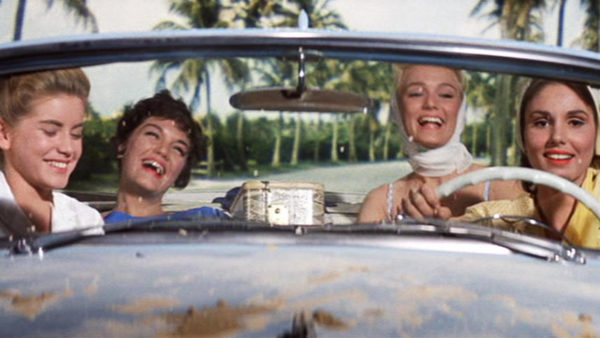
While it’s not exactly a venerated subgenre, the beach party movies are enjoyable nonetheless for evoking the surf craze and the teen beach culture of the 1960s. What they brought together was youth trends of the era from fashion to music and heartthrobs like Frankie Avalon and Annette Funicello.

Although there are too many knockoffs and offshoots even to begin cataloging them all, here are 4 titles to consider if you want to dip your toe in.

Where The Boys Are (1960)

Image result for where the boys are"

While there were earlier pictures like Gidget (1959) and there were plenty of copycat films like Palm Springs Weekend, Where The Boys Are bottles up a lot of the charm that makes these classics a guilty pleasure. The cast is packed with the likes of Dolores Hart, George Hamilton, Paula Prentiss, Jim Hutton, and Frank Gorshin. And with Connie Francis singing the title tune it’s too much fun to refuse.

Ride The Wild Surf (1964)

It doesn’t get much better than the title track sung by surf sound icons Jan & Dean. The cast is another ensemble of teen idol who’s who, including Tab Hunter, Shelley Fabares, Fabian, and Barbara Eden. The exploits of real-time shredding pro Miki Dora were also featured in the place of corny back projection.

Beach Blanket Bingo (1965)

There would be no sub-genre without AIP’s series including the likes of Beach Party and the highly original follow-up Muscle Beach Party. While they stuck to much of the same formula (and essentially the same plotline), the charisma of Frankie and Annette, buoyed by hip music, campy antics, and crazy adults, provides more than enough diversions for a summer night shindig.

Don’t Make Waves (1967)

don't make waves

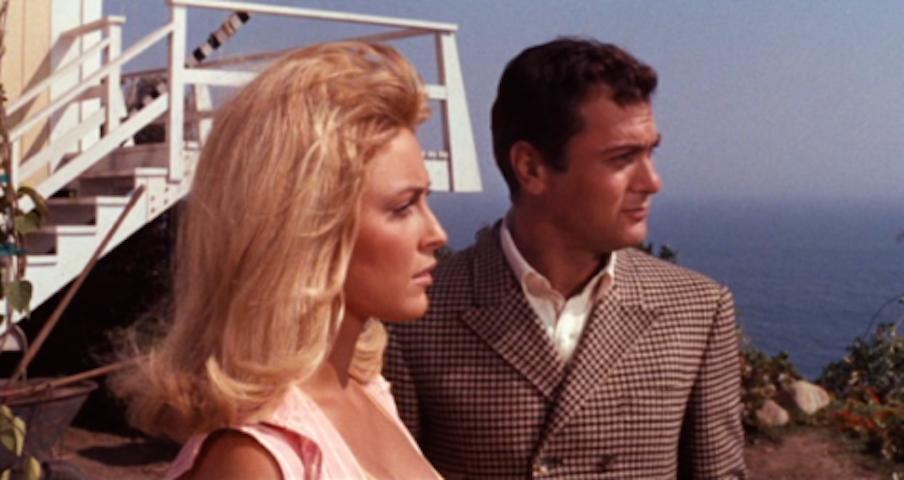
While it’s not as well-remembered and near the tail-end of the cycle, the cast is quite spectacular. Tony Curtis. Claudia Cardinale. And Sharon Tate appears in her first prominent film role. It’s got more than enough in the form of landslides, bodybuilding, sky diving, and most certainly romantic entanglement to easily fit the bill of a beach party movie.

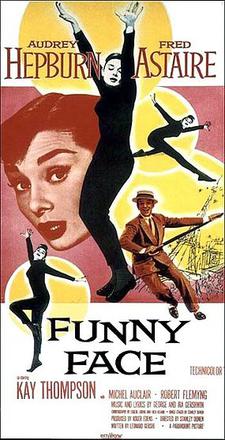
Funny Face (1957) Shows Audrey Hepburn’s Enduring Beauty

Funny_Face_1957.jpgI’m not an expert on fashion photographers, but with only a passing interest in the industry, two of the most luminous names I know are probably Richard Avedon and Bob Willougby. Their names seem to crop up more than almost anyone when you consider film stills. It’s no coincidence that they both famously did shoots of Audrey Hepburn: one of the most widely photographed women of all time.

I never realized it before, but it also seems little coincidence that Richard Avedon is fairly close in name to Richard “Dick” Avery, a fashion photographer, played by Fred Astaire in this picture. Avedon himself was an advisor on the musical even providing the now-iconic headshot of Hepburn, capturing her iconic eyes and the contours of her face.

That’s the first level of reality being reworked for a bit of frothy fantasy. We’re met in the opening minutes by a histrionic tastemaker, Magazine matriarch Maggie Prescott (an uproariously assertive Kay Thompson) who comes off a bit strong but slowly sinks into our affections. Ruta Lee is constantly scampering about with the rest of her staff, getting whisked around by Prescott’s every whim.

She champions a change in direction for Quality magazine as they’ve gotten a bit lax and set in the status quo, and so she catalyzes a pink extravaganza to shake up the fashion world. It just might work.

Astaire is as affable as ever, remaining mellow with age and yet the models he has to deal with, in his line of work, are shown to be ditzy and a dime a dozen. He proposes an even bolder deviation from the norm than Prescott. The idea: Taking a bookkeeper, frumpy and austere at first glance, and turning her into a starlet.

Hepburn makes for the sweetest intellectual, running a bookshop that gets overrun by a magazine syndicate in Greenwich Village. She’s all but lost in the fray while simultaneously giving Avery the touch of inspiration. It’s right there in her face.

As she flees from the editor’s frenzied staff of ladies, intent on finding her and making her over, it’s in the darkroom where she seeks refuge and comes face-to-face again with Avery, who lightens her spirits and makes her feel at ease. Now I can check another thing off my list, as Hepburn and Astaire share a lovely darkroom dance together, which I hardly remembered from before.

In the end, she takes a minor liking in the idea of traveling to Paris for a photo shoot, even if it’s only a means to get her closer to the philosopher that shes always deeply admired for his work with empathicalism. Apparently, it’s all the rage in some circles.

At any rate, a new kind of fashion icon is born. She’s denoted by “Character, Spirit, and Intelligence.” Imagine that. Of course, the bookish Jo Stockton doesn’t see it either. She confesses, “I have no illusions about my looks. I think my face is funny.” Upon closer observation, the near autobiographical aspects seep out again.

Because, if memory serves me right, Hepburn never considered herself attractive or glamorous, even if she was seen as such the world over. Her figure was too slight or her nose too this, and her eyes not enough that. It’s the typical human fallacy to only see the blemishes and imperfections. We either have too big a view of ourselves or too little. It takes other people to straighten us out. We see a funny face, and they see the character that dwells therein — the adorableness and glamour Audrey Hepburn personfied.

In Funny Face Hepburn also gets to relive some of her training as she initially had an extensive background in ballet and dance as a teenager. Her most visible number comprises a beatnik hangout teaming with new and peculiar forms of artistic expression. There she is right in the midst of them whipping around with a peppy hand-clapping verve that sees her arms and springy ponytail flying too.

Back on the fashion circuit, she’s turned into a stunning pink bird of paradise with the spotlight beaming down on her and everyone entranced by her pure exquisiteness. Meanwhile, Astaire gives his cane dances of old a facelift with an umbrella and overcoat, including a brief interlude as a whimsical matador.

“He Loves and She Loves” has them at their most euphoric, acting outt a wedding scene that can never be. They are co-workers and nothing more. But when the fashion gala is made a shambles of, and they have a major tiff over a certain French philosopher named Emile Flostre (Michel Auclair), it looks to be the end of the story. However, we’ve seen enough movies to know not to get up and leave in the seventh inning. There’s a comeback in the ninth.

Hepburn’s voice makes an appearance in all of its demure glory. While not spectacular in nature, I’m a proponent of hearing people’s actual voices when they’re given the task of trebling through a tune. I’m of the sentiment that I would rather hear an unadorned, even “warts and all” performance opposed to the airbrushed “dubbed” showings that were so prevalent. Hepburn was a particular casualty of this phenomenon in My Fair Lady (1964), even as her quivering rendition of “Moon River” goes down as one of the most intimate performances on film. I rest my case.

While not the most cohesive musical out there, we have enough glimmers of fun and frivolous entertainment to more than satiate our wants. Of course, our stars are two of the most sunshiny personalities the movies ever bore, and together there’s the expected amount of good-natured amiability. At least, in the end.

Likewise, Cole Porter and the rich imagery courtesy of Stanley Donen, Richard Avedon, Technicolor, et. al. make the balloons brighter and the wardrobes all the more luxuriant. A true feast for the eyes, as they say, even if the plot could be tipped over with a feather.

3.5/5 Stars