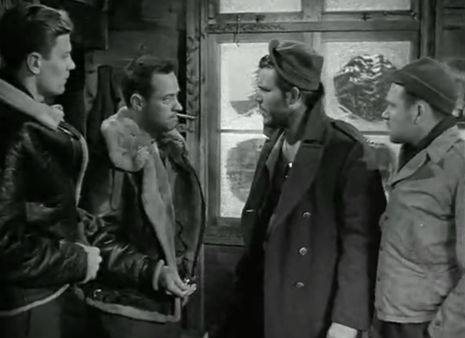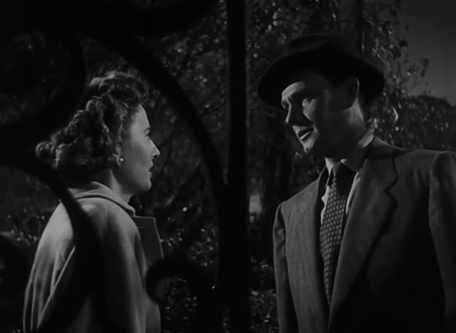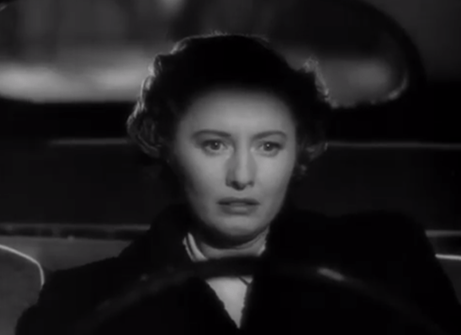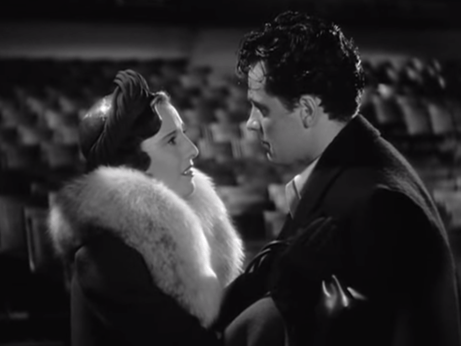
Executive Suite (1954)

executive suite 1.png

Executive Suite is a story of the high rise corporate jungle where on a daily basis it’s a Darwinian experiment not only pitting company against company but, on a microscale, man against man. After all, in the most cynical sense, that’s what free market capitalism is.

Top to bottom, the film boasts rich reservoirs of talent from sure-handed director Robert Wise and screenwriting newcomer Ernest Lehman who would soon be a hot commodity in the industry thanks to the likes of The Sweet Smell of Success (1957) and North by Northwest (1959).

It also proves to be an All-Star cast if there ever was one,  stacked with at least 10 easily recognizable names rounding out a lineup which could go toe-to-toe with any other drama of the decade on talent alone. Such a bevy of stars hearkens back to the golden years of MGM in the 1930s before television was ever a thing and they had as many stars as there were stars in the sky.

Today Executive Suite admittedly doesn’t get much coverage as a drama because, in spite of its vast ensemble, it’s not necessarily grandiose or vibrant, even compared to later Wise successes like West Side Story (1961) and The Sound of Music (1965). However, this in no way should downplay its striking qualities and there are some compelling ones.

Out of all the stylistic choices, one of the most noticeable ones and, subsequently, unusual decisions for the era is the absence of any form of traditional musical scoring. In this regard, we could say the scenes are not manipulated by any amount of sonorousness. What we see is making some claim at authenticity with street noise in lieu of diegetic sound and Chet Huntley introducing our narrative set in the upper echelons of a skyscraper.

Though a bit gimmicky by today’s standards, Wise does immediately catch our eyes with an extended POV shot taking on the perspective of an unseen big wig name Bulliard, the formidable head of Tredway Furniture Co. He’s coming back to town and has slated a meeting for that same evening, upon his return. Except something highly unsuspected happens. One might blame the taxing strain of his work but he winds up dropping dead in the street. Some scrounger conveniently picks up his discarded wallet, making any form of identification more difficult for the police.

The company is thrown into an uproar following his sudden and untimely death, especially because there is no true contingency plan as the deceased had no single, hand-picked second-in-command.

Nina Foch is the secretary managing a vast network of information, funneling down to all the executive suite. She is the runner between offices and boardrooms, relaying the information to all the necessary contacts as Bulliard’s right-hand assistant.
executive suite 2.png

They gather for their impromptu meeting. There’s Frederick Y. Alderson (Walter Pidgeon), a career man who has been by the side of his friend Mr. Bulliard for many, many years now. Loren Shaw (Frederic March) is a relatively new addition to the company but as chief controller and a shrewd numbers man; he’s been able to up the annual earnings at Tredway as of late.

J. Walter Dudley (Paul Douglas) is the charismatic head of sales who could talk anyone into buying just about anything. He’s that good. Of course, his dirty little secret is he’s been embroiled in an affair with his secretary (Shelley Winters).

The ambitious young family man Don Walling (William Holden) holds a more hands-on position in the factory, overseeing design and development while the old warhorse, Mr. Grimm (Dean Jagger), is in charge of manufacturing. However, with their product going down in quality to cut expenses, he’s got an idea to retire. He holds no pride in his work anymore.

Between all these men and the opportunistic snake-in-the-grass, George Caswell (Louis Calhern), we have the gathering of the top brass and quality acting talent. It’s a bountiful proposition getting all these people in a room together. And when the news breaks it’s essentially an exhibition of “who died and made you king” as the factions scramble into action, assembling to vie for some form of supremacy.

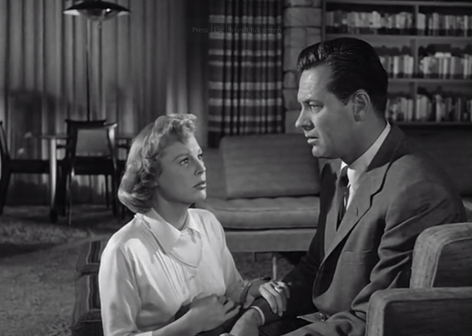
Shaw is the first man spurred into action in the wake of Bulliard’s death because though Alderson holds private aspirations, he resigns himself to acquiescence. But that doesn’t mean they’re going down without a fight. Walling plays the number games late at night trying to figure where everyone stands. He confides in his wife (June Allyson) and plays catch with his son but his work-life balance is suffering. His wife worries the instability will bury him professionally.

It’s true the names are continually interchanging thanks to dirty politics and a plethora of finagling, leveraging, and leaning to line everything up for the impending nominations session to be undertaken on a closed ballot.

executive suite 4.png

In a man’s world, it’s fitting that Barbara Stanwyck would be the only woman with any sway on the meeting of the mind’s thanks to her stock holdings in her father’s company, which Bulliard helped appreciate. She doesn’t have much screentime but her very financial capital makes her crucial to the picture as an unpredictable swing vote. Her wild card and some late arrivals obscure the resolution to the last possible instant in thrilling fashion.

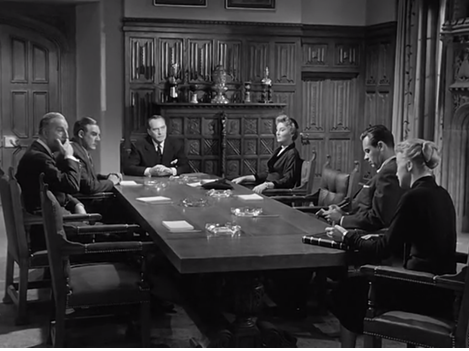
It’s true Henry Fonda was up for a part in the movie and that inkling gives me a rather obvious realization. Executive Suite does play like a bigger, loftier version of 12 Angry Men (1957). Especially in its most crucial minutes. Far be it from me to say people sitting around a boardroom table cannot be interesting because once more I was invested in what decision was arrived upon and I knew it took every one of those actors around that table to make it stick.

Someone has to rise to the occasion and that person is William Holden, positioned as the initially hesitant one, dismissed as still inexperienced, and yet he has a vision the others lack. He’s not a tired old man. He’s not driven solely by profits or bitter over past affronts.

He’s looking beyond to new territory and a future where the company can prosper not simply because of penny-pinching but an actual pride in the quality of the product they can offer their customers. If you wanted to make a sweeping statement, you could say he, even momentarily, redeems the American Dream, a symbol of the American everyman with his white picket fence, beautiful wife, and high ideals. That is until the next board meeting happens. But I would like to think he is capable as a leader for change. It’s true we need people like him in this world of ours.

4/5 Stars
Review: Stalag 17 (1953)

stalag 17.png

I grew up with Hogan’s Heroes reruns on our Magnavox analog television. In fact, at one point it was my favorite show because it had such a colorful cast, it was perennially entertaining and utterly goofy to the extreme. But others have understandably decried the show because they see it finding humor in something that is not very funny. They contend it was making light of the Holocaust and WWII on the whole. Although I do believe this is an oversimplification and I don’t have time to tackle it right now, it’s still an important dialogue to have. I will defer to others for the time being.

The point of discourse I want to take up is Billy Wilder’s Stalag 17 because it’s obvious there would be no Hogan’s Heroes without this P.O.W. comedy-drama. The plots, even the characterizations, are eerily similar, close enough to prompt plagiarism lawsuits. But the difference is Hogan functions as pure zaniness carried by the strength of its ensemble where the Germans are utter buffoons. That’s the hallmark of characters like Sergeant Schultz (John Banner) and Kommandant Klink (Werner Klemperer) who are both lovable imbeciles. They will never be allowed victory over Hogan and his allies.

In Wilder’s hands, a P.O.W. camp is silly and light-hearted at times, yes, but it’s also equally dark and cynical. Because what would a Wilder picture be without some pointed comic venom? Two obvious points of reference would have to be the wartime comedy directed by his idol Ernst Lubitsch, To Be or Not to Be (1942), which some would argue employs morbid humor. Then there’s Grande Illusion (1937) starring Erich von Stroheim (featured in Sunset Boulevard) as a prison camp commander who can easily be contrasted with Otto Preminger’s Colonel von Scherberg. In both, you have those evident counterpoints of humor and tragedy exquisitely executed.

Stalag 17′s opening escape attempt of two men is snuffed out by machine gun fire just waiting to mow them down. It’s the definition of unsentimental and it is the first of numerous breakdowns in communication. There is a rat somewhere. There has to be.

stalag 17 2.png

Then, the picture is back to its belly laughs supplied most obviously by Harry Shapiro (Harvey Lembeck) and his tubby, scruffy buddy Animal (Robert Strauss). They spearhead all of the shenanigans, including a daring attempt to break into the prison camp of Russian women to sneak a peek. You see, Animal’s deeply broken up by his unrequited love for Betty Grable. They bicker with the resident Sergeant Schultz (Sig Ruman), another Hogan’s Heroes precursor, who good-naturedly chortles at all their ribbing. Surely this isn’t anything like how Stalags actually operated?

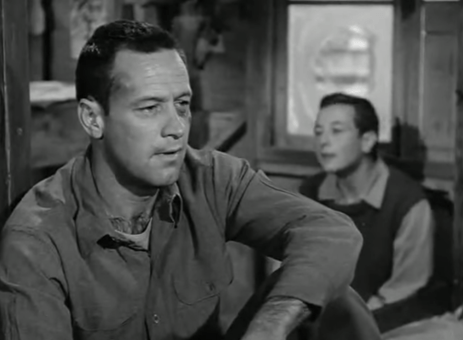
Wilder’s trademark biting wit is most fully realized in Sefton. For the part he was initially reluctant to take, William Holden donned a crew cut and scruff generally masking his normally dashing features. But this was hardly the aspect making him uneasy about the role.

Sefton is a textbook undesirable. He openly trades with the enemy in an effort to make himself as comfortable as possible. He bets a boatload of cigarettes the two fugitives won’t make it out of the camp and when it proves morbidly correct, he makes a killing.

Likewise, he’s the local wheeler-dealer, maintaining the Stalag 17 rat race turf complete with betting for all the servicemen. His other enterprises include a distillery — a flamethrower of sumptuous potato peel schnapps — and “The Observatory” where all the boys eagerly line up for a tantalizing look at the Russian delousing shack. Conveniently, he’s also the obvious culprit when a stoolie is suspected within their ranks.

It takes all kinds to liven up the joint and make it into a space with real drama to go along with so many lighter notes. We already mentioned Harry and Animal but the Barracks chief is the always reliable Hoffy (Richard Erdman), head of security is Peter Graves, Duke (Neville Brand) is the rough and tumble one who’s not squeamish about having a fist fight. There’s a blond brainiac, the catatonic one, the amputee who uses his spare space to sneak materials in and out of the barracks, and the nasally mailman with a voice to top all voices.

stalag 17 3.png

When a new prisoner named Dunbar (Don Taylor) gets brought in with his copilot (Jay Lawrence), who has a penchant for spot-on impersonations, they receive a hero’s welcome. After all, they helped to sabotage enemy armaments on their way to being captured. But the information leaks continue with their radio being confiscated and Dunbar being called in for questioning, due to his treacherous activities. The SS is coming to take him to Berlin for questioning. If he’s ever going to come out alive the P.O.W.s must make a last ditch effort to try and get him to safety.

Meanwhile, Sefton gets a going over by the whole barracks, which is quickly overshadowed by Christmas in the camp complete with carols, dancing, and parading full of gaiety. It’s meant to lull us into a false sense of security as Sefton is put in his place and things are good again. It all conveniently diverts from something else. Sefton’s not the culprit. Someone else has been communicating with the Germans and tipping them off.

The final confrontation is when the film really puts it all on the line. We find out who the perpetrator is and Sefton’s vindicated in everything, even going out as a kind of hero. Except to the bitter end, he’s never redeemed as a human being. He’s as hard-edged and acerbic as ever and yet to the folks at homes, he’s who will be cast a hero because he did something brave. Holden was uncomfortable with this as much as we are as an audience but Billy Wilder was unflinching and ultimately right in creating this dissonance.

If anything, Stalag 17 as realized by Billy Wilder and his team is a reminder of the harshness and utter absurdity of war. This is how he conceives it — a man who lost his parents to concentration camps and was sent over to his former land to help rebuild it. He probably knew as much as anyone how horrible the Nazi atrocities were but to memorialize every attribute of the Allies as noble would not document the whole truth.

If Sefton’s the poster boy of the war, then we have to take a deep hard look out our ideals and what we stand for. Because, of course, he was the only one not taken in. Everyone else was so quick to accuse him and to see what they wanted to. It’s almost as if a film documenting an aspect of WWII was in the same breathe suggesting what was afoot with the red scare in the rising fury of the Cold War. Heaven forbid a person we don’t like or don’t agree with is not so easy to demonize as “other.”

It’s far too scary to concede they’re probably just like us. They just didn’t have the decency to hide it. Perhaps they’re better because they were not swayed by the clouded judgment of others.

So if I watch Stalag 17 and become turned off by this incongruity between the historical setting, the lightness in tone, and the shock of a generally unsympathetic lead, maybe it says more about my conception of the world than anything wrong with Billy Wilder’s admittedly incisive picture. It’s a scary admission to make but it just might be true.

4.5/5 Stars

The File on Thelma Jordon (1950)

the file on thelma jordon

There is arguably no director who is, in retrospect, more important to the film movement that became classified as film noir than German emigre Robert Siodmak. His name isn’t quite as well known as the Billy Wilders or Fritz Langs necessarily but one can contend his influence on this style is without equal.

While not his greatest achievement, The File on Thelma Jordon is yet another example of the man’s proclivities for deliciously shadowy melodrama which, while not always plausible, is more often than not incessantly intriguing.

In this particular case, we are involved with a local district attorney (Wendell Corey). He is a man who loves his wife while not being too fond of her overbearing father. In fact, Cleve conveniently stays away from home whenever the in-laws are around. It’s certainly complicated his marital relationship as of late.

One such night he stays at the office to knock a few back only to cross paths with a Ms. Thelma Jordon (Barbara Stanwyck) who mistakes him for someone else as she recently inquired about protection for her paranoid aunt — a woman fearful of burglars. On the verge of a real bender, he invites her for a drink and they spend some time together. She’s just what he’s been looking for to fill the void in his life.

Meanwhile, his wife is going away with the kids for a summer at the beach house and he hates to see them leave; he really does. Maybe he knows deep down they are slowly drifting apart and his urges to see the other woman are all but insurmountable. He can’t fight it much longer. There used to be someone — an estranged one-time husband named Tony — but he’s purportedly no longer around. Cleve brushes him off and they keep seeing each other whenever possible.

But their relationship hits a dramatic turn one evening. She calls him up in the thick of night and he comes at her beck and call. They slink in the shadows as she breaks the news to him. Her aunt has been killed by an intruder; the old woman’s worst fears coming to fruition with priceless jewels being stolen from the safe.

The situation is complicated by a frantic Thelma who panicked by altering the crime scene and failing to call the police. Now the man across the road has his interest piqued and comes over to investigate. In the heat of the moment, they must hastily cover everything up as Cleve rushes out of the window and Thelma feigns sleep. It’s all part of an intense interlude coursing through the middle of the picture making the collective heart of the audience pulse with anxiety.

What follows is a murder inquest and then a trial with Ms. Jordon standing as the defendant. She’s got herself a stone-cold and exacting lawyer who could care less about her guilt or innocence. In his mind’s eye, she is innocent and that’s how he plans to win her case regardless.

Meanwhile, Cleve gets put in a very sticky and uncomfortable situation as he finds himself made the prosecuting attorney on the case. As the two sides try to legally sway the jury, the identity of a mysterious Mr. X still swirls around the case, and Cleve tries everything to throw the case in the most indirect ways possible. It’s a perilous balancing act where he will lose something regardless. Siodmak milks it for all its tension as the frenzied proceedings press on with the media jumping on it like ravenous wolves. Someone’s got to be a fall guy. Stay the course and you might be surprised in how the case resolves itself.

Wendell Corey could always be called on for steady and at times wry support but that being so, it’s refreshing to see him in a substantial leading role playing opposite a true professional. They work capably together as the story relies mostly on their two performances.

Barbara Stanwyck is great when she’s bad. Phyllis Dietrichson is the epitome of this fact, remaining one of the crowning achievements of her career. Though a lesser-known incarnation, Thelma Jordon is worthy of some notoriety in her own right.

However, the sublimeness of Stanwyck here is how she never really feels slimy or full of guile, even in the stages when the books are all but closed on her case and we get a fuller picture of who she is. The whole time we are kept constantly guessing and fluttering this way and that in indecision. More than once she surprises us.

The trick to a femme fatale like herself is never consciously deciding to be destructive. She’s doing what she personally believes to be right even if it’s due to a lapse in judgment or an impending sense of fear. I’m sure there was some greed in there too but we all harbor a little bit deep in our hearts somewhere.

So though it ends with a malaise that can only be film noir, there is some sense of rightness in the way everything goes down. It’s not to say there’s not a bite to the picture. When the file closes on Thelma Jordon two lives have been deeply affected forever with far-reaching repercussions. There’s no changing that.

3.5/5 Stars

No Man of Her Own (1950)

no man of her own 1

Helen Ferguson (Barbara Stanwyck) is slighted by her slimy boyfriend who ditches her for a blonde and the only thing he offers her in return is a train ticket out of town. What can she do but take it dejectedly with barely any money, 8-months pregnant, without any future at all? She’s in a lowly state. That is until she is befriended by the perky Patrice Harkness (Phyllis Thaxter) and her genial husband (Richard Denning), who quickly lift her spirits through their continual ebullience.

The first sign of melodrama comes with a horrible train crash that leaving both Harknesses dead but Helen survives waking up in a hospital to find that her baby was saved. Except there’s a catch and, mind you, it’s the pivot point on which the weight of the whole story balances. In the commotion-filled aftermath of the crash, Helen is mistaken for Patrice, the young wife her purported in-laws have never met before. Now she is in their home to be taken care of.

Of course, at first, Helen is scared. She has nowhere to turn and so she goes along with it as her baby for the moment has a roof over his head. As time progresses, she comes to grow deeply affectionate of Mr. and Mrs. Harkness. The kindly matriarch (Jane Cowl) is so taken with her new daughter-in-law it all but consoles her in the loss of her son. Meanwhile, her other boy Bill (John Lund) takes a deep liking for his sister-in-law and does everything to make her feel welcome in the foreign environment. You can tell he genuinely cares about her. It’s no act.

However, the film also explores themes that Alfred Hitchcock’s Strangers on The Train (1951) would traverse only a year later with strains of blackmail and the specters out of her past coming to ruin the life Helen has created for herself.

Her no-good ex is interested in what she has landed in and what he can get out of it. First, it’s money to keep her secret, then it’s marriage so that he can get in on her cut of the Harkness fortune if ever it comes her way. He’s a filthy parasite and she knows there’s only one conceivable way to be rid of him. You know if already: murder!

But far from getting tossed out by the Harknesses or being completely undone by Morley, Helen, Patrice, whatever you wish to call her, is able to salvage a life for herself because of compassionate folks who are willing to accept her no matter her background. They even get knee deep into her plight, even die for her. The extent of their kindness leaves her forever grateful and hopeful that some form of human love still remains possible for her. Even the prospects of a murder rap seem surmountable.

The ending has one of those final cherry-on-the-top-of-the-sundae resolutions allowing everything to tie together in a nice bow. Some people might find it silly but I rather liked it. It gives the storyline one ironic twist of fate perfectly suited for this turbulent strain of drama. The police are satisfied. Crime didn’t pay. Our romantic leads get to stay together. All is right with the world. After such bleak beginnings, it’s almost laughable.

Despite being an utterly preposterous conceit, Barbara Stanwyck rides it out with her usual measured commitment to her craft both sympathetic and to the degree possible, believable. In the latter half, she’s an absolutely pasty mess personifying a woman terrified about being found out in her lie and subsequently rejected by the ones she’s worked so hard to love.

Director Mitchell Leisen, though given his penchant for finely wrought romantic comedies and an eye for costumes and interiors, shows he is no less capable in this woman’s picture, keeping it afloat even as it cycles through all sorts of implausibilities. I was generally fond of John Lund in The Mating Season (1951) as well, though it’s true he’s all but overshadowed by his female costars in both movies. However, when the people in question are the caliber of Barbara Stanwyck, Gene Tierney, and Thelma Ritter it’s quite understandable.

3/5 Stars

Sorry, Wrong Number (1948)

sorry wrong number.png

“In the tangled networks of a great city, the telephone is the unseen link between a million lives…It is the servant of our common needs — the confidante of our inmost secrets…life and happiness wait upon its ring…and horror…and loneliness…and…death!!!” ~ Opening Prologue

Sorry, Wrong Number is a fairly unique adaptation in that it came into being from a radio play written by Lucille Fletcher, successfully realized for audiences as essentially a one-woman production by Agnes Moorehead — a fine actress in her own right. Director Anatole Litvak does an extraordinary job of making this film version tense and certainly cinematic, as it cannot function in the same ways as a radio show if it is to be similarly effective.

Like Rear Window (1954) or Wait Until Dark (1967), the suspense in the film comes with being constrained in a space with no way of escape from an impending intruder. It’s little surprise Barbara Stanwyck is divine offering her typically captivating performance even if, given her usual predispositions, she hardly fits the helpless wife archetype. Being the professional that she is, there’s no doubting the ferocity of emotion within her. To use a hopelessly corny pun, she hardly phones in her role as Mrs. Stevenson, the bedridden wife of a husband who just cannot seem to be located.

Though still young, Burt Lancaster brings the screen presence that made him a mainstay of early film noir. Still, he and Stanwyck somehow seem ill-paired as husband and wife. One could contend that works nicely into the plot as their marriage is essentially one-way, becoming increasingly loveless as more of the picture is revealed. She wants him and her daddy has the money to make the world spin. It’s not romance. It’s a business transaction.

So although Harry Stevenson (Lancaster) is initially going with another gal (Ann Richards), soon enough Leona’s got him. They get married and he gets a job working under the father-in-law but he feels his hands are tied with no real prospects of making anything of himself. He’s not content with this kind of lifestyle. He has ambitions of his own.

One might suspect he’s finally had enough and left his wife for good. Of course, part of the fun is that the story is pieced together through different characters recounting events, done through voiceover fragments. It becomes a kind of compulsory game we must play along with.

First, it’s Mr. Stevenson’s secretary who recounts the woman who came to his office with something urgent to talk about and it piques Mrs. Stevenson’s suspicions. Then, she gets in contact with the old flame named Sally Hunt Lord who is now happily married to a District Attorney. Nevertheless, she was worried that Henry might have been mixed in something awful, even tailing her husband and trying to get at her old beau to uncover what might be the matter. It’s all very mysterious.

Next Leona breaks up her Doctor’s (Wendell Corey) dinner engagement only to hear more of the story and how her husband kept the doctor’s prognosis from her. By this point, we’ve gotten in so deep that we have layered flashbacks. Only in noir, and we still have yet to stitch the entire convoluted mess together.

The last crucial figure is a specter of a caller named Waldo Evans who actually turns out to be a kindly old man caught up in the racket that Stevenson’s been promoting. The script doesn’t give us much to go on based on the restrictions of the production code but it has to do drug trafficking. That much is almost certain.

By this juncture, we’ve almost forgotten William Conrad was in the picture but he shows up right where you would expect him in the thick of something big. As she’s put through the ringer of psychological duress, trapped in her ominously vacant home, Stanwyck’s absolutely maxed out on the intensity.

Admittedly it does feel like two pictures told in tandem and spliced together. Stanwyck headlines what we might term the “woman’s drama” while her husband is embroiled in a shifty noir replete with the murky shadings of a criminal underworld. Of course, Lancaster is remembered for his early pictures like The Killers (1946), Brute Force (1947), and Criss Cross (1949) which share some nominal similarities.

Sorry, Wrong Number showcases an icy ending that was nearly unexpected for not only how abrupt it is but also how very unsentimental. To say more would give it away outright. Flaws readily acknowledged, Sorry, Wrong Number is a noir worth making time for as it builds tension to a fever pitch and obscures its hand behind minute after minute of methodical voiceover. When we’ve finally caught up with the events rumbling forward in real time, it’s too late to do anything and before we know it, everything’s already come to fruition. One might call that an adequate success in the storytelling department.

Due to its histrionics, the picture was ripe for parody. In fact, Barbara Stanwyck was featured on a segment of The Jack Benny Program in 1948 using extensive recordings from the film only to have Benny wind up in much the same mess. And of course, there’s Carl Reiner’s noir sendup/clip show starring Steve Martin, Dead Men Don’t Wear Plaid (1982). It’s all in good fun.

3.5/5 Stars

Golden Boy (1939)

Golden Boy (1939)

“See you in 1960. Maybe you’ll be someone by then. ” ~ Barbara Stanwyck 

At the Academy Awards in 1978, Bill Holden took a momentary aside to thank his co-presenter, Barbara Stanwyck, for her encouragement and support in helping to forge his career in its nascent stages. That picture they starred in together was, of course, Golden Boy.

By the late 30s, she was already a veteran actress in such saucy pre-code pictures as Baby Face (1933) and searing tearjerkers like Stella Dallas (1937). In an instance where fiction overlaps with reality, Holden played the scrawny newcomer. He could have just as easily been “baby face” in this film as a 21-year-old unknown bit player.

His Joe Bonaparte, a green kid and a newly-minted voice, has yet to mature into the smoky standard the moviegoing public would come to know as a handsome first-class flirt and sardonic wit.  Still, Stanwyck fought for him to stay and he did.

The film itself is thinly wrought and certainly has aged poorly with the passage of time. The simplistic dichotomy at its center begins with a young man who has an artistic gift as a violinist and his dear father (Lee J. Cobb) wants him to cultivate the talent. However, the boy has realized he has the tenacity to be a fighter and he gets a promoter (Adolph Menjou) to take him on so he can start making some dough. After all, it’s a practical means to give his family what they have always wanted.

What it teases out is the age-old dilemma between the allure of materialism and what will actually give you a far more contented life, in this case, love and the cultivation of talents which lend beauty to the world. Initially, Joe buys into the hype backed by a gangster (Joseph Calleia) but seeing another man die in the ring straightens out his priorities for good. Many boxing dramas are fatal. Thankfully for contemporary audiences, his is allowed a palatable happy ending.

Although this would happen to him more than once, because he’s rather good at it, Lee J. Cobb is nevertheless cast way out of his age range as an ethnic Italian father-type. It’s true that this one is an overtly stagy adaption from Clifford Odet’s famed play. His presence even inadvertently reflects the overlapping nature of theater and film of the period as he would precede the likes of Tennessee Williams, Arthur Miller, and William Inge who would all see their works made into movies.

Director Rouben Marmoulian himself had an extensive background in the theater and while the initial fight sequences fly by as montage blips throughout, the culmination in the final fight in Madison Square Garden has the atmospherics down like all the foremost boxing movies. He undoubtedly gets that right and this picture effectively precedes the frenzied reaction shots of the audience mesmerized by violence in Robert Wise’s The Set-Up (1949) by almost 10 years.

Stanwyck carries her scenes with that passionate, winning verve of hers and she propels Holden along with her taking the inexperienced, no-name actor and helping him get by. He’s no star at this point, except one day he would be. She had enough guts to fight for him and thanks in part to her, we were given one of the most remembered Hollywood stars, “Golden Holden.”

What most people wouldn’t give to have Barbara Stanwyck in their corner. It could be unsubstantiated hearsay but the story goes Holden was forever grateful, sending his costar a bouquet of flowers every year to commemorate Golden Boy and what it meant to his career. He knew it more than anyone.

But the story did not end there. In 1982 Barbara Stanwyck was bestowed with an honorary Oscar as the Academy had never found time to give her an award for her plethora of quality performances. Shame on them. That’s not the main point, however.

Her dear friend William Holden had just recently passed away months before and so while thanking the many people behind the camera who helped her in her career from directors to stunt personnel and electricians, she also said a final word for her friend. Her Golden Boy had always wanted for her to win an award and fittingly she finally did. She raised it up, teary-eyed, in his honor, before walking off. It’s human stories such as this that transcend Film. We are better for them.

3/5 Stars

Review: Night and The City (1950)

night and the city 1

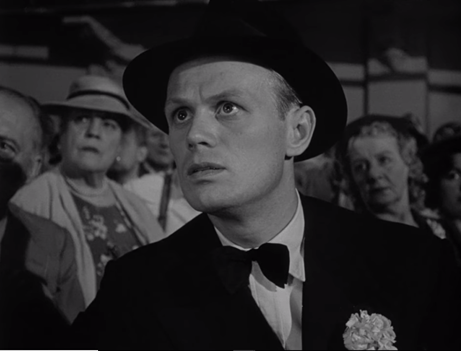
I’m not sure why but like Tommy Udo, the name Harry Fabian always stays with me when I think of Richard Widmark. One is the apex of sadistic evil and the other an archetypical noir hero met with utter calamity.

It’s true that for those who know a bit of the oeuvre of American director Jules Dassin, Night and the City might be perceived as a new rendition of The Naked City (1947). However, instead of New York, the suburban jungle of a thousand stories captured in documentary-like realism, we are given instead London, in all of its seedy glory, warts and all.

It’s fitting we meet Harry Fabian on the run from some unseen pursuer and whether someone is there or not hardly matters because that’s just Harry. The life he leads means he’s always in a jam with someone and always looking for the next big scheme to get him out of the doghouse. One might say he knows the dives of London like the back of his hand. He frequents them often trying to drum up business.

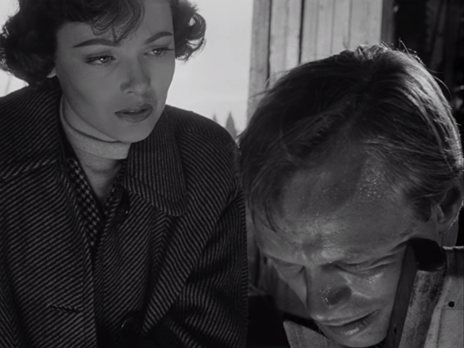
Because Harry is Widmark certainly at his most charismatic, an artist without an art and a constant idea man floundering in hot water every minute of the day. Like all such figures, he aspires to be something more than what he is. We’ve seen it many times before. For no conceivable rational reason except love, Mary (Gene Tierney), a nightclub singer, has remained faithfully by his side, despite all his flaky tendencies.

The mad chemist cooking upstairs also proves to be a pretty nice guy who cares deeply about Mary’s well-being. Especially since it seems that she is so easily tossed around by Harry. He doesn’t seem to care for her well. In fact, if we can cast it as such Harry is the Homme Fatale, even a slightly sympathetic one, while Adam (Hugh Marlowe) is his utter contrast in every way — the man who seems to have nothing but Mary’s goodwill in mind, even if he is in love with her too.

“The Silver Fox” is an underground tavern with some small consequence to the plot. Because you see, under the grubby hands of portly Phil Nosseross and his opportunistic and manipulative wife (Googie Withers), Harry works a hustle.  He drums up business like an all-purpose promoter, fishing around for unsuspecting out-of-towners and worming his way into their confidence. Meanwhile, Mary remains the main attraction with a floor show. They do quite well. Mary has scrimped and saved a great deal but Harry is still unsatisfied. It’s all small potatoes.

He’s waiting for the next great lightning rod of inspiration to strike and of all places, it comes at the fights. A big-time promoter (Herbert Lom) tells him to keep away because he’s already profiled Fabian as a no-good scrounger who cannot be trusted. He’s not wrong. However, Harrys a quick wit when he needs to be, instantly gaining the favor of formerly renowned wrestler Gregorius.

night and the city 2.png

Not only is he disillusioned with the way that modern wrestling bouts are fought, he also has a young pupil named Nikolai who he deems can take on any man. What makes his stamp of approval stick is the very fact the old man happens to be Kristos’s dearly beloved father. If Harry has this formidable ally in his corner he’s got it made.

Soon all the cash he can lay his greasy paws on is sunk in Fabian’s Promotions, even coaxing the boss’s conniving wife for a bankroll. He’s got his angle; he’s got his shield to help him shoulder his way into the wrestling game. It’s a cinch. But he’s also got everything riding on this endeavor because that’s his game. Go big and risk the chance of falling flat on his face.

So with Kristos all but threatening his life and a scorned husband pulling out his backing unless Harry can land The Strangler (Mike Mazursky), a competitor Gregorius has little taste for, that’s the end. The utter elation is Harry pulling a miracle out of his hat for the fight of a lifetime but just as easily the rug gets pulled from under him. Fate is a cruel taskmaster.

night and the city 4.png

Now a price sits on his head which essentially means he’s a dead duck. His dreams of success evaporate instantly. In the latter stages of the film, Widmark scrambles around London down all the back alleyways and abandoned brickyards he can. But everything he does seems futile. He has no friends with that much money at stake. The irony is that even Harrys last foolproof scheme doesn’t take when he pretends Mary is turning him over to Kristos for the cash. It wasn’t to be. For their love or for Harry. Noir is nothing without a heavy dose of fatalistic tragedy to become its ultimate undoing. Night and the City is little different.

As the story goes, Jules Dassin would be blacklisted during the production of the picture and therefore had no hand in the editing or scoring, at least to his liking. Thus, we have two distinct cuts. Otherwise, after a rough patch stricken by the Blacklist, he got back to work in France with the deeply revered Riffifi (1955). His career would have a second life all throughout Europe, yes, but for all intent and purposes, his days of hardboiled American noirs were over for good. All in all, he left behind a stellar body of work during the late 1940s. Night and the City remains a testament to a perennially underrated director.

4/5 Stars

Note: I watched the British version with a score by George Frankel opposed to a different American cut with slightly different footage and score by Franz Waxman.

5 Favorite Films of the 1950s: The B Sides

Just a day ago a whole slew of individuals shared their 5 Favorite Films of the 1950s for National Classic Movie Day. Thank you again to The Film & TV Cafe for spearheading that quality endeavor!

In retrospect, I realized all my choices were really “A Pictures,” which were difficult and yet at the same time fairly easy to choose. They were all no-brainer picks because I love them a great deal. Many others also chose the likes of Singin’ in The Rain, Roman Holiday, and Rear Window (for good reason, I might add).

However, the decisions that left me the most intrigued were, of course, the dark horses and the underappreciated gems. Certainly, you have to start somewhere when it comes to embarking on the classic movie journey, but half of the fun is unearthing treasures along the way. For instance, I was left charmed by the following picks, all wonderful films in their own right, that I would have never thought to choose:

People Will Talk, The Narrow Margin, The Earrings of Madame De…, It’s Always Fair WeatherThe Burmese Harp, and Night of the Demon, just to name a handful.

All of this to say, I was inspired by these folks to take on “Round 2” for my own edification. I’m going to leave my highly subjective list of “A Sides” behind for what I’ll term the “B Sides.” The only rule I’m going to place on myself is that this fresh set of picks must be what I deem to be “underrated movies.” Again, it’s a very subjective term, I know.

Regardless, here they are with only minor deliberation!

stars in my crown.png

Stars in My Crown (1950)

Jacques Tourneur is an unsung auteur and if all he had on his resume were Cat People (1942) and Out of The Past (1947), his would be quite the legacy. However, throughout the ’50s, he helmed a bevy of fabulous westerns and adventure pictures. I almost chose Wichita (1955), also starring Joel McCrea. In the end, this moving portrait of a frontier minister won out because it cultivates such a fine picture of how one is supposed to live in the midst of a bustling community of disparate individuals. This involves conflict, tension, tragedy, and ultimately, a great deal of human kindness.

the breaking point 1

The Breaking Point (1950)

Howard Hawks’s To Have and Have Not with Bogey and Bacall is probably more well-known but this version has merits of its own. Namely, a typically tenacious and compelling John Garfield playing a returning G.I. and family man trying to make a living in an unfeeling world. His wife portrayed by Phyllis Thaxter deserves a nod as well for her thoroughly honest effort. The movie gets bonus points for shooting in and around my old summer stomping grounds on Balboa Island.

bigger than life.png

Bigger Than Life (1956)

It does feel a bit like Nicholas Ray was the king of the 1950s. Rebel Without a Cause is the landmark thanks, in part, to James Dean. However, his best picture, on any given day, could be Johnny Guitar with Joan Crawford, On Dangerous Ground with Robert Ryan, or The Lusty Men with Robert Mitchum. Today I choose Bigger Than Life because James Mason gives, arguably, the performance of his career as a man turned maniacal by the effects of his new miracle drug, cortisone. It employs the same gorgeous Technicolor tones and Cinemascope Ray would become renowned for while also developing a truly terrifying portrait of 1950s suburbia.

ashesanddiamonds1

Ashes and Diamonds (1958)

I skipped James Dean’s most famous film, but never fear because in his place is a film featuring an actor who channeled the American icon’s angsty cool. In Andrzej Wajda’s Polish drama, set at the end of WWII, Zbigniew Cybulski embodies much of the same electric energy. His defining performance is central to a gripping tale about a country absolutely decimated by war, between German occupation and the ensuing columns of Russian soldiers arriving on their doorstep.

good morning.png

Good Morning (1959)

This might be my personal favorite of the Yasujiro Ozu’s films for its pure levity. The images are meticulously staged as per usual with glorious coloring. Every frame could easily be a painting. However, against this backdrop is a domestic story about two brothers who hope to wage a pouting war against their parents who won’t cave and buy them a TV like they want. The conceit is simple but the results are absolutely delightful.

Well, that just about wraps up my 5 supplemental picks…

Except I would be remiss if I didn’t share at least a handful of other outliers. Let me know what you think of the films I chose!

Honorable Mentions (in no particular order)

National Classic Movie Day Blogathon: 5 Favorite Films of the 1950s

Thank you Classic Film & TV Cafe for hosting this Blogathon!

Though it’s tantamount to utter absurdity to try and whittle all my personal favorites of the decade down to five choices (I might cheat a little), this is part of the fun of such lists, isn’t it? Each one is highly subjective. No two are the same. They change on whims; different today, tomorrow, and the next. But I will do the best to make a go of it.

If anything this is a humble beacon — a twinkling five-sided star — meant to shine a light upon my profound affinity for classic movies on this aptly conceived National Classic Movie Day. For those in need of gateway films, these are just a few I would recommend without deep analysis, solely following my most guttural feelings. Hopefully that is recommendation enough. Let the adulation begin!

Singin'_in_the_Rain_trailer

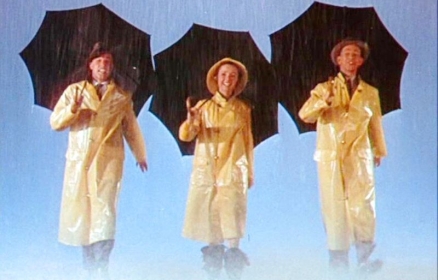
1. Singing In The Rain (1952):

Many classic film enthusiasts weren’t always so. At least, on many occasions, there was a demarcation point where the scales tipped and they became a little more frenzied in their pursuits. For someone like me, I didn’t always watch many movies. However, Gene Kelly, Donald O’Connor, and Debbie Reynolds were household names even from my earliest recollections.

Singin’ in the rain with the giddy abandon of Don and bringing down the house with gags like Cosmo were childhood aspirations. Kathy, the young hopeful, aspired for big dreams, not unlike my own. They were idols because they made life and the movies — even song and dance — so very euphoric. It took me many years to know this was a part of a musical cottage industry or who Cyd Charisse was (because we’d always fast-forward through that risque interlude). Regardless of anything else, the film effects me in the most revelatory way. You can barely put words to it. You need simply to experience it firsthand.

After seeing it so many times it becomes comforting to return again and again. What’s even better is how the magic never dies. We lost Stanley Donen this year but this extraordinary piece of entertainment will live on for generations to come.

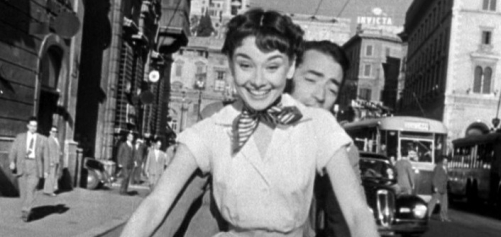
90a01-audrey_hepburn_and_gregory_peck_on_vespa_in_roman_holiday_trailer.jpg

2. Roman Holiday (1953)

I distinctly remember the first time I ever saw Roman Holiday. It was on an international flight to England. I was young and ignorant with not the slightest idea who Audrey Hepburn and Gregory Peck were. You can determine whether or not I was living under a rock or not. However, what did happen is a young kid was decisively swept off his feet by a film. Those were before the days I gave even a moderate consideration of directors like William Wyler, much less debated or bandied about terms like auteur.

What does become so evident is the chemistry between our stars, hardly manufactured, even as the setting, placed in living, breathing Rome, imbues a certain authentic vitality of its own. Vespa rides are exhilarating. The sites are still ones I want to see and haven’t. And of course, I’ve only grown in my esteem of both Audrey and Mr. Peck as I’ve gotten older.

It’s crazy to imagine my only point of reference for such a picture was Eddie Albert (having been bred on more than a few episodes of Green Acres). Any way you slice it, this is, in my book, the quintessential romantic comedy because it is part fairy tale and it comes with all the necessary trimmings, while still planting itself in the real world. I always exit the halls of the palace feeling rejuvenated. Each time it’s like experiencing wonderful memories anew.

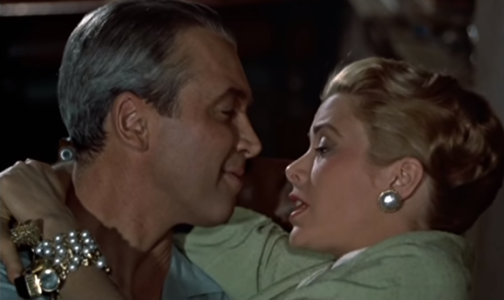
rear window 2

3. Rear Window (1954)

It’s a weighty task to even begin considering your favorite film but to make it easier on myself whenever the inevitable question is dropped in my lap, I’m quick to reply: Rear Window. The answer is actually quite an easy one. Alfred Hitchcock is as good a reason as any. Add James Stewart and Grace Kelly and you’ve entered the gold standard of movie talent. They don’t come more iconic.

The Master of Suspense’s chilling thriller was another fairly early viewing experience with me and it immediately left an impression. Again, it’s another example of how appreciation can mature over time. Thelma Ritter is always a favorite. The use of diegetic and non-diegetic sound throughout the picture accentuates this artificial but nevertheless meticulous sense of authenticity.

How Hitchcock utilizes the fragments of music and the supporting characters in the courtyard to comment on these secondary themes of romantic love playing against the central mystery is superb. It’s a perfect coalescing of so much quality in one compelling cinematic endeavor. Even down to how the opening and final scenes are cut perfectly, introducing the story and encapsulating the progression of character from beginning to end. It is pure visual cinema.

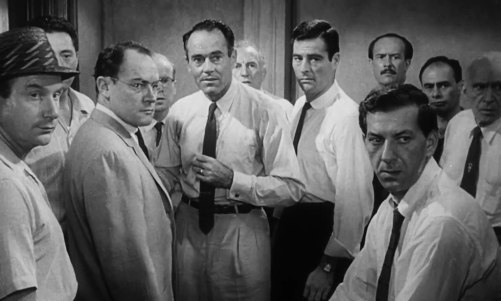
1024px-12_Angry_Men.jpg

4. 12 Angry Men (1957)

I care deeply about interpersonal relationships and as movies have become more a part of my life it has become increasingly more important for them to hold a microscope to how we interact with one another in the world at hand. For me, there are very few films that channel real human relationships in a meaningful way as effectively as Sidney Lumet’s debut 12 Angry Men. Like Rear Window, it is developed in limiting environs and yet rather than such constraints leading to the stagnation of a story, it only serves to ratchet the tension.

Because the ensemble is an impeccable range of stars spearheaded by Henry Fonda and balanced out by a wide array of talent including a pair of friends from my classic sitcom days John Fiedler (The Bob Newhart Show) and Jack Klugman (The Odd Couple). However, all of this is only important because the story has actual consequence. Here we have 12 men battling over the verdict on a young man’s life.

But as any conflict has the habit of doing, it brings out all the prejudices, inconsistencies, and blind spots uncovered and aggravated when people from varying points of views are thrust in a room together. it’s an enlightening and ultimately humbling experience for me every time because it challenges me to actively listen to where others are coming from and empathize with their point of view so we can dialogue on a sincere level. It’s also simultaneously a sobering analysis of the gravity of the American justice system.

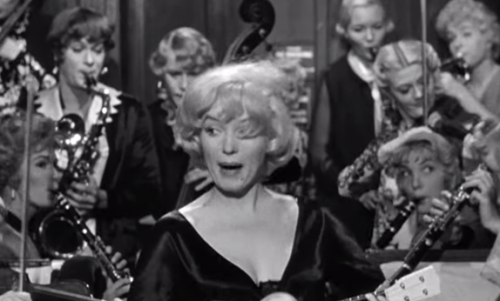
somelikeithot5

5. Some Like it Hot (1959)

I most recently saw Some Like it Hot as part of a retrospective across the globe from where I usually call home. But what a wonderful viewing experience it was. Again, it’s akin to getting back together with old friends. I personally love Jack Lemmon to death and paired with Tony Curtis and the incomparable Marilyn Monroe, you’d be hard-pressed to find a more hair-brained, raucous comedy coming out of Hollywood.

Billy Wilder is certainly one reason for this and I’ve always come to admire his ability for screwball and often mordant wit. There is arguably no higher watermark than Some Like it Hot and the script is wall-to-wall with hilarious gags and scenarios. Like all the great ones, you wait for a favorite line with expectancy only to be ambushed by another zinger you never found time to catch before.

But there is also a personal element to the picture. Many might know the Hotel Del Coronado in sunny San Diego filled in for the Florida coast and having spent many a lovely day on those very shores, I cannot help but get nostalgic. Not only was this film indicative of a different time — the jazz age by way of the 1950s — it also suggests a very different juncture in my own life. While I cannot have the time back I can look on those memories fondly just as I do with this film…

So there you have it. I gave it my best shot pulling from personal preference and the idealistic leanings of my heart of hearts. I hope you enjoyed my Top 5 from The ’50s!

But wait…


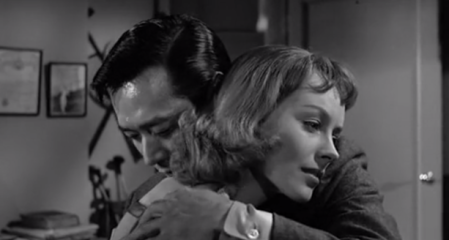
james shigeta and victoria shaw embracing in the crimson kimono

Honorary Inclusion: The Crimson Kimono (1959)

Full disclosure. I know this is cheating but I take any occasion I possibly can to promote Sam Fuller‘s gritty Little Tokyo police procedural. For me, it deserves a special acknowledgment. As a Japanese-American and coming from a multicultural background myself, it was a groundbreaking discovery and an unassuming film with a richness proving very resonant over the recent years. It blends elements so very near and dear to me. Namely, film noir and my own heritage — all wrapped up into one wonderful B-film package. Please give it a watch!

THE END

Review: Where The Sidewalk Ends (1950)

where the sidewalk ends 1.png

There’s something intriguing about the opening titles of Where The Sidewalk Ends thanks to a stripped-down quality ditching a conventional score for whistling and recognizable street noise as the credits come painted on the sidewalk. Feet trample over the names in the picture and we get a very concrete sense (apologies for the pun) of the environment we are about to be embroiled in.

This is a gutter noir that, along with the Asphalt Jungle (1950), deserves the title of one the most grungy, seedy, and therefore aptly named films noir of all time. The movie begins where the credits end quite obviously.

Otto Preminger is back together with his two stars from Laura (1944) and that picture proves to be a double-edged sword as his shining success but also the measuring stick all of his follow-ups would be held to. I’m not sure if any of them measured up but that’s beside the point. Where The Sidewalk Ends is an extremely gritty delight worth remembering in its own right.

The script by prolific Hollywood icon Ben Hecht knows all the beats well and delivers the action with an assured cause and effect hinging on our main character’s inner conflict. Detective Dixon (Dana Andrews) is a tough guy cop who has a history of indiscretion when it comes to running in criminals. He’s not always diplomatic and it gets him in hot water in the form of a demotion and a stern talking to from his superior.

In a crooked gambling joint, something else is going on entirely, with one man left for dead from an altercation. Soon enough, the police are on the site poking around. Later, Dixon out on the beat unwittingly lays a man out cold in self-defense. Regardless he knows what he’s in for. With steel-nerves, he takes on the mantle of the criminal in a lapse of judgment hiding the body and masquerading as another man because he knows the hit is already on and if found out this will sink him for good.

He spent his whole life trying to get out from under the shadow of his no-good dad and here he winds up, despite his best efforts, right back in the thick of it with guilt weighing on him. It’s easy to compare him with other analogous characters like Kirk Douglas in The Detective Story (1951) who had a similar chip on his shoulder that makes him absolutely merciless. Then, there’s Robert Ryan in On Dangerous Ground (1952) who gets chewed out for rough and tumble antics only for the film to leave the seedy world entirely behind.

In this case, Preminger never gives us an escape valve nor are we cooped in a police precinct. We are on the streets walking the beats and living the lives with the normal, average, everyday people. It’s more personal and real. This allows us to understand Dixon better and feel empathy for him. However, there’s little doubt that he’s in the wrong and will be implicated in the cover-up.

There is a slight reprieve as he meets Gene Tierney. Because despite her poor choice in men, she nonetheless gives the picture a much-needed edge of humanity. Momentarily, she makes Dixon and the audience forget what a fix he is in.

Likewise, Martha (Ruth Donnelly) at the local hole-in-the-wall restaurant is a riot. She and Dixon feign mutual distaste but you know she’s one of the few people in his corner and she hopes to see him settle down into a real life. Because his identity is always that of a cop. Strip that away from him and what do you have?

However, when Morgan’s loquacious father, a veteran cabbie, winds up getting the rap pinned on him, Dixon is truly faced with muddled moral lines he must untangle. Still, he doggedly goes after Scalise the man he knows was privy to one of the murders but not two. Dixon is well aware who is implicated in that one… He tries to champion the dad’s release by helping to hire a lawyer and trying to convince his newly instated superior (Karl Malden) otherwise. It’s to no avail.

A striking sequence comes in a very mundane moment utilizing traditional voiceover dialogue as Andrews reads off the contents of his confession to be read in case of his death. You see, he’s about to go after Scalise single-handedly and hopes to get a bullet in the stomach to maintain his image in life. It’s his last chance at a blaze of glory. But as he writes out the note there is a palpable bitterness in his words that you can almost taste. Tierney is in the same room like a sleeping angel, laid out on the nearby sofa.

Maybe it’s a run-of-the-mill scene in the midst of a film blessed by Otto Preminger’s eye for camera setups and the like, but Andrews reading nevertheless got to me. Maybe we can partially chalk it up to Hecht’s veteran quill laden with regret, but someone also had to deliver the lines.

It very much serves as a personification of who he is an actor — always playing tough ever tortured heroes who must grapple with their flaws in an ultimate effort to do good in a jading world. I’m sure others could have filled the part and done it well but I admire Andrews here with his perpetually grim mug and cynicism. No one could do it exactly like he was able to.

As much as I enjoy Gene Tierney’s glowing countenance, there’s not all that much for her to do except be concerned and dote, though she does admittedly stir our rogue cop to action. Even with a very sobering ending verging on the fatalistic, one could argue there is a silver lining because, if nothing else, Dixon’s morality has been upheld. His conscience to this end proves he’s not his father’s son.

We don’t know what the future holds for him and yet he can hold his head up high. Because the streets of noir are perennially a battleground between light and dark not only visually but morally as well. It’s this very struggle at the core of the film and subsequently within Dixon. The good inside him is able to prevail.

4/5 Stars