Kiss Me, Stupid (1964)

KissMeStupidPosterWhile a less heralded picture, this Billy Wilder film is a minor classic built around a contrived comedic situation. Dean Martin opens playing a parodied version of himself as Dino the boozing, womanizing, but altogether good-natured playboy who makes a short pit stop in the gas station of the small town of Climax, Nevada following his latest Las Vegas circuit.
The beauty of his performance, though it may be exaggerated, there is no sense that this is a thinly veiled caricature. It’s blatantly obvious that “Dino” as he is called in the film is really only playing his “Rat Pack” persona that was known the world over.

That sets the groundwork for the film’s self-reflexive nature that is keenly aware of its cultural moment and the preoccupations of the general public as with many of Wilder and I.A.L. Diamond’s best scripts.

Truthfully I’ve always been fond of Ray Walston ever since my first viewing of My Favorite Martian and before this picture, he cropped up in Billy Wilder’s The Apartment (1960). Although I do adore Peter Sellers (who had to bow out due to a heart attack) and he’s often an ad-libbing genius, somehow Walston seems to more aptly fit the bill here.

That doesn’t mean I don’t regret that Jack Lemmon couldn’t take the role because he really was Billy Wilder’s greatest comedic counterpart, portraying every bit of neuroses that manifests itself in the middle-class everyman. He just gets it and putting him opposite his real-life wife in Felicia Farr would have been another delightful ironic layer to this comedy with its roots in infidelity.

No matter. It was not to be and what we are left with is still some fairly hefty star power. Walston audaciously takes center stage as Orville Spooner, a small town piano teacher with a paranoid fit of jealousy in relation to his gorgeous wife (Felicia Farr). He believes everyone from his teenage pupil to the local milkman is out to pluck his bright-eyed, loving bride away from him.

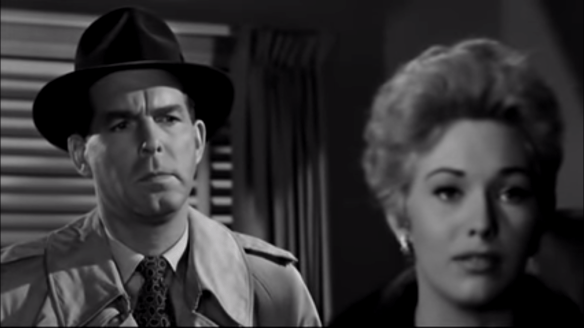
That’s of the utmost importance when his buddy (Cliff Osmond) dreams up a plan to get themselves a contract deal with Dino. It involves hosting the conveniently laid up pop singer, getting rid of Orville’s wife, and employing the services of one of the main attractions at the local watering hole The Belly Button — the one and only Polly the Pistol (Kim Novak). It seems simple enough to get her to masquerade as Orville’s wife just for the evening so she can make Dino feel at home.

You can see already that the narrative is entangled with bits and pieces of The Apartment (1960) and The Seven Year Itch (1957). Miscommunication and four parties involved means all sorts of foreseeable consequences. Kiss Me, Stupid is also fully aware of the contemporary Hollywood framework much in the same way of Sunset Blvd. Thus, it’s not above satirizing the ways of the entertainment industry — especially the movie stars — with the Rat Pack placed front and center thanks to Martin.

The small-time piano man and gas station attendant also have dreams of being the next Henry Mancini & Johnny Mercer dynamic duo with aspirations for The Ed Sullivan Show no doubt.

Even in its throwaway lines about churchgoers, there’s something starkly sobering being acknowledged as there are in many of the things that Wilder finds time to take a jab at. The owner of the Belly Button, Big Bertha, has all her girls attend the local church because she thinks it’s good for public relations.

It passes like a blip but the suggestion seems to be that these lines of dialogue and what we see on screen might point out some kind of hypocrisy and although it’s played for comedy, instead what I see is the inherent brokenness.

The film spins in such a way that the infidelity somehow ends in a kind of loving understanding that feels like utter absurdity but maybe Wilder has done that on purpose. Still, in spite of myself, I found some humor in this film in ways that I never could in The Seven Year Itch or The Apartment.

The first was too empty with little to offer of substance and the second is often too stark and morose to be funny. This film is raucous and utterly insane in a sense but that’s the way Wilder likes it from Some Like it Hot (1959) to One, Two, Three (1961). Kiss Me Stupid isn’t such a spectacular comedy with some misfires but there’s no doubt that Wilder still has his stuff.

He always seemed to take a very basic concept that was wacky and far from allowing it to fizzle out, he sees it to completion, finding an ending that derives laughs while simultaneously providing wry commentary.

In another screenwriter’s hands or another director for that matter, the romantic comedy aspects would be endangered of becoming trite and uninspired but no such issue here. Wilder would never allow it.

The punchline of Kiss Me, Stupid is that both spouses were deceptive and unfaithful but they do it out of love — that final touch of trenchant Wilder wit. Ultimately, the film’s title is reminiscent of the famed quip in The Apartment (1960), “Shut up and deal.” You get the same sense of the relationship.

The men are essentially cads — spineless at times — and lacking much of a moral makeup (even if Orville plays the organ at church) but their women seem to give them some substance whether they be barmaids or plucky housewives. It’s still slightly mindboggling that Wilder pulled this movie off and got away with it no less.

3.5/5 Stars

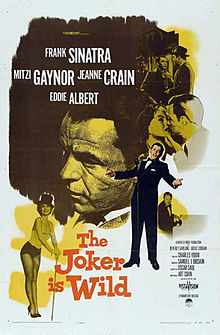
The Joker is Wild (1957)

Jokerwild.jpgIt required quite the journey to make it to this film, starting out with a different joker entirely. My introduction to comedian Joe E. Lewis happened because of the late, great Jerry Lewis. Revisiting his life and work I made the discovery that the comedian changed his name to avoid confusion with two men. First, Joe Louis the stellar boxer of the 1930s and then Joe E. Lewis the comedian.
I had never heard of the latter and if you’re in the same boat, here is a biopic that gives a little more definition to his life and times. It seems desirable to actually turn back the clock and see footage of the man himself but if anyone has to play him why not have Frank Sinatra and he does a fine job with a performance that finds time to crack the jokes, throw back a few tunes, while still revealing the inner demons that befall even a funny man. Yet again Ol’ Blue Eyes proves he’s an acting talent to be taken seriously.

Lewis’s beginnings were nearly tragic as he found himself under attack by one of Al Capone’s enforcers who slit his vocal chords and left him for dead after he walked out of his current contract to sing at another club. Except he fought back and even with a shaky voice he found his way to burlesque shows and then stand-up comedy followed.

All the while he was supported by his piano accompanist and best friend (Eddie Albert) and even finds time for love or rather it comes to find him in the form of Jeanne Crain. However, with obligations in serving the troops and his own insistence that a marriage would never work, he balks at popping the question only to regret it for years to come.

Soon his alcohol problem is even more of an issue — even affecting his work — and the marriage he got into with one of his precocious chorus girls (Mitzi Gaynor) was doomed to fail from the beginning.  The self-destructive tendencies seem present in this life as they often are for those in entertainment. And far from rewriting the ending to his story, we leave Brown in a very real state. He’s no longer married and he’s still trying to break his habit for the sauce. It’s a very honest place to be and that’s to the film’s credit.

I will forever be a pushover for Jeanne Crain who always plays the most charming romantic roles and here it is little different. Though she’s older, her beauty is still as striking as ever. Furthermore, Mitzi Gaynor slightly subverts her reputation here delivering in a couple of scenes that aren’t simply song and dance showcases.

Meanwhile, Eddie Albert just might be the greatest second banana known to man because he instantly makes his star all the more lovable acting as their faithful foil in all circumstances. He was just so phenomenal in those types of roles building something out of almost nothing.

There’s little left to do but let the lyrics of All the Way carry us away into to the evening with a bit of melancholy:

When somebody needs you
It’s no good unless he needs you all the way
Through the good or lean years
And for all the in-between years come what may

Who knows where the road will lead us
Only a fool would say
But if you’ll let me love you
It’s for sure I’m gonna love you all the way all the way 

3.5/5 Stars

Arrival (2016)

arrival.png

Abbott and Costello can be placed with the most revered comic duos of the 20th century and their greatest skit revolved around a terrible miscommunication. The bit, of course, is “Who’s on First.” Whereas the “failure to communicate” found in Cool Hand Luke (1967) has more to do with our human tendency toward stubbornness and rebellion, it’s just as likely that we just don’t understand each other semantically speaking. The results can be comedic like Abbott and Costello demonstrated or they can be dire as exhibited in Arrival.

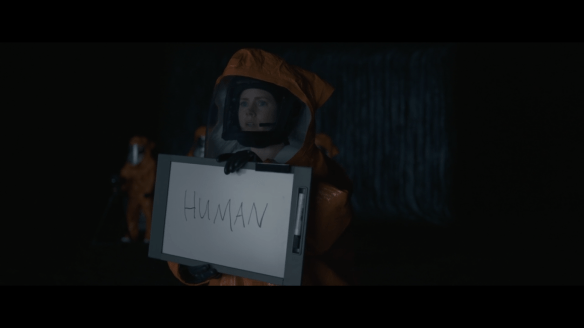
It was only later that I realized that far from being a pair of human, cultural pet names, bestowing the two aliens in this film these monikers came with a deeper resonance. There’s this recognition that hinges on the lack of an ability to communicate. What devolves is a thoroughly cognizant exploration of such dilemmas packed into a sci-fi thriller.

Imagine, there can actually be an intelligent sci-fi film about intelligent life. The themes that stood out to me concern themselves with our articulation of time and space which are also so thoroughly interlinked with language. When we actually look at the components that Denis Villeneuve has joined, we have a thoughtful effort that takes us through the minutiae of language and the mechanics of communicating with foreign life forms starting from scratch. The tension comes in not being able to decipher if they are friend or foe. Because any extraterrestrial life always delivers an element of surprise and a fear of the unknown.

Louise Banks (Amy Adams) is a linguistic expert and college professor who is quickly called upon by the U.S. government’s Colonel Webber (Forrest Whitaker) to examine an alien capsule that has landed in Montana. It is 1 of 12 such units discovered all over the earth. Banks is joined by physicist Ian Donnelly (Jeremy Renner) as they attempt to create a line of communication between the two heptapods they come in contact with. Ian is the one to nickname them Abbott and Costello.

What begins is a tedious process to form some sort of mutual understanding using the very building blocks of linguistics. It leads to an incremental understanding of creatures who compose their language not moment by moment but simultaneously, front to back, in a perfect cohesive composition. The goal is to get to a point where they can be asked what their purpose on earth is. Of course, that will take time and with time comes increased anxiety.

Far from being a singular endeavor, since 12 different pods have emerged, it’s an ongoing ordeal involving the entire world which adds a more complex dimension to it all. It’s not simply about navigating relations with these unidentified life forms but also coping with other countries with different ways of dealing with this tenuous situation. Not everyone is on the same page and as is often the case, fear drives action more than rationality.

Still, this paves the way for revelations and eureka moments that bend the ways we perceive the world through language and time whether linear or nonlinear. The implications are many. Because Film has often been a medium to manipulate, constrain, and contort time. But what if our very lives were defined by a different set of parameters as put in place by our very basic forms of communication? Life envisioned from start to finish. Palindromes endowed with a rich lode of meaning they never seemed to have before.

Arrival belongs to a hopeful strain of science fiction explorations that seems to look at the outer reaches of the galaxy with expectancy instead of trepidation. Instead of isolationism toward the universe at large, there’s an ardor to know what it might teach us. Instead of recoiling in fear, other life forms become helpers, not hinderers. The same could be said for the small-scale world. Progress is made when we hold onto altruistic intentions. Tools become far more vital than weapons. Everyone can thrive.

So often aliens and other lifeforms were forever depicted as horrible and dangerous beings that have come to decimate us. But rather like its forefather, Close Encounters of The Third Kind (1977), Arrival seems to be more sympathetic to any life that might be out there. Ironically, by making them more human we begin to see the flaws in our own society. We are very often fearful, petty people. But we can also be capable of great expressions of love with global impact.

The film’s cinematography is marked by a distinctive washed-out palette that cloaks everyone. It’s composed of a foggy haze that far from just defining a corner of the earth seems to be emblematic of the entire world. And yet such a dour world with obscured contours is surprisingly hopeful as discovery burgeons up through its core. Because if the world around us is murky that simply means that the light is put in sharper relief. Arrival proves to be satisfying to the very last iota.

4/5 Stars

The Man with The Golden Arm (1955)

220px-The_Man_with_the_Golden_Arm_poster

Everybody’s habitual something ~ Kim Novak as Molly

Otto Preminger was the creator of a number of important “issue pictures” because he dared deal with themes that others had shied away from, mostly in part because of the production codes that ruled Hollywood well into the 1960s. Thus, any type of drug addiction was seemingly out of the question.

Such an issue might seem almost unthinkable in this day and age but that very fact is one of the reasons that The Man with the Golden Arm still maintains some resonance. Perhaps it has aged some and looks tame by today’s standards, a film that hardly dares to mention the drug in question, and yet there is much to be enjoyed all the same.

Saul Bass’s opening titles for one made the credit sequences of a film into an important attraction and he did much the same for Alfred Hitchcock and other Preminger films as well. The film is also laced with what might be best termed as sleazy jazz music to underscore the world that Frankie Machine (Frank Sinatra) returns to.

Before a word of dialogue is even spoken in the local dive we already have a pulse on what kind of place this is. It’s the type of world that sucks the life out of you. People lead you astray and if you’re not able to make something of yourself you’re bound to sink into the pits.

He is just off a stint in the State Penitentiary but unlike many, his story has a touch of hope. He’s gotten the monkey off his back as they say. He’s no longer addicted thanks to the help of a doctor who also tried to line up a job for him as a drummer. It looks like he has some talent that can take him places. He’s got a lifeline out of town.

His return is a heralded one. Everyone’s intent on welcoming him back including first-rate scrounger Sparrow (Arnold Stang) as well as the pudgy local card shark Schwiefka and the “dealer” Nifty Louie. He’s very much the devil on Frankie’s shoulder coaxing him to give him a call if he ever needs a fix of candy because he used to be a great customer.

Meanwhile, Charlie’s wheelchair-bound wife Zosh (Eleanor Parker) is constantly paranoid about his purported unfaithfulness and simultaneously quells any of his aspirations to make anything more of his life. She’s just a scared little person and her fear stifles Machine even as he tries to make her understand that things are different now.

The one person who does seem to understand him is his old flame Molly (Kim Novak) who is currently a hostess at the local club. He remains faithful to Zosh and yet it is the friendship with another woman that gives him the encouragement to pursue this new path.

Yet the film soon delves into the depths of addiction. As often rings true, after you think you’ve got addiction beat (any kind), it comes back with raging abandon and it goes for the choke hold. A bad break and the plethora of undesirable influences are leading Machine down the well-trod paths of old. He initially gives in and yet still battles and fights and shakes his way back to sobriety. But it’s not easy. The only place he has to turn is Molly and she gladly gives him her support.

All in all, this is a fairly unflinching portrait for the time and this picture points to the fact that Frank Sinatra was a serious actor, not simply a singer, a personality, or a star. Here he offers up an honest to goodness performance though his career was ripe with many others. Still, this one encapsulates the tortured cycles of those trapped in the throes of addiction.

Meanwhile, Kim Novak’s performance flows with a sincerity — a woman who is willing to do what is good and right even when it is difficult and seemingly offers very little recompense. It’s a stirring turn indeed.

The histrionics of Eleanor Parker are maybe a bit much and yet in this performance, you begin to see why she is hardly remembered along with other classical beauties. It’s because she actually wanted to be an actress first and a star second and thus, instead of projecting a certain image in all her pictures, it does seem like she’s constantly changing and stretching our expectations of her. Today her choices look quite audacious and yet it no doubt left her contemporary audiences a little befuddled. That in no way detracts from her efforts here if only to magnify our appreciation for Sinatra and Novak’s characters.

Rather than simply seeing this as an antiquated issue picture, a film made for a different era and for a different person than me, I would like to say that there is something of note in The Man with the Golden Arm. As Molly so lucidly acknowledges, many of us go through some type of cycle or we succumb to some habitual pattern whether it be an addiction or something less extreme. Still, either way, these very things can detract from our lives and trap us in rhythms of life that hinder our relationships and all that is truly paramount. That’s just a small caveat to take heed of.

3.5/5 Stars

Hollywood Canteen (1944)

hollywood canteen 1.png

This propaganda extravaganza showcases Hollywood in all its glory from the Brown Derby to the Hollywoodland sign and of course the pride and joy of wartime morale-boosting, the Hollywood Canteen.  It’s a bit of a faux reality, Hollywood’s rendition of what real life might actually be like since the Hollywood Canteen did in fact exist.

Historically, it began as an effort by John Garfield and Bette Davis of all people to support the troops and give them quality entertainment from the entertainment capital of the world. Though newsreel footage might serve as a better historical marker (albeit still biased), there’s no questioning the patriotic waves flooding through this picture.

True, even in this film there are anecdotes that point to a slightly different reality. Namely the fact that this was meant to be a Hollywood wide endeavor but all other studios balked and so the lineup is filled out by Warner Bros. catalog of stars and them alone.

Furthermore, it’s easy to surmise that far from being overcome by patriotic fervor, Joan Crawford probably took her role because the alphabetical billing conveniently put her above a couple perennial rivals in Bette Davis and Barbara Stanwyck.

Even with its authenticity in question, there’s no doubt that the film boasts talent. There’s an inexhaustible array of song & dance from the likes of the Andrew Sisters, Roy Rogers (with Trigger) and Jimmy Dorsey.  The stars also come out in full force with cameos from everyone conceivably under contract to Warner Bros from Kitty Carlisle, Jack Carson, Joe E. Brown, Ida Lupino, Jack Benny, and of course Peter Lorre and Sidney Greenstreet staying in character. Each one provides enough star power to fill in the idle moments around our main love story.

Still, there’s no doubt that Joan Leslie was one of America’s sweethearts and it’s no coincidence that our protagonist falls head over heels for her all the way in the South Pacific. The pair of lovebirds represents all that is seemingly good and upright about American ideals even if she is a movie star and he is only a common soldier.

That makes the prospect of actually meeting her beyond his wildest dreams, but Hollywood purportedly is in the dream making business and so Slim gets his wishes granted. A date with his dream girl is soon arranged by those tactful matchmakers Davis and Garfield.

Robert Hutton is almost uncannily reminiscent of Jimmy Stewart who was at the time leading bombing raids over Germany. It seems little coincidence that he would then land the crucial role as the universal soldier Slim — a man who saw his share of action and is home for a short spell — before heading out on his next tour of duty.

He represents all the boys fighting for not just the Red, White, and Blue but every color and creed. In his very starry-eyed and candid way, he mentions each one as the camera picks each out of the crowd. Curious the only group not mentioned were members of the Japanese-American infantry. Yet another incongruity with the world at large. But the red carpet that is rolled out for him at the Hollywood Canteen is meant to be only a small recompense for all his service to his country.

Delmer Daves’s picture much like Stage Door Canteen (1943) fits the realm of saccharine propaganda, even blatantly so, but if you allow yourself to be carried away by the historical moment it has its certain charms.

True, the Home Front or the Allied cause isn’t quite as unified and squeaky clean as it claims to be just as humanity on the whole and the stars behind Hollywood rarely could hold up to scrutiny. However, there’s still something here that can make you smile. Publicity stunt or not. Maybe it’s the romantic in me that likes to believe there’s at least a kernel of truth in here and if nothing else there’s honest to goodness sincerity.

3.5/5 Stars

Caged (1950)

caged 1.png

Caged proves to be a stark, even uncompromising picture for the 1950s. Director John Cromwell had a long career in Hollywood, helmed some quality film noir, and became a subsequent casualty of the Blacklist, but this just might be his finest effort.

Furthermore, despite being an actress of some acclaim, I must admit that even I forget about Eleanor Parker aside from her well-remembered appearance in The Sound of Music (1965). But if Caged is any indication, she is most certainly worthy of more credit. She freely channels a bit of the flustered timidity of Joan Fontaine early on only to transform into a completely different person entirely.

It’s a film that dances on the complete opposite spectrum of George Cukor’s The Women (1939) another film that is dominated by the lives of female characters. In that case, the narrative is preoccupied with the intricacies of their frivolous catty ways and malicious gossip. Caged has not even a pretense for laughter.

Likewise, the scenes of incarceration bring to mind images of  The Snake Pit (1946) and Shock Corridor (1964) but even those films were about mental illness and the lack of quality care, not so much the abominable corruption that begins to coalesce within prison walls.

Marie Allen (Eleanor Parker) is one of the first-time offenders who comes in with the new batch of prisoners. At only 19 years of age, she seems like no more than a girl and yet she’s already been married, had her husband fatally killed during a bank robbery, is pregnant with a child, and has an accessory rap pinned on her. That’s how Marie got where she is even if she doesn’t seem meant for such a hardened life.

Agnes Moorehead delivers one of her most sympathetic performances as a champion of rehabilitation who unfortunately is fighting a losing battle against the system as we soon see.

Some might remember the imposing Hope Emerson from Cry of the City (1947) but she leaves an even more indelible mark on this picture as the ever-necessary sadistic prison guard — an individual who sees little worth in her inmates — believing them to be animals to be treated as such. She is indicative of the institution as the cog that lays down the law and narrowly believes that there is no worth left in these women. They’re trash.

When everyone thinks that it becomes a bit of a self-fulfilling prophecy. And in time as she comes up for parole and then has it spit back in her face, the changes begin to show in Marie’s face. It’s hardened. Her voice is tougher. She’s more defiant.

Andy Dufresne in Shawshank Redemption (1994) was another character with unfortunate circumstances but he maintained his humanity in a dank place. You either get busy living or get busy dying. Yet being an impressionable girl Marie takes to heart the words of her veteran prison mates, “You get tough or you get killed.”

Maybe Caged outcome is easy to read and it ultimately succumbs to melodrama but there’s still something unnerving about the film on the whole with its overarching unsentimentality.

When I saw the name of famed composer Max Steiner as part of the production that was a tip-off but Caged rather audaciously functions in many sequences without any scoring and that lends to the overall sense of realism that pulses through this prison noir.

The utter irony is that the notes of “Rock of Ages” can be heard wafting through the corridors as Marie prepares for her final parole hearing and she makes it this time. But by now there seems little chance for redemption. She is intent on calling her own shots and not about to rely on anyone else. She’s gone beyond clinging and seeking shelter from the world around her. She doesn’t seem to need anyone. She’s become part of that world. The before and after are startling. They make for a harsh indictment of a flawed prison system.

4/5 Stars


Battle of the Sexes (2017)

Battle_of_the_Sexes_(film).pngEmma Stone portraying Billie Jean King was an idea that I had never entertained before but there’s a certain resilience to her coupled with that winsome go-getter attitude which shines through her brunette locks and iconic frames. Simultaneously Steve Carell feels like just about the perfect person to embody Bobby Riggs a man I know very little about thanks only to hearsay and one caricature of a performance on The Odd Couple. Admittedly that’s not a lot to go on but Carell’s comedic background does it justice.

However, despite enjoying Battle of the Sexes thanks to its leads and it’s subject matter, there’s still something inside of me that can’t help but desire a documentary instead. Because it’s one thing for a film to graft in references to the cultural moment and quite another to be a cultural phenomenon in itself.

The Battle of The Sexes between Billy Jean King and Bobby Riggs was that type of event being televised and publicized like nothing before it in professional tennis. In the film, we have moments like Howard Cosell delivering coverage with Natalie Morales edited in. The lines between the real and the fictitious are so closely tied together.

It’s all so well documented. Billie Jean King is still with us and it seems more ripe for documentation than a dramatized biopic because with such a project there’s a questioning of how the story is being framed. Have certain things been repurposed or reimagined or are the majority of the facts delivered to us as they originally were?

For instance, it’s easy to read the relationship of Billie Jean King and Margaret Court through the lens of the present day and where they fall across the social spectrum now. Would that have been so cut and dry in 1973? I don’t know.

However, what is undeniable are the statements made by the likes of Rosie Grier and Ricardo Montalban commenting on the match. Those things particularly interested me because the words were pulled directly from the moment they came out of. They are as close to reality as we can get.

As a young boy, I had enough wherewithal to know about this event but the gravity of the moment never hit me until years later because I could not quite comprehend why it mattered. It was just one of the greatest tennis players in the world facing off against some old guy who used to play tennis.

Perhaps that might be selling Bobby Riggs a bit short because though he was in his 50s, he was already a member of the tennis hall of fame and won quite a few majors in his prime. But that completely misses the point of the argument.

As put so crucially by Billie Jean in the film, she was never trying to prove that women were better at tennis than men or even equals necessarily. What she was trying to show was that they deserved the serious respect and attention paid their male counterparts.

Because the inequality of pay alone seemed ludicrous given the number of ticket sales for both circuits. Billie Jean King had pioneered a new Woman’s Tennis League in protest only to be pushed out of the Lawn Tennis Association for those very reasons. The old guard represented by Jack Kramer was not yet ready to concede women’s tennis as a major draw and Billie Jean and the rest of her contemporaries were fighting up an uphill battle. They needed a major victory to turn the tides.

The stage had been set with Court, another preeminent star, getting fairly trounced by Riggs on Mother’s Day. It all but confirmed Riggs continued assertion that men were the dominant sex.

You could make the case that Billie Jean King was hardly just doing battle against Riggs because he was simply a gambler, a showman, and a clown who made the event into a media circus. It was the majority that sided with him that she was after. The men who would never concede that women deserved to be thought of in more multidimensional terms than housewives and marital companions. They could play tennis too and play it well.

So in its most gratifying moments, Battle of the Sexes suggests the import of what Billie Jean King accomplished for the sport of tennis turning the final match into a true cinematic showdown between Riggs and King. A singular event that has so much riding on it. Thus, I’m less inclined to be interested when it attempts to become didactic. The history speaks for itself.

3.5/5 Stars

Logan Lucky (2017)

Logan_Lucky.png

On a surface level, Logan Lucky is diverting for the basic fact that it proves to be the utter antithesis of Steven Soderbergh’s Ocean films as far as heist pictures go. As one savvy newscaster notes within the film, it’s Oceans Seven-Eleven, if you will.

Sure, the novelty of a red-neck heist is probably enough to get us started but the execution and the characters of interest make it far more than a run-of-the-mill endeavor.

What’s evident is that there’s a quirky down-home absurdity to seeing these country bumpkin types filled by actors like Channing Tatum, Adam Driver, and especially Daniel Craig. Adam Driver’s not necessarily a classically handsome performer but he’s even more unique armed with a fake appendage and a fairly free and easy personality.

Tatum likewise is a miner saddled with a hard hat and a limp of his own. He’s a fairly sorry individual who gets laid off from work and has been estranged from his former wife for some time. The glory days as a high school quarterback with NFL aspirations didn’t really pan out. Still, he loves his daughter, loves himself some John Denver, and cares about his family. We can buy into liking such a figure.

Because even in their less than perfect life, an everyday dignity is attributed to both Logan brothers that feels relatable in human terms.  Even with these characterizations and as breezy as the scenario might seem at times, there’s still a kernel of truth buried under it all.

After being equated with Bond for so many years, there’s also this underlying sense that Craig relishes this opportunity to play such a weirdo as Joe Bang, a prison inmate with a penchant for salted eggs. His southern twang and bleached hair mask Craig’s usual British sentiments while his rap sheet leaves little doubt that he’s the man to help pull off the job, supremely capable of concocting homemade bombs out of gummy bears, salt substitutes, and bleach wrapped in a plastic bag.

Of course, the only problem is that he’s still in prison. Nothing for it but to break him out. Clyde gets himself sent to prison and starts their plan in motion. He and Joe orchestrate the perfect escape while the inmates cover for them by instigating a riot.

Meanwhile, on the outside, Jimmy gathers the talents of his sister Mellie behind the wheel (Riley Keough) and Bang’s two cockeyed yet surprisingly competent brothers (Brian Gleeson and Jack Quaid) to bring all the pieces together in a remarkably efficient operation organized on meager means.

However, somehow, through it all, there manages to be that continued dose of humanity on display and an uncertain amount of depth to our everyday antiheroes. Look no further than the former flame and physician assistant that Jimmy sends a donation to or his joy in seeing his little girl go off script and sing his favorite song at her beauty pageant. You aren’t going to find those scenes in Oceans Eleven (2001) or Baby Driver (2017) for that matter.

But the payoff is the kind of double-take ending that makes us rethink the events we have witnessed, suggesting that things are not always as they appear. Still more satisfying than any of that is that Jimmy still has his family and there’s this sense of closure to it all. We can sit back with a smile on our face and really take a moment to appreciate all that has transpired. No better place to end up than the old watering hole Duck Tape. Classic.

One of the film’s major pluses is the number of characters who just randomly seem to pop up within its frames. Foremost among them is Hilary Swank as a government investigator, an almost unrecognizable Seth Macfarlane as a batty racing promoter, and Sebastian Stan as his health-conscious driver. Fans of The Office and Parks and Recreation will also see a couple strangely familiar faces.

By my own admission, I have never considered Steven Soderbergh in the upper echelon of filmmakers but there’s no disputing his station as a skilled craftsman and Logan Lucky proves once more that he knows how to assemble efficient entertainment of quality and levity. Expect both in this much-appreciated riff off your typical sleek heist confections.

It’s perfectly fit for laid-back blue-collar, NASCAR-cheering, John Denver-loving Americans.  The kind of people who know full well that some days are diamonds and some days are stone. Logan Lucky is a crime film carrying that kind of sentiment.

3.5/5 Star


Allene Roberts in The Red House

the red house 5.png

This is terribly delayed but I would be remiss if I didn’t submit an entry to this year’s addition of THE REEL INFATUATION BLOGATHON. Without further ado…

I’ve only seen Allene Roberts in one film and she’s hardly even the star of the picture. That privilege goes to Edward G. Robinson as the matriarch of a family with a secret. Still, from the first moment I saw her in The Red House (1947), I couldn’t help but be taken with her persona on screen — that of the daughter Meg — because it feels so very genuine. Infatuation is too strong a word. But nevertheless, being young I was taken with her doleful innocence. That’s as best as I can describe it.

In his contemporary review for the film Philip K. Scheuer paid her the ultimate compliment in The Los Angeles Times, “Allene Roberts appears to be a real find-winsome like Teresa Wright, and with an appealing loneliness.”

To watch the film is to know exactly what he means. It’s no surprise that Teresa Wright is one of my favorite actresses. They share that same girl-next-door charm that’s quintessentially indicative of the war years. It exudes Americana. And yet when I look at Allene Roberts the first name that came to mind — the person she reminded me of the most — was Wright’s costar from The Best Years of Our Lives (1946), Cathy O’Donnell.

There’s an inherent warmth and a naivete that they seem almost incapable of shedding. It’s just a part of who they are. They can’t help but be any other way. Roberts, on her part, is so youthful and innocent and yet look into her eyes in quieter moments and you see a pensive moroseness that comes to the fore.

the red house 4.png

As Meg, she cares deeply for family and cultivates those relationships through love and loyalty. The boy she admires is equally calm in temperament (played by Lon MacAllister) and they look to be a match made in heaven. Though he admittedly already has a girl, the sultry Julie London who provides the complete antithesis to Robert’s angelic demeanor. It’s a very purposeful juxtaposition that makes each characterization all the more striking.

Because though The Red House is ultimately a film about a buried family secret, it’s most fascinating for the at times curious character dynamics that it displays as well as moody atmospherics. It’s impossible to pull away from the screen not because of the mystery but due to the individuals brought to the screen. They intrigue us. Not the least among them being this girl.

Allene Roberts was only about 17 years old when she came to the screen and she was just about as humble as one might be while still winding up in Hollywood. She was heavily active in her church back in Alabama and lived a generally happy childhood although her father passed away when she was young.

the red house 1.png

Look over her life and hear bits and pieces of her own account in the wonderful interview from Films of The Golden Age and you are inundated by a story that feels so warm and genuine. There was no drama, scandal, or deep-seated regret, only a life of contentment, nostalgic reminisces, and a refreshing ordinariness.

As she is still with us today, it’s a charming discovery to read some of her recollections from those Golden Years of Hollywood including encounters with Bette Davis and James Cagney (though she didn’t like him too much). However, she was very fond of Robinson for how he treated her in The Red House. She recalls,

“I was working with one of the biggest stars in history, Edward G. Robinson, and I remember my first scene was with him and it was on location on a farm about halfway up California, near San Francisco-somewhere up there… I was terribly nervous. I was seventeen. So we talked and laughed. You know, it just felt like he was somebody I had known forever. Our first scene was in that barn where I asked him to hire Lon McCallister to come and help him in the afternoons. He always played the bad guy in most every picture he did, but he was anything but bad. He was the sweetest person to work with. I just really loved him.”

the red house.png

Furthermore, of her director Delmer Daves she remembers the following,

“I had a scene where I had to cry and when we were through shooting, I looked at him and tears were rolling down his face. He was touched by the scene and that really thrilled me that I made that kind of impression on him. He was very sweet to everybody.”

But the beauty of Roberts’ life is that even though her career never bloomed to the heights of a Teresa Wright and didn’t even feature many high profile pictures like Cathy O’Donnell who was closely related to William Wyler, she nevertheless led a pleasant life. She met a charming man whom she dearly loved and left the screen behind for good.

Still, to discover her again in The Red House feels like something uniquely special. It only takes one performance for the viewer to be affected and to want to know more about someone. Because for me Allene Rogers seem so real and genuine in a way that was so very unmanufactured or manicured. We often think of Classic Hollywood making stars like a factory churning out commodities. Changing their names. Giving them certain hairstyles or looks. Stirring up the news columns about them. It’s refreshing to find someone like Roberts who comes off so charmingly normal. She was able to live a life away from the gossip columns and scandals that seem all too prevalent.

I dearly hope she is still doing well and I thank her immensely for her showing in The Red House. The magic of the movies is we can continually be spellbound by her work all these years later. Truly remarkable.

Hacksaw Ridge (2016)

Hacksaw_Ridge_poster.pngHacksaw Ridge is not for the squeamish, its greatest irony being that for a film about a man who took on the mantle of a conscientious objector and would not brandish firearms, it is a very violent film, even aggressively so. But Mel Gibson, after all, is the man who brought us Braveheart (1995) and The Passion of the Christ (2004) while starring in The Mad Max and Lethal Weapon franchises.

Like its predecessors, this picture does not shy away from any depiction of violence but you can make the case that it is not violence for violence sake. There is a broader and some would say even a spiritual message behind it. Still, the chaos, the images of war, the killing, and the suffering are all there on the screen. No doubt about it.

Thus, Mel Gibson’s war biopic on Desmond Doss will not be a film for everyone. Perhaps it was not even a film that I truly needed to see (as I briefly skipped over some of the gorier sequences). Because the truth is I have some idea of what war can do to a man’s body. It was not something I needed to be reminded of.

However, this story is nevertheless an uplifting one and if nothing else it was a story I needed to unearth. Because as is usually customary, something as volatile and pernicious as war always seems to bring out not only the very worst in people but in others, the very best and those individuals take on the banner of heroes.

In the case of the unassuming Desmond Doss, it meant giving life instead of taking it away. And without a doubt, it’s a noble ideal and as a Seventh Day Adventist, he held ardently to that belief. Still, a major component of war is taking the life of your enemy. Some would say even that there is a time of killing especially going up against certain foes.

But Doss would not budge on the tenets of his beliefs and I think any person can laud him for that. There’s no hint of hypocrisy or contempt in him only an unswerving adherence to what he deemed to be right.

For these very reasons, it’s quite easy to draw parallels between Doss and Eric Liddell in Chariots of Fire (1981) who was another man of faith who would not compromise his belief in keeping the Sabbath either. What further connects these stories is how these men took those circumstances and made a name for themselves beyond them. For Liddell, it was winning gold during the Olympics and for Doss it meant saving countless men on the battlefield.

However, Hacksaw Ridge’s closest and most obvious predecessor might be Sergeant York (1941) which while being about a similar figure who held to his convictions, was nevertheless a great deal tamer and felt more focused on its hero in light of American’s imminent involvement in WWII. It was a patriotic propaganda picture starring one of the era’s icons in Gary Cooper and one of its up and coming girls-next-door Joan Leslie.

In fact, Hacksaw Ridge is carried by a romance of its own and while not a substantial portion of the narrative, the romance between Doss and a local nurse is one that does tug at the heartstrings for the very fact that we know a version of this meet-cute probably existed in real life.

There’s also something deeply moving when the camera dies and we first see Mr. Doss himself looking back on his earlier exploits. His humility stands front and center. Dare I say, he seems an ordinary fellow but sometimes it’s those very fellows who prove just what extraordinary things men can be capable of in the midst of tremendous duress. The numbers speak for themselves. He saved 75 soldiers in one day’s work. There are few words applicable except Awesome.

Andrew Garfield once again proves his seriousness as an “actor” and his joint performances in Hacksaw Ridge as well as Martin Scorsese’s Silence (2016) make for an extraordinary one-two showing on the year. Meanwhile, both Vince Vaughan and Hugo Weaving inhabit roles that you would not initially peg them for. But all and all, if you can tolerate Hacksaw Ridge’s gore, there is a great deal that can be gleaned from this story of unassuming heroism.

3.5/5 Stars