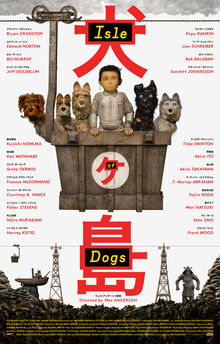
Isle of Dogs (2018)

IsleOfDogsFirstLook.jpgIt only became apparent to me after the fact that Isle of Dogs sounds quite close to “I love dogs.” You might even say there was a certain amount of forethought in this play on words. However, the pun only works in English as the Japanese pronunciation of the comparable kanji is “Inu ga shima.” Here we have the inherent beauty and simultaneously what some would deem the problematic nature of Wes Anderson’s latest film in a nutshell.
It’s necessary to lay out how I come at Isle of Dogs because it does contribute to how I perceive it. I’m Japanese-American. I’ve lived in Japan. I know some of the language though it’s an admittedly meager amount. However, I’ve invested in the culture and care about its people and fostering cross-cultural bonds. That’s part of the reason I was drawn to live there for an extended period of time, more than any pop culture infatuation with anime and manga. In those regards, I’m very much American. I also revere Kurosawa, Ozu, Mizoguchi and all the rest as most cinephiles do. There you are.

Wes Anderson is someone that I genuinely admire for his aesthetic though I would never necessarily sing his praises needlessly. He doesn’t need me to defend him nor do I look to. Still, when I consider Isle of Dogs I do not see a superficial homage. As with everything he does Anderson’s film feels fairly meticulous and the stop-motion creation is phenomenally precise. Beyond that, it’s infused with Japanese tradition. Certainly, there are markers that some might deem superficial like Taiko or sumo or cherry blossoms (さくら). They are all present. 

Thus, I do worry about people who have not interfaced with Japanese culture or the people. Specifically, the character of Tracy (voiced by Greta Gerwig), the foreign exchange student, feels problematic. I’ve met some folks like her where they let their own personalities take control of every situation and there seems to be no sensitivity or give and take. 

Because they don’t seem to have any sense of the culture they are in or at the very least they expect others to play by their rules. Hence why many Americans including myself are only fluent in one language. An example springs to mind of Tracy wandering into a bar and hollering at the man behind the counter in English that she wants chocolate milk. Then she berates a Japanese scientist (voiced by Yoko Ono) for not doing anything in opposition to the rampant government corruption. Again, in English. 

It was fascinating that I watched the film with an audience where the majority were Japanese so they were not ignorant of their country like Tracy or I might be. But how about viewers in another pocket of the world or even back home where I come from? The audiences saw a different movie altogether with different nuances and connotations.

Some people have noted rightly that a lot of the Japanese dialogue is lost because as the opening disclaimer notes: “The humans in this film speak only in their native tongue (occasionally translated by bilingual interpreter, foreign exchange student, and electronic device). The dogs’ barks are translated into English.” Except for the dogs, that’s a large margin for error.

Even the words of the little pilot, the intrepid boy Atari (voiced by Koyu Rankin) are all but lost on the dogs who don’t speak human and for me as well because, again, my Japanese leaves much to be desired. But the bottom line is that he almost always intuitively knows what the pack of alpha dogs is doing. 

They have a connection. He is looking for his faithful guard dog Spots (voiced by Liev Schrieber) who has been cruelly deported by his distant uncle Mayor Kobayashi in his effort to rid the dystopian Japanese city of Megasaki of infectious dogs. Spots was the first of many canines to be deported to the putrid rubbish pile of Trash Island. There you have the film’s plot but it relies on the fact that the boy and the dogs work together.

It goes back to that core tenet of society that dog is man’s best friend. And strip away any amount of visual artistry or cultural layering and that fact remains universal. Kobayashi is a cat person and we surmise his decision was merely a vendetta against canines (going back generations) more than any scientific evidence would suggest. 

To be honest, it never feels like Anderson is putting out a giant placard with film references at least not like Tracy with her megaphone. If anything the film conjures up one of Japan’s great national heroes the faithful dog Hachiko. Any traveler to Tokyo will recognize his statue in Shibuya but he is a cultural icon — emblematic of the same bond expressed in this story.

It’s still an Anderson film and as such, I never get emotionally connected with the material (actually maybe I take that back; stop-motion dogs suffering is heartbreaking to watch) nor do I gel with his very personal idiosyncrasies all the time.

But somehow, though the film’s cultural representations and relationship with Japan are flawed, nevertheless it left me more impressed than anything. It seemed like a degree of care was taken. And in the end, this story of canines has moments that unquestionably do resonate with me.

I thought I would have more problems with all the quality voice talent distracting from the story itself and it happened at times where I was stuck on Jeff Goldblum or Bill Murray but more often than not it didn’t seem like one voice stole the show. It was a story that involved many voices.

Some that we are able to understand, others that we can only gather bits and pieces of. But for me personally, rather than that being a deterrent I find it fascinating that the same film can play differently for different audiences and that native Japanese speakers can be in on the movie in a way that I never could.

It’s not that we don’t deserve to know that part of the story necessarily or need to be singled out because we don’t know the language but isn’t that one of the confounding things about culture and language? Oftentimes we don’t understand one another and need to find points of mutual understanding. Things get lost in translation and I think one could make the argument that this happens in Isle of Dogs purposely.

Certainly, Wes Anderson doesn’t know Japanese culture like the back of his hand. In an interview, he said he’s been to Japan some but his references were namely Kurosawa, Miyazaki and the woodblock prints of Hokusai and Hiroshige. And yet if that is true, it still feels as if he’s surrounded himself with some voices different than his own even if his typical ensemble is in place.

We have Kunichi Nomura with input on the script and voice duty for Mayor Kobayashi. More include Akira Takayama, Mari Natsuki, Akira Ito and then better-known names like Nojiro Noda, Yoko Ono, and Ken Watanabe. That’s not to mention the countless other Japanese contributors whose names scrolled by with the end credits.

Admittedly this is only my perception of the film but when I watch it, I never feel like it is assuming the primacy of the English speaking audience or if it is then that assumption gets slyly subverted. I mentioned already that the character of Tracy often speaks in English, in her opposition to Mayor Kobayashi or to the man serving up drinks at the bar counter.

The implicit understanding is that the Japanese characters understand the English being spoken but they choose instead to respond in their native language. So they have met us half way but have we met them? Learning Japanese is difficult, maybe even impractical, but growing our cultural literacy comes in many forms that would only assist in deepening our ties with one another. Only later did I realize that Tracy, the “white savior” as it were, essentially fails in her attempts. If anything she needs the help of an audacious Atari, his guard dog, and the nameless hacker from her school. Without them she is powerless.

As is often the case, certain people use their voices and assertive personalities to push themselves into the limelight unwittingly but those people would be nothing without the taciturn heroes who willingly stay in the periphery until they need to stand up. While Tracy turns me off slightly in fiction and in real life, it’s the others like Atari that resonate with me. Just as the tale of dogs in both camaraderie and loyalty rings a universal note.

However, I realize only now that I didn’t talk much about the actual mechanics and formalistic aspects of the movie but I’ve spoken my peace. Do with it what you will.

3.5/5 Stars

Note: Two articles that I found interesting on this topic were the following: What “Isle of Dogs” Gets Right About Japan and Justin Chang’s Isle of Dogs Review


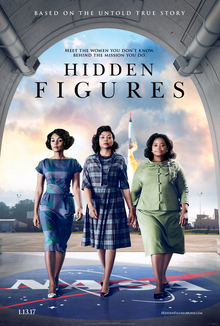
Hidden Figures (2016)

Hidden_Figures,_2016In some respects, this feels very much like a paint by numbers biopic that takes us through the many paces of such a narrative. The rise, fall, conflict, and self-actualization of our heroes that navigates us to the film’s conclusion.

But this is also unequivocally a story that necessitated a telling for the very fact that stories like these have been hidden for decades — swept under the rug if you will. Because first and foremost Caucasians were usually the ones at the center of the master narrative of history and namely white males at that.

In one of my courses in university, the term of intersectionality would have undoubtedly cropped up in conversation right about now to denote a doubly marginalized group (African-American women). Feel free to consider the term if you are so inclined because there are others who can probably bring a lot more to the table on issues of gender and race and oftentimes those are very necessary conversations to entertain.

However, I am more interested in the actual story in question and so I will jump right to that topic. At its core, there are three women who you have probably never heard but that’s only a part of it. It’s that and the fact that they were integral cogs in something truly extraordinary.

Our first person of note Katherine Johnson (Taraji P. Henson) who is promoted to the Space Task Group, given the pressure following the Soviet’s launching of Sputnik and Johnson’s unreputed skill in analytical geometry. She moves from her own segregated division to an environment full of passive-aggressive bigotry and whites-only bathrooms. In her home life, she raises three daughters while falling in love with a handsome National Guardsman (Mahershala Ali).

The firecracker among her friends is Mary Jackson (Janelle Monae) who has aspirations to finish her schooling so that she can become a full-fledged engineer. Lastly, is the sagely one, Dorothy Vaughan (Octavia Spencer), who has seen a great deal of the world and continually shows tremendous qualities of leadership over her segregated branch which she leads with a self-possessed wisdom. One would gather these skills would apply well to any arena and so they do eventually.

For our parents’ generations events such as Neil Armstrong walking on the moon and the Challenger Explosion left an indelible mark on society and it was all for the sake of exploring the great unknown of outer space. Those later triumphs and, yes, even the tragedies would not have come into being if it wasn’t for some of the unsung individuals who got John Glenn off the ground in 1962 as we desperately tried to counter Russia’s Sputnik successes.

There’s also a slightly refreshing reversal of the age-old supporting character archetypes where this film dares to put its white characters in secondary roles while still giving them a decent amount of importance in the overall trajectory of this narrative.

Kevin Costner is the most rewarding supporting character as the head of NASA who is looking for results more than anything and that causes him to push past the accepted walls of racial hierarchy not necessarily because he’s trying to make a social statement but because he wants to get the job done. Skin color has no bearing on whether or not someone is savvy and can get John Glenn into the wild blue yonder.

Jim Parsons part does not stretch the boundaries of his Sheldon Cooper image but it is underlined by a bit of prejudicial malice as is Kirsten Dunst’s turn which no doubt adds a touch of realism representative of the defacto bigotry of the era. Meanwhile, Pharrell Williams score of sorts while somehow anachronistic undoubtedly imbues these three women with a spark of energy following every step of progress they make with NASA.

The film’s decidedly punny title aside, Hidden Figures is still full of joy even if it’s only a minor pleasure as a film. Because in some instances it doesn’t seem to take its material all that seriously and sometimes that is more refreshing than a dour and self-important exploration. Still, it takes itself out of the running from among the greatest biopics for that very reason. It’s a bit too formulaic and probably too tongue-in-cheek with historical events. Certainly this cannot take away the full impact of this history or the enjoyment value of the film. We should do well do appreciate them both.

3.5/5 Stars

Review: Back to the Future (1985)

back to the future 1.png

Back to the Future zooms at us as a lovely mishmash of sci-fi thrills and 50s nostalgia that feels like pure happenstance. The one purported flaw, the fact that Marty McFly has no right to be in his family, is partially understandable. As Michael J. Fox wasn’t even slated to appear in the film. He was a last-minute replacement that just happened to pan out. But what a bit of serendipity it was all the same.

Without question Back to the Future clocks in as one of the most enjoyable adventures of the 1980s for delivering unadulterated audience satisfaction. It has all the great hallmarks we yearn for starting with rewarding characters, inventiveness that makes up for any corny interludes, and a pulse on what’s fundamentally entertaining.

Our introduction to the story tells us as much about Doc Brown as it does the teen rolling in on his skateboard, if not more so. Marty, the plucky kid with a penchant for rock n roll, finds Doc’s workspace in complete disarray thanks to an extended period of neglect. More on that later.

For now, the iconically cool vibe of “The Power of Love” underscores Alan Silvestri’s own cinematic orchestration on the project providing a fitting anthem for everything that is Back to the Future. McFly coasts around town on his skateboard using each passing car as his own personal lift. Rock is his main passion while his girlfriend Jennifer remains his main distraction. Meanwhile, Mayor Goldie Wilson looks to get reelected a la Nashville (1975) and Marty is accosted by locals championing the “Save the Clock Tower” campaign.

In fact, Hill Valley is a bit of a mythical city. It’s part Middle America, part fantasy, where the local principal is out to get our hero, his closest friend is a mad scientist, and he must battle against the ultimate affront of all time that he might not amount to anything just like his old man. Those are the stakes and this is the world. The perfect place for time travel. Doc in all his scatterbrained kookiness makes an appearance to introduce a DeLorean time machine into the storyline as well as the main conflict. The rest is in Marty’s hands as he whizzes away into the past.

The fact that it paints this world as a caricature as well instead of reality, far from being a weakness, becomes one of its bolstering charms. Refrains of “Mister Sandman” play throughout town. The local marques boast the star power of Barbara Stanwyck and Ronald Reagan (wink wink) in Cattle Queen of Montana (1954). Further still, the local five and dime features the tunes of Nat King Cole, Pattie Page, and of course, Tennessee Ernie Ford. Everyone gets a plug to set the scene.

A few good-natured jabs at incumbent President Reagan are also in order. After all, who could ever believe that an actor could become a president? Of course, nothing is all too surprising in this day and age. Still, the 50s via the 1980s were in many ways both simpler times. Star Wars and Van Halen. Chuck Berry and Jackie Gleason. That was the life.

It devolves into a glorious unfolding of circumstances as worlds collide and Marty’s cause begins to unravel at two ends. First, he needs to get back to the future, hence the all-encompassing title but in his haste, he accidentally tampered with the natural order of things – namely the initial meet-cute of his mother and father. It subsequently instigates one of the most awkward cinematic mother-son relationships known to mankind.

Having done irreconcilable damage to their relationship, Marty must do all he can to get his parents back on track. The problems are innumerable. Namely his mother’s infatuation with him, the dreamy out-of-towner Calvin Klein, his father’s undeniable dorkiness, and of course the bullies to end all bullies Biff. In fact, he’s been a thorn in George’s side for 30 years.

Still, with Doc’s aid (the quintessential secondary helper), Marty looks to right all that is wrong. It proves difficult as he attempts to set his parents up to attend the Enchanted Under the Sea Dance together – the fateful dance where young love kindled. Yet Marty watches his life slowly disappearing moment by moment as his parent’s union seems a slight chance at best.

With a few riffs of “Johnny B. Goode” and an imminent date with Doc at the old clock tower in town, a happy conclusion seems possible if not for the Libyan Terrorists still waiting for Doc in the future. After all, Plutonium doesn’t grow on trees and there are consequences for swiping it. Thankfully he doesn’t necessarily listen to his own advice about altering the future and Marty returns to a world that is strikingly different to the one he used to know. It’s strangely rewarding even if it does feel all too perfect in this third world.

While it becomes one of the most obvious films to shamelessly set up and plug its sequels (ultimately two other offerings), there’s no doubt that Back to the Future makes each a rewarding prospect. Not only is it boosted by a winsome performance by Family Ties favorite Michael J. Fox in a now defining role but Christopher Lloyd’s turn is equally laudable even if it easily typecast him in future tech nerd projects. There are certainly worst places to be.

Furthermore, under the tutelage of executive producer Steven Spielberg, director Robert Zemeckis became one of the great successes of the 80s and 90s with Back to the Future being yet another reason why Spielberg remained at the forefront of popular entertainment throughout the decade.

For their part, whether they like it or not Michael J. Fox and Christopher Lloyd will remain pop culture gods in the hearts of nearly everyone. Bless them for that. Doc and Marty are as memorable now as they were back then and no doubt even years into the future. That’s right, a movie about a time-traveling DeLorean has staying power. There’s a bit of the magic of the movies for you.

4.5/5 Stars

I Was Born But… (1932)

800px-I_Was_Born,_But..._1932.jpg

What strikes me right away about Yasujiro Ozu’s silent classic is just how relatable it feels. Yes, this is a Japanese film and yes, it’s silent too but watching the scenarios play out on screen have an undoubted timelessness. This is decidedly fresh material that’s blessed with humor and grace like the best silent comedies.

It’s a narrative about two young boys who have moved with their family to the Tokyo suburbs. As is usually the case it’s brought on by their father’s work and the whole family must get used to it. For the boys specifically, that means a new school and getting to know the neighborhood kids with their carefully enacted social hierarchy. Simply put, the biggest kid rules the roost and the new kid on the block is always bound to get the worst of it.

So obviously we witness the ensuing verbal skirmishes and a few fistfights where the clogs come off and are brandished as built-in weaponry. That’s all part of the rite of passage where the brothers must prove themselves. If we learn anything from this comedy, again, it’s the fact that many things have not changed all that much. Boys haven’t changed that much. At least not in the core important things that still hold weight.

Certainly, this is a less organized and less done up exploration compared to Ozu’s later endeavors but that’s part of the charm. The comedy at times is so pure and simple it gives the sensation of some of the early kid comedies like Our Gang or Chaplin’s The Kid (1921). Watching the posse of boys scamper every which way necessitates no understanding of language or culture. Watch and you understand.

Sparrow’s eggs preclude the pumice stones in Ohayo (1959) decades later as the boy’s favorite keepsake. In this particular hierarchy, it buys them a coveted place at the house of the richest kid whose parents are showing off their home movies. It’s a novel thing for all the boys and they look on with baited breath.

As it turns out, the Yoshi boys’ father is a real cut up, a real funny man, and they couldn’t be more ashamed, from the self-deprecating performance he gives for the bosses camera. This is far more than a few images that garner a few laughs. This is an affront to their father’s character and subsequently their family honor. But this hardly ever feels like a Japanese cultural issue, this is an issue that arises in the hearts and minds of proud, naive boys.

It’s the colliding viewpoints of children and adults and rather surprisingly the film is willing to look at the perspective of the kids. If Ozu’s initial work shares any similarity with Ohayo many years later, it’s at this juncture. The boys decide to protest their father by keeping silent and not acknowledging his presence since he has wounded them so egregiously. They’ve mastered the scowl to perfection as they glower in the front yard eating their mother’s onigiri. It seems like they’ll never be able to face the other kids again and they’ll never forgive their father.

Those very themes alone make this universal storytelling and it’s easy to forget for even a moment that this is a film brought to us from 1930s Japan. Because there is something going on here that feels so real. Every young boy wants to think of their father as a big deal, the king of the hill, a big success, and when we are met with anything that seems to contradict that vision we have, it does hurt us.

Still, what the story does well is to find a resolution where the boys can still be content in who their father is, beginning to comprehend a little bit the situation he is in. Even as they get a little help from the local paperboy to vanquish the local bullies, they ultimately gain a small dose of sympathy for their dad. If they don’t quite understand why he has to say good morning to his boss every day and treat him with such deference, as they grow older they might start to appreciate him more.

However, it does seem like something is lost in the translation of this title for American audiences but the subtitle does suggest more meaning. This is an “Adult’s Picture Book View” so we are looking at a child’s world from an adult perspective and though it’s inherently funny we gain a greater respect for both children and parents.

4.5/5 Stars

I, Tonya (2017)

I,_Tonya_(2017_film)Sufjan Stevens released a song not too long ago as an elegy to Tonya Harding. Being the modern-day folk poet that he is, he cast her as a tragic hero, championing her as a definitive portrait of an All-American girl, larger-than-life, unapologetic, and ultimately beaten back by society at large.

I will date myself and say that I don’t remember much about Tonya Harding because I was barely born when she was in the public spotlight. So, I come at the events as an “impartial” observer or at least one who lacks any clear understanding of what her story was really like in the heat of the moment.

Thus, Stevens’ song and this film, I, Tonya, were necessary for me as obvious mechanisms of empathy. Emphatically the film proves that Tonya Harding — at least for me — cannot be cast as a hero and I don’t necessarily think that she was expecting that. But what has been done on her behalf is equally vital. Finally, it seems like others have been willing to speak up on her behalf in telling a more multifaceted even sympathetic side of the story.

Her life and times as detailed in Craig Gillespie’s film functions as a nearly absurd black comedy as it plunges into familial discord and moments you could hardly make up if you tried. But what we would do well not to forget is that this is a dramatization of someone’s life — someone with inherent worth even as she’s being berated and abused by a mother and then abused by her husband and finally raked over the coals by the mass media.

If anything, this film is an indication that Tonya’s life does have meaning. The flaws are there but also present is immense trauma and the subsequent tenacity that made her the first female skater to ever land a triple axel.

Screenwriter Steve Rogers’ work employs slightly pretentious talking head moments and fourth-wall breaking monologues that were used in a similar fashion to Experimenter (2015), except it’s hardly a gimmick and there’s a great deal of resonance within the madness of narrative dissonance with a smattering of different perspectives colliding.

Because Tonya’s story really is recalled and remembered in so many different ways by all sorts of people with their facts conveniently conflicting. First, there’s Tonya herself (Margot Robbie) who was the skating prodigy by the age of 4 and despite a lack of education, her enduring work ethic made her one of the finest American skaters to ever grace the ice.

Allison Janney is as acidic and foul-mouthed as they come, pushing the envelope as Tonya’s ultra-vitriolic mother LaVona who never seems content, continually berating her daughter in all regards because every penny she makes as a waitress goes into her lessons. Love is not in her lexicon.

Then there’s the infamous Jeff Gillooly with Sebastian Stan donning that regrettable mustache as the awkward boyfriend who no doubt loved Tonya at one point and yet still embroils her in an unhealthy and abusive relationship. His slobbish oaf of a friend Shawn Eckhart, who fancies himself a counterterrorism expert of some kind, is a surprisingly authentic caricature. He’s got grand delusions of how they will sabotage Nancy Kerrigan’s chances in the Olympics by unleashing an onslaught of psychological warfare.

Jeff condones the plans but soon he’s shelling out $1,000 that disappears after Shawn gives it to a pair of dubious contacts. Little does he know that this will devolve into “The Incident” after Shawn okays a hit and an equally vacuous nobody, Shane Shant, injures Kerrigan with a police baton. They’re so inept that the FBI is soon on their trail. First, it’s Shawn, then his fingers point to Jeff, and finally, Tonya is implicated. Right here we have the clearest embodiment of both the real-life farce the and tragedy of Harding all rolled into one.

The extensive soundtrack is utilized not only as casual character development but an instant accessibility point in denoting either an era or a mood. In fact, it’s one of the few constants in a story that regularly hurtles back and forth between different points of views, time frames, and the like. Hearing Norman Greenbaum, Fleetwood Mac, Supertramp, Chicago, Doris Day and a whole host of others offer instant touchstones throughout.

For these very reasons I, Tonya is the most inventive biopic in narrative terms that I can remember since Brian Wilson’s story told so evocatively in Love & Mercy (2014). There is a similar exploration going on here as we try and make sense of someone who has gained, in this case, so much notoriety whether it was totally deserved or not. And the beauty of the picture is that it never fully divulges the truth because in so many words “the truth” in the lowercase sense is relative and like innumerable pieces of history how are we to say that we have the definitive answer?

The media’s part in all of this feels almost damning and yet we cannot condemn them without condemning ourselves too. Some David Letterman footage articulates the ubiquitous reality that Tonya Harding became a punchline in the wake of the Lillehammer Olympics in 1994 even as she received a lifetime ban from skating. Should I feel sorry for Tonya Harding? I’m not sure. Regardless, it’s a sorry affair.

Though it starts to paint some layers of Harding’s backstory and her working-class roots rubbing up against the protocols of standardized perfectly primped and costumed female figure skaters, that’s not necessarily the film’s allure. It gets its zing, admittedly from the almost soap-operatic twists. And yet with anything, if that is what gets you to stay and kept the media involved in the story for such a long time, maybe it’s good that time has passed.

Even as the script tries to put the pieces together it can hardly succeed perfectly though it does give us something to work with. Again, it all comes down to some form of greater understanding. But then again, Tonya Harding probably doesn’t care about what others think about her or about anyone trying to mount a defense on her behalf. So be it.

Now, all that seems left to make is a Nancy Kerrigan movie. Yes, she was cast as the perfect ideal, Snow White on Ice, but as with any media fixation, it cannot always serve true justice nor capture the hardships in a person’s life. Tonya Harding, Nancy Kerrigan, and nearly every other person on God’s green earth is a testament of that. As Sufjan puts it only God knows what they are.

4/5 Stars


Tonya Harding, my star
Well this world is a cold one
But it takes one to know one
And God only knows what you are

Just some Portland white trash
You confronted your sorrow
Like there was no tomorrow
While the rest of the world only laughed

Triple axel on high
A delightful disaster
You jumped farther and faster
You were always so full of surprises

Are your laces untied?
What’s the frown on your face for?
And just what are the skates for now?
Tell me which is your good side?

Are you lonely at night?
Do you miss all the glory
And the mythical story
Of the Olympian life?

Yamaguchi in red
She had high rise and roses
And red-carpet poses
And her outfit was splendid

Nancy Kerrigan’s charm
Well she took quite a beating
So you’re not above cheating
Can you blame her for crying?

Tonya, you were the brightest
Yeah you rose from the ashes
And survived all the crashes
Wiping the blood from your white tights

Has the world had its fun?
Yeah they’ll make such a hassle
And they’ll build you a castle
Then destroy it when they’re done

Tonya Harding, my friend
Well this world is a bitch, girl
Don’t end up in a ditch, girl
I’ll be watching you close to the end

So fight on as you are
My American princess
May God bless you with incense
You’re my shining American star

~Tonya Harding by Sufjan Stevens


Review: A Place in the Sun (1951)

a place in the sun 1.png

George Stevens is only one among a plethora of filmmakers who came back from WWII changed. He had seen a great deal of the world’s ugliness — Dachau Concentration Camp for instance — and as a result, the films he made thereafter were more mature ruminations on humanity at-large. Adapted from Theodore Dreiser’s An American Tragedy and a subsequent play, A Place in the Sun is one of those pictures crafted in the wake of such historical change.

There’s no doubt that this is Hollywood melodrama backed by a raging score from Franz Waxman but this is no less, high powered high-class stuff. It’s augmented by gorgeous black and white imagery that reaches pitch-black tones and still manages to make Lake Tahoe into a scintillating getaway. Meanwhile, the camera captures the action with elegant movements, sashaying through space, at times nearly imperceptible to the eye. Though admittedly the film’s stature as a social commentary is less interesting now than it probably would have been in its day. Still, we can’t have everything now, can we?

Montgomery Clift is often forgotten in the fray of powerhouse actors but the line can easily be traced from his intense performances to the work of Brando and Dean which would also sprout up in the 50s. Though that same intensity is there, it never feels like he’s trying to sell us a gimmick or a method. He’s simply trying to provide a lens to see a bit more clearly the intricacies of an individual, in this case, one George Eastman. It manages to be a profound and at times an agonizing performance.

Of course, Elizabeth Taylor is exquisite in every frame as always but her bright-eyed sincerity is equally arresting. She feels perfectly made for the role of Angela Vickers and seamlessly transitions into more adult fare with A Place in the Sun, standing tall alongside Clift, destined to make them one of the great romantic pairings of the 1950s. She supposedly said that she finally felt less like a puppet and more like an actress after this film. It shows.

Still, though given a thankless role at times, Shelley Winters is equally important because, in her simpler, humbler way, she reflects how quickly a man can change. She’s not a bad person at all, just a frail, even helpless one who feels like she has very few people in the world to hold onto. George proves to be a comparable companion until he unwittingly finds himself running in different circles and that’s where the tension begins.

I look at George Eastman and see the same drive for recognition, power, and wealth in many of us, those desires that oftentimes can be our undoing because they turn out to be meaningless. The irony is that his intentions never seem malicious but he is undermined by something. He quickly sinks into this double life. At first, he was simply happy to have a job and some companionship. His desires were simple. But slowly, as he found himself rising in the ranks of the Eastman company and getting more recognition, he couldn’t help but want more. Are these impulses bad? Not in the least, but they led him to some pretty rocky soil.

The scene that stands out in my mind could seem fairly mundane. But Stevens maintains a fairly long shot that’s peering through Eastman’s living room and we can see into the next room over as he is on the phone. It feels like minutes go by and Stevens fearlessly never cuts the sequence. The first call is from Alice which he takes.

But the second comes from Angela and at that point, we know that things have changed. It’s set up the dilemma. He genuinely loves Angela and wishes to be with her and to be a part of her life. Yet for that to come to fruition he must do something about the other girl. Alice won’t disappear. It’s funny how someone who you used to appreciate so dearly now feels like a burden. To her credit, we feel sorry for  Winters’ character without question.

In fact, the film succeeds along those lines. We pity her for the sorrowful position she is placed in — essentially abandoned by George. And even in her frivolity and opulence, there’s a candidness to Angela that makes us want to root for her and that allows us to simultaneously pity her because she has no idea of George’s other life. If there is anyone to lash out against it is George Eastman himself and still even in that regard, Montgomery Clift reveals the full gamut of this tortured man so even if we are hesitant to feel sorry for him, he does open us up even with a tinge of compassion.

But the muddled morality is complicated by the fact that Clift’s character has a sense of remorse. Surely he cannot be all bad based on what Vickers saw in him? His capacity to love and be tender is evident. Still, that is not enough to keep him from going on trial and the film’s final third takes place, for the majority, in a courtroom. The district attorney is played by Raymond Burr, who might well be in a dry run for Perry Mason and he comes at Eastman with all the fervor he can muster to convict him in his lies. Even in these moments, we must fall back on George’s inner conflict, his capability to love others, and his intentions for love.

If A Place in the Sun gets too preachy or succumbs too much to Hollywood’s stirringly romantic tendencies, it still might be one of the finest examples of such a film. Front and center are two phenomenal stars and Stevens films their euphoric romance with a meticulous eye, catching them in particular moments, with close-ups, and such angles that we are constantly aware of their intimacy.

As much as Eastman is looking for his place in the sun, and he could spend hours just sitting with Angela soaking in the sun’s rays (not many would blame him), it’s just as true that there is nothing new under the sun. That’s what we’re left with. Mankind is still distracted by many things. Oftentimes they are good things, but we make them ultimate things, and they wreak havoc on our lives. Meaningless, meaningless, everything is meaningless under the sun. But that doesn’t keep us from wanting to bathe in its tantalizing warmth any less. That’s part of the American Tragedy.

4.5/5 Stars

After The Storm (2016)

after the storm 1.png

There is a phenomenon in Japan called hikikomori (pulling inward). It mostly applies to 20-somethings. But in 2017 an article came out in The New York Times to document a different and yet somehow similar occurrence.

Many older people risk the chance of dying alone if they have no family because many live without a network of community and neighbors while in such proximity might still leave them invariably isolated. I have lived there for an extended period of time, granted as a foreigner, and yet I could feel the weight of such an environment

Thus, the dutiful grown children worry about their parents, about being the good son or the good daughter. Ryota’s mother is a wonderful lady. She gives him a playful slug in the stomach, tells him to his face he’s a horrible liar but always in love. Quibbles ensue between siblings over taking advantage of their mother’s good graces since she lives only off her pension following the death of her husband years back.

And yet there is a certain relish in these core relationships because even if it’s not a perfect picture you get the sense that mother and son care deeply for each other. It’s the films most gratifying interaction watching Hiroshi Abe and Kiki Kirin play off each other. Menial events take on the utmost meaning because they manage to color the characters in honest ways and the film has many of these seemingly inconsequential moments. That’s a product of its pacing.

For people who haven’t lived in Tokyo, preconceived notions of it might come from the likes of Lost in Translation (2003). Personified by ultra-hip areas like Shinjuku, Shibuya, and Harajuku touted for their nightlife and shopping. But there are a lot of other places too as director Hirokazu Kore-eda suggests. The Tokyo made up of suburbs, apartment complexes, and more ordinary landscapes. The Nerimas and Kiyoses of the world.

Coppola’s film worked because it was going for the perspective of an outsider. I enjoyed After The Storm immensely because it has the attention to detail and the touches of a local — someone who has known this terrain intimately.  I distinctly remember the first time I ever came back to the states knowing I would soon be returning to Japan. And in that moment I no longer felt like a tourist but someone with a new sort of understanding. It’s crucial because it changes your entire outlook and what you deem important. The big moments aren’t as relevant as the day-to-day.

Abe’s performance is so exquisitely rendered because while the picture is by no means a comedy his various ticks, expressions, even his lumbering figure are humorous without ever truly meaning to be. And they are organic moments that never feel forced. In other words, they are human and so despite his shortcomings, there’s something that resonates about him. When we look at his life we see a bit of his restlessness. He’s still not the man he wants to be. He realizes that.

His ex-wife is seeing another man. The rich new boyfriend feels like a universal trope that doesn’t need much explanation. Meanwhile, Ryota rarely gets to see his son, only on prearranged days were he pays child support. He’s notoriously bad on making their meetings on time. That and other reasons are hints to why his wife left him. That doesn’t mean he doesn’t hold onto some wistfulness, especially where his son is involved.

Though once an award-winning author most recently he’s taken on a job as a private investigator. He says it’s only temporary — research for his latest project — but it’s been going on far too long. He’s started getting used to it and so have his coworkers.

The film’s point of departure and ultimate revelation, if there is one, comes in the wake of a typhoon. Again, living in Japan you understand that this is a fairly common occurrence. But it’s the regular person’s side of Tokyo away from the bright lights.

Trying to field lost lottery tickets in the swirling downpour or shielding oneself inside a slide at a park watching the debris fly by is enough of a diversion because the intent is to consider not so much environmental changes but how our characters change.

Of course, implicit in the translated title is that there is something new (あたらしい) about life. And yet when we get on the other side of the storm it’s difficult to know. That would be the form of a typical film. To make the before and the after drastically different. Here the characters have changed — no doubt — but externally their behavior seems all but the same. The development is incremental and internalized.

I appreciate that. In life, there is rarely a megaphone to announce change for us. Sometimes it’s imperceptible to the eye. It’s even notoriously difficult to acknowledge some changes in ourselves. And yet we know they are there. Because to our last breath, we are indubitably a work in progress. We will never be perfect. That’s part of what makes life and this film thoroughly intriguing. What’s more is that it still glimmers with a certain hopefulness.

4/5 Stars


Densha Otoko (2005)

densha otoko.png

In English, it means Train Man and it finds its origins in a media franchise that now includes Manga, a book, a television show, and of course this movie. But the events of the story are purportedly based on real life when a young otaku (Japanese tech nerd) in Akihabara came to the defense of a woman on a train who was being accosted by a drunken businessman.

This isolated, geeky 22-year old male was her knight in shining armor and probably had never talked to a girl before in his life. Every syllable comes out of his mouth jumbled, rushed, and breathless. If they were American we would say that she’s out of his league — the head cheerleader or what have you.

But the film is blessed because it is set in Japan. Densha Otoko proves to be part dorky rom-com while also giving us a view into a unique subculture. While it deals in stereotypes somewhat, we see his constant communications taking place over online chat and although it’s dated by today’s standards the Akihabara vibe is unquestionable as is the integration of technology into modern day romance.

At the time we were on the cusp of where we’re at now and you see the signs of it. Flip phones and laptops on the train. People at their computers at work and home. Such luxuries have become increasingly more invasive and some might say they have come at the detriment of human relationship.

What this film does well is to consider both rather implicitly with online friends on one side acting as his constant peanut gallery offering conflicting pieces of advice, constant pep talks, and further considerations as they all analyze his prospects as a body.

Then, of course, we have this demure woman he stood up for on the train. She might be the Japanese iteration of a manic pixie dreamgirl — granted I’m not sure what that means exactly — no matter she’s considerate and sweet. Their interactions continue with a present sent as a Thank You, then a dinner where they split the bill, and several other affable encounters.

The film’s aesthetic might be off-putting to some as it reflects a world constantly interfacing with their screens. Further suggesting the interweb of relationships that are created where people only know each other online, denoted by a continuously split screen and yet their lives spill outside of that and we get a small taste of not just Densha Otoko but all of his fan club. These characters too could have used more definition but they serve their purpose.

Train Man pushes onward and enters territory that none of them could have ever dreamed of. And he does it by being as nervous and frantic and considerate as ever. He gets a haircut (thank goodness), buys some new duds, and tries a few other techniques. Researching dinner conversations and testing the food beforehand. It’s actually quite sweet if he weren’t so uncomfortable to watch. But then again, who am I to judge?

Still, what matters is the time they spend together. It’s pleasant and kind not interrupted by awkward kisses or embarrassing hijinks with best friends. It just the two of them and he tries to discern how to move forward with this girl on that ever perilous tightrope of male-female relationships. They’ll at least have men befuddled for eternity. I can’t speak for the ladies.

That’s not to say there aren’t throw away moments or wacky and slightly peculiar ones that we probably could have done without. I won’t bother listing them because most importantly the film remains in our good graces for what it’s mainly set out to do. Allowing a socially awkward underdog a chance to shine. Through all his tripping and falling, sniveling and awkwardness, he gets some amount of satisfaction.

Consolidate it down to its best themes and scenes and you have a rewarding picture of just that. Because after all, it’s fairly easy to forgive a heartfelt movie like this for its gaffs since even in those very things it’s staying true to its core hero: Densha Otoko.

Likewise, I’m going to stick by my guns and enjoy this film perhaps more than I should have and yet in its innocence and jubilation, I found something that is so often lacking in American films trying to work within the same genre. Tighter editing would have been a major benefit but I’ll always hold that sincerity covers a multitude of faults. Call me an old softie if you will but maybe it’s the fact that I’m probably an otaku at heart. Whether he gets the girl or not, he has my sympathy.

3.5/5 Stars

Review: Lost in Translation (2003)

lost in translation 1.png

30 minutes into Lost in Translation our two traveling misanthropes finally meet in the hotel lobby at the bar sharing a friendly exchange. They are two people who share one striking similarity — they are Americans in a foreign land — and they’re looking for a friend.

It’s a very pertinent film for places I’ve gone as an American who has traveled to Japan of my own volition but still as a bit of an outsider. Not because I am rejected or an outcast but for the very fact that there are obvious cultural and linguistic barriers in my way. I resonate with this film not so much because it takes on the point of view of the Japanese and empathizes with them but on the contrary, it focuses on those on the outside looking in. Like Bob & Charlotte and you and me in our manifold cultural illiteracies.

Bob is a big shot movie star. Probably not unlike Bill Murray. Big in the 70s and 80s but now his popularity is slowly waning as the years begin to catch up with him and he’s demoted to cameos. In fact, maybe Murray has fared better. Bob’s in Tokyo promoting Suntory Whiskey in their latest ad campaign. It’s good money but certainly not what he wants to be doing with his career.

He’s Suntory Time’s latest spokesperson. It’s the epitome of culture becoming completely muddled along language lines. My Japanese admittedly leaves much to be desired, but the Japanese director’s stage directions are full of passionate vision of what this scene will be, a shot out of Casablanca, full of emotion and heartache. The translation Bob gets is simply “He wants you to turn and look to the camera.” He feels like he’s missing something. Just as each reference that’s tossed haphazardly his way is never fully understood.

The Rat Pack, Bogart, Sinatra, Roger Moore, even Johnny Carson. Each of these names comes with so much more. But the context has been ripped away from them and appropriated and transplanted to different settings. It’s nothing to be up in arms about it’s simply the reality of our internationalized culture and it’s utterly befuddling to Bob. He can’t navigate it at all.

Charlotte (Scarlett Johannson) is a recently married philosophy graduate who looks hardly a day over 20. Friends back home seem too preoccupied to listen as she calls them up over the phone. Meanwhile, her dweeby husband with a particularly whiny voice (sorry Giovani Ribisi) is consumed with his own career as a photographer and distracted by old acquaintances ( namely Anna Faris). He says he loves his wife but he certainly doesn’t spend much time with Charlotte. Her loneliness shows. She’s even hit the bottom of the barrel listening to CDs to discover the purpose of her soul.

Bill Murray’s characteristic deadpan cheekiness feels entirely at odds with the culture that he is thrown into where you’re forced to cook your own food (Shabu Shabu) and he dwarfs the national average in terms of height. Bob is the prototypical American movie star making his press junket of Tokyo but at the same time, he’s also oblivious that he forgot his son’s birthday again until he receives a reminder.

In fact, Murray never feels like he could be anyone’s best friend because he’d either be a flake or he’d never open up to you because he’s too busy making jokes in lieu of actual conversation. Still, maybe there’s a grain of hope.

Bob and Charlotte are totally adrift in the city. Lost in the sea of Tokyo and it’s really no fault of the city despite its astronomical population and unfamiliar customs. It only serves to magnify the real problem — a small-scale parallel to what is going on in their lives. Their problem doesn’t start with Tokyo. It starts with the person who looks back at them in the mirror. Though they come from two very different stations of life, their current state of affairs is all but analogous. Bob and Charlotte are in the midst of personal crises — the biggest ones imaginable — what’s life really about?

That’s why when they break out in conversation it means something. Of course, he leads with an extended joke, “I‘m trying to organize a prison break. I’m looking for, like, an accomplice. We have to first get out of this bar, then the hotel, then the city, and then the country. Are you in or you out?”

Their meeting in the hotel lobby is a lifeline that they both willingly grab hold of and it leads them out into the world around them. They frequent the video game parlors, traverse Shibuya crosswalks, perform in late night Karaoke joints, and sit up talking with Japanese surfers as Tokyo’s bright lights illuminate the night air. Coppola even drops a nod to her significant other with Phoenix’s “Too Young” exemplifying the vibe around town.

The film hints at infidelity at times and Bob’s marriage is a flimsy one at best but the beauty of his relationship with Charlotte is that first and foremost it is a friendship and by the time they must part ways it’s heartbreaking. They’ve grown so close. But a hug can be as meaningful as any sexual relationship might have been. They genuinely care about each other. It turns out Bill Murray can be a good friend and one with wisdom and grace no less.

In its fleeting moments, Lost in Translation, captures just how horrible goodbyes can be. There’s so much you want to be able to say and nothing you can begin to say. In fact, Bob cannot leave it there and so he goes after her, tracks her down, and shares one final embrace and one last word. Both of them go their separate ways but there’s no doubt that Bob and Charlotte have grown and helped each other to a better place. It’s still a work in progress but that’s part of what life is about right? Living and growing alongside other people.

We can scour YouTube to come up with the latest and greatest, definitive enhanced audio video to tell us exactly what Bob leaves her with, although each one undoubtedly claims something different, or we can bask in that ambiguity which while so maddening in some way feels satisfying for the very same reason. Floating through Tokyo has never been so wistfully affecting.

4.5/5 Stars

lost in translation 1.png

Review: Hiroshima Mon Amour (1959)

hiroshima mon amour 1

Like you I know what it is to forget and yet still be endowed with memory. These are only a couple fragments from this film stitched together but in many ways, they encapsulate the essence of its core themes.

I suppose such words ring true for all of us and Alain Resnais’ film is composed of a plethora of equally perplexing paradoxes that though never quite coming into full clarity nevertheless prove Hiroshima Mon Amour to be one of the most bewitching cinematic expressions born out of the French cinema. Without question, it is an undisputed touchstone of the forthcoming Nouvelle Vague that blew up the conventions of the 1960s.

The first time I ever saw Resnais’ romantic meditation there was something so arresting about it such that I will never forget the likes of Nevers and Hiroshima — the two entities that make up this film as not simply places of past tragedy but crucial to the very identities of the characters who come within the frame.

We never need to know the true names of this French actress (Emanuelle Riva in a riveting performance of immense grace) and the equally candid Japanese architect (Eiji Okada) who fall into the throes of a passionate affair together. They are represented well enough by these monikers — symbolic torchbearers of these names — emblematic of the age they ascribed to.

Like L’Eclisse (1961) or Dr. Strangelove (1964), this film too is in the wake of the atomic bomb and any subsequent discussion thereof cinematically speaking must at least acknowledge such films. Part of the necessity in this specific case is how the film takes a particular event and then extends it and intertwines it with so much more in such a way that it not only a monument to Hiroshima but a testament to human history.

We are people so quick to forget. We lose sight of the past. We bury our hurts deep inside. We are doomed to repeat many of our past mistakes. But still, more so we are capable of passions, emotions, and love that carry us through times of tribulation, pain, and suffering. It’s something to be immensely thankful for.

Resnais film is one of the great visual marvels of the 20th century with its graceful fade-outs and flashbacks — delicate camera zooms connecting memories and realities. Stylistically there’s a continuous poetic cadence of image and dialogue, repetitions with recollections. A solemnity exists in its very purposeful pacing that ties everything together with the utmost elegance which, far from being a muddled hodgepodge, forms a perplexing experience never to be fully elucidated.

It has very few equals and remains so as an achievement that can hardly be defined as a typical love story or any such blase categorization. It’s what we might conceive when we think of Film as art worthy of any sphere of discussion.

There’s hardly a meter to begin measuring how it makes us feel or the emotions it elicits.  Somehow connected to fate — two lovers crossing paths — these two individuals seemingly meant to be together and tied together not only by their romantic passion but their own histories. The striking flashback structure subsequently creates tiny microcosms of emotional resonance that flood with abandon.

Recollections of past scars unearthed over the course of the love affair. Both historical and personal. We have the depiction of the devastation in the aftermath of the bomb with images that are all but scorched into our mind’s eye with an unfettered pointedness. We are meant to see these images and take into account how they came into being.

But there’s also the personal trauma brought to the fore and exhumed with a kind of transfixing equanimity that’s hard to fully comprehend but nevertheless leaves us with something to ruminate over. Equally telling is the passage of time as memories begin to fade and minds begin to slowly forget. Again, that is the curse of our beings that we must fight to remember what has come before.

It’s no small coincidence that the cafe that our two lovers rendezvous at is none other than the Casablanca. The yearning and the melancholy are right there in the lyric of “As Time Goes By.” If you’ve never consciously thought about their meaning before then Resnais film might make you hear them anew and be moved.  Love, memory, and heartbreak are often so closely tied together. This is a film that dwells on each and finds some amount of catharsis.

The diversity of the crew is another glimmering bright spot of this joint partnership between nations with an abundance of involvement from both French and Japanese staff taking the shoot on-location to both countries. It’s a lovely marriage and a bond is formed by the picture just as the romance signals a tight-knit cross-cultural relationship on screen.

For some, individuals somewhat attuned to diverse backgrounds, Hiroshima Mon Amour is utterly groundbreaking in this realm. Though its cast is small, it’s a mighty statement having a French woman playing opposite a Japanese man. 50 years on it remains as an image that we do not see all that often, despite the changing of the tides.

Their closeness is palpable. Hands clasping tenderly. Eyes gazing with the deepest longing. The intimacy that they share speaks volumes. Even as it’s undercut by the morose strains of infidelity and wistfulness; this is a love story like few others.

4.5/5 Stars