The Kid (1921)

The Kid 1“A picture with a smile — and perhaps, a tear…”
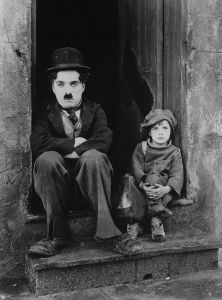
In his earliest works The Tramp made a name mostly for his antics but here Chaplin shows an innate understanding of pathos which would become his main calling card throughout his illustrious career because it was never just about the jokes. Surely, the Tramp is a gloriously funny character time and time again but that would mean nothing without his tender heart and soul. The qualities that in one sense make him “a tramp” but also allow him to win over the masses because there are very few figures who have ever been so endearing. If anything The Kid shows that The Tramp could also make a sympathetic father.

Edna Purviance is cast as a Hester Prynne type heroine except she gives up her child, an ignominious reminder of her transgressions, only to regret the decision later on. Because she has fortune smile upon her and with her destitution gone all she can think of is the child who she left behind — the child she lost. It leads her to spend many of her waking hours in charity paying visits to the poorest of the town, unwittingly bringing her in contact with the very son she is looking for.

Except he has grown up in the stead of the lowly Tramp who found him discarded by a rubbish pile. Though he’s at a bit of a loss of what to do with a small infant initially, he uses his general ingenuity and natural affections to take on the paternal role. Jackie Coogan is the boy, and the cutest, pluckiest kid you’ve ever seen with a floppy mop of hair often kept in check by an equally floppy cap. And it’s fitting that he would be the most prominent child stars before Shirley Temple or Jackie Cooper and all the rest because his adopted father was the patriarch of Hollywood.

There’s an inherent chemistry that just simply works between Chaplin and Coogan as they sit around their humble flat together eating pancakes or traipsing around town shattering/repairing window panes. Some of the street scenes especially share striking similarities to Chaplin’s Easy Street as he must face off against the town thug and authoritarian policemen while his son battles it out with a pint-sized bully. Both throw wickedly hilarious haymakers.

Strikingly, in this narrative, Chaplin leaves behind the more simplistic themes of his earlier shorts to go for more lofty territory and it pays heavy dividends. There’s also an indisputable spiritual undertone to the film that becomes evident through numerous allusions. First, with the women and making her into a sort of scandalized martyr. Going so far as to intercut her tragedy with an image of Christ carrying his cross up to Golgotha to give his life for all humanity. It’s certainly hyperbole but also an astute piece of storytelling. Because no matter your religious belief, there’s no doubt this parallel casts our heroine in a sympathetic light as well as Chaplin’s rather overt choice of placing her in front of a stain glass window giving her a makeshift halo.

In the film’s waning moments, the heavenly dreamscape of harps, angels, and yes even a few demons fill up the Tramp’s head and give Chaplin yet another creative avenue as his visions take him into a world rife with whimsical antics that signal a change. Whether or not the new heaven and earth are realistic is nominally beside the point because they suggest the joys that are ahead for the Tramp and his adopted child.

Fittingly he’s reunited with his son in the residence of the woman who welcomes them both in.The lost get found, the downtrodden get lifted up, and all can be redeemed. A fluffy conclusion, perhaps, but an enjoyable one nonetheless from one of the seminal masters of storytelling. You can make the argument that there were greater directors than Chaplin but he truly was second to none not only as an actor but in building a universal connection with his audience. A connection that still manages to reach out to us earnestly nearly a century later.

4.5/5 Stars

Charade (1963)

Charade_2.jpg

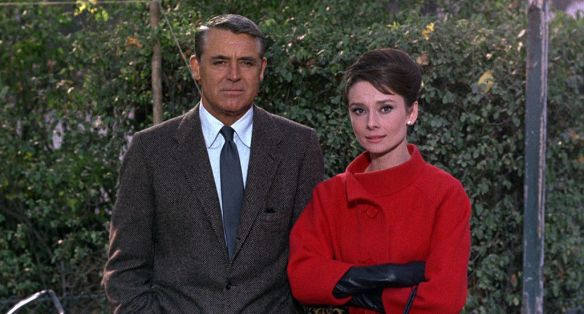
It’s easy to yearn for the days where they made stylish, amusing films like Charade which were equal parts charm, class, and wit all stirred together to perfection. Those were the days when two stars as beloved as Cary Grant and Audrey Hepburn could carry a picture no questions asked because people would turn out to see them no matter the story. And it’s true, though they were never in another picture together, there’s a wonderful chemistry that builds between them and never ceases from the outset of this lithe thriller.

From their first exchange up until their last, it’s hard not to delight in their every interaction, every word, every smirk. There’s a consistent playful patter bubbling up that’s at times suggestive but never loses its sensibilities. There’s a constant twinkle in the eyes of our stars interrupted every now and again by brief moments of sheer terror. Hepburn playing her elegant self but perpetually frantic while Grant exudes his general charisma that sees him through peril as well as innumerable comic situations (ie. an awkward game of pass the orange as well as showers with his clothes on).

Of course, it hardly hurts a bit that Charade has a surprisingly tense plot that while a little flimsy in some areas still manages to have a plethora of twists, turns, and about-faces to come off generally befuddling like many of the most enjoyable thrillers out there.

It all begins with a body getting tossed from a passing train. Regina Lampert (Audrey Hepburn) is on a vacation on a snowy mountaintop away from her husband with a wistful sense that her marriage is done for. Little does she know how right she is. She returns to her residence in Paris only to find all her belongings gone and her husband dead. The police believe it has to do with a missing $250,000 that Lampert was purported to have absconded with during the war. Their guess is that one of his old platoon mates let him have it so they could get the payload for themselves. All of this is news to Regie who was painfully ignorant of her husband’s affairs. And now with it all dropped in her lap, she doesn’t quite know what to think.

The police inspector (Jacques Marin) on one side questioning her and the Federal Agent Hamilton Bartholomew (Walter Matthau) frightening her out of her mind. The only real bright spot is her newest acquaintance Peter Joshua (Grant) and she’s bent on chasing after him before the people chasing after her catch up. Because life, even a spy life, is better with a companion.

Forget the fact that this film has often been attributed to Hitchcock. This is Stanley Donen’s creation and if nothing else it exhibits his admiration for the Master as well as his adaptability taking his own skills as a comedic and romantic director and adding a touch of the thriller to the mix.

He makes it work very well and paired with the typically jazzy score of Henry Mancini, a continually entertaining script by Peter Stone, and generally immaculate color cinematography by Charles Lang, Donen can’t miss.  If it’s not the greatest film if only for the very fact that it doesn’t take itself all that seriously, Charade uses that very quality to its advantage with plentiful splashes of fun and romance.

Audrey Hepburn robed as per usual in iconic creations by Givenchy looks to play the huntress on the prowl. While on his own admission Cary Grant takes the passive role as the pleasant older gentlemen who nevertheless wears many hats and many names. Though Hepburn and Grant undoubtedly take center stage and rightfully so,  that’s not to discount quality character actors like Walter Matthau, George Kennedy, and James Coburn filling in as the deceased Charles Lampert’s old war comrades each carrying a bit of a vendetta.

The surprisingly tense conclusion sweeps through the Parisian streets, subway stations, colonnades, and finally an abandoned theater. But, above all, Charade does well to neutralize its more intense or even grisly moments (at least by 60s standards) with its persistent charm. The type of charm that make those films of old so endearing much like the actors who starred in them.

It’s as if in the twilight years of the studio system some of the greatest names coalesced to gift the world another gem for the road. There certainly were signs of change with wistful mentions of Gene Kelly’s early classic An American in Paris or a passing remark about stamps commemorating Princess Grace’s coronation (which took her away from a brilliant film career). At 59 Cary Grant was aging gracefully but still near the end of his career with only two more pictures to follow. And Audrey Hepburn herself would finish out the 1960s with several notable classics and then she would all but conclude her illustrious career for good.With Stanley Donen still with us, he truly acts as one of the last strands connecting this generation with those Golden Years of Hollywood.

However, the most significant reality is that this film came out in December of 1963, a mere month after John F. Kennedy was assassinated near the Book Depository in Dallas Texas. That singular event more than any other was emblematic of the change that would surge through society and the world at large. That is the world that Charade was born into.

So if you were to use the unforgivable cliche at this point that they “just don’t make movies like they used to,” you probably would be correct because that’s close to the truth. Films like Charade are all but gone and when you actually consider the joy of watching Hepburn and Grant together, it really is a terrible shame, though it simply seems a testament to the rolling tides of change.

Still, there’s something truly magical that occurs when they’re together. They were an altogether different breed of star. Maybe it’s the way they carry themselves, dress, or speak. Maybe it’s the way they look at each other. Maybe it’s their quips. Maybe it’s something else entirely. But they’re two of the greatest we’ll ever know for the simple fact that they were so beloved. They made us love them and as a result, we buy into this entire film. We bought into their charade and enjoyed every last minute of it.

4/5 Stars

The Princess Bride (1987)

the princess bride 1.png

Few films can please the restless masses that inevitably gather at some unfortunate souls home for a movie night. Because as varied and diverse individuals of a myriad of backgrounds we very rarely agree on anything especially given the proliferation of content that is available to us at any given time. But most can agree on one thing. The Princess Bride is one of the great crowd pleasers of its generation and for good reason.

If quotability was the sole parameter for a great movie then The Princess Bride has few equals and it also happens to be the most fun you’ll have in a single sitting because all that it does, it does with an unquenchable zeal. There’s a spirit to the film full of romance and humor and adventure, even playing to those who will forever be skeptical.

Adapted from his own novel, the venerable William Goldman carries over his framing device of a grandfather reading to his sick grandson and it works marvels to bring us into this tale. Especially when the two actors in question are a precocious Fred Savage (Pre-Wonder Years) and the inimitable Peter Falk (Post-Columbo) slipping seamlessly into the role of a grandpa with a twinkle in his eye.

The story unravels like many great fables with a love story torn asunder by circumstance. A young man who goes off to seek his fortune only to die (or more likely take on the identity of the Dread Pirate Roberts) and a young maiden who is made a princess and remains unhappy all the same without her true love. Of course, she does not understand the nefarious intentions of her soon to be husband Humperdinck nor that her love is going to great lengths to find her. And amidst the fantasy, swordplay, trickery, and rampant humor, love conquers all as it has a habit of doing in fairy tales with everyone of note living happily ever after.

This unabashed tale also boasts near pitch-perfect casting. Cary Elwes as Westley does embody a certain quietly confident charm that while not quite Flynn or Fairbanks still manages to guide the film with similar charisma. He can be the hero, handsome and witty, made to play perfectly off all the intriguing figures who inhabit this fairy tale.

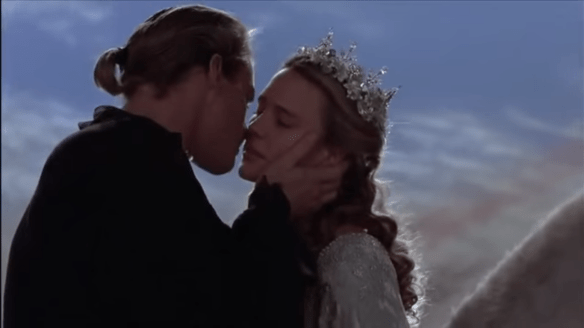
In her debut, Robin Wright glows with a radiant beauty and stubborn defiance that’ s enduring and which in many ways has remained a defining moment in her career and it’s certainly not a bad film to be forever remembered for. Meanwhile, Mandy Patinkin plays the vengeful Spaniard Inigo Montoya with the perfect amount of bravado, honor, and charm in his lifelong search for the six-fingered man who killed his beloved father. He’s the perfect accompaniment for Andre the Giant’s lovable brand of brawn and Wallace Shawn’s hilariously irritating turn as their cackling leader.

But what makes the film even better or the odd sorts who pop up here and there including Miracle Max (Billy Crystal) a curmudgeon wisecracker like no other and The Impressive Clergyman (played by the oft-underrated Peter Cook) who single-handedly ruined the solemnity of wedding vows for all eternity.

Rob Reiner is rarely considered a masterful director but if anything it’s easy to make the case that The Princess Bride remains years later his greatest achievement because it has so much life provided indubitably by Goldman’s superlative script and the very figures who dare to fill his world. And Reiner captures it all with a clarity that comprehends the humor but very rarely goes for that at the expense of characters or story (unless they are villains or Billy Crystal). After all, this isn’t a Mel Brooks film.

By this point, it’s a disservice to call The Princess Bride a parody or mere homage– simply a cult classic that’s garnered widespread affection. The reason people love this film is connected to those aspects but also the very fact it stands on its own.

As Falk sings the praises of the story early on, so we can affirm, it has “Fencing, fighting, torture, revenge, giants, monsters, chases, escapes, true love, miracles…” If that’s not exciting nothing is and it’s quite easy to forget that the film is continuously hilarious but there’s something remarkably moving about its story.  It plays the comedy well but simultaneously builds its own road through the mythology and fantasy of fairy tales that have captivated all people for eons.

In The Princess Bride, there’s not simply roots in comedies like The Court Jester but swashbucklers like The Adventures of Robin Hood or the magical journeying of the Wizard of Oz. It covers the spectrum of entertainment which is part of the reason it’s so satisfying.

It has scenes, moments, lines, those little idiosyncrasies and quirks that have left an indelible mark on viewers and as a result our culture as a whole. Lines like “As you wish,” “INCONCEIVABLE,” or best yet, “My Name is Inigo Montoya, you killed my father. Prepare to die.” Each has its special place within the context of the film and is still imbued with that same meaning hours after.

If I write about this film more from my heart than my head you’ll have to forgive but it truly is a weakness. I can envision being little Fred Savage enchanted by the sheer magic of fairy tales. I wouldn’t begin to care about romance until years later but swashbuckling and humor always had me enthralled and they continue to capture my imagination to this day–no more powerfully than in The Princess Bride.  It’s sheer magic in all the best ways.

5/5 Stars

Blazing Saddles (1974)

Blazing_saddles_movie_posterThough it’s easy to be a proponent of Support your Local Sheriff for its sheer scatterbrained zaniness, Blazing Saddles has that and something more to offer, making it arguably the greatest western satire of all time. Brooks took part in all facets of the film as was his normal prerogative and he sets up the introduction with Frankie Laine belting out the main theme with a tremendous gusto that evokes the grandeur of the West. It makes it ten times funnier when the film actually begins to hit its stride. Because it sounds like a western in the beginning, it even looks like a western, and it goes through many of the plot cycles that we’ve grown used to, but in other ways, it’s so fundamentally different.

The most obvious demarcation Blazing Saddles takes in telling its tale of the Old West involves the very fact that Bart (Cleavon Little) is made acting sheriff of the quaint frontier town of  Rock Ridge. In actuality, it’s all part of a nefarious scheme by the local man in black Hedley Lamarr and his right-hand thug Taggart (the iconic Slim Pickens). Hedley Lamarr uses the incompetent, womanizing governor as his pawn to get the new sheriff installed so the town will be sent in an uproar and he can swoop in and buy off all their land. After all, none of the white folk could possibly hope to live in a town with a black sheriff.

So that is the main conflict at the center of Blazing Saddles and it’s absolutely ludicrous and at the same time still somewhat unnerving and telling about American society. Mainstream white society did not really know how to cope with African-Americans and other racial minorities in some ways and even more so they didn’t know what to do with their own amount of messy history. Because it’s true that even in film, the mythic Old West was not very good to Native Americans or Asians and African-Americans were all but nonexistent. And in his film, Brooks takes all of that on thumbing his nose at every archetype as well as political correctness (although that term undoubtedly did not exist as prevalently as it now does throughout our culture).

Supposedly the writer’s room was utter mayhem for this film with Brooks certainly at the center of the mix with the likes of Richard Pryor and Andrew Bergman also heavily involved. No matter the amount of chaos, however, the film does come off fairly well. It’s laden with purposely absurd anachronisms like Count Basie’s orchestra, for instance, a medieval hangman’s noose complete with a medieval hangman, and of course, droves and droves of Nazis and other baddies who answer Hedley Lamarr’s call for criminal types of all descriptions.

There’s a local dance hall singer (Madeline Kahn) who does her best Marlena Dietrich knockoff from Destry Rides Again, while Mel Brooks even manages to portray a Yiddish-speaking Native American who allows the segregated black wagon train to pass as the whites get attacked.

Gene Wilder takes on a typically understated role as the town drunk and deputy who shares some traces of Dean Martin’s role in Rio Bravo. Meanwhile, the locals (all named Johnson) gather at their place of worship to have a plaintive dialogue about what they are to do to protect their good names a la High Noon. So there you have it. That’s the film in a very small nutshell as Bart must try to calm the townsfolks fears and quell his enemy all the while trying to not go crazy with all the racist white folk.

Be warned that this film does have funny segments but it also happens to be fairly crude which is not necessarily a surprise. Still, it’s obviously something to consider before watching. But it does seem that sometimes comedy such as this is able to enter territory that we’re squeamish to go in our everyday conversations and more serious moments. Because in some sense maybe comedy can poke fun at all the things we take so seriously — the things we need to lighten up about and connect over by the very fact that we’re all human beings.

However, it can also be pointed, ribbing its audience as it highlights the very things problematic not only in our past but in our present too. And that’s one of the most redeeming things that can be taken out of Blazing Saddles. Sure, you can take it simply as a raucous, inane, often vulgar western comedy from the estimable nut Mel Brooks, but it also speaks a little bit to film’s ability to enter into areas that we as a society still need to address.

The use of the “N” word throughout the film personally makes me tense as that word has so much history and a racial charge going through it. But when Brooks used it, apparently with the vehement backing of Cleavon Little and Richard Pryor, you could even argue that its very use takes some of the power away from those who wish to use it perniciously. But that’s necessary dialogue to have.

The best scene in the film has to be near the end, at the studio, as the camera pulls back and we realize we’re only on a film set. An absolute doozie of a pie fight ensues at the commissary to punctuate the utter tumult that is going down thus far and Hedley is pursued by Sheriff Bart and the Waco Kid to the film’s premiere. In the end, they get their man and ride, err, are driven off into the sunset. The fitting ending to arguably Mel Brooks greatest cinematic achievement.  If John Wayne’s any litmus test, Duke famously told Brooks being in the film didn’t fit his image, but he would be the first in line to see it. That gives you a good idea of what you’re in for.

4/5 Stars

Road House (1948)

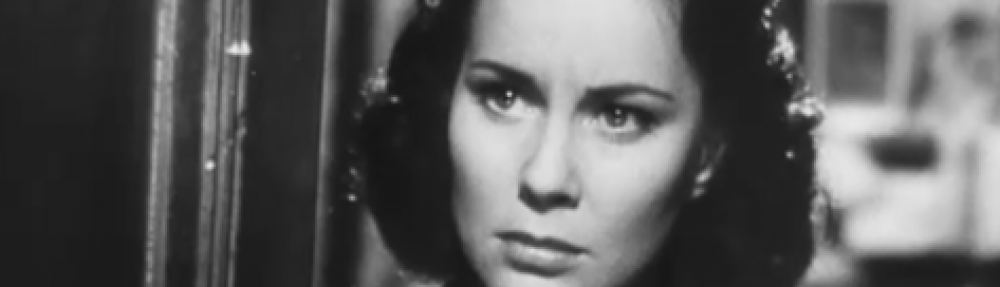
Road House 1“Doesn’t it ever enter a man’s head that a woman can do without him?” ~ Ida Lupino as Lily Stevens

Jefty’s is quite the joint. Bowling, drinks, floorshows. In a one-horse town, it’s the place to go especially when the establishment’s proprietor (Richard Widmark) brings in the alluring nightclub singer Lily Stevens (Ida Lupino) to liven up the bar. Although he hired her without much forethought following a trip to Chicago, Jefty’s convinced this girl is really something although his faithful right-hand man Pete Morgan (Cornel Wilde) has her pegged from the start.  Smoking and playing solitaire. It sums up her life. It’s true.

They don’t exactly hit it off because he thinks he already knows what type of girl she is and she’s not too happy about getting pushed out of this gig. But ultimately she stays, the general public starts coming in droves, Jefty’s happy, and Pete does his best to keep away from her. But she does exactly the opposite. She appreciates Jefty but really has eyes for Pete and she pursues him.

What the film hinges on is really a love diamond with Ida Lupino and Cornel Wilde at the points. She is the object of desire for Jefty who thinks he could finally tie the knot with a girl. He’s in love no question. But Pete warms to Lily as well and is the one looking to go away with her. There also must be some necessary credit given to Celeste Holm for her performance although she has the most thankless role as Susie, the cashier at the Road House who also has obvious feelings for Pete.

But everything is thrown for a loop when Jefty comes back from a week long hunting trip with big news to spring on Pete. He’s gotten a marriage license. He’s going to ask Lily to marry him. However, over that same week, Pete and Lily have gotten closer than ever. Obviously, when the truth comes out the old friends have it out and the two lovers look to leave town.

The whole film thus far, Jefty has been a bit of a loose cannon but a generally nice guy. Except on a dime, things turn. Soon Pete is being detained for some cash missing from the company’s safe that his old friend claims is missing. It’s Pete’s words (with Lily’s) against Jefty’s with the police in the middle. It seems like a small deal but in a whirlwind sequence of events, Pete is brought to court and convicted of grand larceny. However, in a diabolical turn of events, Jefty becomes Pete’s savior as well as his master following a talk with the judge who agrees to put the convicted man on probation at the Road House. It’s just like old times, the gang all back together again except this time Jefty has Pete in a bind. One false move, one thing that he doesn’t like and Pete goes back to fulfilling his prison sentence. Jefty’s got him on a string and everyone knows it.

It’s in these moments where the remnants of the maniacal cackle of Tommy Udo from Kiss of Death begin to rear their ugly mug. And the next hunting trip Jefty plans with everyone included fills liked forced fun. No one’s having it and Lily and her love look to take one final chance to run away because any life is better than a life under Jefty’s thumb. What follows is a race for the woods and the Canadian border with Susie fleeing after them pursued by the crazed man packing a gun a bit like A Dangerous Game. It’s bound to be a deadly finale. Someone has to lose.

Cornel Wilde always feels too much like cardboard or plastic, whichever you prefer especially when put up against Ida Lupino and Richard Widmark. The latter pair is more at home in the worlds of film noir, Lupino being both alluring and assertive, boasting a gravelly voice perfect for rasping out “One for my Baby (and One More for the Road)” that is enhanced by her smoking habits.

Meanwhile, Widmark always had a handle on the sleazy and embittered characters who were in one moment grinning and in another seething with a cunning anger. There’s a volatile polarity that he taps into that makes most every character he plays enjoyable as we slowly watch their evil tendencies overwhelm any good that is in them (or vice versa). He also likes hitting the sauce. Cigarettes and booze have always been a hallmark with noir and so it is with this film. So if you’re looking for a good time and a bit of uncompromising filmmaking, look no further than the Road House.

3.5/5 Stars

Casablanca (1942): 75th Anniversary Review

Casablanca,_Trailer_Screenshot.JPG

When someone inquires if I consider Casablanca one of my favorite movies, I don’t quite know how to respond. Yes, I do love this film passionately but I feel as if Casablanca is more deeply America’s favorite classic movie. It is not for me to call my own and I will gladly share a joint appreciation for it. Because it’s a film for all of us. As it should be. It’s the perfect articulation and expression of that former Hollywood that existed during the studio age as brought to us by Michael Curtiz.

When we are finally allowed to enter into Rick’s Cafe Americain, it almost feels like hallowed ground. It’s a mythical place that never existed in reality and yet feels so immersive to us as an audience. Curtiz moves through the space with such intent that it makes us completely involved with every person his camera settles on. This is a picture for romantics and sentimentalists to be sure but it caters to those with a cynical edge too. It suggests a deceitful world of pickpockets, unscrupulous officials, and of course, Nazis.

The political tides of the times are reflected in that cinematic bastion of a man Rick Blaine (Bogart). His foreign policy is that he sticks his neck out for no one. But that’s only on the surface. That’s the beauty of the character. There’s a sensitivity and a sacrificial nature that wells up deep inside him, hidden from view. Tortured and embittered as he is, that is not the last word.

There’s also an undeniable undercurrent to the film. Yes, this is not reality. As enveloping as it is, this is wholly a Warner Bros. aesthetic but moreover there’s a sense that the emotions that deluge over Casablanca are very real.

Aside from Bogart and the lovely, incomparable Ingrid Bergman, our cast is made up of a plethora of emigres, men and women, who fled the Nazis for this reason or that. Whether they were Jewish or had different political affiliations or just couldn’t bear to live under such an oppressive regime.

Director Michael Curtiz was originally from Hungary and in him, we find someone who totally understood the plight of those fleeing and the context of the moment where Casablanca was only a pitstop for America. Because take the picture out of its context and something would be lost. Firmly plant it in the era and you have blessed the production with something enduringly special.

Furthermore, in the scene where Lazlo (Paul Henreid) calls on the band to play “La Marseillaise” to drown out the German’s proud merrimaking it ceases to be a mere scene in a film but becomes an event that swells with real emotions. You can see it in the very body language, the tears in the eyes, and the fervor that comes over everyone. Madeleine Lebeau (the film’s last surviving cast member who passed away last year) singing defiantly, with the tears freely flowing. No longer acting but pure feelings incarnate.

When so many other minority characters make me cringe in pictures of the 30s and 40s, Sam, the piano man (Dooley Wilson), remarkably rarely does. That’s because he’s endowed with a certain autonomy attributed to him in part by Blaine. They are partners, friends, and they watch out for each other.

His singing holds the love story together. Like many of the film’s greatest faces, he’s not a mere sideshow attraction. There’s a necessity to his characterization that adds another dimension to the world that has been conjured up on the Warner Bros. lot. What would Casablanca be without Dooley Wilson, Peter Lorre, Sydney Greenstreet, S. Z. Sazall, Curt Bois, Leonid Kinskey, Marcel Dalio, John Qualen, etc.? It would lose so much color — so much definition.

Another joy of the picture after you see it too many times to count is the continued relish of the script, waiting for your favorite lines only to be taken with new quips that you never picked up on before. For me, most lines of this nature come from the wonderfully amoral and yet completely personable Captain Renault (Claude Rains). But there’s also so much going on around the edges of the frame. One of my favorites involves the young woman who fled from Bulgaria with her husband. The young lady is played by Jack Warner’s step-daughter Joy Page.

Here we see a relationship that mirrors that of Rick and Elsa in a way that only becomes apparent later on. Because she is a woman desperate to get to America with her impoverished husband. He is trying to win money gambling but it’s a desperate even futile situation.

She loves him so much, she is willing to try and use her own beauty and the influence of another man, Inspector Renault to help the man she truly loves. There’s so much subtext to the scene written with the production codes in mind and the sincerity is immediately evident even if some of the import can be lost on us. The same can be said for the foreshadowing.

Part of what makes the picture’s final act work is the fact that Lazlo is such a decent human being. He loves his wife so much, he’s willing to have Blaine take her to safety by using the Letters of Transit if need be. Thus, this dichotomy is set up and Rick must make a decision. He must do the thinking for both of them but that request from Lazlo saves Rick’s reputation no matter the decision that he makes. We know that either might be right. Even though deep in our hearts, there’s only one denouement we want.

Did I even need to write this review? Certainly not but it’s more for my sake than anyone else’s. Casablanca is a dear friend of mine and after 75 years it still comes up smelling like roses. Its themes are timeless in the sense that it allows romance to be its guiding light while still tempering it with the disillusionment and licentiousness that often is so prevalent in this world of ours. That makes its bittersweet interludes ring with a certain deep-seated truth that never comes off as fake. It’s as evocative and witty now as it was in 1942. Perhaps even more so.

5/5 Stars

Manchester by the Sea (2016)

Manchester_by_the_SeaIn Manchester by the Sea, you can distinctly see Kenneth Lonergan once more translating some of his skills as a playwright and stage director into his film. There’s a very inherent understanding of two-dimensional space and how images can be framed in a very linear way as they would be seen by an audience taking in a stage production. But even more noteworthy than that is his dialogue which functions in remarkably realistic ways. Some will easily write this film off as the sheer doldrums because it’s fairly fearless in its pacing.

But that very structure and the things it spends time on slowly reveal more and more about the characters as if the curtain is slowly being torn away and their guts are being spilled out in front of us, in the most labored way possible.

It’s true that a great deal of the acting is an exhibition in non-emotive near anti-acting. It goes against the normal penchant for histrionics and gut-busting displays of emotion. Those crop up here and there understandably for a story that deals with such heart-wrenching topics. However, this particular study finds the majority of its most illuminating revelations in the minor moments, quiet asides, and soft tears rather than more overt outbreaks.

Sometimes it’s those very dramatic moments that catch our attention but most of the film — most of the instances that we actually come to learn a great deal about these seemingly unextraordinary individuals happens in the moments that initially appear far more mundane.

Crucial to this whole narrative is Casey Affleck as Lee Chandler. His performance is painful to watch because he himself looks so uncomfortable, despondent, and forlorn in every frame. There’s no relief for him. He never gives it to himself and he never accepts it from others. The fact that his elder brother has passed away suddenly is the inciting action that only aggravates his status quo but it’s not the main cause for his current state of being.

Because, of course, the question becomes what happened to him to make him such a misanthrope? That’s one issue because the past informs his present and stoke the flames of his continual discontentment.

The latest revelation is that he is made the legal guardian of his teenage nephew and this among all his other personal demons is the situation he must grapple with. Their dynamic stays front and center.

Together they must navigate all the responsibilities that come after Joe’s death whether it’s signing off on his belongings or setting up his burial with this insurmountable amount of grief still hanging over them. Lee willfully takes his nephew to school and band practice at one of his girlfriends.

But he’s not good at showing affection. He’s difficult and in such a contentious moment of pain they both lash out at each other more than once. But there’s still an underlying sense that they care for each other. Lee wants to protect his nephew but he doesn’t quite know how–he does not know if he will be able to bear the responsibility.

Still, others of note also crop up and play a part in the story including Lee’s ex-wife Randi (Michelle Williams) who has moved forward with her life but still feels tortured for the very way that she treated Lee when they were married. There’s so much hurt there and Lee buries that too.

His now deceased brother (Kyle Chandler) who we begin to meet through flashback is not developed quite as much but he does stand as a symbol of family and how deeply the loss of loved ones is earth-shattering. Because often these are the people who are a perpetual part of your life. You come to love them and accept that they will always but there. Even when your own life is going down the drain at least they remain. Except in an instant, their flames can be cruelly snuffed out.

The story’s visuals not surprisingly cast a vision of a tranquil seaside locale that nevertheless can be a place of bitter cold and blue-collar mediocrity. Lee would be the poster boy of this lifestyle as he spends his days as an isolated handyman janitor grinding away at life. But as with any life, we can never make preconceptions. We need to get to know someone before we judge their character. That’s what a film such as Manchester by the Sea makes us realize as human beings.

Everybody has a story. We all make mistakes. Our flaws are many. No one knows how to cope with guilt and it hurts like a slug in the face sometimes. Even if it is a taxing film and a difficult film to traverse with its share of profanity, Lonergan’s piece is still a nuanced look at what that process is like. Perhaps you haven’t experienced the death of a loved one yet but most definitely you have and you know the pain and the helplessness and the messiness therein.

If any of that resonates with places you’ve been before then Manchester by the Sea might easily speak to you because it understands some of the unassuming power in the human experience and its innumerable complexities. Unsatisfying in the end, yes, but alas that is life so often. People constantly struggling with trials, tribulations, and dissatisfaction til the end of days.

It’s after one particular scene where a very special guest star makes an appearance a man that Patrick notes is “Pretty Christian” while Lee responds that “we’re Christian too. Catholics are Christian.” And he’s perfectly correct. It’s in this passing moment that the film teases on something interesting that it, unfortunately, doesn’t wrestle with more. Spirituality and faith in a God in the midst of suffering. Maybe the characters still need time to get there and that’s okay. But Manchester by the Sea does make us empathize with other people and come to understand their stories. That is crucial if we’re ever going to live together in this world of ours. For that reason alone this story has something to offer us.

4/5 Stars


Suddenly (1954)

Suddenly_(1954_movie_poster)In some ways, the sleepy town of Suddenly feels like it could have easily been the prototype for Mayberry (Willis Bouchey’s appearance acting as the one actual tie-in to The Andy Griffith Show). The sheriff wanders around lazily. He knows everyone by name and they probably haven’t had anything exciting actually happen for 20 or 30 years at least. But then they go and have something bigger than Mayberry ever dreamed. No filling station robberies, or shipments of gold, or even a group of out of towners trying to case the bank. This is big. It involves the President of the United States and Frank Sinatra or rather Johnny Baron, the man who`s looking for a big payday from assassinating the commander in chief. But people generally liked Ike and so the Secret Service roll in to take the necessary precautions including cueing in the local sheriff on the particulars and shutting down the town.

But the one family that doesn’t happen to get the memo are the Bensons who just happen to have the property overlooking the town — the perfect point to knock off an unsuspecting president from but, of course, a thought like that would never cross their minds, not in a quaint town like Suddenly. Still, Baron has thought about it quite a lot and he and his cronies make a house call on the Bensons and subsequently take over their humble abode, except the family doesn’t realize yet that this is a home invasion.

It just so happens that one of the Veteran servicemen Agent Carney (Willis Bouchey) goes way back with Pop Benson (James Gleason) and so he and Sheriff Shaw pay a visit to the family but the welcoming committee is far from obliging. After the initial setup, the film evolves into a tense drama involving not only the imminent attack on the President but the very real hostage situation that we are now privy to. The majority of the ensuing drama is crammed inside the tight quarters of the home as all the hostages tensely wait for events to unfold. Sheriff Shaw looks to keep Baron talking as they bide their time.

But even his background in law enforcement cannot fully prepare him for who he is dealing with and that’s a great deal of the enjoyment that comes out of Suddenly. The characters are ripe with possibilities and Sinatra, in particular, gives an electrifying performance off of Hayden’s somewhat uncharacteristic stalwart turn.

Paul Frees as one of the thugs wasn’t quite bad-enough (sorry for the Rocky & Bullwinkle pun) and the other hired gun is constantly clutching his ulcer.

Richard Sale’s script is surprisingly vibrant and it does a lot in a limited amount of time building up connections and backstories of characters that help make each life valuable while simultaneously increasing the stakes, packing a punch on multiple occasions. And although there were more guns than I was expecting it’s far more than a simple shoot ’em up.

Sinatra’s character is tormented by demons, constantly referring to his own war record and the silver star he won, and in the same breath writing off the hit on the President as just another job for him. It’s true that the specters of World War II seem to affect everyone. Likewise, Ellen Benson (Nancy Gates) must grapple with her own hatred of violence and guns as a result of her husband’s death in the war that keeps her from allowing her spunky son Pidge from seeing war movies or playing with firearms. She’s also hesitant to indulge the calling of Tod because she’s not ready to move on. Each of these aspects underlines the film’s main conflict.

There’s also some striking connections that can be made to the Manchurian Candidate (also featuring Sinatra) as well as the realization that this was the pre-Kennedy era, meaning no one knew what was possible. In some ways, the film’s premise seems rather incredible but then again maybe it was more credible than even the makers of the film realized. Just a few years down the road our President would be killed, the man Frank Sinatra would sing a campaign slogan for.  So, Suddenly comes off as a B-picture but it rises above those meager expectations and turns into a fairly impressive thriller with some stalwart talent and moral issues anchored in its plot.

3.5/5 Stars


Blade Runner: 2049 (2017)

Blade_Runner_2049_poster.pngThe finest compliment that can be paid to Blade Runner 2049 is that it is indubitably the most enigmatic film I have seen in ages. Typically, that’s newspeak for a film that probably deserves multiple viewings, because its intentions, much like Ridley Scott’s Blade Runner (1982) are not always clearly laid out. Especially in this day and age when we often expect things to be given to us and our hands to be held as an audience.

For that very reason, those who admired the original will potentially find a worthy successor in Denis Villeneuve’s rendition but this cult franchise might be hard-pressed to convert a new fanbase. Because while the greatest cinematic achievements are often equally artistic endeavors and continually entertaining, Blade Runner is worthy of the former while still lacking the kind of visceral fun that will grab hold of a new generation.

Still, there’s a necessity to draw up a distinction between faulty pacing and a film that is completely comfortable moving at the pace it deems important. The film paints in panoramas and epic strokes that the Ridley Scott’s original simply could not manage. Though perhaps more importantly, it did develop a cyberpunk, tech-noir aesthetic that created a new template for so many future projects.

The veteran cinematographer and Villeneuve favorite, Roger Deakins, produces visual splendors of the first degree with his own brand of photography. They are the kind of immaculate frames where shot after shot can be admired each one on its individual merit as if perusing a vast gallery of paintings. One important key is that oftentimes we are given enough time to take them in without frenetic editing completely cannibalizing the pure joy of a single image.

It can similarly be lauded as not merely a piece of entertainment for thinking people but a piece of visual art and a philosophical exploration. That last point will come up again later.

But it’s also quite easy to liken this installment to George Miller’s Mad Max Fury Road (2015) which was able to provide a facelift to its material by successfully expanding the world that had been built in the original Mad Max trilogy. Likewise, this movie maintains much of the integrity of its predecessor by seeing the return of several cast members, screenwriter Hampton Fancher, and even Ridley Scott to a degree as executive producer.

Our story in this addition begins with a new model of replicants, Nexus-9, who are used as the current force of blade runners as well as other more menial duties. Among their ranks is K (Ryan Gosling) an officer assigned by his boss at the LAPD (Robin Wright) to track down the last remaining rogue models of “skin jobs” still surviving.

Simultaneously the Tyrell Corporation has been replaced by a new organization led by a visionary named Wallace (Jared Leto) who has aspirations to create an even more magnificent android in search of true perfection of the human form. He’s also very much interested in a mysterious discovery that K makes while performing his duties.

Wallace sends out his henchwoman (Sylvia Hoeks) to do his recon for him. Meanwhile, K travels far beyond the metropolis of Los Angeles with its unmistakable imagery full of Coca-Cola ads, Atari game parlors, and countless women walking the streets looking to pick someone up.

It’s comforting to know that my home away from home, San Diego, has been turned into a giant rubbish heap while Las Vegas looks more like the Red Planet than any earthly locale though still strewn with the remnants of the strip’s sleaze. If we ever took for granted that this is an apocalyptic world then we don’t anymore.

In keeping with the integrity of the picture and the curiosity of the viewers, it’s safe to say that Edward James Olmos makes his return as Gaff still partaking in his origami-making ways though his subject matter has changed slightly. And of course, the man everyone has been waiting for, Rick Deckard (Harrison Ford) is of crucial importance that becomes at least a little bit more clear as K progresses in his search for concrete answers. The cornerstone of the story is, of course, Deckard’s beloved Rachael and the life of anonymity he has taken up since his retirement as a blade runner.

But until its very last frame Blade Runner 2049 feels cryptic and mesmerizing in a powerful way. The narrative is so expansive and grandiose making it questionable whether or not the film is able to maintain a cohesive core with a singular purpose but some potentially profound ideas are undeniable.

Plenty of spiritual imagery courses through it and hardly by accident. An almost Christ-like birth of a supernatural nature remains at its center and what we can presume to be several very conscious references to the book of Galatians —  a letter that not only tackled the so-called “fruits of the spirit” but Gnosticism or the idea that the Creator was a lesser divinity (not unlike Wallace).

Upon reflection, I’m still partial to the original because while both films grapple with the dividing line between the human and the non-human, the first Blade Runner came from a human perspective and that’s even in how it was shot and the technology of the time. It looks like our world, dark, dank, and gritty as it may be.

But in this narrative, while a further extension of that same world much of what we know is in question and it hardly feels like we are taking on a human point of view anymore but we are put in the place of a replicant — an android — even if he has a desire to be human. And again, that lack of humanity reveals itself in the very frames of the film full of unfathomable sights acting at times like a tomb-like mausoleum– so bleak and austere and cavernous.

That is to say that the original even in its darkness still managed to have a soul in the incarnation of Deckard. This picture though trying so desperately to do likewise feels even more detached. It, in some ways, brings to mind Gosling’s Drive character who was very much the same. And yet the other side still deserves some acknowledgment because there is an underlying sense that K does evolve into a more sympathetic individual as time passes. The case can be made that he is the most human.

Going beyond that, it’s also an exploration of how the world is saturated with sex and probably even more so than its predecessor. There’s a particularly unnerving scene where a man tries to combine fantasy with physical intimacy in a way that feels all too prevalent to our future society and consequently it brings up similar themes to Her (2013).

Even in such a future, it’s comforting to know that Presley and Sinatra live on in the hearts and the minds of the populous though that reassuring truth cannot completely overshadow the myriad of issues still to be resolved.

The final irony remains, the problems do not begin with the replicants themselves but in the hearts and souls of mankind. I see that central complexity of the film very clearly reflected in the two iconic objects. One an origami unicorn, the other a wooden horse.

Because we can read into the first if we want to as an indication that Deckard is a replicant and we can see the latter as confirmation that K is, in fact, human and yet on both those accounts we might be gravely mistaken. It comes downs to our own personal perceptions. Whether these beings were “born not made” or vice versa.

It gives more credence to the assertion that the eyes remain the window to the soul. That is never truer than in Blade Runner a film that fittingly opens with a closeup of an eye — the ambiguity established in the first shot. As K notes later, he’s never retired something that was born. Because “to be born means you have a soul.”

Of course, that razor-thin dividing line can be very difficult to dissect completely and that’s Blade Runner 2049 stripped down to arguably its most perplexing issue. Could it be true that an android could act with far more humanity than any human? The verdict might well be out far longer than 2049.

4/5 Stars

A Few Good Men (1992)

A_Few_Good_Men_posterUpon watching A Few Good Men for the first time, it was hard not to draw parallels with An Officer and a Gentlemen for some reason and it went beyond some cursory elements such as both films involving branches of the military. Perhaps more so than that is the intensity that manages to surge through the plot despite the potentially stagnant battleground like Cadet Schools, Courtrooms, and the like. And that can in both cases is a testament to the stellar performances in front of the camera.

Instead of a seething Richard Gere, we get the smart aleck wunderkind Tom Cruise as Daniel Kaffee. The full-throttle turn by Lou Gossett Jr. is matched in this film by another sneering tour de force from none other than Jack Nicholson as Colonel Nathan Jessup. Most refreshingly of all we trade out the heartfelt yet admittedly schmaltzy romance of Gere and Debra Winger for the professional tension that underlies Kaffee’s relationship with his colleague Joanne Galloway. Demi Moore, surprise, surprise, is more than a love interest even if Cruise is in the driver’s seat and that is a commendable creative decision by screenwriter Aaron Sorkin. Because their characters have two feet to stand on without having to dive headlong into a full-fledged romance. There’s already enough at stake without having to enter any further into melodramatic territory.

The men involved are two young U.S. Marines stationed in Guatamano Bay who are charged with the murder of one of their compatriots, one William Santiago. Galloway is eager to play point on the case, only to get passed over for Daniel Kaffee a plea bargain king who nevertheless has little courtroom experience or passion for his work. His stint in the navy seems only to be in respect to his late father, who was one of the preeminent judges of his day. Daniel will forever live in his shadow and instead of taking his work seriously, he devotes his efforts to the company baseball team.

Still, joined by Joanne and the veteran support of Lieutenant Sam Weinberg (Kevin Pollak), he begins to realize that there is more at stake in this case even if he doesn’t want to deal with it. As the young marines constantly beat into his skull this isn’t about getting the cushiest deal, it’s about their very honor, the code that they live by as united states Marines.

While hesitant Kaffee agrees to bring the case into the courts realizing what is at stake but it’s also in these precise moments that he realizes the need to man up instead of taken the path of least resistance as has always been his M.O. But of course, doing such a brazen thing has consequences for the young Lieutenant bringing him up against people much bigger than he is, namely the aforementioned Colonel Jessup. Because there is something running down the line of command that simply does not add up going from Jessup, to his Lt. Colonel Markinson (J.T. Walsh), one Lt. Kendrick (Keifer Sutherland), down to one of the accused Lance Corporal Dawson (Wolfgang Bodison). Kaffee takes a chance on the truth and that’s where the film blows up.

In our sound byte culture “You can’t handle the truth” has been perfect fodder for parody and the like. But doing so we take it out of context and as a culture we seem to be very adept at doing that. Misconstruing information and ultimately succeeding in draining words of all their impact. But when Colonel Jessup lets the words fly under tense interrogation from Lt. Daniel Kaffee there’s so much rooted in those words.

The film probably does not dig into this issue enough but it does imply something. As Americans who take pride in our freedoms, in our very Americanism, are we so naïve as to believe that it does not come without a cost? Not simply of human life but of perhaps darker realities that are kept under wraps for the good of the people, for the betterment of society. It’s a cliché saying, but the old adage goes that you cannot make an omelet without breaking a few eggs and I know that’s a rather callous statement, how far from the truth is that actually?

I’ve heard a quote attributed to Winston Churchill something to the affect that Truth is so precious she should be protected with a bodyguard of lies. And if this film is any indication, not only truth but our very freedoms or the things we use to define freedoms like honor and codes are indubitably hidden away and swept under the rug.

So A Few Good Men ends on a poignant note because at the very basic, ground level it is an underdog story played out in a courtroom. It has Tom Cruise playing the young Tom Cruise character we know (and maybe love). And that brings me to the final general parallel I found with Officer and a Gentlemen. Both films are invariably predictable and they play to our sensibilities as an audience, yet despite those very things, they manage to be moving and strangely compelling human dramas.

Rob Reiner might not be called an auteur and we unfortunately, are still waiting for his next great picture but his string of modern classics during the 80s and 90s are a joy for the very qualities mentioned above. Everyone can enjoy them and A Few Good Men is yet another example of that.

4/5 Stars