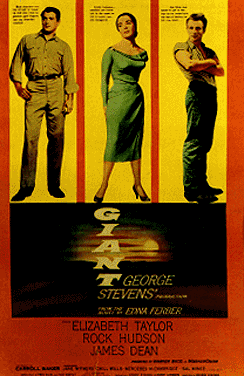
Giant (1956)

This is an epic film that stars Elizabeth Taylor, Rock Hudson, and James Dean, with direction by George Stevens. It shows the ongoing conflict between a rancher (Hudson) and his former hired hand who becomes rich off oil (Dean). As Jett Rink (Dean) exclaims, he becomes even richer than the rancher Bic Benedict (Hudson) ever dreamed. The relationship escalates when Rink makes a rude remark to Leslie Benedict (Taylor), and some punches are traded. From this point on the three main characters slowly grow older and the Benedicts have children. In his final screen appearance, Dean’s character is suppose to give a speech at a large banquet. However he is so drunk he falls flat on his face a complete wreck. Giant was ahead of his time by giving commentary about the race relations with Mexicans. It also took young actors and progressively made them look older, something that was quite unusual. Although this was Dean’s final movie I think it can be said he came full circle. He began as a youth in East of Eden and by the end of Giant he was a old man.

4.5/5 Stars

Shane (1953)

10788-shaneposterThere is often something special about westerns, and Shane is no different. Directed by George Stevens and starring Alan Ladd, Van Heflin, Jean Arthur, and other great character actors, Shane is simple yet charming. It has many of the qualities of a great movie, because of what it shows of mankind. Furthermore, it simply makes you feel good.

In the film Shane (Ladd) is a wandering ex-gunslinger, who decides to live with a frontier family as a hired hand. His presence makes everyone happy because he is quiet, humble, and fundamentally so good. However, there is trouble from a man named Riker and his gang. Heflin’s character is adamant he must face the foe and defend his home. Shane will not allow it knowing this is a job for him. The two friends fight it out with Shane winning and riding into town. In the end, he wins the shootout but more importantly he is reconciled with the family’s boy Joey. The time has come for him to move on and Shane rides off into the distance, a humble hero.

The first thing that always strikes me about this film is the brilliant scenery around Jackson Hole, Wyoming with the Tetons looming majestically behind a solitary cabin. In some sense, this is not just a western, but the archetypal story of a family taming the land.

The very next thing of importance is the eponymous and unassuming drifter Shane. He always seems so kind and good, but early on there are glimpses of another, perhaps darker past. And yet from the point of view of Joey, he is an idolized, almost mythological figure. What is so striking about Shane is that he is obviously handy with a gun and an excellent fighter, but he never flaunts it. Perhaps it is because he wishes to rely on it as his last possible resort, or maybe it is because he is just a humble man.

As an audience, much like Joey, we want him to fight back, and we are happy when he finally does. During the course of the film, Grafton’s mercantile and saloon is often the place of conflict, and here multiple times Shane ultimately uses violence. It is his fallback, but he uses it effectively even against his own friends if he sees fit. Then Shane drifts on and the cycle undoubtedly continues again.

Yes, he certainly could be called a hero, with no last name to speak of, but he is a man, who will always be on the move. This may not be because he wants to, but because he really has no other option. Shane foresaw what we did not want to see, and now he cannot come back even if he wants to, so he rides on. This is the middle of George Steven’s so-called “American Trilogy” and probably the hallmark of his illustrious career.

5/5 Stars

A Place in the Sun (1951)

In this film starring Montgomery Clift, Elizabeth Taylor, and Shelley Winters, with George Stevens directing, a young man (Clift) tries to rise up in his uncle’s company. He is poorly-educated yet ambitious and he slowly moves up in the Eastman business. While he works George begins to fall for a modest girl (Winters) who also works in the assembly. They slowly begin to show romantic feelings for each other because they face the same hardships. With a new found postition George begins to interact with people of higher social status. Although he feels out of place there, he meets the beautiful and rich Angela (Taylor) who he begins to fall in love with. As he begins to get more involved with Angela, he learns that his former love interest is pregnant and therefore wishes to marry him. Faced with a dilemma, George makes a decision that will ruin him forever, whether he goes through with it or not. A hard-hitting drama, and an adaptation of “An American Tragedy” by Theodore Dreiser, the latter half is the best part, including the chilling finale.

4/5 Stars

The Searchers (1956)

d4eb3-the_searchersOne of John Wayne and John Ford’s best westerns respectively, The Searchers follows an ex-Confederate soldier (Wayne) as he looks for his niece Debbie, who was taken by Indians when they killed her parents. Now Wayne and a young man played by Jefferey Hunter must look for her and bring Debbie home. With an almost obsessive desire, Wayne’s character Ethan Edwards vows to find her. Along the way, the old vet and young man have conflicting personalities that get in the way. Even when they finally find her, she has become more Indian than white, and Edwards seems bent on killing her much to Hunter’s horror. In the end, the gruff but courageous searcher shows his true colors.

A great western, and simply a wonderful film, The Searchers has a lot to offer with great action, Monument Valley scenery, and of course John Wayne. The supporting cast is good as well, including Vera Miles, Natalie Wood, Ward Bond, John Qualen, Hank Worden, and Ken Curtis.

There are some pivotal scenes in this film that I think really get to the core of what it is about, and Ford constructs a multitude of scenes which are simply a joy to observe as they unfold. One turning point has to be when the two Searchers look over a few white girls that the cavalry recovered from the Comanche. One of the girls gives off a childish screech, which causes Ethan to turn around, and Ford’s camera closes in on his scowling face half covered by shadow. Here is a proud man who would not surrender during the end of the Civil War. Here is a man full of prejudice and vengeance. Here is a man who shows glimpses of kindness, and here is a man who knows pain. It is complicated because he heads out after Debbie seemingly in an act of love. But soon it seems that it has become his vendetta, and Ethan has simply become bent on revenge. It takes his final confrontation with Debbie to reveal the true depth of his character.

Undoubtedly this is one of the preeminent American westerns, but I think you could also call it a social commentary on racial prejudice. Furthermore, The Searchers influence ranges from the plight of Luke Skywalker in Star Wars to the music of Buddy Holly (“That’ll be the Day”). I think fittingly enough the film ends with Wayne framed in the doorway, walking off into the distance. After all, he is a searcher, and you cannot expect a man like that to stay put.

5/5 Stars

The Grapes of Wrath (1940)

472a2-wrathposters141I must admit this film directed by John Ford and starring Henry Fonda, surprised me in a positive way. This movie seemed like it could potentially be another Citizen Kane  (a movie so inflated with praised that it becomes a letdown when actually viewed). However, The Grapes of Wrath  in fact has a fairly good story adapted loosely from John Steinbeck’s novel. You come out of it feeling the strength of the Joads as well as the inhumanity they face traveling from the Dust Bowl in Oklahoma to California. Still, there is hope that they will endure it all in the end. Fonda gives a solid performance as the plain-speaking, young man Tom Joad. Jane Darwell also gives a very moving performance as his Ma . Some may say this movie has its slow parts but it also has some very good moments that reflect genuine humanity.

4/5 Stars

Stagecoach (1939)

Directed by John Ford and starring a young John Wayne, this classic western opens with various people boarding a stagecoach for various reasons. The passengers include a drunken doctor, a prostitute, a soft-spoken whiskey salesman, a gambling southern gentleman, an impatient banker, and the wife of a cavalry officer. Driving up top is Buck and the Marshall rides with his eyes open for the wanted Ringo Kid (Wayne) and the threat of Apaches. Despite their differences and the imminent danger, these people are forced to push on toward their destination together. They face unexpected challenges including hostile Apaches, but they finally do reach the town of Lordsburg. After the arrival, Ringo must figure out his relationship with Dallas while also facing the foes that are waiting for him. He does what he has to and ultimately his friends show their true colors. This film is a great character study with very good scenery, stunts, and action. As Wayne’s first big role, it is easy to see how he became a star after this performance. He was supported nicely by the likes of Claire Trevor, Andy Devine, Thomas Mitchell, and John Carradine. Without them and other like them this classic would lose the character depth that makes it work so well.

5/5 Stars

My Fair Lady (1964)

Adapted from the play Pygmalion, originally written by George Bernard Shaw, My Fair Lady stars Audrey Hepburn and Rex Harrison. It follows a speech therapist (Harrison) as he tries to win a bet with an old acquaintance that he can pass off a poor flower girl as a duchess. He takes Eliza Doolittle (Hepburn) and begins to train her, not as a person but as an experiment. Eliza eventually gets fed up with this treatment but at the same time also wants to become sophisticated. With Harrison’s help she does become that person and is no longer a subject to be experimented with. This is a role where Hepburn plays completely against her image for most of the film but she does pull it off in the end. Putting together a good cast, plot, and songs, this film is quite good.

4.5/5 Stars

It’s a Wonderful Life (1946)

This is not only a Christmas classic but a classic in any sense of the word. It is the best of Stewart and Capra adding up to one of the most heartwarming stories of all time.  This may exhibit Stewart is his everyman role once again, but it breaks away from Mr. Smith in many ways making it another uniquely great film. A film like this that makes you know and feel for characters so profoundly is certainly worth watching.

Starring Jimmy Stewart and Donna Reed with a fantastic supporting cast,  the film tells the life story of George Bailey. We watch with the angel Clarence as he sees George’s life unfold. George saves his brother Harry as a boy and as a result, loses hearing in his ear. He works in the Bedford Falls drugstore and keeps the proprietor Mr. Gower from making a deadly mistake. Later on, he plans to travel the world and go to college so he can escape his hometown and do bigger and better things. But once more he sacrifices. One fateful day, he doesn’t know it yet, but he meets the love of his life Mary, and the same day his kindly father has a stroke. Soon after,  Harry goes off to college and George is left holding down the fort at their father’s old building and loan. He builds up all those around him with selfless kindness, while simultaneously standing up to the grumpy millionaire Mr. Potter. Eventually, he marries Mary and has children. First, during the Depression George gives up his honeymoon to keep the building and loan open. Then, during WWII while his brother and others become heroes, George stays in Bedford Falls because of his poor hearing. In this post-war period, the story picks up in the present.

Although, by unfortunate circumstances George Bailey finds himself contemplating suicide after the absent-minded Uncle Billy misplaces $8,000. That’s when Clarence comes into his life to show George just how important he really is. George sees a world where Harry is dead, Mr. Gower is a disgrace, Martini does not own the bar, his mother has no sons, Uncle Billy is insane, Violet is disgraced, Bert and Ernie do not know him, Mary is an old maid, and Mr. Potter has monopolized Bedford Falls.

Once he gets his life back George finds immediate joy and gains so much because of his friends and family. He runs through the streets of Bedford Falls yelling out “Merry Christmas,” because he is simply grateful to live again. Miraculously, the whole town rallies around him, and George reaps the reward for all he has sowed over the years. Clarence is finally awarded his wings and George Bailey is the richest man in town. There is nothing much to do after this film but simply be happy and sing “Auld Lang Syne.” It is a Wonderful film in many ways, with a wonderful cast, and a wonderful message. It has some of the greatest character development of any film ever because you do not simply become attached to one man but an entire community. That’s what makes the scene where Uncle Billy loses the money one of the most difficult for me to watch. Each and every time I’m so attached to these people. Even if I already know the resolution, I cannot bear for anything bad to happen to them. In fact, it is interesting to focus on just one of the supporting characters and see how they are affected by the life of George Bailey. It makes me ask myself if I were to die tomorrow would anyone care? We know in the case of George they certainly would.

I am further reminded of the phrase that is written on the wall of the building and loan, “You can only take with you, that which you give away.” This is what George Bailey did, and I believe it is something that each and every one of us should be mindful of. He is a great character not only because James Stewart played him genuinely and with such magnetism and heart, but because he was such a sacrificial figure. True, this is a sentimental film given the title and the director, but it is paramount to realize the progression this film follows. George must sink into the depths of his despair and disillusionment before he can truly realize that It’s a Wonderful Life. I would challenge you the next time you watch this film, to not simply acknowledge it as perennial Christmas fare, but look a bit deeper because there is so much more here. As always, Attaboy Clarence! You did it again.

5/5 Stars

The African Queen (1951)

1c3a0-the-african-queen-1With the ultimate pairing of Humphrey Bogart and Katharine Hepburn, this film throws together two starkly different people in extraordinary circumstances. Hepburn is a prim and proper missionary in Africa whose brother dies after a confrontation with German soldiers. Bogart is the rough-edged pilot of an old steamboat christened The African Queen. Together they take on the dangerous task of going down the river in order to sink a German ship. At first they are both at odds with each other and struggle to cope with their situation. However, with no one else to turn to, over time, they become close. Their bond is so great that they are willing to die rather than to be separated. This is truly a heartwarming story of love and loyalty with two legends who literally light up the screen.

5/5 Stars

The Treasure of The Sierra Madre (1948)

4d2bb-treasuremadrePutting Humphrey Bogart in his element once again, The Treasure of The Sierra Madre is another wonderful adventure film. Directed by John Huston, it tells the story of three men who join together in their search for an elusive treasure in Mexico. At the beginning, they are in good spirits eager to become wealthy. However, when they finally strike it rich they find it is not all it is cracked up to be . The situation escalates and they become paranoid of each other. Finally, Bogart’s character Dobbs is pushed over the edge and commits a malicious act out of desperation. Seemingly as an act of karma, he meets with another form of justice. However, it seems that by the end no one actually wins. A surprisingly good film, Sierra Madre takes your usual treasure hunt and realistically depicts man’s greed which often can overpower everything else. Bogart was supported nicely by Walter Huston (the father of the director) and Tim Holt.

5/5 Stars