Frankenstein (1931)

e7a7f-frankenstein13Starring Colin Clive and Boris Karloff, this archetypal horror film is loosely based on the novel written by Mary Shelley. Frankenstein is a man intent on creating life. However, his creation is made out of corpses and then comes the fateful day that he brings his Creature to life. Once it is alive his own life will never be the same. Soon it begins to cause havoc by killing a little girl and scaring others. It even attacks Frankenstein and his wife on their wedding day. In the end the Creature meets his demise in a burning barn and Frankenstein seemingly escapes utter disaster. This became the perfect set up for the Bride of Frankenstein (1935).
4/5 Stars

City Lights (1931)

In this Charlie Chaplin film we follow the Tramp as he romances a blind flower girl and is befriended by a crazy millionaire. In line with all the great Chaplin silent films, this one has many comedic moments but also sentimentality. In one scene the Tramp might find himself dragged along with the millionaire or fighting in a boxing match. However, the next sequence he might be sharing a very nice moment with the girl who only knows him by his voice and kind deeds. Fittingly, in the final moments of the film, the flower girl who can now see is reunited with the humble tramp who showed her so much kindness. Overall this was a very good film and it seemed to have a wonderful balance of humor and romance. It proves that sound is not always needed if you are a good storyteller.

5/5 Stars

Other Chaplin films I may watch in the future include The Kid (1921), The Circus (1928), and The Great Dictator (1941)

The Gold Rush (1925)

3c3f8-the_gold_rushIn this Charlie Chaplin flick we follow the little man or the Tramp as he prospects for gold in the Yukon. All alone and cold he stumbles upon a cabin where a corrupt man lives. However, the weather wreaks havoc and the Tramp finds himself eventually left with a fellow prospector. After a time the two friends split up. In the city the little man finds love while his former partner meets up with trouble on the road. Eventually they  do reunite, strike it rich, and become millionaires. Along the way there are many characteristic Charlie Chaplin antics. It is extraordinary, because for a film that is not a “talkie,” The Gold Rush is surprisingly complex with humor, drama, and romance. If you take into consideration the era of this film, it is very good.

4.5/5 Stars

Charlie Chaplin will be continued in the next review…

Ben Hur (1959)

Ben Hur, directed by William Wyler and starring Charlton Heston, tells the tale of Christ in connection with the young nobleman-turned slave, Judah Ben Hur. We follow Hur as a friend turns against him and he and his mother and sister are imprisoned. Soon he is doomed to a life rowing on a galley but on the way there a kind , mysterious stranger gives him a drink to quench his thirst. It takes a few years but Hur’s fortune turns and he is no longer a slave but a great chariot racer. The time comes to seek revenge and he beats his former friend in the ultimate chariot race. However, his victory is shorlived since he learns his kin are now lepers and the man who showed him kindness years before is now to be crucified. Returning the favor, he gives the suffering man water before He is hung on the cross. Despite the man’s death, miraculously his mother and sister are freed from leprosy. This epic is monumental and tells a wonderful story intertwined with the Gospel.

5/5 Stars

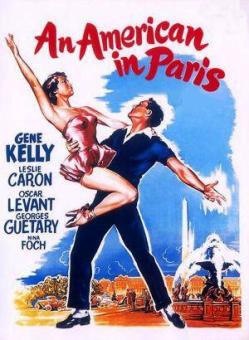
An American in Paris (1951)

18e5b-an_american_in_paris_posterStarring Gene Kelly and Leslie Caron with director Vincente Minneli, this musical follows an American painter in Paris (Kelly) as he struggles with life and love. Jerry Mulligan is a painter who loves Paris and has made friends with many of the locals. The only problem is that he has no money. That all changes when a rich patron begins to sponsor him and his luck begins to change. Soon he becomes enchanted with a French girl (Caron) and after initial conflict they try to meet up whenever they can. At the same time Jerry is tied up with his patron and Lisa is engaged to a kind Frenchman who Jerry knows. When Jerry learns this he is devastated, however in the end he does get the girl. Although the final dance sequence seemed out of place, awkward, and too long, much of the rest of the musical is enjoyable. I Got Rhythm and The American in Paris Theme are catchy Gershwin tunes that Gene Kelly performs to perfection.

4.5/5 Stars

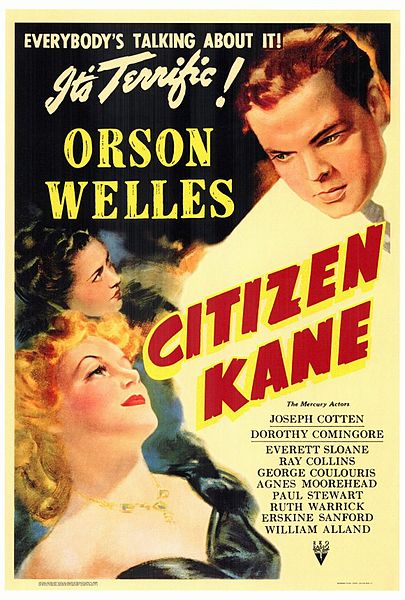
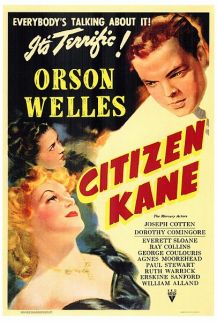
Citizen Kane (1941)

The first time I ever saw the film, I actually wrote Citizen Kane off because my hopes were so high thanks to its major critical acclaim. Those hopes were soon dashed after viewing it once, but over time I realized I needed a second viewing. This second chance allowed me to see the minute details, which can be easily overlooked or forgotten. Now I can truthfully say I have a new found respect for this film.

The brainchild of Orson Welles, Citizen Kane opens somewhat unimpressively, however it is certainly very moody and atmospheric. As the camera closes in on a great mansion, we are given a first-hand view of a dying man followed by his mysterious final word “Rosebud.” In the following newsreel, we learn the man was Charles Foster Kane (Welles), a millionaire tycoon and newspaperman. A journalist (William Alland) is enlisted to find out anything he can about Kane. First, he scours the memoirs of Kane’s deceased childhood guardian (George Coulouris). Then, he talks with Mr. Bernstein (Everett Sloane), who worked with Kane’s paper the Inquirer. He gets around to talking to Kane’s unstable former friend Jedediah Leland (Joseph Cotten), as well as Kane’s second wife (Dorothy Comingore). We learn from these accounts about Kane’s early years, his success with yellow journalism, the evolution of his first marriage, and the rise and fall of his political career. Furthermore, we find out about Kane’s unhappy second marriage that ultimately left him loveless after looking for affection his whole life. Fittingly, we are again left with the bleak view of his fortress Xanadu, and we now have the knowledge that “Rosebud” was in fact utterly trivial.

Obviously, Greg Toland’s black and white cinematography using deep focus and low camera angles is noteworthy. The framing of the narrative with different points of view and flashbacks was unique at the time. The actors age in front of us showing the progression of time and montage is used to effectively condense time. There are the overlapping and fragmentation of dialogue to create a realistic feel throughout the film. Bernard Hermann puts together a score that slowly changes along with Kane. And of course, you have the supposed basis of Kane on William Randolph Hearst. Historically, Citizen Kane may, in fact, be the most important film of all time, and artistically it is certainly up there with the best of them. I will let others decide if that makes it the very best film, period.

4.5/5 Stars

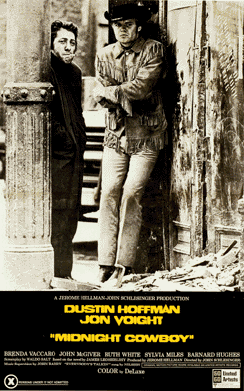
Midnight Cowboy (1969)

The film stars Jon Voight as a naive Texan and Dustin Hoffman as Ratso Rizzo, the bum who initially cons him and eventually befriends him. Voight comes to New York expecting to make money off of rich city women as a male hustler. However, his callowness leaves him broke. That’s when the crippled, coughing, stealing, and nasally-voiced Ratso invites him to stay in Rizzo’s home on a condemned lot. Because they are both just trying to survive on the streets of New York, they befriend each other. When they are not walking the streets, stealing, or trying to bring in money, they talk and we slowly see into the pitiful lives of Joe and Ratso. Since winter has hit, Ratso gets ill so they decide to head out to Florida. On the way Rico (as he wanted to be called) spent his last breath. Both actors have powerful performances and Nillson’s Everybodys Talking is a nice added touch to the soundtrack.

4/5 Stars

All the President’s Men (1976)

89d88-mv5bodaxmtc4odcxnf5bml5banbnxkftztcwndy0ntaymq-_v1-_sy317_cr80214317_Starring Robert Redford and Dustin Hoffman, this political thriller follows two young investigative journalists as they try to uncover the truth after a mysterious break in at the Watergate Hotel. The Washington Post is the only paper covering the issue that many have dismissed as an isolated event. These two men try to follow all the leads they have but they reach a dead end since no one seems willing to talk. However, with the help of the anonymous source Deep Throat, tireless searching, and a few witnesses, the pieces begin to come together. Little do they know the extent of what they have happened upon. Ultimately, their story about Watergate would lead to the scandal that ended in Richard Nixon’s resignation. This is not only an intriguing film, but it also holds tremendous historical importance.

4.5/5 Stars

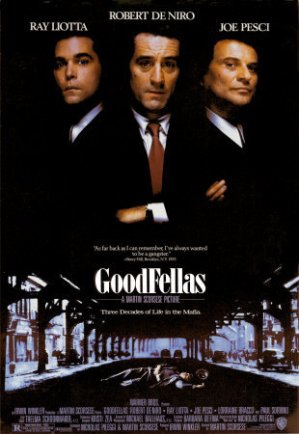
Goodfellas (1990)

Starring Ray Liotta, Robert De Niro, and Joe Pesci with direction by Martin Scorcese, the film follows the true story of Henry Hill and his life as a mobster. Early on in the 50s Hentry began doing work for the influential mobster Paulie (Paul Sorvino). He began skipping school and slowly begins making a lucrative living with the mob.  Soon he meets Jimmy Conway (De Niro) who loves to hijack trucks as well as the foul-mouthed, quick-tempered robber Tommy DeVito (Pesci). Over time Henry becomes successful after an Air France robbery and eventually he gets married to a woman named Karen (Lorraine Bracco). However, Henry gets caught up in a murder and he also starts seeing another woman. He still has problems but he begins a lucrative drug trade and the Lufthansa heist is pulled. The heat is on and Henry is eventually caught and decides to rat on his friends. He is then forced to live life as a nobody. I appreciated the period music, voice over, tracking shots, and freeze frames. The language of DeVito and others is tiresome but it shows how inherently corrupt they are.

5/5 Stars

A Streetcar Named Desire (1951)

The film adaption of the Tennessee Williams’ play, A Street Car Named Desire was directed by Elia Kazan and stars Marlon Brando as the rough Polish husband of Stella Kowalski. Vivien Leigh plays the role of Stella’s airy and superficial sister Blanche. The film opens in the French Quarter of New Orleans where the Southern Belle Blanche DuBois comes to live with Stella and Stanley. Over time we learn of her past full of forbidden love and other problems. Stanley is a brutish, dominating man and the arrival of Blanche upsets his relationship with his wife. A friend of Stanley’s, Mitch (Karl Malden) is drawn to Blanche but the conflict between her and Stanley make the relationship impossible. Now Stanley knows of her past and confronts Blanche about it. His cruelty and violence lead to her final breakdown. Ultimately, Mitch is angered, Stella is grief-stricken, and Stanley shows his dependence on Stella. This film is full of drama and at times you dislike both Stanley and Blanche. Mitch is one of the characters you actually feel for.

4/5 Stars