I Walked with a Zombie (1943): Shadow and Psychology

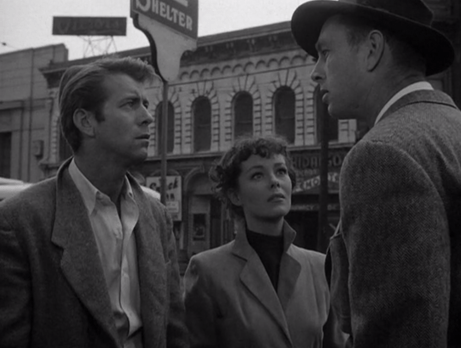
IwalkedwithazombieThe film commences brilliantly as Frances Dee can be heard in voiceover with almost fond recollection, matter-of-factly stating, “I Walked with a Zombie.” The way she expresses it immediately debunks anything we might think from an admittedly exploitative title. Producer Val Lewton does not settle for a straightforward slapped together horror flick.

His ambitions were always to elevate the concepts he was handed into something indelibly interesting. Our heroine Betsy Cornell (Dee) is a Canadian nurse who applies for a position taking care of a man’s wife. It’s all very mysterious, but she’s eager to work and sets sail for San Sebastian where she will be in the service of Mr. Paul Holland (Tom Conway).

Lewton re-framed the source material into a Jane Eyre tale transplanted to the West Indies. Here Ms. Cornell arrives by boat, immediately struck with a callous first impression of the aloof Mr. Holland. He easily dismisses her childhood fear of the dark, while noting he never should have hired her.

I still contend most children are never afraid of the dark per se but what might come out of it. It’s the fear of an unknown thing lurking out of reach. Meanwhile, his younger brother (James Ellison) is a charming fellow who immediately takes a liking to the new nurse and helps to make her feel welcome. We have polar opposites set up and obvious points in a possible love triangle.

However, in following the plotting of Bronte’s work, the elder half-brother is tortured by a secret, literally locked away. It is, in fact, his mysterious wife, whom Betsy unwittingly meets one night, upon hearing a startling noise. At first, she’s taken aback by this specter of a woman, this ghost, this living dead.

But as her kindly doctor explains, supplying a firm foundation of ethos to this enigma, a portion of the spinal cord is burned out, and it has permanently made her a sleepwalker who can never be awakened. Aside from a potentially dangerous foray into shock therapy — to induce some sort of coma and hope for the best — her future prospects look dim. That is unless there’s an alternate means to bring about healing.

Like the Wolf Man before it, we are introduced to a stylized but nevertheless real locale that thrives by mixing the logical digressions that come from our world with ghostly influences. Screenwriters Curt Siodmak and Ardel Raye create a kind of poetic mythology for a supernatural conclusion to be crafted out of. Whether they meant to or not, they succeeded in canonizing zombies in the same manner werewolves were developed in Siodmak’s earlier script.

What’s lovely is how Betsy foreshadows all sorts of events to come and there are strangely mesmerizing objects to captivate us. The figurehead of a slave ship features Saint Sebastian himself pierced by arrows. It lends this undercurrent of the brutish injustices of the slave trade to the landscape we must come to terms with.

These very same traditions have the same weighty dolefulness but are also imbued with an otherworldly quality of its own. It gives this shading to the African-American characters who seem so happy-go-lucky like other Hollywood creations, and yet there’s an almost unnerving sense about them as if something is working under the surface. It’s hard to put an exact finger to it, but though they look similar, they aren’t quite straightforward stereotypes.

A local club singer chants an island song mixed with family folklore telling of the deep-rooted tragedies of the Holland family. The local populations are also adherents of local voodoo customs, and their nightly drumbeats ring out through the air ominously, picked up by the tropic winds. It’s yet another layer to this continually bewitching atmosphere.

Another character of crucial importance is Mrs. Rand, the deceased patriarch’s widow, and Wesley’s birth mother.  Her own station in life, as the wife of a Christian missionary, creates a juxtaposition between a so-called normal religion and a darker, more dubious strain.

Because it cannot help but bump up against the voodoo rituals even as black and white people now exist together. In fact, one might say the religious rituals become nearly intertwined. Betsy begins to realize maybe some powers at be might be capable of lifting the spell that has entranced Ms. Holland, even as she herself falls for the comatose woman’s husband.

As such, it is not horror lingering over the frames but a near mesmerizing catatonia. It carries you up in its grips from start to finish, trying to decipher what to make of such a vision. Enchantment, ugliness, cruelty all apply. And yet it’s difficult to cry out and out evil against the people partaking in these dances or voodoo ceremonies. The acts themselves might be evil, but the people are held in the grips of entrancement. Everyone is, to varying degrees, weighed down with desolateness even before the fateful dead are laid to rest.

We must recall the beginning voiceover once more. The fact Betsy walked with a zombie might hold an inherent element of terror, but more so, it carries with it a despondency that cannot be lifted. It hangs over us and haunts us just as the lurching Carrefour does throughout the picture.

The beauty of most any of the Val Lewton films of the 40s is how the studio and the audience expected one thing — a low budget horror flick with a provocative title — then the producer turned around to make micro-budget gems steeped in shadow and psychology. They have more depth and complexity than they have any right to.

Each entry boasts sumptuous visuals hiding weaknesses in the budget department to fully develop, not necessarily a world, but the impression of a world. One might contend the latter is far more powerful in an expressionistic capacity. Arguably, Lewton had no more formidable collaborator than director Jacques Tourneur who had an established knack for conjuring up the most splendid atmospherics.

This time he is aided by the black and white photography of Roy Hunt. In their hands, every character has a doppelganger in the form of shadows creeping along the walls with their human counterparts. It’s developed with the utmost efficiency, which seems all but a lost art these days.

But the astounding economy is matched only by a ceaseless ingenuity. Because the artfulness they managed to accomplish on the very same shoestring budget, is part of what makes them marvels even today. If you willingly invest your time in one of these RKO pictures, it’s very likely you’ll be met with a lasting impression. The dividends, as far as cinematic capital is concerned, are enormous.

4/5 Stars
Daughter of Shanghai (1937) Starring Anna May Wong and Philip Ahn

daughter of shanghai

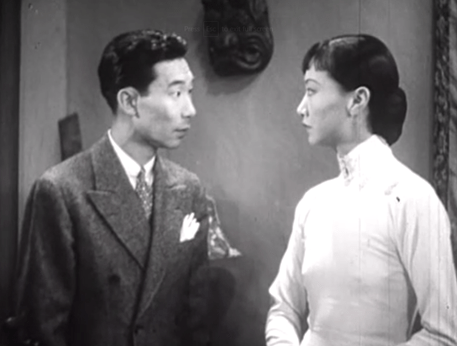
No, this isn’t an alternate universe. There really was a film from the 1930s starring both Anna May Wong and Phillip Ahn. They’re not just supporting players or bit parts to fill in a few stereotypical roles, either, but actual leads. More amazing still, they both speak English without a hint of an accent. They are Asian-American, intelligent and brave — in an era lacking comparable heroes.

Ahn is a G-Man sent by the government to investigate a smuggling ring bringing in hordes of aliens from foreign locales. Wong is front and center as a woman whose father, a local merchant, will not cave to the strong-arm tactics.  He ultimately becomes a casualty of the clandestine syndicate looking to elbow its way further still into the illegal trade.

Lan Ying Lin (Wong) escapes her captors and is intent on infiltrating their racket and putting an end to it, once and for all, to avenge her father’s death. She ends up going undercover as a dancer at an exotic dive in an effort to get to the bottom of the mystery. She does not know the meaning of the word danger, her finest attributes being a certain stubbornness and resiliency.

She makes quite the impression bringing her “Daughter of Shanghai” act to the seedy exotic cantina. Her boss (Charles Bickford) is a grungy braggart who discloses that he is instrumental in helping sneak certain people in through Uncle Sam’s backdoor. Bingo.

Meanwhile, Kim Lee (Ahn) takes up with a mangy sea captain who’s on the other end of the racket supplying the “cargo.” The inside man convinces his not too bright superior that he can speak Russian — a sample of his linguistic skills include those useful Russian phrases, “Alpha, Beta, Gamma, Epsilon.” Being as “exotic” as he is, it’s easy enough to swallow and not another inquiry is made on the subject.

Despite being a quickie, clocking in at barely over an hour, Daughter of Shanghai still manages to have enough time for a couple murders, a barroom brawl, some exotic dance numbers, gambling, and copious amounts of alcohol. The dialogue’s a bit shoddy and there’s no time to waste so the story operates in very straightforward, uncomplicated turns. It’s B level without a doubt, but it utilizes everything at its disposal to draw up the punchy melodramatics necessary to make a story such as this impressionable.

In the end, our two heroes are reunited in their quest only to make the chilling discovery that villainy is a little closer than they ever dreamed. Ahn gets a chance to slug it to Anthony Quinn in a very early spot in the actor’s career. But he gets some much-appreciated help from a pug-nosed, good-natured chauffeur who makes up for his lack of brains with brawn.

One of the strangest dichotomies comes at this point because although Wong has been our guiding heroine thus far, she nevertheless watches the fighting between the men all but powerless to intercede. Regardless, justice is enacted. It’s a group effort.

Admittedly, if it wasn’t for the leads, maybe we would quickly forget The Daughter of Shanghai, but such a cast is so few and far between that this is a historical relic certainly worth unearthing and therefore worth remembering. That doesn’t imply it’s perfect by any means.

The road toward nuanced representation is a long and arduous one requiring baby steps only to be impeded with various obstacles and inevitable steps backward. Because it’s easy to be homogenous, unimaginative, and flat. The outliers are where we find intriguing artifacts suggesting exceptions to the rule, cultural documents that dared to give us a different portrait of humanity. In my labyrinthian odyssey to discover hidden gems, those are the ones I’m invariably drawn to.

Anna May Wong and Philip Ahn should have been bigger stars if not for the perceived impediment of their ethnicity. Daughters of Shanghai is a tantalizing taste of something altogether groundbreaking. That makes it worthwhile even as there’s an air of disappointment. Oh, what might have been. However, we must be thankful this treasure still exists.

3.5/5 Stars

The Naked Dawn (1955): An Edgar G. Ulmer Western

220px-The_Naked_Dawn_film_poster.jpgThe western is founded on certain unifying archetypes, from drifters to revenge stories, showdowns and the westward progress of civilization butting up against the lawless wilderness. It always proved a fitting genre for morality plays and deeply thematic ideas. The tradition of the bank robbery goes back to Edwin S. Porter and The Great Train Robbery, and it plays an important role in The Naked Dawn.
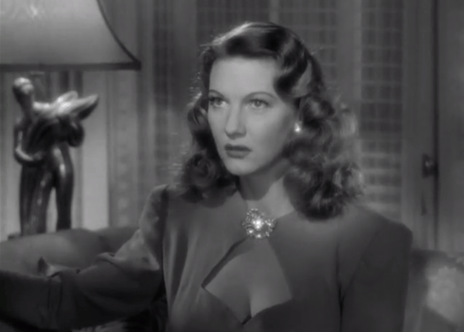
The action opens with Mexican banditos robbing a train and looking to flee the scene. Though they manage to get away, it’s not without consequences. One hombre named Santiago watches as his campanero Vincente dies in his arms. He comforts him with visions of heavenly cattle grounds even though the man’s life was full of indiscretions, to put it nicely.

The story does occupy itself with religious rhetoric, which feels very much a part of the cultural landscape, as do the Spanish language and such ubiquitous elements as taco stands, cantinas, and a mariachi soundtrack. The film rightly steeps itself in this perceived world below the border. Whether it is authentic or not feels slightly immaterial, because something fairly immersive is erected. In one sense, this is the most impressive success of The Naked Dawn.

There is “brownface” needing acknowledgment and a certain stereotypical gaze, but director Edgar G. Ulmer develops a surprising amount of atmosphere for such a meager western. Secondly, Arthur Kennedy somehow manages to give a thoroughly flamboyant performance showing his competency in anchoring a leading role — even in an admittedly small scale oater like this.

Because in typical drifter fashion, he goes from leaving his dead buddy behind to finding a day’s shelter at a farmhouse along the trail. There he is met by an energetic young farmer and his dutiful wife. The presence of such a figure as Santiago unearths all their flaws even as he overwhelms them with his vagabond existence, full of a certain high-living and nostalgia for the old days.

Although initially hesitant to get involved, the husband finds himself brought along for a raid on a crooked shipment manager who they overpower and string up while raiding the contents of his safe. In the midst of all the money, Manuel (Eugene Iglesias) suddenly becomes brave and also greed springs to life in his heart.

For thence onward, Manuel holds this stranger in high regard, in awe of this man who has seen so much and takes him for the time of his life in the local watering hole, partaking of all the worldly pleasures afforded from strong drink, saucy women, lively music, and a bar brawl to wind out the entertainment.

But if this is the grand exciting world away from the ranch, then back with his doting wife (Betta St. John), we find a certain amount of unrest. She does not love her husband but his prospects were so much better than what she had before. Still, this new man makes her heart glad; she is ready to elope with him without fear of consequences.

The utter irony is the very fact that while Santiago is the outlaw, at least he is obvious and upfront about his waywardness. In his new company, Manuel fancies himself an honest man and his wife comes across as an angel. However, whether it’s unwitting or not, they both have more conflicted characters than they let on. Santiago is the one who allows them to salvage their lives.

It should be noted Francois Truffaut purportedly gleaned inspiration from this film’s love triangle for Jules et Jim. At first, any sort of comparison seems superficial at best. However, I finally settled on the fact both films contrive this three-way relationship that plays peculiarly for the very fact it lacks a great deal of interpersonal drama.

There is a passivity to how it unwinds and this feels counterintuitive to how these stories are supposed to function. Although we have tragedy on both accounts, the fact it is so detached leaves a different taste, rather than a blistering, jealousy-fueled gunshot finale. For that, we have to look at alternatives like Laura (1944) or Truffaut’s own Soft Skin (1964).

There is not a lot of time and space but the resources are used in all number of facets to at least touch on issues of religion, law and order, romance, greed, and unquestionably, so much more. Fittingly, as the picture zips to its rapid conclusion, we have come full circle with our larger-than-life Bandido dreaming of the pearly gates much like his campanero before him.

Ulmer blesses the audience with another extraordinarily lucid 10-day effort. Let that sink in for a second. The Naked Dawn is yet another marvel in economic ingenuity. Better yet, any drop off in quality or production values only seems to add to the film’s inherent flavor.

3.5/5 Stars

Decoy (1946)

decoy 1.png

THIS IS MY VERY LATE ENTRY IN THE CMBA SPRING BLOGATHON: FEMME/HOMME FATALES OF FILM NOIR! 

Like any self-respecting noir, this one chooses to open in a grungy gas station bathroom with a hero (Herbert Rudley) disheveled, hobbling, and covered with grime. We can gather he’s been through hell. Better yet, Decoy begins at the end of the story with murder!

He hobbles past a gas station attendant, stands at the side of the road to hitch a ride to San Fransisco. Mind you, this is without saying a single word. Upon arriving, he wanders into a hotel. He takes the elevator up, pushes open the front door, sees an attractive woman packing and proceeds to fill her with lead! What’s even stranger is the cop who follows close at hand as if he knows exactly what’s about to happen. He plods in to find the shooter dead and the lady dying.

Here’s this pretty dame, Margot Shelby (Jean Gillie), in the arms of a hardboiled flat foot (Sheldon Leonard) recounting her indiscretions on her deathbed. Really all she’s doing is helping him pick up the stray pieces he already knew but for the audience, it’s all news. To get a line on the story, we must start back with an incarcerated gangster named Frankie Ollins (Robert Armstrong).

He is in line for the gas chamber and Margot has long been his girl. She assuages him, saying they’re lining up money to get him out of his jam — but she also is concerned about security — he has promised to keep her sitting pretty. And he has the resources to do it with $400,000 waiting out there for her somewhere. He just needs to give the word. We get the sense foul play might be a central component of our story.

From thenceforward she goes to work efficiently. She exerts her feminine charms on a local clinician who also regularly gives his services to the local prison. You see, he is pegged to do the autopsy on Frankie’s body just to make sure everything’s on the level. Except Margot’s got his head spinning — most of it happens off camera —  but we believe he’s fallen for her, like putty in her manicured, greedy little fingers.

And Margot goes all in, playing it up. The love angle is seemingly candid even as she tells him the plan to revive the “dead” gangster with Methylene Blue. We witness the gas chamber in a groggy POV shot. In another picture about regenerate gangsters, this would be the end. For Decoy it is merely the beginning.

Because Margot is the film’s greatest force as a notable apex in the gallery of B noir femmes. She keeps gangsters madly jealous, twisted around her fingers, and then righteous men start caving, relinquishing their high ideals just to be with her.

Two of the most oddball supporting characters in the pictures are the morgue attendants who distract themselves with solitaire and reading words out of the dictionary — a real hoot — but they are plain folk who don’t ask questions when the good doctor skips out on the normal autopsy.

They go on obliviously as the body gets carted off to the “oven” only to get picked up by waiting gangsters. By now, there’s little doubting it. Owens is to be resurrected and yet it’s the devil incarnate doing it! But someone like Margot is only operating in viable currency. People are only needed for their immediate value to her.

Frankie is out of the picture when he’s not needed, Jim Vincent (Edward Norris) is just a handy thug to have around, and of course, Dr. Craig’s expertise made him invaluable (although he does smoke cigs which always leaves me scratching my head).

Everyone else is under the illusion that she actually wants them. Her intentions surely cannot be completely self-serving? Can they? And yet she can be found jamming the accelerator to get rid of people and gunning down hapless accomplices with waves of giddy relish. Even on her deathbed, she gets the last laugh on a cop who falls momentarily under her spell. But for all her trouble she got absolute zilch. A creature of crazed avariciousness will ultimately be met with total destruction.

Jean Gillie’s accent somehow elevates her performance with an edge of refinement and respectability the British seem to have and yet her actions and words are like vicious daggers of selfishness. There is no other way to see her vindictiveness but within the context of film noir; it’s a pulpy delight. Detour is still the standard bearer and the pinnacle of Poverty Row, throw ’em together noir gems, but Gillie is a preeminent femme fatale, especially for such an unassuming picture.

3/5 Stars


Tall In The Saddle (1944)

tall in the saddle 1.png

“Boy oh, boy has somebody come to town!” – Gabby Hayes

How else is there to describe Gabby Hayes except for a cantankerous old cuss? When we first set eyes on him he’s berating his old mare for making him spill his liquor although he’s already swigged down quite the snootful.

Even Walter Brennan who was often cast in similar roles showed some diversity in performances during his early years (maybe Hayes did too) but Gabby will always be such a lovable coot in my eyes. Because, you see, if you grow up on westerns of the B variety with the likes of Gene Autry and especially Roy Rogers, Gabby Hayes was a mainstay of the genre as far as sidekicks go. I was fond of Smiley Burnette and Slim Pickens but no one holds a candle to Hayes.

He makes us chuckle along with the tall handsome stranger who’s just witnessed the same events. Before ever interacting we know they will wind up good friends. They hold a mutual admiration for each other.

The man named Rocklin, played by Marion Morrison and known to the world as John Wayne, rides shotgun on the stage headed for the town of Santa Inez. The coach’s other occupants are a terribly irksome old crone and her demure young niece who are heading to the same town for some business. Rocklin has come for the prospect of work.

However, he finds out the man who paid for his train passage was killed and his holdings have passed on to the very same young lady in the stage except her peevish aunt is not about to allow her to conduct her own affairs.

Rocklin seems to have little reason to stay and yet he does. He gets into a tussle with a young hot-head over a poker hand. Then, the next day he gets a faceful from strong-willed Arly Harolday (Ella Raines); she comes into town to get this brazen newcomer to hand the money over.

How can you not love John Wayne? His lady costar confronts him, guns-drawn and shrilling at him to stop and turn around but he just keeps on walking nonchalantly as she fires a hail of bullets all around. He pushes the saloon’s door open and saunters up to the bar, nice as you please.

The next such moment could have easily been a climax — as a gun duel looks all but imminent. Wayne cuts a business proposition short and proceeds to clock hulking George Clews over the head with the butt of his revolver before going back inside to return to his conversation. He subsequently gets hired on as Topaz ranch foreman.

tall in the saddle 2.png

As he so eloquently puts it, “No women is going to get me hogtied and branded.” However, that does not account for the power-hungry land grabs and the shooting of men in the backs that’s being orchestrated. Wayne must navigate with his own brand of sleuthing. A later highlight follows our hero destroying an entire office space having it out with his old football chum Ward Bond, playing a local judge.

While there’s nothing especially novel about the yarn spinning, there’s nevertheless something comforting in this as Paul Fix pulls double duty as co-scriptwriter (with Michael Hogan) and also portraying the thug Bob Clews.

It does feature two formidable female characters, one in Raines whose fiery pistol-packing showcases her own charisma opposite Wayne, while Audrey Long, who plays the reticent Easterner, proves to have enough intuition to see the picture to its conclusion. Because it must end with Wayne a wanted man, a posse coming to get him, and two guns looking to finish him off. But he has some corruption to thwart and let me assure you he puts an end to it just as assuredly as he nabs the girl — I’ll let you be the judge which one it ends up being.

Search for an underlying moral and you might not discover anything outright. What you will receive for your trouble is a good ol’ fashioned western vehicle for John Wayne that he tackles with his usual fearless gumption. Despite his rediscovery in Stagecoach in 1939, that didn’t mean that The Duke had quite risen above B fair completely. For what it’s worth, Tall in the Saddle does the low budget genre justice.  Besides Duke would get plenty of other quality movies in the future.

This is an unnecessary aside but whenever I hear John Wayne speak Spanish it always seems to add another layer of authenticity to his persona. He once said that he’d want to be remembered by the phrase, “Feo, fuerte y formal.” He was ugly, strong, and had dignity. Sounds about right.

3.5/5 Stars

Crime Wave (1954)

crime wave 1.png

The opening gambit is wonderful. It’s marvelous. You can’t blame me if I get a little…Well, anyways if you thought that squeaky-clean Doris Day could never turn up in a film noir you were gravely mistaken.

In this particular case, a jovial gas station attendant has her blaring loud on the radio right before he gets whaled on. Crime Wave makes its intentions fairly clear right from the beginning. Here is yet another arbitrary noir title that tells you next to nothing. That’s what this first scene is for. It tells everything to us in visual language.

A trio of San Quentin convicts are pulling bank jobs dotted all the way up and down the coast of California and this is just one of them. But a cop has been killed and they ran off with the cash register’s contents.

I had to do a serious double take because my eyes must have passed over Charles Bronson’s name in the credits. Seeing him young and tough as ever is like seeing an old friend — even if he’s playing a thug.

He’s an ogling and ill-mannered brute as can only have a life in such a darkly cynical world. Meanwhile, Ted De Corsia is the ringleader who has been sitting on his scheme for years now. But they need someone to call on — a new home base for their operations after one of their men gets a bullet in the gut.

Just like that, reformed jailbird Steve Lacey (Gene Nelson), currently working as an airport mechanic and married to a nice respectable girl (Phyllis Kirk) hears his old life calling. It’s the old Out of the Past (1947) conundrum. You never truly escape the specter. So he gets netted once more by his old mates and slowly dragged back into the crime world he hoped to never look back on.

But even in his attempt to maintain his path on the straight and narrow and remain on the right side of the law, one momentary lapse in judgment is all that it takes. He tells his wife to keep a pact with him. A man came to their house and that was all. He doesn’t want to be implicated any further so he leaves out the shady doctor who took the cash on the dead convict’s person. It seems such an easy bit of information to divulge but then again, the world is twisted in knots of confusion. He’s paranoid and distrusting of everyone. Perhaps he has every right to be.

Two dueling philosophies seem to present themselves from the side of the law. Police Detective Sims (Sterling Hayden) holds fast to that old adage that “Once a crook, always a crook” while Lacey’s kindly veteran parole officer seems to think that “sick men get well again.” And as the film seesaws back and forth we are forced to consider both trains of thought. The cop with no heart for ex-cons or their wives, while the parole officer entertains more sympathy. But it’s hardly enough.

However, that plays precisely in its favor as a gritty picture rooted in realism while still overlaid with a cinematic crime story inspired by a Saturday Evening Post write up. The film presents a world where the cops are as cunning as the villains and in a sense, they have to be.

It has the imprint and the contours of an L.A. that existed at one time — though now eroded and reconstructed through the years — but this is a stylized vision of it all from Andre de Toth. The streets and names might be all too real from Glendale to San Diego but the events and accents are not — overrun with stray cats and dogs — not to mention the colorful mugs of pet doctor Jay Novello (some might remember his nervous-types on I Love Lucy) and the forever crazed-faced Timothy Carey.

It becomes a sort of neorealism with the Hollywood touch even in its ending which while not a complete sellout definitely caps the film with optimism. And in that moment, maybe Crime Wave gives us a hope for the real world. Maybe cops and robbers don’t look all that different. Maybe they both are prone to corruption and vice. But maybe justice can still be enacted.

If this film was all about morals it wouldn’t be worth much to many movie audiences. Thankfully it’s a gripping picture that places us right into the scenario like all the great caper films and it gives us a hero to empathize with. The visuals are presented as a stellar piece of added everyday reality. Search this one out if you’re a fan of small-time gems.

3.5/5 Stars

Shack Out on 101 (1955)

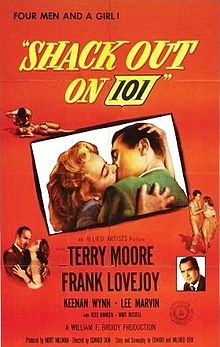
Shack_Out_on_101_film_posterLike a Cry Danger (1951) or a Private Hell 36 (1954), this low budget film noir flick is such a joy to watch because it wears what it is right on its sleeve, clear out in the open. What we get is an utterly absurd paranoia thriller that also happens to be a heaping plate of B-noir fun.

It’s a dirty, grimy picture about a dirty, grimy place. The cook behind the counter’s named Slob (Lee Marvin) and he has a dirty mind and disheveled look to match. He’s constantly at odds with the owner of the roadside shack (Keenan Wynn) and they make countless verbal barbs at each other time and again. You get the feeling that they relish jawing and putting the other man down.

Meanwhile, though the joint might not be one of the most frequented attractions there is some traffic from PCH and it brings in a few regular visitors.

The day-to-day “Hash Slinger” and longtime waitress Kotty (Terry Moore) is in the middle of a rapturous romance with a local professor Sam Bastion (Frank Lovejoy), and she’s beyond ecstatic to be going with someone who is a real man — intelligent and gentlemanly. Though recently he’s been especially occupied with work.

The traveling salesman Eddie (Whitt Bissell) with a nervous streak nevertheless remains a tried and true friend. He and George (Wynn) both made it through D-Day together and since then he always makes a habit of coming by the old place when he has a free moment. Kotty and the Professor take kindly to him too. He’s just that kind of amiable fellow.

Shack Out on 101 shines most obviously amid its small talk because there’s an invention to the dialogue that’s delightfully slovenly and colloquial. It’s full of the types of dialects, jabs, and put-downs that fill our everyday conversations in a way that feels thoroughly authentic and brings each character alive as they sit at the counter.

There might be two men standing in the front of the diner on a slow day lifting weights and talking about how muscles are for amateurs. Pecs are what real men call them.  Then they proceed to show off and compare their physical attributes. No reservations whatsoever.

Later on, they try out the latest fashions in spearfishing attire as they dream about the mythical “Pancho” who they’ll soon spear in the tropical waters off the coast of Mexico. Little do they know how close that is to the truth. Except there’s no need to go to Mexico. The catch is right at home.

When the film actually gets preoccupied with its plotting, it starts to go cockeyed and crazy. Admittedly, fallout from the Cold War must have been on everyone’s minds because, like Aldrich’s Kiss Me Deadly (1955), this picture too tries to play the nuclear angle. It’s hardly effective though I suppose it needed a broader, more concrete story to add a certain amount of intrigue and this one is complete with spies and government secrets.

Still, in the end, it comes out pretty thin. What we truly relish as the audience are not the attempts at drama but the way the film manages to make its apparent lulls invariably interesting and even how it manages to have asides at all given its infinitesimal running time. Sure, it won’t win any awards and the joint is a real dive but that’s all part of its cruddy charm. For a B-picture, this cast is quite the array of talent.

3.5/5 Stars

Blast of Silence (1961)

Blastofsilence.jpgIt looks like we’re staring into a black hole. Disorienting. Dark. Swirling around us. Our eyes adjust as our narrator begins his voiceover that will cover the majority of the film’s canvas. In this moment he talks about that initial spark, that moment of birth when humans leave the womb behind and see the light of day for the first time. In that same instance, we burst into the open air and realize that what we were looking at all along was the long dark tunnel from a moving train.

It’s from that train that our main protagonist hops off to get to work. He settles in a hotel room. Gets his assignment laid out with all the applicable details. He spends some time getting to know his target from the comfort of his car and picks up the gun he’ll use to commit the dirty deed. His supplier is a pudgy beatnik with a penchant for rats — a real salt of the earth kind of guy — but Frankie (Allen Baron) was never looking for a new friend.

However, he does bump into an old one. Because New York City used to be his home when he was a boy. He tried to get away from it. His memories of the orphanage and the Nuns who once cared for him. But now he’s back and one of the boys he grew up with is staring right back at him with his good tidings and Christmas cheer.

Frankie gets distracted. This complication throws him off his agenda because for one brief moment he becomes an actual human being and his very human desires begin to overtake the mechanisms of a stone cold killer. These are the same callous instincts that dictated his actions thus far. Things begin to come into their own and evolve into something truly inspired. It’s when Blast of Silence stops being a mere atmosphere or an aesthetic and becomes something real.

Because initially, this crime film is a grungy unsentimental picture that wears its low budget on its sleeve, delivering the kind of crime scenes that Jean-Luc Godard would have been proud of. However, this is not a French New Wave auteur but instead the director and star Allen Baron. At first, it seems like an exhibition not so much in style but a look and a mood and a feel. Drudging up images of the gritty pavements of Brooklyn, shipyards, and train tracks. Meanwhile, the score meanders between jazzy interludes and melodrama given the mood.

There’s a sense that it relies too heavily on its voice-over — the inner monologue of its lead — and still, that’s hardly a criticism because the film does so much that is engaging. In the end, Blast of Silence begins to suggest the immense isolation of a man in such a position. We’ve seen it before but few portrayals are so unflinching and pointed. Even as he pushes towards his objective, he’s simultaneously a picture of loneliness. We begin to question what leads someone to this career path. Some hints are left for us to make our own inferences. He’s an orphan. He’s searching for love. He wants something more. He wants a life with other people. Love, community, family perhaps.

Yet as it goes, God works in mysterious ways and you’re alone again back in the cold black silence like how things began. The film takes on a thoroughly pessimistic ending that nevertheless feels like a fitting conclusion amid the whirling rage of real-life Hurricane Donna. A truly unsentimental journey in the existence of a hitman.

3.5/5 Stars

Plunder Road (1957)

220px-Plunder_Road_posterThe rain is pouring down. A group of men sits in silence in truck cabs their heads full of all sorts of thoughts. Two more sit in the rear hoping the explosives sitting in their stead don’t decide to go Kablooie over the next bump. Nary a word is spoken, the entire sequence playing out in silence except for the inner monologues of each man.
But surprisingly enough all goes as clockwork with this heist as they gear up for a train carrying a U.S. Mint gold shipment. They divert the track. Get their men in place and board the vehicle to subdue all aboard. That’s done quick and efficiently and they continue doing their work that same way. They use one of the truck’s crane to hoist their plunder into the waiting beds of their getaway vehicles. No one sees it go down and no one will know anything about their job until they’re well on their way.

Of course, that’s only the first leg as the five accomplices break off. Now the spoil is split between the three trucks one loaded with furniture, another with “chemicals” and so on. So even though the events have all been done before, the execution of Plunder Road makes its version interesting in its own right.

The one lone driver steadies himself by chewing gum like there’s no tomorrow but that doesn’t help him to get past a police checkpoint after some radio static gives him away. He’s one casualty.

The only name of repute in the film that I knew was Elisha Cook Jr. now quite along in years and he’s playing a con man with the gift of nervous gab in the second vehicle. He tries to get buddy-buddy with his mate and we actually do learn some small trifles about them. It’s not much but it’s the kind of stuff that begins to make them into human beings.  They both have sons. One had his wife die while he was in the clink. The other never married. Their journey takes them to a rural gas station out of necessity and there we have the second casualty a neighborly old gas station clerk.

By this time the story has progressed to the third vehicle and they’re really sweating it now no thanks to special correspondent John Oliver from Salt Lake City who practically lives on the radio airwaves to provide the latest up to date news flashes. They weather routine police questioning and bide their time at the usual rest stops on their way to their final destination — a foundry near LA.

It’s an odd place to go but they do their best to conceal their prize in order to make their final getaway way far away from any nosy policemen. Though there plan doesn’t work completely. Still they manage. They pick up a girl who has their passports waiting for them and it looks like smooth sailing. But film-noir was born in an era that was hard-pressed to allow crime to pay and it’s a single moment of cruel fate that leads the heist off the tracks for good. Like Detour or The Killing and other such classics when fate rears its ugly head, things are never allowed to work out. That’s the accepted convention.

Plunder Road is so close to letting at least a few of its perpetrators get away but then it snatches their gold away from them. Compact heist films don’t come much better than this and this one benefits from a heightened sense of unsentimental realism.

3.5/5 Stars

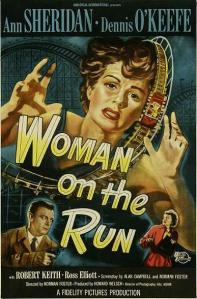
Woman on the Run (1950)

Woman_on_the_RunB-films have little time to waste and this one jumps right into the action. In a matter of moments, a man is shot, another man has killed him and a third witness gets away into the night. Although Frank Johnson (Ross Elliot) is rounded up by the police to be a witness he gives them the slip for an undisclosed reason and they must spend every waking hour trying to track him down.

What’s important to this particular story is that he left behind his wife Eleanor (Ann Sheridan) to be questioned by the police and they are hurting for a break. They need answers so they slam her with all sorts of inquiries.

She’s not all that cooperative though and the reasons are rather hard to discern. Is it belligerence, fear, or sheer apathy to the entire ordeal? Because you see, Ms. Johnson for some time had been drifting apart from her husband an accomplished painter who nevertheless put little stock in his own skill.

And that’s where the film’s two themes begin to intertwine.  The police surmise that the runaway man is fleeing a killer, but for his wife the implications are twofold. In her eyes, he’s just as likely running away from a marriage he couldn’t cope with. That is her dilemma which she masks both pointedly and inadvertently with various diversions to keep the police reeling.  After all, she’s not particularly keen on helping them or sticking around for that matter.

Whereas in earlier roles Ann Sheridan was always slightly overshadowed by other performers, most notable of those being the always electrifying James Cagney, here she gives perhaps her finest performance and she’s at the center of it all. That’s not to say she isn’t surrounded by a stellar supporting gallery.

Dennis O’Keefe, remembered as a gritty leading man in pictures such as T-Men and Raw Deal, showcases a new playful side as a journalist trying to nab a scoop on the runaway witness and at the same time making eyes at the man’s bride. But he manages to give the part some life that goes far beyond a one-dimensional characterization. There’s more to him as we soon find out.

The other important player turns out to be Inspector Ferris (Robert Keith) who as the long arm of the law is looking to find his man before his adversary does. But he’s not about to take flack from anyone and if ever there was a cop who was no-nonsense he fits the bill. His croaking voice always interrogating his subjects in a continuous effort to get his job done. Too bad he wasn’t quite counting on Ann Sheridan.

A relentless climax aboard a roller coaster at a local amusement park precedes Hitchcock’s Strangers on the Train when it comes to making carnival games such a deadly ordeal. And there are hints along the way ratcheting up the tension whether it’s a familiar cigarette lighter, a striking coincidence, or a passing remark that initially goes unnoticed.

The script strikes a strange path at times given to clunky expositional dialogue that feels as trite as can be and then in the very next sequence there’s a bit of patter or a dry quip that makes things all the more interesting. Also, a pair of small supporting roles for Victor Sen Yung and Reiko Sato add another layer of authenticity to the characterization only surpassed by the on location shooting that catches the essence of mid-century San Francisco.

In the end, Woman on the Run turns out to be one of those wonderful treasures that has rather unfairly gotten buried in the dusty attic of film noir. But far from being an antique, it plays fairly well today with an underlying tension running through Sheridan’s performance as she not only reflects on her own dwindling marriage but stresses to discover her husband’s whereabouts in fear of his very well-being.

It’s surprisingly entertaining and you get the sense that if Norman Forster (a fairly prolific actor, director, and screenwriter) were someone other than Norman Forster, this picture might have been scrutinized more closely. As it is, it’s just waiting for more people to dredge it up. How did I get here? If you’re a sucker for film noir and Ann Sheridan there’s no better place to go than Woman on the Run.

3.5/5 Stars