Review: Bringing up Baby (1938)


bringingup2“Our relationship has been a series of misadventures from beginning to end, so if you don’t mind, I’ll see Mr. Peabody alone and unarmed.” –
David Huxley

Bringing up Baby is really and truly one of a kind, almost headache-inducing with its sure energy and dizzying with its scatterbrained tracks, but nonetheless it is a screwball masterpiece. From Hollywood master Howard Hawks comes arguably one of his greatest films, boasting the rat-ta-tat-tat of some killer dialogue, some fantastic comedic sequences, and a number of memorable performances.  Honestly, if I learned anything from this film, you can’t watch it just once, because you’re bound to get bowled over, and afterward you probably won’t realize half of what you saw. For instance, there’s so much talking you hardly realize that there’s not much of a score.

Young Katharine Hepburn is at her most radiant and almost smothering with her constant barrage of words. You either love her or hate her. There’s no way to ignore her performance here because it’s completely out there. It’s hard to believe she was a novice when she came into comedy. There’s no inhibition whatsoever. Not in the least.

Cary Grant is the bookish paleontologist who is content with constructing the skeleton of his prized Brontosaurus and then marrying his admiring, no-nonsense sweetheart Ms. Swallow. It sounds like a pleasant albeit mundane lot in life. In an effort to gather a $1 million in funding, he goes out to the golf course ready to do a little business on the side with Mr. Peabody. That’s when hell strikes in the form of one scatterbrained lady extraordinaire Susan Vance (Katharine Hepburn). First, she swipes his golf ball (quite certain it is her’s), then she batters up his car (sure it is her’s again), and to top it all off she causes him to sit on his hat when they cross paths again at a club. Poor Dr. Huxley doesn’t know what’s hit him. He just wants to get away from her and all the fury that comes in her wake.

Good luck with that Cary, because she’s a force of nature! She misunderstands everything, and he gets endlessly caught in her web of miscommunication.  Susan initially roped him into coming along with her, thinking he was a zoologist who could help her take care of “Baby.” Of course, it turns out to be a tame leopard that they must get to her aunt’s home out in Connecticut (Only in a screwball comedy). By now he’s bothered. She’s falling in love.

So she does what any resourceful girl would. She keeps him occupied. First, she swipes his clothes. Then the dog George runs off with his prized possession, the intercostal clavicle. Initially, they want to get rid of the leopard. Then they want to keep it. Auntie comes home along with her gentleman friend Major Horace Applegate. A not so friendly leopard escapes from a carnival. The police get involved led by their bumbling leader Constable Slocum.
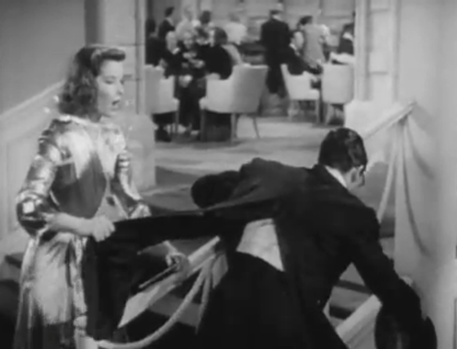
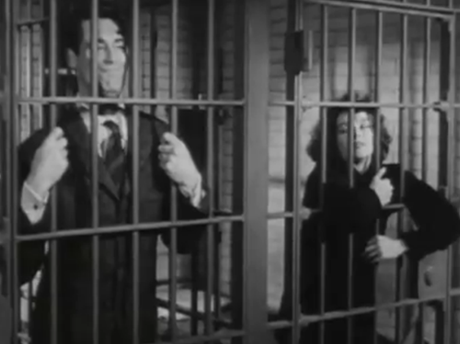
bringingup1It’s a doozy of a masquerade and most everything and everyone is utterly confused. It’s as if everything that enters the world of Susan Vance is further complicated. To her, it’s simply a day in the life and Huxley begins as an outsider, but despite all the madness, he becomes accustomed to it.  Running after the dog, getting soaking wet, tripping, falling, fending off a leopard, getting thrown into the clink. Dr. Huxley realizes that he’s never been happier and it ends pretty much as it began. Never a dull moment.

This has to be one of Hepburn’s greatest performances earlier in her career because she has everyone in a tizzy. Although he’s literally getting the run around from Hepburn, Grant is her perfect comedic foil. He dons the glasses at first and carries the sensibility that goes with them. However, he is equally equipped to go without them as a scatterbrained gentleman ready for all the pratfalls, quips, and escapades that ensue. And they are surrounded by a solid set of character actors including a drunken Barry Fitzgerald, the easily distracted Walter Catlett, the big game aficionado Charles Ruggles, and the peppy dog Asta (of Thin Man fame) among others.

Howard Hawks once said that “a good movie is three good scenes and no bad scenes.” In Bringing up Baby some of the memorable moments include the fateful meet cute at the golf course, the chuckle-worthy encounter at the club, and of course the sequence leading up to jail. But it’s also the little comedic moments wedged in between. Maybe Hepburn’s parked in front of a fire hydrant and trying to pull the wool over the policeman’s eyes. Or perhaps Grant dons the only piece of clothing, a frilly bathrobe, and is forced to answer the front door. It’s utterly absurd. It’s become classic and it shows the ability of Hawks behind the camera to make the action flow so organically.

It’s amazing that this film was a flop, Hepburn was labeled “Box Office Poison” by this point, and Cary Grant had yet to become an established star. Oh, how things changed. Because this film, in a sense, was the beginning of something truly wonderful. When two of the greatest stars aligned with one of the great directors.

5/5 Stars

People Will Talk (1951)

peoplewill1People Will Talk is in this weird gray area between genres. It has humor but it’s not screwy enough to be a screwball. It has drama, but it’s not intense enough to be a full-fledged melodrama. And underlining all this are issues that reflect such areas as the medical industry, the Korean War, and most definitely the witch hunts that were going on in the nation — bleeding into the Hollywood industry.

Written and directed by Joseph L. Mankiewicz, this is a minor classic about a doctor named Noah Praetorius (Cary Grant), who is under investigation from one of his by-the-book colleagues Dr. Elwell (Hume Cronyn), who dislikes the good doctor’s unorthodox and thoroughly effective approach to his trade. Praetorius by now is a preeminent physician who started his own clinic and also teaches classes at a local med school.

One of these individuals happens to be Mrs. Deborah Higgins (Jeanne Crain). She is not a student but sits in the lecture because her former partner was a medic. A date with a cadaver proves to be too much for her and she faints. Seems normal enough right? Wrong. After examining her, the Dr. tells her she’s pregnant. The truth comes out that she’s not really married and the father is dead. Her own father would be greatly distressed to learn about her condition, since he cannot provide for her.

That’s where Dr. Praetorious comes into the picture, and he takes great concern in Ms. Higgins condition. He attempts to allay her anxiety by saying she’s not really pregnant, and she runs away from his clinic out of embarrassment, since she is falling in love with him. He goes with his stoic friend Mr. Shunderson to the farm owned by Deborah’s uncle.

Deborah turns out to have a strange mix of aloofness and lovesickness, but when she realizes the Doctor’s true motive for being there (before he even does) she is wholly relieved. They share a passionate kiss and leave the farm behind to get married. Of course, the Doctor still hasn’t told her about the pregnancy.

Meanwhile, the whole storyline culminates with a concert conducted by Praetorious himself, but it just so happens that the hearing to analyze his conduct is happening simultaneously. Some mysterious truths about Mr. Shunderson are given in his own words, and stale Mr. Elwell’s case is dumped. Everything wraps up nicely as you expect with a happy marriage and Grant free to direct the symphony in one last glorious crescendo.

So you see if you really look at this film, there are these two main story arcs. One is a response to McCarthy’s witch hunts, the other an equally subversive love story about a doctor marrying a woman who had a pregnancy out of wedlock. When you put it that way this film seems chock full of controversy, and yet it is all veiled in a palatable comedy-romance. Walter Slezak is a welcomed addition to the cast as the nutty colleague and Hume Cronyn has taken on better roles, but nonetheless, he is always an enjoyable character actor. Obviously, this is a lesser Grant performance, but his pairing with Jeanne Crain is still a fun one.

4/5 Stars

My Favorite Wife (1940)

My_Favorite_Wife_posterThis is a film that I arrived at by a rather roundabout route indeed. Let me explain. I genuinely loved Cary Grant and Irene Dunne’s chemistry in The Awful Truth, but I wanted to watch My Favorite Wife before moving onto their final film together Penny Serenade. Time passed and I found two other films.

First, Something’s Got to Give which was Marilyn Monroe‘s final project that remained unfinished after her death. Only about 30 minutes were completed and it was scrapped, only to be reincarnated a year later as a Doris Day vehicle co-starring James Garner. Being a fan of Day and especially of the late-great Garner, I had to indulge in this romantic comedy Move Over, Darling.

All that is to say that the Monroe film and ultimately the Doris Day film were both based on this same basic plot. A man just recently gets married only to learn that his wife who has been missing for seven years is alive. He must figure out how to break it to his new wife, only to learn that she was shipwrecked on a tropical island with a strapping young man.

After three renditions it certainly feels over-trod, but the beauty of each adaptation is that they only have this basic framework intact. A lot of the really juicy bits are filled out by the cast. Of course, your stars change. Because James Garner is no Dean Martin is no Cary Grant. And the same goes for Monroe, Day, and Dunne. However, the same goes for the crotchety judge, the desk clerk at the hotel, the bookish shoe salesman who takes part in a deception, or even the friendly neighborhood insurance salesman.

It becomes a fun game of compare and contrast, but these different performances also free you up to watch these films on their own merit and enjoy that three times over. I have found myself to often be a proponent of characters over plot and this is another case of that.

Grant and Dunne are a lot of fun together once more even if I have seen these predicaments before because Day and Garner are great to watch, but for different reasons. And of course, all the locales and fashion trends changed a lot in two decades.

Also, I will not pass judgment on who my favorite wife was out of the three and, truth be told, I saw them out of order — I would usually pick the original. In this rendition, the judge played by Granville Bates was a real scene stealer so I was sorry to discover he passed away the same year and had very few other roles.

My only question is, would this film have been propelled to greater status if Leo McCarey had been able to direct it? Also, I am now excited I finally feel clear to watch Penny Serenade and I might just have to go back and revisit The Awful Truth because it has been a while.

3.5/5 Stars

Monkey Business (1952)

monkeyb5I always was under the assumption that the screwball comedy died off in the 1940s with homages coming out years later. Is there such a thing as neo-screwball comedies? Anyways, after watching Monkey Business I feel it is necessary to reevaluate that general conclusion. Here is a film from Howard Hawks that channels a great deal of the madcap craziness that you see in his earlier works like Bringing up Baby (1938). For lack of a better term, it is very screwy indeed. Right from the opening credits, you have the voice of God (Hawks himself) breaking the fourth wall and calling Cary Grant by his real name.

Then the film actually opens, and we meet the quintessential absent-minded genius Barnaby (Grant) and his loving wife Edwina (Ginger Rogers). They are meant to go to a social gathering and yet he is so caught up in his work that they stay behind. You see he is trying to develop an elixir of youth. His experiments are of interest to the business-minded and much older Oliver Oxly (Charles Coburn), who only sees the positives of such a discovery. Barnaby tries to explain to him that it’s not so cut and dry. In fact, his work could have dire effects if careful precautions are not taken.

Little does Dr. Fulton know that one of his lab chimps got loose in his lab and tampered with some chemicals, dumping them in a water cooler. After this absurd moment, Barnaby unknowingly consumes the rejuvenating concoction and his whole demeanor takes a turn.

Soon he’s out buying flashy clothes, getting a flamboyant car, ice skating, and driving like a speed demon down the thoroughfares with an astonished secretary Ms. Laurel (Marilyn Monroe). Cary Grant even shows off his impressive acrobatic skills, performing a cartwheel and a few other tricks.monkeyb3Only when the concoction wears off does he figure out what happened, and he resolves to be more careful next time. Except next time turns out to come sooner than he was expecting when Edwina willingly drinks some of the substance so Barnaby can observe her. Just like that, she is a prank-pulling schoolgirl with insatiable energy.

Once more Barnaby takes the elixir while Edwina is sleeping off the effect. However, when she wakes up a misunderstanding leads to more mayhem as she tries to get help from Mr. Oxly. What develops is a spiral into more hilarity. Barnaby and Edwina are reunited, Edwina’s old flame is incensed, Ms. Laurel is petrified, and chimps and man alike are taking part in some Monkey Business. If none of this makes much sense then I did my job!

3.5/5 Stars

An Affair to Remember (1956)

anaffairto2An Affair to Remember (1956) has always been noted as a great American romance as far as I can ever remember, and I figured out that part of that was because it gets a mention in Sleepless in Seattle (1993). Whatever the reason, I finally got around to watching it and it is certainly an enjoyable weepy. Any film with Cary Grant as a romantic lead is usually, at the very least, charming and this one is too. He is a famed man on an ocean liner who has finally gone and gotten himself hitched. It’s big news and as soon as the ship touches down he is going to meet his love.

Quite by chance, he meets Deborah Kerr’s character and they are immediately taken with each other. Soon their friendship grows into an affectionate romance, and yet they feel uncomfortable in front of the other passengers who seem to be watching their every move with interest. They both know that once the boat reaches New York things will not be the same between them for some time.anaffairto4And so it is, but they had made one last plan to meet each other at the top of the Empire State Building. Grant makes it, but Kerr is detained for a very good reason. After seeing her in an awkward situation at the theater, Grant resolves to go see her and get to the bottom of what happened. It’s a tearful, albeit happy, reunion as they come back together.

If any of this feels familiar, like a rerun, that’s because it is. Leo McCarey actually made An Affair to Remember (1956) as a scene for scene remake of his earlier film Love Affair (1939). I never thought I’d say that I like a film with Charles Boyer more than a comparable one with Cary Grant, but it’s the truth. I’m not sure if it’s because I saw it first or that the film feels more intimate, but I really enjoyed Love Affair. An Affair to Remember is certainly elegant in color and Deborah Kerr gives a fine performance, but I was personally blown away by Irene Dunne as an actress. In fact, back in the day, Dunne worked quite a bit with Cary Grant (The Awful Truth, My Favorite Wife, and Penny Serenade).

So my advice is, go back and give Love Affair a watch. It’s still by McCarey with much of the same story so it’s really a personal preference what film you like more.

3.5/5 Stars

To Catch a Thief (1955)

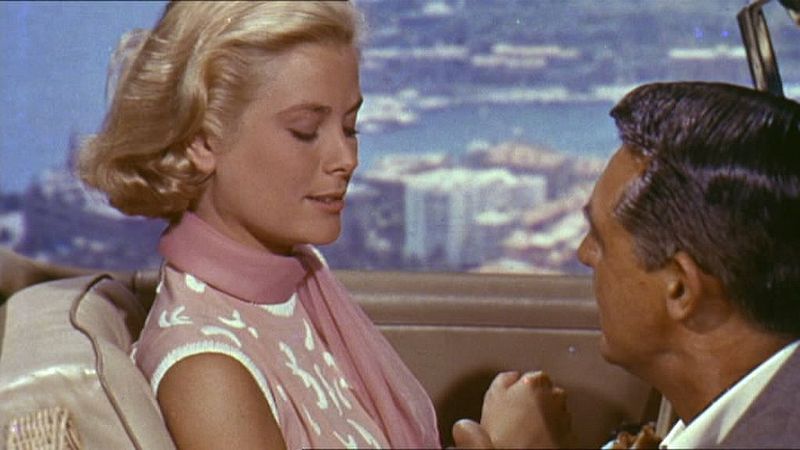
800px-To_Catch_a_Thief3Robert Wagner certainly knows It takes a thief, to catch a thief. The same goes for Cary Grant in this film which has him playing reformed cat burglar John Robie who is suspected for a series of thefts that have struck the French Riviera.

However, he knows he is not the culprit so he must clear his own name by catching the cat himself. The police want to nab him, his old French resistance buddies suspect him, and a beautiful young American woman (Grace Kelly) traveling with her mother is sure he is the cat. With a little help, mixed with some passionate romance, he is able bring some closure and get the girl.

That is all fine and dandy if you wanted a typical romance thriller. However, no one does it as well as Hitch. He somehow wonderfully balances the little bits of humor with his darker moments of suspense.  Jessie Royce Landis helps bring that comedy whether she is putting her cigarette out in some eggs or holding her book upside down as she commits a little white lie.

Hitchcock certainly had better films, but this one is so fun and it has the same glamorous Hollywood look as Hitchcock’s Man Who Knew Too Much (1956) with location shooting and vibrant colors.

Cary Grant and Grace Kelly make quite the pair, perfectly matched with the French Riviera in all its glory. I am convinced that Grace Kelly is and always will be one of my favorite actresses, period. Any era, any genre. Her name sums up her persona, because much like Audrey Hepburn, she has an extraordinary grace in how she carries herself. She can also be quite mischievous as well in her role as Francie. She is sure to set off fireworks.

4/5 Stars

Review: His Girl Friday (1940)

25148-hisgirl1It all happened in the “Dark Ages” of the newspaper game — When to a reporter “Getting that story” justified anything short of murder. Incidentally you will see in this picture no resemblance to the men and women of the press of today.”

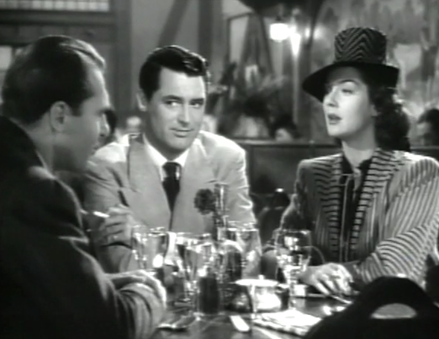
Hildy Johnson (aka His Girl Friday) is making her return to the Morning Post but not to get her old job back. She came to pay a visit to her former husband (and paper editor) who she divorced because she is newly engaged and wants to break everything off for good. It means she can go off into the sunset with her new beau, but it also means no more paper. She drops the news and it turns out the wedding is set for the next day so Walter has very little time to go to work. He soon begins a sly barrage of subtle and not so subtle jabs, ridicules, and put downs aimed at the easy target Bruce Baldwin (Ralph Bellamy). Walter cuts him off, plays dumb, and is in general condescending and conniving. Hildy sees it all unfolding and half watches with bemusement, while also trying to stop Walter from causing any major trouble.

You see he’s a wonderful fellow in a loathsome sort of way, but you cannot help but like him. Because as Hildy notes he comes by charm naturally since “his grandfather was a snake.” These are the kinds of barbs and witty put downs we deal with the entire film. Besides being good fun, it also is quite extraordinary, since they never stop coming. It’s also fascinating to simply watch the many expressions of Cary Grant, whether it is a smirk or straight face, it always has a tinge of mischief which suits his character just fine. He seems more like a little boy at times, trying to win back his girl, and in many ways, that’s what he’s trying to do. But back to the action.

Hildy unwittingly falls into Walter’s trap, and from that point on there’s no stopping her, or Walter’s scheme for that matter. When the wheels of journalism start turning there’s no stopping someone like Hildy with newsprint in her blood. Walter lets her catch wind of a man who pleads innocence though he is to be hung for shooting a black policeman. Hildy puts up a fight, but she doesn’t last very long.

Soon she’s gotten into talk to the nervous prisoner Earl and gets his point of view on the whole messy ordeal. The other newsboys are callous to the world, and as the gallows goes up outside their window, all they can do is play cards and think about the best scoop. Hildy is a little different but she’s still leaving…or is she?

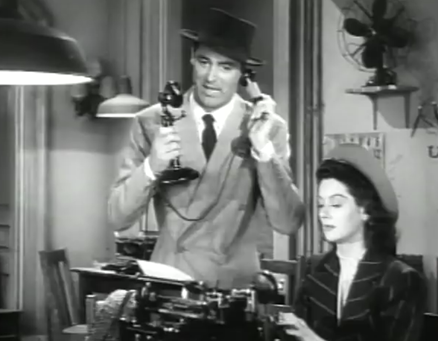
Next, Williams escapes and the mad search for the fugitive is on as the newsroom goes into an uproar. The mayor and sheriff are in a tizzy and then a reprieve for Williams comes, but they ignore it because they need this hanging in order to get re-elected. By a stroke of luck, Hildy finds Williams and stashes him away in a desk. Now she is hooked, and when Walter hears about her stroke of luck, everything begins again like old times. Bruce and his mother are soon disregarded as Hildy types feverishly, and Walter wheels and deals on the telephone. Then, the sheriff and mayor burst in with the rest of the boys. Williams’ hiding place is uncovered and the two reconciled lovebirds look like they might wind up with a jail sentence. But the honorable air-head Mr. Pettibone saves the day. All that’s left to do is depart on a two-week honeymoon to Niagara Falls or maybe a workers riot in Albany. All is right with the world again. Walter’s got His Girl Friday, and she’s got her lovable wiseguy husband back.

I’m not quite sure why I am so often drawn to this movie because it is more than it being readily available in the public domain. The dynamic of Grant and Russell is certainly superb. Walter can be an absolute cad, but Grant’s charm makes him bearable to the end. Russell is the true star of this film and she deals the punches with the rest of the boys. It really is the perfect role for her. The film is blessed with the great supporting cast including Porter Hall, Roscoe Karns, Gene Lockhart, Billy Gilbert and a host of others who populate the film with colorful faces and voices.

After seeing Nothing Sacred (1937) it was also interesting to see another script from Ben Hecht about journalism. Again, it might be a screwball comedy but there are also political undertones. Most blatantly about journalism itself, but also about corrupt leaders (like the mayor and sheriff), the Red Scare, gender roles, capital punishment, and even WWII.

Of course, it must also be noted that this is a film directed by the great Howard Hawks. I have always had difficulty pinpointing his trademarks, because the reality is, he was so versatile, trying his hand at so many different genres. All I know is that I more often than not enjoy his work behind the camera because it is seamless and it feels quintessentially American. His Girl Friday is no different. Although, this one is just a tad faster than most. It’s sure to raise your blood pressure so be warned.

5/5 Stars


Talk of the Town (1942)

0db8e-the_talk_of_the_townThis comedy-drama begins with a rather stark montage chronicling how the unfortunately named Leopold Gilg (Cary Grant) was accused of arson, murder, and finally imprisoned by one owner of a mill named Holmes. After escaping from prison and an imminent conviction, in a torrential downpour, the hampered Gilg seeks asylum in a nearby house. It just happens to belong to Miss Nora Shelley a local teacher in Lochester and an acquaintance of Gilg. She reluctantly allows the injured fugitive to hold up in her attic, but then her new tenant arrives a day early, the distinguished professor Lightcap (Ronald Colman).

After Gilg finally reveals himself to Lightcap as the gardener Joseph, what forms is an interesting triangle with the two men on the sides and Ms. Shelley in the middle. Both men take a liking to each other despite their difference in opinion on justice. Lightcap is much the academic and he goes by the book. “Joseph” on the other hand has a more practical approach.

It does not matter much until the professor finally learns Joseph’s true identity and now he feels it is his duty to report Gilg no matter his affinity for him. But after Gilg gets away once again, the professor is finally coaxed to look into the case that he has been so reluctant to involve himself in. Both men make concessions out of respect for the other. The professor involves himself, buys some borscht, and cuts his beard, while Gilg turns himself in. It almost drives Ms. Shelley up the wall with grief. You see she loves both of them.

In his final search, Lightcap finds something very interesting indeed. The town mob bursts into the courtroom as Gilg stands trial again, but the professor shows up with a surprise of his own. He ends up as the next Court Justice, a very happy man and Ms. Shelley and Gilg are very happy for him. They don’t have much to complain about either.

George Steven’s film has a bit of a contrived plot much like The More the Merrier. Things certainly feel set up, but that’s okay because the cast is so wonderful it makes the set-piece work. Jean Arthur is in top form when she is exasperated and sneaking about making little white lies as people file in and out of her home. Gilg seemed like a rather odd role for Grant, but he pulled it off with his usual charm and charisma. Someone else might have made Lightcap unbearably stuffy, but Colman’s portrayal is always tolerable and very often charming. This had a lot more drama than I was expecting, but it was not short on the comedy either. My only complaint is that it ran a tad long, but it just meant more screen time for the leads. That’s not so bad. They were The Talk of the Town after all.

4/5 Stars

Holiday (1938)

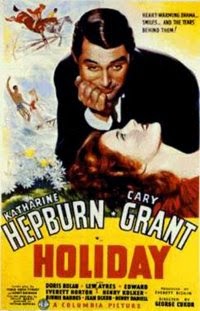
2c3de-holiday_posterJohnny Case (Cary Grant) is a happy go lucky fellow who is crazy in love with the girl of his dreams. He returns to town telling his friends the Potters that he has plans to marry this girl he met 10 days ago at Lake Placid! He is ecstatic and not afraid to show it.

However, he must become acclimated with her family and their lifestyle. Most important is gaining the approval of her sometimes stuffy and always money-minded banking father. Julia Sefton is by all accounts a lovely girl who seems to truly return Johnny’s affection. Honestly, though he is not quite used to her type of society. He makes his entrance by arriving through the servant’s door and wanders around the stately manor marveling at all the trappings. Doing the rounds he runs into her drunken but genuine brother Ned (Lew Ayres). Then, there is sister Linda (Katharine Hepburn), the so-called black sheep of the family, although her only fault is being an energetic free-spirit.

Immediately she and Johnny hit if off, and she soon realizes that her sister has a real catch on her hands. The wedding is finally agreed upon by Mr. Seton, and a big New Year’s Eve Party is thrown much to Linda’s chagrin. The night of the big to do there are two parties that take place. Downstairs all the snobs and high society mingle with Julia parading Johnny around. Upstairs is a different matter where the quarantined Linda is eventually joined by the Potters,  Ned and even Johnny.

The little gathering gets quashed and that is not all. Father and daughter are adamant that Johnny works at the bank and make money because that’s what any respectful husband would do. They take little heed of Johnny’s dream to take a holiday once he has raised enough money to live off of. He just wants to live life free of distractions for awhile, but they just do not understand. Finally, Johnny is feeling too restricted by all the obligations to bear it any longer, because he simply cannot live that way. Again, both father and daughter do not understand. But Julia does, and she finally realizes what she must do. It’s time to take a holiday.

Here is a formidable trio in Cary Grant, Katharine Hepburn, and director George Cukor. It makes me beg the question, how this film has become so overshadowed by Bringing up Baby and The Philadelphia Story? Johnny Case is a wonderfully vibrant role for Grant, and his acrobatics alone are worthwhile viewing. Hepburn on her part plays an equally spirited individual but without the scatter-brained or feisty edge that she often carried. Instead, she is just wonderfully footloose and fancy-free. Edward Everett Horton and Jean Dixon are an absolute riot, and I would love to have friends like them. Lew Ayres role was rather an odd one, but both Doris Nolan and Henry Kolker had an adequate amount of stuffiness to pull off their parts. That juxtaposition was necessary for the film to work and it did.

4/5 Stars

Walk, Don’t Run (1966)

a64da-walk_donThis was the last screen performance of legendary actor Cary Grant and for once he is not the one getting the girl. This time he is the matchmaker in this adaption of the earlier classic The More the Merrier. Grant’s character finds himself in Tokyo during the 1964 Olympics and the only room he can get is from a young English girl. This causes some difficulty but they make it work. It gets even more complicated after Grant meets a young American architect who is competing in a mysterious event in the Games. Sir William Rutland secretly puts the two young people together. It seems doomed from the beginning but through a wacky conclusion somehow it all works out in the end. Not a great film, but a decent swan song for Grant and it is certainly fun to have the film set in Tokyo.

3.5/5 Stars