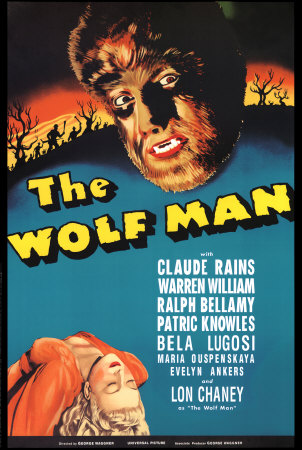
The Wolf Man (1941)

The-wolfman.jpgEven a man who is pure in heart, and says his prayers by night; May become a wolf when the wolfbane blooms and the autumn moon is bright.

Universal had an impressive catalogue of horror films during the 30s and 40s that integrated gothic and science fiction themes into stories such as Frankenstein, Dracula, and The Invisible Man. The Wolf Man can be considered part of that same dynasty and it established Lon Chaney Jr. much like Boris Karloff and Bela Lugosi before him, as a horror film staple. He was the Wolf Man as Karloff was Frankenstein’s Monster and Lugosi was Dracula. That’s how it worked.

What makes many of these films compelling is how they take myth and ground it in a believable reality. Fact and fiction becomes homogenized in a sense and such a world is a wonderful place to draw out horror. Because it can be supernatural, otherwordly, and frightening but it also hits close to home since there is a shred of truth always visible.

In this case, the film opens with the prodigal son, the lumbering, good-natured Larry Talbot (Lon Chaney Jr.) returning to the estate of his well to do father Sir John (Claude Rains). There’s some mention of a dead brother and a hunting accident–some tragic events. This is what brought Larry home and he seems to have patched things up well enough with his dad. As they say, time heals all wounds and it’s easy enough to dismiss it with that.

Anyways, life seems generally good. He’s getting acclimated with the quaint town of Lianwilly and he conveniently spies a girl working in her father’s shop across the way, the pretty ingenue Gwen Conliffe (Evelyn Ankers) who happens to be already engaged. But that doesn’t stop her from wanting to spend time with him because he really is a giant teddy bear with nary a violent bone in his body.

This is the preexisting world that the story develops only to be thrown off its axis by a telling event. It’s the origin of Larry’s troubles and they begin with a visit to a gypsy caravan, ending with him incurring a bite from a killer wolf. But the implications are much more ominous and deep-seated than that.

Because the trauma begins to eat away at him and his father though the local doctor sees his change of state as merely a psychological issue. Something he can be cured of. He’s only misguided–a little wrong in the head. They fail to see the full manifestations of his new sickness which transform him and lead him off into the night seeking after victims.

But if The Wolfman was simply an excuse to see a beast, it’s hard to gather that the film would have resonated with anyone then or now. In fact, this film is very much comparable to the superhero films we are so accustomed to now. The great installments are made that way by compelling characters and solid storytelling.

Curt Siodmak the brother of famed film noir director Robert Siodmak must be commended on his script which in a mere 70 minutes develops a streamlined story line full of a certain moodiness. To his credit, he helped lay the foundation for a whole legend that has become the standard archetype for any narratives involving werewolves.

The very fact the little poem uttered throughout the film is practically omnipresent, conjured up by so many individuals, works as a fitting harbinger of things to come. Meanwhile, the gypsies played by (Bela Lugosi) in an unfortunately relegated role and Maria Ouspenska, while pigeon-holed takes on the role of mystical soothsayers with ease. Throw in silver bullets, silver-headed walking sticks, and pentagrams and you have all the necessary touchstones (except full moons). Apparently that comes later.

Furthermore, the general atmosphere, time lapse effects, and painstaking makeup work of Jack Pierce all contribute to the heady brew. Perhaps because it is precisely these things that will make some disdain the horror genre with scorn that actually imbue a B-picture such as this a surprisingly engaging aura. It’s very much a part of the mythology that has been built around these monster movies and while meeting our expectations in a sense, that’s only a small, albeit integral part of this story.

Because, everything must ultimately return back to Lon Chaney’s performance as the genial giant Larry Talbot. He’s the complete antithesis of a monster. It’s not what he wants to be and he proves to have such a strong capacity for love. He keeps short accounts and he has a tremendous urge to protect others from harm. It’s innate in him. That’s what makes his ghastly transformation so devastating. Literally no one sees it coming (except Maleva) and you can attribute that to pure ignorance or you could go out on a limb and say it’s because Larry comes off as a genuinely good human being. By the film’s conclusion we feel truly sorry for him and that’s the key

But if we dare take the metaphor further still, I suppose we could say that his curse was a physical manifestation–reflecting the animalistic evil that can be inside of any person.  The stuff that’s churning inside of our being at any given time. That cauldron of dark desires bubbling up. That’s what makes the dividing line between the physical and psychological so interesting in The Wolf Man. Normally they exist in separate spheres but in some ways this film makes them one in the same.

4/5 Stars


Review: The Adventures of Robin Hood (1938)

the adventures of robin hood 1As a young boy, no hero was greater in my mind’s eye than Robin Hood and only Star Wars held a more honored spot in my childhood imagination. Because, to this day, Robin of Locksley remains the quintessential hero of mythical lore. Part historical truth mostly canonized myth and that’s the beauty of him. We can believe in him — see how he was in so many ways real but in the same instance larger than life.

To his credit, Erroll Flynn does a surprisingly phenomenal job in portraying the legendary outlaw in Lincoln green with a bit of British (Australian…) cheekiness, as well as bravado and charm. In fact, the film is full of so many wonderful elements from its engaging action sequences full of timeless spectacle and a plethora of characters who come right off the pages of the greatest Robin Hood narratives. Will Scarlett, Much the Miller, Friar Tuck and of course Little John still hold a great deal of esteem in my heart. While there are no men more villainous and corrupted than the likes of Prince John (Claude Rains), The Sheriff of Nottingham (Melville Cooper) and Guy of Gisbourne (Basil Rathbone).

Meanwhile, Michael Curtiz took the reigns of the film and makes it a lively swashbuckler that revels in a sense of good fun and that starts with Flynn’s performance radiating out from there. While this early use of three-strip Technicolor only serves to add yet another layer of elegance and vibrancy to the film’s look. It truly was made for color and every shade of Lincoln green and every bit of medieval opulence proves to be a feather in the film’s cap. It looks absolutely stunning and the same goes for young Olivia De Havilland as Maid Marian.

Olivia_de_Havilland_and_Errol_Flynn_in_The_Adventures_of_Robin_Hood_trailerFrom what I know from Robin Hood folklore, specifically Howard Pyle’s seminal edition, the film is surprisingly true to many of the origin stories and tales that have long since proliferated. As an audience, we become privy to the first meetings of Robin and the formidable Little John (Alan Hale) who lays him out in the local stream after a bout with quarterstaffs. Then, in another instance, Robin provokes the portly Friar Tuck (Eugene Palette) who happens to be a master swordsman and a lover of good food and drink. Still, other vignettes include Robin’s successful masquerade as a lowly archer who wins the grand prize at the Sheriff of Nottingham’s Archery Tournament.
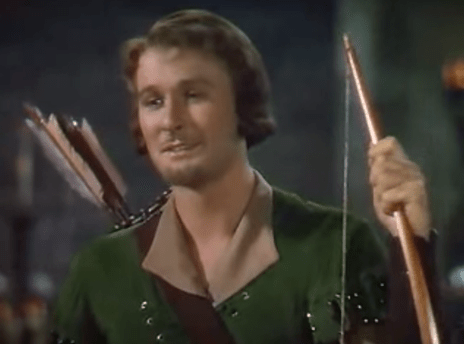
Of course, the most thrilling set pieces occur in Nottingham Castle, initially when Robin brazenly drops in on Prince John and his cronies bearing a deer over his shoulders. Admittedly I have Star Wars on the mind, but this sequence is rather reminiscent of Luke wandering into Jabba’s Palace.

Then, the climax comes later with the return of King Richard and Robin’s assault on the castle full of stellar swordplay and general chaos. The duel between Flynn and Basil Rathbone is especially thrilling and it holds up well even today because there is something so satisfying in watching them thrust and feint back and forth.

the adventures of robin hood 2For me, the reason very few heroes surpass Robin Hood is based on his innumerable qualities. He’s a superior fighter with bow, sword or staff. He’s blessed with a wonderful wit and impressive leadership capabilities. He wins over the girl with his charm. He gets to live out in the forest with his best friends, eating great food. But most of all, he’s a rebel with a heart of gold, robbing the rich to feed the poor.

He’s an embodiment of all things that a little boy dreams of as a kid and in many ways, he’s a fairy tale, but the kind of fairy tale that a boy readily conjures up in his own imagination. The villains are formidable and the action is unmistakable, but it’s all in good fun. That’s why the Adventures of Robin Hood remains an enduring folk tale of the cinema. Its hero transcends a single medium. Because he lives in the heart of many a young lad long after the title credits have rolled.

5/5 Stars

Notorious (1946) – Alfred Hitchcock

dc86a-notorious_posterPairing Cary Grant with Ingrid Bergman along with Hitchcock directing, Notorious tells a story of spies in South America after World War II. Bergman is the daughter of a former Nazi so she is enlisted by a T.R. Devlin (Grant) to spy on other Nazis in South America. Pretty soon Bergman has been accepted and is married to one of the men (Claude Rains). Bitter and cold, Devlin shows no pity for her plight. However, during a party an important discovery is made that puts her in danger. To make matters worse, she is now sick and the others are suspicious. Showing his true loyalty, Devlin comes to her aid before she is harmed and brings her to safety.

To some extent we feel for Claude Rains who will be terminated if it ever comes out he married a spy and that pity is a credit to his portrayal. This film also seems to speak well of Grant as an actor since he plays so against type here. Hitchcock memorable used the key in the film to move the plot forward effectively. Aside from that a couple of sequences stand out to me. The first occurs when Grant enters a room and then we have the POV of Bergman’s heroine. She is lying in bed and drunk so as he gets closer he appears up side down in the frame. Then, there is the famous kissing sequence that all happens simultaneously while Grant is on the phone. The final one I recall is the tracking shot at the party that closes in on the key hidden in Bergman’s hand. Hitchcock practically shoves it in our faces so we know its importance. I think these moments reflect the great direction and showmanship of Hitch.

Partially for this reason Notorious is undoubtedly one of Hitchcock’s best films with a truly stellar cast of characters. If Casablanca was the beginning of the story then this seems to be the perfect sequel. You have a WWII related plot, Bergman, Rains and Cary Grant to stand in for Bogart after all. But that is a topic for another post in the future!

5/5 Stars

Review: Casablanca (1942)

It was over 70 years ago that Casablanca hit the silver screen for the first time. All the main players are dead and gone now. The Golden Age of Hollywood, where pictures were being churned out with factory-like efficiency, has given way to a modern era of blockbusters. To borrow a quote from the movie, it doesn’t seem that one little film would “amount to a hill of beans” in our present world. Still, somehow Casablanca is beloved to this day, despite the numerous other films that have undoubtedly entered the black hole of film oblivion. It seemingly will not die and for good reason.

Considered one of the greatest films of all time, this well-loved classic deserves to be here. It is the hallmark of Humphrey Bogart and Ingrid Bergman’s careers. It also has one of the greatest scripts of all time, and it has achieved legendary status over the years. Many consider it purely the best film ever made and in all honesty, I would never try to refute that.

The film opens quickly and we are immersed in a world that is at the height of the Nazi terror, and many people are fleeing Europe by way of Casablanca. It is a treacherous place full of pickpockets, corrupt authorities, refugees, and naive tourists as well. Two German couriers have been murdered and some invaluable letters of transit have been stolen. That’s when we are first introduced to Rick’s Café Americain and its cynical proprietor Rick Blaine (Bogart).

A shady fellow named Ugarte (Peter Lorre) comes to Rick with the letters and asks Blaine to keep them for him. However, later that night Ugarte is taken into custody, and things begin to get even more complicated. Wanted resistance leader Victor Laszlo (Paul Henreid) is now in Casablanca, however, a Major Strasser has arrived from Germany to take him in. To top it off, Laszlo’s wife Ilsa (Bergman) was Blaine’s old flame in Paris and, needless to say, it didn’t end well.

Laszlo desperately needs the letters of transit to escape, and he inquires about them. Soon he is led to Blaine, but as Rick often admits he sticks his neck out for nobody. Knowing all too well that he is in danger, Laszlo still shows his defiance against his enemies by leading the people in a round of “La Marseillaise” and as a result, Rick’s is shut down.

All the memories of Paris begin flooding back, and then Ilsa confronts Rick in order to get the letters. This is possibly the most critical point in the film because this tense altercation ultimately renews the relationship between Rick and Ilsa. Rick asks her to trust him, and he begins to take things into his own hands. The results of his actions created one of the great romantic and cinematic moments in the history of film. The whole film leading up to this point hints at it, but Rick truly is a sentimentalist at heart. He can live with the notion that they will always have Paris and that leads him to commit a selfless act of love.

This film holds such a tremendous presence in movie history, and upon seeing the movie it makes complete sense what all the hype is about. What more could you want than Bogey, Bergman, Casablanca, and some of the greatest quotes ever uttered? Do not forget the corrupt, but nevertheless lovable French Captain Louis (Claude Rains), who delivers some terribly witty lines. Honestly, he may be my favorite character in the whole film, and that’s saying a lot!  Then, of course, there is the immortal tune of “As Time Goes By,” sung by Dooley Wilson which will forever be ingrained in film lore.

However, you also gain an appreciation for the other interesting characters of Casablanca, some comical, some sympathetic, and others despicable. We have a rogue gallery of everybody under the sun from Peter Lorre, Sidney Greenstreet, German soldiers, various guests, and all the staff at Rick’s Place. This movie has conflict and the uncertainty of war in practically every scene because at the time World War II was in full force. There are a broken romance and a forlorn hero who shows his courage in the end. As an audience, we come to realize the transformation of Rick into a truly great man. Ilsa on her part has the most radiant face I have ever seen.

It is wonderful that Casablanca succeeds as entertainment despite the fact that it is not modern. In fact, part of its charm is the black-and-white cinematography that helps make Rick’s Café so atmospheric. It effectively makes each interior shot moodi34 and every romantic scene even more striking. I am very doubtful that they would ever be able to pull this film off in color. It just wouldn’t work.

You do not need explosions and violence either, only great characters and a story with both drama and humor to reel the audience in. Up until the final moments of the movie you are captivated the entire time. Then, fittingly, you are left with the two men walking off into the night with the words, “Louis, I think this is the beginning of a beautiful friendship.”

In fact, with this film, my thoughts always go back to the script. Lines like “Here’s looking at you kid,” “We’ll always have Paris,” and “Round up the usual suspects” are so rampant that you cannot possibly remember them all, and I doubt there will ever be another film that is so immersed in American cultural lexicon. Still, many of my favorite lines in the film are those that get overshadowed by the more famous ones. That is the sign of an amazing film that never grows old. Even those who have not seen this classic film like to think they have, because the influence of Casablanca reaches everywhere. I guess I’m rather an idealist myself, so I would like to think that even if 70 more years pass, we’ll always have Casablanca.

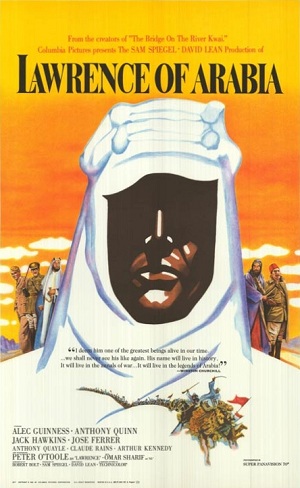
Lawrence of Arabia (1962)


A film of truly epic proportions, in length, scenery, and brilliance, Lawrence of Arabia is essential cinema. Peter O’Toole delivers a stellar performance as T.E. Lawrence, a British soldier during World War I. The movie begins with his death from a motorcycle crash, which gives an early glimpse of the character.

Then, a flashback goes to his time in Arabia where his task was to unite the Arab tribes, and lead them in rebellion against the enemy so the British might win. Against the better judgment of his commanding officer, a Mr. Dryden of the Arab Bureau suggests Lawrence be sent to assess the possibility of an Arab revolt against the Turks. Lawrence heads with his guide to pay a visit to Prince Faisal. However, his guide is shot by another man and Lawrence resolves to make the journey alone. Their paths cross again in the camp of Faisal. There Lawrence interests the Prince because his ideas are far different from his commanding officer.

Showcasing his audaciousness Lawrence suggests a bold attack on Acaba which would allow the British to bring in supplies. He leads a group of men across the brutal desert knowing that this will be less expected. Sheriff Ali (Omar Sharif) doubts it will work and disapproves that Lawrence takes two young outcasts as his servants. It is later during the journey that Lawrence truly wins over the other men, including Ali, because he is relentless, even going back for a lost straggler. With some luck, Lawrence is able to gain the help of Auda Abu Tayi, but it is not without tension. Ultimately, his forces are able to take out the Turks, and Lawrence heads back to Cairo to relay his progress. However, on the way back he must struggle with the loss of a servant and the guilt of executing a man.

Lawrence is sent back to Arabia and there he leads his forces in guerrilla operations against the Turkish railroads. His exploits are documented by an American newsman, and by this point, he has become a mythical hero among his followers. However, after going to scout a town the seemingly invincible Lawrence is ultimately flogged and tortured, leaving him a broken shell of a man. He insists on leaving Arabia but his new commander, General Allenby orders him back for one final push towards Damascus.

This final mission sees a change in Lawrence, who has hired killers and missionaries to help him in his siege. Against the better judgment of Sherif Ali, Lawrence leads a massacre of Turks as they move onward. He takes Damascus, but his fragmented counsel of Arabs are unable to unite, and the city is given back to the English. Major Lawrence is promoted once more to Colonel, and then gets shipped home because his services are no longer necessary.

This is one of those films you want to see on the big screen because the scenery and cinematography is just that impressive by itself. David Lean had a skill at making epics, and this is perhaps his masterpiece. The desert is often stark and desolate, and yet striking in the same instance. The expanse of space that is viewed in a single shot is often mind-blowing. A human being on the horizon is hardly a speck, and the ever-present camels are hardly any more substantial. To complement these grand images is an equally magnificent score by Maurice Jarre, complete with overture and all. The cast must be mentioned too with such supporting stars as Omar Sharif, Anthony Quinn, Alec Guinness, Claude Rains, Jack Hawkins, and Anthony Quayle.

Then, of course, there is the man who played Lawrence. As portrayed so wonderfully by Peter O’Toole, Lawrence is an intelligent and, at times, arrogant man, who can be odd, distant, audacious, and also unscrupulous. That being said, he was an extraordinary man who was a mover and a leader of men. A very unique, at times controversial, and long unheralded man, who contributed to the war effort in a far different way.  In many ways, he was an adopted brother to the Arabs, and their country was also his. He was “Lawrence of Arabia.”

5/5 Stars

Mr. Smith Goes to Washington (1939)

84a24-mrsmithgoestowashingtonposterAs both a political drama and feel good movie, this film cemented James Stewart as an acting powerhouse. Furthermore, despite its age, it acts as a timeless reminder of the evils of political machines. It makes us root for the underdog, and it is distinctively American. Here is a cast and a story that seemingly could never be equaled, but what this film really had going for it was an idealistic outlook. I can, myself, often be a cynical person, and still Mr. Smith never fails to make me acknowledge the numerous attributes that make our country great, whether it is through montage, monuments, music, and of course Jefferson Smith himself. 

In one of his best performances, Jimmy Stewart is an idealistic, naive boy’s troop leader named Jefferson Smith. The starry-eyed Smith trusts that our nation is founded on some very noble principles that should be fought for tirelessly in government and in society. Above all, he is a likable fellow, who earnestly believes in the merits of this country, and he is beloved by boys all across the state. Now, this all sounds fine and dandy, but it would never have come across on the screen if it had not been for Stewart. He emanates this awkward and innocent energy that puts life into the idealistic creation of Jefferson Smith. 

When the film opens, everything is in turmoil when a senator suddenly dies and a replacement is needed fast. Believing Smith will be a pawn, a powerful man named Taylor (Ed Arnold) gets Smith a seat in the nation’s Senate. There he joins the respected Senator and old family acquaintance, Joe Paine (Claude Rains), who is also a cog in Taylor’s machine. However, although he is out of place in Washington, the patriotic Smith does his best to be worthy of his position. He realizes that the press will not give him a break, and the other Senators do not take him seriously.

So, on the urging of Paine, he decides to come up with a bill for a boys camp back in his home state. He requires the help of the world-weary secretary Saunders (Jean Arthur) to get his bill done. Initially, she is disgusted by his naivete, but as she grows to know him, she realizes he is only going to get himself hurt. His action to propose a bill soon find him face to face with the political machine that elected him. Taylor also has stakes on the piece of land where the boy’s camp would be, and he wants it for a dam. 

Smith finds himself being accused of using his position for his personal gain, and pretty soon he is before a committee with false evidence piling up against him. With all odds and seemingly everyone else against him as well, Smith makes one last monumental effort. Thanks to the help and guidance of Saunders, Smith fights to plead his case through a filibuster.

Fatigued by many hours of giving impassioned speeches and reciting the Constitution, Smith finally collapses, but not before effectively succeeding at his task. I doubt this would ever happen in real life, but in the film, it is fantastic watching the Senate break out into complete and utter mayhem. Ultimately, a young man with “a little bit of plain, ordinary, everyday kindness and a little looking out for the other fella,” was able to win. True, it may be overly sentimental, but it is a wonderful piece of sentiment all the same.

Frank Capra was wonderful at these type of cheering tales and his stars were in top form. There is an absolutely wonderful supporting cast here including Claude Rains, Edward Arnold, Eugene Pallette Thomas Mitchell, Charles Lane, Harry Carey, William Demarest, Beulah Bondi, and numerous other familiar faces I don’t even know the names of. That’s the beauty of the studio system I guess. It may have the same director, same leading man, and some of the same general themes, but Mr. Smith Goes to Washington covers completely different territory from Capra’s later classic It’s a Wonderful Life. Mr. Smith should be seen as a unique, and very much American film.


5/5 Stars

The Adventures of Robin Hood (1938)

Starring Errol Flynn, Olivia de Havilland, Basil Rathbone, and Claude Rains, the film chronicles the legendary exploits of the outlaw Robin Hood. Whether he bolder enters the royal castle, meets Little John, or encounters Friar Tuck, Robin always exhibits bravado and bravery coupled with lightheartedness. Ultimately, he always helps the needy and that makes him the sworn enemy of both Prince John and Guy of Gisbourne. After narrowly escaping death again following an archery match Robin soon returns to the castle to profess his love for Maid Marian. However, after he leaves, Robin learns she has been imprisoned but also King Richard is rumored to have returned. With one final bold and clever move Robin aids Richard and duels Gisbourne to the death. Of course everything ends happily ever after. This film is full of swashbuckling fun, a good score, striking color cinematography, and light moments as well.

5/5 Stars

“Hanging would be a small price to pay in the company of such a charming lady” – Robin Hood

Casablanca (1942)


Considered one of the greatest films of all-time, this well-loved classic deserves to be here. It is the hallmark of Humphrey Bogart and Ingrid Bergman’s careers. It has one of the greatest scripts of all time, and it has achieved legendary status over the years. Many consider it purely the best film ever made and in all honesty, I would never try to refute that.
The film opens quickly, and we are immersed in a world that is at the height of the Nazi terror, and many people are fleeing Europe by way of Casablanca. It is a treacherous place full of pickpockets, corrupt authorities, refugees, and some tourists as well. Two German couriers have been murdered, and some invaluable letters of transit have been stolen. That’s when we are first introduced to Rick’s Café Americain along with its cynical proprietor Rick Blaine (Bogart). A shady fellow named Ugarte (Peter Lorre) comes to him with the letters and asks Blaine to keep them for him. However, later that night Ugarte is taken into custody and things get even more complicated. 

Wanted resistance leader Victor Laszlo (Paul Henreid) is now in Casablanca, however, a Major Strasser (Conrad Veidt) has arrived from Germany to take him in. To top it off Laszlo’s wife Ilsa (Bergman) was Blaine’s old flame in Paris and it didn’t end well. Laszlo desperately needs the letters of transit to escape and he inquires about them. Soon he is led to Blaine but as he often admits Rick sticks his neck out for nobody. Laszlo shows his defiance against his enemies by leading the people in a round of “La Marseillaise” and as a result, Rick’s is shut down. 

All the memories of Paris begin flooding back, and then Ilsa confronts Rick in order to get the letters. This is possibly the most critical point in the film because the tense altercation ultimately renews the relationship between Rick and Ilsa. Rick asks her to trust him and he begins to take things into his own hands. The results of his actions created one of the great romantic and cinematic moments in the history of film. The whole film leading up to this point hints at it, but Rick truly is a sentimentalist at heart. He can live with the notion that they will always have Paris and that leads him to commit a selfless act of love.
This film holds such a tremendous presence in movie history it is quite extraordinary. Upon seeing the movie it made complete sense what all the hype was about. What more could you want than Bogey, Bergman, Casablanca, and some of the greatest quotes ever said? Do not forget the French Captain Louis played by Claude Rains or the immortal tune of As Time Goes By sung by Dooley Wilson. However, you also gain an appreciation for the other interesting characters of Casablanca, some comical, some sympathetic, and others mysterious. We have a rogue gallery of everybody under the sun from Peter Lorre, Sidney Greenstreet, German soldiers, various guests, and all the staff at Rick’s place. 

This movie has conflict and the uncertainty of war practically in every scene because at the time World War II was in full force. There are a broken romance and a forlorn hero who shows his courage in the end. As an audience, we realize the transformation of Rick into a truly great man. Ilsa, on her part, has the most radiant face I have ever seen! If you take into consideration when this movie was made, it truly is wonderful to watch. You do not need explosions and violence, only great characters and a story with both drama and humor. Up until the final moments of the movie you are captivated the entire time. Then, fittingly you are left with the two men walking off into the night with the words, “Louis I think this is the beginning of a beautiful friendship.”

 In fact, with this film, my thoughts always go back to the script. Lines like “Here’s looking at you kid,” “We’ll always have Paris,” and “Round up the usual suspects” are so rampant that you cannot possibly remember them all, and I doubt there will ever be another film that is so entrenched in American culture. Many of my favorite lines in the film are those that get overshadowed by the more famous ones. That is the sign of an amazing film that never grows old. Even those who have not seen this classic film like to think they have because the influence of Casablanca reaches everywhere.

5/5 Stars