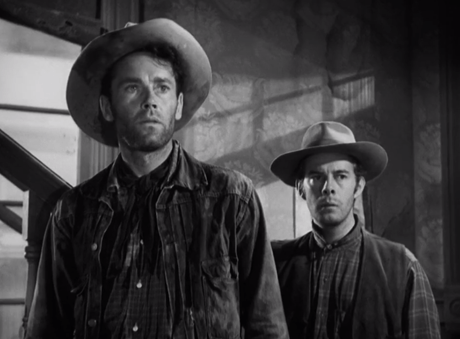
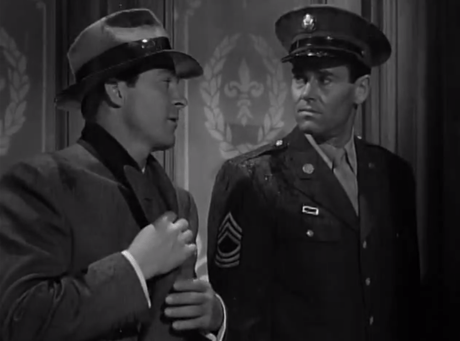
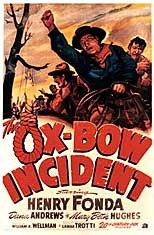
We know the score. Two drifters ride into town. They sidle up to the bar for some shots, looking for something to do in a lazy Nevada dust-hole. Their faces are equally familiar to anyone who has ever seen even a few of the old oaters. Feisty Henry Fonda as Gil Carter and his more even-keeled pal Art (Henry Morgan). Though folks question what they’re doing around, it comes to nothing except an exuberant fist fight for Fonda just itching for some thrills. He’s not disappointed.
Soon the community catches wind of the death of a beloved local named Kincaid at the hands of cattle rustlers. The wheels are set in motion as the sleepy town awakens and a lynching mob forms under the guise of a posse. With the sheriff out of town doing his duty and the local judge incapable of stopping them, they ride off looking for vengeance and some excitement to liven up their one-horse town. As the deputy illegally swears in the entire crowd as temporary deputies, our boys Gil and Art reluctantly sign on as not to draw more suspicion to themselves.
A Major Tetley (Frank Conroy) tries to take charge forcing his callow son (William Eythe) to join in as they begin their hunt. The two most reluctant and subsequently the most interesting additions to their party are the African-American preacher named Sparks (Leigh Whipper), whose own brother was lynched when he was a boy, and then the rational-minded Old Man Davies (Harry Davenport) who desires for true justice to be upheld. He is wary of the repercussions of a mob mentality.
Ultimately, they happen upon three strangers and circle them like ravenous wolves practically willing them to be guilty. In these crucial interludes, Wellman deliberately focuses on close-ups instead of scenery to ratchet the tension. It’s evident the bread and butter of this picture are within the characters themselves.
The crowd begins peppering the suspects with questions though they’ve already drawn up their answers for them. It doesn’t help that the trio’s leader (Dana Andrews) must try and explain some extenuating circumstances, namely how he acquired some of Kinkaid’s stock, which he purportedly bought off the murdered man without a bill of sale.
True, the posse doesn’t go off absolutely nothing but the integrity of democratic justice, as flawed as it might be, in the day-to-day, still maintains people are innocent until proven guilty. It’s not the other way around. That’s key. It also calls for not dealing in emotions like anger and hatred but impartial wisdom. Again, that might be impossible to attain but we must try our best. Otherwise, the consequences are potentially dire.
William A. Wellman was so eager to adapt Walter van Tilburg Clark’s original novel he agreed with Daryl Zanuck to direct two other pictures that are now all but forgotten. The Ox-Bow Incident might be small but it’s no less mighty thanks to the teaming of Wellman and Lamar Trotti. In fact, its volatility was so great no one knew how to market it during the war years. How do you try and redeem the debasement of humanity originating out of our own traditions, even as we try and reconcile that with the evil going on overseas? It’s a tall order.
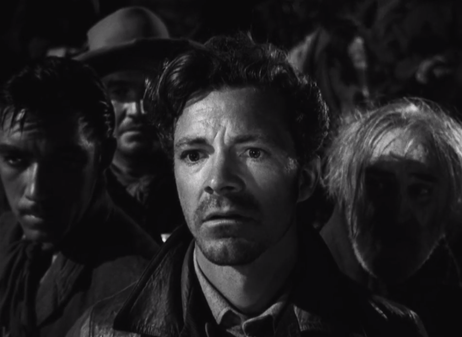
The equally horrifying thing is the fact lynchings had yet to be exterminated from American society and the blood of such injustice still soaked American soil. Though this is a showing of three men getting hung, one white (Andrews), one old (Francis Ford), one Mexican (a defiant Anthony Quinn), this could have just as easily been racially charged with African-American victims.
Regardless of guilt or innocence, justice was never meant to function in this fashion where lawlessness is masked by perceived legitimacy. Nothing good can come of it. Fonda’s own memories drew him to the material as he supposedly witnessed the lynching of a man named Will Brown in Omaha, Nebraska on September 28, 1919. You can only imagine how the images scalded him for life. 12 Angry Men (1957) is indubitably another film which dealt with comparable themes very close to his heart.
His part, along with Morgan by his side, remains crucial because they essentially act as impartial bystanders and their choice is faced by anyone at the crossroads of such an issue. Because good can be quantified by commission and omission just as evil can be perpetrated through action and inaction.
The final wallop of the film is, of course, finding out what the actuality of the matter is — knowing full well they acted in error. To cap off the most moving showing of his generally hardboiled career, as the dying family man, Dana Andrews touches them from the grave with his words one last time:
“A man just naturally can’t take the law into his own hands and hang people without hurtin’ everybody in the world, ’cause then he’s just not breaking one law but all laws. Law is a lot more than words you put in a book, or judges or lawyers or sheriffs you hire to carry it out. It’s everything people ever have found out about justice and what’s right and wrong. It’s the very conscience of humanity. There can’t be any such thing as civilization unless people have a conscience, because if people touch God anywhere, where is it except through their conscience? And what is anybody’s conscience except a little piece of the conscience of all men that ever lived?”
Even if his words serve the film more than they are the authentic words of a husband, their affecting nature is undebatable. Every man standing around the bar sullenly has been given a costly lesson — a lesson requiring the lives of three men. It’s fitting for our two drifters to ride out of town just as they came in the same hound dog sulking across the road. And yet so much has changed. If anything our hero has found his conscience in a sea of injustice.
4/5 Stars
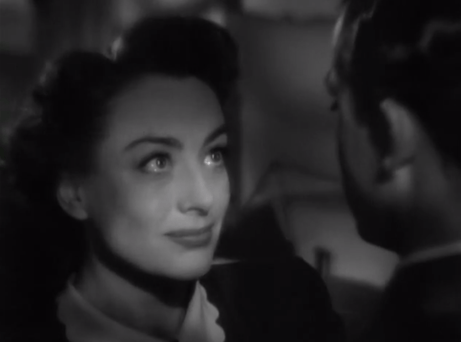
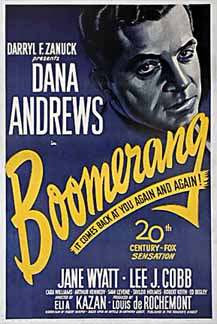 Boomerang shares some similarities to
  The film opens with a dead end drifter being ushered off a bus in the little every town of Walton, wedged somewhere between LA and SF. Although in actuality it was shot partially on location in Orange, California, serving up a perfect representation of quaint Middle America. You can almost hear Paul Simon singing from the future (Got off a greyhound to look for America) as Dana Andrews gets off the bus. Except he winds up at Pop’s instead. There he sizes up the town and gets his first eyeful of the alluring waitress Stella (Linda Darnell).
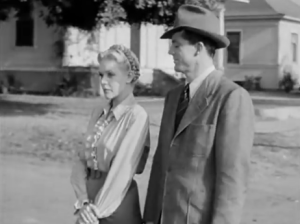 Being blessed with a certain amount of charm, Stanton strikes up a relationship with the untouchable gal, the churchgoer, the book reader, the generally good human being, June. He knows how to pull her out of her shell. Catering to her necessity to get out and live life (All the things you look down on are the things that make up life. Little things, like a game of bowling..or a swim at night, or a dance, a kiss, stuff that bubbles). It works and she begins to be swayed. Conveniently she also has a great deal of money. The outcome seems obvious and yet the story twists in unexpected ways.
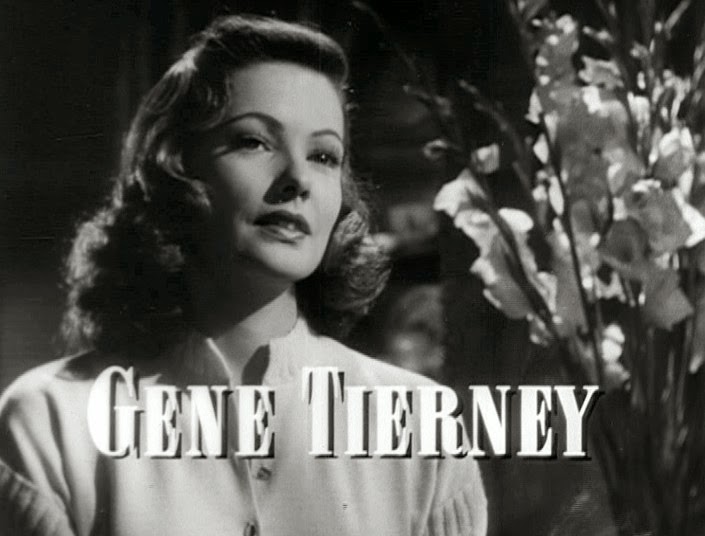
 Fallen Angel undoubtedly gets a bad rap because it does not reach the rapturous, beguiling heights of Laura (1944) from the year prior, but it deserves to be seen in its own light. It’s true that both films are murder mysteries but while Fallen Angel isn’t all that interesting in that regard it has a surprisingly sharp script in other ways. Preminger works through his story with a certain dynamic assurance and like its predecessor, it’s the characters that are by far the most fascinating. Laura was a superior mystery, character study, etc., but Fallen Angel gleams brightly thanks in part to its classical chiaroscuro cinematography and an engaging menagerie of locals including Charles Bickford, Percy Kilbride, Bruce Cabot, and John Carradine.
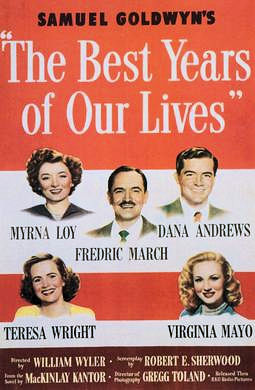 Inherent in a film with this title, much like It’s a Wonderful Life, is the assumption that it is a generally joyous tale full of family, life, liberty, and the general pursuit of happiness. With both films you would be partially correct with such an unsolicited presumption, except for all those things to be true, there must be a counterpoint to that.


 4 Star Films