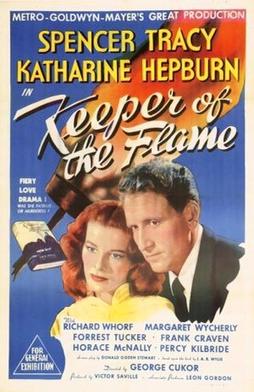
Keeper of The Flame (1942)

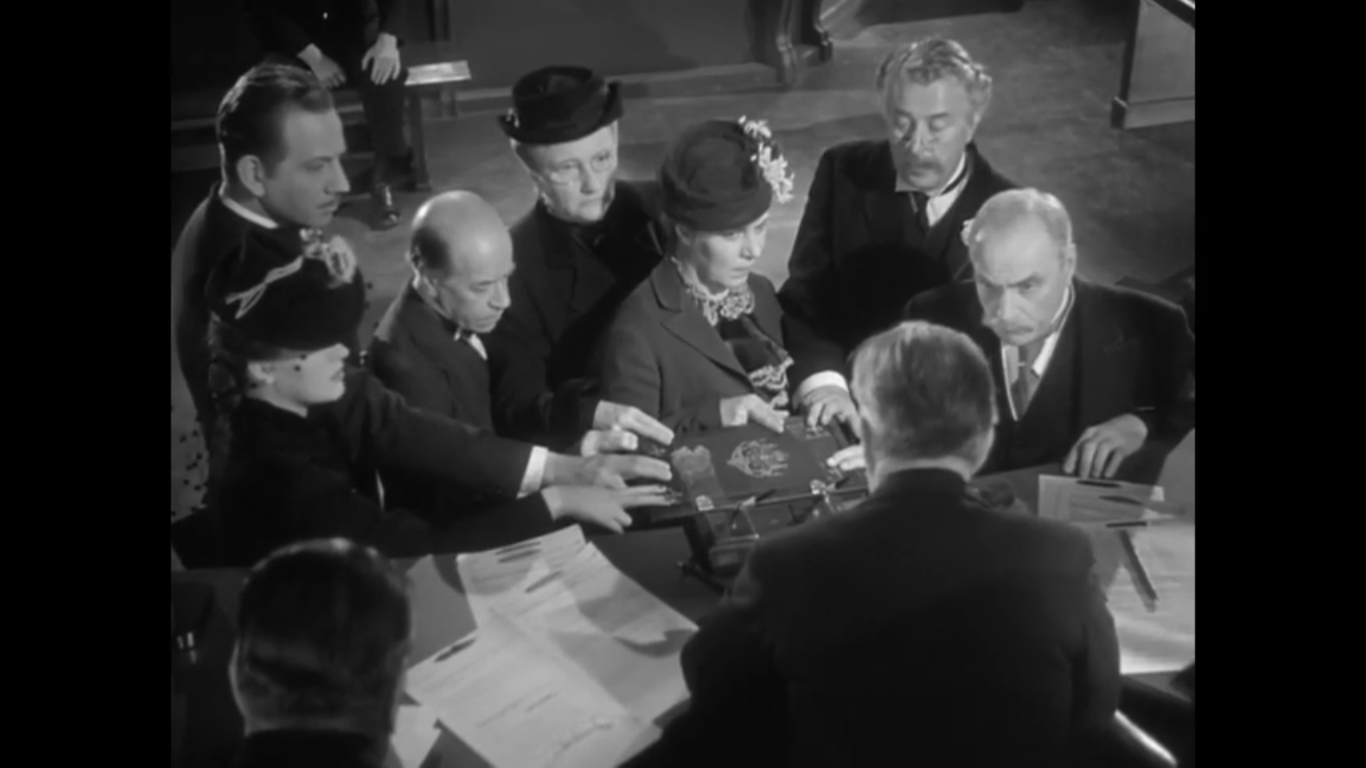
Keeper of The Flame strikes me as good ol’ fashioned Hollywood storytelling. It’s conveyed through a fatal opening car crash and a flashing montage of newspapers spelling the death of that great American institution, Robert Forrest. We’re hooked immediately as the story keeps on rolling.

The world itself in the formerly sleepy town has the definitive consciousness of Home Front America, full of interiors and then exterior-looking interiors, all on the studio lot. Moreover, there’s a frantic industry and a general chaos in the face of shortages, bringing out American know-how and good humor in the face of everyday adversity.

Namely, a bevy of journalists and well-wishers descending on the place not fit to handle such an overflow, especially during wartime. A harried Donald Meek monitors the telephone line and does his best to get the flood of people in front of him booked in any vacant rooms still available.

Steven O’Malley (Spencer Tracy) wanders in unannounced and mostly unseen. He pays respects to an old friend who barely recognizes him. It’s the eyes. He gives Janey (Audrey Christie) that quiet congenial Spencer Tracy look, and she asks quizzically if it hurt much when Hitler gave him the boot.

We glean he must have been a war correspondent, either based in a concentration camp or the Berlin press bureau. Their jokes are casual. You know they must do this in their line of work and in 1942, we can hazard a guess they don’t know the full extent of what they’re saying.

Christie has the whip smart repartee of a journalistic working woman a la Rosalind Russell. Since the house is packed, she coyly registers him as her “husband,” though there’s another colleague up for her affections (a young Stephen McNally).

O’Malley has an aspiration to get into the grieving Mrs. Forrest so he might share her husband’s story with the people. Riffing off of It Happened One Night, his pals quip that she’s the Queen of Jericho and he’s no Joshua. The walls of her castle won’t come down for just anybody. Though Tracy always had a certain dogged tenacity about him, and that’s what makes him a compelling, active hero.

Algonquin Round Table alum Donald Ogden Stewart builds out his screenplay in the opening act with all these intriguing nooks and crannies and characters who seem capable of existing of their own accord with intricate backstories.

Howard Da Silva is a guarded vet of the Argonne and de facto groundskeeper of the Forrest estate. A little boy (Darryl Hickman) grieving the wake of this great man from a lamppost; we learn he too has an intimate connection to the deceased.

There’s another relation to Mrs. Forrest who’s equally distrustful of the press and drinks his sorrows away with ginger ale. The dead man’s bespectacled press secretary (Richard Whorf) chooses a different approach: He’s highly elegiac and accommodating because his job requires levels of PR, though there’s plenty he’s not letting on about.

Beyond Christie, a personal favorite is the peculiar old cabbie (Percy Kilbride), laconic and chewing his cud while offering up homespun wisdom. He provides O’Malley transportation to and fro as the journalist pokes around for his story.

We know from a fair distance Keeper of The Flame is a kind of grade-A American propaganda piece, and it finally becomes most explicit when Tracy gives a little soft-spoken speech to Daryll Hickman about not letting the unseen enemy make them slaves and kick them around by putting chains on their minds and tongues.

In its defense, it’s mostly soft-pedaled moralizing because Tracy’s soapbox is small and he has a way of making the serum of slightly hokey words tolerable thanks to his usual candor.

However, the local doctor (Frank Craven) provides one of the most telling remarks after paying a house call to the imposing estate: “Ever since we’ve been falling out of touch with God, we’ve become pushovers for hero fever.” When he speaks of a young woman who was sent away, he surmises,  “You don’t fall in love with a god, you just worship him.” He’s a sympathetic fellow and in making his opinion of Forrest quite clear, it’s one of the first dubious signs we have to go on.

These ideas are thematically rich with potential, not to mention controversy. The movie becomes less so with the tinges of forested and thunderous gothic melodrama. Coincidentally, it’s not material I would immediately attribute to George Cukor although the 1940s were replete with such fare.

And it’s true there is a vague Citizen Kane-like bend to the story of a prominent man now dead. Although I also think of Welles’s other great figurehead Harry Lime for casting a shadow over the film, which is not too dissimilar to Hitchcock’s Rebecca, albeit gender swapped. These are mostly uncharitable comparisons and few can argue the point.

Katharine Hepburn might seem uncharacteristic in something so grim and restrained, but she proves her capacity for it. While I always am skeptical of her as a shy wallflower in a picture like Undercurrent, she handles this tormented role with a certain inscrutability. Although I don’t know if even she can manage keeping the story from getting out of hand.

There’s something in it on the tip of my tongue tying into almost John Fordesque mythmaking, whether it be Fort Apache or The Man Who Shot Liberty Valance. Sometimes you print the legend to protect people because the truth is too destructive to reveal. Except Tracy isn’t squeamish about giving the electorate a sober reality check.

In this regard, it feels like a daring sort of picture and you wonder if this was the saving grace, making it a draw for audiences beyond the conspicuous nature of the romance and brooding genre elements.

Still, the initial propaganda moments burn off only to come back like a raging conflagration. Hepburn brings them back again and she drops them right in our laps when she mentions fascism as embodied by her late husband. In one sense, it’s an impressive rallying cry and also an utter disappointment given the film’s best parts.

The finale of literal fire and water is all things histrionic and ham-fisted. Hardly the film’s finest achievement. All of this comes with a convenient ending, but I suppose in wartime you give the people what they want — assuming this was it.

Even with the underlying sentiment, Keeper of The Flame still has its moments that feel downright groundbreaking, and better yet, the wit of the supporting characters lives on in the mind’s eye. Alas, this was not meant to be.

Most of all, I regretted characters like Audrey Christie and Percy Kilbride fading away without consideration; I suppose they were sacrificed on the altar of a greater cause. I understand the sentiment and still, it feels like a waste of a stellar set-up for such conventional ends — even if it was for the sake of galvanizing wartime propaganda.

Perhaps this is all the more reason to want more out of the film. This is a good impulse because it means there are more than a few things worthy of praise.

I’ve only one final thought. In many ways the movie presages what Jacqueline Kennedy chose to do in the wake of her husband’s tragic death. More than once in the movie, an allusion is made to Abraham Lincoln, and Jackie made sure her husband had a funeral evoking that of the nation’s first slain president.

Then, at his final resting place in Arlington Cemetery, there burns an eternal flame. She was the keeper of that flame — solidifying his stature for generations of Americans. I won’t get into conjecture about her husband’s legacy, but it does play as an intriguing counterpoint to this film’s central figure.

3.5/5 Stars
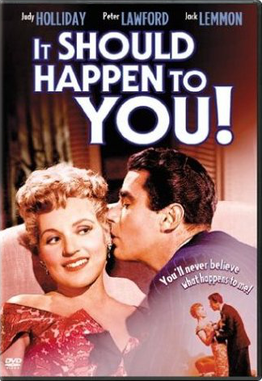
It Should Happen to You (1954)

It Should Happen to You was the brainchild of screenwriter Garson Kanin and director George Cukor with Judy Holliday as their lead. As such it’s easy to cast the movie in the same lineage of Adam’s Rib (1949) and Born Yesterday (1950). Except in this movie, there’s also a featured newcomer, a young man named Jack Lemmon.

The movie opens as any respectable New York movie does in Central Park. In the outdoor reverie of men at their chess boards and kids running around, Gladys Glover causes a hullabaloo for feeding pigeons. One man takes particular umbrage at having her try to pick him up while he was minding his own business, listening to the horse races.

In the aftermath, she meets a documentarian, Pete Sheppard (Lemmon), who has his camera at the ready and an eye for people (Think a precursor to Humans of New York). He’s fascinated by this barefoot woman, and strikes up a conversation before they go their separate ways.

There’s an ethereal, fated tone I can’t quite put my finger on, but we know they will meet again and something is bound to happen. Judy Holliday perfectly exemplifies this airy bubbliness. I would never condescend to exhibit her as a dumb blonde archetype because there is far more going on here.

Gladys Glover sees an open billboard and resolves to buy up the prominent real estate on Columbus Circle. For what purpose we can’t be sure exactly. She says its personal. But she goes through the paces, speaks to the proprietor, and forks out the money that’s normally attributed to marketing corporations, not individual citizens.

Soon the words GLADYS GLOVER appear up on a street corner in lettering that looks like high rises. It’s an extravagant decision and Gladys beams with pride seeing her name like it’s never been before. But that’s not the end of it.

The rest of the movie is about the cascading effects it has since movies are meant to feed off delights of serendipity. It Should Happen to You is that kind of movie.

Peter Lawford plays a disgruntled marketing exec miffed to find out someone else has shouldered in on the billboard that has always been theirs in the past; it was an unspoken agreement between them. When he finds out about Gladys he wants to strike a deal with her. Surely a lady can be bought.

It must be said an angry Jack Lemmon is not always becoming and after moving in down the hall from Gladys, he seems to think more and more that he owns her. A more charitable reading of it is that he’s the only person who actually cares for her well-being beyond her growing reputation as a minor celebrity; he’s also falling in love.

Meanwhile Gladys strikes up an agreement to get her name put up on signage all over the city. When she’s shopping with Pete, a saleswoman helps them only for her demeanor to change instantly when she realizes who she’s helping. It’s like being queen for a day as a crowd forms around Gladys soliciting autographs from the local phenomenon.

She has effectively given them something — a nice souvenir to take with them in their day — and in this way it’s hard not to compare her to Elwood P. Dowd of Harvey. In the movie world they’re able to break into the everyday and give people some common decency and kindness.

However, we also watch from a distance as Gladys gets carried away by the mechanisms and machinery of television. She’s paraded out in front of America without much consideration of who she is as a human being. In one segment she’s even featured on a prim and proper panel show with the likes of Constance Bennett and Wendy Barrie. It feels twee by today’s standards, but the point is made.

Soon she finds herself caught between the indignant protectiveness of Lemmon and the business conferences of Peter Lawford including some extracurricular activities. His company has transformed the typical ethos marketing appeal into the Gladys Glover everywoman appeal for the average American girl. It’s a smashing success.

It Should Happen to You doesn’t feel like a groundbreaking story and part of this might be the fact we’ve seen so many analogous film’s in its wake. There’s this tension between celebrity and success and the kind of down-to-earth humanity that keeps one grounded.

I must say I was taken with the ending where Lemmon says goodbye to his girl using a film, and yet again it presages many of the meta qualities of a film within a film that have enamored writers and directors for decades.

In this particular instance, it’s in service of a romance. The happy ending is that he actually receives a reply. Gladys writes it in the sky for him with letters as big as her billboard. She hasn’t lost her knack for the spectacular, but she simultaneously recognizes someone who has her best interest in mind.

If you said you were going to make a romantic comedy with Judy Holliday and Jack Lemmon, it wouldn’t immediately strike me. Still, if you have two likable performers and put them together, the results speak for themselves, even if the returns are mostly modest.

3.5/5 Stars

A Woman’s Face (1941)

The movie’s faux Scandinavian backdrop can be traced back to its origins in an early vehicle for Ingrid Bergman back in her native Sweden that was released in 1938. Since I haven’t seen the original, I cannot attest to Bergman, but she doesn’t immediately spring to mind in a role that calls for some amount of moral ambiguity — at least on screen.

Still, A Woman’s Face was a stepping stone part for Joan Crawford, from her effervescent flapper days and pertinacious working gals to something vulnerable and bold for a fresh decade. She sheds all glamour, something used so often as a mask in Hollywood, and willfully puts on a different facade of scars and perceived ugliness. It’s a move her rival Bette Davis readily made as well.

Here Crawford is a creature tormented and self-conscious about her own appearance. She’s crawling with shame. Mildred Pierce always gets the plaudits, and rightfully so, but surely there’s room in the conversation for this picture. Still, let’s not get ahead of ourselves.

We stand by as a prisoner is marched through the hallways of a court. A menagerie of witnesses has been called to testify in the wake of a murder trial. The very same woman, her face hidden by her hat brim, stands accused, and the film effectively uses each of these disparate individuals to elucidate her story for the sake of the jury (and the audience).

It’s not an unheard-of device, but it’s rather clever, starting on the outer ring with a peculiar sort of character before getting closer and closer to who she is as a person with each subsequent flashback. As such, a sprightly waiter (Donald Meek) and a more guarded manager (Reginald Owen) recount their days serving at a local tavern.

One of the guests, Torstein Barring (Conrad Veidt), is a curious fellow. He’s the life of the party and expects certain privileges. One of those is running up an overflowing tab at the establishment after a merry night of wining and dining. He exhibits a piercing kind of magnetism, sleek and somehow unnerving.

When the lady of the tavern steps out of the shadows and excuses his bill, he’s immediately taken by her. She’s scarred over her face, and yet all he sees are those striking Joan Crawford eyes. There’s something immediate between them, and it comes out in the courtroom that the whole tavern was essentially a set-up for petty blackmail. When people get giddy their tongues loosen, and they are availed of all their faculties.

There’s a level of dubiousness and doublespeak with her underlings providing another layer to the film involving both humor and intrigue. Because they ran a fine and highly lucrative con game complete with all manner of deception. Now they’re looking to save their necks.

The ready victims are the adultress Vera (Osa Massen) — wife of reputed surgeon Gustaf (Melvyn Douglas) — and then her latest beau. The joy of A Woman’s Face is how there are building blocks for melodrama. In literary form, it might come off as convoluted and unclear, but the cinema screen makes it sing.

In one moment Anna (Crawford) is trying to peddle some stolen letters for a weighty sum with a level of vindictiveness. She scoffs at others. In another, she meets Gustaf, who returns home unexpectedly both catching this woman in the act and becoming genuinely interested in her. His wife doesn’t want any of her dirty business getting out so she reluctantly plays along.

Almost everyone has an enigmatic side, some sort of angle or self-serving motive we’re trying to detect. Melvyn Douglas is the one character who is straightforward and easy to read. He offers to transform her face. Not with an ulterior motive, but out of a sense of decency.

There’s a fine level of suspense waiting to see Anna’s face reconstructed. We know what it will be and yet are forced to wait for moments with the camera working to evade a direct shot of her; it adds something, a level of expectation.

It’s yet another soap opera contrivance that works wonders. Because Joan Crawford takes this blemish and turns it into something powerful and ultimately beautiful. With it comes new confidence and new life. Anna and Torstein grow closer and closer and he’s even more drawn to the vision of her rebirthed self. Also, her disposition shifts.

Still, he has almost a Nietzschean charisma, and he coaxes Anna into playing nursemaid to a young relative who’s set to inherit a large fortune. She’s become a governess of the Phyllis Dietrichson persuasion.

Watching Crawford come down the stairs with the precocious little kiddy, I couldn’t help but think of those old glossies of Marion Davies parties except this is a party at a Scandinavian version of Hearst Castle. Images of piano and dancing superimposed over Crawford’s face say everything.

Actually, I misspoke earlier because aside from the young tyke and the kindly Gustaf, the Consul Barring (Albert Bassman) is a jolly old man, who welcomes Anna cordially even as his housekeeper (Marjorie Main) remains distrustful of their latest guest. In truth, they’re both right. They see the two different sides of Anna on display.

There’s an old Hollywood axiom about getting an actor’s good side, and I couldn’t help noticing how A Woman’s Face plays with this practically. Crawford’s right side is kept hidden for much of the first half of the movie and traditional 180-degree filming means it’s all but masked from us.

I noticed the change at the party when she meets the good doctor again. Finally, she’s on the left side of the frame fully unmasked and open to us. It’s true we see her in a different light just as he does too. Perhaps she’s changing — softening even — and he has something to do with this.

Arguably the best scene of the entire movie comes when Crawford’s with her charge in the trolley over the waterfall. It’s the moment akin to Gene Tierney letting the crippled boy drown in the lake in Leave Her to Heaven. There’s the intent. We know what’s happening, and we watch the mechanisms on the face of Crawford. It’s totally wordless and, thus, so effective because the whole sequence is borne on her features. She has a choice to make — caught in a moral conundrum — and it’s a showcase for the total evolution of her character.

In some strange sense, it feels like the dissolution of a femme fatale starting out one way and then slowly changing and eroding until she has a heart of flesh and blood again. She chooses her inclinations to protect over those to destroy. It comes with consequences. Watching a crazed villain disappear into the snowy rapids below is mesmerizing in black and white. Somehow something so deadly looks equally gorgeous.

The ending itself is pat as Anna is exculpated in the courtroom, and yet it somehow works contrary to a whole generation of noirs made in its wake. In other words, I don’t mind the happy resolution because it leaves just enough to the imagination.

4.5/5 Stars

What Price Hollywood? (1932): Starring Constance Bennett

What-Price-Hollywood-Sherman-Bennett

Here is a film so completely attuned to Hollywood celebrity and fandom in its heyday. We open on Hollywood fashion magazines full of stockings and lipstick, and glossies of Greta Garbo & Clark Gable. Then, Mary Evans (Constance Bennett) pushes her retractable bed into the wall to head off to her shift and our dramatic situation is made instantly identifiable. 

She’s not there yet, but she has aspirations to be under the bright lights someday. For now, she frequents Hollywood haunts like the legendary Brown Derby, although she gets in by the back way — through the kitchen. You see, she’s a waitress there. She’s like so many bright-eyed starlets before and after her — even to this present day — looking for their big break. 

In her case, it comes thanks to a veteran director, Max Carey, whom she waits on. Lowell Sherman is not altogether well-remembered today, but he has a smoky idiosyncratic charm about him playing well off Bennett’s vivacity.

He’s not quite the eccentric heights of late-period John Barrymore nor is he equal to the quipping suavity of William Powell, but his career is as remarkable as it was preempted. Not only was he an actor but also a director of such films as She Done Him Wrong and Morning Glory. This was before his sudden passing in 1934.

The fact that Hollywood always seems self-absorbed and preoccupied with its own mystique and inner workings actually bodes well for all those who desire a microscope to see how the industry actually functioned in the past. For this reason alone What Price Hollywood is a lark from the get-go.

Through her cajoling and giddy persistence, Mary gets her bit part, works tirelessly on her craft, and it gets notices. During the rushes, she’s made a contract player on the spot by the demonstrative Mr. Sax, who offers her a notorious 7-year contract. Far from feeling like a straight jacket, it seems to encapsulate her life’s ambition. She’s on cloud nine even as Carey looks on wryly, sunken down in his theater seat. He’s seen this film before. 

You Ask Me! gossip column supplies juicy bits of exposition all throughout the movie charting the rise and fall of our stars. Mary begins her ascension in the industry even as Carey begins to falter. His films are over budget, he’s a bit temperamental, and his drinking problem has gone off the rails.

These are the obvious beats of melodrama, but in the hands of George Cukor, still an up-and-coming director exerting himself, the story is allowed to play like something more. There’s a lot of good-humored charm, but it’s not just about laughs. At the same time, because it leads with this kind of playful screwball sensibility, we never totally enter that perilous territory of overwrought melodrama. It feels quite light on its feet in all circumstances.

Mary has spunk flying out of her left and right, and it sees her straight to the top. Her first big picture gets her mixed up with a polo-playing playboy. Not only is Lonny Borden (Neil Hamilton) rich and dashingly handsome, but he’s also rather forthright. After setting up an extraordinary dinner, he’s not about to be stood up, and he pulls his date right out of bed to dine with our heroine kicking and screaming her way to a luxuriant dinner for two. What a lovely way it is to do romance, at least in the movies.  

The revelations continue as we get to stand with the grips and the stagehands behind the scenes of the magical world of Classic Hollywood. When Bennett sings her French torch song and we see the camera coming toward her, the light nearby and the spotlights up above shining down, it offers such a delightful visual anatomy of a scene.

While not quite Casablanca, we are afforded a different kind of atmosphere. It gives it breadth outside the bounds of typical movie scenes because we are seeing both what’s in front of and behind the camera in equal measures. It also gives Cukor greater narrative freedom, and he can show us more as Mary’s personal and professional life bleed into one. 

Although Max Carey and Lonny Borden never quite play as romantic rivals — the movie never aspires to be that kind of tripe — they do war for Mary’s affections because she has a soft spot for them both. The director and dear friend who got her into the business; the man who discovered her when she was a nobody, and then the other man who swept her off her feet. 

What Price Hollywood?, like so many other such examinations, must chart both a shooting star and a falling star. Mary wins her Oscar. Max Carey is now an untouchable drunk with no place left in the business. Mary remains his only friend even as her marriage takes a nosedive, and she’s forced to soldier on as a single mother. She’s a highly successful mother but alone nonetheless. 

In the final act, it looks like we might have spoken too soon. We’ve seen this melodrama coming from miles away. It’s embedded in the rhetorical evocation of the title. Mary is beside herself with the gossip and the baseless slander of the fickle journalist and viewing public. Now she only has one friend: the old softie Julius Saxe. The public will make you and break you. It’s true. 

But the movie doesn’t end in the pits. This might be the key. Forget a sudden move to Paris that feels all too convenient or another all too expected happy ending. In some ways, it stays true to the overarching mood of the picture. At its best, it channels the effervescence of Constance Bennett and reminds us why she was one of the unsung comediennes, and one of the unsung talents, of the 1930s. 

4/5 Stars

Bhowani Junction (1956) and Racial Identity

Bhowani_Junction

“It’s about time the Lord started making all human beings the same on the outside as well as the same on the inside.” – Stewart Granger as Col. Rodney Savage

“They’d only change it back again, the moment his back was turned.” – Ava Gardner as Victoria Jones

Some will easily take offense with Bhowani Junction for its portrayals. To be sure, it’s working in terms of imperialism, British-Indian relations, and biracial identity. Oftentimes Westerners, and Hollywood in particular, are suspect of taking an oversimplified, superficial perspective when we represent other cultures. It could be the “White Man’s Burden,” The Nobel Savage archetype, or even “The Tragic Mulatto.”

Certainly, a lot of these stereotypes — now decades later — aren’t only indicative of a skewed or misguided sense of portrayal. Rather they get maintained through prolonged underrepresentation. It starts with ignorance and the kind of clumsy cultural shorthand that tries to make sense of other people who are different than ourselves. However, its continued pervasiveness lasts partially because it’s never fleshed out or totally dismantled by a flood of new portrayals. In many cases, we’re still getting over this very same hump in the 21st century.

For this reason alone, Bhowani Junction makes an admirable go at offering a slightly different perspective. It’s hard to say the Indian characters get to reclaim their own story because this narrative is still dominated by colonialism like its predecessors.

Granted, we must also still court issues of whitewashing (if not simply with Ava Gardner). You have both Bill Travers and Francis Matthews playing a mixed-race and a native Indian respectively. It feels especially regrettable since an actor like Sabu was passed over for a role.

Likewise, there is something convenient about Gardner ending up with the strapping white man (her fellow Anglo-Indian dies a sacrificial death). Meanwhile, the kindly Sikh she nearly marries out of gratitude is forgotten in the wake of ensuing drama. Still, these are only a few qualms.

The backdrop of the story is of vital importance in order to contextualize what’s going on. The British Empire’s foothold in India is crumbling. You have the peaceful protests of Gandhi sweeping the country. Meanwhile, more militant riots are being instigated by a local troublemaker named Davay (Peter Illing). Deciphering the socio-political climate is hardly easy and that’s why the conquerors usually got it wrong wherever they wind up.

The curious thing is how Bhowani Junction is not about holding the empire together. One of its main representatives, Colonel Rodney Savage (Stewart Granger), knows it’s only a matter of time before it crumbles. What gains importance is the process of leaving well. The primary objective is based on creating stability and relinquishing power honorably with as little bloodshed and animosity as possible.

It’s people like Victoria (Gardner) and her childhood friend Patrick Taylor (Bill Travers) who must figure out where they fit into this narrative. However, it’s noteworthy that the dissociation going on inside her own being goes beyond existing as a mere social pariah. Far from being an outcast, she’s a respected member of the British military and not completely rejected by the local Indian population.

Still, she is different than both. It’s reality and she must come to terms with it. What presents itself is a surprisingly unique perspective for 1950s Hollywood and even if it is imperfect, it proves willing to grapple with history in an altogether different manner. Thus, Bhowani Junction is a welcomed contour of 1950s Hollywood filling in and shading a cross-section of society we very rarely see.

Subsequently, what the film does is offer up a case study of racial identity with Gardner caught between three men representative of the three “cultures” tugging at her very being. Because Victoria Jones, half-English, half-Indian, has her affections and allegiances split threefold.

However, Bhowani Junction adds a bit more nuance when it comes to the representation of biracial characters. I will dance around these lines gingerly as I know some might vehemently disagree. I can only speak from my own experience as someone who grew up with a similar background. Even if I am rarely accustomed to this kind of racism or private dissonance, questions of my own identity still creep into my mind from time to time. It’s only natural.

Yes, the romance with Granger and the melodramatics might fall within the realm of accepted convention, but under Cukor’s sympathetic eye, Gardner comes at the part with a ferocity — giving it her all. One particularly scarring moment involves a devastating rape scene.

Far from being a mere lynchpin of the narrative, it’s actually suffused with the terror and concern it should rightfully engender. What a horrible experience to be privy to as Gardner struggles for her life by the local train tracks. In truth, it left the actress so affected she had to make peace with her onscreen aggressor (Lionel Jeffries) off-camera. It’s graphic in movement and emotion and that’s terrifying enough.

Amid the foreseeable beats, there is a far more intimate and engaging story attempting to court themes of a far more personal nature. The hubbub and crowded train depots are momentarily diverting, but they are not Cukor’s prime concern nor his forte. He’s no Demille or David Lean. Give him the relationships, person-to-person, and on this scale, he is a wonderful handler.

Cukor also remains vindicated by history. Because the epiphany that his original structure was ruthlessly bastardized by the studio, through hastily constructed voiceover and other such shortcuts, gives me greater faith in the man. It’s only a shame we cannot see his personal cut of the movie. Not only does the thrown-together bookend narration kill the climax, it feels stilted, wrecking the basic integrity of our story. Alas, what could have been.

3.5/5 Stars

Girls About Town (1931)

girls about town 1.png

I came to this film for Kay Francis and I stayed because of Kay Francis, George Cukor, Joel McCrea, Eugene Pallette, and Lilyan Tashman. All to say, it is a supreme pleasure to watch this cast in action and already Cukor seems capable of handling the material in a way that intuitively understands the comedy while never losing sight of the romantic heart. That balance seems key.

But we also see another Cukor hallmark with two strong female characters who are central to the film’s integrity. Wanda (Francis) and Marie (Tashman) make a living as girls about town. They are bankrolled to get comfortable with out-of-town businessmen. Because a little female company and a lot of bubbly makes any business transaction go down smoothly.

Marie doesn’t mind the vocation but you can see it in Wanda’s eyes. She’s tired of the same haggard men and droll conversation. She wants something of a little more substance. An actual man and a real relationship.

Yet she concedes to do another gig as part of a yacht excursion that’s looking to schmooze a wealthy whale of a man named Benjamin Thomas (Palette). He also is a self-proclaimed king of practical joking. In fact, he doesn’t know when to quit whether it’s glasses of water or deep sea diving for golf balls. Marie gravitates to him for a laugh.

Meanwhile, Wanda has her eyes set on the younger one, Mr. Benjamin’s associate (McCrea) who isn’t much for conversation or any kind of companionship. As hard as she tries there’s nothing doing. But they finally strike up a compromise by playing “pretend.” Their relationship becomes jovial. The only problem is that Wanda is falling for a man who never meant to romance her. Things get a little too real.

But thank goodness, the feelings are mutual and it looks like they will be together for good. A zoo might as well be the tunnel of love as our two euphoric romantics smooch their way through the animals. At this point, the love story is floating on air. Until Jim mentions marriage.

Here Girls About Town earns its keep as a Pre-Code picture due to its subject matter, the flippancy with which it deals with romance, and even fairly radical views on the necessity of the institution of marriage between two people.  None is the focal point per se but they certainly make the picture quite bold even in what it deems to be the status quo when placed up against films that came a mere three or four years later. The inevitable bomb is dropped but it hits like a pin drop. She’s married already. She doesn’t even bat an eye. Divorce is what is called for and there’s no reason her husband would not grant her one. She hasn’t lived with him for a time.

girls about town 2.png

The films secondary narrative involves Benny’s own wife coming back into his life to try and save his reputation only to join forces with the surprisingly reasonable Marie as they scheme to get the old curmudgeon to spend his money and show his affection for his wife.

The final complication just gets better and better and it keeps the picture interesting. At this crucial stage, Wanda’s spineless husband Alex turns an about face and crosses paths with Jim to talk it out.  Now the indignant Jim smells blackmail and lashes out not only at this man but his formerly soon-to-be wife. You can see the heady implications.

But there’s something more to Alex. Perhaps he’s not the villain we assumed him to be. That would have been too easy. So instead of getting the money back from him, Wanda sets her sights on the next best option. An impromptu auction is undertaken as the girls rally to raise $10,000, complete with a heel for a gavel and a wheeling-dealing Marie presiding.

Certainly, it’s not the necessity but the principle of the matter as Wanda wants to pay her man back to show her true character. She was never looking to take advantage of him and she is willing to go to great lengths to renew his trust. It’s made easier by the fact that he’s torn up about what happened. Now she has him where she wants him. Her days as a girl about town are numbered.

Ernest Haller is our cinematographer and there are several setups that are particularly interesting because they trade out our normal frame of reference as the audience by putting us in different places. The first instance comes in the zoo where we find ourselves literally inside different cages with a bear and then some reptiles.

Then, there’s a later sequence where we similarly end up behind the glass of a display case. And of course, we can’t hear the exchange going on outside but the pantomime gets it across just fine. But the creme de la creme is the flurry of close-ups on Palette’s face when he sees all the jewels that he thought he bought for another woman on his wife. Priceless.

3.5/5 Stars

Little Women (1933)

little women 1933 1

I still remember visiting Louisa May Alcott’s home in Massachusetts and of course, my sister read her magnum opus innumerable times when we were younger but for some reason, maybe it was a fear of what the title suggested, I still never cracked it open during my childhood. But I’ve always been intrigued by the story usually brought to me in snippets or in bits and pieces from films (namely the wonderful 1994 version).

Here we have a quintessential Cukor picture that embodies the nobler side of humanity — the little women as represented by the March family — and it’s a winsome charmer, where the world seems vibrant and gay.

Despite their humble state, the March girls are cultivated by love and affection. They grew up playing at John Bunyan’s Pilgrim’s Progress when they were children and now as they become young women they have real burdens.

And yet their lives are still fortified by hope and the pure optimism of youth is captured within this picture. It provides access to that time of life which you wish you could hold onto. You see it most aggressively in Jo (Katharine Hepburn) — young, wild, and free as she is — her life full of frolicking and exuberance. She sees the world as perfect bliss surrounded by her mother and sisters — her father to return from the war at some point, a hero in her eyes.

Her next-door neighbor starts out a stranger and soon becomes one of her finest companions. Laurie (Douglass Montgomery) stirs up all her energy and welcomes being brought into the fold while his stately grandfather proves to have one of the most capacious hearts with which to bless the March girls with. Not to mention the fact that Laurie’s tutor Mr. Brook takes an immediate liking to Meg (Frances Dee) and she harbors a mutual fondness for his gentleness and good manners.

Even a life such as this is struck unmercifully by tragedy. Beth (Jean Parker) is stricken with scarlet fever after watching a neighbor’s baby die in her arms. These are the depths of woe. These are the moments for which the March family stands around the piano and sing a chorus of “Abide With Me.”

The shining moment arrives when the father of the house returns. He barely has any screen time in the entire picture because after all, this isn’t his film. But his presence is used exquisitely to aid how Cukor approaches the material. We look on as he sees each daughter and his wife until the camera’s focus turns completely on Beth bedridden and stricken with sickness as she is. Seeing her father the girl miraculously rises to her feet recalled to life after being incapacitated for so long. The miracle of the moment isn’t lost to us nor the imagery of her father arriving as a savior to lift her up. It’s deeply moving.

But it’s funny how life works. Things cannot and will not stay the same forever. Sisters mature. People grow up and share the company of men. We too grow and progress though we only seem to see it in others and not ourselves.

Jo cannot bear for her older sister Meg to get married – to be forced to watch things change within her household – still they do change and she must accept it. However, she cannot accept that Laurie is in love with her and she reacts to his professions the only way she knows how.

The final act follows Jo as she looks to pursue her career as a writer, Meg is happily married now, and Amy (Joan Bennett) is off to Europe with curmudgeon Aunt March. Time passes and old wounds slowly begin to heal, especially when Jo meets another person of peace in Professor Baehr (Paul Lukas). He is a man of great intellect but humble means and he encourages his “little friend” in her writing. Developing a relationship that they both cherish deeply.

Little Women has always been such a striking example of how life can end up so much different than we could ever imagine and yet in hindsight, there are hardly any complaints to be had. It’s never about the complaints but the difficult things that tear us apart only to tie us closer together. Because, at the end of this story, Jo has progressed so far and yet she still has her family and they love her as much as ever.

Katharine Hepburn feels perfectly at home in the role of Jo always the tomboy, independent, boisterous and such. She rumbles with “coarse talk” her favorite exclamation being “Christopher Columbus!”

I’ll try to head off any criticism that might suggest this adaptation is quaint or dated because I would argue that it’s recalling a different era that in so many ways boasted so much that we should yearn for today in our current world. People putting other’s before themselves — living only with what is necessary not in excess or in pursuit of some self-serving hedonism. These are people who cherish what family can give them and the simplicity of quality time and relationships.

Where Christmas festivities have nothing to do with gifts or monetary value but a spirit of giving and a joyful heart. The March sisters even have the original home theater putting on a performance of their own creation letting their imagination and creativity ignite.

What I respect deeply about this story is that it doesn’t feel like it has to be a romance. True, people get married and fall in love but that is not the pretense for the story. As their father entreats them in his letter, they are to “conqueror themselves.” Finding a man is not the point of their existence and this story makes it clear that life is so much more than that. It’s about love, selflessness, humility, and a great many other traits that we would do well to pursue.

4.5/5 Stars

Les Girls (1957)

220px-Les_Girls.jpgClassic Hollywood musicals usually have a very common framework that they rarely seem to deviate from. There’s almost an accepted unwritten rule that they will function like so. Typically, there is an overarching story being told and yet the narrative is conveniently broken up by song and dance routines that not only provide immeasurable entertainment value and give an excuse for talented performers to strut their stuff but also serve to move our movie forward comedically, romantically, dramatically, whatever it may be.
Thus, Les Girls is a generally absorbing musical simply in terms of its mechanics. They stray slightly from the set formula. It’s a bit of a Rashomon (1950) plotting device. If you will recall, Akira Kurosawa’s film famously told the same turn of events three times over from three differing perspectives. That’s what happens here, in a sense, with the action being set partially in a courtroom (a first for a musical) and then the rest on the road with theater performers.

It all comes into being because of a libel suit that has broken out between two former colleagues who used to be a part of Barry Nichols’ Les Girls act that was a smashing success in its day. But following the publishing of a tell-all memoir and suggestion of a supposed suicide attempt, blood is boiling between Frenchwoman Angele Ducros (Taina Elg) and British-born Sybil Wren (Kay Kendall) who had the gall to publish such a story.

Of course, there are actually three ladies in question, the third being the peppy American Joy Henderson (Mitzi Gaynor) who rounds out the act and, of course, Barry finds himself romantically linked to each one though he specifically makes a habit of never falling in love with his fellow dancers. It proves a hard rule for him to keep but for the audience, it gives us a good excuse to see Gene Kelly share at least one moment on the dance floor with each of his talented costars individually.

This proved to be the final film score of America’s beloved songsmith Cole Porter and he provides a few moderately memorable numbers including the title track. Kay Kendall is thoroughly convivial to watch as a comedienne and performer throughout with her number “You’re Just Too, Too” being one of the most playful in the picture.

Meanwhile, the final number with Kelly and Gaynor is a blast full of romance around table and chairs. But the real kicker is feisty Mitzi Gaynor letting Kelly have it over the head with a picture frame, deservedly so, I might add. But in the end it all comes to naught, the court case is dropped and we are left with an open ending that’s winking at us. At least everyone’s happy.

Though he is not often remembered as a musical director, in some sense, George Cukor seems well within his element with the material at hand always adept at bringing together stories of behind the scenes antics and goings on between women and their men. That’s precisely what we have here.

This would prove to be Gene Kelly’s final film with MGM after an illustrious run. You also get the sense that perhaps this character is closer to the real Gene Kelly — the man who was constantly called a perfectionist and recounted later by Esther Williams to be a terror to work with. And here he still has a dose of his winning charm but there are also signs of that dancing slave driver working his girls to the bone and unwittingly romancing them at the same time. Still, there’s no doubting his inspired screen presence that underlines nearly every picture he was ever in.

It’s true that a previous iteration of the film was to have included Cyd Charisse, Leslie Caron, and Jean Simmons. That would have been an interesting combination to be sure but what we got here instead is still a stunning and at times thoroughly unconventional musical.

3.5/5 Stars


Review: The Philadelphia Story (1940)

philadelphiastory1If there ever was a benchmark for the sophisticated, high-society brand of comedy, The Philadelphia Story is most certainly it. It’s less screwball because instead of Howard Hawks, George Cukor takes the helm and injects the film with his more refined sensibilities. It’s still very much hilarious and impeccably witty, but it’s not quite as scatterbrained as it could have been. Once more you have the iconic pairing of Cary Grant with Katharine Hepburn. Previously they had been in two other Cukor pictures (Sylvia Scarlett and Holiday) and of course Hawks’ romp Bringing up Baby. However, this time they’re joined by another cinematic titan in James Stewart and it proves to be a wonderful battle for command of the screen. The story ends up being a wonderful clash of classes and culture that also manages to illuminate a few bits and pieces of truth.

C.K. Dexter Haven (Cary Grant) had it out rather acrimoniously with his wife Tracy Lord (Katharine Hepburn) and now two years down the line, she is set to marry someone else. She couldn’t be happier to be rid of him and all his faults. Her new husband is a real “man of the people,” the wooden George Kittredge (John Howard), and he got his money doing an honest day’s work. In other words, he’s everything Haven isn’t when it comes to class and manners, but he’s also quite different than Tracy. But she doesn’t seem to mind. She’s on cloud nine to be rid of Haven.

Although Cary Grant does take a back seat at times, it’s only so he can manipulate and connive in the background, because he most certainly has an agenda. It’s great fun to watch. First, he brings in the folks from Spy magazine to do a full spread on the big wedding. There’s belligerent journalist Macaulay Connor (James Stewart) scoffing at all the opulence around him and then photographer Ms. Eilzabeth Imbre (Ruth Hussey), who has something complicated going on with her colleague.

They’re all here because the editor of Spy has a nice juicy expose piece on Tracy’s father and so C.K. advises her to go along with it. She suspects her old spouse has something to do with it, and it’s true, he didn’t put up much a protest when it came to taking part. However, Tracy’s not ready to let him ruin what she’s got going. She and her younger sister the crack-up Dinah (Virginia Weidler), put on a good show of upper-class snobbery to utterly bewilder their guests.

The funny thing is that while Tracy detests C.K. with the vehemence of the plague, her mother and sister quickly welcome the old gentleman back into their home with open arms. After all, what kind of trouble could he cause a couple days before the wedding, and Dinah is always game for a little chaos. She and C.K. have a mutual affection for each other. They’re both serial troublemakers.

After the surprise of Dexter wears off, the next person Tracy clashes horns with is the brusque newsman Connor, who is as turned off by her as she is annoyed by him. As she sees it, he’s invading her house as part of the paper’s plan to make her life miserable and steal away all her privacy. For him, she’s a stuck-up brat, who has had everything served to her on a silver platter in the west drawing-room. He thumbs his nose at the whole set-up. But a chance encounter at the library no less opens up a different side to these characters. Mike Connor is actually an accomplished poet far more skilled than his lousy journalistic pursuits would suggest. He learns just how perfectly imperfect she is.

philadelphiastory2It’s at a party the night before the big day that things get particularly interesting. A lot happens when you fill people up with a little bubbly, some wine, and some early morning gaiety. Tracy is absolutely swimming in exuberance partially thanks to alcohol, partially because of the dancing, and maybe in expectancy of tomorrow’s high. But when things come a little loose around the edges, things happen that you regret. As it turns out Tracy doesn’t remember quite what happened that night, but Dinah saw all the good parts from her balcony. It involved a drunken Mike taking a jaunt to Dexter’s home at a godforsaken hour followed by Ms. Imbrie with an inebriated Tracy in tow. What this sets up is a wonderful little sequence where a hiccuping Stewart helps Grant orchestrate a plot to get back at Spy magazine editor Sidney Kidd. Then, Connor gets to spend the wee hours of the morning rambling on and on. It’s innocent enough, but quite the evening no less. It makes Kittridge quite distraught finding his bride to be in the arms of a man who is singing “Somewhere Over the Rainbow.” And of course, with such an unfortunate moment so close to the wedding it looks like things will be called off. But Kittridge is willing to make amends. It’s Tracy who realizes she has to break things off because ironically this man is too good for her.

philadelphiastory3It looks like Haven has won, but in a split second Connor is proposing marriage and ready to tie the knot with Tracy to save the wedding. Once again Tracy makes a sagacious decision (which is surprising given her earlier condition). Hangovers on your wedding day are not usually a good thing. In this moment everything falls back into place as it should and as we want it to. These are characters that we grow to care about, despite their misgivings and class differences.

When reading up on this film I was astounded to hear that the film supposedly had no outtakes. Everything we see was as it was when it was first shot and that has to be a testament to the strength of these actors and maybe a little luck. It’s true that the film sometimes enters territory that feels unscripted and loose. That’s when it really gets fun. Stewart and Hepburn. Grant throwing a quick retort here and there. Imagine, this could have been a vehicle for Hepburn paired with Clark Gable and Spencer Tracy. I’m sure that would have been great, but the whole dynamic would be very different.

So who is the winner in this film? Grant as C.K. Dexter Haven? Hepburn as “Red?” Stewart as the “Professor?” The Philadelphia Story is a real winner for the audience. What more could you want in terms of high-brow comedy bursting with legendary star power?

5/5 Stars

Dinner at Eight (1933)

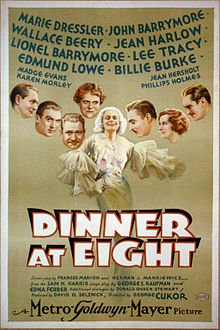
220px-Dinner_at_Eight_cph.3b52734Dinner at Eight is another all-star slug fest from MGM meant to capitalize and top the success of Grand Hotel from the previous year. This time around, well to do wife, Millicent Jordan is setting up a charming dinner party for a wealthy English couple Lord and Lady Ferncliffe who are traveling to New York. The hostess is frantically trying to figure out dinner guests for the big occasion because everything must be perfect. Observant viewers will notice that the high strung lady of the house is played by Billy Burke (more widely known as the Good Witch Glenda). Her husband Louis (Lionel Barrymore) is a kindly shipping magnate, who was hit hard by the depression, and his health is also failing as a result. Their daughter has problems of her own since she does not really love her fiancee and has fallen for the much older, and washed-up alcoholic actor Larry Renault (John Barrymore).

Next on the list of probable invitees is Carlotta Vance (Marie Dressler), the formerly prominent actress, who is now still in the twilight years of her career, but she still carries on a lavish lifestyle with furs and all. She is old friends with Louis, and she is always ready and willing to reminisce, fish for compliments, and offer a little sage advice on the side. She’s a character we like.

The most dynamic pair is most certainly Wallace Beery and Jean Harlow. They play the gruff, crooked businessman and his equally feisty wife, Dan and Kitty Packard. They’re hardly together because he’s working and she’s buying up clothes and caught up in an affair. When the two of them finally are together in the same room, they are constantly at each other’s throats. No punches or barbs are spared. And yet on the invitation to the Jordan’s they both pull their act together. He wants to meet the highly prestigious Ferncliffes, and she wants a chance to get dressed up. They’re quite the match.

With a title like Dinner at Eight, you expect the drama to take place around the table with the guests all seated together. However, that would be rather stuffy, I suppose, and instead, the dinner only acts as the culminating event to push the plot along. We actually never see the guests at the table, only the action leading up to it. Millicent is in a tizzy, especially when she hears the Ferncliffes have a change of plans. Her husband’s health is slowly deteriorating at the same rate as his company. The arrogant actor Larry Renault bickers with his agent about his next role. Honestly, this was the most unsatisfying of the threads, and it did ultimately end in tragedy. However, I’d be interested to know how close this parody actually came to John Barrymore’s actual life, because sometimes it’s hard to know how to parse the fiction from the reality when they seem to overlap.

Once all the guests are assembled it’s a rather ragtag group, but it is a fun mix of characters, and Millicent gets her cousin Hattie to attend along with her Garbo-loving husband who is unenthusiastic about the whole affair. It’s a satisfying overall result and an enjoyable enough ensemble that George Cukor directs with relative ease.

4/5 Stars