Review: Hiroshima Mon Amour (1959)

hiroshima mon amour 1

Like you I know what it is to forget and yet still be endowed with memory. These are only a couple fragments from this film stitched together but in many ways, they encapsulate the essence of its core themes.

I suppose such words ring true for all of us and Alain Resnais’ film is composed of a plethora of equally perplexing paradoxes that though never quite coming into full clarity nevertheless prove Hiroshima Mon Amour to be one of the most bewitching cinematic expressions born out of the French cinema. Without question, it is an undisputed touchstone of the forthcoming Nouvelle Vague that blew up the conventions of the 1960s.

The first time I ever saw Resnais’ romantic meditation there was something so arresting about it such that I will never forget the likes of Nevers and Hiroshima — the two entities that make up this film as not simply places of past tragedy but crucial to the very identities of the characters who come within the frame.

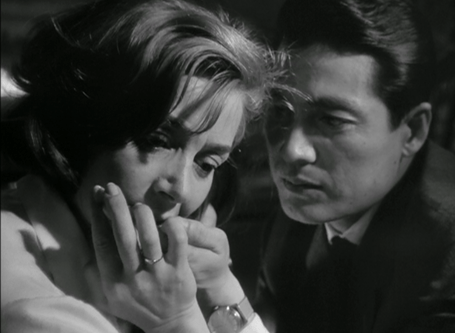
We never need to know the true names of this French actress (Emanuelle Riva in a riveting performance of immense grace) and the equally candid Japanese architect (Eiji Okada) who fall into the throes of a passionate affair together. They are represented well enough by these monikers — symbolic torchbearers of these names — emblematic of the age they ascribed to.

Like L’Eclisse (1961) or Dr. Strangelove (1964), this film too is in the wake of the atomic bomb and any subsequent discussion thereof cinematically speaking must at least acknowledge such films. Part of the necessity in this specific case is how the film takes a particular event and then extends it and intertwines it with so much more in such a way that it not only a monument to Hiroshima but a testament to human history.

We are people so quick to forget. We lose sight of the past. We bury our hurts deep inside. We are doomed to repeat many of our past mistakes. But still, more so we are capable of passions, emotions, and love that carry us through times of tribulation, pain, and suffering. It’s something to be immensely thankful for.

Resnais film is one of the great visual marvels of the 20th century with its graceful fade-outs and flashbacks — delicate camera zooms connecting memories and realities. Stylistically there’s a continuous poetic cadence of image and dialogue, repetitions with recollections. A solemnity exists in its very purposeful pacing that ties everything together with the utmost elegance which, far from being a muddled hodgepodge, forms a perplexing experience never to be fully elucidated.

It has very few equals and remains so as an achievement that can hardly be defined as a typical love story or any such blase categorization. It’s what we might conceive when we think of Film as art worthy of any sphere of discussion.

There’s hardly a meter to begin measuring how it makes us feel or the emotions it elicits.  Somehow connected to fate — two lovers crossing paths — these two individuals seemingly meant to be together and tied together not only by their romantic passion but their own histories. The striking flashback structure subsequently creates tiny microcosms of emotional resonance that flood with abandon.

Recollections of past scars unearthed over the course of the love affair. Both historical and personal. We have the depiction of the devastation in the aftermath of the bomb with images that are all but scorched into our mind’s eye with an unfettered pointedness. We are meant to see these images and take into account how they came into being.

But there’s also the personal trauma brought to the fore and exhumed with a kind of transfixing equanimity that’s hard to fully comprehend but nevertheless leaves us with something to ruminate over. Equally telling is the passage of time as memories begin to fade and minds begin to slowly forget. Again, that is the curse of our beings that we must fight to remember what has come before.

It’s no small coincidence that the cafe that our two lovers rendezvous at is none other than the Casablanca. The yearning and the melancholy are right there in the lyric of “As Time Goes By.” If you’ve never consciously thought about their meaning before then Resnais film might make you hear them anew and be moved.  Love, memory, and heartbreak are often so closely tied together. This is a film that dwells on each and finds some amount of catharsis.

The diversity of the crew is another glimmering bright spot of this joint partnership between nations with an abundance of involvement from both French and Japanese staff taking the shoot on-location to both countries. It’s a lovely marriage and a bond is formed by the picture just as the romance signals a tight-knit cross-cultural relationship on screen.

For some, individuals somewhat attuned to diverse backgrounds, Hiroshima Mon Amour is utterly groundbreaking in this realm. Though its cast is small, it’s a mighty statement having a French woman playing opposite a Japanese man. 50 years on it remains as an image that we do not see all that often, despite the changing of the tides.

Their closeness is palpable. Hands clasping tenderly. Eyes gazing with the deepest longing. The intimacy that they share speaks volumes. Even as it’s undercut by the morose strains of infidelity and wistfulness; this is a love story like few others.

4.5/5 Stars


Ohayo (1959)

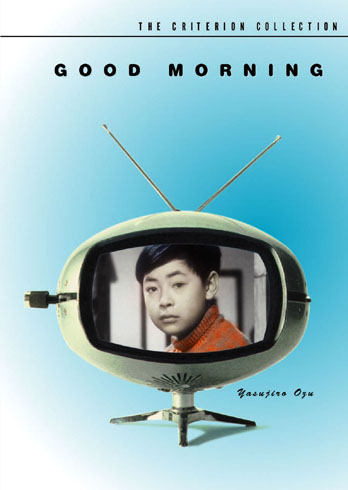
Good_morning_dvdIf Yasujiro Ozu can be considered foremost among Japan’s preeminent directors then there’s no doubt that Ohayo (Good Morning in English) is one of his most delightfully silly films. But that’s only on the surface level.
Young boys are unified in their affection for watching sumo on television and passing gas as a great gag to pull on their friends. Nosy housewives gossip incessantly whether it be the next door neighbor’s new washing machine or the mysterious disappearance of dues for the local women’s association. Meanwhile, most of the men go to work and spend their evenings knocking a few back at the bar noting how much the world is changing around them. Then they go home oftentimes a little drunk.

Ohayo is actually a reimagining of one of Ozu’s most remembered early pictures during his silent days I Was Born But… (1932) and yet he skillfully reworks the storyline into an everyday comedy of family and neighborhood drama that’s full of humor and his brand of quietly observant social commentary.

Ozu always took great care in analyzing family units and matrimonial bonds that affected relationships. Although we have a bit of a fleeting young romance in the works, this film’s greatest concern are two young boys from the Hayashi family who are giving their parents the silent treatment until they are allowed to have a television. Their parents are holding out and it begins a rather humorous ordeal as the brothers Minoru and the ridiculously comical Isamu (constantly exclaiming “I Love You”) try to make it through dinner, school, and so many other daily activities without a word.

As he would dissect many times over, Ozu focuses on the generational divide that was emerging and becoming increasingly prevalent in the post-war years as reflected by technological advancements like television and other such devices slowly turning present Japan into a land of a million idiots. At least that’s what the older generations feel.

Still, it’s just as equally occupied with the moral customs that have long ruled the nation where wives can speak so kindly to their neighbors up front only to slander them behind their backs a moment later. Saving face and personal honor is often cared about far more deeply than anything else — even in some circumstances when it happens to be at the expense of another family member.

Perhaps the most troubling thing is the very Japanese predilection to talk about nothing in particular, filling conversations with salutations, pleasantries, and comments on the current weather patterns. It hardly ever gets to anything of substance and that comes in numerous forms. Sometimes it means a young man never gets around to sharing his feelings with a girl or adults never being particularly candid with neighbors or spouses. There’s very little of that kind of transparency to be had. Few of the words passed along between people in conversation mean all that much.

The irony of the whole situation is that, in one such instance, it’s a young son who calls them out on it and he proceeds to get a heavy scolding from his father (Chishu Ryu) who bluntly tells him that he talks too much. Meanwhile, although Izamu can be constantly chiming “I Love You” in English, there’s an uneasy sense that his parents and most certainly his father, might have never said the words to him.

In these very simple ways Ozu rather delicately and still humorously tackles many of the issues that have long plagued an honor-based culture such as Japan’s but he does it with an adroitness that uses touches of humor and his own understanding of human nature to craft yet another universal tale that’s ultimately sympathetic in its portrayals.

It unsurprisingly feels like it could be a Japanese episode of Leave it to Beaver except for the father never has much of a talking to with his sons and the mother may be as put together as June Cleaver but hardly feels ever as affectionately maternal.

Equally spectacular is Ozu’s mise-en-scene which as per usual is meticulously staged and gorgeous in scene after scene. He offers up each individual image in a flat two-dimensional way that can best be described as taking cues from not only the theater but Japanese woodblock paintings with wonderful symmetry and compositions boosted by color.

He uses the clique of adjoining homes as the perfect set to send his characters in and out of with the hint of comedic forethought. While watching characters walking by on the hillside up above the homes — their figures slowly moving in and out of the frame past the houses — this provides some of Ohayo’s most visually stimulating images pleasing the eye incessantly.

There’s always a visual fearlessness that you see in very few others because he not only has color at his disposal but the staging is on point as is his disregard of the 180-degree rule of perspective. It just works. What is more, he also continues to use what could best be called establishing shots by western audiences. Except they hardly ever need to establish anything. It’s as if he simply put them there because they are vivid depictions of the reality he is painting — adding yet another distinct contour to the world he is working with — going beyond the figures that he places within the frame.

There’s no doubt that this is Ozu but not all that surprisingly this might be my personal favorite in his oeuvre for the aforementioned reasons. It feels like Ozu operating at his most playful while nevertheless maintaining his peak form as a filmmaker.

4.5/5 Stars


Johnny Guitar (1954)

johnny guitar 1.png

“I’m a stranger here myself.” ~ Sterling Hayden as Johnny Guitar

In watching even only a handful of Nicholas Ray films, it’s possible to discern fairly quickly that his films are often about the marginalized outsiders. Rebel Without a Cause (1955) is the most iconic example but this theme goes a lot further than that single movies. He even plays with the same ideas in Johnny Guitar his extraordinarily distinctive western from 1954.

There are other westerns that open like this. A stranger (Sterling Hayden) riding through the mountains and making his way to the nearest town. He overlooks a stagecoach robbery going down and miners blasting away at a mountain with dynamite. There must be a purpose to it all but the significance fails to resonate quite yet.

He goes to the local watering hole: Vienna’s. Except there’s no one there. It’s a ghost town. There are only a few solitary figures working the roulette wheels and the bar. No one else. But still, the stranger walks in as if he’s meant to be there. We don’t know why yet.

By all accounts, Sterling Hayden wasn’t much a cowboy but he had the presence of one. In the movies sometimes that’s enough. Here’s the eponymous Johnny Guitar, the man with his instrument strapped to his shoulder with little stake in the local goings-on.

Namely, the grudge match brewing between the hotel’s fierce proprietress Vienna (the always cutthroat Joan Crawford) and fiery western lass Emma Small (Mercedes McCambridge) who packs a whole posse of cattlemen including ornery John McIvers (the venerable Ward Bond). It doesn’t help matters that Vienna opens her doors to the despised Dancin’ Kid (Scott Brady) and his cronies.

We, like Johnny, have no particular stake in their quarrel though there is a sense of some past grievances. In fact, everyone seems to have a history but we are hardly ever given a nibble, never through flashback and rarely in exposition.

Nicholas Ray creates a gorgeous world in color that showcases some of the most attractive imagery of the West in Classic Hollywood on par with The Searchers (1956) and Rio Bravo (1959). And it boasts an equally colorful array of characters including quality supporting cast members like Bond, Ben Cooper, Ernest Borgnine, Royal Dano, John Carradine, Frank Ferguson, and Paul Fix.

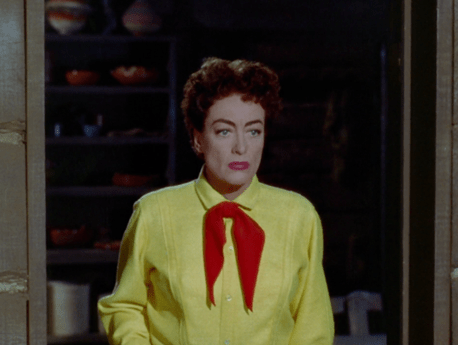
But the subversion of all norms begins with Joan Crawford, the woman who loves the sound of the roulette wheels spinning, ever severe, packing a six-shooter in her blue jeans. While the TruColor does much to enhance not only the scenery but her performance as her piercing eyes burn through everyone she stares down. Johhny Guitar might be in our title but Vienna is our undisputed star.

The relish of the film is perfectly rendered by the complete lack of clarity initially. It’s trying to get a line on everyone in an attempt to understand what’s going on as their allegiances are made fairly evident. It’s a matter of picking a side. But the sides are incredibly difficult to decipher. In fact, even in her moments of complete innocence, it helps her character that Crawford very rarely comes off as a sympathetic person — in reality or on the screen. So if she’s our protagonist then we’re in for a tough outing.

Of course, the feud that’s central to the tale was also twofold unraveling on both sides of the camera. Mercedes McCambridge and Joan Crawford loathed each other to put it lightly. They probably wanted to tear each other’s hair out and while not the most benevolent of relationships, it undoubtedly stoked the fires of the film’s drama. In fact, it seems like there weren’t many people who did like working with Crawford. Hayden never wanted to be in another picture with her again either. Still, once more, it all functions in front of the camera exquisitely.

There’s certainly some truth in drawing up parallels with George Stevens’ Shane (1953) but the moral lines are a lot more jumbled and the intentions of the plot far less direct. Shane is a success because it’s a fine piece of classical storytelling still underlined with an imminent threat. Johnny Guitar is beguiling because it breaks with all the conventions of the West while still carrying its own amount of subtext that’s hard to figure.

Should we even care that the posse gets these men? But you see, that’s nearly beside the point. It’s not about right or wrong but this muddled center controlled by Joan Crawford and Sterling Hayden. The man and the woman with a bit of a past but not enough that they will fall into each other’s arms and live a faithful life at one another’s side. That’s just not in their nature. Still, riding the fence proves to be a taxing ordeal.

We witness the most peculiar bank robbery as far back as I can remember committed by the local outlaws who until they ran off with the loot hadn’t exactly done anything wrong, in spite of being despised by a whole town. In other words, they played the roles expected of them. Then, a pair of hangings takes place but instead of your typical unrepentant criminals being strung up, you have a kid and a woman both ending up with a rope around their necks. The enforcers’ stomachs begin to churn uneasily. This isn’t how mob justice is supposed to work.

Subsequently, the battle to subdue the frontier is brought home with the most unconventional showdown in the western canon that’s fundamentally also one of the most stunning. It blows up in your face and then leaves you questioning this entire ordeal.

Peggy Lee’s title track is used to sing them out as one final note in this dazzling western courtesy of Nicholas Ray; dazzling for the very reason that it does everything contrary to what we have learned. It continually makes a conscious choice to upend the accepted script attached to the mythology of the West, rewriting its own narrative full of vivid imagery and equally blistering outcomes.

4.5/5 Stars

Review: Jules and Jim (1962)

jules et jim 1.png

Jules and Jim breaks out of the gates with a frantic burst of energy giving off the effect of a comedic circus act or a whirling carousel and at times it functions as both. Champion of the French New Wave, Francois Truffaut, at 29 years of age injects the film with this kind of frantic lifeblood tearing through the material and time with almost reckless abandon. If Breathless (1960) was not the title taken by one of its contemporaries, this picture could have just as easily taken the name.

You see, Truffaut takes Henri-Pierre’s Roche’s autobiographical novel, the work of an old man, and transforms it into a period piece shot by a young man. The distinctions reveal themselves in full force.

It’s a cinema of attraction with whips, tracks, freezes, jumps, and flies constituting a fluid adventure that’s given free reign to go in so many directions thanks to the versatile camerawork of Godard regular Raoul Coutard as well as connecting voice-over narration (provided by Michel Subor) and a score courtesy of George Delerue.

Still, as Truffaut lets us sink into his story things come more clearly into focus but never so they reach a point of complete clarity. He never dwells too long on a moment or an idea. Instead, choosing to move through the lives of his protagonists touching on so many moments and relationships and ideas. Thus, in one sense Jules and Jim never slogs but it also still functions as a fairly compelling work of historical drama covering a lot of terrain in a condensed amount of time. Some may find that off-putting others will welcome it as a refreshing permutation of the Hollywood status quo.

The year is 1912. An Austrian named Jules (Oskar Werner) and a Frenchman named Jim strike up a friendship that feels like the perfect representation of the deep lasting bond that can form between two individuals. They are young men with a great many of the same interests and a comparable outlook on life.

They’re always benevolent toward one another, they never fight, and they share a mutual satisfaction in the arts while diverting their time at the gymnasium, playing dominoes, and of course, in the company of women. From there one of the great cinematic friendships is forged for life. Though tested, not even a woman can tear their bond asunder…completely. At least not in the way we might expect.

It all begins when they become enamored with a statue, an opaque figure with a pleasant smiling face that captures them so much so that they must go and see it for themselves. But far more striking is the woman they meet back in France who embodies that same bewitching quality.

They meet Catherine (Jeanne Moreau) as they have met many other women in the past for tea or an afternoon of trivialities and conversation. Except Catherine is one of the few that stays with them. Of course, she is personified by none other than Jeanne Moreau that monumental beauty and one of the undisputed queens of the Nouvelle Vague alongside Anna Karina in Godard’s early works.

There’s a frisky and lithe vivacity that carries her through the film’s earliest scenes as she dons her disguise as Thomas frolicking through Paris in one of the most iconic and enduring sequences of the cinema. An overwhelmingly attractive abandon radiates out of her. Truffaut has set Moreau up as such with his narrative and she does the rest.

However, still, as the story continues to progress and she marries Jules and they make a life together with a daughter named Sabine, there are other qualities that come to the fore. Namely, her maturity with a hint of sophistication that still leaves space for that same carefree vigor continually coursing through her and garnering the undivided attention of the camera.

In the complete inverse of the film’s title, you find its true attraction and the figure who makes the whole story what it is.  Jules so aptly puts it that she’s “a force of nature that manifests itself in cataclysms.” She’s so very uninhibited.

Thus, Jules will love her for a lifetime and Jim will count her among his very closest companions but still, she is a complicated creature and perhaps Truffaut is playing out his own mesmerization and subsequent befuddlement with women. Catherine is an epitome of that. She has other lovers. She openly cavorts with Jim who wants to love her even as he wants to stay true to his best friend. She constantly does what is least expected but that goes with the territory of Truffaut’s invention.

As such, it is less of a conventional love triangle and more precisely a menage a trois as the French might say. This is not so much about dramatic conflict as it is tragically sad in the end. Because this is a film about friendship as much as it is love and it’s a dream friendship as much as it is a romantic fantasy. Maybe it’s possible for both to exist partially in the forms projected onscreen and yet Truffaut fills both with so much that we easily yearn for.

There’s the song “Le Tourbillon” that Moreau sings and it quite remarkably ties into this film. The words come from her lips gayly, describing a woman who could very much represent Catherine and then a lover who are both “Each blown their way by the whirlpool of days.” There’s not a better way describing the course of this film.

It’s consumed with so many interludes and subsequent shifts that are almost matter-of-fact from the breakout of the Great War to its ultimate resolution or the marriage of Jules to Catherine and her eventual affectionate advances toward Jim.

Within these segments, it occurs to me that the film hardly comes off like a drama. Still, there are moments of comedy and undoubted tinges of bitter tragedy. But what we’re left with is what Truffaut best described himself — a bit of a knowing paradox of tones.

“When humor can be made to alternate with melancholy, one has a success, but when the same things are funny and melancholic at the same time, it’s just wonderful.”

It is another of the great tragicomedies of cinema like a Citizen Kane (1941) or 8 1/2 (1963) but there’s no doubt that this is Truffaut’s own rendition and it remains the heart & soul of the Nouvelle Vague for its defining visuals that have ingrained themselves in the cultural landscape the world over.

4.5/5 Stars

Review: Notorious (1946)

notorious 1.png

I never put much stock in a Hitchcock title out of force of habit or lack thereof because he never seemed to. But thinking on Notorious I came to the rather unextraordinary epiphany that it refers to lovely Ingrid Bergman as much as any Nazi, at least from a certain perspective.

In the film, she plays the daughter of a Nazi war criminal who was put on trial and found guilty. She, however, is not implicated in his deeds. Instead, busying herself with having a good time, drinking, dancing, laughing — all the superficial pursuits that can distract her from a post-atomic world. You might even say her reputation precedes her and that provides the framework for how others see Ms. Huberman. Namely, one government agent named Devlin, put on her case and writing her off early on as a certain kind of woman.

There’s that initial shot at one of her parties where all the guests are dancing and drinking and everything’s jovial and there Cary Grant sits on the edge of the frame just his profile identifiable to us. And the beauty of the scene is that Ingrid Bergman starts talking to him but instead of showing us his face Hitchcock elects to wait until everyone is gone and they’re sitting together in the next scene. But already there’s this implicit sense that there’s something unusual about this man even without putting words to it.

In the subsequent scene, we get our first view of Cary Grant and Ingrid Bergman together and how wonderful they look. But Bergman’s character makes an off-handed remark about love songs, about how they’re a bunch of “hooey.” Of course, that pertains to this film and where it will decide to go in the realms of romance, but in my own mind, I see it also functioning as a reaction to Casablanca’s “As Time Goes By” — a film where lovers fell in love partially because of a song.

It’s easy to put the title of a spiritual sequel on Notorious for numerous reasons. Once again we have Bergman and Rains in crucial roles and then trading out Bogey for another legend in his own right, Cary Grant. The paranoia of Casablanca is replaced with the sunnier disposition of Rio de Janeiro which nevertheless is underlined by a certain looming Cold War menace. In this case, instead of the letters of transit, we are provided a Hitchcock MacGuffin, including a bottle of wine, some uranium, and an iconic UNICA key.

But if nothing else these minor remarks can put the debate to rest conclusively. Notorious is a spectacular film in its own right and it enters some similar yet still uncharted territory in accordance with the waters Casablanca chose to ford a few years prior. Meanwhile, Grant has glimpses of his previous self from other films but soon enough he falls into the role of cool and calculated federal agent Devlin in what feels like a true departure.

There’s that supremely unnerving shot as we take on the perspective of a disoriented Ingrid Bergman as Grant walks into the room and hangs over her in a strangely alarming way. Everything is setting up the dynamic at this point.

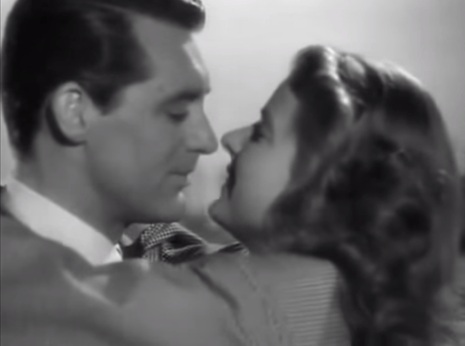
Still, others will remember the extended make-out session that made history by upholding the Hays Code ” three-second rule” while simultaneously perfectly encapsulating nearly an entire romance in a matter of four or five minutes. There was little else to be said because it was all seen in that one sequence and Hitchcock could proceed with his conceit.

Because, ultimately, Hitchcock’s picture is built around this idea: The American government has a little job to be done and Alicia and Devlin are caught in the middle. Thus, it becomes that time-worn idea of love versus duty. In one sense, Devlin’s caught in a terrible position and yet in the other he treats Alicia so badly — and it’s not simply that this is Alicia but this is beautiful, sweet Ingrid Bergman that he is pushing away. Still, in pushing her away, it’s leading her toward the objective.

He’s simply not willing to dictate anything because that means being vulnerable. Very simply he’s not willing to open up.  Cary Grant has never felt so icy, so aloof, and so unfeeling. Then, on top of this, Sebastian (Rains) looks a far more agreeable fellow cast in such a light. He genuinely loves this woman even if she is a spy. It makes for a conflicted viewing experience.

Though there is a juncture in the film where Devlin is beginning to shift his way of thinking. But as if on cue (undoubtedly) one line of dialogue out of Alicia’s mouth during a racetrack exchange (“You can add Sebastian to my list of playmates”) poisons his whole frame of mind again. His prior opinions of Alicia are confirmed and he sours to her — never giving her the benefit of the doubt from that point forward — and ultimately torturing her so that there is no other choice.

Just like that, she goes through with it. Instigating her relationship with Alexander Sebastian (Claude Rains) and succeeding so thoroughly that she’s married to him soon enough. For the U.S. government this is a smashing success but for Alicia and Devlin it’s nothing of the sort.

The descending stairwell crane shot is textbook Hitchcock and so often cited but it’s for that very reason. He so directly points us toward the cues of the scene and he does it with his usual technical elegance.

He gives us a party but it’s a party underlined with so much tension because there are stakes that go beyond the nominal appearances. There’s the fact that Devlin’s one of the party guests but also Alicia has that all important key that proves to be their chance to figure out what Sebastian is hiding. But it also makes them far more suspicious.

Beset with paranoia as much as illness she’s suffocated by the presence of her husband and mother-in-law. It looks like Devlin will never come to her. But he does. We’ve seen this before. Cary Grant comes to her bed as she lies there disoriented and looks up into the eyes of this man looking to be her savior instead of opting to use her. At least on one account, the tension has been resolved.

But in the same breath never has there been so much sympathy as for Claud Rains in the closing moment indicative of how Hitch has even given his purported villain a chance to be sympathized with and Rain’s typically compelling performance does precisely that. So even in this final moment, Hitchcock is playing with us giving us that Hollywood ending that we desire and at the same time undermining it in a wonderful way that’s both suspenseful and artistically arresting.

Notorious just might be the Master’s purest expression of his art lacking the micromanagement of Selznick in Rebecca (1940), the technical experiments of Rear Window (1954), the psycho-sexual layers of Vertigo (1958), the man-on-the-run motif of North by Northwest (1959), or even the low budget and marketing frenzy of Psycho (1960), while still garnering the highest production values in its day.  The results speak for themselves, positioning Notorious as one of the definitive romantic thrillers by any standard.

5/5 Stars

Review: Rebecca (1940)

rebecca 1.png

“Last night I dreamt I went to Manderley again…” ~ Joanne Fontaine in Rebecca 

In normal circumstances, voice-over introductions rarely resonate but for some reason, the ethereal tones of Joan Fontaine opening Rebecca leave a lasting impact and that’s after well nigh 80 years.

This was Alfred Hitchcock’s first film in Hollywood and it truly is a stunning debut but if you take a step back and see who was working behind the scenes, it soon because fairly plain that this was as much of a David O. Selznick film as it was a Hitchcock one, if not more so. Because Selznick had Hitch under contract and he was following up the grandeur of Gone with the Wind (1939) with another costume drama positioned to be a smash hit.

Though Rebecca was slightly less ornate and preoccupied with its more gothic sensibilities, Daphne du Maurier’s novel was nevertheless ripe for a Selznick treatment with a sturdily constructed story and quality production values all across. And of course, you have the acting talent which while not necessarily head and shoulders above all of Hitch’s previous works was nevertheless top of the line.

First, of course, is Laurence Olivier providing a great deal of import to the part of one of our protagonists, George Fortescue Maximilian De Winter, the tortured man of breeding whose life is stricken with past tragedies. But equally crucial is Joan Fontaine’s role as the unnamed woman who subsequently becomes the second Mrs. De Winter after a whirlwind courtship in Monte Carlo. She began as the meek lady in waiting for a boorish socialite Mrs. Edythe Van Hopper only to fall in love with the older man.

Fontaine inhabits the role with a breathless wide-eyed timidity that’s immediately attractive and makes her the object of our sympathies. She always gives off the appearance of a frazzled little deer in the headlights like she doesn’t quite know what to say or what to do in the presence of others whom she deems more important than herself.

It’s that very quality that drew me to Fontaine from the outset the first time I saw Rebecca and no doubt a similar quality that draws Maxim de Winter to her character. There’s an undeniable innocence there full of an angelic beauty that exerts itself each time she interacts with others, eyes wide with mouth agape. That in itself is an immaculate illusion given Fontaine’s own life full of estrangement. Here she is faultless and demure.

And that comes into focus even more clearly because Maxim can often be an unfeeling man, swarmed with past demons though he might be. Put them together and he’s certainly the dominant figure. The same goes for their arrival at his stately home Manderley. The current Mrs. De Winters is totally overwhelmed by this grand estate and the staff that frequent its halls.

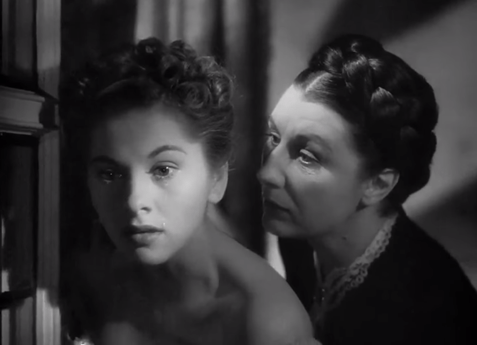
The shining example is the apparition of a housekeeper Ms. Danvers (Judith Anderson) and it’s a career-defining role for a character actress who always could be imperious and a little unscrupulous. But she was never as harrowing as the fiercely loyal woman who starts playing mind games with her new employer.

You also have the incomparable George Sanders playing his English gentleman with biting wit and a touch of blackmail. He becomes pivotal to the story for the very sake that he speaks up on the deceased Rebecca’s behalf as much as Mrs. Danvers does. They adored this woman that Maxim loathed so deeply by the end of their relationship. And it’s in this chafing that the ultimate conflict is uncovered — the type of conflict that threatens to rip Maxim away from his new love and splatter his reputation in the courtroom drama that ensues.

Much like Laura (1944) in her eponymous film, Rebecca lingers over the entire narrative and haunts its frames from start to finish. Yet in the latter work of Otto Preminger, the lady actually makes an appearance on screen incarnated by the entrancing Gene Tierney.

Here Rebecca is a specter who never tries to show herself. There is no physical semblance of her, only signs and references of her being — most memorably the scripted letter “R.” Because, truthfully, she doesn’t need to show her face. She almost wields more power without being seen. It’s that rather unnerving feeling of impending dread that’s hanging over the audience as much as it does Mrs. De Winter.

In the end, Hitchcock didn’t exactly get the murder that he would have liked but in any case, it does not fully take away from the impact of Rebecca. Instead of being a film of overt actions it starts to work on our psyches as a sterling psychological exercise matched by its deliciously dark atmosphere. The mental distress is heightened by the eerie interiors marked by layers of shadow and the shrouded impressionistic seaside that envelops the De Winter compound. Fittingly, Manderley is razed to the ground once and for all.

Ironically enough, though the production is very much on the Hollywood scale, it’s probably the most “British” film that Hitchcock ever made in America based on not only the subject matter but the majority of the acting talent because on top of Olivier and Sanders you have such esteemed character actors as C. Aubrey Smith, Nigel Bruce, Melville Cooper, and Leo G. Carroll (a Hitchcock favorite).

Still, he was blessed with the best talent he had at his disposal since the infancy of his career, in part because of his move across the Atlantic. Joan Harrison who would become one of the most prominent and only female producers in Hollywood turned in work on the script along with Robert E. Sherwood with the score being composed by Hollywood icon Franz Waxman. Even if the players at work are not necessarily evocative of the many trademarks we usually attribute to the director, that hardly makes Rebecca any less of a delight.

Furthermore, there is something inherently honest about the lead portrayals throughout the film. Not necessarily because they’re realistic but they are full of fear and hatred and emotion and you see it in the words and on the faces of the characters. This is hardly a playful film. It’s not trying to subvert drama with humor or dry tonal reversals. But it’s candid in its despair as much as in its joy.

For all their intrigues and complexities in technical feats, storytelling, and psychology, sincerity is not always something you look for in a Hitchcock picture. Here it works. Casting this devasting love story up against the backdrop of gothic horror makes it all the more affecting. The marriage of the talents of David O Selznick and Alfred Hitchcock turns out to be a surprisingly bountiful proposition. Even if it wasn’t made to last.

5/5 Stars

Review: Psycho (1960)

psycho 1.png

For all intent and purposes, Psycho could be an episode of Alfred Hitchcock Presents and Hitchcock knew that better than anyone else. Foregoing the more lavish Technicolor tones he had used in Vertigo (1958) and North by Northwest (1959) and lacking the same type of studio backing, he shot this film in the much cheaper black and white format and brought on a great deal of his television crew to make this production a much more inexpensive package.

In that way alone it paled in comparison to some of its much more ostentatious predecessors but that cannot for a moment take away from the impact or cultural clout that Hitchcock still managed — truly topping any of his previous efforts to date. If not his greatest film, then Psycho was certainly his greatest feat of marketing and ingenuity. Because he would never allow his public to forget their experience witnessing Psycho and very few have for generations with it becoming so closely tied to our public consciousness.

The plotline itself is a simple affair of love and small-time crime set in Arizona then transplanted to California. Marion Crane (Janet Leigh) has a man but a life with him seems unlikely especially with both of them being terminally strapped for cash. He’s got alimony to pay and she makes very little on a secretarial salary. But when $40,000 is dropped on her desk in cold hard cash — money she is supposed to deposit in the local bank — in a brief moment of decision she attempts to buy happiness.

She takes the money and keeps on going. From the moment Marion first sees her boss on a crosswalk as she drives off with the money, Bernard Hermann’s score starts pounding. Every time she hits the gas the composer does too and it’s one of the most unnerving pairings in cinematic history.

Even without the scoring, this would still be matchless silent storytelling and yet it’s improved upon by the music working with the image.  A paranoid Leigh becomes the latest iteration of Hitchcock’s icy blonde, curt and still constantly looking over her shoulder because she is not made to be a lawbreaker. She tries to dodge the interrogation of a suspicious policeman and brushes off the friendly salesmanship of California Charlie (John Anderson). But she rides on no thanks to the guilt written all over her face only to be impeded by Hitchcock’s latest implement, a fateful rainstorm that lays her up at the first motel she can find: The Bates Motel.

In Vertigo and Psycho, you can see how Hitchcock distinctly puts us in the eyes of the main character so we have no choice but to view the world as they do and it’s highly effective in bringing us into the story. Thus, it’s even more jarring when he rips our star and stand-in away from us brutally and forces us to frantically search for another anchoring character.

psycho 2.png

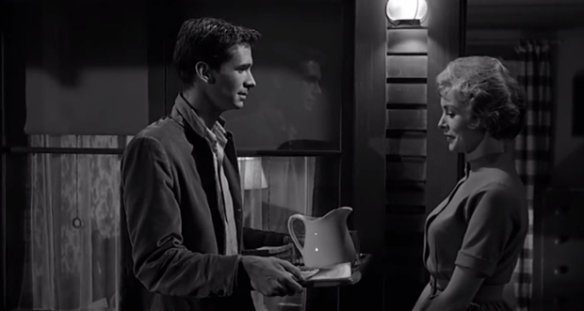
That brings us to Norman. Norman Bates (Anthony Perkins) is such a fascinating character because in one sense he’s like a shy little boy. The moment he asks Marion to have dinner with him is brimming with candor and a pitiful awkwardness — like a boy asking a girl out to the prom or something. That sweetness and social ineptitude are at the core of his being. He can’t hide it just as Anthony Perkins playing Bates feels like he is hardly acting at all. It’s just his way.

The Bates home could be a character in itself, a looming beast that hangs over Marion as the domain of the unobserved Mrs. Bates. It poses itself as a portent of Norman’s own ominous instability along with his pointed drawing room conversation with Marion where he freely discloses, “We all go a little mad sometimes. Haven’t you?” 

That, of course, brings us to the famed shower scene that is a tour de force not only in editing but in the synthesis of all the cinematic components from the image, to sound, to the scoring of Hermann’s impeccable cacophony of screeching strings. It stands alone as arguably the single most iconic scene in all the movies. Thus, it’s surprising that from the very moment Hitchcock was showing Leigh flush some pieces of paper down a toilet he was already making history — because bathrooms were long-held off-limit locations. Hitchcock made them far worse for folks after Psycho.

He also starts moving around the bathroom in a way that’s vaguely reminiscent of Rear Window’s opening. Finally, cutting from the drain to the eye of Marion Crane suggesting the same spiraling black holes of emptiness as Vertigo. It pretty much sums of the conclusion of her life.

But then we’re back to Norman. There’s an extreme distaste in how goes about cleaning up the bathroom but also a certain industry to it. He gets to it silently and efficiently in another one of Hitchcock’s great sequences that unfold without the aid of any dialogue whatsoever until it leads us the precipice of the swamp where Marion’s car is disposed of.

It’s in these interludes that we understand the full gravity of Hitch’s wicked humor. That money — the load of cash that propelled the film forward — is cast aside as simply as that. No two thoughts about it as if to say you thought that’s what this picture was about but he’s not entirely interested in that. He just wants to hook his audience on that objective before sending them hurtling in completely different directions.

psycho 3.png

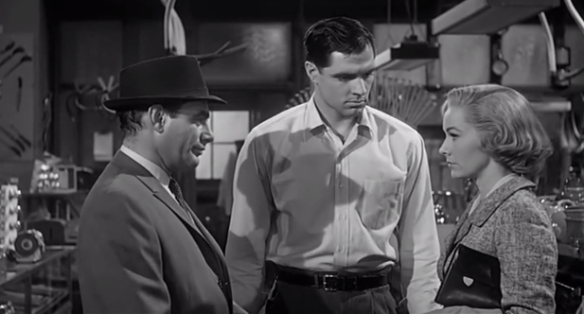
John Galvin plays Leigh’s lover and he’s the stark contrast to Perkins’ character. Both dark-haired and handsome but Sam is a virile man even a masculine ideal of the 50s and 60s. Nevertheless, he joins forces with Lila Crane (Vera Miles) Marion’s concerned sister, subsequently becoming the driving force in the latter stages.

But also of note is the hired private investigator named Arbogast (Martin Balsam) who coincidentally comes onto the scene at the same time at the behest of the old coot that lost $40,000. Balsam a wonderful character actor throughout his career, not surprisingly appeared in two episodes of Alfred Hitchcock Presents and he’s at his best as he questions Norman Bates in that genial manner of his about his person of interest, one Marion Crane.

At this point, in some small way, it feels like we are a bit of an accomplice in this crime of Norman’s.  Complicit in his secret and as Arbogast digs around for answers we crawl inside our skin. Norman tries to cover up and we know he’ll be caught in his lie.  Hitchcock frames his nervousness most overtly peering over to look at the guest registry knowing that something might give him away.

For its day and age, Psycho goes into admittedly dark and taboo territory. But what’s most unsettling is the subverted ideas of romance it showcases. Marion is looking for some form of companionship. She has desires for the American Dream including money and love. All the things that lifestyle entails and yet her desires are quickly snuffed out never to be realized. She doesn’t even receive the hope of love because on the horizon there is nothing for her — only the nothingness of a drain taking away her lifeblood.

Then, of course, Norman is so closely intertwined with his mother that it destroys his being so much so that he cannot even comprehend how to cope with other people. He’s so injured and wounded by a dominating woman and a lack of love that he has no healthy way to express his love and it’s not so much his undoing as it is his stumbling block. Sure it makes for chilling outcomes and a remarkable turn from Anthony Perkins but what resonates time and time again is the pitiful brokenness within Norman Bates. It’s all there in his famed observation that “A boy’s best friend is his mother.” His is a sorry state of mind.

Even in Sam and Lila, we find our best chance at romantic satisfaction. But that relationship too falls on problems when you cast it in the light of Vertigo. If they do continue their relationship, will it simply be because Sam sees Marion in his sister and wishes to have that or does he see the true worth of this woman in front of him blessed with an insurmountable persistence? If anyone can make it work they can but that is not to say it will not be messy. After all, this is a film of messiness — relationally, psychologically, morally. We all go a little mad sometimes. That’s why we’re not to go through life alone. We’re communal beings.

In the denouement, a psychiatrist tries to explain things away and provide a voice of reason that looks to stabilize everything his audience has just ingested. But even that fails to undo and rationalize Norman Bates completely. Yes, his psychological instabilities, his compartmentalized personalities, and the utter dissonance coursing through him can be understood at least partially by such deductions. Human psychology has its place as does scientific thought. Still, that cannot take away from that final shot as the voice inside Norman’s head keeps talking to us and he raises his eyes with a possessed grin breaking out over his face.

There is no explanation that can be given for that look. It burns into us. Emblazoned on our minds and sending shivers down the spine. That image and all those proceeding are what the cinema is capable of, evoking emotion far beyond what any word can possibly begin to unearth. That is the exorbitantly visceral brilliance of Psycho. Hitchcock was a proponent of so-called pure cinema and this is yet another showing of the “Master of Suspense” at the peak of his creative powers. Few filmmakers have made such a stream of classics of such variety and of such a multitude in such a condensed span of time — each one slowly reworking and ultimately rewriting the rules of suspense. Psycho is yet another testament to that.

5/5 Stars

Review: The Lady Vanishes (1938)

The-Lady-Vanishes-1938.jpg

Though he would make Jamaica Inn the following year, it’s undoubtedly The Lady Vanishes that situated Hitchcock for the move to Hollywood as his last great British film showcasing once more his immense aptitude as a storyteller no matter the resources on hand.

At the beginning of the proceedings, an avalanche makes accommodations at an inn, hidden away in Europe somewhere, rather sparse and it makes for strange bedfellows and noisy neighbors. Among them are the prized comedy duo Caldicott and Charters (Naunton Wayne & Basil Radford), a pair of quibbling cricket enthusiasts. Meanwhile, radiant Iris Henderson (Margaret Lockwood) is just coming off a glorious vacation with a couple girlfriends as she returns to get married to her fiancee.

Dame May Whitty makes a fine showing as a rather whimsical eccentric, playing the role of a kind-spirited governess enjoying some time in the land she deems a little slice of paradise. In one off-handed comment, she notes with bright eyes, “I don’t think you should judge any country by its politics. After all, we English are quite honest by nature, aren’t we?”

It’s a passing line that suggests Hitchcock’s own indifference to politics. He briefly touches on the political climate at the time but never looks to go in depth and make some grandiose statement about the state of affairs in Europe. That is not his sentiment. Instead, he takes the natural climate of the times utilizing them for the sake of his narrative.

Things couldn’t be more delightful for them both in their encounter and yet the overcrowding is far from agreeable as an obnoxious neighbor in the attic (Michael Redgrave) unwittingly serenades the entire floor below him with an atrocious melody. It pales in comparison to the beautiful vibrato Ms. Froy was met with on her balcony nor is it quite as significant.

Of course, it’s Iris that Gilbert Redman really perturbs especially when she gets him ejected by the manager only to have him turn right back around and make himself at home in her suite. Thus, we have a bit of initial friction at home in a rom-com soon to be turned into a delightful mystery escapade with splashes of intrigue and absurdity.

The largest and most enjoyable leg of the adventure takes place onboard the train but it only works because of a seemingly inconsequential development. Iris is positively swimming after an ill-fated brick conks her on the temple and she is helped onto the train by Ms. Froy who tells her to rest up.

Iris obliges. Except when she awakens her lady companion is not in their compartment. She’s nowhere to be found. In fact, everyone that she interrogates corroborates that they never saw this kindly old lady. She must not exist. Just like that the game is afoot as our heroine endeavors to track down her friend and stave off the impending doubts that this woman was only a figment of her imagination.

It’s these perplexing developments that feel rather like a conspiracy. Still, it’s hardly that type of thing at all. It’s the very fact that all these people are humans — they’re selfish –with different self-serving motives for keeping up the charade. The clandestine couple with the man looking to stay conspicuous and a woman not minding a little bit of scandal.

The Cricket aficionados bent on getting to their match in time along with a whole host of others. Meanwhile, the psychiatrist (Paul Lukas) points out that Ms. Froy sounds vaguely like Freud and must simply be the inner workings of Irises subconscious. Of course, that’s only an easy way to explain away what is actually happening.

She likens Gilbert (Redgrave) to the dog that follows her around and it’s true he quite faithfully stays by her side even taking up the mantle of her investigation. Soon they’re traipsing around like a maladjusted Holmes and Watson, Redgrave going so far as to don a deerstalker as Lockwood coughs and passes him a pipe in utter parody.

They end up making quite a ruckus in the magician car full of hats, rabbits, and boxes with false bottoms and for the added fact that they get into a bit of a scuffle. But that’s only the beginning. Because, of course, what is a Hitchcock film without a little bit of international espionage? But once again he brings it into the world of tourists and well-to-do British subjects who have no right to be in such a scenario.

Factions form and the remaining passengers look to make a break for it amid a gunfight with foreign adversaries. Never before has there been such a droll reaction to a gunshot wound. A very Hitchcock moment without question.

The Lady Vanishes fits into the long lineage of Hitchcock with similarly high profile sequences from The 39 Steps (1935) to Shadow of a Doubt (1943), Strangers on a Train (1951), and North by Northwest (1959) but for the amount of time spent aboard, this picture is his most formidable train film.  It uses the very motion and sound of the steam engine to add crucial momentum to the plot.

Hitchcock speeds events to their conclusion and once more we find that in many cases our objective was utterly pointless, even throwaway, but it did give rise to one of the great thrillers of the 1930s. Part of the film’s unequivocal success comes from drawing equally from the wells of comedy and suspense. The laughs are ever present but far from being to the detriment of the drama they only augment the action, adding to the contours of our characters and pointing out the sheer ridiculousness found in this plotline. It’s wonderful.

4.5/5 Stars

Rear Window (1954): Visual Cinema and “Lisa”

rear window 1.png

There are such a vast number of levels to appreciate Rear Window on and one of those is its impeccable use of sound as well as a score courtesy of Franz Waxman. In fact, it is quite easy to consider it as a film with a wholly diegetic soundtrack but it’s really a complicated weaving of sound orchestration playing against the images onscreen. For instance, against the credits, as the blinds come up, we’re met with the playfully cool jazzy beats of “Prelude and Radio” which proves to be in perfect juxtaposition with the deathly hot heatwave hitting Greenwich Village in the film’s opening moments.

We’re also inundated with all types of songs popular and otherwise which can be picked out of the story organically if you’re paying attention. Two of the most obvious additions are “That’s Amore” and then “Mona Lisa” which can be heard being sung by a group of party guests.

Whether or not it’s a slight nod to our heroine Lisa is up for debate but it’s also notable that she, in essence, receives her own theme song which is concurrently composed by the songwriter who lives in the courtyard that we come to know over the course of the film. It slowly involves from its nascent stages into a full-fledged tune that gains its wings once the romance between Lisa and our protagonist L.B. Jefferies has come into its own.

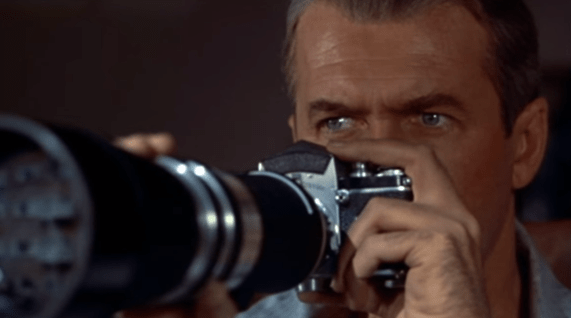
Obviously, beyond the elements of soundtrack Rear Window develops so immersive a world and Hitchcock expertly inserts us directly into the environment to the extent that we have no choice but to become involved in the whole ordeal. We are accomplices, if you will, in this viewing party of Jimmy Stewart’s.

It truly is an exhibition in the moving image because the film works so brilliantly with them. Certainly, it begins with the staging and the complex setup Hitchcock had to work with at Paramount Studios but there’s simultaneously the use of color cinematography, the lighting of the stages which sets the scene given the time of day, and common street noise that lends an almost imperceptible authenticity that we take for granted.

Furthermore, working with his long trusted photographer Robert Burks you see Hitchcock moving so fluidly and with so much purpose through the playground provided him. The camera captures objects with clear intention and a crispness that far from simply giving us the illusion of being in the space, in many ways, makes us feel like we are actually right there with Stewart looking out into the courtyard.

You also get the true essence of what visual filmmaking is because his powers of suggestion and even persuasion of the audience are impressed upon us by what he deems important. Hitchcock lays out nearly all of Stewart’s backstory not with clunky expositional dialogue but by giving us a wordless parade of his apartment while our protagonist sleeps. And the whole picture is a constant rhythmic cadence of being fed images followed by Stewart’s reaction shots. It’s Film at its primacy. Where two images put together are blessed with so much more meaning and suggestion than they could ever have alone.

But far from simply marveling at what Hitch has accomplished it’s far more miraculous that we become so enveloped in this story. It’s an admirable mystery plot chock full of tension that’s built up over time and successive shifts in perception, time of day, and personnel moving in and out of the complex. Our one commonality is Stewart stuck in that wheelchair with only his broken leg, his camera, and the neighbors to keep him entertained. They do far more than that.

rear window 4.png

Rear Window’s A-Plot is a perplexing mystery thriller that we watch unfold with a systematic unraveling that’s unnerving in part because Hitchcock has orchestrated it all in a limited space. Furthermore,  he has handicapped his protagonist and the outsiders coming in are constantly causing us to second guess or reevaluate our assumptions be they the insurance agency nurse Stella, Jefferies’  policeman pal, or his best girl Lisa. Each character is at one point in opposition to Jefferies while also providing a sounding board for his cockamamie theories which start to bear the grain of truth. We get to be a part of it all.

The utter irony is that once more not only is Hitchcock’s villain atypical — in nearly all areas a seemingly unspectacular man — he’s also quite overtly styled after David O. Selznick. If you know anything about the producer he shares some resemblance with Raymond Burr and there’s no denying that Hitchcock was never fond of the other’s meddling. As much as I love the Rebeccas (1940) and his earlier American works if Rear Window was a representation of the hands-off approach to his filmmaking than I would have to side with him.

At least by this point in his career, there’s no denying that he projected a singular vision that could hardly be quelled by any individual. This is “Alfred Hitchcock’s Rear Window,” after all, as the opening credits proclaim.

However, the beauty of this picture is that it truly does stand up to multiple viewings and every repeated viewing offers up new depths or at least minor revelations that add an even greater relish to the experience.

In particular, are the underlining themes of romance. Because this is a film about love in all its many facets with each character or couple reflecting a certain permutation of what romantic love looks like.

The love stories are playing out in each compartment of the apartment complex. Miss Torso, the queen bee with the pick of the drones. She’s very much eye candy but in the final frames, we realize there’s more to her as her love comes back home from the army. There’s Miss Lonelyhearts who is desperately seeking love and yet has enough respect not to stoop below her dignity. It’s a song that lifts her out of her despair. The Newlyweds are still in the honeymoon phase and we never see them.

rear window 2.png

Meanwhile, you have Stella providing her homespun philosophy that people shouldn’t overanalyze their situation. Jefferies is pushing back against any serious romance because in his estimation Lisa is far too perfect for him. Meanwhile, Lisa is left believing she can live in any world that Jeff is in. The list goes on and on.

But for the threads to be resolved that must become fully intertwined with the murder at its core because such an event calls for a response from our characters — at least our main ones. When Lisa sacrifices so much to show her love and devotion to him, he realizes how much he misjudged her character and perhaps more profoundly how dearly he loves her and never wants to lose her. He has made the transition from armchair philosopher and misanthrope to a man smitten with someone else. As long as he ditches the window watching he should be fine.

That leads us to another area of discussion. There’s a bit of a moral commentary present though Hitchcock doesn’t seem all that interested in those conclusions per se as much as he likes manipulating them for the sake of his drama. And yet like Vertigo four years later there is this unnerving sense that he is tapping into some of humanity’s darkest desires to watch and spy on others for pleasure without any consequence or any vulnerability on the part of the peeper.

That draws me to another aspect of the film that I’ve never really considered. Rear Window implicitly asks what it is to be a neighbor or at least what it is to live with neighbors. There’s very little in the realm of actual judgments except for the small condemnation that comes from the woman who lives just above the murderer after her yippy dog has been killed. What does she say?

You don’t know the meaning of the word ‘neighbors’! Neighbors like each other, speak to each other, care if somebody lives or dies! BUT NONE OF YOU DO.

What she provides is a heartfelt and searing indictment which is nevertheless lost in all the commotion whether it’s the big party going on across the way or the realization by our heroes that their theories about murder have been confirmed. It did make me consider even briefly if the so-called Great Commandment is to “Love Thy Neighbor,” what does that look like?

Far from peering in at other people and staying anonymous, it seems like it involves reaching out to others. In some ways, being vulnerable and candid — transparent even — so others feel comfortable entering into our lives. Like Stella says sometimes people need to go on the outside and look in for a change. If nothing else that breeds empathy.

Of course, if that was the case, there would probably have been no murder and that’s what we want right? Well, anyways, Rear Window still stands as my favorite Hitchcock picture and one of the most clinical and compelling thrillers of all time.  But you probably already knew that. If you did not I implore you to break both your legs if need be and go lock yourself in a room and force yourself to watch it right this minute.

5/5 Stars

Review: The 39 Steps (1935)

39 steps 1.png

With The 39 Steps, it’s possible to witness Alfred Hitchcock coming into his own and one of the most obvious markers are numerous motifs, character archetypes, and techniques that would crop up in his work again and again. But it’s also conceivable to trace the influences of this film in most every spy-thriller-comedy-romance that has ever come in its stead.

Like The Man Who Knew Too Much the year before, this picture takes little time to get going and Hitchcock strings scenes together in such a way that the narrative is constantly on the move. Our modern sensibilities might tell us that his picture is rushed but it’s unquestionably interesting. It’s equally likely that we might believe other scenes are too slow. And yet he really does offer up a wonderful thriller that maintains a driving force of suspense. The key is balancing the more complacent moments with great jumps and leaps in story that both work to keep us simultaneously engaged and off balance.

He rather brilliantly cuts from scene to scene giving us just enough information to grow invested in his man-on-the-run spy thriller that looks vaguely familiar. In fact, it’s easy to see the groundwork for Cary Grant’s Roger Thornhill from North by Northwest (1959) in Robert Donat’s own credible characterization. In many ways, it’s a humbler version of the later cross-country epic trading the vast expanses of North America for the quaint and still majestic United Kingdom. We even are treated to one of Hitchcock’s original blondes in Madeleine Carroll and like all his greatest stories, he uses the seemingly useless plotting device, the so-called MacGuffin, as the motor to his narrative.

The action opens in a music hall where a lively performance is going on in front of a rowdy crowd and the festivities showcase the rather unbelievable phenomenon of Mr. Memory, among other acts. But in typical Hitchcock fashion a gunshot goes off and pandemonium breaks loose.

In a moment, we’re shown the outside of the venue and our hero Richard Hannay finds his hand being held by a frightened woman. Hitch moves the action forward on this coincidental meeting and never ceases from that point on. You see, this woman is connected with the international spy world. She gives a vague notion of her business but what isn’t vague are the men who are looking to kill her or the subsequent knife found in her back.

It’s yet another thrust forward in the film that sends Donat hurtling toward Scotland, the location where his female visitor noted her contact was located in. But equally telling is her warning to watch out for a man missing the tip of his finger. So, of course, in perfect Hitchcock fashion, in a completely ludicrous turn of events, the double chase is on. Both the authorities and the bad guys are after this innocent man. One for the murder attributed to him and the others for the knowledge that he now has.

From this point onward the almost picaresque plot is continuously streamlined and functions on a subsequent row of fascinating scenes and locales that all could work as separate entities entirely. First, he’s riding aboard the Flying Scotsman jumping free of the train to evade capture. Then, Hannay is holed up in the home of a gruff farmer and his sympathetic wife in the Scottish Highland. He meets the big man face to face and gets away with his life only through sheer coincidence. Next, he unwittingly ends up giving a stirring speech to the local electorate about their obligation to live a life of brotherly love before getting whisked away by the authorities.

Subsequently, he finds himself handcuffed with one of his earlier acquaintances from aboard the train (Madeleine Carroll). The fact that they despise each other perfectly highlights the best comedic elements of The 39 Steps as they bicker and struggle to keep their cuffs inconspicuous moonlighting as newlyweds.  This section of the film hearkens to some similar moments in the screwball comedy of the prior year It Happened One Night and it doesn’t hurt that Donat has a mild resemblance to Clark Gable. He happens to whistle a lot too.

Still, this is a Hitchcock thriller and it takes them through the moors of Scotland, their fleeing feet masked by bleating sheep and their mutual distaste finally traded for a general amount of concern. You might say they grow on each other. Yet that does not take away from the bottom line.

Government secrets of the utmost importance are about to be smuggled out of the country and they haven’t the faintest idea how it is to be done. Surprise, surprise, we end up in a packed London Palladium where everything must come to fruition. By this point, we hardly know how we got where we are as an audience and when it’s all over there’s more than a few questions — maybe even a few objections — but there’s no doubt that the 39 Steps is a clinical exhibition in the art of the spy thriller.

Although his actors would arguably become more prestigious (though Donat and Carroll are no slouches) and his whole productions more impressive, it’s decidedly difficult to deny the sublime vision that courses through the film. It could really function as several films all in under an hour and a half and yet ultimately it comes off unequivocally as one picture. It’s not simply one of Hitchcock’s finest British efforts, it’s a high watermark in any conversation of his oeuvre.

If you desire even a single moment of pure ingenuity look no further than the interlude when the maid comes into the murdered woman’s flat. We expect to hear her bloodcurdling screams as she turns toward the camera but instead, we are met with the high-pitched screeching of the train as Donat idly sits now miles away. In the hands of another director, this whole sequence might have slogged on. Hitchcock makes it positively gleam with possibility and that’s indicative of the whole picture.

4.5/5 Stars