Silver Linings Playbook (2012)

silverlinings1There was something rather therapeutically soothing about coming back to Silver Linings Playbook. I must admit this time around I was not quite as drawn to the direction of David O. Russell, because in some scenes it felt like too much attention was brought to his camera. However, I loved Jennifer Lawrence, Bradley Cooper, and Rober De Niro, since each one of them is screwed up in their own unique ways. Although their story takes place in Philadelphia and a lot of talk is made about the Eagles, what these characters really are is a cross-section of humanity.

I was just thinking recently how I dislike the term “escapism” referring to watching movies and going to theaters to get away. I do not often consider that I go to movies to escape my life. Maybe I do sometimes, but I am fascinated by movies because they can tell us more about ourselves. More about what it is to be human and coping with all that is messed up — all that is broken.

Tiffany (Lawrence) and Patrick (Cooper), are both screwed up. There’s no getting past it. She’s a widow who got fired from her job for sleeping around and now she does dance as a sort of therapy. He just spent an 8-month stretch in a Psych ward after he caught his wife in the shower with one of her coworkers. Now whenever he hears his wedding song, he goes into an enraged fit. He tries to look for the silver lining in everything, but that does not stop him from hurting the ones he loves.

Tiffany and Patrick are made for each other, even if Patrick refuses to believe it. They both know what it is to be put through therapy, drugs, and the like after personal trauma. They both lack the common filter or etiquette that humanity usually requires. We love them anyway, in spite of these reasons or more likely because of these reasons.

De Niro is Patrick’s father and a man so invested in betting on Eagles football games that it drives his life. Superstitions run rampant in his household, but he refuses to acknowledge them, just like his son refuses to accept his own problems. It makes for some familial fireworks and interesting altercations, but at the end of the day, they are still family.

The whole film culminates in a dance competition that Tiffany and Patrick have been working up to for a long time. It has the big stakes that you would expect for a climatic event, but most importantly it is this moment in time where Patrick finally realizes Tiff is the girl for him. He finally sees what most of the audience saw all along. They are made for each other, and they can accept each other with all their idiosyncrasies. He continues living his life by The Silver Linings Playbook and it makes both Tiffany and him very happy.

4.5/5 Stars

The Battle of Algiers (1966)

The_Battle_of_Algiers_posterBeing rather oblivious to the relations between France and Algeria as well as the battle of Algiers, this documentary-style film proved to be an enlightening and thoroughly engaging historical exercise. I certainly cannot corroborate all the facts, but the reality is, The Battle of Algiers is one of the most well-paced films that I have ever seen coming out of Europe. There is a great deal of drama, harrowing intensity, and it all brings up numerous political questions that parallel the world we live in even to this day.

It’s the story of 1950s Algeria and specifically the Casbah Muslim district of the city. It is there between 1954 to 1957 that the National Liberation Front waged war against their perceived oppressors from France. And they certainly had a point that imperialism has left an indelible mark on them. However, their own strategies include bombings and assassination that utilize civilians and people loyal to the front. You don’t know when the next attack will come, and they sweep across the land like wildfire. The leaders of the FLN include the fiery Ali la Pointe and El-hadi Jafar, who recruited la Pointe early on. A Lieutenant Colonel named Mathieu is brought in to bring down the enemy, but it proves to be a difficult task since the FLN, much like a tapeworm, will never die until the head is destroyed. Otherwise, it’s extremities will keep rebuilding in the form of loyal underlings.

The film is rather shocking in its straightforward depiction of violence, whether it be bombed buildings, gunfights in the streets, or French authorities being gunned down by insurgents. Somehow these images feel still very relevant to the contemporary age. You have the imperialists clashing horns with the locals. There’s racial profiling. Women and children are involved in the violence just as much as anyone else, and destruction pervades the public squares. There is no refuge from bomb or evil. Anyone coming around a corner could be carrying a bomb or looking to shoot you when you least expect it. Really it is amazing that a film like this was even made, and it was undoubtedly a lightning rod for controversy.

In the film’s epilogue, the unrest continues and it is finally noted that Algeria did eventually receive their independence. The French may have won the battle, but they ultimately lost the war. The audience is left to develop their own opinions about this conclusion. As for me, I find Gillo Pontecorvo’s film fascinating, because he takes a point of view that does not seem especially biased. This is not noticeably propaganda in its depiction, but instead, it is a thought-provoking document of civil unrest developing questions on war and race relations. Maybe we can even learn something from it as well in this modern age that still includes so much human conflict.

5/5 Stars

Review: Schindler’s List (1993)

Schindler's_List_movieWhat is there to say about Schindler’s List except that it is necessary viewing for its depiction of Shoah, suggesting that, literally, out of the ashes beauty and hope will rise. It would be rather callous to call Steven Spielberg’s film pure entertainment. True, he comes with a pedigree that includes such escapist classics like Jaws, Raiders of the Lost Ark, and Jurassic Park. However, Schindler’s List is a far different creature and it is arguably his most significant film. It is so moving on a heart-wrenchingly beautiful level. Because great films are more than entertainment, pure and simple. They are affecting, tapping into some deep well inside of us that causes us to laugh, to cry, and have feelings.

Schindler’s List shows us the horrors of the Holocaust without dumbing them down. We see those getting shot. We see the naked bodies. We see the mass graves and the billowing ashes. It can be hard to watch. Abrasive in its content, but not in its form. The film itself is beautifully cast in black-in-white with the most moving of compositions by John Williams and poignant performances by many. But permeating through all of this is, of course, the tragedy, but with the tragedy comes the hope which is crucial to a story such as this.

Spielberg’s reference point is one man named Oskar Schindler (Liam Neeson), who not only was a war profiteer and womanizer but a member of a Nazi party. He’s not afraid of ingratiating himself with the right people to make a pretty penny off the imminent war because in his mind it’s all good business acumen. And aside from his affiliations, what’s not to like about him? He’s well-groomed, a gentleman, and charismatic. It still would be a far cry to call him a hero, at least not yet.

With his main motive still being money, he makes contact with a Jewish man named Itzhak Stern (Ben Kingsley) who not only has the bookkeeping abilities he is looking for but also connections to the black market and Jewish investors. So as the ghettos in Poland fill up to the brim, Schindler is quick to capitalize, offering the Jews more practical resources in exchange for their money. They get something, but he’s the big winner. He begins to set up his factory for the production of pots and pans which proves to be a lucrative business, especially with most of the bigwigs on his side. At the same time, he takes on Jewish laborers since they’re cheap, and Stein is able to save them from a fate of a concentration camp or being shot.

Our primary villain, Amon Goeth (Ralph Fiennes) is ordered to start a new camp and just like that the ghettos are closed and the Jews are forced out. He is a despicable creature and a sadist to the max, exemplified by the many people he shoots from his balcony in the mornings. There’s no provocation for it. He just does it because he can. He is not the type of man you can seemingly deal with normally, and yet being a man with immense charisma, Schindler does just that, all in the name of business.

But Schindler too sees the chaos, destruction, and killing that is going on. He can not try to underplay it now since he has seen it all firsthand. But there is a point in the film where his focus slowly evolves from a desire to make money to actually saving Jews from complete annihilation. The most obvious moment occurs after he sees the little girl in the red coat lying in a wagon, dead. Moments earlier he had seen her scampering through the streets, an innocent beacon of color amidst the chaos. What is the world coming to when a girl such as this can be killed for no apparent reason? It begs for a response from Schindler. He can no longer be a passive observer and so he does take action.

With the aid of the ever faithful Stern, Schindler is able to construct a list of over a 1,000 Jews to save from the concentration camps. As the war is going poorly for the Germans, Goeth is ordered to transfer his prisoners to Auschwitz, and although Schindler almost loses all his workers, he is able to save them by literally buying all their lives from Goeth. He spends his entire fortune to save them as well as ensuring that his armament plant does not actually make any working shells. It’s bad business, but it is all in the name of one of the greatest acts of humanity he could perform.

In one final word to the people, Schindler protects his Jews one last time, daring the Nazis working at his factory to kill them or go home to their families as men. They silently choose the latter, and he flees the camp as a war profiteer.  He breaks down looking at the few possessions he has left suggesting that more Jews could have been saved with them, but the Jews in front of him, represented by Stern, point out the great good he did. They bestow upon him a ring with the inscription: “Whoever saves one life saves the world entire.”

He is gone now and the story of Schindler’s Jews is not yet complete, because they do not know where to go, but they head out with purpose making their way towards the future. And it is in this moment that their story stops being a memory and breaks on into the present. It is a wonderfully powerful device from Spielberg that evokes an overwhelming flood of emotion. In a line of solidarity, the Schindler Jews walk forward toward the grave of Oskar Schindler. Nothing can quite explain the feelings pulsing through the body as we watch actors and their real-life counterparts laying stones on the grave of this man, much like the Israelites laying stones down in remembrance of what their God did for them.  In one final moment, Schindler’s wife lays one final stone and Liam Neeson lays downs a final rose and we see his imposing but solitary silhouette off in the distance. It’s magnificent, to say the least.

Out of the many scenes that become ingrained in the mind, there were two that especially resonated with me. One of them occurs when the children were trying to evade capture and imminent death. In such a life or death situation they willingly resolved to literally swim in the urine of the outhouse. Another scene that got an immense reaction from me was when all the naked women, with their hair now cut off, are herded into the showers. Both they and the audience think this is the end of their lives so it is almost a cruel trick when water begins flooding from the shower heads. I’m not sure the last time I have felt so much anxiety as an observer. It’s hard to discount.

There are so many great performances big and small, but Liam Neeson and Ralph Fiennes are both superb. We always love a good anti-hero or at least a complex one, and Oskar Schindler fits that bill beautifully. Also, we love the same in our villain, and I must say although I absolutely despised Goeth for all his evil, I must admit that somehow I still felt sorry for him. He was only a cog in the machine, a lonely man who was really so insignificant, in spite of what he wanted to believe. He shoots Jews, beats them, and yet can have such a twisted and somehow intimate relationship with his Jewish maid Helen.

For over 20 years this film has been a beacon of hope and fragment of truth from a period of history that contains so much darkness. Hopefully, it can continue being that touchstone to the past so that there is never the danger that anyone would forget these catastrophic events, but also the heroes like Oskar Schindler who through their actions were able to do a great deal of good.

5/5 Stars

Review: Jaws (1975)

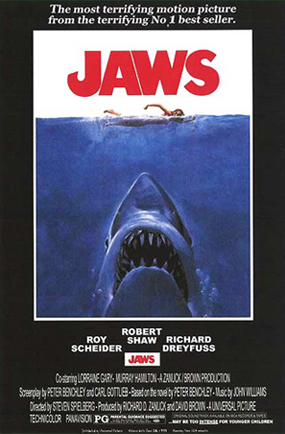
JAWS_Movie_posterAlfred Hitchcock once was quoted as saying, in typical Hitchcockian fashion, “There is no terror in the bang, only in the anticipation of it.” A young Steven Spielberg channeled this type of sentiment when he directed the smash hit and archetypal summer blockbuster Jaws in 1975. It’s still a cultural phenomenon and for good or for bad, it has forever instilled a fear of great white sharks in the general populous.

The film is a man-versus-beast type of story. It starts off on Fourth of July weekend on a New England resort town named Amity. After a girl is found the beach chewed up, it starts a frenzy. Well, not quite initially because although police chief and mainlander Martin Brody (Roy Scheider) wants to shut down the beaches, the local mayor will have nothing of it. Really, the first half of Jaws is very much political, as the mayor attempts to do anything he can to keep the masses flocking to his town because Amity gets all their revenue from the summer months. Meanwhile, Brody has the beaches monitored, but that does not stop a young boy from getting attacked. Up until now, we have only seen the handiwork of the beast, but in a brief instant we can catch a glimpse of him and it is shocking.

The vacationers flee the shoreline, and Brody is left to answer to the boy’s mother since he did not close down the beaches. She holds him responsible. However, Brody’s hands are still tied, especially when local fishermen catch another shark that they assume is the culprit that has terrorizing the town. He is met by a young marine biologist named Matt Hooper (Richard Dreyfuss), who also realizes the gravity of this shark problem. No one will take him seriously except Brody, and Hooper labels him the only other sane man on the island.

Because all the precautions that are taken cannot avoid still another shark attack from going down. And it is at this point that Brody and most certainly the Mayor, have to change things. At a tense news conference, they must walk a fine line in order to assuage the locals and the business owners. Ultimately, Brody convinces the mayor to let him go out with the salty veteran seaman named Quint (Robert Shaw) who agrees to take the shark down for a fee.

For most of us, the second half is what we all remember or at least equate with the film (probably for the iconic line, “We’re going to need a bigger boat.” It is this part of the story that breaks the adventure down to three men, our stars, going off on a mission to take on the terror of a great white (ie. “Bruce”). It feels very Captain Ahabesque, thanks to the addition of the grizzled fisherman Quint, but if he is a stabilizing force it soon becomes obvious that not even he is fully ready to take on this behemoth creature. It seems like no amount of barrels, harpoons, or even a “shark-proof” cage can humble it.

What we end with is utter destruction that spirals out of control. That’s what makes this shark such an intriguing foe because we certainly cannot really call it evil, but it certainly is an overpowering force of nature. Brody stands in for many of us who have an innate fear of the ocean and what lies underneath the surface. For all the plucky young adventurers they have a stand-in in Hooper. I am struck by how tense this film is even to this day, and Spielberg never seems to show is hand too early and he never gives us too much of the shark. Otherwise, it might look faker, and it would lose that heightened anticipation. Above all, John Williams lent a great deal of potency to Jaws, single-handedly, with his ominous score. Without his score, Jaws is nowhere as scary and certainly not as memorable.

5/5 Stars

L’Atalante (1934)

LatalanteHere is perhaps one of the greatest wedding processions we could ever hope to see. Buster Keaton is more outrageously funny in Seven Chances, but this one is solemn, and somehow still funny in its own way. And that’s what is most striking about L’Atalante (which also serves as the name of the boat of choice). This film seems so serious and strait-laced, you might say, and yet it brims with comedy. It’s the type of everyday comedy that makes us laugh even now. Funny looking characters, odd voices, a plethora of cats all over the place. There’s no way for that to get lost in translation, and it remains quirky and engaging 80 years later.

It also happens to be a beautiful film exemplified by a newly-wedded bride walking the prow of a boat with the fog billowing around her. Or perhaps it’s two lovers embracing passionately and a smile bursting on the face of the woman. It’s so visceral, so engaging in its displays of love, energy, and emotion. In this way, it brings to mind other love stories of the age like Sunrise, It Happened One Night, and certainly the early works of Jean Renoir. Except the thing here is that director Jean Vigo never made another film after L’Atalante. He entered bad health even during filming and died soon afterward in his early 30s, but he left behind a masterpiece.

In short, the story revolves around four main characters living life together on a boat named L’Atalante. Jean is the captain and groom who has picked a beautiful wife named Juliette who is going to share his existence on the sea. His first mate is the weathered and scruffy Pere Jules. He might have a rough exterior, but he and his cabin boy are full of bumbling and buffoonery that endears them to all.

For the two lovebirds, Paris is the enchanting destination for a fantastic makeshift honeymoon, but it also proves to test their relationship from the get-go, since Jean is extremely jealous and a street peddler openly flirts with Juliette. It’s a tragic turn in their love story which leads to Juliette looking for a way home and Jean sinking into a state of depression aboard his boat. That’s what makes their ultimate reunion all the sweeter.

Thus, L’Atalante blends a timeless topic like love with little moments of magic that bubble up from within these scenes. Whether it is Juliette walking the streets window shopping, or Pere Jules giving a lens into his past with all the souvenirs he has accrued over the years. Without a doubt, he was my favorite character. I have never quite seen anything like him.

4.5/5 Stars

Through a Glass Darkly (1961)

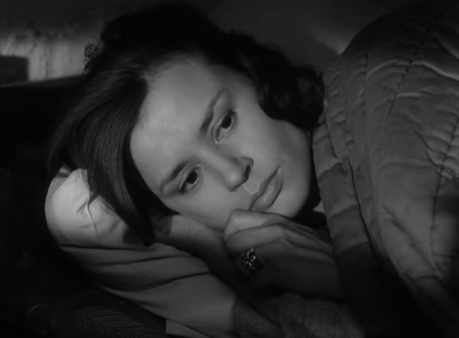
througha2There is so much that could be talked about with Through a Glass Darkly, but I feel the need to point out the more obvious, to begin with. Ingmar Bergman, in retrospect, envisioned this film as the first installment in his 1960s trilogy. As such, the film is a chamber piece that takes place entirely on a single island with only four main players. It lets go of some of the symbolism of many of Bergman’s films, but it still surges with religious content that reflects Bergman’s own background and spiritual conflict.

Through a Glass Darkly is one translation of 1 Corinthians 13, essentially suggesting that at the present time we only get a poor reflection of what is to come. In other words, we cannot fully understand the ways of the world and the ways of God. But how does this theme relate to the film you ask? That’s what I wanted to know as well.

At a basic level, this is yet another story about family and interpersonal relationships. Karin is staying on an island with her husband Martin (Max von Sydow), her father David (Gunnar Bjornstad) who is an author, and her baby brother Minus. She recently was released from a hospital for schizophrenic-like symptoms while her father has recently returned from Switzerland trying to combat a fierce case of writer’s block.

In a day’s time, these four individuals try to parse through all that is going on. Though they initially attempt to shroud it with morning swims and silly stage productions, they cannot completely disregard their reality.

througha3Minus feels he is lacking love and affection. He feels like his sister makes fun of him while his father is aloof and withdrawn from his life. Meanwhile, David is grief-stricken in private, realizing that his daughter’s condition is incurable and yet he also regrets his morbid fascination with it. David tries to cope with his wife’s condition, but although she seemed jovial and fine at first, Karin’s situation begins to decline.
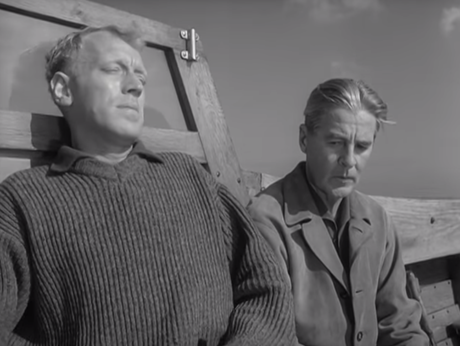
She hallucinates, speaks of going through the walls, and faints. Matters are made worse when the voices in her head tell her to go through her father’s diary. There she reads about his thoughts on her and her “incurable” state. When they take a boating outing Martin asks his father-in-law about what he wrote on the request of Karin, and they get into a discussion. As Martin surmises he seems to be a man with all the right words, but no clue about life itself, and David does not try and object.

Back on the island Minus is with his sister, who confides in him about the voices, and when a storm hits she hides dejectedly in the hull of a boat. Minus follows soon after along with his father. They send for an ambulance to fetch Karin and in a penultimate moment, she speaks candidly with her father one last time before she is to be taken to the hospital. In these final moments she goes up to the attic and while being observed by her husband and father, Karin, breaks into hysterical fits. The visions she has seen are obviously too horrible to bear

througha5This is a film about brothers, sisters, husbands, wives, fathers, and daughters. All revolving around four characters wrapped up and intertwined in this complex spider web of relationships. The spiritual content is great and there is also a lot of minutiae in Through a Glass Darkly. It shares some of the same mind-bending moments as Persona (1966) and yet this film felt even more personal if that is possible. As the title suggests and David even tells his son, we cannot fully understand what is happening, but we can be certain that someday we will know if only we grasp hold of love and the love that God has for his people.

Ingmar Bergman’s type of film-making seems foreign to us now and I don’t mean simply since it’s Swedish, but due to the fact that it is so connected to issues of spirituality and deep questions of faith and love. He cannot and will not allow his work to be cut and dry, because he cares about delving into the human condition. And that condition by default is chock full of ambiguity and complexity. Through a Glass Darkly. The title fits aptly indeed.

4.5/5 Stars

Review: Breathless (1960)

breathless2Breathless is such a fresh, smooth piece of cinema that feels as cool now as it was back then. The transcontinental French vibe paired with the revolutionary production is strangely still appealing. It does so many things with such style that is always unique but never quite off-putting. Not to mention the score which is playful in an elegant sort of way. The film has an array of quick cuts, it’s discontinuous, abrupt, and it literally jumps between images. Actions, like shooting a cop or sitting in a room with a girl, become more interesting than we could ever give them credit for.

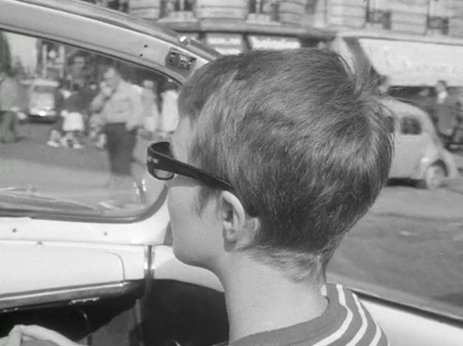
Godard is known for saying that all you need for a film is a girl and a gun and that’s basically all Breathless is. Michel (Jean-Pierre Belmondo) is a low down, no good hood who also happens to be quite funny at times. He shoots a cop for no good reason and after that, the police are after him on the streets of Paris.breathless5He’s also broke and all his buddies are either unavailable or in some trouble of their own. He swipes money from one girl and rendezvous with his latest fling, the aspiring American journalist Patricia (Jean Seberg). They do very little except drive around the city or lounge around her room. In one memorable shot, jump cuts piece together scenes of the back of Patricia’s head as she sits in the passenger seat observing the world around her pass by.

Michel, on his part, seems only to want sex and yet he says he’s never loved a girl before. He’s continually drawn to Patricia, and he never can quite pull himself away.

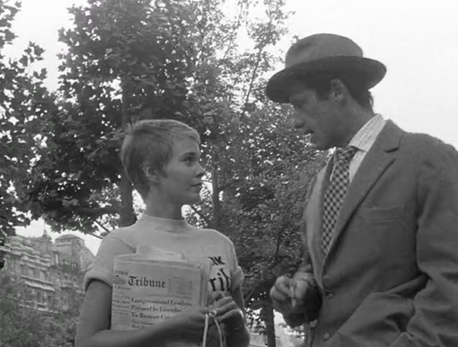
She, meanwhile, has another man with an eye on her, and she hopes to propel her fledgling journalism career. Her one assignment happens to be interviewing the highly philosophical and somewhat pompous Mr. Parvulesco (Jean-Pierre Melville).breathless10The billboards around town even foreshadow the impending doom of Michel. Patricia later learns from the police that her lover is wanted for murder, and she must decide what to do about it. In a memorable scene, Patricia is shown pacing around the room in a wide circle. In the end, she does turn in the hood to prove to herself that she doesn’t truly love him.

Michel looks utterly pitiful, like a wounded deer after he gets winged by the police and collapses in the middle of a quiet avenue. Patricia stares straight at the camera giving the queerest of looks as Michel breathes his last. If you wanted narrative clarity you’re definitely looking in the wrong place.

breathless9In some ways, Jean Seberg’s iconic look reminds me a young Audrey Hepburn another gamine glamour girl. The photography of Seberg is iconic from the reflection in her sunglasses to her donning Michel’s hat. Breathless proves film is not just entertainment, but it can also be lastingly stylish. There’s nothing wrong with that, and it still seems to work after over 50 years. Honestly, when I was starting out, Breathless helped open up all of European cinema to me and for that, I am indebted to Godard and The French New Wave.

4.5/5 Stars

Young Mr. Lincoln (1939)

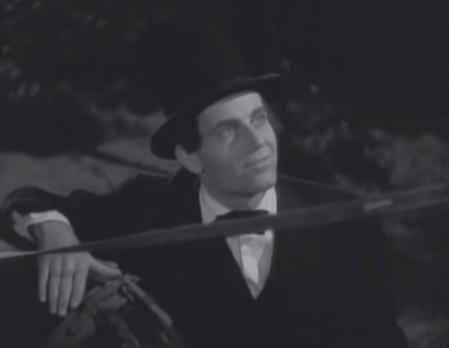
youngmr1Hailing from a year laden with numerous American classics, Young Mr. Lincoln is undoubtedly overlooked in deference to other titles like Gone with the Wind and The Wizard of Oz. Even John Ford’s own Stagecoach, starring John Wayne, overshadowed this autobiographical work headed by Henry Fonda. Then the next year they came out with The Grapes of Wrath and that title garnered praise for both men. But again, it seems like most have forgotten about Young Mr. Lincoln.

It really is a shame, because this is a quintessential Ford film, and Henry Fonda gives an iconic turn as one of the great historical giants of all time. Except instead of focusing on his major accomplishments, trials, or fatal death, this story contents itself with a simpler story. The focus is the fledgling law career of Abraham Lincoln, who back in 1857 is only a lanky country boy with a hankering for learning. He sees tragedy at a young age when people pass away around him and yet out of those formative years rises a man who is wise beyond his years, because he understands his fellow man and cares deeply about justice.

Lincoln is hardly a lawyer of any repute, and he seems hardly a political figure compared to the likes of the great Stephen Douglas. But the people respect him because he wins them over with his common sense and homespun witticisms. Aside from his ubiquitous top hat, he willingly judges pie eating contests, and play the Jew’s harp with feet reclined at his desk.  One of his dear admirers is the young socialite Mary Todd who takes an immense liking to him. He’s the kind of figure that the elite and common folk alike can truly respect.

So when two brothers are accused of murdering another man after a fight one night, it is Mr. Lincoln who avoids a lynching and appeals to the morals of the locals. He, in turn, promises the mother of the boys that he will do his very best to win their freedom and he does all he can to gain her trust.

When the trial begins he carefully picks the jury and faces off against a venerable prosecutor with much greater experience than himself. The mother of the accused saw the squabble, but she cannot bear to implicate her sons. Lincoln pleads on her behalf.  It also looks like the key witness and friend of the deceased man will put a seal on the case, but young Mr. Lincoln is not done yet.

Thus, the film ends and Lincoln is most certainly on the rise, but we get to imagine his future knowingly, on our own, because none of that length of the story is told. In that way, it’s rather interesting to juxtapose Ford’s film with Spielberg’s more recent biography Lincoln, starring Daniel Day-Lewis. They represent different generations of filmmaking, because the latter film takes a monumental moment in history, the passing of the 13th amendment, and places a magnifying glass to it. Focusing on all the individuals involved, and it is certainly going for an amount of period realism, starting with the impressive performance by Day-Lewis as our 16th president.

Young Mr. Lincoln is a lot simpler because it does not need to focus on the highlights. It takes as great of an interest in Abe’s origin story so to speak. On his part, Henry Fonda plays the role wonderfully using his mannerisms and plain speaking delivery to give a homey quality to Lincoln. He’s believable, but in a different way than Day-Lewis. It’s not better or worse necessarily, just different. That being said, Young Mr. Lincoln deserves a place among the exulted classics of that legendary year of 1939. Hopefully, it will continue to receive the respect that it deserves, because it is a moving and surprisingly very witty film. Probably in the way Abraham Lincoln was.

4.5/5 Stars

Terminator 2: Judgment Day (1991)

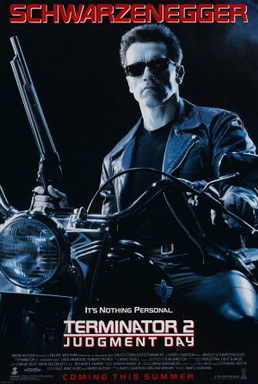
Terminator2posterBack in 1984 a strange life form came to earth in search of Sarah Connor and ultimately left a trail of destruction. It’s the same terminator (Arnold Schwarzenegger) who now shows up in the year 1991 intent on getting the right clothes, transport, weaponry, and cool shades to aid in the completion of his new mission. It’s the same terminator, except not really because he has been reprogrammed to protect young John Connor who will be the future savior of civilization as we know it. Right now he is a 10-year-old juvenile delinquent living with foster parents. His mother, the aforementioned Sarah Connor, is locked up tight in a mental institution after the events in the previous film.

But there also is a second more highly advanced terminator that Skynet has sent to assassinate Connor, and it becomes obvious that he is in grave danger. Both cyborgs converge on his location, and he flees with the help of his new found guardian. The terminator is programmed to listen to him and over time they form a bond with John teaching him slang (ie. the famed “hasta la vista baby”) and perhaps more importantly that he cannot kill everyone he sees.

They go to rescue Sarah from captivity on John’s bidding, but the other terminator has the same idea. The resourceful mother has plans of her own that are disrupted by witnessing her former executioner with her son close in toe. It’s all very confusing as they must alert her to the real danger and escape the present dangers.

Sarah leads them out of the city to the home base of a loyal friend who can give them resources and, above all, weapons. She sets her sights on Miles Dyson, the man who unwittingly developed the technology that would end in “Judgment Day.” In a fit of vigilantism, she mercilessly goes after the innocent man, for his work which would cause millions of future deaths. It takes the arrival of John and the Terminator to get her to calm down.

With Dyson’s help, they head to his office to destroy the prototypes for good, but they get a little company and it turns into a firework show complete with pyrotechnics and blockbuster explosions.

Yet again the shift-shaping, poly-alloy terminator pursues the trio and this time they are trapped inside of a steelworks. It’s a fitting locale for a desperate showdown with a wounded Sarah, a battered Terminator, and a thoroughly frightened John. Some last-ditch heroics finish off the futuristic assassin, but that is hardly the end of the story. John must say goodbye to his friend and probably the best male role model he’s ever had. He was a faithful companion to John, and he, in turn, came to understand why humans cry. There are just some things that cannot be expressed through words, protocol, or any type of rationale. The future is still to come, but at least for the present is safe.

I am unabashed to call Terminator 2 thoroughly enjoyable, because it embraces the fundamentals of a great sci-fi blockbuster, while never quite losing its human component. Perhaps we could have used more character development and less action, but the characters played by Linda Hamilton, Edward Furlong, and Arnold Schwarzenegger have enough depth to make them work proficiently. In fact, they are icons by now and I can understand why. James Cameron certainly knows how to develop thematic spectacle to the nth degree and this installment is no different. This sequel is bigger and better than the original 1984 film, which is a testament to not only the special effects but the story and characterizations. Hasta la vista Baby. Until next time anyway.

“If a machine, can learn the value of human life, maybe we can too” ~ Sarah Connor

4.5/5 Stars

Review: The Big Heat (1953)

bigheat2The Big Heat is not a noir where the darkness comes from the shadowy visuals, but from within its characters themselves. In fact, some of these individuals are so subtle in their corruption that it easily gets overshadowed. Homicide cop Dave Bannion is, rather ironically, the straight-arrow trying to do what is right, and he becomes the most vengeful character in Fritz Lang’s film. It’s a subversion of the typical noir arc because his greatest help ultimately comes from the former femme fatale. That’s not how it’s supposed to happen, but then again a lot of things happen a little differently in The Big Heat.

The film opens and within a second a man has shot himself and left a confession on his desk. The cues tell us that he’s a cop and he’s just committed suicide. His wife comes downstairs strangely composed and shuffles through the pages he has written. She goes to the phone, not to call the police, but she talks to a third party. We quickly forget what’s she’s done, but the fact is Mrs. Duncan represents the corruption that reigns supreme in this film. She’s used a juicy piece of blackmail to receive large payoffs from someone and she’s not the only sellout.

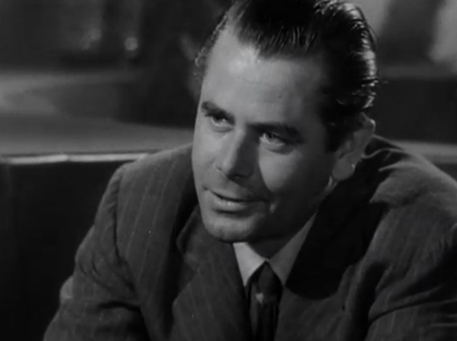
Bannion (Glenn Ford) is a cop by day and a family man at night with a loving wife and a beautiful little girl. By convention, he is supposed to be the moral compass of this film — the emblem of good conquering evil. He takes on the straightforward case of Officer Duncan’s death, but it gets convoluted when a B-girl named Lucy Chapman calls him up to say she knew the deceased, and he would never kill himself. Initially, Bannion takes little heed of this girl, because she is hardly as respectable as Mrs. Duncan, or so society says.

He gets pressure from his superior Wilks to lay off, but Bannion is discontent with loose ends, especially when he receives news that the Chapman girl has been brutally murdered. This can’t all be all coincidence, and he begins sniffing out the truth like a bloodhound. Bannion leads us into the home of this empire of crime literally. He confronts local businessman/crime boss Mike Laganna, who he accuses of involvement in the corruption. Things are beginning to heat up, and they start to infiltrate the sanctity of his home life. The dark recesses of the noir world can never be subdued, and Bannion dives deeper into the labyrinth that is created by his own obsessive vendetta. He has no tolerance for his colleagues who don’t take a stand, in favor of their pensions. He can’t stand tight-lipped locals who give him no help and most of all he hates Laganna’s guts.

bigheat3At the local shady nightclub “The Retreat,” Bannion has his first run-in with the hired thug Vince Stone (Lee Marvin). Afterward Vince’s girl Debby is genuinely impressed by Bannion’s methods, but he will not give her the time of day. He expects her to be the same superficially ditsy dame that we have all seen before. Hardly a femme fatale, but still there is the potential to be deadly. The one character who seems to conform to the stereotype is Stone, and yet he is even more brutal than most, burning girls with cigarette butts and splashing scalding coffee on Debby’s face.

Bannion gets to one of the other hired guns named Larry and both Stone and Laganna decide that something must be done to stop Bannion in his tracks. The obvious target is his little girl, but this time the family life prevails over the noir world. His family and colleagues rally around him and yet Bannion is not done with his obsession.

In fact, it is Debby who actually finishes off Bannion’s work by paying a visit to Mrs. Chapman and then Vince. Bannion arrives soon after to reprimand Vince, but Debby has already done the dirty work. The nightmare is over and everything that is good and right comes to the forefront. Debby proves her allegiance, the criminals are put away, and Bannion gets a new position with the homicide department. But underlying this seemingly happy ending is still a sense of tension. The film ends as Bannion heads out on a new homicide case with the cycle continuing and it seems like he will never be free of it.

The world will continue ripping away the ones he loves. Before he knows it, he will be left with only his personal vengeance to drive his future. Bannion very easily could cross the line between righteousness and corruption. He already almost strangled two characters and was not opposed to slugging it out with others. It’s only a matter of time before he totally blows his cool and collected exterior. It’s a dark assumption, but then again that is a lot of what film-noir is. Fritz Lang seems to get this and that’s what makes his characters here so powerful because he knows that the root of all evil can be in everyone.

4.5/5 Stars