Review: His Girl Friday (1940)

25148-hisgirl1It all happened in the “Dark Ages” of the newspaper game — When to a reporter “Getting that story” justified anything short of murder. Incidentally you will see in this picture no resemblance to the men and women of the press of today.”

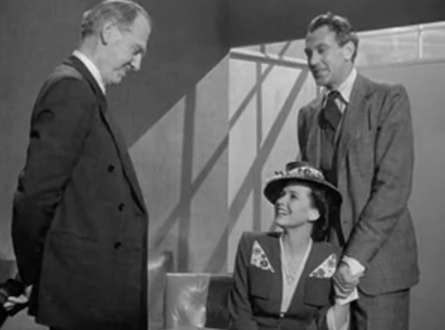
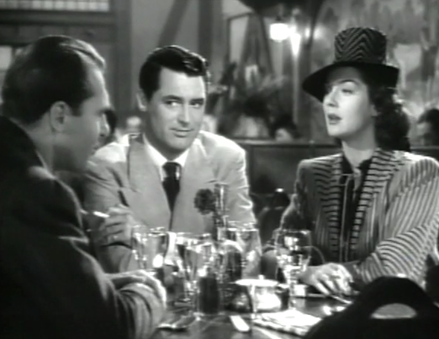
Hildy Johnson (aka His Girl Friday) is making her return to the Morning Post but not to get her old job back. She came to pay a visit to her former husband (and paper editor) who she divorced because she is newly engaged and wants to break everything off for good. It means she can go off into the sunset with her new beau, but it also means no more paper. She drops the news and it turns out the wedding is set for the next day so Walter has very little time to go to work. He soon begins a sly barrage of subtle and not so subtle jabs, ridicules, and put downs aimed at the easy target Bruce Baldwin (Ralph Bellamy). Walter cuts him off, plays dumb, and is in general condescending and conniving. Hildy sees it all unfolding and half watches with bemusement, while also trying to stop Walter from causing any major trouble.

You see he’s a wonderful fellow in a loathsome sort of way, but you cannot help but like him. Because as Hildy notes he comes by charm naturally since “his grandfather was a snake.” These are the kinds of barbs and witty put downs we deal with the entire film. Besides being good fun, it also is quite extraordinary, since they never stop coming. It’s also fascinating to simply watch the many expressions of Cary Grant, whether it is a smirk or straight face, it always has a tinge of mischief which suits his character just fine. He seems more like a little boy at times, trying to win back his girl, and in many ways, that’s what he’s trying to do. But back to the action.

Hildy unwittingly falls into Walter’s trap, and from that point on there’s no stopping her, or Walter’s scheme for that matter. When the wheels of journalism start turning there’s no stopping someone like Hildy with newsprint in her blood. Walter lets her catch wind of a man who pleads innocence though he is to be hung for shooting a black policeman. Hildy puts up a fight, but she doesn’t last very long.

Soon she’s gotten into talk to the nervous prisoner Earl and gets his point of view on the whole messy ordeal. The other newsboys are callous to the world, and as the gallows goes up outside their window, all they can do is play cards and think about the best scoop. Hildy is a little different but she’s still leaving…or is she?
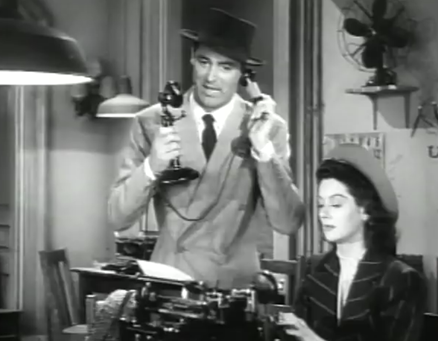
Next, Williams escapes and the mad search for the fugitive is on as the newsroom goes into an uproar. The mayor and sheriff are in a tizzy and then a reprieve for Williams comes, but they ignore it because they need this hanging in order to get re-elected. By a stroke of luck, Hildy finds Williams and stashes him away in a desk. Now she is hooked, and when Walter hears about her stroke of luck, everything begins again like old times. Bruce and his mother are soon disregarded as Hildy types feverishly, and Walter wheels and deals on the telephone. Then, the sheriff and mayor burst in with the rest of the boys. Williams’ hiding place is uncovered and the two reconciled lovebirds look like they might wind up with a jail sentence. But the honorable air-head Mr. Pettibone saves the day. All that’s left to do is depart on a two-week honeymoon to Niagara Falls or maybe a workers riot in Albany. All is right with the world again. Walter’s got His Girl Friday, and she’s got her lovable wiseguy husband back.

I’m not quite sure why I am so often drawn to this movie because it is more than it being readily available in the public domain. The dynamic of Grant and Russell is certainly superb. Walter can be an absolute cad, but Grant’s charm makes him bearable to the end. Russell is the true star of this film and she deals the punches with the rest of the boys. It really is the perfect role for her. The film is blessed with the great supporting cast including Porter Hall, Roscoe Karns, Gene Lockhart, Billy Gilbert and a host of others who populate the film with colorful faces and voices.

After seeing Nothing Sacred (1937) it was also interesting to see another script from Ben Hecht about journalism. Again, it might be a screwball comedy but there are also political undertones. Most blatantly about journalism itself, but also about corrupt leaders (like the mayor and sheriff), the Red Scare, gender roles, capital punishment, and even WWII.

Of course, it must also be noted that this is a film directed by the great Howard Hawks. I have always had difficulty pinpointing his trademarks, because the reality is, he was so versatile, trying his hand at so many different genres. All I know is that I more often than not enjoy his work behind the camera because it is seamless and it feels quintessentially American. His Girl Friday is no different. Although, this one is just a tad faster than most. It’s sure to raise your blood pressure so be warned.

5/5 Stars
 

Review: Sunset Boulevard (1950)

f5016-sunset_blvd_title

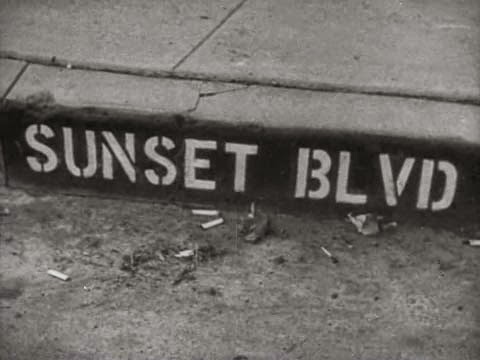
“Yes, this is Sunset Boulevard, Los Angeles, California. It’s about five o’clock in the morning. That’s the Homicide Squad – complete with detectives and newspapermen. A murder has been reported from one of those great big houses in the ten thousand block. You’ll read about it in the late editions, I’m sure. You’ll get it over your radio and see it on television because an old-time star is involved – one of the biggest. But before you hear it all distorted and blown out of proportion, before those Hollywood columnists get their hands on it, maybe you’d like to hear the facts, the whole truth.”

So begins one of the most caustic dramas ever constructed in Hollywood, or about Hollywood, and it was gifted to us by screenwriter-director extraordinaire Billy Wilder. His previous hard-edged film noir Double Indemnity had its own cynical narrator with a memorable voice-over of his own. However, Walter Neff was only on the verge of dying. When we hear the voice of Joe Gillis he is already speaking from the grave. It is a fantastic angle in which to look at this seemingly perfect Hollywood construction, and Gillis never ceases to tell his story until we wind up at the pool as the story comes to a close.

For now, we learn that six months back Joe (William Holden)  is a writer who is having difficulties being published, and some men want to repossess his car. Desperate, he pays a visit to a friend at Paramount named Mandrake to pitch an idea, but the script is of little merit according to a pretty young script reader. That’s a dead end so Joe leaves, but the men are waiting for him and he zooms away. A flat tire leads him to drive away into an empty garage connected to a dilapidated old mansion on Sunset Boulevard. 

There he is mistakenly introduced to drama queen Norma Desmond (Gloria Swanson) who used to be big on the silent screen, back in the day. Now all she has is money, fan letters, and old memories to rehash, while her butler Max (Erich von Stroheim) watches over her. The theatrical actress believes her big comeback is soon at hand, and when she learns Joe is a writer, she takes an interest. He needs the money so he takes a look at the rough script meant to be a vehicle for her. A small commitment turns into a life-consuming undertaking. Desmond constantly hovers and dotes over Joe, going so far as having his things moved into her home and buying him new clothes and trinkets. He reluctantly accepts the first class treatment, not minding the cushy lifestyle. But to Norma, it’s more. 

He is her closest companion. Her love. Joe cannot bear to tell her that she is washed up and that there will never be anything between them. He ditches her intimate New Years party for a more friendly affair where he crosses path with his old bud Artie (Jack Webb) and his girl, the previously critical script girl Betty Schaeffer (Nancy Olson). She takes an interest in a few of his past ideas, but he does not, and after getting shocking news from Max he is pulled back to his lavish prison.

Eventually, Norma is prepared to drop off her script with her former collaborator the great Cecil B. DeMille. However, it becomes all too clear that her story will amount to nothing, but her friend cannot bear to break her heart. She is sent off again with the strong conviction that her day is coming. Makeover’s, diets, and facials follow in preparation. Joe is indifferent to it all and secretly begins working at nights with Betty on a new screenplay. 

Desmond finds the script and jealousy takes over, causing her to call Betty to ruin the romance that is rapidly budding there. Joe hears it all and angrily tells the disbelieving Betty to come see his set-up on Sunset Boulevard. He acts as if he likes the life, and Betty leaves broken-hearted. Soon after, a fed-up Joe packs his bags to head back to Ohio. Thus, begins the systematic breakdown that we had expected for so long. Norma Desmond completely falls apart and does the one thing she knows to hold on. 

Back in the present the crowds and journalists have turned out to see the has-been movie star who is stark raving mad, and one last time Norma does not disappoint. She glides seamlessly down the stairs with a serenely ethereal look on her face before preparing for her closeup. So ends the career of one Norma Desmond and the life of Joe Gillis. We can only hope that Betty got together again with Artie, otherwise this would remain one of the bleakest tales of all time.

However, that is part of the power of this film. It is strangely dark and ominous. Franz Waxman’s score is fit for a Gothic melodrama and Desmond’s mansion is a creaky old foreboding castle that hardly sees the light of day. Max is a solemn figure who we learn brought Norma stardom, married her, got divorced, and then could not live without her. Joe Gillis gets caught in a cycle he cannot get out of, and in the middle of the whole mess is Desmond herself. She is so preoccupied with herself, so obsessed with her own former glory, and yet she is a lonely, insecure aging actress. In many ways, she is Citizen Kane’s female counterpoint. A person with so much money, prestige, and power who slowly drifts away into oblivion without anyone caring except ravenous journalists. Much in the same way, although Norma is so petty and vain in so many ways, I cannot help but feel sympathy for her sorry existence. She is an utterly pitiful person in the end. No one deserves her fate.

In this way, Sunset Boulevard seems to critique Hollywood, a place that makes stars like Norma Desmond and spits them back out just as easily. It is not easily figured out or understood it just does at is pleases. For instance, Billy Wilder became an immigrant writer and director of great repute. Cecil B. Demille was a longtime respected director. Erich von Stroheim had early success with silent films then had to turn to acting. Gloria Swanson was a silent star then struggled in the 1930s. William Holden broke out in the 30s, hit his peak in the 1950s and continued to act into the 70s. Nancy Olson went on to make a few classic Disney movies and Jack Webb, of course, went on to create the TV Show Dragnet. Each Hollywood career starkly different from the others. 

 There is also such an authenticity in this film so much so that sometimes the line between fiction and reality is blurred. First, Wilder cast Gloria Swanson to play former silent star Norma Desmond in the film, so it seems like she is playing herself (Complete with old promotional photos and silent footage). He also had appearances by both von Stroheim and Demille, who had each directed Swanson in her silent days. Some of Desmond’s bridge friends include other real silent stars including Anna Q. Nilsson, H.B. Warner, and the legendary Buster Keaton (His career had also crumbled). Even gossip columnist Hedda Hopper gets into the mix to tell the tragic story of Desmond, and it all works. 

So whether you watch Sunset Boulevard for the Hollywood angle, or as a film-noir, or a love story, or a tragic drama, the beauty of it, is that it functions as all of those things simultaneously. Gloria Swanson is absolutely loopy, William Holden is as cynical as ever with his smoked-out gravelly voice. Von Stroheim is haunting as the faithful Max, and Nancy Olson is the one young friendly face in juxtaposition with Swanson. Billy Wilder’s script with Charles Brackett is inspired a multitude of times, but instead of telling you I will give you a taste: 

“There once was a time in this business when I had the eyes of the whole world! But that wasn’t good enough for them, oh no! They had to have the ears of the whole world too. So they opened their big mouths and out came talk. Talk! TALK!”

That’s Norma Desmond in a nutshell for you. That’s Sunset Blvd.

5/5 Stars

Review: The Pride of the Yankees (1942)

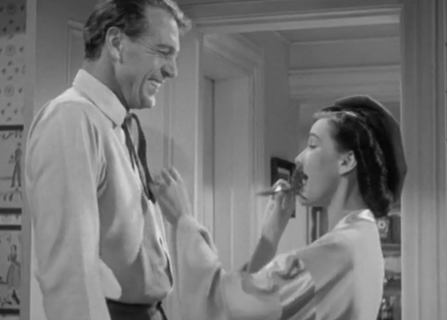
b9d42-prideofthe3Before superheroes headlined any Marvel or DC blockbuster, it was real life heroes that audiences wanted to see. No pastime was quite as popular as baseball and in that era Lou Gehrig was one of the titans along with Babe Ruth and the rest of the Yankees. You see this film is less of a biography (It certainly is not completely accurate), and more of a visual eulogy to a contemporary hero. The prologue explains as much:

“This is the story of a hero of the peaceful paths of everyday life. It is the story of a gentle young man who, in the full flower of his great fame, was a lesson in simplicity and modesty to the youth of America. He faced death with that same valor and fortitude that has been displayed by thousands of young Americans on the far-flung fields of battle. He left behind him a memory of courage and devotion that will ever be an inspiration to all men. This is the story of Lou Gehrig” ~ Damon Runyon

As a modern viewer, I am just happy I can recognize baseball names like Miller Huggins, Joe McCarthy, Bill Dickey, Tony Lazzeri, and of course, Babe Ruth. When audiences went out to see this film starring Gary Cooper and Teresa Wright back in the day, they were practically living it. World War II had already heated up and one of the great American heroes had died the previous year. Lou Gehrig was all those things in the prologue and more making it hard to get it all into a film.
Like any other superhero, he has an origin story beginning with his childhood in Manhattan, living with his poor German immigrant parents. His domineering mother convinces him to go to Columbia for engineering, but he soon ends up in the big leagues because of his tremendous skill with a bat. He is often a shy and even awkward young man, but he loves his parents and he can sure play ball. It’s that last point that gains him a lot of respect after a less than graceful start as “Tanglefoot.”
He soon becomes a lethal one-two punch with Babe Ruth, after initially being dismissed as the rookie and a boob. Journalist Sam Blake (Walter Brennan) has a major influence in Gehrig’s life and never loses faith in the young man’s abilities. He also does Lou a favor by introducing him to an attractive young Chicago socialite named Eleanor Twitchell (Teresa Wright), who finds Gehrig quite ridiculous at first. Soon, however, a budding romance begins with the often reserved Gehrig falling for the vibrant and vivacious young Eleanor. He gets engaged, married, hits two home runs for a little boy, and wins a world series. A lot of his other exploits are laid out for us too and the trophies and accolades start stacking up. All of this happens during the happy times when Gehrig is on top of the world, first with Murder Row and then The Bronx Bombers.
But all fairy tales must come to an end, and Lou Gehrig’s is especially tragic. He plays an, at that time, unheard of 2,000 consecutive games, but he also falls into a rapid decline. Eleanor looks on helplessly as her husband begins to deteriorate in front of her eyes, and the fans know something is not right. Gehrig gets examined and learns he has ALS, but very little is known about it. Much less can be done to treat it.
His final appearance at Yankee Stadium came on Lou Gehrig Day in 1939. That day he gave his “Luckiest Man Speech,” and he walked off the field for good. Gary Cooper delivers the partially revised dialogue with a calm and clear delivery that seems to truly epitomize Gehrig. Although he is playing the man, it is almost as if he is giving a eulogy.
That’s a fitting ending because we do not need to see the suffering or the death. What we remember is the wonderfully full life he led. Perhaps this film had more cultural relevance back in 1942, but I would argue that it is still a stirring, heart-wrenching film. You have a small heart if you cannot find a place in it for this one.
Although he was not too good at baseball, in the other sequences Cooper seems like the perfect man to embody Gehrig. He is distinctly American, strong, quiet and he also has a pleasant charm with a comical streak in him. The look on his face when he realizes his weakness tears the heart. Teresa Wright had many fine performances early on in her career, but I will step out on a limb and say that this is probably the best one. She has so much spirit and at the same time, she is funny with a noticeable tenderness. She is the perfect wife and a wonderful actress to embody Eleanor Gehrig.
In a society that places so much interest in make-believe superheroes, I don’t mind taking some time to acknowledge a real one. We were the lucky ones Lou, thanks. Let anyone and everyone who does the Ice Bucket Challenge know who you are. You deserve to be remembered. Always.
4.5/5 Stars

Annie Hall (1977)

annie hall 4 alvy“I would never want to belong to any club that would have someone like me for a member. That’s the key joke of my adult life, in terms of my relationships with women.”

So begins Annie Hall a film that Woody Allen, also known as Alvy Singer, begins with an opening monologue borrowing a quip from Groucho Marx. It acts as a lead into his life story, romantic and otherwise.

He had a childhood characterized as being morose, depressed, and so on, because as he noted early on “the universe is expanding.” He grew up living under a roller coaster and having fun with the local bumper cars. He grew up to be a comic with the same despondent outlook on life. In one memorable long shot of a sidewalk, we listen to Alvy talking to his friend about people making jokes about him being a Jew and his assertions seem uncalled for.

Alvy Singer and Marshall McLuhan

When Alvy was dating Annie, they went to Ingmar Bergman films and The Sorrow and the Pity was a personal favorite of Alvy. A favorite film with a perfect title and subject for the pessimistic fellow. However, what really vexes him are puffed up know-it-alls who pontificate on and on like they are God’s gift to the universe. It seems necessary at this point to break the fourth wall.

As Alvy recalls his early childhood and first relationship which began at an Adlai Stevenson rally, it is rather funny that he remains unchanged the whole time. Physically Woody Allen is playing Alvy as a young man and an old man without any change.

Then there is the fiasco with the lobsters and the memories of his first meeting with Annie over tennis. That was when he met the girl who came out of the Norman Rockwell painting. Seemingly the antithesis of Alvy himself.

Their relationship is examined with all its quirks from a trivial conversation about art, with underlying subtitles that reflect their real thoughts, to Annie’s stint as a nightclub singer. They have a comical time people watching, and Alvy recalls his second wife and the one who was a Rolling Stone reporter. His relationship with Annie also has its share of arguments, over spiders at 3 in the morning and adult education. Through it all Alvy still views Annie as a cartoon version of the Wicked Queen from “Snow White,” who he secretly loves.

It is during a famous split screen sequence (actually a split room) where the stark differences, not only between the pair, but the genders are pointed out. Things are changing. They take a trip out to sunny California and Alvy cannot help but hate it compared to pleasantly gray New York. They have laugh tracks, wheat germ killers, and trash which is subsequently made into T.V. shows. Annie loves it all.

The inevitable comes and Annie breaks up only to have Alvy soon revisit California to propose marriage. Needless to say, it does not happen. He returns to New York and makes his first play about their last conversation verbatim, with one small revision. Alvy sees Annie one last time when she returns to New York, and they share some laughs while highlights role across the screen.

Allen’s stand-in Alvy sums it all up with one final joke about a guy who has a brother who thinks he a chicken, but he fails to do anything about it because he needs the eggs. That’s how he feels about relationships. “They’re totally irrational, and crazy, and absurd,” but you keep on because you need the eggs. Another philosophical gem from Alvy Singer.

The irony of Annie Hall is that many a person has gone on to pontificate on and on about it, but if we actually pulled an Alvy Singer and dragged Woody Allen from out behind a movie poster, I’m sure he could set us straight. Annie Hall is chock full of humor, a far from typical type of romance, and people trying to find their way in life. Take away discussion about psychoanalysis, modernism, antisemitism, and what you are left with are people just talking. Some of what they say is about such philosophical topics, but sometimes it’s not. It’s about memories, simple observations of life, and the little things that happen along the way.

There are clashing worldviews that come up against each other like New York and California (brought to us by the cinematography of Gordon Willis). There are different sorts of people like Alvy Singer and Annie Hall. Yet we still go through relationships “because we need the eggs” so to speak. We are searching for that type of intimacy and closeness, and very often we keep looking and looking. It is painful, seemingly necessary, and all the same, it can feel pointless. It’s part of being human I suppose.

Annie Hall works for me because of the quirks that give a fresh face to the typical romantic comedy and it will be the measuring stick for other such films that are being released for years to come. I am not usually a major fan of Woody Allen films, but this one is his undisputed masterpiece. It exemplifies his general philosophy and approach to comedy. Not to mention his typical players in Diane Keaton and Tony Roberts.

4.5/5 Stars

Seven Chances (1925)

seven chances 1We’ve seen a derivative of this story many times before, but thanks to Buster Keaton, Seven Chances has a lot of marvelous comedic moments created by his wonderful physical ability.

The story goes something like this: Boy meets girl and he loves her but never makes his move. Now he has the chance at $7 million if he gets married before his 27th birthday. But that’s today so all he has to do is marry his sweetheart Mary. It sounds so easy until he complicates the whole situation with muddled words and misunderstandings.

Now he only has a matter of time to find another bride. His law partner puts down a line of candidates, and he strikes out each time earning a face full of laughs in reply. Even the secretary and coat attendant turn him down his pitiful plea.

He drives off desperate for a bride and his buddies put an ad in the paper sure to grab him a wife. Jimmy waits patiently at the church, but there’s a problem. Hundreds of women show up and soon turn into a mob bent on clobbering him for making fools of them.

Then and there begins one of the grandest, most epic, and extraordinary chase scenes of all time. Forget Bullitt or The French Connection, this is the seminal chase scene. It’s mind boggling to think how many extras they used and all dressed in drag no less. It is difficult not to marvel at Keaton’s physical prowess because that is where he tops Chaplin. He’s fantastic at scampering about, sliding around, and making pitfalls in general, given the right environment. Soon the world becomes his playground with coattails flying and droves of angry women hot on his heels.

He hitches a ride on the spare tire of a car, dangles from a crane, does frantic Australian crawl across a pond, rides a falling tree, and of course, dodges an avalanche of fake-looking boulders. All I can say is Keaton could have been a professional dodgeball player, but we can be thankful he stayed with film. He was pretty decent at comedy too.

Needless to say, Jimmy gets back in the nick of time, or did he? Of course, he did! It seems like he’s the only one who cannot plant a kiss on the bride. At least he has one now, and Mary is far more important than the money. That’s all that really matters.

Chaplin was great because his Tramp had so much expression. The Great Stone Face was great for the exact opposite reason. He lacked it. His nervous fidgeting or obvious dismay in all situations heightens the comedy making the laughs even more hilarious.

His two buddies are a comical pair in their own right with their differing heights and good-natured blunders. They get caught up in Jimmy’s unfortunate predicament and get knocked about a bit as well.

Keaton may have had greater films, but in his golden age during the 1920s, he could hardly do any wrong. Seven Chance has one of the greatest sustained comedy sequences of any of his films and it certainly does showcase his skills. He gave Chaplin a run for his money, literally.

4.5/5 Stars

Review: The Killing (1956)

e4855-thekilling1Stanley Kubrick is one of the most acclaimed directors of all time, and The Killing is his first great film. The main focus of the action takes place at a racetrack, but a great deal of the story occurs in other places before and after the job is pulled.  Recently released Johnny (Sterling Hayden) is the mastermind behind an intricately planned job. It’s a whole complex jigsaw puzzle involving a few “Average Joes” and a couple professionals. When you put it together it all adds up to the perfect heist.

Marvin is a friend of Johnny’s and a fatherly figure who is backing the deal. George (Elisha Cook Jr.) is the paranoid window teller banking on the job so he can hold onto his shallow wife. Randy is the policeman who is set to pick up the plunder. Then, Mike is the bartender who is supposed to help with the distraction. Johnny lines up the brawn, Maurice, to start a fight at the race track with Mike. He gets a sharpshooter named Nikki to bump off a horse and it’s all set. All their plans revolve around the Seventh Race, and they have it planned out to the minute. The beauty of The Killing is that it all but works like clockwork. The horse is shot, the brawl does its job, the vault is cleaned out, and the money gets picked up. Only a few small problems crop up.

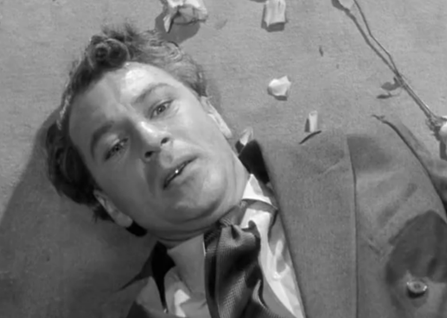
After the job is done is another matter, as the perfect timetable begins to break down. In a matter of seconds, things blow up thanks to George’s backstabbing wife (Marie Windsor). Soon the carnage is strewn all over the floor. Johnny holds onto the money as previously decided since things go awry, and he makes the getaway. His girl (Colleen Gray) is waiting at the airport and it looks to be smooth sailing from here on out.

Thanks to a yippy dog and a precarious perch, the money-laden suitcase takes a tumble and the contents fly off. All too soon it’s raining money, and there’s nothing Johnny can do about it. He leaves the terminal with Fay, but with no taxi to be had, he gets nabbed and there is no chance to escape. After everything lining up so perfectly for him, in a cruel turn everything that could go wrong did. He was not going to be so lucky.

The title of this film always struck me as ambiguous, whether it meant the amount of money being taken or the deaths that take place I’m not sure. However, I do know that The Killing is tautly constructed. The non-linear and sometimes overlapping narrative is held together by the narrator. He seems fit for a newsreel, but he complements the straightforward procedure of the film with timestamps included.

Because of the lead performance of Sterling Hayden and the main plot element of a heist, this film can sometimes be confused with John Huston’s The Asphalt Jungle (1950). However, I enjoy this storyline more because the heist is not the issue. It is the aftermath and all the subsequent problems occurring so rapidly.

It is a wonderful unraveling thriller and although we do not see Johnny arrested, he might as well be because there are two men with pistols drawn walking right towards him. The Killing was not a big payoff for Hayden’s character, but it certainly is for the audience.

4.5/5 Stars


Review: On The Waterfront (1954)

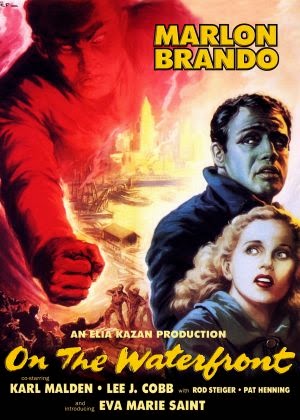
8542a-on_the_waterfront_poster“They always said I was a bum, well I ain’t a bum Edie.” That is what washed up prizefighter Terry Malloy (Marlon Brando) must try and prove to himself and others for the entirety of this crime-drama. On the Waterfront is ultimately his story of conscience and redemption that we watch unfold. It’s not pretty, but you’ll soon see for yourself.

Living on the waterfront is a tough existence. The mob decides who works and who won’t. Longshoremen are expected to be D & D (Deaf and Dumb) or else they have something coming. That’s how big shot Johnny Friendly (Lee J. Cobb) and his boys can run the entire area. They utilize fear and money to keep the working masses at bay. No matter what police or the crime commission might try to do, they have no hold on the waterfront. It’s a jungle out there and if you want to survive you look out for number one, don’t ask questions, and live another day.That is Terry Malloy’s philosophy and it suits him just fine. His brother Charley is Friendly’sright-handd man and he’s made a good life for himself thanks to his brains. Terry is more brawn than brain, and he does what his brother says. One night he blows the horn on a young man named Joey because he called out Johnny Friendly. That same evening Joey is knocked off, literally. Terry tries to justify it. He only thought they were going to “lean on him” a bit. With that incident begins Terry’s inner battle.

The moral compass of the film is supplied by two people. Edie Doyle (Eva Marie Saint) returns to her town from school with her beloved brother Joey now dead. She cannot understand why no one else will speak out about it or do anything to carry his cause. It is ultimately Father Barry (Karl Malden) who does just that realizing that his parish is the waterfront. He must fight against the injustice of the mob and hope others will join him. It’s a tall order. At the first meeting he holds in the church, a window gets busted, and thugs wait outside for people to beat up on. Terry was sent by Johnny to check it out and it is there that he meets Edie. He is immediately taken by her, and she warms to him. She sees him differently than the others without knowing what role he had in her brother’s death. The Father and Edie encourage Terry to testify at the crime commission after another man is killed in an “accident.”

Friendly can’t have a canary and its Charley’s job to straighten out his brother. That’s when they take their fateful car ride. Terry spill his guts (I coulda had class. I coulda been a contender. I coulda been somebody, instead of a bum, which is what I am, let’s face it. It was you, Charley.) and Charley responds the only way he knows how. He saves his little brother who he has always looked out for and pays the price.

Now Terry has his reason to testify and soon enough he goes before the crime commission to call out John Friendly. He has broken the waterfront code and gone canary. All respect for him is gone and Friendly wants his hide, but Edie is overjoyed in him. Finally, Terry has left the shackles on the waterfront and freed his conscience. He confronts the big man himself and is beaten to a pulp. But as Father Barry says he may have lost the battle, but he won the war.

Before getting to Brando, I must acknowledge the other players for their stellar performances. Eva Marie Saint is just that, a saint, and she gives a heartfelt performance as Edie. It is her love and care that leads Terry to turn himself around because she sees a little piece of humanity left in him. Karl Malden has perhaps one of his finest roles as the Father who represents a man of the faith remarkably. He is no joke, and he does not cave to hypocrisy. His waterfront sermon is one of the most powerful moments:

“You want to know what’s wrong with our waterfront? It’s the love of a lousy buck. It’s making the love of the lousy buck – the cushy job – more important than the love of man! It’s forgettin’ that every fellow down here is your brother in Christ!”

However, Rod Steiger’s poignant scene with Brando in the car is similarly extraordinary, because he realizes where he has failed. He does not need the words. He just stays silent, and we see it on his face. He is the one who pays for the mistakes, though, and he is far from a bum. Then, of course, there is Marlon Brando himself. He is often hailed one of the greatest actors of all time, but he usually played corrupt undesirables or rebels. Terry Malloy is perhaps his best role, and he is the good guy for once. He must struggle to do what is right by him, and he must struggle to prove himself to others. Brando plays him with some much genuineness, heart, and vulnerability at times. He is far more than the brusque meat head we take him for initially.

Elia Kazan was a champion of hard- edged dramas especially in the 1950s and he never succeeded more so than with this film. The black and white cinematography with perpetual fog drifting in fits the dire mood nicely and Leonard Bernstein’s score further compliments the drama. This is a fine example of Classic Hollywood cinema which was praised back then and lauded now. Our fake blood may have gotten better, but otherwise, it’s hard to top this film.

5/5 Stars

Review: 12 Angry Men (1957)

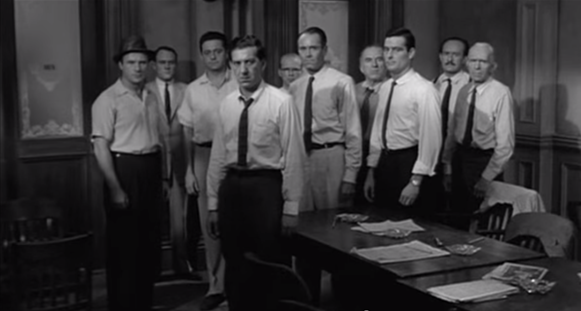
ebd81-12angrymen1With a title like 12 Angry Men you might come away with the false idea that all the characters in this film are the same, emotionally and otherwise. That is far from the truth. The reason a film like this stands up even today is because the fellows who sit down around that table are everymen that each and every one of us can relate to in some way. Yes, they are all male and all white, but they reflect little bits of us and our own humanity.

But getting down to the specifics, what is 12 Angry Men really and truly about? If you want to break it down, all it boils down to is 12 men gathering in a room to talk out a murder case. It sounds pretty dull and it had the potential to be so. In fact, calling it a courtroom drama is partially a misnomer because we hardly spend five minutes there before the jury is deliberating. We see the members of the jury, hear the final statement of the judge, and get a last look at the young defendant.

What comes next is the beginning of the decision-making process and seeing as it looks like an open and shut case, an initial vote is called for. If everyone agrees, this boy will be sent to the electric chair for killing his father. The vote is taken and it is 11 to 1 with one man holding out. Juror Number 8 (Henry Fonda), an architect, cannot bring himself to send the boy off without talking some more and so, begrudgingly, they do talk.

That is where the true heart of this film comes out, through the discussion and back and forth of the characters. They get around to evidence like the switchblade which the boy supposedly dropped. There were two witnesses: One being an old man living downstairs and the other a middle-aged woman who lived across the train tracks. Then, there is the business about the boy’s flimsy alibi about going to the movies. All are hotly debated and quarreled over.

It just happens to be the hottest day of the year and about an hour in it starts pouring cats and dogs. Tempers reach their apex, feelings are hurt, and major prejudices are revealed. The beauty of this film is not simply the sentiment that the jury switches its decision. The beauty truly comes from this wonderfully colorful ensemble of actors under the direction of Sidney Lumet in a confined space. But before mentioning the direction it is important to acknowledge the players because they are the heart and soul of this story.

Juror # 1: (Martin Balsam) He is the foreman who moderates, and he tries to keep the discussion civil with a relatively calm demeanor. All we know about him is that he is an assistant coach for a high school football team.

Juror # 2: (John Fielder) He is one of the younger members of the jury and a quiet individual with a timid voice. He is a banker.

Juror # 3 (Lee J. Cobb) The main driving force of conflict, he holds out when everyone else switches their vote. He is a businessman who also has familial issues with his son that come into play.

Juror # 4 (E.G. Marshall) A rational and measured broker, he holds that the boy is guilty until some facts are laid out that make him think otherwise.

Juror # 5 (Jack Klugman) A meek man and Baltimore baseball fan who also has a fiery side as well. It comes out that he grew up in the slums when he was a kid.

Juror # 6 (Edward Binns) A straightforward and kindly painter who is respectful in his conduct.

Juror # 7 (Jack Warner) The jokester of the group who makes his living selling Marmalade. He is looking forward to a Yankees baseball game and tries to push the proceedings forward as fast as possible.

Juror # 9 (Joseph Sweeney) The eldest member of the jury and the first to side with Juror # 8. He has a fighting spirit and also some thoughtful observations on the case.

Juror # 10 (Ed Begley) A loud-mouthed older man with a penchant for insults and unsavory remarks about foreigners.

Juror # 11 (George Voskovec) He is a watchmaker and the foreigner in the group. However, he is obviously quite intelligent and passionate about American democracy. He takes seriously the duty that comes with being a juror.

Juror # 12 (Robert Webber) Lastly comes the wisecracking man in advertising who tries to lighten up the conversation. He is the major flip flopper in the group.

A mention now must be made of Sidney Lumet’s direction, because for his first film he was extremely bold to film it essentially in one room. He does it so wonderfully, however, because the confined space only heightens the drama thanks to his progressive change in camera angles. They start above eye level and slowly get lower as the drama increases. He is very rarely stagnant either, having the camera on the move or cutting to different characters. A great example of this is the tracking shot as the jurors enter the room. We are introduced to almost every character in such a fluid, natural way that sets up the story nicely.

There is so much else that could be said about Fonda’s performance and individual actors who I admire, but I will leave this discussion by saying that this is one of the greatest ensembles I have ever seen brought together. The intensity they created makes me want to get up right now and serve on a jury. Too bad I already served my jury duty this year!

5/5 Stars

Review: Roman Holiday (1953)

Joe: Today’s gonna be a holiday.
Princess Ann: But you want to do a lot of silly things?
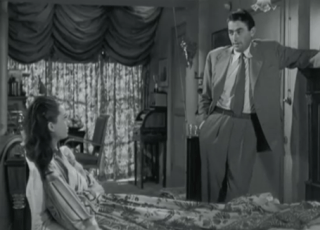
The answer is yes, yes we would!! That is the beauty of this film, which plays out as a lovely jaunt through Italy with two favorites in Audrey Hepburn and Gregory Peck. With Hepburn being practically unknown at this point in time, it made her a wonderful choice to play Princess Ann. She was someone without any prior identifying roles making her young princess seem plausible. William Wyler took a chance on an unknown and he certainly hit the jackpot.
Gregory Peck on his part was always a strong leading man and an All-American type, perfect to play Joe Bradley. However, he also exuded gentlemanliness,s so despite the fact that the princess spent the night in his apartment we know nothing went on.  He had no ulterior motives bringing her to his apartment and even when he arranges to get an article out of her we know that is not who he is.
The film itself consists of wonderfully connected vignettes incorporating the Roman culture and landscape. Princess Ann leaves behind the hospitality of Joe in order to explore a bit before she goes back to her real life. In order to get that major scoop, he tails her and finally invites himself to tag along, so beginning the real fun. Princess Ann gets her beautiful locks cut by a friendly barber and buys some gelato from a street vendor.
 
Soon she takes her first puff of a cigarette, takes in the glory of the Coliseum, rides a Vespa through the hectic streets of Rome, and winds up in police headquarters with some explaining to do.They finish up their afternoon on a more thoughtful note at a wall of wishes originating during World War II.
 
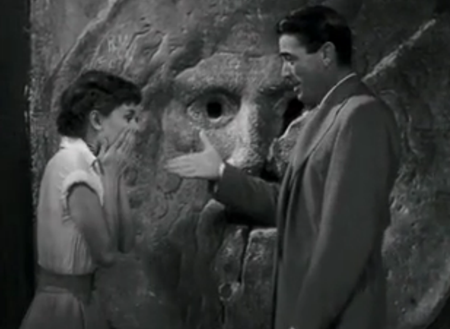
One of the best moments occurs at the mouth of truth, a great stone statue, which you are supposed to stick your hand in before it eats it up. In a moment of sheer fear Princess Ann or Audrey Hepburn, I’m not quite sure who looks on in horror as a screaming Bradley removes his arm and his hand is gone. Up comes the hand from the coat sleeves and the jokes on her. It has absolutely no bearing on the plot but it makes us love Peck and Hepburn even more.
 

To finish off the evening the two companions and Irving (Eddie Albert) cause a ruckus at a dance aboard a barge before swimming away to safety. There Ann finds love and a soaking wet kiss to go with it. But it is at that moment when the laughs stop and the romance begins that everything becomes all too clear. This wonderful day cannot last forever. There is a moment, after one final embrace, when they have to say goodbye for good.

This is not one of those “love at first sight” stories, but it is a different sort of fairy tale where two individuals share an enchanting day together and fall in love. Every Cinderella story must end and so does this one (Anna: At midnight I’ll turn into a pumpkin and drive away in my glass slipper). They must eventually come back down to reality with Princess Ann fulfilling his duties and Joe moving on with his career.
 
Joe’s major newsflash is not a thing anymore. The whole day means too much to him and being the buddy he is, good ol’ Irving understands that. Speaking of Irving, he deserves some discussion. Eddie Albert’s character is spilled on, stepped on, knocked over, tripped, and through it all remains the perfect buddy for Gregory Peck.  Even his little car is a riot, not to mention his inconspicuous tiny cigarette camera and his sly efforts at photography in every type of circumstance. Irving shares a great deal of double talk with Joe which somehow gets past the unsuspecting princess. However, by the end of the film, the princess is also a cohort in their memorable adventure with commemorative photos included! 
 
When Joe Bradley walks out of the grand palace he leaves content knowing that he shared something special. No one else needs to know (aside from Irving) about the fairy tale they shared and that is the beauty of it all. It is just their little secret, their Roman Holiday
 
5/5 Stars

Review: Butch Cassidy and the Sundance Kid (1969)


Not that it matters, but most of it is true…

The film opens with some old sepia-toned footage of a notorious gang from the turn-of-the-century and that is when we meet our two anti-heroes Butch Cassidy (Paul Newman) and the Sundance Kid (Robert Redford). Butch is the brains behind the operation (I got vision and the rest of the world wears bifocals) and Sundance is the brawn, with the most accurate gun in the West.

They make a living robbing banks and trains, but due to their lifestyle, they seldom come out ahead. Life becomes more difficult with tumult within the gang, a crackdown by the authorities and a price tag on the heads of Butch and Sundance.
Soon it becomes evident that their life of crime will never be the same with a professional tracker on their tails and a posse formed to see them hang. They are chased through hills, rock, water, and the like before finally getting away in one final desperate attempt at escape.
With one last brilliant piece of inspiration, Butch decides they should head for Bolivia to lay low, and soon enough they pack their bags and bring along The Kid’s girl (Katharine Ross) to the promised land of South America. They get more than they bargained for thanks to the language barrier and a lack of decent plunder. However, even abroad, their legend grows, winning them the new moniker “Banditos Yanquis.” The pair takes a stint on the right side of the law for once, but it somehow seems bleaker than their early days as bandits. It is evident that the hourglass is running out on them. And so it does, but not without one final glorious battle to cement the aura around two legends of the West.
I will not go so far as to call Butch Cassidy and the Sundance Kid a masterpiece because I have read too many reviews to know that there has been a great deal of division over the film. I can only speak from my own experience when I say that I quickly grew to love this story. This appreciation stems from the spot on chemistry of Paul Newman and Robert Redford. Their outlaws are not your typical thugs but lovable buffoons you cannot help but cheer for through all their screw-ups and pratfalls. Paul Newman has his ever-present mischievous smile plastered on his face, and Redford plays the cool and collected Kid to the tee. Perfect casting for the roles and to think it might have been Steve McQueen and Warren Beatty.
 
They got together again in The Sting, which was another good film, although I will always be partial to their first collaboration. William Goldman’s script can only be described as a fun romp that accentuates the comradery of Butch and Sundance. The musical score by Burt Bacharach with the inclusion of “Raindrops Keep Falling On My Head” is often at complete odds with what we have come to expect with classic westerns, but that suits the film just fine.
 
You see this is not your typical western by any means. It’s not supposed to be. Butch and Sundance are working in the twilight of the West. The horse is soon to be replaced with the future: the bicycles. Bank vaults are becoming more complex, fervor for the Spanish-American War is at its peak, and lawlessness is no longer going to be tolerated. Whether people realize it or not, this film is one in a final wave of classic westerns that finally petered out in the 70s. Now the western genre, just like the West before it, is dead. A dying breed of genre much like film-noir or even musicals.
 
That’s why Butch Cassidy works for me. People have criticized the constant change in tones, but this story never claims to be the absolute truth, and it would not be the same film if it did. This story of outlaws is not a history lesson but a legend about two infamous bank robbers. There are moments where we love these antiheroes and moments where we do not know quite what to think of them. They become disillusioned and beaten down by the changing times. Their ambush in Bolivia has only one apparent conclusion. It ended in a bloody and violent death. However, we do not have to see that for the sake of the legend of Butch Cassidy and the Sundance Kid. In one mythical moment, they regained their previous status. They went out as they came in, and they will forever be remembered as Butch and Sundance of the Hole in the Wall Gang. They have since been replaced by superheroes on the silver screen, but in their day and age, they were the original supermen — tarnished as they were.
What is amazing is that the film has not only resonated with audiences for generations, but with the leads themselves who really identified with their roles. That is perhaps the greatest compliment to its characters. 

5/5 Stars